Genesis 50:25
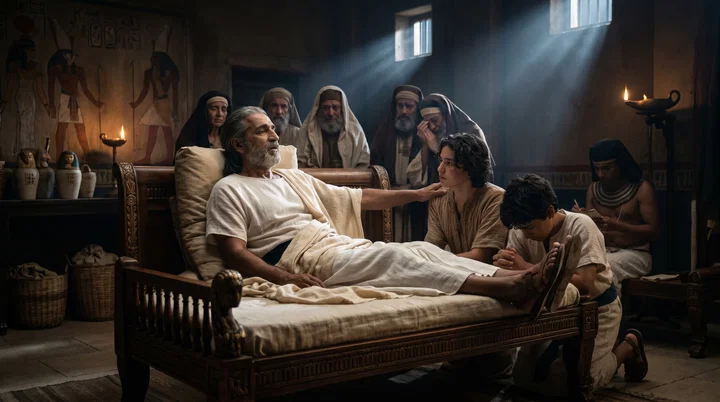
And Joseph took an oath of the children of Israel, saying, God will surely visit you, and ye shall carry up my bones from hence.
Translations
And Joseph took an oath of the children of Israel, saying, God will surely visit you, and you shall carry up my bones from hence.
King James Version, KJV Cambridge Paragraph Bible, Webster Bible, Revised Version, American Standard Version
And Joseph took an oath of the children of Israel, saying, God will surely visit you, and ye shall carry up my bones from hence.
And Joseph causeth the sons of Israel to swear, saying, 'God doth certainly inspect you, and ye have brought up my bones from this [place].'
And Joseph took an oath of the children of Israel, saying, God will certainly visit you; and ye shall carry up my bones hence.
Then Joseph made the sons of Israel swear saying,—God will, surely concern, himself for you, So shall ye carry up my bones, from hence.
Berean Standard Bible, Majority Standard Bible
And Joseph made the sons of Israel take an oath and said, “God will surely attend to you, and then you must carry my bones up from this place.”
Joseph took an oath from the children of Israel, saying, “God will surely visit you, and you shall carry up my bones from here.”
Then Joseph made the children of Israel take an oath, saying, God will certainly give effect to his word, and you are to take my bones away from here.
And Ioseph tooke an othe of the children of Israel, saying, God will surely visite you, and ye shall cary my bones hence.
Douay-Rheims (Challoner revision)
And he made them swear to him, saying: God will visit you, carry my bones with you out of this place:
Pictures
Cross-references
- Exodus 13:19
And Moses took the bones of Joseph with him: for he had straitly sworn the children of Israel, saying, God will surely visit you; and ye shall carry up my bones away hence with you.
Moses carries Joseph’s bones out of Egypt, fulfilling the oath.
- Hebrews 11:22
By faith Joseph, when he died, made mention of the departing of the children of Israel; and gave commandment concerning his bones.
Joseph’s instruction about his bones expresses faith in Israel’s departure.
- Genesis 15:13-14
And he said unto Abram, Know of a surety that thy seed shall be a stranger in a land that is not theirs, and shall serve them; and they shall afflict them four hundred years;
God foretells Israel’s affliction in Egypt and their deliverance from it.
- Joshua 24:32
And the bones of Joseph, which the children of Israel brought up out of Egypt, buried they in Shechem, in a parcel of ground which Jacob bought of the sons of Hamor the father of Shechem for an hundred pieces of silver: and it became the inheritance of the children of Joseph.
Joseph’s bones are buried at Shechem after Israel enters the land.
- Exodus 12:40-41
Now the sojourning of the children of Israel, who dwelt in Egypt, was four hundred and thirty years.
Israel’s departure from Egypt fulfilled the promised time.
- Genesis 49:29
And he charged them, and said unto them, I am to be gathered unto my people: bury me with my fathers in the cave that is in the field of Ephron the Hittite,
Jacob’s burial request reflects the patriarchs’ claim to Canaan.
- Exodus 1:6-11
And Joseph died, and all his brethren, and all that generation.
A new king enslaves Israel, seeking to prevent their departure.
- Hebrews 11:16
But now they desire a better country, that is, an heavenly: wherefore God is not ashamed to be called their God: for he hath prepared for them a city.
Joseph’s oath reflects the patriarchs’ hope for a better, heavenly country.
Commentary
Each commentary is drawn from primary sources: the writings of Ellen G. White and Adventist pioneers and periodicals. Each commentary is separate. Its own words are not a quotation; follow the references to read the source passages.
Ellen G. White
7 sources
Joseph spoke the oath just before he died as an expression of unshaken faith and prophetic assurance that God would surely visit Israel and bring them out of Egypt, delivering them from bondage and oppression and restoring them to the land promised to Abraham, Isaac, and Jacob.PP 240.1–2ST Mar 4, 18801SP 214.1–215.1PP 259.2–260.1SG3 240.2–242.1 Although honored in Egypt, he regarded it as a place of exile, so he bound the children of Israel by oath to carry his bones up from there to Canaan when they departed.PP 240.1–2PP 259.2–260.11SP 205.3 His coffin remained among them as a reminder that their stay in Egypt was temporary and that deliverance would come.PP 240.1–2
During cruel enslavement under the last two tyrannical kings of Egypt, the elders repeated Joseph's words, together with the promise made to Abraham, to sustain and strengthen the people's sinking and failing faith and to encourage hope for deliverance.ST Mar 4, 18801SP 214.1–215.1PP 259.2–260.1SG3 240.2–242.1 The faithful were confident God would soon bring them up and break their oppression.1SP 215.2SG3 240.2–242.1 Some who heard listened and believed, while many looked at their sad condition and suffering and lost hope because it seemed to contradict the promise.1SP 214.1–215.1SG3 240.2–242.1 The Egyptians learned of the expectation and mocked it, speaking scornfully of the power of Israel's God to free them.SG3 240.2–242.1
The charge was fulfilled when Moses took Joseph's bones with the Israelites as they left Egypt.1SP 205.3
Sources
Pioneers and periodicals
23 sources
As he lay dying, Joseph made the children of Israel swear that when God visited them they would carry his bones up from Egypt when they left.ST Apr 23, 1894ST Apr 23, 1894ST May 12, 1890 It expresses his faith and confidence that God would surely visit Israel and bring and deliver them out of Egypt to Canaan, to the land promised to Abraham, Isaac, and Jacob at the appointed time.ST Oct 30, 1901ST Jun 11, 1894 It shows faith in the prophecy given while Abraham still lived that Israel would be in bondage in Egypt and would be delivered at a set time, and the charge about his bones was proof of belief in its certain fulfillment.ST Jan 17, 1906 His preserved bones and coffin served as a prophecy to Israel that God would deliver them from Egypt and kept alive in Hebrew hearts the expectation of the promised land, and the elders recalled his words to strengthen failing faith and encourage hope for deliverance.ST May 28, 1885ST May 28, 1885ST May 28, 1885 The request expressed faith and hope beyond burial beside his ancestors, pointing toward reunion with them in a heavenly country and confessing faith in deliverance from death, the resurrection of the just, and the redemption of the body.ST May 28, 1885RH Aug 20, 1872ST Feb 6, 1896
Dying Oath and Faith
As he lay dying, Joseph made the children of Israel, his brothers, swear that when God visited them they would carry his bones up from Egypt when they left.ST Apr 23, 1894ST Apr 23, 1894ST May 12, 1890ST Dec 25, 1901ST Feb 4, 1889 His charge was an act of faith in the promised departure, made in the confidence that God would bring them out of Egypt.ST Apr 23, 1894ST Apr 23, 1894ST Feb 4, 1889ST Dec 1, 1898 The verse expresses his faith and confidence that God would surely visit Israel and bring and deliver them out of Egypt to Canaan, back to the Promised Land.ST Jun 11, 1894ST Jul 22, 1913RH Jan 2, 1913ST Dec 1, 1898 That deliverance was to the land promised to Abraham, Isaac, and Jacob, to be accomplished when the appointed time came.ST Oct 30, 1901ST Jul 22, 1913
The verse belongs to the closing story of Joseph's life and family, with the fulfilment of his dreams.ST Jan 28, 1913ST Jan 10, 1911 That closing story stands alongside Jacob's blessing of his sons and the adoption of Joseph's sons among the twelve tribes.ST Jan 28, 1913 It reflects God's providential care in preserving the ancestors of the promised Seed through whom the promised Seed would come.ST Jan 10, 1911 Joseph's final disposition of faithfulness had developed strength throughout his life.ST Jun 11, 1894
The passage is a plain record of a patriarch's death when near death, trusting God's promise to visit Israel and bring them out of Egypt.RH Sep 26, 1854 It contains no mention of a distinct immortal soul or spirit surviving death.RH Sep 26, 1854
Prophecy Hope and Application
Genesis 50:25 expresses confidence in the prophecy given while Abraham was still living that Israel would be in bondage in Egypt and would be delivered at a set time.ST Jan 17, 1906 The charge to carry his bones up to Canaan when Israel left Egypt at that appointed time was proof of belief in its certain fulfillment.ST Jan 17, 1906 It stands as an example of prophecy directing God's servants to do the right thing at the right time, and it formed the basis for the deliverance through Moses and for the organizing of Israel as the church in the wilderness, made the depository of God's law and the teacher of the way of salvation.ST Jan 17, 1906
The oath about his bones was bound up with the greater promise of Israel's deliverance and inheritance.ST May 28, 1885 His preserved bones and coffin served as a prophecy to Israel that God would deliver them from Egypt.ST Mar 4, 1880ST May 28, 1885ST Jan 25, 1910 They kept alive in Hebrew hearts the expectation of the promised land.ST May 28, 1885ST May 28, 1885 The elders recalled his words to strengthen failing faith and encourage hope for deliverance.ST Mar 4, 1880 His descendants kept and watched the command for more than two hundred years, and their care was not merely an effort to preserve physical remains as relics.ST May 28, 1885
The verse assured the return from Egypt to Canaan and kept alive the national right to the land of the fathers even though famine in Joseph's time had compelled refuge in Egypt.RH Jan 2, 1913 The command to carry his bones up kept sight of the sepulchres of the fathers as title to possession, as Jacob was carried from Egypt to be buried in Canaan. His words made Israel's expectation of returning known to the Egyptians.RH Jan 2, 1913 Their Egyptian oppressors, a kindred branch of the tribes that had by that time taken entire possession of Palestine, refused to let them go lest they claim the inheritance of their fathers.
The request expressed faith and hope beyond burial beside his ancestors, pointing toward reunion with them in a heavenly country, the land of the redeemed.ST May 28, 1885ST Feb 6, 1896 His coffin pointed beyond Egypt and the grave to Canaan and the promised inheritance in the world to come.RH Aug 20, 1872 It was a confession of faith in deliverance from death, the resurrection of the just, and the redemption of the body, rather than a mere relic or fear of decay.ST May 28, 1885RH Aug 20, 1872 The history of Joseph trusting that God would guide Israel to the promised deliverance and that they would carry his bones from Egypt illustrates that God may lead a person by a roundabout way while still bringing him to the intended end.RH Jan 19, 1860 Yet Israel's later return to Egypt through idolatry led many to be buried there, contrary to the hope expressed in Joseph's request to be carried to the promised land.ST Mar 25, 1903
Sources