Genesis 50:26
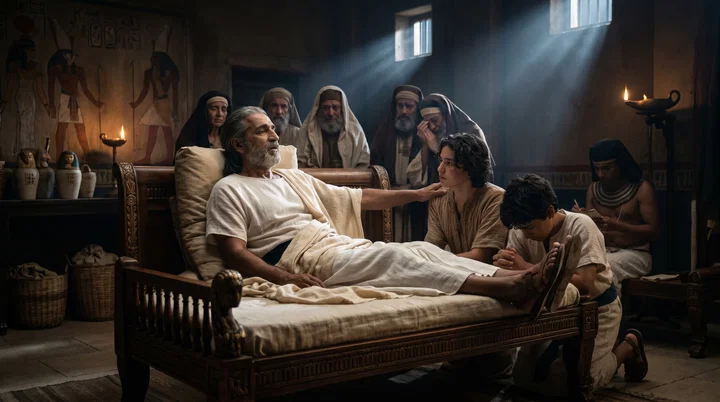
So Joseph died, being an hundred and ten years old: and they embalmed him, and he was put in a coffin in Egypt.
Translations
American King James Version, King James Version, KJV Cambridge Paragraph Bible, Revised Version
So Joseph died, being an hundred and ten years old: and they embalmed him, and he was put in a coffin in Egypt.
Webster Bible, American Standard Version
So Joseph died, being a hundred and ten years old: and they embalmed him, and he was put in a coffin in Egypt.
And Joseph dieth, a son of an hundred and ten years, and they embalm him, and he is put into a coffin in Egypt.
And Joseph died, a hundred and ten years old; and they embalmed him; and he was put in a coffin in Egypt.
So Joseph died, being a hundred and ten years old,—and they embalmed him, and put him in a coffin in Egypt.
Berean Standard Bible, Majority Standard Bible
So Joseph died at the age of 110. And they embalmed his body and placed it in a coffin in Egypt.
So Joseph died, being one hundred ten years old, and they embalmed him, and he was put in a coffin in Egypt.
So Joseph came to his death, being a hundred and ten years old: and they made his body ready, and he was put in a chest in Egypt.
So Ioseph died, when he was an hundreth and ten yere olde: and they enbaumed him and put him in a chest in Egypt.
Douay-Rheims (Challoner revision)
And he died being a hundred and ten years old. And being embalmed he was laid in a coffin in Egypt.
Pictures
Cross-references
- Exodus 13:19
And Moses took the bones of Joseph with him: for he had straitly sworn the children of Israel, saying, God will surely visit you; and ye shall carry up my bones away hence with you.
Moses carries Joseph’s bones out of Egypt as Joseph had requested.
- Joshua 24:32
And the bones of Joseph, which the children of Israel brought up out of Egypt, buried they in Shechem, in a parcel of ground which Jacob bought of the sons of Hamor the father of Shechem for an hundred pieces of silver: and it became the inheritance of the children of Joseph.
Joseph’s bones were buried at Shechem after Israel entered the land.
- Genesis 45:5-7
Now therefore be not grieved, nor angry with yourselves, that ye sold me hither: for God did send me before you to preserve life.
God’s purpose in bringing Joseph to Egypt was to preserve many lives.
- Genesis 15:13-16
And he said unto Abram, Know of a surety that thy seed shall be a stranger in a land that is not theirs, and shall serve them; and they shall afflict them four hundred years;
Joseph’s death recalls God’s promise to bring Israel out of Egypt.
- Genesis 46:6
And they took their cattle, and their goods, which they had gotten in the land of Canaan, and came into Egypt, Jacob, and all his seed with him:
Records Jacob’s household and possessions entering Egypt.
- Genesis 49:33
And when Jacob had made an end of commanding his sons, he gathered up his feet into the bed, and yielded up the ghost, and was gathered unto his people.
Jacob’s death is recounted alongside Joseph’s.
Commentary
Each commentary is drawn from primary sources: the writings of Ellen G. White and Adventist pioneers and periodicals. Each commentary is separate. Its own words are not a quotation; follow the references to read the source passages.
Ellen G. White
1 source
Joseph died at one hundred and ten years of age, and after his death his body was embalmed and laid in a coffin in Egypt.PP 240.1–2 That coffin was left to remain among the Israelites in Egypt rather than being taken at once to Canaan.PP 240.1–2 Its continued presence reminded them that Egypt was not their permanent home but only a temporary dwelling place.PP 240.1–2 It stood as a pledge that God would surely visit them and bring them up to the promised land, and that when He did they were to carry Joseph's bones with them.PP 240.1–2
Sources
Pioneers and periodicals
14 sources
Genesis 50:26 records that Joseph died at 110 years old, was embalmed, and was put in a coffin in Egypt, closing the book and the account of Joseph and his family in Egypt.ST Jun 11, 1894ST Jan 10, 1911ST Feb 17, 1904 It states plainly that Joseph himself died, showing that a person known by name is not exempt from death.ST Jan 30, 1879ST Jun 15, 1904 It gives a simple account of a patriarch's death with no mention of a distinct immortal soul or spirit surviving him.RH Sep 26, 1854 As part of the lesson on his last days, it illustrates that the faithful disposition shown in his youth grew stronger throughout his life, and his death-bed faith in God's promise was shown by requiring his brothers to swear to carry his bones back to Canaan when they returned.ST Jun 11, 1894ST Dec 25, 1901 Closing the book with Joseph, a representative of God's work, dead and placed in a coffin in Egypt carries both sorrow and hope for Israel's future deliverance, standing within the record of God's care in preserving the ancestors of the promised Seed and Joseph's role in preserving many people alive.ST Jan 10, 1911
Wording and Historical Setting
So Joseph died at a hundred and ten years old, and was embalmed and put in a coffin in Egypt.ST Jun 11, 1894ST Dec 25, 1901RH Sep 26, 1854 The old expression rendered put in a coffin means chested, since chest was an old word for coffin. The coffin was likely a wooden mummy case decorated with colors and perhaps an image of Joseph, of the spice-scented kind sometimes kept for centuries in family halls, and it may have been kept in the home of his principal son Ephraim.ST Apr 23, 1894 The fact that he was left in a coffin shows that, despite Egypt's debt to Joseph, the Egyptians did not provide him with a grave.ST Mar 18, 1880
His a hundred and ten years comprised seventeen years as a boy at home in Hebron, ten years as a slave, three years in prison, and eighty years as a ruler in Egypt.ST Apr 30, 1894 The cares, burdens, and trials of that unusually eventful life shortened it.ST Apr 30, 1894 About ninety-three of those years were spent in Egypt.ST Dec 25, 1901
His death occurred in 1635 B.C., fifty-four years after Jacob's death in 1689 B.C. and seventy-one years after Jacob and his family went down to Egypt in 1706 B.C.RH May 14, 1901 He had lived through the reign of Thothmes III and three successors until the beginning of Amenophis IV's reign.ST Aug 9, 1910 Up to that time there were still no signs of slavery, since Israel was dwelling in the best of the land with possessions and being nourished through the famine.RH May 14, 1901
His death is the last event mentioned in Genesis, occurring over twenty-three hundred years after creation and nearly twenty-four hundred years from creation, at about B.C. 1635 as given in the marginal columns of Bibles, a date reached not by guesswork but by computation from necessary data furnished by the inspired record itself. The verse closes the book and the account of Joseph and his family in Egypt.ST Jan 10, 1911 His age at death stands as the endpoint in a decline of lifespans from Noah through his descendants to Joseph.ST Feb 17, 1904
Theology and Life Application
The record states plainly that Joseph died, showing that to be known by name is no exemption from death.ST Jan 30, 1879ST Jun 15, 1904 It means that Joseph himself died, not merely that his body died.ST Jan 30, 1879ST Jun 15, 1904 The account is simple, telling of a patriarch's death at one hundred and ten years, his embalming, and his placing in a coffin in Egypt, with no mention of a distinct immortal soul or spirit surviving him.RH Sep 26, 1854ST Jun 15, 1904
As the close of the lesson on Joseph's last days, the death shows a faithful disposition first seen in his youth growing stronger through all his life.ST Jun 11, 1894ST Dec 25, 1901 That faith on his death-bed in God's promise was proved when he required his brothers to swear to carry his bones back to Canaan when they returned, after about ninety-three years of his life had been spent in Egypt.ST Jun 11, 1894ST Dec 25, 1901 The death closes the account of Joseph and his family in Egypt, standing within the record of God's care in preserving the ancestors of the promised Seed.ST Jan 10, 1911 It closes his part in preserving many people alive, including Israel's family.ST Jan 10, 1911
To close the book with Joseph, a representative of God's work, dead and placed in a coffin in Egypt, joins sorrow with hope for Israel's future deliverance and redemption. His history shows that God may lead a person by a winding path and yet guide him to the end He intends.RH Jan 19, 1860 His life holds principles designed to guide the various contingencies of life, since almost every human experience has its counterpart in Bible narrative and biography.ST Nov 29, 1905 Its underlying principles and practical lessons are to be as familiar as one's own name, for the good of the soul and for counseling others called to pass through similar difficulties, as the Bible becomes more and more the trusted guidebook to be trusted with confidence in the Word of God till the very end.ST Nov 29, 1905
Sources