Isaiah 19:7
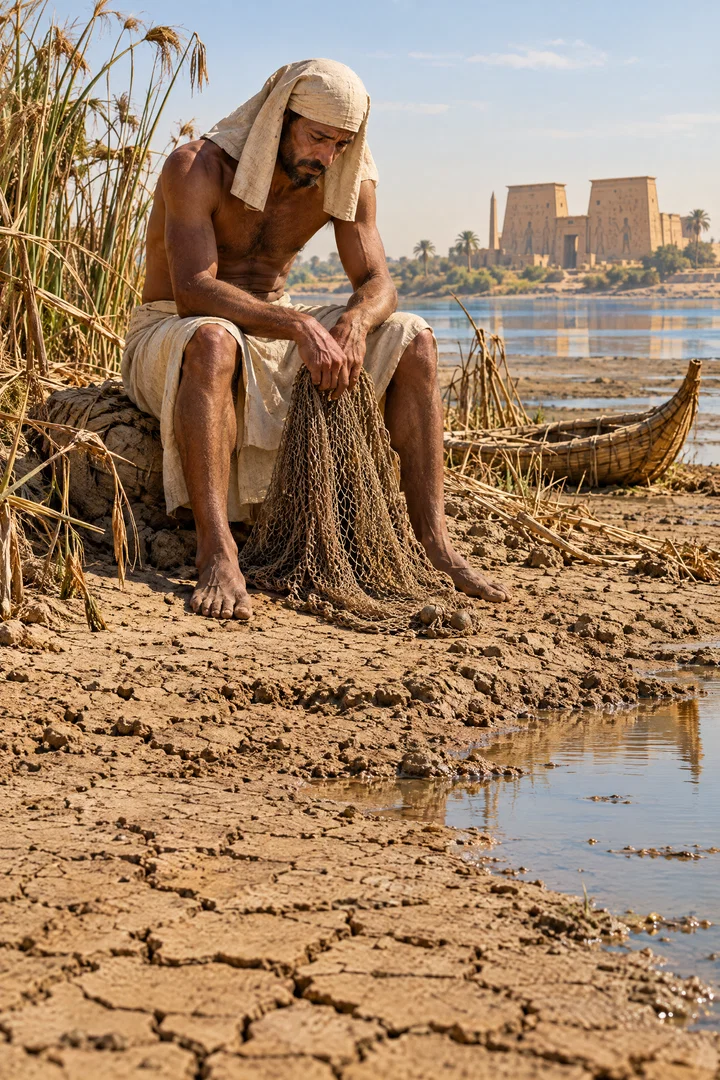
The paper reeds by the brooks, by the mouth of the brooks, and every thing sown by the brooks, shall wither, be driven away, and be no more.
Translations
American King James Version, King James Version
The paper reeds by the brooks, by the mouth of the brooks, and every thing sown by the brooks, shall wither, be driven away, and be no more.
The paper reeds by the brooks, by the mouth of the brooks,
And every thing sown by the brooks,
Shall wither, be driven away, and be no more.The paper-reeds by the brooks, by the mouth of the brooks, and every thing sown by the brooks, shall wither, be driven away, and be no more.
The meadows by the Nile, by the brink of the Nile, and all that is sown by the Nile, shall become dry, be driven away, and be no more.
The meadows by the Nile, by the brink of the Nile, and all the sown fields of the Nile, shall become dry, be driven away, and be no more.
Exposed things by the brook, by the edge of the brook, And every sown thing of the brook, hath withered, It hath been driven away, and is not.
The meadows by the Nile, on the banks of the Nile, and everything sown by the Nile, shall be dried up, be driven away, and be no [ more].
The meadows by the Nile, by the mouth of the Nile. And all that is sown in the Nile, Shall be dry, driven away, and not be!
Berean Standard Bible, Majority Standard Bible
The bulrushes by the Nile,
by the mouth of the river,
and all the fields sown along the Nile,
will wither, blow away, and be no more.The meadows by the Nile, by the brink of the Nile, and all the sown fields of the Nile, will become dry, be driven away, and be no more.
The grass-lands by the Nile, and everything planted by the Nile, will become dry, or taken away by the wind, and will come to an end.
The grasse in the riuer, and at the head of the riuers, and all that groweth by the riuer, shall wither, and be driuen away, and be no more.
Douay-Rheims (Challoner revision)
The channel of the river shall be laid bare from its fountain, and every thing sown by the water shall be dried up, it shall wither away, and shall be no more.
Pictures
Cross-references
- Ezekiel 30:12
And I will make the rivers dry, and sell the land into the hand of the wicked: and I will make the land waste, and all that is therein, by the hand of strangers: I the LORD have spoken it.
Both foretell Egypt’s rivers being made dry.
- Isaiah 11:15
And the LORD shall utterly destroy the tongue of the Egyptian sea; and with his mighty wind shall he shake his hand over the river, and shall smite it in the seven streams, and make men go over dryshod.
Both describe Egypt’s waters drying up.
- Joel 1:19-20
O LORD, to thee will I cry: for the fire hath devoured the pastures of the wilderness, and the flame hath burned all the trees of the field.
The day of the Lord brings dried rivers and ruined vegetation.
- Ezekiel 29:10
Behold, therefore I am against thee, and against thy rivers, and I will make the land of Egypt utterly waste and desolate, from the tower of Syene even unto the border of Ethiopia.
Both texts prophesy Egypt’s desolation.
Commentary
Each commentary is drawn from primary sources: the writings of Ellen G. White and Adventist pioneers and periodicals. Each commentary is separate. Its own words are not a quotation; follow the references to read the source passages.
Pioneers and periodicals
8 sources
Isaiah 19:7 belongs to a prophetic denunciation and judgment upon Egypt.RH Sep 22, 1868ST Jun 11, 1912 It describes and predicts the drying up of the Nile, rivers, brooks and watercourses and the withering, driving away and disappearance of the paper reeds, vegetation, plants and crops sown beside them.ST Aug 1, 1911ST Jul 31, 1884RH Mar 23, 1852RH Nov 11, 1862RH Sep 22, 1868 The chapter's prophecy has already been partly fulfilled in Egypt.ST Aug 1, 1911
This withering belongs to the same period of calamity in which the waters fail and fishing and linen and cotton work are brought to ruin.RH Mar 23, 1852 When the Nile's waters dry up, the plants and crops growing along its banks wither, leaving the land barren and contributing to its destruction as a habitable country.RH Sep 22, 1868 The prophecy concerning Egypt to which the verse belongs refers to the preaching of the gospel in Egypt and Assyria in New Testament times.ST Sep 29, 1909
The drying has come true in Egypt where in one day's travel in the Delta forty dry watercourses are crossed and water-skins are needed now around ruined cities whose walls were once blockaded by Greek and Roman navies.RH Nov 11, 1862 It stands together with Egypt's invasion and subjection by Nebuchadnezzar and afterward by Persians, Macedonians, Romans, Saracens, Mamelukes and Turks as proof fulfilled over twenty-four centuries.RH Nov 11, 1862 It stands together also with its perpetual rule by strangers and slaves with no native prince, its becoming the basest of kingdoms, and the ceasing of its idols and images.RH Nov 11, 1862
The prediction was of the complete disappearance of the papyrus paper-reeds and of every cultivated plant by the brooks, and Egypt's lack of papyrus is a literal fulfillment of that prediction.RH Jul 21, 1874ST Jul 31, 1884 This overcame great improbability because in Isaiah's time the indispensable papyrus flourished through the whole Thebaid, Heptanomos and Delta, was protected by stringent laws for its cultivation, and was held under the special care of local deities and planted, tended and cut with almost religious ceremonial.RH Jul 21, 1874 It was adaptable for paper, cloth, brushes, sails, cordage, shipping baskets, sandals, hats, skirts, carpets, chairs, seats, food for men and animals from its tender shoots, syrup and medicine, cradles, Pharaoh's throne canopy, street processions, house paintings, granite temple carvings, ladies' hair blossoms and neck amulets, and altar offerings for the dead.RH Jul 21, 1874 It was the plaything of the child and scepter of the god, the glory of the country, the staple of its commerce and the hieroglyphic emblem of its name, so that withholding its supply let Ptolemy Philadelphus repress a rival Pergamean library while opening the Delta markets spread Greek poetry and Roman philosophy through the known world.RH Jul 21, 1874
After thirty centuries of oppression, superstition and neglect the artificial lakes where it was cultivated dried up, rush after rush was cut down to warm baths and litter horses with no successors planted, and the hot south wind and desert sands exterminated it.RH Jul 21, 1874 Not a single indigenous papyrus remains in Egypt proper, with only a stream in Sicily and the marshes of Merom in Palestine holding the nearly extinct plant and the conservatories of London, Sion and Kew holding more living papyri than can be found from Syene to Alexandria.RH Jul 21, 1874
Sources