Isaiah 3:16
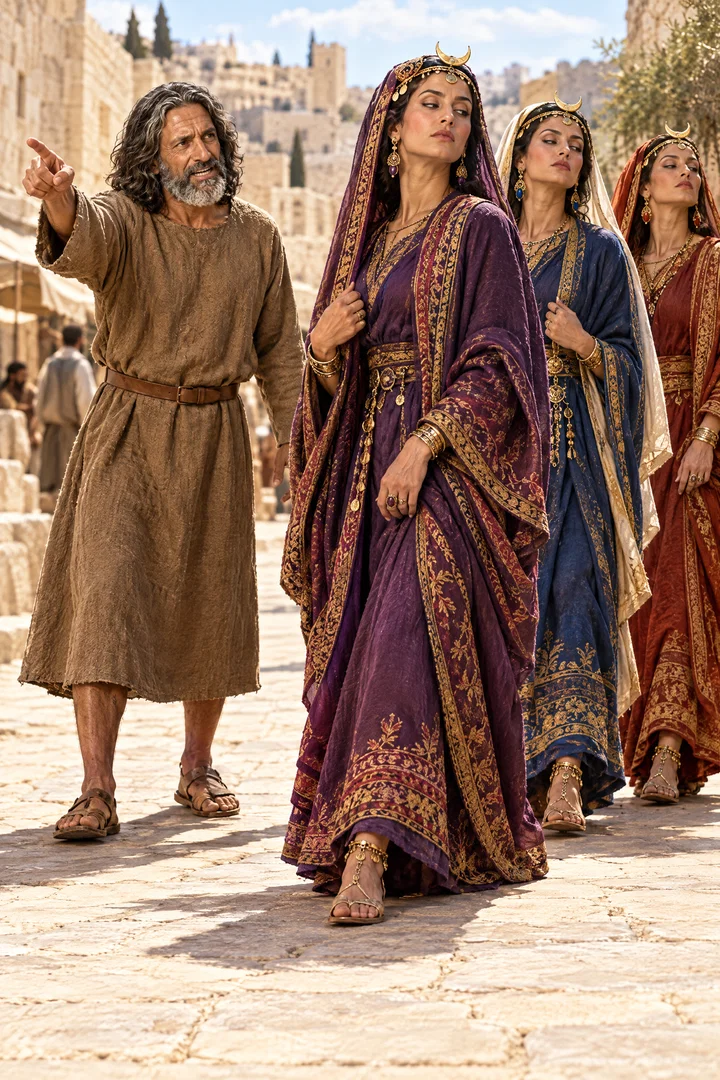
Moreover the LORD saith, Because the daughters of Zion are haughty, and walk with stretched forth necks and wanton eyes, walking and mincing as they go, and making a tinkling with their feet:
Translations
Moreover the LORD says, Because the daughters of Zion are haughty, and walk with stretched forth necks and wanton eyes, walking and mincing as they go, and making a tinkling with their feet:
Moreover the LORD saith, Because the daughters of Zion are haughty, and walk with stretched forth necks and wanton eyes, walking and mincing as they go, and making a tinkling with their feet:
Moreover the Lord saith,
Because the daughters of Zion are haughty,
And walk with stretched forth necks and wanton eyes,
Walking and mincing as they go,
And making a tinkling with their feet:Moreover the LORD saith, Because the daughters of Zion are haughty, and walk with extended necks and wanton eyes, walking and mincing as they go, and making a tinkling with their feet:
Moreover the LORD said, Because the daughters of Zion are haughty, and walk with stretched forth necks and wanton eyes, walking and mincing as they go, and making a tinkling with their feet:
Moreover Jehovah said, Because the daughters of Zion are haughty, and walk with outstretched necks and wanton eyes, walking and mincing as they go, and making a tinkling with their feet;
'Because that daughters of Zion have been haughty, And they walk stretching out the neck, And deceiving [with] the eyes, Walking and mincing they go, And with their feet they make a tinkling,
And Jehovah said, Because the daughters of Zion are haughty, and walk with stretched-out neck and wanton eyes, and go along mincing, and making a tinkling with their feet;
Because haughty are the daughters of Zion, And they walk with neck thrown back, and wanton eyes,—Tripping along as they go, And with their feet, making, a tinkling sound,
Berean Standard Bible, Majority Standard Bible
The LORD also says:
“ Because the daughters of Zion are haughty—
walking with heads held high
and wanton eyes,
prancing and skipping as they go,
jingling the bracelets on their ankles—Moreover the LORD said, “ Because the daughters of Zion are arrogant,
and walk with outstretched necks and flirting eyes,
walking daintily as they go,
jingling ornaments on their feet;Again, the Lord has said, Because the daughters of Zion are full of pride, and go with outstretched necks and wandering eyes, with their foot-chains sounding when they go:
The Lord also saith, Because the daughters of Zion are hautie, and walke with stretched out neckes, and with wandering eyes, walking and minsing as they goe, and making a tinkeling with their feete,
Douay-Rheims (Challoner revision)
And the Lord said: Because the daughters of Sion are haughty, and have walked with stretched out necks, and wanton glances of their eyes, and made a noise as they walked with their feet and moved in a set pace:
Pictures
Cross-references
- 1 Timothy 2:9
In like manner also, that women adorn themselves in modest apparel, with shamefacedness and sobriety; not with broided hair, or gold, or pearls, or costly array;
Both condemn vanity in adornment and commend modest dress.
- 1 Peter 3:3-4
Whose adorning let it not be that outward adorning of plaiting the hair, and of wearing of gold, or of putting on of apparel;
Both contrast outward adornment with godly character.
- Isaiah 4:1
And in that day seven women shall take hold of one man, saying, We will eat our own bread, and wear our own apparel: only let us be called by thy name, to take away our reproach.
Women seek husbands after the loss of men described in the preceding prophecy.
- Isaiah 4:3-4
And it shall come to pass, that he that is left in Zion, and he that remaineth in Jerusalem, shall be called holy, even every one that is written among the living in Jerusalem:
The prophecy continues with Zion’s survivors called holy and cleansed.
- Isaiah 4:5
And the LORD will create upon every dwelling place of mount Zion, and upon her assemblies, a cloud and smoke by day, and the shining of a flaming fire by night: for upon all the glory shall be a defence.
The preceding chapters provide the setting for the promised divine presence on Zion.
Commentary
Each commentary is drawn from primary sources: the writings of Ellen G. White and Adventist pioneers and periodicals. Each commentary is separate. Its own words are not a quotation; follow the references to read the source passages.
Ellen G. White
3 sources
In its original setting the verse describes the pride and love of display that accompanied wealth and oppression in Judah.PK 306.1–2 The daughters of Zion are haughty, thinking only of appearance and display, walking with outward pride and self-indulgence in a provocative and immodest manner.RH Apr 25, 1871Ms 1, 1888, par. 11–13 Their conduct is connected with sexual indulgence and with the corruption and suffering that such indulgence brings.Ms 1, 1888, par. 11–13 The verse that follows declares that the Lord will bring judgment upon them for this conduct.Ms 1, 1888, par. 11–13
The verse applies to the last days as a reproof to professed believers whose worldly, display-centered choices reveal a lack of Christian experience and responsibility.RH Apr 25, 1871
Sources
Pioneers and periodicals
43 sources
The verse portrays proud women displaying vanity through uplifted heads, bold glances, affected mincing steps and jingling foot ornaments such as anklets with bells.RH Apr 28, 1868RH Aug 21, 1855RH May 19, 1863RH Jul 11, 1871 Their pride in bearing and conspicuous finery is met with judgment in which their ornaments and beauty are stripped away and replaced by humiliation, shame and desolation.RH Jun 16, 1859RH Aug 21, 1855 The daughters of Zion represent worldly churches keeping the outward form of Christianity without its life, so the prophecy of proud and extravagant dress applies to women professing Christianity in the last days.RH Feb 18, 1915RH Apr 8, 1873RH Oct 5, 1869RH Jun 27, 1865 God condemns such pride, vanity and costly outward adornment and requires his people to be plainly dressed and distinct from the world, adorned instead with a meek and quiet spirit.RH May 21, 1901RH Jan 9, 1900RH May 30, 1912RH Oct 8, 1872 It is therefore a warning to all professed followers of God, women and men, against pride, worldly fashion and needless adornment, calling even his remnant people to humility and separation from conformity to the world.RH Jun 16, 1859RH Aug 21, 1855RH Jan 9, 1900RH Oct 25, 1864RH Jun 16, 1859
Words and Imagery
The daughters of Zion are haughty, displaying pride and vanity through raised-neck bearing, bold looks, delicate mincing walk, affected posture and movements, and jingling ornaments.RH Apr 28, 1868RH Aug 21, 1855RH May 19, 1863ST Apr 13, 1915ST May 31, 1910 Their pride shows in posture, eyes, and manner of walking and dressing, with affected ways meant to draw attention to themselves.RH Aug 21, 1855RH May 19, 1863ST Apr 13, 1915ST May 31, 1910ST Dec 9, 1880 To walk with stretched forth necks is to hold the head high, and to look with wanton eyes is to look with an unashamed, provocative, bold and immodest gaze.RH Apr 28, 1868
Making a tinkling with the feet refers to wearing ornaments that sound as they walk, such as anklets with attached bells.RH Jul 11, 1871 The final phrase is rendered in the Septuagint as drawing their garments in trains.RH Jan 11, 1912
In scriptural times fashion was expressed chiefly through elaborate adornment even while the general style of clothing remained much the same. The verse belongs to a catalogue showing that elaborate female finery was already practiced in Isaiah's day.RH May 19, 1863
Setting and Judgment
The pride exposed lies in bearing and gait — proud carriage, bold looks, mincing steps, and conspicuous jingling ornaments — and the judgments that follow strip that finery away.RH Jun 16, 1859RH Aug 21, 1855RH Oct 25, 1864 The ornaments, elaborate finery, and beauty named from this verse onward are to be taken away from the professed people as punishment for pride, leaving humiliation, shame, exposure, and desolation in their place.RH Jun 16, 1859RH Aug 21, 1855RH Oct 25, 1864RH Jun 16, 1859 Such display of personal adornment draws attention to self, belongs with idolatry and apostasy, and is not pleasing to God. Zion's later humiliation and captivity in Babylon shows in history what that stripping and desolation means.RH Jun 16, 1859RH Jun 16, 1859
The verse stands within the forcible setting forth of awful backsliding in chapters 2 to 5, a description of the backsliding of God's people.ST May 30, 1911ST Sep 22, 1909 Departure from the simplicity designed for God's people is seen here in haughtiness of manner, walk, and adorning of the body.RH Jun 3, 1902 That course ends in the lamenting and desolation of the gates of Zion.RH Jun 3, 1902 Leaders come under judgment, men fall by the sword, and the city is left desolate, with differing outcomes for the righteous and the wicked and with the escaping remnant in Zion afterward called holy.RH Jun 27, 1865
The judgment also works through war that greatly reduces the number of men, leaving many women without husbands.ST Jun 4, 1912
Prophecy for Last Days
Zion and Jerusalem stand for the church under the Christian dispensation, and the daughters of Zion are worldly churches that retain the name and outward form of Christianity while rejecting the life and righteousness of Christ.RH Feb 18, 1915RH Jun 27, 1865 The backsliding set forth with force in chapters 2 through 5 is a fit symbol for the greater events of the Messianic age, and that backsliding condition of God's people serves as a type of last-day apostasy.ST May 30, 1911ST Sep 22, 1909
The chapter portrays the exaltation of the professed church in the last days and its humbling in the day of the Lord that immediately follows when He arises to shake terribly the earth, which places the promise that follows in Isaiah 4 in the last days.RH Mar 18, 1875 Pride and extravagant, vain fashions in dress are made a subject of prophecy applying to the present time and to women professing Christianity in the last days, marking a falling away rather than an advance in piety and virtue, with the adornment and manner of walking illustrating the pride and excess seen in dress and apparel.RH Apr 8, 1873RH Oct 5, 1869
The verse reproves professed believers in the last days who think only of appearance and display, warning against outward pride, self-indulgence, immodest display and needless adornment as showing lack of Christian experience and responsibility.RH Apr 25, 1871RH Apr 28, 1868 It is directed to God's people in the judgment period, when they are found proud, worldly and adorned with ornaments rather than ready for the solemn events of the judgment, with haughty bearing, bold and immodest looks, delicate mincing walk and jingling ornaments displaying vanity and immodesty.RH Apr 28, 1868RH Jan 11, 1912 Holding the head high and an unashamed, provocative gaze reveal that vanity, and the threatened judgment in the following verses is connected with the first plague.RH Apr 28, 1868
With the whole of Isaiah 2 and 3 it is God's own divine commentary on the nations when they declare that peace and fellowship among all religions are coming, showing their character in Heaven's light as forsaken because filled with customs from the east, soothsaying like the Philistines, striking hands with children of strangers, and full of idols worshiping the work of their own hands.ST Oct 23, 1901 Isaiah 2 and 3 describe the day of the Lord of hosts as the time of the promise that the Lord will create upon every dwelling place of Mount Zion a cloud and smoke by day and the shining of a flaming fire by night for a defence, and as Israel moved only as the cloud and pillar of fire moved, so He now leads His people by His Spirit, causing light to shine as they can bear it and leading step by step into truth as fast as they are prepared to practice it.RH May 28, 1867 The professed church fills up the measure of its sins and faces the Lord's judgment with leaders judged, men falling by the sword and the city left desolate, yet the judgment brings different outcomes for the righteous and the wicked, and those who escape are followed by the promise that the remnant in Zion will be called holy.RH Jun 27, 1865
Teaching on Dress
God condemns the pride, vanity and display of the daughters of Zion, including their ornaments, costly outward decorations and elaborate appearance, as signs of lightness, depravity and excess.RH May 21, 1901RH Jan 9, 1900 Dress worn as an ornament and the pursuit of fine clothing are condemned, for dress began after sin and the loss of innocence, making it a badge of disgrace rather than a proper decoration. Such display of personal adornment belongs with idolatry and apostasy, draws attention to self, and is not pleasing to God.
God never designed His people to dress like worldlings but requires a marked difference between the dress of the Christian and that of the worldling.RH May 30, 1912 In the great war between the prince of darkness and the Saviour, fashionable dress is the uniform of the enemy, which misrepresents the Lord and which no one who loves the Lord can afford to wear.RH May 30, 1912 Wearing fashionable, worldly apparel sows seeds of pride and vanity in weaker believers, just as wearing disease-infected garments spreads infection wherever they go, and garments infected with pride and vanity should be burned rather than worn.RH May 30, 1912 Claiming inward victory over pride does not excuse wearing them.RH May 30, 1912
The warning is against wearing gold ornaments and costly apparel, including rings, chains and bracelets, and against earrings, bracelets and rings to be put off before new converts are received.RH Apr 20, 1911RH Jun 20, 1871 It is applied to dress trimmings such as flounces, hooked-up skirts, ribbons, cording, braid, embroidery and buttons, which women professing godliness should not countenance.RH May 8, 1866 It belongs with feathers in hats, ornaments in ears, rings on fingers, clasps on arms, lacing of the body and round tires, and with bracelets, chains, beads and other ornaments that shimmer and tinkle on girls who mince along with proud, affected walk. The fashionable articles listed from this verse onward were a temptation even for God's people and are still prevailing fashions in different portions of the earth today.RH Aug 21, 1900RH Jun 3, 1902
God's people should dress plainly and reject fashionable adornment, with outward appearance reflecting a changed heart free from pride and vanity.RH May 21, 1901 Outward adorning of hair, gold and apparel is condemned and set against the ornament of a meek and quiet spirit, with lives shaped by God, beside which outward gloss and tinsel are worthless.RH Jan 9, 1900RH Oct 8, 1872 The chapter's condemnation of ornaments, including earrings, leads to giving up earrings as an offering to the Lord, though the verse itself does not mention earrings.RH Apr 20, 1911RH May 27, 1915
Call to Humility
The haughty bearing condemned here shows pride as a sin that brings serious consequences, for the display of vanity through walk and conspicuous ornament is met by a judgment that strips away finery and leaves shame, exposure and desolation, as later seen in captivity in Babylon.RH Jun 16, 1859RH Aug 21, 1855RH Jun 16, 1859 It stands as a warning against pride, self-indulgence, worldly fashion and needless adornment, teaching humility and reverence.RH Jun 16, 1859RH Jun 16, 1859RH Dec 9, 1858 Even the remnant people of God are called by it to separate from worldly conformity rather than follow pride and fashion.RH Dec 9, 1858
The warning belongs to professed followers of God, both women and men, who are not to adorn themselves with the costly outward decorations listed onward in the passage, since those are signs of lightness, vanity, show and immodesty.RH Jan 9, 1900RH Oct 25, 1864 Women who dress like the worldly-minded are to examine their clothing by this teaching.RH Oct 25, 1864 In place of outward gloss and tinsel God marks his people by the inward ornament of a meek and quiet spirit and by lives shaped by him.RH Jan 9, 1900
Conspicuous adornment both displays and fosters vanity, and the example of Christian women in dress influences others toward pride or away from it.RH Jul 8, 1862 Clothing and jewelry worn for display are vain and wasteful and contrary to godly humility. Such dress visibly declares disobedience to what God's word forbids, and imitating the world through pleasure, pride and fashion, copying the worldly ways of surrounding people in attire, stands condemned.RH Feb 18, 1915RH Jan 16, 1866RH May 25, 1916 In its wider application this imitating of the world pictures churches that keep the name and outward form of Christianity while rejecting the life and righteousness of Christ.RH Feb 18, 1915
Ostentatious adornment carried into the house of prayer profanes worship, turning manner and appearance into pride and vanity before God.RH Oct 2, 1855 A mincing, affected walk belongs to that same vanity and pride in dress, as the effort to be thought pretty, to gain admiration and flattery, and to bow to fashion, taking its place with feathers in hats, ornaments in ears, rings on fingers, clasps on arms, lacing of the body and round tires.RH Mar 21, 1907 For women professing godliness it reverses the good influence that modest apparel with shamefacedness and sobriety and good works should exert upon the world, bringing dishonor instead of honor, mourning in heaven and rejoicing in hell.RH Mar 21, 1907
The same picture applies to those who oppose self-denial by going about in gay attire and minding earthly things, who like Jonah's gourd will wither and perish when the Son of man comes in his Father's glory.RH Feb 25, 1858 The proud, showy manner of walking marks moral decline and public degeneracy that calls for stern prophetic rebuke, seen in women walking the streets with affected, mincing eyes and outstretched necks and in pride and immodesty displayed through conspicuous fashions and affected mannerisms.ST Apr 13, 1915RH Sep 19, 1871 Such degeneracy carries the expectation that God will bring retribution.RH Sep 19, 1871
Training girls to seek public attention and praise fosters this same pride.ST Oct 6, 1887 The affected, mincing walk with tinkling display of dress and body reappears in girls who mince along with shimmering and tinkling bracelets, chains, beads and other ornaments, and in little girls who imitate fashionable adult women by twisting and looking over their shoulders to display their clothes.ST Apr 14, 1887RH Jan 30, 1872 In them fashion replaces modesty, simplicity and the natural manners of childhood with prideful display.ST Apr 14, 1887RH Jan 30, 1872
Sources