Isaiah 38:5
Go, and say to Hezekiah, Thus saith the LORD, the God of David thy father, I have heard thy prayer, I have seen thy tears: behold, I will add unto thy days fifteen years.
Translations
Go, and say to Hezekiah, Thus says the LORD, the God of David your father, I have heard your prayer, I have seen your tears: behold, I will add to your days fifteen years.
King James Version, Revised Version
Go, and say to Hezekiah, Thus saith the LORD, the God of David thy father, I have heard thy prayer, I have seen thy tears: behold, I will add unto thy days fifteen years.
Go and say to Hezekiah, Thus saith the Lord, the God of David thy father, I have heard thy prayer, I have seen thy tears: behold, I will add unto thy days fifteen years.
Go and say to Hezekiah, Thus saith the LORD, the God of David thy father, I have heard thy prayer, I have seen thy tears: behold, I will add to thy days fifteen years.
Go, and say to Hezekiah, Thus saith Jehovah, the God of David thy father, I have heard thy prayer, I have seen thy tears: behold, I will add unto thy days fifteen years.
Go, and thou hast said to Hezekiah, Thus said Jehovah, God of David thy father, 'I have heard thy prayer, I have seen thy tear, lo, I am adding to thy days fifteen years,
Go and say to Hezekiah, Thus saith Jehovah, the God of David thy father: I have heard thy prayer, I have seen thy tears: behold, I will add to thy days fifteen years.
Go, and say unto Hezekiah—Thus, saith Yahweh, the God of David thy father: I have heard thy prayer, I have seen thy tears,—Behold me! about to add unto thy days, fifteen years;
Berean Standard Bible, Majority Standard Bible
“ Go and tell Hezekiah that this is what the LORD, the God of your father David, says: ‘ I have heard your prayer; I have seen your tears. Behold, I will add fifteen years to your life.
“ Go, and tell Hezekiah, ‘ The LORD, the God of David your father, says, “ I have heard your prayer. I have seen your tears. Behold, I will add fifteen years to your life.
Go to Hezekiah, and say, The Lord, the God of David, your father, says, Your prayer has come to my ears, and I have seen your weeping: see, I will give you fifteen more years of life.
Goe, and say vnto Hezekiah, Thus saith the Lord God of Dauid thy father, I haue heard thy prayer, and seene thy teares: behold, I will adde vnto thy dayes fifteene yeeres.
Douay-Rheims (Challoner revision)
Go and say to Ezechias: Thus saith the Lord the God of David thy father: I have heard thy prayer, and I have seen thy tears: behold I will add to thy days fifteen years:
Pictures
Cross-references 20 of 22
- 2 Kings 20:5-6
Turn again, and tell Hezekiah the captain of my people, Thus saith the LORD, the God of David thy father, I have heard thy prayer, I have seen thy tears: behold, I will heal thee: on the third day thou shalt go up unto the house of the LORD.
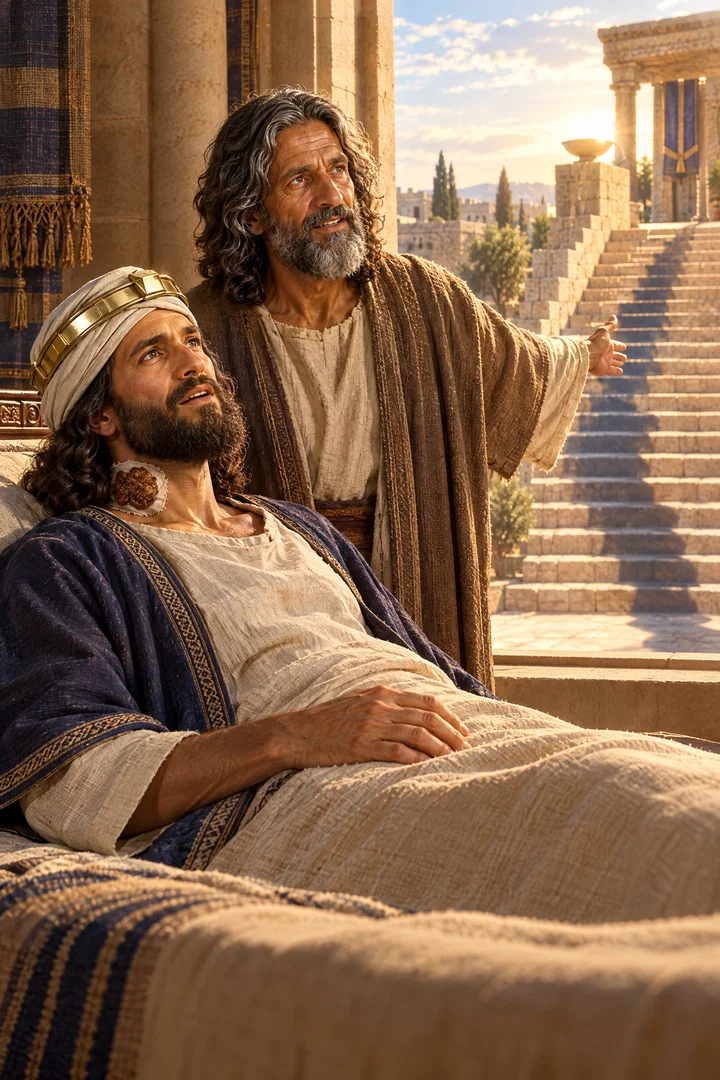
God hears Hezekiah’s prayer and promises healing and fifteen added years.
- Isaiah 39:1-2
At that time Merodach-baladan, the son of Baladan, king of Babylon, sent letters and a present to Hezekiah: for he had heard that he had been sick, and was recovered.
After Hezekiah’s recovery, Babylonian envoys visit, and he displays his treasures.
- 2 Chronicles 32:24-31
In those days Hezekiah was sick to the death, and prayed unto the LORD: and he spake unto him, and he gave him a sign.
Hezekiah’s recovery is followed by the Babylonian embassy, which tests his heart.
- Isaiah 38:18-19
For the grave cannot praise thee, death can not celebrate thee: they that go down into the pit cannot hope for thy truth.
The dead cannot praise God, but the living can.
- Isaiah 38:1
In those days was Hezekiah sick unto death. And Isaiah the prophet the son of Amoz came unto him, and said unto him, Thus saith the LORD, Set thine house in order: for thou shalt die, and not live.
The death sentence prompts Hezekiah’s prayer before God grants him more years.
- Isaiah 38:21
For Isaiah had said, Let them take a lump of figs, and lay it for a plaister upon the boil, and he shall recover.
A fig plaster is applied to Hezekiah’s boil as part of his recovery.
- Isaiah 39:6-7
Behold, the days come, that all that is in thine house, and that which thy fathers have laid up in store until this day, shall be carried to Babylon: nothing shall be left, saith the LORD.
Babylonian captivity is foretold after Hezekiah’s recovery and display of the kingdom’s treasures.
- 2 Kings 20:12-18
At that time Berodach-baladan, the son of Baladan, king of Babylon, sent letters and a present unto Hezekiah: for he had heard that Hezekiah had been sick.
Hezekiah shows Babylon’s envoys his treasures, and Isaiah foretells their removal to Babylon.
- 2 Kings 20:8-11
And Hezekiah said unto Isaiah, What shall be the sign that the LORD will heal me, and that I shall go up into the house of the LORD the third day?
The shadow’s return was the sign accompanying God’s promise to restore Hezekiah.
- 2 Chronicles 32:25
But Hezekiah rendered not again according to the benefit done unto him; for his heart was lifted up: therefore there was wrath upon him, and upon Judah and Jerusalem.
Hezekiah failed to respond gratefully to God’s gift of added years.
- 2 Kings 18:5-6
He trusted in the LORD God of Israel; so that after him was none like him among all the kings of Judah, nor any that were before him.
Hezekiah trusted the LORD, clung to him, and kept his commandments.
- Isaiah 38:17
Behold, for peace I had great bitterness: but thou hast in love to my soul delivered it from the pit of corruption: for thou hast cast all my sins behind thy back.
Hezekiah rejoices that God delivered him from the pit of corruption.
- 2 Chronicles 32:24
In those days Hezekiah was sick to the death, and prayed unto the LORD: and he spake unto him, and he gave him a sign.
Hezekiah prays during his illness, and God answers him.
- Isaiah 39:1
At that time Merodach-baladan, the son of Baladan, king of Babylon, sent letters and a present to Hezekiah: for he had heard that he had been sick, and was recovered.
Babylon sends messengers after hearing of Hezekiah’s recovery.
- Isaiah 38:12
Mine age is departed, and is removed from me as a shepherd’s tent: I have cut off like a weaver my life: he will cut me off with pining sickness: from day even to night wilt thou make an end of me.
He describes his life being cut off.
- Psalms 39:12
Hear my prayer, O LORD, and give ear unto my cry; hold not thy peace at my tears: for I am a stranger with thee, and a sojourner, as all my fathers were.
Both texts describe prayer accompanied by tears.
- Isaiah 38:10
I said in the cutting off of my days, I shall go to the gates of the grave: I am deprived of the residue of my years.
Hezekiah expected gates of the grave, not heaven.
- Jeremiah 18:7-10
At what instant I shall speak concerning a nation, and concerning a kingdom, to pluck up, and to pull down, and to destroy it;
explains why announced word changed
- Isaiah 38:11
I said, I shall not see the LORD, even the LORD, in the land of the living: I shall behold man no more with the inhabitants of the world.
Hezekiah says he will no longer see the Lord or other people among the living.
- Isaiah 39:4
Then said he, What have they seen in thine house? And Hezekiah answered, All that is in mine house have they seen: there is nothing among my treasures that I have not shewed them.
Hezekiah failed to show visitors God's doings
Commentary
Each commentary is drawn from primary sources: the writings of Ellen G. White and Adventist pioneers and periodicals. Each commentary is separate. Its own words are not a quotation; follow the references to read the source passages.
Ellen G. White
11 sources
Hezekiah was sick unto death after being told he would die, and when he cried out to the Lord, God answered that He had heard his prayer and seen his tears and would add fifteen years to his life.MH 232.1CH 411.2–412.1GW 220.2HPMMW 53.1–54.2Lt 37, 1892, par. 6–7 The message reversed the sentence of death and turned his plea for life into a promise of recovery and added years.GW 220.2Lt 67, 1899, par. 3–7Lt 182, 1899, par. 1–2RH May 13, 1915ST Oct 1, 1902 God could have healed him instantly with a single word, yet He gave the promise together with specific directions for treatment.MH 232.1Lt 37, 1892, par. 6–7
The healing joined divine power with the use of a practical remedy, a lump or bunch of figs laid as a plaster upon the boil or sore.MH 232.1CH 411.2–412.1HPMMW 53.1–54.2Lt 37, 1892, par. 6–716MR 288.2–289.2 Using what God has provided to aid recovery in harmony with providence and natural laws cooperates with God and is not a denial or hindrance of faith.MH 232.1CH 411.2–412.1HPMMW 53.1–54.2Lt 37, 1892, par. 6–7 Divine healing in this way can work through ordinary means, with God blessing a natural remedy to heal.CH 411.2–412.1HPMMW 53.1–54.2Lt 182, 1899, par. 1–2 God worked through the simple fig remedy while turning away from the physicians' preparations that were hindering the body from rallying against the disease.Lt 67, 1899, par. 3–716MR 288.2–289.2
The promise was accompanied by a sign in which the sun went back ten degrees and the shadow on the sundial turned back.Lt 182, 1899, par. 1–2RH May 13, 1915 That turning back of the shadow was the sign of the gift of added life.Lt 182, 1899, par. 1–2RH May 13, 1915 It prompted the Babylonian king to send ambassadors to learn about the God who had performed the wonder.RH May 13, 1915
The recovery and its accompanying sign gave Hezekiah an opportunity to testify to God's power, goodness, and compassion, but instead he displayed his treasures and failed to give God the glory.ST Oct 1, 1902 As part of the account of deliverance from battle and sickness followed by the reception of the Babylonian ambassadors, the history warns that a home and its hospitality should reveal God's goodness rather than worldly possessions, vanity, and idle pursuits.ST Oct 1, 1902
Sources
Pioneers and periodicals
38 sources
God answered Hezekiah when he was sick unto death and weeping in prayer by promising to heal him and to add fifteen years to his life, with deliverance for him and the city from Assyria.ST Oct 9, 1884RH Sep 13, 1906ST Oct 6, 1909 He hears earnest, definite, deeply felt prayer and sees tears, and prayer turned aside death when all else had failed.ST Apr 3, 1879ST Jan 29, 1908RH Jul 10, 1860ST Dec 31, 1874 Hezekiah's sore weeping to have death deferred and his gratitude for deliverance from the pit show that death brings the righteous to the grave and not at once to heavenly glory, and that only the living can praise God and learn His truth.RH Sep 26, 1865ST Aug 29, 1878ST Feb 28, 1911ST Nov 25, 1886ST Sep 29, 1881 The gift of life and its sign in the sun's turning back was meant to make God's saving power known to Babylon, but Hezekiah exalted himself and displayed his treasures instead of giving God the glory, and Manasseh born in those added years later brought great trouble through wickedness.ST Sep 13, 1905ST Jul 30, 1902ST Jun 18, 1902RH May 21, 1908 Time spared when death seemed near is a further period of probation to use well, to gain victory over wrong and to prepare for everlasting life, and the use of figs for the boil shows that healing through natural means expresses God's own working power.ST Apr 3, 1879RH Apr 4, 1871ST Mar 31, 1898
Setting and Promise
Isaiah 38:5 is God's answer sent through Isaiah to Hezekiah when he was sick unto death, promising after hearing his prayer and seeing his tears to add fifteen years to his life and to restore him to health.ST Oct 9, 1884ST Oct 6, 1909ST Nov 21, 1911STST Jan 13, 1888 It belongs to the account of Hezekiah's sickness and healing during his reign as king, within his experiences recorded in Isaiah 36-39.ST Oct 6, 1909 After Hezekiah prayed when sick unto death, the Lord sent Isaiah to tell him he would recover.ST Jan 13, 1888
Isaiah had first told Hezekiah when sick unto death to set his house in order, for he would die and not live.RH Sep 13, 1906 Hezekiah turned his face toward the wall and prayed and wept greatly, and even before Isaiah had gone out into the middle court God sent him back to tell Hezekiah that He had heard his prayer and seen his tears and would heal him.RH Sep 13, 1906 He would go up to the house of the Lord on the third day, have fifteen years added to his days, and be delivered with the city out of the hand of the king of Assyria, the city being defended for God's own sake and for David's sake, with a wonderful miracle wrought to show that prayer had been heard.RH Sep 13, 1906 This reversal does not mean God changed His mind or made a mistake or that Isaiah contradicted himself, but shows that God at times reveals what is in the heart to prevent the thing itself, and when attitude toward Him is changed by repentance and prayer He forgives and sends a different message, repenting of the evil He thought to do or the good He said He would do as declared concerning a nation and kingdom to pluck up or to build and plant.RH Sep 13, 1906
The healing from an illness that threatened life was accompanied and confirmed by the remarkable sign of the sundial's shadow moving backward, the turning back of the shadow being a sign of the gift of life.RH May 13, 1915RH Aug 4, 1904 That wonder prompted the Babylonian king to send ambassadors to learn about the God who had performed it.RH May 13, 1915 The gracious deliverance from life-threatening sickness came after deliverance from the dangers of battle, with the account joining deliverance from battle and sickness before the reception of the Babylonian ambassadors.ST Oct 1, 1902ST Jul 22, 1875
Prayer Heard and Answered
God hears earnest, definite, deeply felt prayer and sees tears, and in answer prolongs life when everything else has failed and death threatens.ST Apr 3, 1879ST Jan 29, 1908RH Jul 10, 1860RH Jul 21, 1863RH Oct 23, 1860 When Hezekiah was gravely ill he prayed specifically for health with a definite, deeply felt request, and God heard the prayer, saw the tears as the expression of earnest prayer, granted the request, and mercifully deferred the threatened death by adding fifteen years to his life.ST Apr 3, 1879ST Jan 29, 1908RH Jul 10, 1860RH Jul 21, 1863RH Oct 23, 1860 That added time was a further period of probation given in answer to prayer.ST Apr 3, 1879
God sets repentant tears to account just as idle words, repentant words, inward desires, endeavors, longings, and prayers are set to account and kept in the record on high, with the disease and the remedy fully described.RH Dec 9, 1858 To impute is to set to account, and the tears of His children are imputed to them.RH Dec 9, 1858 He forgives only what He fully knows with all its attendant circumstances.RH Dec 9, 1858 He cannot pardon sin until it is repented of and turned from, nor accept any except those who loathe and hate sin for its own hatefulness.RH Dec 9, 1858
After Isaiah told Hezekiah, sick unto death, to set his house in order for he would die and not live, Hezekiah turned his face toward the wall and prayed and wept greatly, and even before Isaiah had gone out into the middle court God sent him back to say He had heard the prayer and seen the tears and would heal him so that on the third day he would go up to the house of the Lord.RH Sep 13, 1906 The promise added fifteen years to his days, with deliverance for him and the city out of the hand of the king of Assyria and defense of the city for God's own sake and for David's sake, confirmed by a wonderful miracle to show that prayer had been heard.RH Sep 13, 1906 This reversal from you shall die to you shall live fifteen more years does not mean God changed His mind or made a mistake or that Isaiah contradicted himself.RH Sep 13, 1906 It shows that God at times reveals what is in the heart to prevent the thing itself from happening, and when attitude toward Him is changed by repentance and prayer He forgives and sends a different message, repenting of the evil He thought to do or the good He said He would do as declared concerning a nation and kingdom to pluck up or to build and plant.RH Sep 13, 1906
Hezekiah's urging of his petition for more life is an example of asking God to yield to one's own will rather than submitting to His will.RH Dec 29, 1868 The outcome admonishes against prayer that seeks to change God's preference, for fervent, effective prayer remains consistent with complete submission to God's will.RH Dec 29, 1868 Secret prayer gives relief and strong consolation in affliction and adversity, for Hezekiah applied to God in his trouble and God heard him, gave him fifteen more years of life, made his soul joyful in the Lord, turned great bitterness into peace by delivering him from the pit of corruption and casting his sins behind His back, and proved Himself a refuge in the day of trouble for the one who dwells in the secret place of the Most High.RH Apr 23, 1857 Prayer in this history turns aside death and brings blessing.ST Dec 31, 1874
Death Is Not Glory
Hezekiah was righteous, with a perfect heart and doing what was right, yet when told he would die he wept sore and prayed to have death deferred and fifteen years added to his life.RH Sep 26, 1865ST Aug 29, 1878 That prayer proves death is not a welcome messenger that takes righteous people straight to heaven, for if dying had taken him to heaven fifteen years sooner his prayer to stay out of heaven that long would have been foolish.RH Sep 26, 1865ST Aug 29, 1878ST Sep 29, 1881 What he sought was to be spared from dying and having his earthly life ended, not to enter heavenly joys, and he described the grave as the pit of corruption.ST Aug 29, 1878RH Jul 28, 1863 His dread of being cut off in his days and his song of gratitude for having his soul delivered in love from the pit of corruption show he knew death meant going to the gates of the grave, hades, and not going to paradise or the third heaven.ST Aug 29, 1878
Because Hezekiah remained alive he could praise and thank God among the living, while the dead cannot praise Him.ST Feb 28, 1911ST Nov 25, 1886RH Sep 22, 1859RH Nov 19, 1872 His added fifteen years were a reprieve from death in which, as one of the living, he praised God, while the dead cannot praise Him or hope to learn His truth.ST Feb 28, 1911ST Nov 25, 1886 The opportunity to learn and accept the truth and the further period of probation belong to this life, not to life after death.ST Nov 25, 1886
The fifteen years added to mortal life illustrate how human life is brief and counted in days, in contrast to the endless life promised to the faithful.ST Aug 9, 1899 Hezekiah's knowing that death was near did not promote piety in him.ST Feb 9, 1882
Consequences and Witness to Babylon
The fifteen added years were not necessarily better for Hezekiah, for God let him have what he asked and gave him the chance to use it well, but he acted foolishly.ST Sep 13, 1905 His son Manasseh was born during those added years, three years after his recovery, and later brought great trouble on the kingdom through wickedness.ST Sep 13, 1905
The healing and its accompanying astronomical miracle were a gift of life as a sign of salvation from death and a means of making God's saving power known in distant Babylon.ST Jun 18, 1902RH May 21, 1908 That deliverance gave Hezekiah an opportunity to reveal God and to proclaim the gospel of life to the Babylonian visitors and messengers.ST Jul 30, 1902ST Jun 18, 1902RH May 21, 1908 His recovery gave him an opportunity to tell visiting nations, including Babylon, about God's goodness, power, compassion, and salvation.ST Oct 1, 1902
Instead of giving God the glory he exalted himself and displayed himself, his treasures, and his kingdom's wealth and earthly riches.ST Oct 1, 1902ST Jul 30, 1902ST Jun 18, 1902ST Jun 7, 1910 That display prompted desire for those riches and foreshadowed the kingdom's later plunder.ST Jun 7, 1910 His example warns that a home and its hospitality should reveal God's goodness rather than worldly possessions, vanity, and idle pursuits.ST Oct 1, 1902 The turning back of the sundial's shadow as a sign of the gift prompted the Babylonian king to send ambassadors to learn about the God who had performed the wonder.RH May 13, 1915
Living Out the Gift
The threatened death was mercifully deferred when prayer was heard, and fifteen years were added to life as a further period of probation.ST Apr 3, 1879 Life spared when death seemed near is therefore to be treated as opportunity to use the added time well.ST Apr 3, 1879RH Apr 4, 1871 It is opportunity to gain victories over wrongdoing and to prepare for everlasting life.RH Apr 4, 1871
Recovery and longer life were assured while a plaster of figs was directed to be applied to the fatal boil.ST Mar 31, 1898 The figs served as a means of healing, showing that recovery through natural agencies can be an expression of divine power.ST Mar 31, 1898 Practical means are therefore to be used in treating disease while recognizing God as the power working through them.ST Mar 31, 1898 The same gracious adding of years is seen when four additional years with his family were granted to Peckover before his peaceful death.RH Jul 27, 1916
Sources