James 2:3
And ye have respect to him that weareth the gay clothing, and say unto him, Sit thou here in a good place; and say to the poor, Stand thou there, or sit here under my footstool:
Translations
And you have respect to him that wears the gay clothing, and say to him, Sit you here in a good place; and say to the poor, Stand you there, or sit here under my footstool:
And ye have respect to him that weareth the gay clothing, and say unto him, Sit thou here in a good place; and say to the poor, Stand thou there, or sit here under my footstool:
and ye have respect to him that weareth the gay clothing, and say unto him, Sit thou here in a good place; and say to the poor, Stand thou there, or sit here under my footstool:
And ye have respect to him that weareth the gay clothing, and say to him, Sit thou here in a good place; and say to the poor, Stand thou there, or sit here under my footstool:
Revised Version, American Standard Version
and ye have regard to him that weareth the fine clothing, and say, Sit thou here in a good place; and ye say to the poor man, Stand thou there, or sit under my footstool;
and ye may look upon him bearing the gay raiment, and may say to him, 'Thou — sit thou here well,' and to the poor man may say, 'Thou — stand thou there, or, Sit thou here under my footstool,' —
and ye look upon him who wears the splendid apparel, and say, Do thou sit here well, and say to the poor, Do thou stand there, or sit here under my footstool:
And ye eye him that hath on the gay clothing, and say, Thou, be sitting here, pleasantly,—and, unto the destitute man, say—Thou, stand, or sit there under my footstool,
If you lavish attention on the man in fine clothes and say, “ Here is a seat of honor,” but say to the poor man, “ You must stand” or “ Sit at my feet,”
If you lavish attention on the man in fine clothes and say, “ Here is a seat of honor,” but say to the poor man, “ You must stand” or “ Sit here under my footstool,”
and you pay special attention to him who wears the fine clothing and say, “ Sit here in a good place;” and you tell the poor man, “ Stand there,” or “ Sit by my footstool”
And you do honour to the man in fair clothing and say, Come here and take this good place; and you say to the poor man, Take up your position there, or be seated at my feet;
And ye haue a respect to him that weareth the gaie clothing; and say vnto him, Sit thou here in a goodly place, and say vnto the poore, Stand thou there, or sit here vnder my footestoole,
Douay-Rheims (Challoner revision)
And you have respect to him that is clothed with the fine apparel, and shall say to him: Sit thou here well; but say to the poor man: Stand thou there, or sit under my footstool:
Pictures
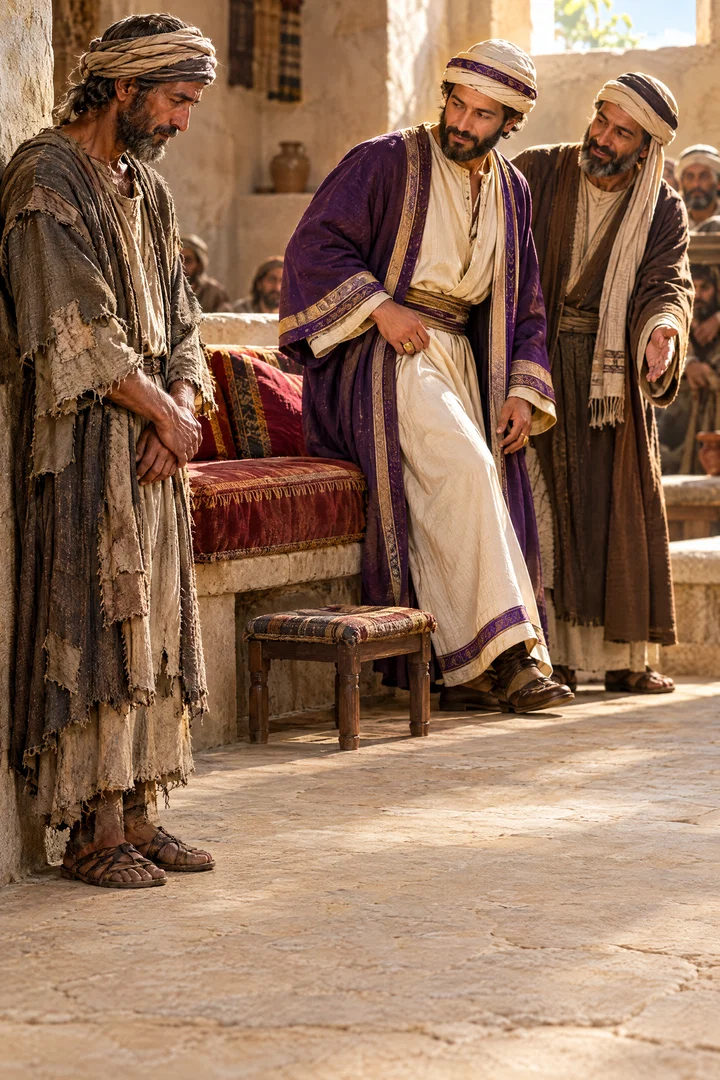
Cross-references 20 of 23
- James 2:8-9
If ye fulfil the royal law according to the scripture, Thou shalt love thy neighbour as thyself, ye do well:
Favoritism violates the royal law to love your neighbor as yourself.
- Acts 10:34
Then Peter opened his mouth, and said, Of a truth I perceive that God is no respecter of persons:
Both texts state that God shows no partiality among people.
- James 2:9
But if ye have respect to persons, ye commit sin, and are convinced of the law as transgressors.
Respect of persons is condemned as sin and transgression of the law.
- Matthew 25:40
And the King shall answer and say unto them, Verily I say unto you, Inasmuch as ye have done it unto one of the least of these my brethren, ye have done it unto me.
Slighting a brother is described as slighting Christ.
- Leviticus 19:18
Thou shalt not avenge, nor bear any grudge against the children of thy people, but thou shalt love thy neighbour as thyself: I am the LORD.
It gives the command to love one’s neighbor that favoritism breaks.
- Proverbs 22:2
The rich and poor meet together: the LORD is the maker of them all.
Both rich and poor are made by God.
- Romans 2:11
For there is no respect of persons with God.
God shows no partiality among people.
- 1 Samuel 16:7
But the LORD said unto Samuel, Look not on his countenance, or on the height of his stature; because I have refused him: for the Lord seeth not as man seeth; for man looketh on the outward appearance, but the LORD looketh on the heart.
Both teach that worth is not determined by outward appearance or status.
- Galatians 3:28
There is neither Jew nor Greek, there is neither bond nor free, there is neither male nor female: for ye are all one in Christ Jesus.
Earthly distinctions do not divide those who are one in Christ.
- Proverbs 14:31
He that oppresseth the poor reproacheth his Maker: but he that honoureth him hath mercy on the poor.
Despising the lowly reproaches God.
- Luke 14:12-13
Then said he also to him that bade him, When thou makest a dinner or a supper, call not thy friends, nor thy brethren, neither thy kinsmen, nor thy rich neighbours; lest they also bid thee again, and a recompence be made thee.
Jesus teaches inviting the poor rather than seeking social advantage from the rich.
- Matthew 22:39
And the second is like unto it, Thou shalt love thy neighbour as thyself.
It recalls the command to love others as oneself.
- Acts 10:28
And he said unto them, Ye know how that it is an unlawful thing for a man that is a Jew to keep company, or come unto one of another nation; but God hath shewed me that I should not call any man common or unclean.
Both forbid ranking people by nation or condition.
- James 3:17
But the wisdom that is from above is first pure, then peaceable, gentle, and easy to be intreated, full of mercy and good fruits, without partiality, and without hypocrisy.
Heavenly wisdom is described as impartial.
- James 2:15-16
If a brother or sister be naked, and destitute of daily food,
Both condemn failing to meet the needs of the poor.
- Psalms 140:12
I know that the LORD will maintain the cause of the afflicted, and the right of the poor.
God upholds the cause of the poor.
- Luke 14:21
So that servant came, and shewed his lord these things. Then the master of the house being angry said to his servant, Go out quickly into the streets and lanes of the city, and bring in hither the poor, and the maimed, and the halt, and the blind.
The passage contrasts excluding the poor with bringing them in as guests.
- Matthew 7:12
Therefore all things whatsoever ye would that men should do to you, do ye even so to them: for this is the law and the prophets.
It invokes the golden rule as contrary to selfish treatment.
- Luke 16:19-21
There was a certain rich man, which was clothed in purple and fine linen, and fared sumptuously every day:
The rich man feasts while poor Lazarus suffers at his gate.
- Proverbs 19:17
He that hath pity upon the poor lendeth unto the LORD; and that which he hath given will he pay him again.
giving to poor lends to Lord
Commentary
Each commentary is drawn from primary sources: the writings of Ellen G. White and Adventist pioneers and periodicals. Each commentary is separate. Its own words are not a quotation; follow the references to read the source passages.
Ellen G. White
33 sources
It rebukes giving the well-dressed and wealthy an honored seat while telling the poor to stand aside or take a low inferior place, which is partiality and respect of persons and judging with evil thoughts.4T 550.1–2CH 230.1–2Ms 111, 1893, par. 2–4 God makes no distinction on grounds of caste, color, rank, wealth, honor, talent or learning, and a person's worth is measured not by outward appearance, clothing or possessions but by character, integrity, purity and oneness with Christ.4T 550.1–2CH 230.1–2GW 332.1–2RH Jul 21, 19109T 223.1 All are one family bought by Christ's sacrifice, the poor of this world are chosen to be rich in faith and heirs of the kingdom, and slighting needy believers slights Christ Himself who dwelt among the lowly and will judge by purity and love rather than wealth or position.Ms 111, 1893, par. 2–4CH 231.2GW92 313.1STMW6 28.2Ms 30, 1891, par. 3 It requires giving the poor as much interest, sympathy, counsel and courtesy as the rich, and forbids letting fashionable dress rule in worship, or in God's institutions bestowing favors on a select few while neglecting and discouraging faithful worthy workers.4T 550.1–2CH 230.1–2Ms 26, 1891, par. 6–9CH 231.2CTBH 85.4 Applied to race it forbids putting dark-skinned people in back seats or behind a curtain while others come forward and treating them with contempt, requiring them to be welcomed and valued as fully as white believers, though this does not require fanaticism and intermarrying, and separate schools in the prejudiced South are allowed while principle is still taught.4MR 16.1–3STBk 163.2STA 159.2Lt 304, 1903, par. 9–11
What the Verse Rebukes
The verse pictures a well-dressed, wealthy person being given an honored good seat while a poor person is told to stand aside or take an inferior low place beneath another's footstool or in back seats.4T 550.1–2CH 230.1–2Ms 111, 1893, par. 2–4CH 231.2GW 332.1–2 In the setting of the Sanitarium, its managers must not show that favoritism to the wealthy and neglect of the poor, since the poor may have greater moral worth in God's sight.4T 550.1–2CH 230.1–2 The same unequal seating condemns ranking visitors by wealth, clothing, or social standing and refusing the company of those who belong to Christ because they are poor, unlearned, or socially lowly.CH 230.1–2CH 231.2GW 332.1–2 It likewise forbids giving the rich or favored a good place while putting fellow workers in God's institutions in a low place, requiring that every worker be treated as bought by Christ's blood under the command to love neighbor as self.Ms 111, 1893, par. 2–4Ms 26, 1891, par. 6–97T 265.6 Forming a confederacy to bestow favors on a select few while neglecting and setting aside others and assigning them hard places leaves them with grieved and wounded spirits, and the temptations that come to those unjustly treated are charged to those who dealt partially with them.Ms 111, 1893, par. 2–47T 265.6
That unequal treatment is branded as respect of persons, partiality, unkind judgment and caste spirit.4T 550.1–2CH 230.1–2Ms 111, 1893, par. 2–47T 265.6STA 163.1 It is being partial and becoming judges with evil thoughts, despising the poor, and exalting self or selected people over others.4T 550.1–2CH 230.1–2Ms 111, 1893, par. 2–4Ms 26, 1891, par. 6–9 Union with Christ rules out such exalting of oneself or a favored few, calling instead for serving the weak and suffering with sympathy and forbearance.Ms 111, 1893, par. 2–4Ms 26, 1891, par. 6–9 The strength and spirituality of God's people is shown by a distinct line separating them from the world's selfish love of earthly things, luxury, self-indulgence and applause, manifesting Christ's self-sacrificing spirit heartily and not by halves in every branch of the work.STA 163.1 Those who live by it do not seek their own aggrandizement, cannot by practice sanction any phase of oppression or injustice to the least child of humanity, and by a well-ordered life and godly conversation condemn the folly, impenitence, idolatry and iniquitous practices of the world, being willing to be humble and unknown and to sacrifice even life for Christ's sake.STA 163.1
The verse belongs to practical instruction that presents principles for daily life and character building.Lt 26, 1907, par. 7–8 Putting those principles into practice brings spiritual strength, happiness, and an experience of God's salvation.Lt 26, 1907, par. 7–8
How God Values People
With God there is no caste, no rank, no color, no wealth, no worldly honor, no nationality, no talent and no education admitted as ground of distinction.GW 332.1–29T 223.14MR 16.1–3Ms 129, 1902, par. 1Ms 92, 1893, par. 5 A rich man counts for no more than a poor man on account of riches, position, talent or education, for all such advantages weigh nothing in His scale unless they are brought as tribute to lay at His feet and the whole being is surrendered to Him to cooperate with divine agencies as a vessel unto honor.GW 332.1–2RH Jul 21, 1910Ms 92, 1893, par. 5 To rank visitors by dress and social standing, giving the finely dressed a seat of honor while bidding the poor stand or sit beneath a footstool, is therefore rebuked as false measurement, since worth is not decided by rank, wealth or learning but by oneness with Christ.GW 332.1–29T 223.1Ms 129, 1902, par. 1
Outward appearance, clothing, possessions, real estate, bank stock, rank and learning do not determine moral worth before God.4T 550.1–2CH 230.1–2SW 2.1 What He values is character, integrity, purity, nobility, love for Christ and oneness with Christ, prizing in particular the humble contrite heart and a meek and quiet spirit above outward beauty and riches.RH Jul 21, 19109T 223.1SW 2.1Ms 53, 1899, par. 13–14 The poor may possess greater moral worth in His sight than the wealthy, so to honor fine dress and neglect the needy for lack of it is partiality that dishonors them.4T 550.1–2CH 230.1–2 Refusing the company of those who belong to Christ because they are poor, unlearned or socially lowly brings His rebuke.GW 332.1–2
God has chosen the poor of this world to be rich in faith and heirs of the kingdom and of the immortal inheritance promised to those who love Him and believe in Him.Ms 111, 1893, par. 2–4Ms 30, 1891, par. 3 For that reason the poor, if a child of God, is an heir to what Christ will give in that day to all believers, and despising him while favoring the rich and preferred is becoming partial and a judge of evil thoughts.Ms 111, 1893, par. 2–4Ms 30, 1891, par. 3
All stand as part of the great web of humanity, objects of God's love bought by the sacrifice of His Son, having the same heavenly Father and the same Redeemer who loved them and gave Himself for them all without distinction.GW92 313.1STMW6 28.2Ms 92, 1893, par. 5Ms 73, 1903, par. 18–20 In Christ they are made one family quarried out from the world by truth and brought into His worship to be prepared for His temple and the same heaven, where rich and poor and learned and ignorant meet without social rank or worldly distinction.GW92 313.1Ms 73, 1903, par. 18–20 The worth of human beings is to be judged in the light of that sacrifice rather than by wealth, for He gives His blessings to rich and poor alike, and men are designed to regard themselves as brethren helping one another with pity, sympathy and love.STMW6 28.2Ms 92, 1893, par. 5 No caste, no pride of nationality and no difference on account of skin color can remain on this ground.Ms 73, 1903, par. 18–20
To slight His needy children is to slight Christ in the person of His saints, and to neglect those who suffer in poverty may be to neglect Christ in His people.CH 231.2RH Jul 21, 1910Ms 53, 1899, par. 13–144T 551.1 Christ Himself kept this law by seeking no worldly admiration or applause, commanding no army and ruling no earthly kingdom, passing by the wealthy and honored and the leaders of the nation and dwelling among the lowly as a humble man with few friends.SW 2.1GW92 313.1 His impartiality is as the sun, Christ the Sun of Righteousness, shining on rich and poor alike.RH Jul 21, 1910 At the final judgment wealth and position will make no difference, for men will be judged by purity, nobility and love rather than by rank or possessions.RH Jul 21, 1910Ms 53, 1899, par. 13–14
Showing No Partiality Today
The poor are to receive as much interest, attention, sympathy, counsel, courtesy and compassion as the rich, with no favoritism shown to relatives, friends, the wealthy or the favored, and no neglect, slighting, cold treatment or oppression of the poor before the wealthy.CH 230.1–2CH 231.24T 551.1Ms 30, 1891, par. 3 Honoring the rich while slighting, neglecting or treating the poor coldly is partiality shown by wealth or clothing and is sin before God, for outward wealth does not determine moral worth before God.CH 230.1–2CH 231.24T 551.1Ms 30, 1891, par. 3 Union with Christ rules out exalting self or a select few over others, and His followers serve the weak and suffering with sympathy and forbearance.CH 230.1–2Ms 26, 1891, par. 6–9 Neglecting those who suffer in poverty can mean neglecting Christ in the person of His saints, and slighting His needy children slights Jesus who loves them.CH 231.24T 551.1 The reason is that a poor man, if he is a child of God, is an heir to the immortal inheritance Christ will give to all who believe in Him.Ms 111, 1893, par. 2–4Ms 30, 1891, par. 3
When fashionable dress gains distinction for the wealthy in worship while the poor are made to feel unwelcome and embarrassed, that is the wrong of treating worshipers differently because of clothing and wealth.CTBH 85.4CH 272.2 It illustrates the world's proud, partial, exclusive spirit that gives the well-dressed a favored place while treating the poor as inferior.CTBH 85.4CH 272.2 Such favoritism is opposed to pure religion, which makes God's children one family in Christ and welcomes suffering people of every class.CTBH 85.4CH 272.2
The same partiality is forbidden in God's institutions and among fellow workers, where there must be no confederacy to bestow favors on a select few.Ms 111, 1893, par. 2–47T 265.63T 23.2 Every worker is bought by Christ's blood under the command to love neighbor as self, so giving special favors to those who do not need them while neglecting faithful, worthy, deserving and suffering workers is being partial and becoming judges with evil thoughts, despising the poor though God has chosen the poor of this world to be rich in faith and heirs of the kingdom promised to those who love Him.4T 550.1–2Ms 111, 1893, par. 2–43T 23.2 The same distinction appears when one person is favored and another is treated harshly or indifferently, when deserving souls are assigned hard places, discouraged, left with grieved and wounded spirits, and when needed means are withheld and turned into other channels.Ms 111, 1893, par. 2–4Lt 185, 1902, par. 19–217T 265.6GW 496.53T 23.2 That withholding is called robbery which God will judge, the temptations that come to those unjustly treated are charged to those who dealt partially with them, and those who hinder instead of help must examine themselves and without delay reform and do the work needed.Ms 111, 1893, par. 2–4Lt 185, 1902, par. 19–21 In the setting of the Sanitarium its managers must not favor the wealthy and neglect the poor, who may have greater moral worth in God's sight, for God values a meek and quiet spirit above outward beauty, adornment, riches or worldly honor.4T 550.1–23T 23.2
Applied to race and nationality, the verse forbids giving places of honor or exclusion based on skin color, and Christ would not tell the dark-skinned to file into back seats while those of lighter skin come forward, nor draw a curtain between colored people and white people, for to do so grieves His heart.4MR 16.1–3STBk 163.2STA 159.2Ms 73, 1903, par. 18–20 There is to be no caste, no pride of nationality and no difference made because of color, since color is no criterion of the soul's value, all have the same heavenly Father and the same Redeemer who loved them and gave Himself for them all without distinction, and all classes and nationalities have been quarried out from the world by truth and brought into His worship to be prepared for His temple and for the same heaven.Ms 73, 1903, par. 18–20Ms 7, 1896, par. 4–54MR 100.2 Treating Black people with contempt because of black skin, keeping their minds in a species of slavery, depressing and trampling down those who should be helped up and educated to clean, pure souls, shows ignorance of God's mind and reproaches God who gave the colored skin which none can change.Ms 7, 1896, par. 4–54MR 100.2Lt 304, 1903, par. 9–11 Converted colored men and women who love God and do His will are His property and children of as much value in His sight as white people, and they must be treated just as respectfully, welcomed into places of worship, hold membership in the church with white brethren, and receive care, consolation, tender regard and every effort to wipe out the terrible wrong done to them.STBk 163.2STA 159.2Ms 73, 1903, par. 18–20Ms 7, 1896, par. 4–5Lt 304, 1903, par. 9–11 Believers are to labor for every soul for whom Christ died, make Christian effort where it is most needed, use influence against prevailing worldly customs, and unite to accomplish a special work for Blacks to restore to them as far as possible what was lost through years of privation and slavery.Ms 73, 1903, par. 18–20Ms 7, 1896, par. 4–5Lt 304, 1903, par. 9–11 White prejudice in the South does not excuse neglect, the question must be placed on the ground of principle with those who accept the truth educated to be Bible Christians working according to Christ's order, there is no license from God to exclude colored people from worship, and the church bears sin when it fails to work with greater effort for their salvation and enlightenment.STBk 163.2STA 159.24MR 100.2
That duty must not be carried to extremes and fanaticism, and does not require throwing down every partition wall and intermarrying.STA 159.2Lt 304, 1903, par. 9–11 Separate schools for white and Black people in the South are allowed because of particular prejudice, while the duty must still be placed on principle and believers educated to work according to Christ's order.STA 159.2Lt 304, 1903, par. 9–11
The strength and spirituality of God's people is shown by a distinct line separating them from the world, which loves earthly things and acts selfishly without regard to the principles Christ set forth in His life.STA 163.1SW 17.1 Christians manifest the self-sacrificing spirit of Christ heartily and not by halves in connection with every branch of the work, not studying their own aggrandizement, not living in luxury and self-indulgence while suffering ones are around them, and not sanctioning by practice any oppression or injustice to the least child of humanity.STA 163.1SW 17.1 They relinquish all selfish delights, unholy passions and love of applause which is the food of the world, are willing to be humble and unknown and to sacrifice even life for Christ's sake, and by a well-ordered life and godly conversation condemn the folly, impenitence, idolatry and iniquitous practices of the world.STA 163.1SW 17.1 They work from the Bible standpoint and not from the world's standpoint, live fully in the light of God's countenance to know how to treat those less favored, help one another with pity and love, exemplify the spirit of Christ to elevate character, and act nobly and courageously in the sight of God and the Saviour and before heavenly intelligences without cowardice and without regard to gain or loss, winning others to equal respect by precept and example.STA 163.1SW 17.1Ms 7, 1896, par. 4–5 As the church appointed by her Lord, they are to overthrow slavery, the caste system, unjust racial prejudices, the oppression of the poor and the neglect of the unfortunate, which are unchristian respect of persons on account of social status and a serious menace to the well-being of the human race.STA 163.1SW 17.1LSEGW 473.3
Sources
Pioneers and periodicals
86 sources
The verse pictures two visitors coming into the assembly, with the one in fashionable showy dress given a good seat while the poor one is told to stand or sit beneath a footstool.ST Jun 28, 1877RH Dec 17, 1901RH Jul 1, 1862RH Aug 21, 1900 That act is having respect of persons, judging by outward appearance and flattering the rich for wealth and influence while despising and humiliating the poor.ST Jun 28, 1877RH Dec 17, 1901RH Jul 14, 1868RH Jan 15, 1857 Such favoritism breaks the royal law, Thou shalt love thy neighbour as thyself, and makes those who show it transgressors of God's moral law of liberty.ST Jun 28, 1877RH Dec 17, 1901RH Jul 1, 1862RH Feb 3, 1852 God is no respecter of persons, valuing people by soul and character rather than clothing or rank, and He has chosen the poor of this world to be rich in faith and heirs of the kingdom.RH Jul 21, 1910ST Jun 28, 1877RH Aug 21, 1900RH Dec 11, 1856RH May 28, 1861 Christian fellowship must therefore give rich and poor equal welcome and honor without reserved pews, best seats for the wealthy, or cold neglect of poorly dressed strangers, and the same gospel equality requires equal and exact justice to all before the law without regard to position, wealth, or condition.RH Jul 14, 1868RH May 4, 1869ST Sep 17, 1885ST Jun 4, 1885
Wording and Setting
The scene is of two visitors coming in, with the one wearing gay clothing told to sit in a good place and the poor one told to stand or sit under a footstool.ST Jun 28, 1877RH Dec 17, 1901RH Jul 1, 1862 The honored seat given to the well-dressed, wealthy visitor set against the inferior place assigned to the poorly dressed visitor is having respect of persons, being partial and becoming judges with evil thoughts.ST Jun 28, 1877RH Dec 17, 1901RH Jul 1, 1862RH Jul 14, 1868 To give honor to the rich and great over the poor and unlearned in this way despises the poor and violates the royal law, Thou shalt love thy neighbour as thyself, committing sin and making offenders transgressors of a law that remains in force.ST Jun 28, 1877RH Dec 17, 1901RH Jul 1, 1862RH Jul 14, 1868
It belongs to a practical letter addressed to Christians scattered abroad, applying both in the apostle's day and when the Lord's coming is near.ST Dec 12, 1911ST Nov 10, 1909 It stands at the close of readings running from Hebrews 10:19 through James 2, in an epistle tremendously strong in practical application and prophetic in its last chapters about present times.ST Dec 12, 1911ST Nov 10, 1909 The writer was not James the brother of John who was slain by Herod, but James the brother of the Lord, called James the just for his piety, a pillar in the church at Jerusalem who presided in the Jerusalem council and was stoned to death by order of Annas the high priest about 63 A.D.ST Nov 10, 1909
The gay clothing denotes fashionable, showy dress and ornaments like the world worn by some who came into the early assemblies.RH Aug 21, 1900 Those so dressed were not the ones honored by the Lord, for God has chosen those who are rich in faith and love Him to be heirs of the kingdom promised to them that love Him.ST Jun 28, 1877RH Aug 21, 1900 In chapter 2 this concerns the formation of character through actions after being justified by faith, not obtaining forgiveness for past sins, which works cannot affect.ST Mar 29, 1883
Partiality Defined and Condemned
The act pictured is having respect of persons, being partial and becoming judges with evil thoughts by judging people from outward appearance and treating them unequally instead of giving equal courtesy to all.ST Jun 28, 1877RH Dec 17, 1901RH Jul 14, 1868ST Jul 21, 1898 To give the finely dressed visitor a good seat while telling the poor visitor to stand or sit beneath the footstool is to honor wealth and despise poverty, and such unequal treatment contradicts the faith of Christ.ST Jun 28, 1877RH Jul 14, 1868RH Sep 2, 1862ST Jul 21, 1898 It remains common in churches and must be rebuked as sin rather than accepted as proper conduct.RH Sep 2, 1862 The poor visitor is a brother, not an unwelcome presence to be merely tolerated while wealth and fine clothing are welcomed.ST Jul 21, 1898
It honors and flatters the rich because of wealth, dress, influence, popularity, numbers, or religious profession, while despising, dishonoring, and humiliating the poor even when the poor person is pious.ST Jun 28, 1877RH Jul 14, 1868RH Jan 15, 1857RH Aug 19, 1851RH Jul 8, 1858 Bowing and scraping to the rich while the poor are passed unnoticed and crowded aside is carnal favoritism and aristocratic religion, an abomination rooted in unwillingness to come down to the level of the poor and ignorant.RH Nov 18, 1873 Such partiality is idolatry of wealth, selfishness, and desire for respect based on possessions.RH Sep 2, 1862 Those so favored among the rich oppress believers and blaspheme the worthy name by which they are called.ST Jun 28, 1877 If any preference at all were shown, it should be toward the poor and those who feel forsaken by the upper class.RH Nov 18, 1873
The same forbidden partiality includes honoring people of one nation over another and valuing people for being educated, clever, or socially polished.RH Dec 17, 1901RH Jul 8, 1858 It appears in giving a pleasant countenance and kind word to those who are feared or whose influence is valued, while giving a sullen frown and curt reply to those who are disliked, even being blunt to nearer friends because connection makes it safe.RH Aug 2, 1864 It extends to favoring some children over others and to letting social standing, friendship, hospitality, past help, or opposition make judgment unjust.RH Nov 20, 1860 People are not to be valued or treated differently because of wealth, popularity, numbers, religious profession, or other outward circumstances.RH Jul 8, 1858RH Jul 8, 1858 This condemnation of partiality based on outward status does not make different treatment based on a person's work the same kind of favoritism.
Relying on dress and wealth to gain or give respect shows a small soul without better grounds for respect.ST Sep 23, 1889 Honoring a person for fine clothing and judging social standing by the cut of a coat or the style of a hat is narrow judgment over small outward details that must not enter the estimate of Christianity.RH Jul 6, 1911 People are to be regarded according to true character and soul, not clothing, rank, or outward conditions.RH Dec 11, 1856RH Sep 21, 1911RH Jul 8, 1858 Seeing the person beneath the clothes means looking beyond rags or regalia to the soul.RH Sep 21, 1911 Human worth is not measured by apparel or wealth.
Such favoritism contradicts holding the faith of the Lord Jesus Christ, contradicts His example and Spirit, and contradicts the gospel teaching of the equal worth of all people.ST Jan 30, 1879ST Jul 21, 1898RH Nov 6, 1900RH Dec 11, 1856RH May 28, 1861 It reflects a spirit of caste and personal admiration rather than the meekness and equity His disciples must practice toward the downtrodden.ST Jan 30, 1879ST Nov 21, 1900 Christ is the friend of all without regard to rank or wealth, with deep compassion especially for those suffering poverty, despotic laws, and suffering virtue, in contrast to lordly and unjust men who raise up privileged classes to rule rigorously over the masses in selfishness and pride.ST Nov 21, 1900 Misusing distinctions of wealth and status in the Christian gathering was never sanctioned apostolic practice.RH Dec 11, 1856RH May 28, 1861
Royal Law and Faith
Showing the well-dressed visitor to a good seat while telling the poor visitor to stand or sit under a footstool is partiality, becoming judges of evil thoughts and despising the poor, and it violates the royal law, Thou shalt love thy neighbour as thyself.ST Jun 28, 1877RH Dec 17, 1901RH Jul 14, 1868RH Feb 17, 1852 To have respect of persons in this way is to commit sin and to be convinced of the law as transgressors.ST Jun 28, 1877RH Dec 17, 1901RH Feb 17, 1852RH Nov 6, 1900 The same forbidden honoring of the rich and great over the poor and unlearned includes honoring one nation over another.RH Dec 17, 1901 Though God has chosen the poor of this world to be rich in faith and heirs of the kingdom promised to them that love Him, those so favored among the rich oppress believers and blaspheme the worthy name by which they are called.ST Jun 28, 1877 Such respect of persons cannot be held together with holding the faith of the Lord Jesus Christ.RH Dec 17, 1901RH Nov 6, 1900
The royal law so broken is the Ten Commandment moral code.RH Jul 1, 1862ST Oct 25, 1877 It was given by itself with no ceremonial precept mixed with it, including love of neighbor and including the Sabbath.RH Feb 3, 1852RH Jul 22, 1852RH Feb 17, 1852 It is God's constitution of holy principles, the law of liberty, distinct from the handwriting of ordinances and the appendages of the law and Levitical ministration that were done away by the glory of Christ's more excellent ministry.RH Feb 17, 1852ST Oct 25, 1877 Because this law is appealed to in order to convict of sin, it remains in force and applies to all as moral beings accountable to God, for an abolished law could not convict.RH Feb 3, 1852 The Ten Commandments remain binding as the rule of righteousness, and the gospel cannot save without them; the law is a yoke of bondage only to the carnally minded, while the spiritual man delights in it.ST Oct 25, 1877RH Aug 5, 1852
One position identifies the royal law directly with loving God and loving neighbor rather than with the ten precepts as such.RH Jul 1, 1862 Another holds that this violation of loving neighbor as self is not itself a breach of any of the Ten Commandments, but that code is referred to to illustrate that breaking the law at one point still makes a person a transgressor.RH Jan 31, 1854 The command to love neighbor did not originate with Christ, since it is already stated in Leviticus.RH May 3, 1864 The faith of Jesus is manifested in works, and those works are the keeping of the law of God, so the faith of Jesus cannot be held while consciously breaking the commandments even in a single point.RH Nov 6, 1900 Those who have the faith of Jesus keep the commandments of God and the faith of Jesus.RH Nov 6, 1900
Genuine faith is active in obedience and in supporting God's work in one's own time, not mere belief or honoring past work, and living faith is visible in good works expressed in keeping His commandments and doing what pleases Him.ST Mar 1, 1877RH Jul 9, 1901 Faith without such works of obedience is no better than the faith of devils, and faith establishes rather than abolishes the law as the standard of righteous conduct.RH Aug 5, 1852 Those who believe with all their heart that the third angel's message is now being given cannot grasp after the world.RH Dec 9, 1852 To profess present truth while holding back means and seeking worldly gain is deception from not reading James 2 and Luke 12 enough, for true belief trusts God to sustain His cause until victory turns on Zion's side.RH Dec 9, 1852
God's Care for Poor
Giving the finely dressed visitor a good seat while telling the poor visitor to stand or sit under a footstool is partiality and becoming judges of evil thoughts, despising the poor even though God has chosen the poor of this world to be rich in faith and heirs of the kingdom promised to them that love Him, while those favored among the rich oppress believers and blaspheme the worthy name, and such respect of persons violates the royal law to love one's neighbor as oneself and commits sin and transgression.ST Jun 28, 1877 Some who came into the early assemblies dressed fashionably and wore ornaments like the world, yet those so dressed were not the ones honored by the Lord, for God has chosen those who are rich in faith and love.RH Aug 21, 1900 The unfair seating of the well-dressed in honor and the poor beneath another's footstool shows that God does not favor people on the basis of wealth and that He takes notice when the poor are oppressed.ST Mar 4, 1889
God is no respecter of persons and recognizes no rank or caste, valuing people by their souls rather than clothing or station, so that the poor and those who labor are no less deserving of respect.RH Dec 11, 1856 Giving the rich a favored place because of fine clothing while directing the poor to an inferior place is unjust and misuses distinctions of wealth and status, since the gospel teaches all people are equal in worth before God and rich and poor alike should be treated with honor.RH Dec 11, 1856RH May 28, 1861 Wealth or position will make no difference at the final judgment, where people will be judged by purity, nobility, and love for Christ.RH Jul 21, 1910
Christ is the poor man's Saviour, and bowing and scraping to the rich while the poor are passed unnoticed and crowded aside is carnal favoritism and aristocratic religion, coming from unwillingness to follow Jesus and associate with the poor and ignorant and forgetting His footsteps in the lanes of the lowly.RH Nov 18, 1873 He who is not willing to come down to a level with the poor can never enter the kingdom, for the wealthy and those in easy circumstances must be converted the same as the poor, and the high must be brought down or they cannot be saved.RH Nov 18, 1873 If any preference is shown at all it should be to the poor and to such as feel forsaken by the upper class.RH Nov 18, 1873 Christ is a friend of all without regard to rank or wealth, with deep compassion especially for those suffering from poverty, from despotic laws, and for suffering virtue, in contrast to lordly unjust men who raise up privileged classes to rule rigorously over the masses in selfishness and pride.ST Nov 21, 1900 Because Christ is no respecter of persons, all His disciples must practice meekness and equity and reach a helping hand to the downtrodden and oppressed.ST Nov 21, 1900 His sun, representing Christ the Sun of Righteousness, shines on rich and poor alike, and this impartiality must guide those who help others.RH Jul 21, 1910
Slighting His needy children slights Jesus, who loves them, so Christians are to show courtesy, sympathy, and unselfish compassionate care to all.RH Jul 21, 1910RH Sep 12, 1871 True religion does not profess love while scorning the poor or shutting them out, but joins humility with love as God has done in Christ and loves everyone without respect of persons.RH Dec 11, 1855ST Mar 12, 1894 Pride and disregard for the lowly, honoring the richly dressed with a good seat while directing the poor to stand or sit low, is what Christ's followers must reject.RH Sep 12, 1871
Honoring the richly dressed while humbling the poor comes from a heart grown hard and cold in selfish struggle after gold.ST Oct 2, 1879 Grudging the poor their scanty hire and crushing them with violence and wrong is oppression that causes the tearful eye of the oppressed to cry to the God of vengeance.ST Oct 2, 1879 God in kind compassion smiles upon His poor with tenderest love, and man made in God's own image must not refuse his fellow creature aid.ST Oct 2, 1879 Freely giving to the poor is lending to the blessed Lord, and those who do so will receive a full reward when the Master calls them hence, a crown of life for treasuring gold in heaven.ST Oct 2, 1879
Earthly wealth and status do not determine final destiny, for rich and poor will stand together before the great white throne where some are saved and some lost.RH Mar 12, 1861 The poor man's humble worship at the Saviour's feet contrasts with the rich family's pride, and the poor man's humble clean appearance does not fix his worth, for at the final judgment the poor may be shown among the saved while the once-proud rich are lost.RH Mar 12, 1861RH Mar 26, 1872 Turning a shabby old woman out of the richest member's pew to leave space for fine ladies and seating her in the last pew between the threadbare and shabby is respect of persons, since human worth is not measured by clothing or wealth and in heaven there is room for rich and poor alike. The earthquake's bread line erased the distinction of favored place for the well-dressed and lowly place for the poor, for rich and poor received food together, showing clothing and wealth did not shield people from hunger, sorrow, or distress.ST Jun 27, 1906 The sharp contrast between the rich surrounded by luxury and the poor languishing under penury and treated without compassion reflects the same division between a favored place and a lowly one.
Equal Welcome in Church
Christian fellowship must reject social rank and caste, showing humility and care toward the poor and giving equal welcome, honor and courtesy to high and low without favoring the wealthy, for to honor the well-dressed visitor with a favored seat while telling the poor visitor to stand or sit beneath the footstool is to judge by outward appearance, to treat people unequally, to become judges with evil thoughts, to despise the poor and to act contrary to Christian instruction and the command to love neighbor as self.RH Jul 14, 1868RH May 4, 1869ST Sep 29, 1881 Rich and poor are to share the same welcome and fellowship, with no one made to stand aside while another is given the better place, as seen when rich and poor sit side by side and a well-dressed woman shares her hymnbook with a poorly dressed woman, and poverty or poor attire must never offend the well-dressed so as to keep them from recognizing and greeting a poor friend.RH Jun 23, 1859 Love is to be given without favoring status and especially where it is most needed, rather than giving special respect to the rich and popular while despising the poor and dependent.RH Jul 17, 1860 People matter more than fine clothing, and they are to be valued for who they are rather than for outward conditions, for seeing the person beneath the clothes means looking beyond rags or regalia to the soul.RH Sep 21, 1911ST Jan 27, 1904
The verse forbids giving the wealthy the best central seats, cushioned pews and recognition while sending the poor to the back, to distant corners, to alleys, to uncushioned seats, outside or beneath a footstool, for the poor should have a place to sit among the congregation and placing them in the alleys while others occupy the pews is not equal treatment.ST Sep 17, 1885RH Mar 14, 1854ST Aug 16, 1883 It likewise forbids reserved and exclusive pews, rented and paid-for pews, and the annual pew auction where money buys a place and the Lord's poor are assigned theirs, and even reversing prominent seats by class still makes poverty conspicuous.ST Jun 4, 1885ST May 6, 1880 In a stately church with carpeted aisles, to pass a poor old stranger from pew to pew with surprise and smiles and no friendly voice bidding him sit to hear gospel truth, with no deference from youth and no generous hand opening a door because he is a stranger, old and poor, is respect of persons that denies Christ, who is to be found there and is sought by the poor who come thitherward.ST May 6, 1880 Such judging by clothing and status humiliates the poor instead of welcoming them, sending the uncushioned corner and the place at others' feet to the poor while the gay and wealthy receive the better places in a house claiming to worship God.RH Mar 14, 1854RH Jan 17, 1856
The same partiality appears in costly church arrangements that make the poor feel unable to share in what others pay for and make the church appear intended for the wealthy, even when the poor are politely welcomed.RH Jun 25, 1867 Expensive furnishings, fine carpets and furniture, luxurious buildings needing large incomes, costly choirs and preachers, showy Sabbath dress, fairs and shows with music and feasting, courting the wealthy to rule, giving rich men high position for money rather than moral worth, and ushers and ministers who accommodate wealth and avoid speaking against riches and fashion all embody honoring the rich and marginalizing the poor and allowing wealth to shape treatment of people.ST Dec 17, 1885ST Mar 22, 1883 Costly, showy Sabbath dress draws attention, feeds competition and makes poor people feel unwelcome because their plain clothes contrast with it, and display of fine dress with expensive furnishings creates the same embarrassing contrast that keeps ordinary poor people away.ST Nov 18, 1880ST Dec 17, 1885 The church should be where rich and poor meet in equal humility before God without clothing marking one as superior, for fine showy dress can discourage the poor from attending worship while simpler dress and simple worship help them feel welcome and encourage observance.RH Oct 26, 1869
It is also partiality to pass a poor old stranger from pew to pew with no friendly welcome, and hospitality with courteous words and actions reflecting humility and care must not depend on wealth or status.ST May 6, 1880ST May 6, 1880 It is the same sin to smile and speak to one another after service while leaving the lonely poorly dressed visitor unseen, with no greeting, no invitation to come again and no personal effort to befriend him or bring him into fellowship, leaving the stranger more alone in the house of God than elsewhere.ST Dec 11, 1884 Expecting strangers occupying one's pews to leave rather than treating them with courtesy and respect, and greeting the stranger with looks of displeasure until he leaves never to return, violate love for neighbor.ST Sep 6, 1883ST Dec 11, 1884
Such treatment shames, humiliates and mortifies the poor, makes them feel the contrast with the wealthy, treats them as unwelcome and distasteful, and drives them away into bad company and ruin, as when a church welcomed the well-dressed but left a washerwoman and her sons without a seat, alienating them from fellowship and turning them away from faith in transgression of God's law which teaches all are God's children and one in Christ.ST Jun 29, 1882ST Nov 10, 1881ST Dec 11, 1884 It suspects the poor of vice while presuming the rich virtuous, gives the wealthy the best central seats and recognition while relegating the impoverished and uncultured to some distant corner, to a mission chapel or out of a reserved pew, indirectly but effectually informing them they are not wanted, distinguishing broadcloth from common dress and refusing the average person a seat.ST May 7, 1885 This Pharisaic, cold, heartless church pride and selfishness keeps tens of thousands from entering the sanctuary on the Sabbath because they will not attend to be patronized or scorned, it empties churches, causes declining attendance and makes genuine conversion almost unknown, whereas genuine Christian warmth and hearty welcome would bring marvelous change and fill congregations with common people.ST May 7, 1885ST Nov 7, 1900 Classifying Sunday-school attendants by social status is this same forbidden, unchristian partiality that cannot succeed in really Christian work in any country and causes falling off in attendance, and class prejudice also appears when worthy people are treated as unfit for good seats at a church wedding because they are considered socially insignificant.ST Aug 26, 1880ST Nov 7, 1900
Instead the church should be where rich and poor meet in equal humility, sitting side by side and sharing a hymnbook, keeping worship and dress simple on something near an equality so costly clothing and display do not shame or drive the poor away.RH Jun 23, 1859ST Feb 13, 1879 Bowing and scraping to the rich while the poor are passed unnoticed and crowded aside is carnal, aristocratic favoritism, an abomination forgetting Christ's footsteps in the lanes of the lowly, for He is the poor man's Saviour, the high must be brought down and the wealthy in easy circumstances must be converted the same as the poor, and if ministers show any preference it should be to the poor and such as feel forsaken by the upper class.RH Nov 18, 1873 A plainly dressed old woman deemed unworthy of hearing the preacher is to be welcomed with dignity rather than contempt, and a poor blind beggar hurried past outside prayer is not to be neglected for outward respectability and concern for one's own soul, for tearful compassion and prayer are purer than pearls.ST Jun 8, 1882ST Jul 8, 1880 Labor must be given both to the well-dressed and morally inclined who think themselves good enough already and to the poor criminal far down in sin, whose heart may be nearer right than the respectable man's, since Jesus came to save the sinner and each soul is of infinite worth.RH Jun 11, 1901
The principle applies to classifying Sunday-school attendants by social status, which is forbidden partiality.ST Nov 7, 1900 It applies beyond wealth to treating all sects with kindness and courtesy without favor or prejudice based on a group's popularity or standing, seeking truth wherever it is found.RH Jul 8, 1858 At communion rich and poor are to be treated as equals, with no honored place for the wealthy well-dressed and low place for the poor.RH Jan 24, 1871 In the church, caste titles, separate schools, ranking communicants at the Lord's table, caste-marked marriages, separate burial areas and treating outcasts as inferior amount to honoring social standing rather than treating believers equally, whereas the spirit of Christianity works to elevate the outcast.ST Jun 21, 1905 The same favoritism appears when costly favors are given to the rich while every legally allowed amount of interest is exacted from the needy poor.ST Sep 16, 1889
Justice Beyond Church
The verse teaches the gospel principle of the equality of men as men, that every person stands equal to every other before the law because all are equal in the court of heaven.ST Jan 15, 1902 This equality does not mean sameness of talents, powers of intellect, inherited means, or bodily weight, but equal footing before the law with equal rights recognized, so that any law or court granting favors to one and withholding them from another out of regard for position does injustice.ST Jan 15, 1902 It forbids honoring the well-dressed with a good place while degrading the poor to stand or sit low because of the positions they occupy, which is unequal treatment by class contrary to equal justice.ST Jan 15, 1902RH Sep 16, 1909 It requires equal and exact justice among all without regard to creed, color, birthplace, occupation, or social condition, with no distinction for or against a man because he does or does not belong to a union, any more than because he is Protestant or Catholic, Jew or Gentile, since law is for the benefit of the whole people.ST Dec 16, 1903
It forbids standing for or against any man because he is rich or poor, because he is engaged in one occupation or another, or because he works with his brains or with his hands.ST Dec 23, 1903 Each man is to be treated on his worth and merits as a man and given a square deal, because he is entitled to no more and should receive no less.ST Dec 23, 1903 Each is to be judged not as a member of a class but on personal worth, applying no test save that of personal worth and drawing no distinction save the distinction of conduct that marks off those who do well and wisely from those who do ill and foolishly, recognizing good citizens and bad citizens in every class and locality.ST Dec 23, 1903 This requires orderly liberty through equal domination of the law over all alike, administered resolutely and fearlessly so that no man is above it and no man below it, for a republic and healthy social system can exist only by impartial justice to rich and poor alike resting upon individuals and not upon classes or sections, since making government for the poor as such or for the rich as such proves fatal.ST Dec 23, 1903
This demands one law only, alike for rich and poor, for great and small, especially in dealing with the accumulation and wise distribution of wealth.ST Dec 23, 1903 Obedience to the law is to be required of rich and poor alike without asking permission from either, and the man of great wealth least of all can break the law for financial advantage, for the law is his prop and support.ST Dec 23, 1903 The same injustice condemned in giving the well-dressed rich an honored place while directing the poor to a lesser place appears when courts and police treat people with money and social standing more favorably than poor or friendless people, rather than judging them fairly according to their offenses.RH Jan 3, 1907
Sunday laws show this condemned partiality when they allow a rich man's carriage but restrict a poor man's streetcar, for the religion of Jesus Christ places rich and poor on equal terms and does not support such a law.ST Dec 12, 1892 They show it in honoring the rich and putting down the poor by rarely if ever being enforced against wealthy employers, railways, great manufacturing establishments, and large printing offices, which go unmolested.ST Feb 20, 1893 Meanwhile zealous prosecution falls on peanut vendors, newsboys, and Sabbath-keeping farmers who employ no one, so that the law appears made especially for the restraint of the weak and poor.ST Feb 20, 1893
Sources