James 2:4
Are ye not then partial in yourselves, and are become judges of evil thoughts?
Translations
Are you not then partial in yourselves, and are become judges of evil thoughts?
King James Version, Webster Bible
Are ye not then partial in yourselves, and are become judges of evil thoughts?
are ye not then partial in yourselves, and are become judges of evil thoughts?
are ye not divided in your own mind, and become judges with evil thoughts?
do ye not make distinctions among yourselves, and become judges with evil thoughts?
ye did not judge fully in yourselves, and did become ill-reasoning judges.
have ye not made a difference among yourselves, and become judges having evil thoughts?
Would ye not have been led to make distinctions among yourselves, and have become judges with wicked reasonings?
Berean Standard Bible, Majority Standard Bible
have you not discriminated among yourselves and become judges with evil thoughts?
haven’t you shown partiality among yourselves, and become judges with evil thoughts?
Is there not a division in your minds? have you not become judges with evil thoughts?
Are yee not partiall in your selues, and are become iudges of euill thoughts?
Douay-Rheims (Challoner revision)
Do you not judge within yourselves, and are become judges of unjust thoughts?
Pictures
Cross-references 20 of 23
- James 2:8-9
If ye fulfil the royal law according to the scripture, Thou shalt love thy neighbour as thyself, ye do well:
partiality breaks the royal law and is sin
- Acts 10:34
Then Peter opened his mouth, and said, Of a truth I perceive that God is no respecter of persons:
God shows no partiality among people.
- Romans 2:11
For there is no respect of persons with God.
Both teach that God shows no partiality.
- James 3:17
But the wisdom that is from above is first pure, then peaceable, gentle, and easy to be intreated, full of mercy and good fruits, without partiality, and without hypocrisy.
Wisdom from above is described as without partiality.
- Leviticus 19:18
Thou shalt not avenge, nor bear any grudge against the children of thy people, but thou shalt love thy neighbour as thyself: I am the LORD.
The command to love your neighbor is violated by partiality.
- Matthew 25:40
And the King shall answer and say unto them, Verily I say unto you, Inasmuch as ye have done it unto one of the least of these my brethren, ye have done it unto me.
Care for Christ’s needy followers is treated as care for Christ himself.
- James 2:9
But if ye have respect to persons, ye commit sin, and are convinced of the law as transgressors.
It names partiality as sin and transgression of the law.
- Matthew 5:45
That ye may be the children of your Father which is in heaven: for he maketh his sun to rise on the evil and on the good, and sendeth rain on the just and on the unjust.
God’s sun shines on both the just and the unjust.
- James 2:10-11
For whosoever shall keep the whole law, and yet offend in one point, he is guilty of all.
Breaking one command makes a person a transgressor of the whole law.
- Galatians 3:28
There is neither Jew nor Greek, there is neither bond nor free, there is neither male nor female: for ye are all one in Christ Jesus.
Believers are one in Christ, so worldly distinctions do not divide them.
- Leviticus 19:15
Ye shall do no unrighteousness in judgment: thou shalt not respect the person of the poor, nor honour the person of the mighty: but in righteousness shalt thou judge thy neighbour.
Commands judgment without favoring rich or poor.
- Galatians 2:6
But of these who seemed to be somewhat, ( whatsoever they were, it maketh no matter to me: God accepteth no man’s person:) for they who seemed to be somewhat in conference added nothing to me:
God is not impressed by a person's status.
- 1 Samuel 16:7
But the LORD said unto Samuel, Look not on his countenance, or on the height of his stature; because I have refused him: for the Lord seeth not as man seeth; for man looketh on the outward appearance, but the LORD looketh on the heart.
Both teach not to judge by outward appearance.
- Matthew 7:1
Judge not, that ye be not judged.
Christ warns against judging, while James warns against judging motives.
- Acts 10:28
And he said unto them, Ye know how that it is an unlawful thing for a man that is a Jew to keep company, or come unto one of another nation; but God hath shewed me that I should not call any man common or unclean.
both forbid honoring one nation or rank above another
- Matthew 22:16
And they sent out unto him their disciples with the Herodians, saying, Master, we know that thou art true, and teachest the way of God in truth, neither carest thou for any man: for thou regardest not the person of men.
Jesus is praised as teaching without regard to status.
- Proverbs 22:2
The rich and poor meet together: the LORD is the maker of them all.
God is maker of both rich and poor.
- Mark 12:31
And the second is like, namely this, Thou shalt love thy neighbour as thyself. There is none other commandment greater than these.
The command to love your neighbor is the royal law.
- Luke 18:9-14
And he spake this parable unto certain which trusted in themselves that they were righteous, and despised others:
contrasting error to James's rebuke
- Matthew 25:45
Then shall he answer them, saying, Verily I say unto you, Inasmuch as ye did it not to one of the least of these, ye did it not to me.
Neglecting afflicted people is treated as neglecting Christ.
Commentary
Each commentary is drawn from primary sources: the writings of Ellen G. White and Adventist pioneers and periodicals. Each commentary is separate. Its own words are not a quotation; follow the references to read the source passages.
Ellen G. White
36 sources
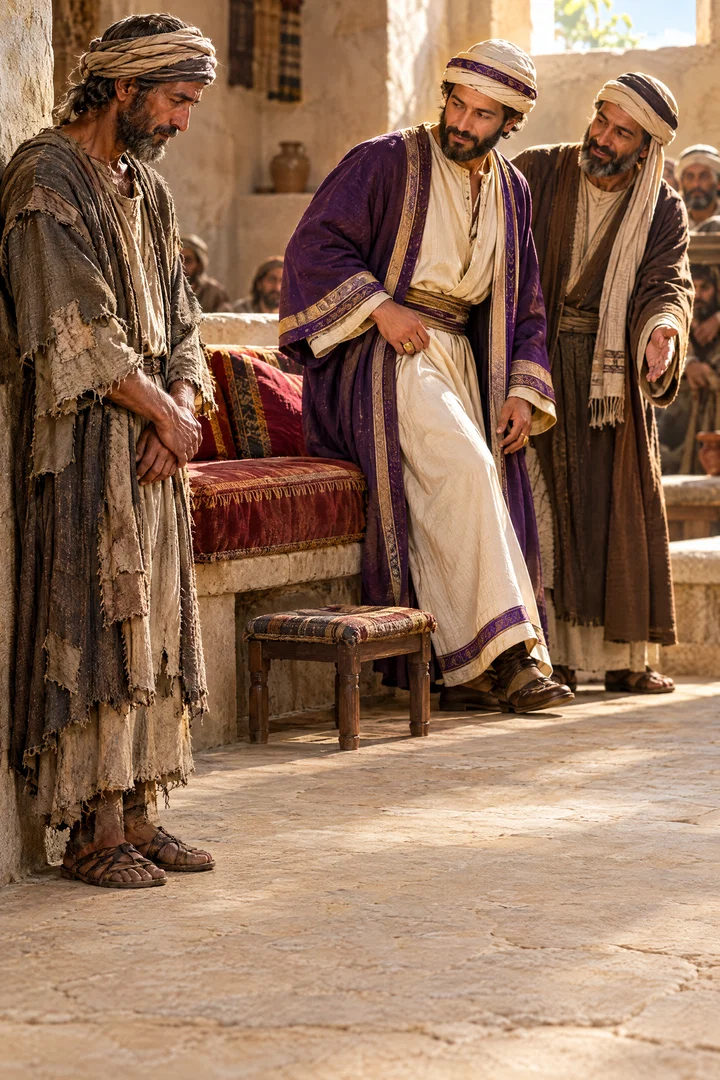
To be partial in yourselves and become judges with evil thoughts is to give the honored seat to the rich or well-dressed while telling the poor to stand aside or take an inferior place.4T 550.1–2CH 230.1–2Ms 111, 1893, par. 2–4 God makes no such distinction of rank, wealth, talent, or education, but values people simply as people and judges by character, purity, and love for Christ.Ms 111, 1893, par. 2–4GW 332.1–2RH Jul 21, 1910SW 2.1Ms 129, 1902, par. 1 In Christ all are alike objects of divine love, bought by the same sacrifice, prepared for the same heaven, with the same Father and Redeemer, so earthly distinctions lose their force.GW92 313.1STMW6 28.2Ms 73, 1903, par. 18–20 The verse therefore forbids favoring the rich, the learned, the well-dressed, friends, or one race or color over another in worship, care, and daily work, and requires treating the poor and despised with the same interest, welcome, and tender consideration as the wealthy.CH 231.2Ms 53, 1899, par. 13–144T 551.1STA 159.2STBk 163.2
Nature of Partial Judgment
To be partial in oneself and to become a judge guided by evil thoughts is to give the rich or well-dressed person a good, honored seat while telling the poor person to stand aside or sit in an inferior place, even under a footstool.4T 550.1–2CH 230.1–2Ms 111, 1893, par. 2–4 Wealth and fine clothing or outward appearance must not determine a person's welcome or regard, for the poor person set aside may have greater moral worth before God.4T 550.1–2CH 230.1–2CTBH 85.4 In Christian institutions this means every hand employed is to be treated as purchased by Christ's blood under the command to love one's neighbor as oneself, without forming a confederacy to bestow favors on a select number who are no more highly regarded by God than those neglected, set aside, and assigned to hard places with grieved and wounded spirits.Ms 111, 1893, par. 2–4 God has chosen the poor of this world to be rich in faith and heirs of the kingdom promised to those who love Him, so despising the poor is the evil judged here, and the temptations that come to those unjustly treated will be charged to those who dealt partially with them; the cross teaches that human worth is not measured by wealth, since God gives His blessings and mercies to rich and poor alike.Ms 111, 1893, par. 2–4STMW6 28.2
The same partial, evil-thought judging includes favoring people for wealth, rank, learning, social standing, outward appearance, clothing, and for being relatives or friends.GW 332.1–2GW92 313.1 It includes a proud, exclusive spirit that favors only a few, in contrast with pure religion which makes God's children one family in Christ and welcomes suffering people of every class.CH 272.2 It includes treating one person kindly while treating another harshly, with caste feeling and unkind judgment that leads to self-exaltation, whereas faith in Jesus does not make people unkind in thought or feeling toward those for whom Christ died.GW 333.37T 265.6GW 496.5 A person's worth does not depend on rank, wealth, learning, or social standing but on oneness with Christ, in whom all are alike objects of divine love purchased by the same sacrifice so that earthly distinctions lose their force; therefore to refuse the companionship of a humble believer for lacking worldly honor brings divine rebuke.GW 332.1–2GW92 313.1
Making distinctions by color of skin, caste, or nationality is forbidden partiality and proud, haughty judging with evil thoughts.Ms 73, 1903, par. 18–20Lt 304, 1903, par. 9–11Ms 7, 1896, par. 4–5 Examples are seating those of lighter skin in front and those of darker skin behind in worship, drawing a curtain between white and colored believers, separating people by race or nationality, assigning them different places, or turning away from anyone who loves God or for whom Christ died.4MR 16.1–3Ms 73, 1903, par. 18–20 Color of skin is no measure of the value of a soul, for God estimates people simply as people and character, purity of heart, and integrity decide worth with Him.9T 223.1Ms 129, 1902, par. 14MR 16.1–3Lt 304, 1903, par. 9–11 Such partiality grieves the Spirit of God and the heart of Christ and refuses souls for whom Christ died, since all have the same heavenly Father and the same Redeemer who gave Himself for all without distinction, all have been quarried out of the world by truth to be prepared for the same heaven and temple, and with God there is no caste or nationality and no divisions or parties.Ms 73, 1903, par. 18–20
The religion of the Bible recognizes no caste or color and ignores rank, wealth, and worldly honor, requiring believers to recognize the Spirit of Christ in whomever it is revealed, whether white or black, with no shame in speaking with an honest black person in any place or in shaking even a black person's hand, and to honor and help those they are tempted to despise.Ms 129, 1902, par. 1Lt 304, 1903, par. 9–11 It requires leaving the world's standpoint, customs, and practices of racial prejudice and acting from the Bible standpoint in the light of God's countenance, treating white and black as free and equal in one brotherhood in Christ, using influence against prejudice where it is most needed, elevating character, and holding to equality whatever the gain or loss.9T 223.1Ms 7, 1896, par. 4–5 Partiality springs from selfish preferences and corrupt motives, while a heart purified through obedience to truth shows no partiality.HPMMW 43.1 This applies to health institutions, where sentimental attachment must not be allowed to corrupt the work.HPMMW 43.1
God's Impartial Valuation
God recognizes no distinction of rank or caste, and wealth, position, possessions, real estate, bank stock, talent, learning, education, worldly honor, or outward appearance add nothing to a person's value before Him.RH Jul 21, 1910SW 2.1Ms 129, 1902, par. 1Ms 92, 1893, par. 5 A rich man is worth not one jot or tittle more to Him for his riches, position, talent, or education, and these weigh nothing in His scale unless laid as tribute at His feet with the whole being surrendered to cooperate with divine agencies to become a vessel unto honor.Ms 92, 1893, par. 5 He estimates men simply as men, and character decides worth with Him.Ms 129, 1902, par. 1 With Him a person's worth and the final judgment do not depend on outward honor, rank, wealth, learning, or social standing, but on purity, integrity, nobility of character, contriteness of heart, oneness with Christ, and love for Christ.GW 332.1–2RH Jul 21, 19109T 223.1Ms 53, 1899, par. 13–14 By that standard He has chosen the poor of this world to be rich in faith and heirs of the kingdom and of the immortal inheritance promised to those who love Him.Ms 111, 1893, par. 2–4 Refusing the companionship of a humble believer for lack of worldly honor therefore brings divine rebuke.GW 332.1–2
In Christ all people are alike objects of divine love, purchased by the same sacrifice and taught by the cross that human worth is not measured by wealth.GW92 313.1STMW6 28.2 All have the same heavenly Father and the same Redeemer who gave Himself for all without distinction, all have been quarried out of the world by truth and brought into His worship to be prepared for the same heaven and His temple, so earthly distinctions lose their force and pure religion brings people together in oneness.GW92 313.1Ms 73, 1903, par. 18–20 He gives His blessings and mercies to rich and poor alike, and color of skin is no measure of the value of a soul, for with Him there is no caste or nationality and no divisions or parties.STMW6 28.2Ms 73, 1903, par. 18–20 Jesus corrected the world's false standard of judging by outward appearance, wealth, or position by His own life.SW 2.1 He sought no admiration or applause of the world, commanded no army, ruled no earthly kingdom, passed by the wealthy and honored of the world, did not associate with the leaders of the nation, and dwelt among the lowly of the earth as a humble man with few friends.SW 2.1
Honoring the rich while slighting, despising, or neglecting the poor and needy followers of Christ is partiality that is displeasing to God and a crime in His sight.CH 231.24T 551.1 Those worn by one long struggle with poverty have but little in this life to make them happy or cheerful, and therefore especially feel the need of sympathy and tender consideration and will appreciate sympathy and love, while those surrounded with all the comforts of life and petted and pampered by the world because they are rich do not feel that need in the same way.CH 231.24T 551.1 To neglect the poor is to neglect Christ in the person of His saints and to slight Christ in the person of poor believers.CH 231.2Ms 53, 1899, par. 13–144T 551.1 For such favoritism toward the wealthy and socially important, which makes men partial judges, God’s displeasure rests upon them and they will themselves be judged.Ms 53, 1899, par. 13–144T 551.1
Impartial Life and Witness
The verse requires giving the poor as much interest, attention, and care as the rich, with no neglect, oppression, or slighting of the poor in deference to the wealthy.CH 231.24T 551.1Ms 30, 1891, par. 3 Those worn by a long struggle with poverty feel the need of sympathy and tender consideration more deeply than those surrounded with comforts and pampered because they are rich, and they will appreciate sympathy and love.CH 231.24T 551.1 For physicians, helpers, and medical institutions this forbids giving the rich better attention than the poor, forbids neglecting the poor in any case, and forbids letting sentimental attachment corrupt the work, since partiality springs from selfish preferences and corrupt motives while a heart purified by obedience to truth shows none.CH 231.2Ms 53, 1899, par. 13–14HPMMW 43.1 To neglect the poor in this way is to neglect Christ in the person of His saints and to slight Christ in His needy followers, which is displeasing to God and a crime in His sight.CH 231.2Ms 53, 1899, par. 13–144T 551.1
In gathering for worship no distinction of caste, nationality, or color is to be made, such as seating lighter-skinned people in front and darker-skinned people behind or drawing a curtain between believers.STA 159.2STBk 163.2Ms 73, 1903, par. 18–20 Black believers are Christ's property as much as white believers and Christ died for them, so they are to be received on principle, welcomed into the same worship and into full church membership alongside white believers, helped and comforted when in need, with every effort made to wipe out and correct the wrong done to them.STA 159.2STBk 163.2Ms 73, 1903, par. 18–204MR 100.2 Failure to work for their salvation brings guilt and sin upon the church.STA 159.24MR 100.2 The equality required does not teach throwing down every partition wall or intermarriage, and carrying equality to that extreme is fanaticism.STA 159.2STBk 163.2
Racial impartiality requires leaving the world's standpoint, customs, and practices of prejudice and acting from the Bible standpoint in the light of God's countenance.Ms 129, 1902, par. 1Ms 7, 1896, par. 4–5 It means recognizing the Spirit of Christ in whomever it is revealed without shame, speaking with an honest Black man in any place and shaking even a Black person's hand, and honoring and helping those who are tempted to be despised, since God values purity of heart and not complexion.Ms 129, 1902, par. 1Lt 304, 1903, par. 9–11 White and Black are free and equal in one brotherhood in Christ, so the colored man is to be treated just as respectfully as the white man.Ms 129, 1902, par. 1Ms 7, 1896, par. 4–5 Those who have received many favors from God must use Christian effort and influence against prejudice where it is most needed, elevating character and teaching how Christians should live by exemplifying Christ's spirit nobly and courageously without cowardice, holding to equality whatever the gain or loss and winning others by precept and example.Ms 7, 1896, par. 4–5
In positions of responsibility and in Christian institutions every worker is to be treated as purchased by Christ's blood under the command to love one's neighbor, with no confederacy to bestow favors on a select few who are no more highly regarded by God than those neglected.Ms 111, 1893, par. 2–43T 23.2 There is to be no favoring of a few while neglecting faithful and capable workers, and no special attention to forward persons while passing by worthy sufferers in need.Ms 111, 1893, par. 2–43T 23.2Lt 6a, 1890, par. 71–73 Acting as critics who league together to discourage and tear down brethren's God-appointed work, and withholding and turning aside means that should go to hard fields such as Nashville and the South, is robbery in God's sight that will be judged.Lt 185, 1902, par. 19–21 Such partiality harms those under its influence, displeases God, and makes a person unfit for responsibility, so the guilty must look into the divine mirror and reform without delay, since the temptations that come to those unjustly treated will be charged to those who dealt partially with them.Ms 111, 1893, par. 2–4Lt 185, 1902, par. 19–213T 23.2
The verse is practical instruction in righteousness for daily life and character building and part of God's great remedy and health prescription for body and soul.Lt 26, 1907, par. 7–8 Heeded day by day with grace in large measure, it brings prosperity, brings heaven very near, makes the workplace a place where angels delight to come, brings happiness of spirit, gives sight of God's salvation, gives an experience that is a tower of strength, and leads to triumph at last.Lt 26, 1907, par. 7–8 It belongs to true, pure religion that puts away the proud, exclusive spirit favoring only a few and all that hinders unity, makes every wrong right between brethren, leaves no sins unconfessed, and makes God's children one family welcoming sufferers of every class.Lt 204, 1902, par. 1–2CH 272.2
The verse forbids respect of persons and self-aggrandizement and requires a self-sacrificing life distinct from a selfish world that loves earthly things and acts regardless of Christ's principles.STA 163.1SW 17.1 It requires manifesting Christ's self-sacrificing spirit heartily and not by halves in every branch of work, relinquishing luxury, self-indulgence, selfish delights, unholy passions, and love of applause, being willing to be humble and unknown and even to sacrifice life, and by a well-ordered life condemning worldly folly and iniquity.STA 163.1SW 17.1 It condemns slavery, the caste system, unjust racial prejudice, oppression of the poor, and neglect of the unfortunate as evils menacing human well-being that the church is appointed to overthrow, and Christians cannot by practice sanction any oppression or injustice to the least child of humanity.STA 163.1SW 17.1LSEGW 473.3
Sources
Pioneers and periodicals
91 sources
Showing favor to one person over another makes a person divided within and turns judging into thinking that is evil, self-serving and unfair.ST Dec 12, 1911ST Oct 2, 1879ST Jun 28, 1877RH Jul 14, 1868 Its setting is giving honor in the gathering to the one with gold and fine clothing with a good seat while telling the poor in worn and vile clothing to stand aside, sit under a footstool, or take a back corner.ST Jun 28, 1877RH Dec 17, 1901RH Jan 1, 1875 Such respect of persons breaks the royal law, which is the Ten Commandments summed up in the command already given in Leviticus 19:18 to love one's neighbor as oneself, and leaves the offender convicted as a transgressor.ST Jun 28, 1877RH Dec 17, 1901RH Jul 1, 1862RH Jul 1, 1862RH Jul 22, 1852 God is no respecter of persons, recognizing no distinction of rank, dress, station or title, but valuing every person as a soul and looking with compassion upon the poor.ST Oct 2, 1879ST Mar 4, 1889RH Dec 11, 1856 It therefore forbids giving the best and front pews to the rich and finely dressed while turning the poor away to back pews, distant corners or outside, and calls instead for equal courtesy and welcome to poor and rich alike.ST May 7, 1885RH Mar 14, 1854ST May 6, 1880RH Jun 23, 1859
Words and Context
Showing favor to one person over another makes those who do it divided within themselves and turns them into judges whose thoughts or judgments are evil.ST Dec 12, 1911ST Oct 2, 1879ST Jun 28, 1877RH Dec 17, 1901 Favoring the rich over the poor is that partiality, a hardness of heart that was once kind and warm but has grown hard and cold like flinty stone in selfish struggle after gold and refuses aid to a fellow creature made in God's image.ST Oct 2, 1879ST Jun 28, 1877RH Dec 17, 1901RH Jul 14, 1868 It includes oppressing and humbling the poor for a long time, grudging scanty hire, and crushing with violence and wrong.ST Oct 2, 1879 It violates the royal law, Thou shalt love thy neighbor as thyself, and having respect of persons is committing sin and being convicted by the law as transgressors.ST Jun 28, 1877RH Dec 17, 1901 Freely giving to the poor is lending to the blessed Lord, and when the Master calls hence a full reward will be given, a crown of life to those who treasure gold in heaven, while such partiality gives cause to fear lest the oppressed lift the tearful eye and cry to the God of vengeance who directs the starry hosts and looks in kind compassion upon His poor with tenderest love.ST Oct 2, 1879
Being judges of evil thoughts means judging guided by evil, self-serving and wrong motives rather than fair judgment.RH Jul 14, 1868RH Jul 1, 1862RH Sep 2, 1862RH Sep 2, 1862 It includes condemning people by assuming evil motives in them, when a wrong act does not prove evil intent because some are led into sin by deception.RH Apr 28, 1910 It includes treating people kindly only when their influence is valued while slighting those who can be safely mistreated, favoring because of outward appearance, wealth, status and rank while treating the poor as inferior.RH Jul 14, 1868RH Jul 1, 1862RH Sep 2, 1862RH Sep 2, 1862 Such respect for wealth and rank is sin even when treated as a small fault, and this love for neighbor summarizes the second table of the Ten Commandments rather than excluding it.RH Jul 1, 1862RH Sep 2, 1862
The setting is giving honor in the assembly to a man with a gold ring and fine clothing by giving him a good seat, while telling a poor man in vile, worn clothing to stand or sit under a footstool.ST Jun 28, 1877RH Dec 17, 1901RH Jan 1, 1875ST Sep 17, 1885ST Jun 4, 1885 That dishonor extends to leaving a poor-looking visitor standing outside and then isolating him in an inferior seat, in a corner, in a back pew, or outside.RH Jan 1, 1875ST Sep 17, 1885ST Jun 4, 1885RH Nov 18, 1873 It despises the poor whom God has chosen to be rich in faith and heirs of the kingdom promised to those who love Him, while rich men oppress believers and blaspheme the worthy name.ST Jun 28, 1877 Such aristocratic religion unwilling to associate with the poor and ignorant and to come down to their level and follow Jesus in the lanes of the lowly is carnal and an abomination in the sight of God, and he who is not willing to do so can never enter the kingdom.RH Nov 18, 1873 The poor should have room in the pews because the gospel is preached to them equally.ST Sep 17, 1885
The epistle belongs broadly to Jewish people, both believers and unbelievers, and is applicable to every age, and its forceful questions correct errors among Hebrew Christians.RH Oct 19, 1916 Its rebuke of honoring wealth while dishonoring poverty applies to later churches as well as to those of James's day, where it is a common sin, and Sabbath-keepers who are respecters of persons walk contrary to it.RH May 4, 1869RH Sep 2, 1862 Heartfelt belief that the third angel's message is now being given leaves no room for grasping after the world, so grasping after the world proves those professing present truth to be deceived and in need of reading James 2 more.RH Dec 9, 1852
Royal Law Doctrine
The royal law in James 2 is the Ten Commandments, which remain in force as God's constitution and not done away.RH Jul 1, 1862RH Feb 17, 1852RH Dec 1850 There is no new law beginning with Christ, for the royal command to love one's neighbor as oneself was already given in Leviticus 19:18.RH May 3, 1864RH Dec 30, 1873 That same law continues as the rule of good living for Jews and Gentiles, before faith and after faith.RH Jul 1, 1862RH Dec 30, 1873 In the first nine verses partiality and judging with evil thoughts stand condemned by that law.RH Jul 1, 1862
To love one's neighbor as oneself is the royal law and part of the two great commandments on which the law and the prophets hang.RH Jul 1, 1862RH Jul 22, 1852 It sums up the last six commandments and the second table of the Ten Commandments rather than excluding or replacing them.RH Jul 1, 1862RH Jul 22, 1852 The commandments remain binding and reach even the thoughts and motives of the heart.RH Jul 22, 1852 So favoring people for outward status makes a person partial and a judge guided by evil thoughts.RH Jul 1, 1862
The royal law is the law of liberty, not bondage.RH Feb 17, 1852ST Oct 25, 1877 It is a yoke of bondage only to the carnally minded, while the spiritual person delights in it.ST Oct 25, 1877 Only the handwriting of ordinances is abolished by Christ's more excellent ministry, with its appendages of the law and Levitical ministration.RH Feb 17, 1852RH Dec 30, 1873 Those abolished things include circumcision, the Levitical priesthood, and the shadow sabbaths, new moons and holy days nailed to the cross.RH Dec 30, 1873
Having respect of persons breaks the royal law of loving one's neighbor as oneself.ST Jun 28, 1877RH Dec 17, 1901RH Jul 14, 1868 Giving honor in the assembly to the man with gold ring and fine clothing while telling the poor man in vile clothing to stand or sit under a footstool is partiality and becoming judges with evil thoughts.ST Jun 28, 1877RH Dec 17, 1901 It despises the poor whom God has chosen to be rich in faith and heirs of the kingdom promised to those who love Him, while rich men oppress believers and blaspheme the worthy name.ST Jun 28, 1877 Such respect of persons, whether toward the wealthy and well dressed or toward one nation over another or toward color, is committing sin and leaves the offender convicted and condemned by the law as a transgressor.RH Dec 17, 1901RH Jul 14, 1868ST Jun 29, 1882 The faith of Jesus cannot be held together with conscious breaking of the commandments even in a single point, but is manifested in works which are the keeping of God's commandments.RH Nov 6, 1900
People are judged by God's royal law as the standard for decisions affecting eternal destiny.ST Sep 14, 1882 Choosing which known duties to obey makes a person a lawbreaker.RH Sep 2, 1862 Good conduct in other respects cannot cancel that sin, even when respect for wealth and rank is treated as a small fault.RH Sep 2, 1862 James rebukes Antinomianism, the making void of the law through faith.RH Feb 17, 1852 Faith must cause believers to fulfill the righteousness of the law, leaving no room for claiming faith while setting aside obedience.RH Feb 17, 1852RH Nov 6, 1900 Works do not affect the remission of past sins, but they shape character in the future course of obedience and salvation.ST Mar 29, 1883 That rebuke of setting aside the law is as solemn and strong as Paul's rebuke of Pharisee self-righteousness.RH Feb 17, 1852
Divine Impartiality and Justice
God shows no favoritism toward any person and recognizes no distinction of rank, caste, dress, station, or title, for He values human beings as souls and judges by purity, nobility, and love for Christ rather than by wealth or position.ST Oct 2, 1879RH Dec 11, 1856RH Dec 11, 1856 He looks upon the poor in kind compassion and with tenderest love, takes notice of them and of those who oppress them, and warns that those who harden a once kind and warm heart like flinty stone in selfish grasping after gold have reason to fear lest the oppressed lift the tearful eye and cry to the God of vengeance who directs the starry hosts.ST Oct 2, 1879ST Mar 4, 1889 In His house rich and poor are to be alike, esteemed according to spiritual worth rather than money, and making the poor dependent on the rich and conspicuous because of poverty only deepens a distinction God forbids.RH Dec 11, 1856ST Feb 4, 1889
Christ likewise is no respecter of persons but the friend of all without regard to rank or wealth, with deep compassion for those suffering poverty, despotic laws, and suffering virtue, in contrast to lordly and unjust men who raise up privileged classes to rule rigorously over the masses in selfishness and pride.ST Mar 4, 1889ST Nov 21, 1900 His fellowship with the poor and neglected and His ministry among the poor and humble stand against discrimination, worldly splendor, and injustice, so all His disciples must show meekness and equity and reach a helping hand to the downtrodden and oppressed.ST Mar 4, 1889ST Nov 21, 1900RH Mar 27, 1856 A church shaped by worldly splendor that favors the rich over the poor is therefore contrary to true Christianity, which serves and preaches to poor as well as rich.ST Mar 4, 1889RH Mar 27, 1856
The gospel principle is the equality of men as men, that every person stands on an equal footing before the law and in the court of heaven with equal rights that must be recognized.RH Dec 11, 1856ST Jan 15, 1902 It recognizes every person as of equal worth with the prospect of becoming a king and priest to God, and holds one law alike for rich and poor, great and small, with no partiality.RH Dec 11, 1856ST Jan 15, 1902ST Dec 23, 1903 It does not mean all are born with the same talents, powers of intellect, amount of inherited means, or bodily weight, and none object to this equality except those who wish to lord it over their neighbors.ST Jan 15, 1902ST Dec 23, 1903 People are to be judged by their own conduct and worth, not by social position or occupation, whether rich, poor, or members of a class.ST Dec 23, 1903ST Dec 23, 1903
A law, court, or government that grants favors or privileges to one class while withholding them from another out of regard for position does injustice, and the same condemnation falls on handicapping people because of religious faith and practice.ST Jan 15, 1902RH Sep 16, 1909 Honesty, decency, fair dealing, and common sense require one law for all in dealing with complex industrial problems affecting not merely accumulation but even more the wise distribution of wealth.ST Jan 15, 1902ST Dec 23, 1903 No permission is asked when obedience is required, neither of poor nor rich, and least of all can the man of great wealth afford to break the law even for financial advantage, for law is his prop and support and it is foolish and profoundly unpatriotic to fail in hearty support of those who enforce it.ST Dec 23, 1903
Enforcing law against the poor while sparing the rich is being partial and becoming judges of evil thoughts, acting as though law were made especially for restraint of the weak and poor.ST Dec 12, 1892ST Feb 20, 1893 This appears when wealthy employers, railways, great manufacturing establishments, and large printing offices go unmolested while a peanut vendor, newsboy, or Sabbath-keeping farmer who employs no one is eagerly prosecuted.ST Feb 20, 1893 It appears likewise when a Sunday law lets the rich travel while restricting the poor, for the religion of Jesus Christ places rich and poor on equal footing and such unequal restriction is unjust.ST Dec 12, 1892ST Feb 20, 1893
Favoritism Toward Rich
Favoring the rich and great over the poor and unlearned, and favoring people of one nation over those of another, is partiality that makes a person a judge with evil thoughts.ST Jun 28, 1877RH Dec 17, 1901RH Aug 19, 1851RH Jan 15, 1857 It is despising the poor whom God has chosen to be rich in faith and heirs of the kingdom promised to those who love Him, while rich men oppress believers and blaspheme the worthy name.ST Jun 28, 1877RH Dec 17, 1901 Such favoritism hardens a heart once kind and warm into coldness like flinty stone in selfish struggle after gold, refusing aid to a fellow creature made in God's image, oppressing and humbling the poor long, grudging scanty hire, and crushing with violence and wrong.ST Oct 2, 1879 It includes exacting every legally permitted amount of interest from poor brethren while giving costly gifts and banquets to the well-to-do.ST Sep 16, 1889 It includes thinking more of a wicked rich man than of a pious poor man, with pride and scornfulness, holding oneself above fellow men, shunning those less fortunate, and oppressing the poor.RH Aug 3, 1869ST Dec 12, 1878
Treating a poor worshiper with contempt while favoring the rich is evil judgment because outward wealth does not determine worth or final destiny.RH Mar 12, 1861RH Mar 26, 1872RH Nov 20, 1866 The poor man's clean but worn clothing and lonely seat stand in contrast to rich pride and disregard, and a poor worshiper may be neat and devoted while the rich are proud and dismissive.RH Mar 12, 1861RH Mar 26, 1872 Rich and poor alike face judgment, with the saved poor person contrasted against the formerly wealthy person who is lost.RH Mar 12, 1861RH Mar 26, 1872 This partiality also appears in churches that treat the poor as suspect and the rich as virtuous without evidence.RH Nov 20, 1866
Giving rich men high and influential position in the church simply because they have money and not because they are morally better is condemned partiality with evil motives.ST Mar 22, 1883RH Mar 17, 1874 Allowing wealth, or the desire for wealthy members, to give them power over the church must be warned against.ST Mar 22, 1883 Such conduct illustrates prevailing selfishness and the universal desire to get rich, showing professed church members to be no different from worldlings who make no profession, exerting themselves just as hard for worldly riches and scrupling no more about the means of obtaining wealth, with sharpness and overreaching in dealing exceedingly common among them.RH Mar 17, 1874
Preserving caste distinctions in church life is partiality that makes judgments shaped by evil thoughts.ST Jun 21, 1905 This includes keeping caste titles, segregated schools and burial places, and seating communicants at the Lord's table according to caste. It includes treating outcasts and pariahs with contempt, as in exclusion from wells and temples, which exemplifies unjust discrimination, while the spirit of Christianity instead works to elevate them.ST Jun 21, 1905
The condemnation reaches beyond wealth to judging by religion, color, birthplace, occupation, social condition, union membership, intelligence, clothing, or other outward advantages, for justice must be equal toward all.ST Dec 16, 1903STST Jan 27, 1904 Rejecting the poor but accepting the rich, or valuing people only when they are intelligent, or placing oneself above others and withholding equal regard from those considered inferior, is the same partiality.ST Judging a child as worthy or unworthy of attention because her clothes do not match the latest fashion is partiality and evil judgment based on outward appearance.ST Apr 14, 1887 To assume a girl in a lovely skirt and shirt-waist is stuck-up and treat her coldly, and to think plain dress makes one not good enough to visit her, are both evil judgments, since fine clothes do not show character and poor, soiled, wretched condition does not take away worth, and the true standard is to care nothing for fine clothes but just for people, giving self in loving service to the needy rather than only giving things that cost money.ST Jan 27, 1904
Church Exclusion Practices
The verse forbids giving the best, front, or cushioned pews to the rich and finely dressed while turning the poor and plainly dressed away to back pews, distant corners, under footstools, or outside.ST May 7, 1885RH Mar 14, 1854RH Feb 11, 1858ST Jan 13, 1881 Beckoning an officer to remove a poor old woman from the pew of the rich, treating her as unwelcome and unable to understand, and spreading fine clothes over the space she leaves is becoming judges of evil thoughts. Placing poor worshipers in corners or at others' feet, relegating the impoverished and uncultured to a distant corner or mission chapel, and leaving the poor outside while the rich receive honored seats inside show partiality and evil judgment measured by worldly status rather than treating people without such distinctions.ST May 7, 1885RH Mar 14, 1854RH Feb 11, 1858ST Jan 13, 1881 Giving honor, best seats, recognition, greeting and welcome to broadcloth while informing the poor indirectly that they are not wanted and their presence is distasteful, reproving those who seat the poor with the rich, and receiving common visitors with coldness and looks of displeasure institute caste within the church.ST May 7, 1885RH Feb 11, 1858 The opposite belongs to the verse, as when a richly dressed woman shares her hymnbook with a poor, poorly dressed person and the kindness adds to the beauty of the act rather than diminishing it.RH Jun 23, 1859
Renting, reserving, or auctioning pews violates the verse by assigning seats through a pew auction and judging worshipers by wealth and appearance.ST Jun 4, 1885ST May 6, 1880ST May 6, 1880 It gives rich and well-to-do people assurance of good company with a premium to attend, while making attendance impossible for the laboring classes, as impossible as renting boxes at the theater.ST Mar 4, 1889ST Dec 17, 1885 The claim that the poor would be welcome is false, since pewholders crowded out of their rented pews would not long extend welcome to newcomers.ST Dec 17, 1885 Refusing an old, poor stranger a seat while pews are reserved for those who paid for them, leaving him standing without a friendly voice, deference, or open door, violates gospel truth and keeps Christ out, and welcoming him only after he makes his own seat exposes the shame of that treatment.ST May 6, 1880ST May 6, 1880 Favoring people because they can pay for church seats makes the congregation partial and its members judges with evil thoughts, condemning the exclusion of the poor from worship while granting access to those with money.ST Jun 4, 1885ST Mar 4, 1889
Costly arrangements repel the poor even when they are politely welcomed, because they suggest that access to Christian fellowship is suited to the wealthy.RH Jun 25, 1867 The house of worship must not be expensively furnished far above the rag-carpet homes of common people, and must not have the character of a dress parade where ermine and silk put calico to shame, but dress and surroundings must be leveled so the poor man and woman feel no embarrassing contrast and can be reached.ST Dec 17, 1885 Giving the rich and great cushioned pews inside to sit in pomp and pride while the poor in shabby suits sit meekly outside turns the house built for prayer into a costly beautiful house gleaming in purple and gold where fairs and shows are held and laughter and music and feasts are heard with the world and his children present.RH Feb 6, 1913 Turning churches into exclusive clubs with expensive privileges, superb buildings, costly choirs, high-paid preachers, and learned, pretentious oratory attracts cultivated people and people of means who can pay for pulpit eloquence, while the ignorant and uncultivated and the vicious and degraded are left indifferent and unreached.ST Oct 8, 1885 Stately orations never drew and held the lower classes, and the poor know such a system must have money for its support and feel they must wear the insignia of wealth or at least competency to bear their share of the cost in order to be thoroughly welcome, so their instinctive shrinking from splendid church edifices is natural and by no means ignoble, and the gulf between a poor laborer and an affluent minister with the poor man's sense that he is unwelcome in a fashionable church shows how social distance and costly surroundings put partiality into practice.ST Oct 8, 1885ST Oct 8, 1885
Coldness toward the poor keeps tens of thousands from entering the sanctuary on the Sabbath and leaves congregations thin with genuine conversion almost unknown, while genuine Christian warmth and hearty welcome to all would bring marvelous change.ST May 7, 1885 Such lily-fingered, cold, heartless church pride and selfishness smiles and speaks to well-dressed members while brushing past a poor, friendless stranger all winter, leaving him unseen and unwelcomed and leaving his care to someone else as none of one's own business.ST May 7, 1885ST Dec 11, 1884 Receiving common visitors with coldness and displeasure, informing the impoverished indirectly that they are not wanted, reproving those who seat the poor with the rich, making the poor feel that they do not belong, freezing poor people out or treating them condescendingly, and treating strangers rudely because they occupy a fashionable member's pew oppose Jesus' teaching and turn the church into a social club rather than a Christian community.ST May 7, 1885ST May 27, 1889ST Jul 15, 1886ST Sep 6, 1883 Failure to personally notice, welcome, invite, and befriend the stranger as neighbor leaves him to bad company and the downward road, and spending on costly buildings while poor and needy laboring people close at hand are not welcomed and cared for reflects religion without the compassion of Christ, who loved both poor and rich.ST Dec 11, 1884RH Mar 12, 1914
True honor and worship give equal courtesy, lowliness, and worth to poor and rich alike, look past dress and wealth, make room in front for the lowly, and freely offer seat, book, and hand to welcome Christ, because in heaven there is room for all.ST May 6, 1880 Sharing a hymnbook across distinctions of dress adds beauty to worship rather than diminishing it, and meeting the poor on something near an equality in dress rather than wearing costly or showy clothing that puts them to shame or drives them away belongs to impartiality.RH Jun 23, 1859ST Feb 13, 1879 The rebuke of the verse brings shame that leads to repentance and open welcome.ST May 6, 1880 Aristocratic religion unwilling to associate with the poor and ignorant, come down on a level with them, and follow Jesus in the lanes of the lowly is carnal and an abomination in the sight of God.RH Nov 18, 1873RH Mar 27, 1856 Whoever will not do so can never enter the kingdom, for the gospel is preached to the poor equally and the poor should have room in the pews, and the church should not court the rich while neglecting the poor but should serve and preach to the poor as well as the rich and welcome poor and rich alike in God's house.ST Sep 17, 1885RH Nov 18, 1873ST Aug 27, 1894RH Mar 27, 1856ST Sep 9, 1889
Impartial Conduct Required
A wrong act does not by itself prove evil intent, for some are led into sin by deception and need wise and compassionate correction rather than harsh accusation.RH Apr 28, 1910 Human beings cannot reliably judge another person's degree of guilt, because motives may make conduct more or less blameworthy than it appears, and only God can read motives and judge the sinner.RH Apr 28, 1910 Sin must not be excused and the standard must not be lowered, yet judgments of others should be generous and clothed with love and patience toward sinners, not fixed by outward details such as clothing or other minor matters of experience.RH Apr 28, 1910RH Jul 6, 1911
Impartiality does not mean treating good and evil as equal; it means valuing people according to true character rather than wealth, popularity, numbers, age, size, reputation, or religious profession.RH Jul 8, 1858RH Jul 8, 1858 Popularity, age, size, or reputation must not determine how a religious group is treated, and prejudice must neither be created nor favored, but truth sought wherever it is found with courteous dealing toward all groups.RH Jul 8, 1858 People are to be judged by their own conduct and worth, not by social position or occupation, whether rich or poor or members of a class, and fellow believers are to be judged by conduct and worth rather than social standing, clothing, or minor details of experience.RH Jul 6, 1911ST Dec 23, 1903
Impartial discernment belongs in daily life by reproving equals justly without being swayed by social influence and by treating friends, hosts, benefactors, and allies as fairly as opponents.RH Nov 20, 1860 High and low are to be treated with the same gentle manner, and insincere conduct such as speaking behind a person's back what would not be said openly is to be rejected.RH Aug 13, 1908 The person beneath clothes and rank is to be seen instead of treating as inferior one who is unlike oneself, for judging by outward conditions such as clothes or social rank is condemned.RH Sep 21, 1911
Treating Christ's needy followers with partiality and evil judging breaks true discipleship, slights Jesus, and is displeasing to God.RH Sep 12, 1871 True discipleship is tested by entering the Teacher's spirit of love and sympathy in benevolent, unselfish labor, breaking through selfishness that goes no farther than self.RH Sep 12, 1871 It visits the widow and orphan and keeps unspotted from the world, making the convert cheerful, hopeful, charitable, meek and humble, and kind to all, rather than proud and scornful, holding self above others, shunning the less fortunate, and oppressing the poor.RH Aug 3, 1869 It will not sit in ease and luxury while a brother cries for help, wrap itself in pride, shrink from the lowly and unfortunate, or frown upon the poor child of error.RH Sep 12, 1871
Freely giving to the poor is lending to the blessed Lord, bringing full reward when the Master calls, even a crown of life to those who treasure gold in heaven.ST Oct 2, 1879 Such partiality hardens a once kind and warm heart like flinty stone in selfish struggle after gold, refusing aid to a fellow creature made in God's image, oppressing and humbling the poor, grudging scanty hire, and crushing with violence and wrong.ST Oct 2, 1879 There is cause to fear lest the oppressed lift the tearful eye and cry to the God of vengeance who directs the starry hosts and who looks in kind compassion and tenderest love upon His poor.ST Oct 2, 1879 Wealth cannot shield anyone from hunger, sorrow, or distress, as shown when earthquake brings rich and poor together into the same bread line.ST Jun 27, 1906
Scripture with the Holy Spirit's influence exposes and removes caste and sectarian attitudes and teaches hatred of oppression.ST Feb 17, 1881 Humility joined with love must shape how people treat one another, favoring none from evil thoughts.ST Mar 12, 1894 Fine clothes do not show character and poor, soiled, wretched condition does not take away worth, so to treat a girl coldly as stuck-up because of a lovely skirt and shirt-waist, or to count plain dress as making one not good enough to visit, are both evil judgments.ST Jan 27, 1904 The true standard cares nothing for fine clothes but cares for people, giving self in loving service to the needy rather than only giving things that cost money, treating the poor with the same kindness and respect as the well-dressed and prosperous and helping the suffering without looking down.ST Jan 27, 1904ST Jul 8, 1880ST Dec 8, 1881
The warning reaches classifying Sunday-school members by social status, for respect of persons is not Christian and cannot succeed in really Christian work in any country.ST Nov 7, 1900 It condemns judging a child worthy or unworthy of attention because clothes do not match the latest fashion, treating with contempt on the basis of outward appearance.ST Apr 14, 1887 Treating John as less worthy of attention and kindness than his siblings shows how favoritism can slight a child through partiality and its accompanying evil judgments.ST Mar 8, 1883
Sources