Jeremiah 18:2
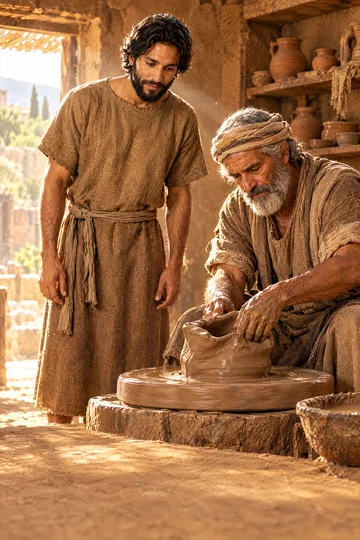
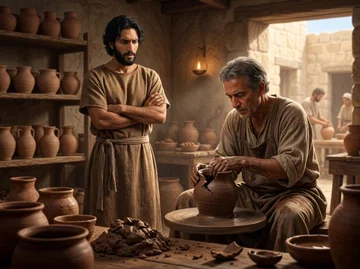
Arise, and go down to the potter’s house, and there I will cause thee to hear my words.
Translations
Arise, and go down to the potter’s house, and there I will cause you to hear my words.
King James Version, KJV Cambridge Paragraph Bible, Revised Version, American Standard Version
Arise, and go down to the potter’s house, and there I will cause thee to hear my words.
Arise, and go down to the potter's house, and there I will cause thee to hear my words.
Rise, and thou hast gone down [to] the potter's house, and there I cause thee to hear My words;
Arise and go down to the potter's house, and there I will cause thee to hear my words.
Arise and go down to the house of the potter,—and, there, will I cause thee to hear my words.
“ Go down at once to the potter’s house, and there I will reveal My message to you.”
“ Go down at once to the potter’s house, and there I will give you My message.”
“ Arise, and go down to the potter’s house, and there I will cause you to hear my words.”
Up! go down to the potter's house, and there I will let my words come to your ears.
Arise, and go downe into the potters house, and there shall I shewe thee my words.
Douay-Rheims (Challoner revision)
Arise, and go down to the potter’s house, and there thou shalt hear my words.
Pictures

Cross-references
- Romans 9:20-21
Nay but, O man, who art thou that repliest against God? Shall the thing formed say to him that formed it, Why hast thou made me thus?
The potter’s authority over clay illustrates God’s authority over people.
- Isaiah 64:8
But now, O LORD, thou art our father; we are the clay, and thou our potter; and we all are the work of thy hand.
God forms His people as a potter forms clay.
- Jeremiah 18:7-10
At what instant I shall speak concerning a nation, and concerning a kingdom, to pluck up, and to pull down, and to destroy it;
A nation’s response to God’s word determines whether it is built up or judged.
- Isaiah 29:16
Surely your turning of things upside down shall be esteemed as the potter’s clay: for shall the work say of him that made it, He made me not? or shall the thing framed say of him that framed it, He had no understanding?
The potter and clay image shows God’s authority over his creatures.
- Jeremiah 19:10-11
Then shalt thou break the bottle in the sight of the men that go with thee,
The broken vessel signifies the ruin awaiting persistent disobedience.
- Isaiah 45:9
Woe unto him that striveth with his Maker! Let the potsherd strive with the potsherds of the earth. Shall the clay say to him that fashioneth it, What makest thou? or thy work, He hath no hands?
The Creator has authority over what he has made, as the potter over the clay.
- Jeremiah 19:11
And shalt say unto them, Thus saith the LORD of hosts; Even so will I break this people and this city, as one breaketh a potter’s vessel, that cannot be made whole again: and they shall bury them in Tophet, till there be no place to bury.
The broken potter’s vessel signifies the fate of a hardened people.
- 2 Timothy 2:20-21
But in a great house there are not only vessels of gold and of silver, but also of wood and of earth; and some to honour, and some to dishonour.
Both describe vessels and the different outcomes people choose.
- Romans 9:23
And that he might make known the riches of his glory on the vessels of mercy, which he had afore prepared unto glory,
God remakes marred vessels for glory.
- Isaiah 61:3
To appoint unto them that mourn in Zion, to give unto them beauty for ashes, the oil of joy for mourning, the garment of praise for the spirit of heaviness; that they might be called trees of righteousness, the planting of the LORD, that he might be glorified.
Both describe God shaping his people.
Commentary
Each commentary is drawn from primary sources: the writings of Ellen G. White and Adventist pioneers and periodicals. Each commentary is separate. Its own words are not a quotation; follow the references to read the source passages.
Ellen G. White
9 sources
Arise and go down to the potter's house is a divine command to Jeremiah to go to a specific place where God will cause him to hear His words through the potter's work with clay.Ms 92, 1891, par. 12–15Lt 34, 1899, par. 11–128T 186.1–2Lt 215, 1899, par. 22–2614MR 33.2 Like clay in the potter's hand, Israel and the nations are subject to God's dealings and judgment, and His warnings call them to turn from evil.Ms 92, 1891, par. 12–15Lt 34, 1899, par. 11–12 What happens to a nation is conditional on its course, for turning from evil and repenting can avert threatened judgment, while doing evil can forfeit promised good and withhold promised blessing.Ms 92, 1891, par. 12–15Lt 34, 1899, par. 11–12 A nation's standing with God is not fixed by its ancestors' sins or virtues, but its own choice to turn to God or persist in evil determines its relation to Him.Ms 92, 1891, par. 12–15 Those who follow God in righteousness receive blessing, while those who persist in their own ways prove unfaithful and cannot be blessed.Lt 34, 1899, par. 11–12
God is the great Potter and Master-worker, and people and His workers are the clay whom He molds and fashions for His purposes and use.8T 186.1–2Lt 215, 1899, par. 22–26ST Dec 11, 190114MR 33.2Lt 48, 1888, par. 16–18 He seeks to mold them according to His likeness, to reflect His character and reveal His perfection and glory, until the glory of the Potter appears in a shapely vessel molded and polished for service.ST Dec 11, 1901Lt 48, 1888, par. 16–18Lt 78, 1901, par. 5–8 The shaping involves turning the clay again and again until the Potter's will is wrought out, with kneading, reshaping, waiting, trimming, polishing, pressure, and preparation, and by grace and truth fashioning the human clay until it becomes a shapely vessel fit for use and service.Lt 215, 1899, par. 22–2614MR 33.2Lt 48, 1888, par. 16–18
The verse calls for submission, giving heed to divine instruction and surrendering self to the divine will, yielding as pliable clay to God's shaping.8T 186.1–2Lt 215, 1899, par. 22–26ST Dec 11, 190114MR 33.2Lt 48, 1888, par. 16–18 It forbids trying to direct the work, do the Potter's work, or shape oneself, requiring instead readiness to receive divine impressions.8T 186.1–2Lt 215, 1899, par. 22–2614MR 33.2Lt 48, 1888, par. 16–18Lt 78, 1901, par. 5–8 Being clay means yielding daily, hourly, and momentarily, being emptied of pride and self-sufficiency to make room for Jesus, accepting advice and counsel and control instead of following one's own mind and judgment, submitting the will to Christ, and living in constant connection with Him under the government of the Spirit of truth.Lt 48, 1888, par. 16–18 When people surrender self and follow divine instruction, God forms them into shapely vessels revealing the perfection He desires every human being to reveal, but refusing to be molded and cherishing defects and tendencies to wrong instead of remedying them mars the character and brings deformity into its growth.ST Dec 11, 1901Lt 78, 1901, par. 5–8
For a faulty worker the verse means God wants to save him by molding him as clay is molded in the potter's hands.Lt 84, 1886, par. 26–29 Every word of reproof showing his unfinished and imperfect work and the wrong mold he has placed upon it is true.Lt 84, 1886, par. 26–29 Such a worker must see his imperfections and put them away, let God take away his defects, and get rid of the peculiarities he has fastened upon the work.Lt 84, 1886, par. 26–29 He must not throw off responsibility and balk in the harness, which would make him a ruined man, but if he yields and lets God remove what is wrong he will become a more useful worker than before and will triumph with the success of the truth.Lt 84, 1886, par. 26–29
Sources
Pioneers and periodicals
21 sources
God sent Jeremiah down to the potter's workshop to receive His message by watching the potter shape clay on the wheel as a picture of His own shaping of people.ST Oct 30, 1879ST Aug 18, 1909ST Aug 18, 1909 The lesson there is that His warnings and promises to nations are conditional, so that He will turn from threatened punishment if the guilty repent and will turn from promised good if the favored rebel.ST Oct 30, 1879ST Mar 13, 1879ST Aug 18, 1909 As Potter and Maker He has full authority over the vessels of His creation and redemption to preserve or destroy according to their fitness, and He fixes the destinies of nations and individuals not arbitrarily but according to their obedience or disobedience to His moral law.ST Jan 17, 1906ST Jan 31, 1906ST Mar 3, 1914ST Mar 3, 1914 People as clay are therefore to yield to His molding rather than attempt His work themselves, surrendering self to be fashioned by His wisdom into His image even through breaking and polishing strokes, since refusal mars the character into deformity.ST Dec 8, 1914ST Dec 11, 1901ST Oct 15, 1902 So Israel as clay in His hand was marred by refusing His guidance, yet He can reshape even a marred people if they submit, making repentance able to avert threatened judgment.ST Aug 18, 1909ST Aug 18, 1909
Setting and Message
Arise and go down to the potter's house is a command sending Jeremiah to receive God's message there, where God would cause him to hear divine words through what he saw.ST Oct 30, 1879ST Aug 18, 1909ST Aug 18, 1909 There the prophet watched the potter shaping clay on the wheel, and that work became the image of God shaping people, forming a person according to wisdom and gracious purpose for divine use.ST Dec 8, 1914ST Aug 18, 1909ST Oct 15, 1902 Like clay in the potter's hands, people cannot remove their own roughness or attain what God's hands can form, and the setting introduces the lesson in Jeremiah 18:1-10.ST Oct 30, 1879ST Oct 15, 1902 There also Jeremiah foretold coming judgments against Israel and Judah.RH Oct 24, 1854
The command stands within warnings to the Jews in a book marked by symbolic signs and figures of speech.RH Jul 27, 1916 Its prophecies are very clear in awful denunciations against sin, in sorrow of heart over transgression, and in touching appeals to return to God that meet utter lack of response from the mass of the people.ST Oct 20, 1909 It belongs to the morning reading for October 29 with Jeremiah 19, paired with 2 Timothy 3 in the evening, within readings of Jeremiah 3 through 21 and 1 Timothy 4 through 2 Timothy 4.ST Oct 20, 1909
That delivery of God's message was faithful even when it brought opposition and suffering, as part of Jeremiah's calling.RH Oct 24, 1854 The going down to the potter's house to hear God's words introduces the parable of the marred vessel as a message of warning and hope calling Israel to heed and obey.ST Aug 18, 1909 Israel would not hear that word but was utterly disobedient and unreasonable.ST Aug 18, 1909 Because the chosen people failed to heed it, God sent another parable out of the potter's house that logically follows the first, reciting the fate of the marred vessel once hardened into its distorted shape.ST Aug 18, 1909 The same going down introduces the metaphor of the marred vessel reformed, a prophetic metaphor whose significance is generally unnoticed.ST Feb 13, 1901
The direction to go to the potter's house is where God would teach through the lesson of the potter.ST Sep 27, 1910 That experience of learning from the lesson is a reason to study God's Word continually.ST Sep 27, 1910
God's Rule and Response
The command to go down to the potter's house illustrates the rule that governs God's prophecies to nations and kingdoms, a rule that applies equally to Ezekiel because Jeremiah was contemporary with Ezekiel and the same Spirit spoke through both.ST Oct 1, 1896 Some prophecies are conditional and will not be fulfilled if their stated conditions are not met.ST Oct 30, 1879 When His purpose toward a people depends on a condition, God may turn from the good He intended if they turn away from Him and do evil, and this is His uniform course of action and not the failure of an unconditional word.ST Mar 13, 1879 His judgments and promises are not fixed regardless of human choice, for a threatened nation that turns from evil will be spared and a favored nation that turns from good will face judgment, which shows that people are not foreordained to be lost but that their choices and response to His appeals matter.ST Aug 18, 1909ST Nov 30, 1915 Israel was like clay in His hand, marred by refusing His guidance, yet He can reshape a marred people if they submit to Him, so that repentance can avert threatened judgment while disobedience can forfeit promised good.ST Aug 18, 1909ST Aug 18, 1909
The potter's-house setting shows God's authority as Creator to preserve or destroy vessels according to His will, with His decision about whether an individual continues to exist according with fitness or unfitness for continued existence.ST Jan 17, 1906 As Creator and Redeemer, His ownership of people establishes His right to command and their duty to obey even when they do not understand the purpose or outcome of a command.ST Jan 31, 1906 There He reveals Himself as the Potter who shapes character and determines destinies in the active administration of His moral law, so that the destinies of nations and individuals depend on obedience or disobedience and His judgments are not arbitrary but follow each subject's relation to the law.ST Mar 3, 1914ST Mar 3, 1914
Like clay in the potter's hands, people are to yield to God's molding and not try to do the potter's work themselves.ST Dec 8, 1914 They are to give heed to instruction, surrender self to the divine will, and submit to be fashioned by His wisdom and gracious purpose for His use, until the Potter's hand produces a shapely vessel revealing the perfection He desires every human being to reveal, while refusing to be molded mars the character and brings deformity when defects and tendencies to wrong are cherished instead of remedied.ST Dec 11, 1901ST Oct 15, 1902 A person cannot remove his own roughness or attain what God's hands can form, and God's skillful work, even through strokes that break and polish, forms people into His image and likeness.ST Oct 15, 1902RH Jun 23, 1868 The potter's work with clay also provides the image in which parents, like makers working clay, shape their children but need God's help to guide them toward the Maker's intended form.RH May 14, 1901
Sources