Jeremiah 19:11
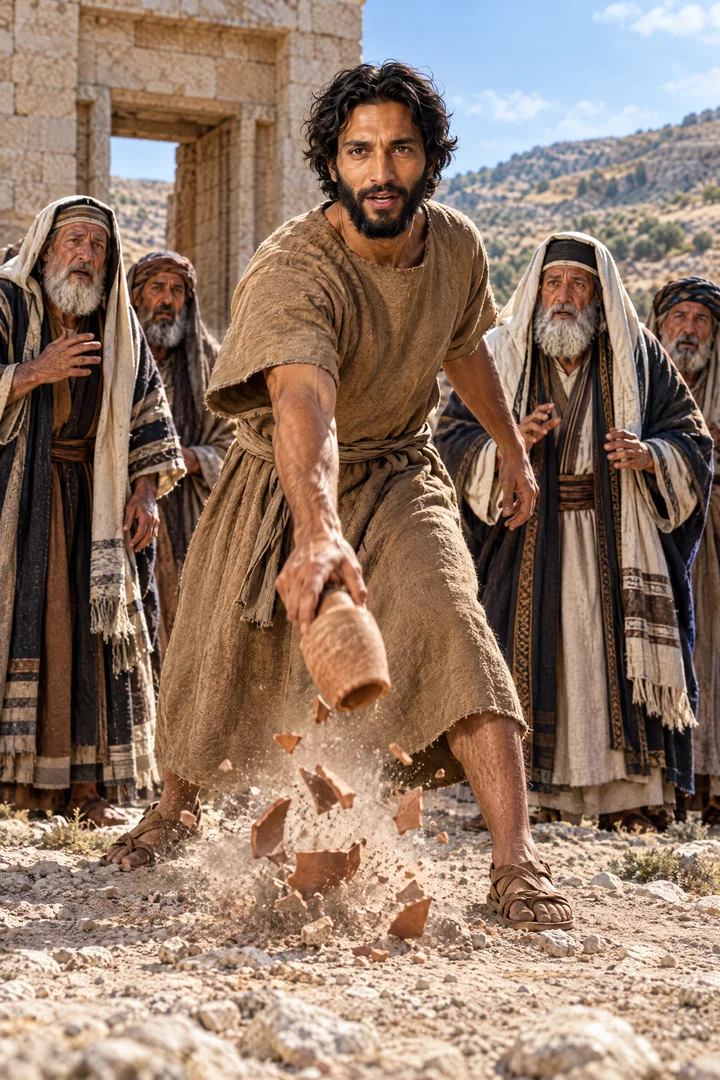
And shalt say unto them, Thus saith the LORD of hosts; Even so will I break this people and this city, as one breaketh a potter’s vessel, that cannot be made whole again: and they shall bury them in Tophet, till there be no place to bury.
Translations
And shall say to them, Thus says the LORD of hosts; Even so will I break this people and this city, as one breaks a potter’s vessel, that cannot be made whole again: and they shall bury them in Tophet, till there be no place to bury.
And shalt say unto them, Thus saith the LORD of hosts; Even so will I break this people and this city, as one breaketh a potter’s vessel, that cannot be made whole again: and they shall bury them in Tophet, till there be no place to bury.
and shalt say unto them, Thus saith the Lord of hosts; Even so will I break this people and this city, as one breaketh a potter’s vessel, that cannot be made whole again: and they shall bury them in Tophet, till there be no place to bury.
And shalt say to them, Thus saith the LORD of hosts; Even so will I break this people and this city, as one breaketh a potter's vessel, that cannot be made whole again: and they shall bury them in Tophet, till there be no place to bury.
and shalt say unto them, Thus saith the LORD of hosts: Even so will I break this people and this city, as one breaketh a potter’s vessel, that cannot be made whole again: and they shall bury in Topheth, till there be no place to bury.
and shalt say unto them, Thus saith Jehovah of hosts: Even so will I break this people and this city, as one breaketh a potter’s vessel, that cannot be made whole again; and they shall bury in Topheth, till there be no place to bury.
and hast said unto them: Thus said Jehovah of Hosts, Thus do I break this people and this city, as one breaketh the potter's vessel, that is not able to be repaired again, and in Tophet they bury — without place to bury;
and shalt say unto them, Thus saith Jehovah of hosts: Even so will I break this people and this city, as one breaketh a potter's vessel, that cannot be made whole again. And they shall bury in Topheth, till there be no place to bury.
and shalt say unto them—Thus, saith Yahweh of hosts—Thus and thus, will I break this people, and this city, As one breaketh the vessel of a potter, which cannot be made whole any more,—And in Topheth, shall they bury, for want of place to bury.
Berean Standard Bible, Majority Standard Bible
and you are to proclaim to them that this is what the LORD of Hosts says: I will shatter this nation and this city, like one shatters a potter’s jar that can never again be repaired. They will bury the dead in Topheth until there is no more room to bury them.
and shall tell them, ‘ The LORD of Armies says: “ Even so I will break this people and this city as one breaks a potter’s vessel, that can’t be made whole again. They will bury in Topheth until there is no place to bury.
And say to them, This is what the Lord of armies has said: Even so will this people and this town be broken by me, as a potter's bottle is broken and may not be put together again: and the bodies of the dead will be put in the earth in Topheth, till there is no more room.
And shalt say vnto them, Thus saith ye Lord of hostes, Euen so will I breake this people and this citie, as one breaketh a potters vessell, that cannot be made whole againe, and they shall bury them in Topheth till there be no place to bury.
Douay-Rheims (Challoner revision)
And thou shalt say to them: Thus saith the Lord of hosts: even so will I break this people, and this city, as the potter’s vessel is broken, which cannot be made whole again: and they shall be buried in Topheth, because there is no other place to bury in.
Pictures
Cross-references 20 of 24
- Jeremiah 7:32
Therefore, behold, the days come, saith the LORD, that it shall no more be called Tophet, nor the valley of the son of Hinnom, but the valley of slaughter: for they shall bury in Tophet, till there be no place.
Both describe burying in Tophet until there is no place.
- Jeremiah 19:6
Therefore, behold, the days come, saith the LORD, that this place shall no more be called Tophet, nor The valley of the son of Hinnom, but The valley of slaughter.
Identifies Tophet and the Valley of Hinnom as a place of judgment.
- Jeremiah 32:35
And they built the high places of Baal, which are in the valley of the son of Hinnom, to cause their sons and their daughters to pass through the fire unto Molech; which I commanded them not, neither came it into my mind, that they should do this abomination, to cause Judah to sin.
Both describe Tophet and its punishment in the valley of Hinnom.
- Mark 9:43-48
And if thy hand offend thee, cut it off: it is better for thee to enter into life maimed, than having two hands to go into hell, into the fire that never shall be quenched:
Gehenna’s punishment is linked to Tophet’s destruction.
- Jeremiah 18:5-10
Then the word of the LORD came to me, saying,
The potter’s remoldable vessel contrasts with the irreparable breaking, under conditions of repentance or disobedience.
- 2 Kings 23:10
And he defiled Topheth, which is in the valley of the children of Hinnom, that no man might make his son or his daughter to pass through the fire to Molech.
Both identify Tophet in the valley of Hinnom.
- Isaiah 30:33
For Tophet is ordained of old; yea, for the king it is prepared; he hath made it deep and large: the pile thereof is fire and much wood; the breath of the LORD, like a stream of brimstone, doth kindle it.
Both identify Tophet as a place of retribution.
- 2 Chronicles 36:19
And they burnt the house of God, and brake down the wall of Jerusalem, and burnt all the palaces thereof with fire, and destroyed all the goodly vessels thereof.
Jerusalem’s burning fulfills Jeremiah’s warning of judgment.
- Jeremiah 19:2
And go forth unto the valley of the son of Hinnom, which is by the entry of the east gate, and proclaim there the words that I shall tell thee,
Names the Valley of Hinnom associated with Tophet.
- Joshua 15:8
And the border went up by the valley of the son of Hinnom unto the south side of the Jebusite; the same is Jerusalem: and the border went up to the top of the mountain that lieth before the valley of Hinnom westward, which is at the end of the valley of the giants northward:
locality of valley of Hinnom
- Psalms 2:9
Thou shalt break them with a rod of iron; thou shalt dash them in pieces like a potter’s vessel.
Both describe the wicked being shattered like a potter’s vessel beyond repair.
- Mark 9:48
Where their worm dieth not, and the fire is not quenched.
Tophet is Gehenna, an image of complete destruction.
- 2 Chronicles 28:3
Moreover he burnt incense in the valley of the son of Hinnom, and burnt his children in the fire, after the abominations of the heathen whom the LORD had cast out before the children of Israel.
Both describe child sacrifice in the Valley of Hinnom.
- Luke 19:43-44
For the days shall come upon thee, that thine enemies shall cast a trench about thee, and compass thee round, and keep thee in on every side,
Jesus foretold Jerusalem’s destruction for failing to recognize its opportunity.
- 2 Chronicles 33:6
And he caused his children to pass through the fire in the valley of the son of Hinnom: also he observed times, and used enchantments, and used witchcraft, and dealt with a familiar spirit, and with wizards: he wrought much evil in the sight of the LORD, to provoke him to anger.
Both texts describe children being passed through fire in the Valley of Hinnom.
- Luke 21:20-24
And when ye shall see Jerusalem compassed with armies, then know that the desolation thereof is nigh.
The passage connects the vessel’s complete breaking with Jerusalem’s destruction by the Romans.
- Jeremiah 7:30
For the children of Judah have done evil in my sight, saith the LORD: they have set their abominations in the house which is called by my name, to pollute it.
Both describe Judah’s judgment for defiling the house of the LORD.
- Jeremiah 8:2
And they shall spread them before the sun, and the moon, and all the host of heaven, whom they have loved, and whom they have served, and after whom they have walked, and whom they have sought, and whom they have worshipped: they shall not be gathered, nor be buried; they shall be for dung upon the face of the earth.
Both describe the people worshipping the heavenly host.
- Luke 13:34-35
O Jerusalem, Jerusalem, which killest the prophets, and stonest them that are sent unto thee; how often would I have gathered thy children together, as a hen doth gather her brood under her wings, and ye would not!
Jesus laments Jerusalem and foretells its coming desolation.
- Jeremiah 25:9-11
Behold, I will send and take all the families of the north, saith the LORD, and Nebuchadrezzar the king of Babylon, my servant, and will bring them against this land, and against the inhabitants thereof, and against all these nations round about, and will utterly destroy them, and make them an astonishment, and an hissing, and perpetual desolations.
Judah’s doom is described as destruction and seventy years of Babylonian captivity.
Commentary
Each commentary is drawn from primary sources: the writings of Ellen G. White and Adventist pioneers and periodicals. Each commentary is separate. Its own words are not a quotation; follow the references to read the source passages.
Ellen G. White
2 sources
Disregard for God's spoken warnings brings swift judgment upon Jerusalem and its people that cannot be turned back.PK 431.1–3 The sentence is pictured as the smashing of a potter's earthen bottle, shattered so completely that it can never be made whole again.PK 431.1–3 That announced breaking was to overtake not only the city itself but also the towns round about it.PK 431.1–3
The same breaking of the potter's vessel also pictures the need for settled and regular lines of work to be broken up.3MR 264.1–3 They must be reconstructed rather than left in their former shape.3MR 264.1–3 Only in this way can the work advance into fields that have been neglected.3MR 264.1–3
Sources
Pioneers and periodicals
20 sources
The verse pronounces swift judgment on Jerusalem and its people for idolatry and the abominations of Tophet, declaring they will be broken as a hardened earthen vessel is broken before witnesses, shattered beyond reshaping or repair.ST Jul 22, 1913RH Jul 21, 1910ST Oct 29, 1894RH Jul 27, 1916ST Aug 18, 1909 Tophet lies in the valley of the son of Hinnom just outside and south of Jerusalem, the same place called Gehenna, once defiled by worship of Moloch and afterward made a place of refuse, carcasses, dead criminals, constant fires and consuming worms.ST Mar 29, 1905RH Jan 17, 1856ST Sep 9, 1930 The dead will be so many from siege, slaughter and famine that they are buried in Tophet till no place to bury remains.RH Dec 19, 1854ST Oct 29, 1894ST Dec 3, 1896 The breaking is irreversible, meaning the Jewish people and Jerusalem as a nation will not be restored or rebuilt to usher in a golden age, but remain desolate till the consummation, with the final gathering belonging to the true Israel in God's everlasting kingdom.RH Jul 21, 1910RH Oct 22, 1861ST Nov 25, 1930RH Jun 11, 1901 Begun through Babylon, the judgment was fully fulfilled when the Messiah was rejected and the Romans under Titus destroyed Jerusalem in A.D. 70, and Tophet stands as a type of the complete destruction of the finally impenitent at the close of the millennium, not a place of eternal torment now in existence, warning the present day against persistent disobedience.RH Jun 11, 1901RH Jan 17, 1856ST Sep 9, 1930ST Aug 18, 1909ST Aug 18, 1909
Judgment in Tophet Valley
The pronouncement is judgment for idolatry and the abominations of Tophet, including the sacrifice of children to Baal.ST Jul 22, 1913ST Oct 29, 1894 It was called forth by treachery, shamelessness and wilfulness that mere form of temple worship could not cover while the people remained ungodly.ST Jul 22, 1913 The punishment for that wilfulness would come swiftly through Babylon.ST Jul 22, 1913 Left to its enemies and besieged, the city in its defense would be brought to the extremity of eating its own friends and children.ST Oct 29, 1894
The sign was the breaking of a potter's earthen bottle or vessel in the valley of Hinnom, proclaimed before the priests to declare the breaking of the people and the city.RH Jul 21, 1910ST Aug 18, 1909ST Aug 18, 1909 Once hardened and shattered, the vessel cannot be reshaped or made whole again.RH Jul 21, 1910ST Aug 18, 1909ST Aug 18, 1909 So broken, it declares a ruin that cannot be repaired and a warning of irreversible ruin if transgression and persistent disobedience continue.RH Jul 27, 1916ST Jul 28, 1909ST Aug 18, 1909 The striking warning and appeal stands with the assurance of God's kindness and everlasting love and applies to the present day.RH Jul 27, 1916
Tophet lies in the Valley of Hinnom, the valley of the son of Hinnom, south of and just outside Jerusalem.ST Mar 29, 1905RH Jan 17, 1856ST Sep 9, 1930ST Dec 17, 1902 Tophet and Gehenna are two names for the same place, with Tophet forming only a part of the larger valley.ST Mar 29, 1905ST Sep 9, 1930RH Jun 15, 1869 It was once defiled by the worship of Moloch and by dreadful crime bringing terrible retribution.RH Jan 17, 1856ST Sep 9, 1930RH Jun 15, 1869 Afterward it was polluted with city refuse, carcasses of animals, and dead bodies of criminals.RH Jan 17, 1856ST Sep 9, 1930ST Dec 17, 1902 Constant fires were kept burning there to consume the corruption and prevent pestilence, while worms consumed what the flames did not reach, so that nothing put there escaped destruction.RH Jan 17, 1856ST Sep 9, 1930ST Dec 17, 1902
The people and the city are broken beyond repair and buried in Tophet till there be no place to bury, conveying the scale of slaughter and destruction.RH Dec 19, 1854ST Jul 28, 1909ST Aug 18, 1909 The dead become so numerous that burial space runs out.RH Dec 19, 1854ST Aug 18, 1909 The passage is an example of calling disposal of the dead in a cave or rock-hewn sepulcher burial.ST Dec 3, 1896
Irreversible National Breaking
The breaking of the people and the city like a smashed potter's earthen bottle that cannot be made whole again, proclaimed before the priests as a sign of coming destruction, means there is to be no future restoration of the natural descendants of Abraham as a nation into a kingdom.RH Jul 21, 1910RH Oct 22, 1861RH Jun 11, 1901 Jerusalem will not be rebuilt and restored, but remains desolate till the consummation, denying the return of the Jews after the flesh and the restoration of Jerusalem before the coming of the Lord.RH Jul 21, 1910RH Oct 22, 1861 This describes the class scattered for hurt to be a reproach, a taunt, a proverb and a curse till consumed, in contrast to the class scattered for good who return unto the Lord with their whole heart and are brought again, built and planted and not plucked up.RH Oct 22, 1861 The final gathering belongs to the true Israel in God's everlasting kingdom, with the breaking meaning the end of the Jews as a nation with no national remaking afterward.RH Jul 21, 1910RH Jun 11, 1901
The irreversible breaking rules out the rehabilitation of the Hebrew race in Palestine in their ancient homeland before the millennium of peace.ST Nov 25, 1930 It rules out a spiritual coming of Jesus to Jerusalem to be crowned king and establish His kingdom in this present world through a religio-political confederacy with Jerusalem as world capital to usher in a golden age.ST Nov 25, 1930
The judgment began in the Babylonian siege but reached its full fulfillment after the long-looked-for Messiah came unto His own and was rejected, after the last little while of light closed and the word turned to the Gentiles.RH Jun 11, 1901ST Aug 18, 1909ST Aug 18, 1909 Then the Romans under Titus destroyed Jerusalem in A.D. 70, the Jewish nation as a nation ceased to exist and entered the warned-of time of darkness.RH Jun 11, 1901ST Aug 18, 1909ST Aug 18, 1909 Once hardened and shattered the vessel cannot be reshaped or made whole again, showing the irreversible destruction that awaited the people for persistent disobedience, as the consequence of the people's own choices and the harvest of their long-standing rebellion.ST Aug 18, 1909ST Aug 18, 1909 The dead were so numerous that burial space ran out, with more than a million people slaughtered.ST Aug 18, 1909ST Aug 18, 1909
The break means they would never be restored to wholeness, so the return of Sodom, Samaria and Jerusalem to their former estate cannot mean a future reinstatement to probation and salvation.RH Jul 28, 1910 Their former estate was pride, fullness of bread, abundance of idleness, and failure to strengthen the poor and needy, and when raised again the inhabitants of Sodom will still have the same mind.RH Jul 28, 1910 There is no resurrection for the wicked until the end of the thousand years, and those then raised will meet their doom in fire coming down from heaven upon them.RH Jul 28, 1910 Christ's dashing of the nations in pieces like a potter's vessel is a complete and final destruction that can never be repaired or restored.RH Jul 25, 1865 The giving of the heathen to Christ is not for their conversion but for their breaking, fulfilled at the second advent in the great day of wrath when the angry nations tumultuously assemble and the beast and the kings of the earth and their armies gather to make war against the coming King of kings and are smitten and ruled with a rod of iron.RH Jul 25, 1865
Image of Final Destruction
Tophet is a place of slaughter and destruction where the people and the city are broken like a potter's vessel that cannot be repaired, and the dead are buried there till no room remains.RH Dec 19, 1854ST Jul 28, 1909 It is a figure of death and the end of life, not a place where people are kept alive for eternal torture.RH Dec 19, 1854 Tophet in the Valley of Hinnom is the setting associated with Gehenna, whose worms and fire became symbols of utter destruction.ST Mar 29, 1905 Tophet is the valley of Hinnom and valley of the son of Hinnom south of Jerusalem, the same place called Gehenna in the New Testament.ST Sep 9, 1930RH Aug 29, 1871 Once used for the cruel rites of the worship of Moloch, it afterward became a public burning place polluted with city refuse, filth, carcasses of animals, and dead bodies of criminals, where constant fires were kept burning to consume corruption and prevent pestilence, while worms consumed what the flames did not reach, so that nothing put there escaped destruction.ST Jul 28, 1909ST Sep 9, 1930RH Aug 29, 1871 Because of this it is proof that Gehenna was a place of punishment by burning, and a concrete demonstration of complete destruction in which the consuming forces do not fail, used as an image of the complete destruction coming upon the finally impenitent in their punishment, with no escape.ST Sep 9, 1930RH Aug 29, 1871
Gehenna thus defines hell as a place of punishment after the judgment, not a place of torment now in existence.RH Jan 17, 1856 Transgressors were punished there in ancient times, and it became a type of the complete destruction of wickedness which will take place at the close of the millennium.RH Jan 17, 1856ST Dec 17, 1902 That destruction falls upon the finally impenitent with no escape.ST Sep 9, 1930
The striking symbol of a potter's vessel broken so it cannot be made whole again to declare the breaking of the people and the city is a warning and appeal, with the assurance of God's kindness and everlasting love, that applies to the present day.RH Jul 27, 1916 It warns of irreversible ruin if transgression and persistent disobedience continue, for the hardened and distorted vessel can no longer be reshaped.RH Jul 27, 1916ST Aug 18, 1909 Its breaking signifies the people's destruction and the dead being buried in Tophet until there is no room.ST Aug 18, 1909 The warning was not fully fulfilled in the Babylonian siege, but its complete fulfillment came after the people rejected Christ, when Titus destroyed Jerusalem and more than a million people were slaughtered.ST Aug 18, 1909
Sources