Jeremiah 19:10
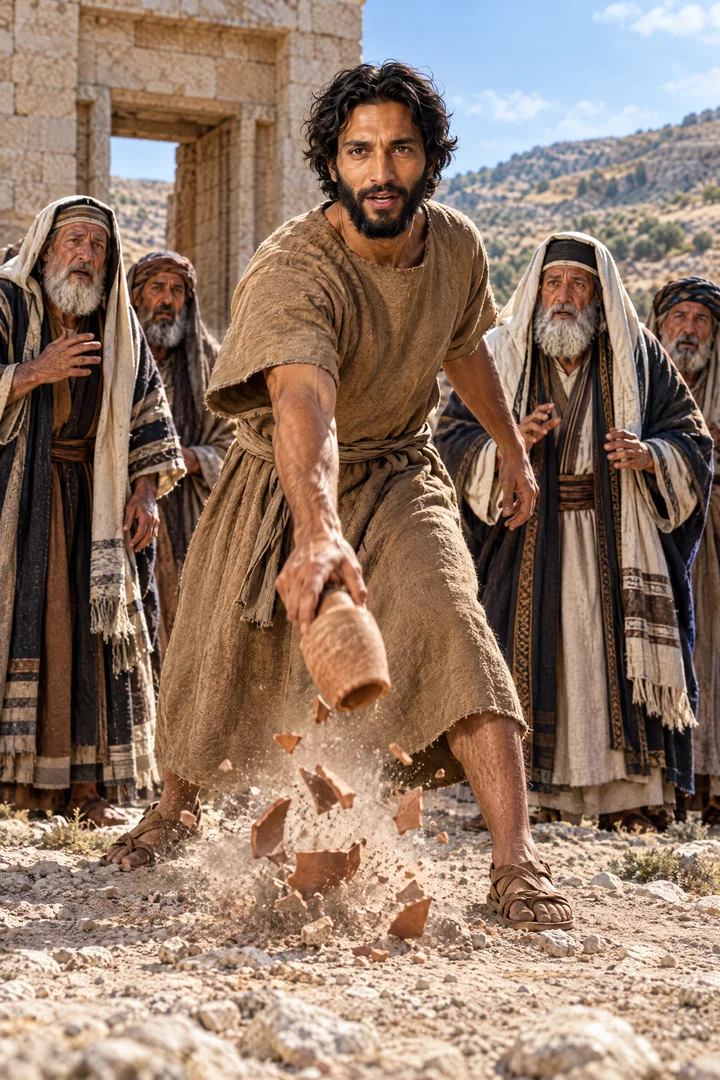
Then shalt thou break the bottle in the sight of the men that go with thee,
Translations
Then shall you break the bottle in the sight of the men that go with you,
King James Version, KJV Cambridge Paragraph Bible, Webster Bible, Revised Version, American Standard Version
Then shalt thou break the bottle in the sight of the men that go with thee,
'And thou hast broken the bottle before the eyes of the men who are going with thee,
And thou shalt break the flagon in the sight of the men that go with thee,
Then shalt thou break the bottle, before the eyes of the men who are walking with thee;
Berean Standard Bible, Majority Standard Bible
Then you are to shatter the jar in the presence of the men who accompany you,
“ Then you shall break the container in the sight of the men who go with you,
Then let the potter's bottle be broken before the eyes of the men who have gone with you,
Then shalt thou breake the bottell in the sight of the men that go with thee,
Douay-Rheims (Challoner revision)
And thou shalt break the bottle in the sight of the men that shall go with thee.
Pictures
Cross-references
- Jeremiah 7:31-33
And they have built the high places of Tophet, which is in the valley of the son of Hinnom, to burn their sons and their daughters in the fire; which I commanded them not, neither came it into my heart.
Both locate Tophet in the Valley of Hinnom, marked by slaughter and judgment.
- 2 Kings 23:10
And he defiled Topheth, which is in the valley of the children of Hinnom, that no man might make his son or his daughter to pass through the fire to Molech.
Both concern Tophet in the valley of Hinnom.
- Jeremiah 18:7-10
At what instant I shall speak concerning a nation, and concerning a kingdom, to pluck up, and to pull down, and to destroy it;
The broken vessel enacts judgment after the people refuse to repent.
- Jeremiah 7:32
Therefore, behold, the days come, saith the LORD, that it shall no more be called Tophet, nor the valley of the son of Hinnom, but the valley of slaughter: for they shall bury in Tophet, till there be no place.
Both describe Tophet as a place of slaughter and retribution.
- Jeremiah 19:1
Thus saith the LORD, Go and get a potter’s earthen bottle, and take of the ancients of the people, and of the ancients of the priests;
cited together denying Jewish restoration
- Jeremiah 19:5-6
They have built also the high places of Baal, to burn their sons with fire for burnt offerings unto Baal, which I commanded not, nor spake it, neither came it into my mind:
Child sacrifice to Baal prompts the announced judgment on Jerusalem.
- Jeremiah 32:35
And they built the high places of Baal, which are in the valley of the son of Hinnom, to cause their sons and their daughters to pass through the fire unto Molech; which I commanded them not, neither came it into my mind, that they should do this abomination, to cause Judah to sin.
Both texts name the Valley of the Son of Hinnom as a place of retribution.
- Joshua 15:8
And the border went up by the valley of the son of Hinnom unto the south side of the Jebusite; the same is Jerusalem: and the border went up to the top of the mountain that lieth before the valley of Hinnom westward, which is at the end of the valley of the giants northward:
both identify the locality of the valley of Hinnom
- Luke 19:41-44
And when he was come near, he beheld the city, and wept over it,
Jesus foretold Jerusalem’s destruction after it failed to recognize him.
Commentary
Each commentary is drawn from primary sources: the writings of Ellen G. White and Adventist pioneers and periodicals. Each commentary is separate. Its own words are not a quotation; follow the references to read the source passages.
Ellen G. White
1 source
Jeremiah was to take the elders of the people and the priests with him to the Valley of the Son of Hinnom, there review the apostasy of Judah, and break a potter's earthen bottle in their sight.PK 431.1–3 The visible breaking was commanded in order to make God's sentence of doom plain, because the multitudes scarcely understood its awful import.PK 431.1–3 It illustrated the nature of the swift-coming judgments, that God would break His people and Jerusalem as a potter's vessel is broken so that it cannot be made whole again.PK 431.1–3
Sources
Pioneers and periodicals
12 sources
The command is a public acted-out sign within chapters 12 to 24 that warn the Jews, one of the book's striking symbols and figures of speech.RH Jul 21, 1910RH Jul 27, 1916ST Aug 18, 1909 The prophet is to carry a potter's earthen bottle before the priests and the men who go with him and then break the bottle in their sight.RH Jul 21, 1910ST Aug 18, 1909 Because Israel had ignored God's warnings, the hardened, distorted vessel pictured the irreversible ruin awaiting the people and Jerusalem if they persisted in transgression.ST Aug 18, 1909
It belongs to a denunciation of the people's sin, over which Jeremiah grieves because they would not return to God after long appeals and warnings.ST Oct 20, 1909ST Aug 18, 1909 It exposes Israel's idolatry centered at Topheth, including child sacrifice to Baal and Moloch, with treachery, shamelessness and persistent rebellion.ST Jul 22, 1913ST Oct 29, 1894ST Aug 18, 1909 Outward temple worship is of no avail to the ungodly.ST Jul 22, 1913 Their willfulness would soon be punished by Babylon as the swift avenger, with Jerusalem besieged until its people ate their own children and friends.ST Jul 22, 1913ST Oct 29, 1894
The breaking means God would break this people and this city as one breaks a potter's vessel that cannot be made whole again.RH Jul 21, 1910ST Aug 18, 1909ST Aug 18, 1909 It is a final and irreversible breaking, picturing final and irreversible ruin if they persisted in transgression.RH Jul 21, 1910ST Aug 18, 1909 That destruction began with the Babylonian captivity but reached its complete fulfillment after the people rejected the Son of God, when the Romans under Titus destroyed Jerusalem and the nation.ST Aug 18, 1909ST Aug 18, 1909 The dead were buried until there was no room and more than a million people were killed, as the harvest of their own choices though God had long offered mercy and a way of escape.ST Aug 18, 1909
Its irreversibility shows there will be no future restoration of the natural descendants of Abraham into a kingdom or Jewish nation in Palestine.RH Jul 21, 1910ST Nov 25, 1930 The idea that the Hebrew race must be rehabilitated in its ancient homeland before a millennium of earthly peace can come is therefore false.RH Jul 21, 1910ST Nov 25, 1930 The surrounding passage places the sign at Tophet in the Valley of Hinnom, the valley of the son of Hinnom south of and outside Jerusalem, the same place as Gehenna.RH Jan 17, 1856RH Jun 15, 1869ST Dec 17, 1902RH Aug 29, 1871 Once celebrated for horrid worship of Moloch, it became a place where transgressors were punished in ancient times and a place of dreadful crime and terrible retribution.RH Jan 17, 1856RH Jun 15, 1869 Afterward it was polluted with filth, refuse, animal remains, carcasses of animals and dead bodies of criminals, where constant fires were kept burning to consume the mass of corruption in order to avert pestilence.RH Jan 17, 1856ST Dec 17, 1902
With its fires and worms and its punishment by burning, slaughter and destruction of the carcasses of the wicked, the valley makes a picture of the complete destruction of wickedness.ST Dec 17, 1902RH Aug 29, 1871 Its warning and appeal still apply in the present day.RH Jul 27, 1916
Sources