Jeremiah 7:11
Is this house, which is called by my name, become a den of robbers in your eyes? Behold, even I have seen it, saith the LORD.
Translations
Is this house, which is called by my name, become a den of robbers in your eyes? Behold, even I have seen it, says the LORD.
King James Version, Webster Bible
Is this house, which is called by my name, become a den of robbers in your eyes? Behold, even I have seen it, saith the LORD.
Is this house, which is called by my name, become a den of robbers in your eyes? Behold, even I have seen it, saith the Lord.
Is this house, which is called by my name, become a den of robbers in your eyes? Behold, I, even I, have seen it, saith the LORD.
Is this house, which is called by my name, become a den of robbers in your eyes? Behold, I, even I, have seen it, saith Jehovah.
A den of burglars hath this house, On which My name is called, been in your eyes? Even I, lo, I have seen, an affirmation of Jehovah.
Is this house, which is called by my name, a den of robbers in your eyes? Even I, behold, I have seen it, saith Jehovah.
A den of robbers, hath this house on which my Name hath been called become in your own eyes? I, also,—lo! I have seen it Declareth Yahweh.
Berean Standard Bible, Majority Standard Bible
Has this house, which bears My Name, become a den of robbers in your sight? Yes, I too have seen it, declares the LORD.
Has this house, which is called by my name, become a den of robbers in your eyes? Behold, I myself have seen it,” says the LORD.
Has this house, which is named by my name, become a hole of thieves to you? Truly I, even I, have seen it, says the Lord.
Is this House become a denne of theeues, whereupon my Name is called before your eyes? Beholde, euen I see it, sayeth the Lord.
Douay-Rheims (Challoner revision)
Is this house then, in which my name hath been called upon, in your eyes become a den of robbers? I, I am he: I have seen it, saith the Lord.
Pictures
Cross-references
- Matthew 21:12-13
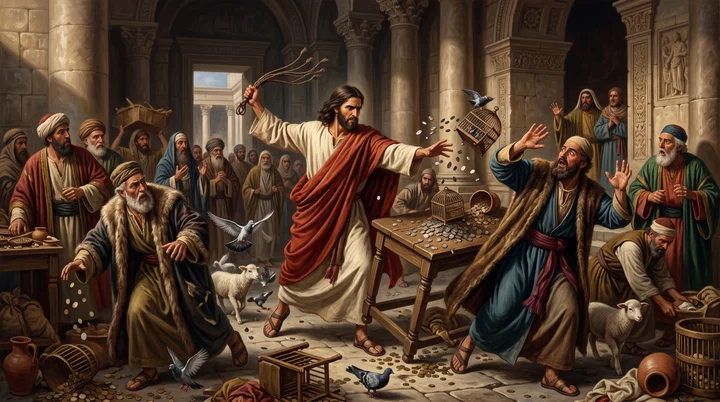
And Jesus went into the temple of God, and cast out all them that sold and bought in the temple, and overthrew the tables of the moneychangers, and the seats of them that sold doves,
Jesus drives out temple traders and condemns the house as a den of thieves.
- Isaiah 56:7
Even them will I bring to my holy mountain, and make them joyful in my house of prayer: their burnt offerings and their sacrifices shall be accepted upon mine altar; for mine house shall be called an house of prayer for all people.
God’s house is meant to be a house of prayer, contrasting with its misuse as a den of robbers.
- Mark 11:17
And he taught, saying unto them, Is it not written, My house shall be called of all nations the house of prayer? but ye have made it a den of thieves.
Jesus condemns the temple’s misuse as a den of robbers.
- Luke 19:46
Saying unto them, It is written, My house is the house of prayer: but ye have made it a den of thieves.
Jesus condemns the temple as a den of thieves.
- John 2:16
And said unto them that sold doves, Take these things hence; make not my Father’s house an house of merchandise.
Jesus condemns turning his Father’s house into a place of trade.
- Jeremiah 7:4
Trust ye not in lying words, saying, The temple of the LORD, The temple of the LORD, The temple of the LORD, are these.
The people trusted in the temple as protection.
- Jeremiah 26:6
Then will I make this house like Shiloh, and will make this city a curse to all the nations of the earth.
Disobedience would bring judgment on the temple, making it like Shiloh.
- John 2:17
And his disciples remembered that it was written, The zeal of thine house hath eaten me up.
The disciples recall Scripture as Christ cleanses the temple.
- Matthew 23:37-38
O Jerusalem, Jerusalem, thou that killest the prophets, and stonest them which are sent unto thee, how often would I have gathered thy children together, even as a hen gathereth her chickens under her wings, and ye would not!
Jesus laments Jerusalem’s rejection and declares its house desolate.
- Acts 7:48
Howbeit the most High dwelleth not in temples made with hands; as saith the prophet,
The temple’s loss points to the truth that God does not dwell in human-made houses.
- Micah 3:8-12
But truly I am full of power by the spirit of the LORD, and of judgment, and of might, to declare unto Jacob his transgression, and to Israel his sin.
Also warns that Jerusalem would be destroyed because of its people’s sins.
- Matthew 21:23
And when he was come into the temple, the chief priests and the elders of the people came unto him as he was teaching, and said, By what authority doest thou these things? and who gave thee this authority?
The leaders challenge Jesus after his rebuke of the temple’s misuse.
- Mark 13:2
And Jesus answering said unto him, Seest thou these great buildings? there shall not be left one stone upon another, that shall not be thrown down.
Jesus predicts the temple’s complete destruction.
- Isaiah 1:11-15
To what purpose is the multitude of your sacrifices unto me? saith the LORD: I am full of the burnt offerings of rams, and the fat of fed beasts; and I delight not in the blood of bullocks, or of lambs, or of he goats.
Ceremonial worship became offensive to God.
- Isaiah 58:1-2
Cry aloud, spare not, lift up thy voice like a trumpet, and shew my people their transgression, and the house of Jacob their sins.
Both condemn professed devotion alongside disregard for God's requirements.
- Psalms 69:9
For the zeal of thine house hath eaten me up; and the reproaches of them that reproached thee are fallen upon me.
Christ’s zeal for God’s house is shown in his defense of the sacred house.
- Jeremiah 8:5-12
Why then is this people of Jerusalem slidden back by a perpetual backsliding? they hold fast deceit, they refuse to return.
Persistent sin and false assurances of peace echo the temple warning.
Commentary
Each commentary is drawn from primary sources: the writings of Ellen G. White and Adventist pioneers and periodicals. Each commentary is separate. Its own words are not a quotation; follow the references to read the source passages.
Ellen G. White
27 sources
God sees people who steal, murder, commit adultery, swear falsely and serve other gods, yet enter the house called by His name and claim they are safe to keep doing evil, and by that hypocrisy the house becomes a den of robbers in His sight.Lt 66, 1897, par. 16–17Lt 2, 1894, par. 7–11Lt 43, 1898, par. 8–12 Its sacred standing cannot shield persistent wrongdoing from judgment, for safety comes only by amending conduct, doing justice, ceasing to oppress the vulnerable, forsaking idolatry and obeying God.Lt 2, 1894, par. 7–11Lt 43, 1898, par. 8–12PK 415.3–416.1 Jesus applied the same charge to the temple courts, where buying and selling, dishonest gain, extortion and inflated charges for offerings had desecrated the house of prayer and displaced reverence with selfish trade.3SP 23.1–24.12SP 117.1–3DA 590.3–591.11RED 76.1–3 With divine authority He drove out the traders, exposing hidden motives and guilt, displaying righteous anger against apostasy and showing that outward religion must give place to inward cleansing, new moral birth and genuine holiness.3SP 23.1–24.1ST Feb 10, 18982SP 117.1–32SP 129.2–130.2ST Feb 15, 1899 The same profanation occurs whenever those entrusted with sacred responsibility transgress God's law for personal advantage, serve mammon while professing to serve God, and turn His house and work into a place of merchandise, whether in the church, in institutions like the publishing house that put commercial work above the truth, or in a world corrupt by love of money and oppression of the poor.11MR 273.1STGC 21.44T 252.28T 92.4STGC 22.1
Jeremiah's Temple Rebuke
The question exposes a people who steal, murder, commit adultery, swear falsely and serve other gods, and then come into the temple and claim that its holiness means they are delivered and safe to keep doing evil.Lt 66, 1897, par. 16–17Lt 2, 1894, par. 7–11Lt 43, 1898, par. 8–12 God Himself sees this hypocrisy, for the house called by His name has become a den of robbers when worship is joined to injustice and idolatry.Lt 66, 1897, par. 16–17Lt 2, 1894, par. 7–11Lt 43, 1898, par. 8–12 Its sacred status cannot shield persistent wrongdoers from His judgment, and it was never meant to be a refuge for those who continue in wrongdoing.Lt 66, 1897, par. 16–17Lt 2, 1894, par. 7–11Lt 43, 1898, par. 8–12
True security was never found in merely claiming the temple's protection.Lt 2, 1894, par. 7–11Lt 43, 1898, par. 8–12 It depended on amending conduct, practicing justice, stopping oppression of the vulnerable, rejecting idolatry, and obeying God.Lt 2, 1894, par. 7–11Lt 43, 1898, par. 8–12
The warning meant that the temple and its appointed services could not protect Judah from punishment while wickedness continued.PK 415.3–416.1 Judah's confidence repeated Israel's earlier mistaken confidence that the ark would guarantee victory even though sin had been allowed to flourish unchecked.PK 415.3–416.1 As in Eli's time, neglecting to confront evil brought disaster.PK 415.3–416.1 Sacred things and outward religious observance could not replace repentance and obedience.PK 415.3–416.1
Christ Cleanses the Temple
Jesus took up the ancient charge against His own temple courts, where buying and selling had desecrated the sacred place and turned the house of prayer into a den of thieves.3SP 23.1–24.1DA 590.3–591.1RH Aug 13, 1908ST Feb 15, 1899 Greed and dishonest commerce had profaned God's house, for commercial activity had made it a place of dishonest gain instead of prayer.RH Aug 13, 1908ST Feb 15, 1899 With commanding authority He drove the traders from it and condemned their misuse of the sacred place.DA 590.3–591.1
The corruption was traffic and dishonest gain carried on by traders, money-changers, and priests.2SP 117.1–3DA 590.3–591.1 Selfishness and extortion ruled there, and dealers' charges for sacrificial offerings robbed the people while their traffic profaned sacred things.4RED 13.2–14.3Lt 116, 1907, par. 6–7 Though the temple was dedicated to God, it had been degraded to a place of traffic and extortion, bringing those responsible under divine judgment as answerable before God the Judge.2SP 117.1–31RED 76.1–34RED 13.2–14.3
Money-making had displaced prayer and reverence, and the priests valued the profits of trade above the healing and praise taking place there.RH Feb 13, 1900 The Passover itself had become sacrilegious trade and worship of wealth, repeating the same profanation whenever sacred things are used for worldly profit.STMW7 54.1–2 A selfish, avaricious spirit ruled while the people professed to be Abraham's children yet refused to follow his example, zealous for outward righteousness and strict for the letter of the law while daily violating its spirit, which forbids hatred and theft, with internal holiness neglected for external appearance.4RED 13.2–14.3
With authority Christ drove out the traders, saying Take these things hence.3SP 23.1–24.1ST Feb 10, 1898 His presence and searching gaze exposed hidden motives and guilt, confronting the people as a divine judge.ST Jan 4, 18771RED 76.1–3 His words exposed the wrong, showing that God sees their hidden motives and that divine love and mercy do not rule out stern justice.3SP 23.1–24.12SP 117.1–31RED 76.1–3 Those who reject God's warnings and offers of pardon will face His judgment, when hidden sins are exposed and the light they ignored can no longer help them.STMW7 54.1–2
Divinity flashing through humanity caused the priests and rulers to flee as if pursued by an armed band of soldiers or by an offended God.ST Feb 10, 1898 Their flight itself proved His divinity, even as shame drove them to return and challenge His authority.ST Feb 10, 1898 His cleansing displayed God's righteous anger, and together with the blighted fig tree it symbolized the apostate Jewish nation and Jerusalem's coming destruction.ST Feb 15, 1899
The purifying of the temple illustrates the work that must be accomplished in everyone who would secure eternal life.4RED 13.2–14.3 Although they professed to be Abraham's children and appeared righteous, their selfishness and extortion violated the spirit of God's law and desecrated the temple, exposing the need for inward cleansing and renewal of holiness.2SP 129.2–130.2 What was needed was a new moral birth, a removal of the sins that polluted them and a renewal of true knowledge and genuine holiness.4RED 13.2–14.3 Traditions and useless forms had taken the place of true holiness, corrupting the nation and desecrating its religious rites, proving that not one who fled that day was fitted by grace to be connected with the sacred services of the temple.4RED 13.2–14.3 Religious name and position count for nothing beside purity of character, honesty, and just dealing.Lt 116, 1907, par. 6–7
Profaning Sacred Trust Today
The verse reaches those entrusted with important responsibilities and positions of trust who become unfaithful to God's principles.Lt 71, 1894, par. 20–214MR 442.3–411MR 273.1 They forget the simplicity of the work, put aside self-denial and sacrifice, indulge selfishness, and follow their own ideas and judgment instead of relying on divine wisdom and power.Lt 71, 1894, par. 20–214MR 442.3–411MR 273.1 Their conduct is a breach of the duty owed to God, and its seriousness lies in treating God's work as a means to serve human aims.Lt 71, 1894, par. 20–214MR 442.3–4
Sacred responsibilities do not hide unfaithfulness, for God sees wrongdoing in the place associated with His name.11MR 273.117MR 172.2 He will not prosper His church while wrongful principles remain its rule.17MR 172.2 Leaders who ignore messages of correction, remain unmoved, or proudly resist appeals follow their own chosen course and are given over to their perverted imaginations.17MR 172.2
God's house becomes a den of thieves and a place of merchandise when His law is transgressed and His cause is betrayed.4T 252.28T 92.4STGC 22.1 This is done by those who profess to serve God while really serving mammon, disregarding His express command for personal advantage.4T 252.2 They become entangled with transgressors of God's law, view matters in their light, fall into their errors, and sacrifice religion for worldly gain.4T 252.2 The same profanation is repeated whenever sacred things are used for worldly profit, as when the temple courts were turned into sacrilegious trade and worship of wealth.STMW7 54.1–2
Those who reject God's warnings and offers of pardon will face His judgment, when hidden sins are exposed and the light they ignored can no longer help them.STMW7 54.1–2 Churches that betray His cause in this way must inquire closely whether they are guilty, because God will visit such unfaithfulness with His judgments and they heap future woe upon themselves.4T 252.2
The image is applied to His publishing institution, including the Review and Herald Office, when printing and circulating stirring appeals for the truth is given little or no attention.STGC 21.48T 92.4STGC 22.1 Commercial work, some of it of a most objectionable character, assumes supremacy and absorbs the energies, time, talent and money that should be devoted to literature of the purest quality and most elevating character.8T 92.4STGC 22.1 The work that ought to be done is left undone, while time is wasted, talent misapplied, money misappropriated, and men covet promotion under God's displeasure.STGC 22.1 Satan's sentiments and theories are printed by presses that should prepare God's truth for circulation, a defiling of the publishing house with consequences even more disastrous than the temple's defilement, so that loss is infinitely better than dishonorable gain.STGC 21.48T 92.4STGC 22.1
The den of robbers also describes a world made corrupt by love of display and money.ST Dec 20, 1883PK 650.3–651.1 It includes people who profess godliness but take from the poor to serve greed and extravagance.ST Dec 20, 1883 There wealth is gained through fraud and the poor are oppressed so the rich can indulge extravagance or hoard wealth.PK 650.3–651.1
Sources
Pioneers and periodicals
35 sources
God's house, though called by His name, becomes a den of robbers when people treat its worship as a cover for ungodly lives of stealing, murder and other sins, while God sees it all.ST Jul 22, 1913ST Jun 25, 1902ST Jun 25, 1902 Mere possession of the temple and its services cannot protect a hollow worship that lacks obedience, and such false confidence brings judgment and loss of the temple itself.ST Nov 4, 1897ST Jul 2, 1902ST Jul 2, 1902 Jesus applied this charge to those buying and selling in the temple courts, declaring that they had turned a house of prayer for all nations into a den of robbers by commerce, greed and irreverence.RH Feb 13, 1900ST Sep 17, 1902ST Oct 4, 1899ST Dec 23, 1886 His cleansing drove out the traders and money-changers who exploited worshipers with excessive prices, exposing hidden motives and vindicating zeal for His Father's house.ST Jan 4, 1877ST Oct 4, 1899ST Oct 7, 1913ST Mar 6, 1901 By the same principle, any place dedicated to God is profaned and made a den of thieves when it is used for marketplace traffic, worldly feasting and revelry instead of prayer.ST Aug 20, 1894ST Dec 9, 1880ST Mar 13, 1907
Meaning and Historical Setting
Temple worship is of no avail to people who live ungodly lives, for though the house is called by God's name that does not make it a refuge for wrongdoing, and God sees it.ST Jul 22, 1913ST Jun 25, 1902 The temple was established as a means of salvation from sin, but the people turned it into a supposed refuge for sinners while continuing in sin, making their ceremonial worship an offense to God that could not protect them from the consequences of sin.ST Jun 25, 1902ST Jun 25, 1902 They treated God's temple and worship as protection while stealing, murdering, and committing other sins, wrongly claiming that being in the temple meant they were delivered and safe to continue wrongdoing. Calling the temple a den of robbers exposes it as a place of crime and refuge for wrongdoers and exposes false confidence in religious forms without obedience. God condemns claiming freedom from His law as a reason to violate its commands, for religious claims do not make such lawbreaking acceptable to Him.ST Sep 29, 1881
Possession of the temple and its services could not protect the people while their worship was hollow and their lives sinful.ST Jul 2, 1902ST Jul 2, 1902 They had lost the reality of the sanctuary services before losing the visible temple, and confidence in the holy temple and other outward signs of the covenant could not hide wrongdoing or prevent judgment.ST Jul 2, 1902ST Jul 2, 1902 Their transgression led to the temple's removal and their captivity.ST Jul 2, 1902 The warning was given while Jerusalem was prosperous, with the conditional promise that if the people would turn to the Lord and especially regard His law and keep His Sabbath, Jerusalem would stand forever.ST Jun 14, 1883 They refused the warning and persisted in pride and building themselves up, so Nebuchadnezzar would come against them, destroy their city, and carry them into captivity to serve Babylon seventy years.
Repeated refusal of instruction brings God's judgment, which must be acknowledged openly with repentance and turning to Him. Judah would not heed the prophets' warnings, and its downfall as an independent nation followed.ST Nov 4, 1897 The verse belongs to the prophecies of Jeremiah 2-11, thought by some to have been written down by Baruch after Jehoiakim burned the first scroll.RH Jul 27, 1916 As part of Jeremiah's warnings and appeals, it is counted among messages especially applicable to the present day.RH Jul 27, 1916 The context shows God's law is distinct from other laws and is identified with the law of God.RH Mar 29, 1864
The temple's magnificence did not protect it when it had become a den of thieves.RH Nov 10, 1863 It was utterly destroyed by the Romans around A.D. 70, fulfilling Jesus' prediction that not one stone would remain upon another.RH Nov 10, 1863
Christ's Temple Cleansing
Jesus turned the charge against those buying and selling in the temple courts, declaring they had made God's house a den of robbers instead of a house of prayer for all nations.ST Sep 17, 1902ST Oct 4, 1899ST Dec 23, 1886 The courts were defiled by commerce, bargaining, hard dealing, wrangling, and irreverent speech instead of holy worship, in direct contradiction to the temple's purpose.ST Sep 17, 1902ST Dec 23, 1886 God sees when His house, though called by His name, is turned into a place of wrongdoing.ST Sep 17, 1902ST Dec 23, 1886
The turning of God's house into a den of robbers gives the reason for Christ's cleansing of the temple.ST Oct 4, 1899 The second cleansing publicly confirmed His Messiahship, and the cleansing was necessary before He could carry out that work in the temple court.ST Oct 4, 1899 He spoke the warning with Take these things hence as He drove the traffickers from the temple, with divinity flashing through humanity.ST Feb 10, 1898 Priests and rulers fled as if pursued by soldiers, by an armed band, or by an offended God, and their flight itself proved His divinity even as shame drove them to return and challenge His authority.ST Feb 10, 1898
God sees the corruption carried on in His temple, where a dedicated place had become a den of thieves.ST Jan 4, 1877 Jesus' presence and searching gaze in applying this rebuke exposed hidden motives, and His authority confronted the people as a divine judge.ST Jan 4, 1877 The charge condemns profanation of God's house by greed and dishonest commerce and money-making that displaced prayer and reverence.RH Aug 13, 1908RH Feb 13, 1900 Jesus drove out the traders, merchants, and money-changers and declared the house of prayer a den of thieves, while the priests valued the profits of trade above the healing and praise taking place there.RH Aug 13, 1908RH Feb 13, 1900
Jesus spoke the rebuke when He entered the temple after His entry into Jerusalem, casting out all who bought and sold there and overturning the tables of the money-changers and the seats of those who sold doves, because they had made God's house a place of robbery instead of prayer.ST Apr 14, 1898 In that cleansing, sellers and money-changers exploited worshipers by charging excessive prices and exchange rates, profaning the temple and its divinely appointed service.ST Oct 7, 1913 Christ's rebuke displayed divine judgment against this abuse, for zeal for the Father's house and for the service that showed sinners the way of salvation could not remain indifferent to its corruption.ST Oct 7, 1913
God's house, designed as a house of prayer for all people, had become a den of thieves and robbers among its professed friends.ST Mar 6, 1901 In Christ's day this was fulfilled by unholy traffic under the corrupt Sadducean regime, with the priests profiting by its desecration.ST Mar 6, 1901 Jesus' words and work in cleansing the temple and denouncing the traffic exposed that corruption and increased the growing hatred of the proud Sadducean priests toward Him.ST Mar 6, 1901 Dishonest trading had corrupted the place meant for prayer into a den of thieves, and His cleansing displayed God's righteous anger.ST Feb 15, 1899 The blighted fig tree symbolized the apostate Jewish nation and Jerusalem's coming destruction.ST Feb 15, 1899
The temple had been corrupted into a den of thieves, and Jesus' work included cleansing it again to restore it to proper holiness. A place set apart for God is profaned when turned to worldly commerce, since the temple's holiness came from its dedication to the Lord's service.RH Jul 4, 1854
Wider Moral Applications
God's house is to be a house of prayer, but it becomes a den of thieves when it is used for feasting and worldly fashion. Spreading roast meats, poultry, pastry, tea, coffee, and luxury in the house dedicated to God's service breaks this word, denies Christ in works while honoring Him with the mouth, and proves a worldly church to be lovers of pleasure more than lovers of God. Their increase as time closes is added evidence that probation is near its close and the second coming is at hand. A place made sacred to God's name is profaned when treated as a marketplace or venue for worldly feasting, revelry, amusement, merchandise, fairs, or festivals, and treated as a place for a spree rather than worship.ST Aug 20, 1894ST Dec 9, 1880 The same principle applies to gatherings held in a church, but calling every social gathering a den of thieves is too broad; the judgment fits when a gathering uses God's house for worldly revelry or improper fundraising.ST Mar 13, 1907 Worship displaced by self-interested trade, with bargaining, hard dealing, wrangling, and irreverent speech instead of holy worship, turns a place dedicated to God into a den of thieves.ST Aug 20, 1894
The charge falls not on the common people only but principally on priests and teachers in Israel, who had made God's house a den of thieves, corrupted His word, and shut their eyes to fulfilled signs even though those signs were read in the synagogues every Sabbath, thereby dishonoring God.RH Mar 31, 1863 Houses called by God's name become dens of thieves when ministers mutilate and desecrate the teachings of His word and mingle the heavenly fire of truth with false fire from the pit, turning them from temples of spiritual worshipers into places of corruption.RH Nov 26, 1861 This profaning of sanctuaries causes infidelity to increase like a flood.RH Nov 26, 1861 A place called by God's name becomes a den of robbers when people use it while practicing injustice, and the image applies to a world made corrupt by love of display and money, including people who profess godliness but take from the poor to serve greed and extravagance.ST Dec 20, 1883
The image of a den of thieves applies to cities where criminals prosper through protection of corrupt police and other officials.ST Dec 8, 1914 Such corruption is widespread and keeps worsening despite reform efforts, bringing destruction to societies that tolerate it, and the passage points to Christ's second coming as the people's only hope.ST Dec 8, 1914 The temple at Jerusalem had become a den of robbers and Jesus broke it up when He cleansed the temple, which was His dealing with ecclesiastical politics.RH Apr 17, 1900 The image of a den of robbers also applies to a heart crowded with pride, lust, malice, envy, and vanity.RH Feb 6, 1866 Such a heart cannot truly welcome Christ, and asking for God's kingdom and will while inwardly hating holiness is hypocrisy, takes God's name in vain, and is not acceptable prayer.RH Feb 6, 1866
The temple made a den of robbers applies to the papacy's use of indulgences, where the sale of pardons and claims to forgive sins for money made the temple of Christ a place of religious corruption and theft.RH Mar 31, 1874 The verse is likewise reflected in describing opium shops as dens of thieves, as dens of wrongdoing that should be prohibited, not licensed.ST Apr 25, 1906
Sources