Matthew 21:12
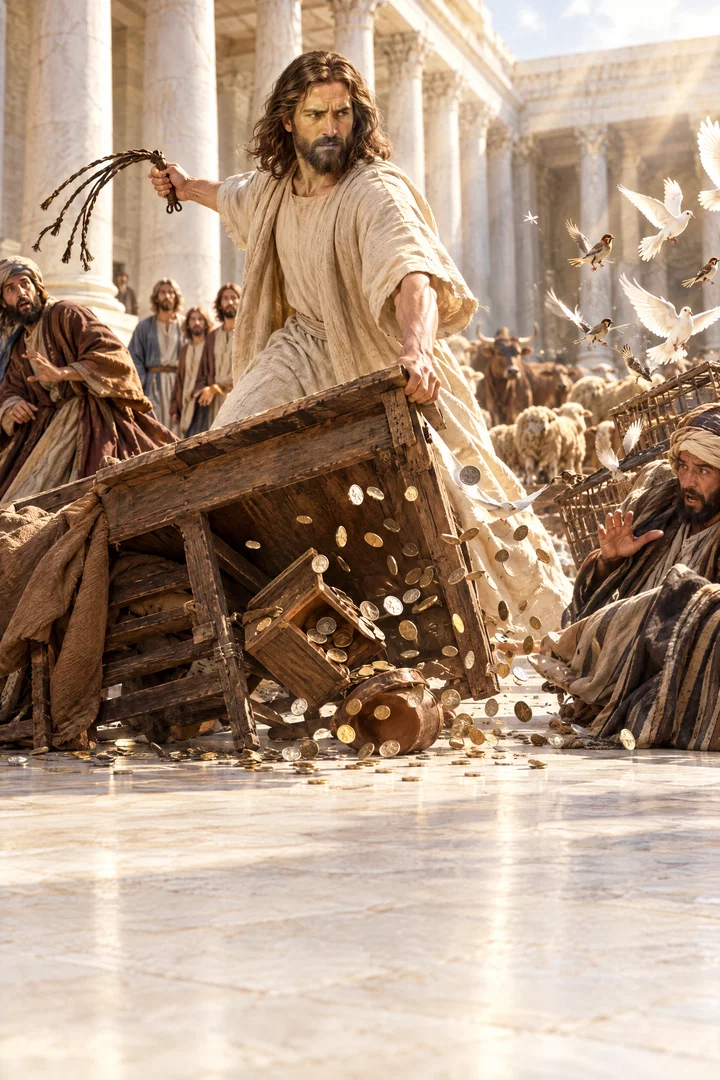
And Jesus went into the temple of God, and cast out all them that sold and bought in the temple, and overthrew the tables of the moneychangers, and the seats of them that sold doves,
Translations
American King James Version, King James Version, KJV Cambridge Paragraph Bible
And Jesus went into the temple of God, and cast out all them that sold and bought in the temple, and overthrew the tables of the moneychangers, and the seats of them that sold doves,
And Jesus went into the temple of God, and cast out all them that sold and bought in the temple, and overthrew the tables of the money-changers, and the seats of them that sold doves.
Revised Version, American Standard Version
And Jesus entered into the temple of God, and cast out all them that sold and bought in the temple, and overthrew the tables of the money-changers, and the seats of them that sold the doves;
And Jesus entered into the temple of God, and did cast forth all those selling and buying in the temple, and the tables of the money-changers he overturned, and the seats of those selling the doves,
And Jesus entered into the temple [ of God], and cast out all that sold and bought in the temple, and overthrew the tables of the money-changers and the seats of those that sold the doves.
And Jesus entered into the temple, and cast out all who were selling and buying in the temple,—and, the tables of the money-changers, he overthrew, and the seats of them who were selling doves;
Then Jesus entered the temple courts and drove out all who were buying and selling there. He overturned the tables of the money changers and the seats of those selling doves.
Then Jesus entered the temple of God and drove out all who were buying and selling there. He overturned the tables of the money changers and the seats of those selling doves.
Jesus entered into the temple of God and drove out all of those who sold and bought in the temple, and overthrew the money changers’ tables and the seats of those who sold the doves.
And Jesus went into the Temple and sent out all who were trading there, overturning the tables of the money-changers and the seats of those trading in doves.
And Iesus went into the Temple of God, and cast out all them that solde and bought in the Temple, and ouerthrew the tables of the money chagers, and the seates of them that sold doues,
Douay-Rheims (Challoner revision)
And Jesus went into the temple of God, and cast out all them that sold and bought in the temple, and overthrew the tables of the money changers, and the chairs of them that sold doves:
Pictures
Cross-references
- John 2:14-16
And found in the temple those that sold oxen and sheep and doves, and the changers of money sitting:
Jesus drives traders from the temple and commands them to remove their goods.
- Jeremiah 7:11
Is this house, which is called by my name, become a den of robbers in your eyes? Behold, even I have seen it, saith the LORD.
Jesus applies the condemnation of God’s house becoming a den of robbers.
- Mark 11:15-17
And they come to Jerusalem: and Jesus went into the temple, and began to cast out them that sold and bought in the temple, and overthrew the tables of the moneychangers, and the seats of them that sold doves;
A parallel account of Christ cleansing the temple.
- Luke 19:45-46
And he went into the temple, and began to cast out them that sold therein, and them that bought;
Luke recounts Jesus driving out temple traders and declaring the temple a house of prayer.
- Isaiah 56:7
Even them will I bring to my holy mountain, and make them joyful in my house of prayer: their burnt offerings and their sacrifices shall be accepted upon mine altar; for mine house shall be called an house of prayer for all people.
Jesus cites God’s house as a house of prayer for all people.
- 1 Corinthians 3:16-17
Know ye not that ye are the temple of God, and that the Spirit of God dwelleth in you?
Jesus cleanses God’s temple; believers are God’s temple and must keep it holy.
- John 2:15
And when he had made a scourge of small cords, he drove them all out of the temple, and the sheep, and the oxen; and poured out the changers’ money, and overthrew the tables;
Jesus drives traders from the temple and overturns the moneychangers’ tables.
- Malachi 3:1
Behold, I will send my messenger, and he shall prepare the way before me: and the Lord, whom ye seek, shall suddenly come to his temple, even the messenger of the covenant, whom ye delight in: behold, he shall come, saith the LORD of hosts.
Both describe the Lord suddenly coming to His temple.
- Matthew 21:23
And when he was come into the temple, the chief priests and the elders of the people came unto him as he was teaching, and said, By what authority doest thou these things? and who gave thee this authority?
The rulers question Jesus’ authority after his temple action.
- Psalms 69:9
For the zeal of thine house hath eaten me up; and the reproaches of them that reproached thee are fallen upon me.
Jesus’ zeal for God’s house is shown in the temple cleansing.
- John 2:17
And his disciples remembered that it was written, The zeal of thine house hath eaten me up.
The disciples recalled Scripture about zeal for God’s house after Jesus drove out the sellers.
- Matthew 21:16
And said unto him, Hearest thou what these say? And Jesus saith unto them, Yea; have ye never read, Out of the mouth of babes and sucklings thou hast perfected praise?
Jesus answers his opponents in the same temple episode.
- Mark 11:18
And the scribes and chief priests heard it, and sought how they might destroy him: for they feared him, because all the people was astonished at his doctrine.
The leaders seek to destroy Jesus after the temple cleansing.
- Luke 19:47
And he taught daily in the temple. But the chief priests and the scribes and the chief of the people sought to destroy him,
The rulers oppose Jesus as he teaches in the temple.
- 1 Corinthians 6:19-20
What? know ye not that your body is the temple of the Holy Ghost which is in you, which ye have of God, and ye are not your own?
Temple holiness calls for honoring God in the body.
- Psalms 8:2
Out of the mouth of babes and sucklings hast thou ordained strength because of thine enemies, that thou mightest still the enemy and the avenger.
The children’s praise fulfills the prophecy associated with their Hosannas.
- Psalms 118
O give thanks unto the LORD; for he is good: because his mercy endureth for ever.
Its words were sung in the temple after its cleansing.
- Matthew 27:51
And, behold, the veil of the temple was rent in twain from the top to the bottom; and the earth did quake, and the rocks rent;
The temple veil was torn when Christ died.
- 2 Corinthians 6:16
And what agreement hath the temple of God with idols? for ye are the temple of the living God; as God hath said, I will dwell in them, and walk in them; and I will be their God, and they shall be my people.
Identifies believers as God’s dwelling place.
- John 12:1-15
Then Jesus six days before the passover came to Bethany, where Lazarus was which had been dead, whom he raised from the dead.
This is identified as the final Passover setting for Matthew’s account.
Commentary
Each commentary is drawn from primary sources: the writings of Ellen G. White and Adventist pioneers and periodicals. Each commentary is separate. Its own words are not a quotation; follow the references to read the source passages.
Ellen G. White
88 sources
Jesus went into the crowded outer court of the temple at Passover and with heaven's authority drove out all who bought and sold there, overthrowing the tables of the moneychangers and the seats of those who sold doves and birds.9T 75.1–2Lt 84a, 1896, par. 3–4Ms 88, 1899, par. 1–4Ms 7a, 1886, par. 8–11ST Mar 28, 1878 This was the second cleansing, near the close of His public ministry, repeating the cleansing at its beginning after the same gain-seeking trade had returned.DA 589.1–590.2STMW7 54.1–2COS 99.1 In doing so He revealed divinity through humanity with divine majesty and kingly power as guardian of the temple, and His word struck guilty consciences and was obeyed without resistance.Lt 84a, 1896, par. 3–4Ms 7a, 1886, par. 8–11Lt 41, 1890, par. 26–29Ms 127, 1899, par. 1–4RH Feb 13, 1900 The act teaches that God's house shall be a house of prayer and must not be made a place of merchandise or a den of thieves, even when the goods are claimed to be for sacrifice.9T 75.1–2Lt 84a, 1896, par. 3–4GC 127.1ST Jan 4, 18771T 471.2–473.1 As the temple was cleansed of buying and selling, so the soul, which is a temple purchased by His blood, must be cleansed of worldliness, selfish lusts and love of money, and Christ alone can cleanse the polluted heart brought to Him in repentance and faith.ST Aug 15, 1878RH Aug 26, 1909Ms 2, 1902, par. 12Lt 102, 1905, par. 8–11Ms 73, 1893, par. 14–16
Temple Courts Profaned
What Jesus entered was the outer court of the temple, which had been arranged as a cattle market and place of general traffic with stalls for beasts, pens for animals, and tables for exchange.Ms 7a, 1886, par. 8–11ST Mar 28, 18783SP 20.21RED 74.1–2 It was crowded and noisy, filled with buying and selling, money-changing, sharp bargaining and angry disputes, quarrelling and confusion, with the lowing of cattle, bleating of sheep, cooing of doves, and chinking of coin.Ms 7a, 1886, par. 8–11ST Mar 28, 18783SP 20.21RED 74.1–2 The clamor of active market business went on as on any common day, the exchange of produce and buying and selling drowning out prayer.ST Jan 4, 18773MR 61.4
He came there early in the morning with His disciples, after coming down from Olivet.Ms 7a, 1886, par. 8–111RED 74.1–2 It was the time of Passover, when Jerusalem was crowded with people from a distance who had come for the festival, and large crowds were already going to the temple.1RED 74.1–2
Cattle, sheep, doves, sparrows, animals and birds for sacrifice were sold in the court to worshipers bringing offerings for their sins, especially travelers from far away who could not bring their own.Ms 128, 1899, par. 16–181RED 74.1–2COS 99.115MR 35.2–4 Under plea of accommodating them, sellers called out their goods and sold at the highest and exorbitant rates, influencing the trade to buy cheap and sell dear.Ms 128, 1899, par. 16–181RED 74.1–215MR 35.2–4 Because a great number of beasts were annually sacrificed at Passover the sales were immense and brought large profit to the dealers.1RED 74.1–2
What began as changing foreign and Roman coins and different denominations to accommodate strangers, and collecting the piece of money each Passover attendant paid to the priests on entering, had grown into a disgraceful traffic and source of great profit.1RED 74.1–2Ms 37, 1894, par. 6 The priests themselves acted as money-brokers and exchangers, with tables set for that work in the court.1RED 74.1–2 Priests, rulers, temple dignitaries, men of authority, ministers of sacred rites, Pharisees and doctors of the law took part in the trade and shared its profit.ST Mar 28, 18783SP 20.21RED 74.1–2ST Aug 4, 190915MR 35.2–4 As hypocritical speculators under cover of holy profession they made their sacred office a source of personal revenue, practiced extortion and robbery upon the people, and counted money gained by fraud.1RED 74.1–2ST Aug 4, 190915MR 35.2–4 Their greed overcame religious scruples and desecrated God's holy place, so that in God's sight they were no better than thieves and robbers.DA 589.1–590.2ST Mar 28, 18783SP 20.2
This was the second cleansing, done almost at the close of the public ministry during the final visit to Jerusalem before death.DA 589.1–590.2STMW7 54.1–2COL 272.3–273.1STOM 31.1 At the beginning of the ministry He had confronted the same sacrilege and driven it out, and near the close He confronted it again when the same trade that had been driven out had returned.STMW7 54.1–2COS 99.1STOM 31.1STA 39.1
Christ's Cleansing Action
Jesus entered the temple of God and cast out all who sold and bought there, driving the traders out with Heaven's authority and overturning the tables of the moneychangers and the seats of those who sold doves and birds.9T 75.1–2Ms 88, 1899, par. 1–4Ms 128, 1899, par. 16–18Ms 127, 1899, par. 1–4 Seeing men counting money gained by fraud, with eyes flashing with indignation He took up a scourge of small cords such as were used to drive cattle to the temple and drove out sellers and buyers alike.15MR 35.2–4 His command carried the power of God upon guilty consciences, so that dishonest traders obeyed in fear.Ms 127, 1899, par. 1–4
His word brought profound silence and terror, for divine glory shining through humanity struck consciences and revealed divine majesty and power.Ms 7a, 1886, par. 8–11ST Mar 28, 1878 Priests, rulers, merchants and crowds fled in fear and haste with their cattle and sheep, as if before a flashing sword like that guarding the tree of life or as if pursued by armed soldiers.Lt 84a, 1896, par. 3–4Ms 88, 1899, par. 1–4SG1 51.2EW 139.3 The traffic stopped as buyers and sellers fled, struck by conviction that He was no common man. Some on the way warned others to turn back, and those fleeing spread an exaggerated report that turned back some who were seeking Him, while others pressed on believing His power surpassed all others to relieve their suffering.ST Mar 28, 1878
His presence silenced people and animals until He stood nearly alone except for a few disciples.ST Mar 28, 1878 Yet He looked upon the fleeing crowd with profound pity, while many who remained hoped He was the long-awaited Messiah.ST Mar 28, 1878
Immediately after the cleansing the sacred space was filled with a different use, for the blind and the lame came to Him in the temple and He healed them and taught the people without interruption.Ms 23, 1908, par. 37–383SP 24.2–25.3ST Nov 15, 1883 The sick and suffering sought His help, and He received them with love and pity, healing their diseases, laying His hands upon them, and revealing true godliness and the true practical use of the temple.4MR 244.13SP 24.2–25.3 Children cried Hosanna to the Son of David, which displeased the chief priests and scribes when they saw His wonderful works.Ms 23, 1908, par. 37–38
The temple leaders had tolerated buying and selling and other disruptive conduct in the courts, yet condemned children's joyful voices and presence as pollution of the sacred place.ST Mar 28, 1878 Confronted by the rejoicing of people healed by Jesus and children praising God, they faced what their commerce had displaced: gratitude and praise in God's temple.Ms 88, 1899, par. 1–4 Though frightened, they later considered returning to challenge His authority, but did not immediately resume their trading.Ms 88, 1899, par. 1–42SP 120.2–121.1
The disciples remembered that the sellers had fled before Him as if pursued by armed soldiers.SG1 51.2EW 139.3 They hoped He would show that same commanding power again to disperse His enemies and the mob, and thereby establish Himself as King of Israel.SG1 51.2EW 139.3
Divine Authority Revealed
In driving out the traders He revealed divinity shining through humanity, acting with divine majesty and power as guardian of the temple and with the majesty and authority of Heaven's King.Lt 84a, 1896, par. 3–4Ms 7a, 1886, par. 8–11Lt 41, 1890, par. 26–29ST Mar 28, 1878 His presence struck priests, rulers, merchants and crowds with fear and conviction that He was no common man, bringing profound silence and terror so that traffic stopped and they fled as before a flashing sword like that guarding the tree of life.Lt 84a, 1896, par. 3–4Ms 7a, 1886, par. 8–11ST Mar 28, 1878 His actions carried a solemn power that the Pharisees could neither intimidate nor turn aside, and that no popular enthusiasm could stop.ST Mar 28, 1878
His word carried Heaven's authority with irresistible, God-given power that struck guilty consciences, confronted dishonest misuse of a house meant for prayer, and was obeyed without resistance in fear.Ms 127, 1899, par. 1–4RH Feb 13, 1900COL 272.3–273.1COL 273.2–3 His healing works joined His presence and command to give undeniable evidence of that authority.COL 273.2–3
The cleansing gave the people evidence of His divine mission and sacred mission as Israel's King, which should have led them to worship Him.DA 589.1–590.22SP 120.2–121.1 The authorities instead feared losing their power and chose disbelief, and their flight revealed fear and ignorance of true worship.ST Aug 4, 19092SP 120.2–121.1 Though frightened, they later returned to the courts yet did not immediately resume their trading.2SP 120.2–121.1
His kingly authority exposed the priests and rulers as hypocrites and robbers who had extorted the people and desecrated the temple while claiming to perform acceptably the sacred services God had ordained.ST Aug 4, 1909Ms 120, 1901, par. 5–6 The richness and beauty of the building did not sanctify its worshipers.Ms 120, 1901, par. 5–6 They charged Him with profaning the temple and declared Him its enemy, but by cleansing it openly before all the people He showed Himself a truer friend to the temple than those violating its sacredness.Ms 120, 1901, par. 5–6
His command, given at the beginning and again near the close of His ministry when divine authority shone through His human form against sacrilege that had turned sacred courts and Passover service into profit and worship of mammon, foreshadowed the voice of judgment.STMW7 54.1–2 It stands as repeated warning that those who reject messages and refuse pardon will face solemn declaration of their hidden sins yet be unable to act or prepare themselves.STMW7 54.1–2
Worship and Sacrifice Taught
God's house is to be called a house of prayer and must not be made a place of merchandise, commercialism, or a den of thieves, for unholy buying and selling profaned its courts and brought righteous indignation.9T 75.1–2Lt 84a, 1896, par. 3–4RH Aug 13, 1908RH Feb 13, 1900 In driving out the traders Christ revealed divinity through humanity, and His presence struck the priests and rulers with such fear that they fled as though before a flashing sword like the one guarding the tree of life.Lt 84a, 1896, par. 3–4 The same money-changing condemned in the verse is selling the grace of God, when the tables of the money-changers were set beside altars with the air resounding with buyers and sellers, publicly selling indulgences for sin by papal authority to raise money for building St. Peter's church at Rome.GC 127.1GC88 126.4 Building a temple for God's worship by the price of crime, with the cornerstone laid with the wages of iniquity, corrupted sacred worship by commerce, and the very means used for aggrandizement provoked the deadliest blow to power and shook the papal throne.GC 127.1GC88 126.4
Trade for profit did not belong in the sacred place even when sellers claimed their goods were for sacrifices, and such traffic during religious meetings distracts people from worship and lowers sacred things to the level of ordinary business.1T 471.2–473.1 At Passover the court was turned into a noisy market with animals for sacrifice and money-changing, where priests and merchants profited from offerings and sold animals at exorbitant prices, exploiting worshipers who had traveled from far away.ST Jan 4, 1877 The traffic was in the outer court, where animals and birds were sold to people bringing sacrifices for their sins, those running the trade practicing extortion and robbery.COS 99.1 The bargaining disturbed worship and drowned out prayer in the temple and disturbed the worshippers inside, and though Jesus had driven the sellers out three years earlier the same trade had returned.ST Jan 4, 1877COS 99.1
Buying and selling had turned sacrificial worship into a means of gain and a worship of mammon, obscuring that animal sacrifices pointed to Christ's blood soon to be shed for the world and that sacrifice without repentance and obedience did not honor God.DA 589.1–590.2STMW7 54.1–2 The priests and rulers were involved in the trade, and greed had made them like thieves in God's sight, yet by driving out the traders and overturning their tables Jesus gave the people evidence of His divine mission as Israel's King, even though reforming the hardened priesthood would not succeed.DA 589.1–590.2 At the beginning and again near the close of His ministry He confronted this sacrilege with divine authority shining through His human form, and His command foreshadowed the voice of judgment with the solemn declaration of hidden sins upon those who reject messages and refuse pardon yet will be unable to act or prepare themselves.STMW7 54.1–2 The crowded animal market and the leaders' avarice and dishonest trading profaned the sacrifices, for the shedding of animals' blood pointed to sin and prefigured the blood of God's Son to direct people to the crucified Redeemer.3SP 21.1–2ST Mar 28, 1878 The people's familiarity with animal blood and their repeated sacrifices and trade had made the sacred services familiar and profane, obscuring that sin made the sacrifices necessary and that Christ's blood was their true meaning, so that Jesus was indignant that priests and elders who had lost sight of this valued His coming sacrifice no more than the animals' blood.3SP 21.1–2ST Mar 28, 1878
The same rebuke condemns selling merchandise during religious meetings and conducting feasting and unholy trade in churches in the name of religion to raise money by appealing to appetite, greed, or pleasure, for Jesus would drive out those who desecrate them as He drove the money-changers from the temple.1T 471.2–473.1GC88 474.2GC 474.2–475.1 It condemns fashionable churches where extravagant dress and display distract from worship and dishonor God's house, as treating such a place as a setting for display rather than worship.4T 642.4–643.1 His action condemns commercial activity that profanes the temple and confronts the misuse of the temple courts with heaven's authority against dishonest traders.RH Aug 13, 1908RH Feb 13, 1900
The noisy activity and exchange of buying and selling in the temple courts, with noisy clamor and active market business in the exchange of produce going on as on any common day, is compared to busy Sunday markets with stores and a market open and busy, as seen at Nimes.Ms 70, 1886, par. 93MR 61.4 That commerce is presented as evidence that Sunday had no sacredness to the people.Ms 70, 1886, par. 93MR 61.4
Prophecy and Final Warning
The cleansing of the desecrated temple, together with the triumphal entrance and the barren fig tree, pointed to the coming doom of Jerusalem and the judgment awaiting a city that rejected love and compassion.3SP 20.1ST Aug 4, 1909ST Jan 10, 1878 It symbolized the dispersion of the Jewish nation for wickedness and impenitence, exposing rulers as hypocrites and robbers who extorted the people and revealing their fear and ignorance of true worship.ST Aug 4, 1909ST Jan 10, 1878 The driving out of buyers and sellers and the overturning of the moneychangers' tables and the seats of those who sold doves displayed kingly authority in that judgment.ST Aug 4, 1909ST Jan 10, 1878
There were two cleansings for sacrilegious profanation, one at the beginning of the public ministry and one almost as its last act near the close, the second answering to the first.STOM 31.1STBk 39.1–40.14MR 242.1Lt 1f, 1890, par. 16–17 Together they foreshadow the last work for warning the world, in which two distinct calls are made to the churches.STOM 31.14MR 242.1Lt 1f, 1890, par. 16–17 The second cleansing answers to the second call, the voice from heaven to come out of Babylon because her sins have reached unto heaven and God has remembered her iniquities, even as God called Israel out of Egypt to keep His Sabbath.STOM 31.1STBk 39.1–40.14MR 242.1Lt 1f, 1890, par. 16–17 That final warning includes the second angel's message and the call for God's people to come out of Babylon.4MR 242.1Lt 1f, 1890, par. 16–17
The cleansing at the beginning and the cleansing at the close together illustrate that Christ purifies His church through tests and trials for its present and eternal good.9T 228.2Ms 34, 1900, par. 47RH Sep 24, 1903 Those trials deepen piety and strengthen His people to carry the triumphs of the cross throughout the world.9T 228.2RH Sep 24, 1903 The temple was cleansed at the first advent because commercial work had been brought into it and God had been forgotten, and this points to a cleansing before the second advent when God will purify His temple in displeasure.Ms 11, 1903, par. 15–17 Religious claims do not excuse conduct forbidden by God's Word, God's law measures obedience, and hurried business must not displace thought of heaven.Ms 11, 1903, par. 15–17 Turning the courts from worship into unholy trade reflects rejection of mercy, warnings, and invitations, repeating the path of the Pharisees who despise reproof and treat God's messages with scorn.Ms 8, 1898, par. 1
The same desecration was repeated when the tables of the money-changers were set beside altars and indulgences for sin were publicly sold by papal authority to raise money for building St. Peter's church at Rome.GC 127.1GC88 126.44SP 101.3 Making merchandise of the grace of salvation and selling the grace of God is the same sin as making God's house a place of merchandise.GC 127.1ST Jul 12, 1883 Building a temple for God's worship by the price of crime, with its cornerstone laid with the wages of iniquity, is the money-changing condemned in the driving out of buyers and sellers and the overturning of their tables.GC 127.1GC88 126.44SP 101.3 The very means used for aggrandizement provoked the deadliest blow to that power and shook the papal throne, overturning religious commerce.GC 127.1ST Jul 12, 1883
Heart Cleansed as Temple
Just as the Jerusalem temple was to be cleansed of buying and selling, so the soul, which is a temple where Christ should be enshrined, is to be cleansed of worldliness, worldly interests, merchandise and commercial cares.RH Aug 26, 1909Ms 2, 1902, par. 12Lt 102, 1905, par. 8–11Ms 148, 1899, par. 20–22 The soul is a temple belonging to God for which He has paid the price of His own blood, and when given to deeds of darkness and sin it is degraded, desecrated and defiled.Ms 73, 1893, par. 14–16Ms 9, 1880, par. 37–42 This cleansing illustrates Christ purifying the soul by removing cherished sins and everything that tarnishes or corrupts it.Ms 148, 1899, par. 20–22 Selfish or corrupt dealings desecrate the soul temple and disregard divine counsels.Ms 2, 1902, par. 12
The temple courts filled with unholy trade and confusion represented hearts defiled by earthly desires, selfish lusts and evil habits.ST Aug 15, 1878RH Dec 31, 1908 That defilement corrupts the heart, which should be Christ's dwelling place, with selfishness, love of money and of the world and mammon, malice, envy, pride, passion and unholy passions.3SP 12.15T 72.3TBC1882 54.2–3 The rebellious heart thus becomes a den of thieves and a robber's haunt, and rejecting Christ's mercy leaves it bound in doubt and despair and exposed to judgment.ST Aug 15, 1878Ms 9, 1880, par. 37–42 This condition reveals base ingratitude, hollow formalism, hypocritical insincerity, Pharisaical pride and apostasy among His professed followers, repeating the neglect and rejection of present opportunities.TBC1882 54.2–3 The temple was meant to witness to the high destiny open to every person, but the Jews did not yield themselves as temples for God's Spirit.RH Dec 31, 1908
The defiled temple courts picture a soul polluted by sin and given over to Satan's rule, which Christ alone can cleanse and keep.Ms 73, 1893, par. 14–16 The sinner must bring the polluted soul to Christ in repentance and faith, ask Him to wash and purify it, and commit it to His care.Ms 73, 1893, par. 14–16 Jesus sees the soul temple in its degraded condition.Ms 9, 1880, par. 37–42
He searches the temple as the citadel of the soul, the heart, to test whether selfish gain remains within.Lt 41, 1890, par. 23–25 When truth has an abiding place within and, through the Holy Spirit, shapes all that a person does and says, and God is enthroned in the heart, He finds no buyers and sellers to condemn.Lt 41, 1890, par. 23–25Lt 5b, 1891, par. 13 His cleansing of the temple from fraud and pollution reflects His desire to cleanse hearts from everything resembling fraud, and His fearless denunciation of dishonest practices and hypocrisy shows that truth did not languish on His lips.RH May 12, 1910
Goods, abilities, means, and physical and mental powers entrusted by God are sacred and must be kept unmingled with worldly business and commercial cares and invested only in the Master's service for results as far reaching as eternity.RH Aug 26, 1909Lt 102, 1905, par. 8–11 Worldliness leavens the mind, destroys the sense of accountability as God's servants, and takes away spiritual discernment.Lt 102, 1905, par. 8–11 The mind must therefore be unloaded of extra burdens that hinder devotion, searching the Scriptures, and prayer.Lt 102, 1905, par. 8–11 Cleansing brings singleness of aim to do the Master's bidding and promote His work, upward growth, the work of the Holy Spirit on the heart to transform the character, death to self, kindness and tender regard for others, and change into Christ's likeness by beholding Him.Lt 102, 1905, par. 8–11
Call to Cleanse Institutions
The driving out of buyers and sellers from the temple belongs also to publishing houses when they are devoted principally to commercial work.Lt 140, 1901, par. 1–4Lt 129, 1895, par. 1–3Lt 46, 1903, par. 9–10 When managers take in a mass of outside work requiring increased facilities and workers and enter into contracts to publish questionable matter merely for commercial gain, the sacred purpose for which the institutions were established to publish present truth is lost sight of.Lt 140, 1901, par. 1–4 Spiritual perception is then perverted, the work is cheapened and regarded as any other commercial enterprise, and the office is made spiritually unfit by commercial work that displeases God and carries false teaching.Lt 140, 1901, par. 1–4Lt 46, 1903, par. 9–10 The temple's cleansing is applied to a coming cleansing of the Review office.Lt 129, 1895, par. 1–3
If present, He would cleanse the office of all things that defile it and command them to be taken away, for He will not leave what dishonors God in a place set apart for His work.6MR 268.1–269.3 The defiling things are literature that dishonors the Redeemer, unsettles faith in Christianity, sows seeds of doubt, questioning and unbelief in youth and workers, undermines the authority and purity of the Old Testament Scriptures, and argues Christ was only a man.6MR 268.1–269.3 Accepting, printing and sending it out with approval lets Satan and his sophistry into the office and sends forth educated infidels.6MR 268.1–269.3
The same cleansing will soon fall on the publishing house at Battle Creek, the Review and Herald office, because justice and integrity and the love of God are not teaching and guiding its leading men and managers.SPBC 166.6Lt 83, 1896, par. 38–4018MR 218.1–3 Their perverse, unsanctified working out of straightforward righteous lines, every unfair scheme savoring of selfish grasping practiced over and over despite reproof, with injustice, fraudulent dealings, controlling practices, arrogance, misuse of authority and dictating of consciences, is iniquity that makes hearts harder and more unimpressible the more it is practiced.Lt 83, 1896, par. 38–4018MR 218.1–3Lt 76, 1895, par. 9–11 God has borne with it long, but His wrath is kindled against this unprincipled work, and He will cleanse it as He cleansed the temple from moral pollution, so its corrupt practices must be corrected that God's name be not dishonored and Jesus be welcomed as a heavenly guest.SPBC 166.618MR 218.1–3Lt 76, 1895, par. 9–11STMW6 45.2 For this reason there shall be publishing plants in other places, no longer dependent on Battle Creek.18MR 218.1–3 A large work of cleansing the temple and its courts, a putting away of unholy things desired for every church, was started but failed of completion and remains undone, especially among those in responsible positions whose faith is dead being alone and who quench the work of the Spirit, and the life and power of God cannot be manifested until there is seen that faith which works by love and sanctifies the soul.Lt 163, 1899, par. 9–10
The cleansing of the temple courts must take place in God's institutions before the work Christ did after the cleansing can be done, and that work has not yet been done.4MR 244.1 After the cleansing all the sick were brought to Him and He laid His hands upon them and healed them all, revealing true godliness, true righteousness, and the true practical use of the temple that brings no defilement.4MR 244.1 This cleansing serves as a pattern for God removing people from positions of responsibility when their conduct is unfit.Lt 57, 1891, par. 7–9 The same kind of cleansing, if He entered schools, would remove defiling influences from them.CT 25.2FE 174.2 Books that should be replaced with sound knowledge and teachings that can be kept in the heart and guide conduct would be taken away, for books and teachings defile the mind through false principles, false reasoning, and Satan's sophistries.CT 25.2FE 174.2
The cleansing of the temple courts of their commercial enterprises is a pattern for sanitariums, which need to be cleansed in the same way.Lt 225d, 1906, par. 15–16 The cleansing belongs with restoring the sick to health and ministering the Word pointing to Christ as the great Healer of sin-sick souls, and with refusing to be beguiled and ensnared by the cunning craftiness of men who lie in wait to deceive ignorant, unwary souls.Lt 225d, 1906, par. 15–16 In the temple the sellers exacted exorbitant prices from people seeking animals for sacrifice, and the act that overturned the money changers' tables and the seats of those selling doves rebukes exploitation and reveals divine character through human actions.Lt 41, 1890, par. 26–2915MR 35.2–4 The same rebuke applies to Christian physicians who charge excessive prices, for their business dealings like those of everyone else must follow God's standard of righteousness.Lt 41, 1890, par. 26–29 The Pharisees and doctors of the law had brought dishonest trade into God's house by influencing sellers to buy cattle cheap and sell them dear to worshipers coming from a distance who could not bring offerings and were compelled to buy in Jerusalem, and seeing men counting money gained by fraud, with eyes flashing with indignation He took up a scourge of small cords used to drive cattle to the temple and drove out those who sold and bought.15MR 35.2–4 Immediately after cleansing He did medical missionary work by healing the blind and lame who came to Him in the temple.15MR 35.2–4 Selfishness, which is an attribute of Satan, governs action and determines character and destiny, and when it enters medicine it makes even lawful-seeming charges unlawful extortion, so that a multitude of sins has been covered under the profession of medicine and as a general thing the medical profession has become a den of thieves.1MR 211.1 Christ would cooperate with and beautify the work of the Christian physician who bears His presence, but when physicians become extortioners all He can do is drive them from His courts as He cast out buyers and sellers from the temple.1MR 211.1 The same cleansing must reach marketplaces, merchandise stores, courts of justice, lawyers' offices, the medical fraternity, and medical missionary work itself, for God will be a party to no dishonest transaction, and Sabbathkeepers stamped with the sign of God's government must honor that sign by honest dealing and by following Christ's methods given in Isaiah 58.15MR 35.2–4
The traffic there was dishonest, unfair buying and selling that transgressed the law of God.Ms 120, 1901, par. 7 Professing Christians who are dishonest in their transactions, unfair in buying and selling, and who take advantage of the confidence others place in them because they are church members, commit the same sin.Ms 120, 1901, par. 7 All who in business relations disregard the divine precepts are transgressors and rebels against the Creator and Redeemer of the world, and will suffer the consequences that must come upon every transgressor.Ms 120, 1901, par. 7
Sources
Pioneers and periodicals
80 sources
Jesus entered the temple of God and drove out all who bought and sold there, overturning the tables of the moneychangers and the seats of those who sold doves in the second cleansing of the temple at the close of His ministry, shortly before His suffering and death.ST Oct 4, 1899ST Apr 14, 1898RH Apr 24, 1879ST Dec 23, 1886 The traffic filled the outer court, the court of the Gentiles where Gentiles could come to learn of the true God, turning the house of prayer into a noisy marketplace of animals, bargaining and exchange that took advantage of worshipers from distant lands.ST Mar 28, 1878ST Apr 14, 1898RH Nov 10, 1863ST Oct 7, 1913ST Feb 22, 1899 He acted as Author, owner, guardian and King of the temple with heaven's authority, His divinity flashing through His humanity to silence traffic and compel buyers, sellers and dignitaries to flee.RH Nov 10, 1863ST Oct 7, 1913 God's house was to be a house of prayer for all nations and all people, not a den of thieves or a place for common commerce, secular business and extortionate gain.ST Oct 4, 1899CO 78.1–2RH Nov 10, 1863 The tables of the moneychangers mean modern church fairs, bazaars, raffles, entertainments and sales for sacred uses, which profane God's house, while the courts filled with unholy trade picture hearts defiled by sin and worldliness that must be cleansed to become a pure dwelling for God's Spirit.ST Aug 15, 1878RH Aug 26, 1909ST Nov 19, 1894ST Apr 15, 1880ST Dec 29, 1887
Cleansing Described
Jesus went into the temple of God and cast out all who bought and sold there, overturning the tables of the moneychangers and the seats of those who sold doves.ST Oct 4, 1899ST Apr 14, 1898ST Dec 23, 1886RH Nov 10, 1863ST Oct 7, 1913 He drove out the buyers and sellers and expelled the money-changers, removing their trade and rebuking the misuse of the temple before teaching there.ST Oct 4, 1899ST Apr 14, 1898ST Dec 23, 1886RH Nov 10, 1863ST Feb 22, 1899 He would not allow the temple to be used for ordinary traffic and confusion.ST Oct 4, 1899ST Feb 22, 1899 His presence and conduct compelled submission, stopping its desecration from common commerce.RH Nov 10, 1863ST Oct 7, 1913
The traffic stood in the outer court, the court of the Gentiles.ST Mar 28, 1878ST Apr 14, 1898RH Nov 10, 1863 That was the only part of the temple where Gentiles could come to learn of the true God, assigned to Gentile worship and intended as a place of prayer.ST Apr 14, 1898RH Nov 10, 1863 Love of money and greed overrode religious scruples, and the court was turned from prayer into a noisy marketplace filled with animals for sacrifice, bargaining, and money-changing.ST Mar 28, 1878ST Jan 4, 1877ST Apr 14, 1898 The bargaining and traffic disturbed worship and drowned out prayer, desecrating God's holy place.ST Mar 28, 1878ST Jan 4, 1877
This was the second time Jesus cleansed the temple.ST Apr 14, 1898ST Feb 22, 1899 It belongs to the close of His ministry, shortly before His sufferings, death and crucifixion, at the last Passover He attended.RH Apr 24, 1879ST Feb 22, 1899ST Feb 14, 1878 It is distinct from the earlier cleansing at the beginning of His ministry, performed at Passover early in His ministry in A.D. 28 and described in John 2:13-14.RH Apr 24, 1879ST Aug 20, 1894 The later cleansing was repeated three years afterward and is the same event recorded in Mark 11:15 and Luke 19:45.ST Oct 7, 1913ST Feb 22, 1899 Those who identify it with John 2 hold it to be the same cleansing described there as well as in Mark 11:15 and Luke 19:45.ST Oct 7, 1913
The cleansing came after the triumphal entry and belongs to a remarkable scene shortly before Christ's sufferings and death.STST Feb 14, 1878 The surrounding scene joined the people's joyful welcome, prompted by the mighty works they had witnessed including healings, cleansings, restored sight and raising the dead, with His coming to Jerusalem amid the hallelujah cry and weeping over the city, also found in Luke 19, Mark 11 and John 12, with Luke 19 giving the fullest account.ST It occurred on the second day of the week, the Monday before the Passover when He cursed the fig tree.ST Dec 23, 1886 It took place at Passover time, when He entered the temple at Passover shortly before His crucifixion.ST Jan 4, 1877ST Feb 14, 1878ST Aug 9, 1910
Worshipers come from distant lands and from far away had to exchange foreign money and foreign coins for sanctuary currency and buy animals for sacrifice.ST Jan 4, 1877ST Oct 7, 1913ST Feb 22, 1899 The animals included sheep, oxen and doves.ST Jan 4, 1877ST Aug 9, 1910 The traders took advantage of them by charging exorbitant rates of exchange and exorbitant prices, and the money-changers charged heavily for the exchange.ST Jan 4, 1877ST Oct 7, 1913ST Feb 22, 1899 Priests and merchants profited from the offerings and from selling animals, sanctioned the traffic, had a personal interest in it, and made the exaction extortion that robbed those who came there.ST Jan 4, 1877RH Apr 11, 1907 Even ministers of sacred rites and temple dignitaries took part in the buying and selling there.ST Mar 28, 1878 After driving out the greedy money-changers and sellers and purifying the holy house of its commercial traffic, He healed the sick, the blind and the lame who came to Him there.ST Aug 9, 1910
Meaning and Authority
God's house was to be a house of prayer for all nations and for all people, not a den of thieves or a den of robbers.RH Aug 13, 1908ST Oct 4, 1899CO 78.1–2RH Nov 10, 1863ST Oct 7, 1913 It was not to be used for ordinary traffic, common commerce, common traffic, or secular business, and commercial activity that profaned it stood condemned.RH Aug 13, 1908RH Feb 13, 1900ST Oct 4, 1899CO 78.1–2ST Oct 7, 1913 The courts were not to be profaned by commerce, for the space assigned to Gentile worship had been turned into a place for trade.RH Nov 10, 1863ST Oct 7, 1913 Traders had brought their traffic into the courts and taken advantage of worshipers come from distant lands who had to exchange foreign money and buy animals for sacrifice, charging exorbitant rates of exchange and exorbitant prices.ST Oct 7, 1913 The temple was most sacred as the place of the divine presence in the holy of holies and as divinely appointed to show sinners the way of salvation, yet it had been made a den of thieves instead of a house of prayer.RH Feb 13, 1900ST Oct 7, 1913
The act exposed the corruption of the Jewish church and the greed and avarice flourishing in the sacred courts where trade had taken over.ST Mar 28, 1878ST Jun 27, 1900 Greed overrode religious scruples, priests and merchants profited from offerings and from selling animals at exorbitant prices while exploiting worshipers who had traveled from far away, and even ministers of sacred rites and temple dignitaries took part in the buying and selling.ST Mar 28, 1878ST Jan 4, 1877 In God's sight they were no better than thieves, for their traffic desecrated God's holy place and turned His dwelling place into a den of thieves.ST Mar 28, 1878RH Jun 6, 1907 His kingly authority exposed the priests and rulers as hypocrites and robbers who had extorted the people, and their flight revealed their fear and ignorance of true worship.ST Aug 4, 1909 The traffic and bargaining disturbed worship and drowned out prayer, and the cleansing prepared the way for healing the blind and lame in the temple without bringing honor to a dishonorable church or dishonor to God.ST Jan 4, 1877ST Jun 27, 1900
The priests and rulers had lost sight of the meaning of the sacrifices, for the shedding of animals' blood pointed to sin and prefigured the blood of God's Son, directing people to the crucified Redeemer.ST Mar 28, 1878 Their repeated sacrifices and trade had made the sacred services familiar and profane, even as the same sellers and buyers desecrated the temple again near the close of His earthly mission as at the beginning of His ministry.ST Mar 28, 1878 At the same time the temple leaders tolerated buying and selling and other disruptive conduct within the courts while condemning children's joyful voices and presence as pollution of the sacred place.ST Mar 28, 1878
Jesus acted as Author of the temple and its service, with heaven's authority, divine majesty and power, and divine authority that adversaries could not resist.RH Feb 13, 1900ST Oct 7, 1913RH May 13, 1902 Divinity flashed through humanity and shone through His humanity in stern rebuke and display of divine power, and zeal for His Father's house fulfilled Psalm 69 that zeal for God's house would eat Him up.ST Oct 7, 1913RH May 13, 1902 His presence and conduct compelled submission, stopped the traffic, silenced the desecration, and caused buyers, sellers, priests and rulers to flee with the conviction that He was no common man.RH Nov 10, 1863ST Feb 14, 1878 As guardian, owner and King He saw a spectacle out of harmony with the purpose of its dedication and His Father's plan, and He could not remain indifferent to desecration of sacred worship when the eternal life of men was at stake, giving the desecrators a miniature idea of judgment realities.ST Oct 7, 1913 While He patiently endured personal reproach, He used mighty power shortly before His crucifixion to drive out the money changers and merchants, warning that those who ignore privileges and the Spirit's warnings let probation run out.ST Oct 7, 1913ST Feb 14, 1878
Prophecy and Judgment
The cleansing belongs to the triumphal entry shortly before suffering and death, when Jesus came to Jerusalem amid joyful welcome and weeping over the city.ST He came as the promised lowly Prince of peace, not as a conquering hero.ST Mar 27, 1901 The welcome was prompted by the mighty works the people had witnessed, including healings, cleansings, restored sight, and raising the dead. The actions of the people and the cries of disciples and children shouting Hosanna to the Son of David accorded with and fulfilled prophecy.ST Mar 27, 1901RH Feb 6, 1866 But the rulers rejected Him, and the multitude's faith weakened when He did not meet their expectations.ST Mar 27, 1901
The passage from the entry through the cleansing is a fulfillment of the prophecy of the rejected stone becoming the cornerstone and of the day the Lord made, identified with the resurrection day, yet it does not establish a change of the Sabbath.RH May 10, 1860 Those who hold the other reading agree that the same account fulfills the prophecy of the rejected stone becoming the chief cornerstone, but hold that it does not identify a resurrection day, mention the Sabbath, or teach that the Sabbath was changed.RH May 10, 1860
Together with the barren fig tree, the cleansing pointed to Jerusalem's coming doom, showing the judgment awaiting a city that rejected Christ's love and compassion.ST Jan 10, 1878 The scene also symbolized the dispersion of the Jewish nation for wickedness and impenitence, as His kingly authority exposed hypocrites and robbers who had extorted the people.ST Aug 4, 1909 He preached the gospel and laid down His life in His work at Jerusalem, yet He did not save the city.RH Jul 7, 1910 Its continued defilement after the cleansing led to its trustees killing Christ, the tearing of the veil, and the temple's final destruction.RH Dec 23, 1909
The cleansing foreshadows Christ's return, when He will drive from His temple those who make it a house of merchandise and are attached to the world.RH May 30, 1865 The two cleansings, one at the beginning and one near the end of His ministry, correspond to two distinct calls in the final warning to the world: the second angel's message that Babylon has fallen, and heaven's call for God's people to come out of Babylon because of her sins.ST Feb 13, 1893 Nehemiah's prohibition of selling on consecrated ground was a faint type of Christ driving sellers from the temple courts.ST Nov 15, 1899
The cleansing illustrates what Jesus still does when He makes His triumphal entry through the power of the cross, suddenly coming to His temple as the Messenger of the covenant with the power of the royal priest to refine and purify as silver and gold so that a righteous offering can be made.ST May 28, 1902 Driving thieves and robbers from the Jerusalem temple pictures why He took part of flesh and blood after the fall: to meet Satan in his stronghold and drive him out, destroying him who had the power of death and delivering those who were in bondage to him.ST Oct 10, 1895
Church Teaching
The driving out of buyers and sellers with the overturning of the moneychangers' tables and the seats of those selling doves struck at the Jewish priestly system, which had been perverted from its divinely appointed design and whose family-based order could not foreshadow the glory of Christ the great High Priest, so that it passed away and was succeeded by Christ's universal priesthood. Together with the cleansing at the beginning of His ministry, this cleansing shows how Christ purifies His church, with the trials He brings serving its present and eternal good and strengthening His people for their work.RH Sep 24, 1903 The temple represents the church, which Christ's representatives are to keep pure while proclaiming the gospel of salvation from sin.ST Oct 7, 1930 The cleansing of God's house as a house of prayer stands as a rebuke to corruption in the church where money can control its offices and shield wrongdoing from discipline.ST Sep 9, 1889
The driving of sellers of oxen, doves and other things exposes the enormous corruptions introduced into the church under the Papacy and lays a duty on Christians to remove as far as in their power images, pictures, monasteries and all instruments fostering idolatry and image-worship, since magnificence of temples and splendid apparatus fascinate the senses and imaginations of the people and pulling them down keeps them from returning. The same driving of buying and selling applies to religious shrines where offerings and ceremonies gather money for apostate Christianity rather than imparting spiritual grace.RH Jul 1, 1909 Protestant churches joining in observance of a Roman Catholic institution shows the temple is in need of cleansing.RH May 23, 1912 This was the only use of force in connection with the services of His house, used to drive men out of His temple and to clear the sanctuary of those defiling it and of unworthy people, not to drive or compel them in to worship, for coming to Christ must be of free will by invitation and not by force, and making the church a place of punishment for criminals or sentencing men to attend mass or practice religion is contrary to Christ's purpose in establishing the church and to the gospel.RH Dec 31, 1914RH Sep 24, 1914
Ministers dedicated to God and the care of souls must not be diverted from their proper pulpit work to trading and secular business, but be driven from the bargain counter back to the pulpit, meeting the old difficulty of keeping the preacher in the pulpit.ST Mar 23, 1915 Rebuking a corrupt church before healing the blind and lame there made it possible for healing works to honor God rather than disgrace Him by bringing honor to a dishonorable church, serving as an example for confronting sin even when it leads to rejection, yet the display of authority was not to be used to advance His kingdom by force or carnal means, which Peter had not learned when he remembered it and hoped Jesus would use it again.ST Jun 27, 1900ST Jun 27, 1900ST Mar 14, 1906 Jesus took possession of the temple as His own and cleansed it though He was neither priest nor Levite, and the temple was the only public building the Romans had left under Jewish control with its authorities as its keepers, so they felt their rights invaded.ST Oct 11, 1899 His bold, striking intervention disrupted their arrangements, was deemed presumptuous for interfering with those responsible for the temple, provoked challenge to His authority, displayed disregard for priestly and scribal prestige, and increased the hatred and jealous anger of the proud Sadducean priesthood who had sanctioned the merchandising, had a personal interest in it, and profited from the desecration that turned a house of prayer for all people into a den of thieves.ST Jun 15, 1882ST Oct 5, 1904ST Mar 6, 1901
He acted when religious leaders' traditions set aside God's commandments and kept people from entering the kingdom, and His brief exposure of hypocrisy served saving not condemning, while His grief over Jerusalem shows His desire to bring its people to peace and gather them to Himself.RH Aug 27, 1914 Removal of buyers, sellers and moneychangers' tables rebuked the temple's misuse and purified the holy house of commercial traffic in sheep, oxen and doves, and was followed by teaching there and by acts of mercy and instruction in which He healed the sick and the blind and lame who came to Him there.ST Nov 15, 1883ST Jun 27, 1900ST Dec 23, 1886ST Jun 27, 1900ST Aug 9, 1910 The presence of children praising Him in the courts provides a precedent for children witnessing by simple words to truth religious leaders have not discerned.RH Apr 11, 1912
Scripture Parallels
The cleansing here is the same event recorded in Mark 11:15 and Luke 19:45, while the cleansing in John 2:13-14 was a separate cleansing at the beginning of Jesus' ministry. Those who held otherwise taught that it was the same cleansing described in John 2 as well as in Mark 11:15 and Luke 19:45.ST Oct 7, 1913 The coming to Jerusalem amid the hallelujah cry and weeping over the city is also found in Luke 19, Mark 11, and John 12, with Luke 19 giving the fullest account.ST
The act fulfilled Psalm 69, that zeal for God's house would eat Him up.ST Oct 7, 1913 While He patiently endured personal reproach, He could not remain indifferent to desecration of sacred worship when the eternal life of men was at stake.ST Oct 7, 1913 His stern rebuke and display of divine power gave the desecrators a miniature idea of judgment realities.ST Oct 7, 1913
The full action included driving out unrighteous people with a whip of small cords.ST Oct 7, 1930 It also included forbidding people to carry vessels through the temple, stopping its desecration from ordinary trade and traffic.ST Dec 16, 1897 The chapter belongs to the lesson that Jesus longed for fruit from His own people.ST Jul 15, 1908ST Jul 15, 1908 That longing was shown in the cursing of the fig tree on the Monday of the cleansing, the Monday before the Passover.RH Jan 29, 1914
Personal Application
Places of worship must be kept free from profane or commercial uses so that they remain houses of prayer for all people, for what God has made holy must not be made common.CO 78.1–2RH Mar 15, 1870 Jesus drove out those who bought and sold because His Father's house was to be a house of prayer and not a den of thieves.CO 78.1–2
The tables of the moneychangers mean modern church fairs, festivals, feasts, sanctified lotteries, raffles, bazaars, entertainments and sales aimed at worldly appetites to raise money for sacred uses.ST Apr 15, 1880ST Dec 29, 1887ST Jun 10, 1875 Though the sellers in the temple offered sacrificial offerings, a more legitimate trade than selling church amusements, and though such trade may be legitimate elsewhere, conducting it in God's house profanes it.ST Nov 19, 1894ST Dec 29, 1887 Turning worship and giving into seeking profit and avoiding sacrifice makes the temple like Babel and leaves the lambs uncared for, and worldly churches must humble themselves and return to faithful worship.RH Jan 19, 1869 Churches that raise money through entertainments and sales aimed at worldly pleasures follow the same practice the cleansing condemned and cannot please Christ.ST Jun 10, 1875
Money gained by such means comes from unclean hands, is unfit for God's service, and must be refused and sent back to the hands it came from even if refusal cripples the congregation.ST Apr 15, 1880 Giving for God's cause should come from duty, need and love, not from schemes that compensate the giver with pleasure and avoid sacrifice. Raffling, as gambling, is wrongful everywhere and makes a church fair still more improper, despite any disturbance caused by driving it out.ST Dec 29, 1887 Exchanging money for admission cards in a church lobby recalls those tables and warns against using a place devoted to God for trade.ST Dec 16, 1897
Driving buyers and sellers out is applied also to driving office-seeking chaplains out of a saloon, as a profanation of religion He would reject.ST Jan 18, 1899 His cleansing of the temple serves as a pattern for cleansing sanitariums, with the warning that if they are not reformed the house will be left desolate. His entering Jerusalem, cleansing its temple, preaching the gospel and giving His life there though He did not save the city calls His followers to enter sinful cities, serve and preach there, and be willing to give their lives even if they cannot save the city.RH Jul 7, 1910
Opposing corruption of sacred things by worldly gain brought Him into conflict with established interests and popular expectations, showing He would not compromise convictions or lower God's standard for honor or approval.ST Oct 11, 1877 The merchandising had been sanctioned by chief priests and scribes who had a personal interest in it, so the cleansing displayed disregard for their prestige and intensified their jealous anger.ST Oct 5, 1904 His power to cleanse the temple is the power needed to confront political corruption and remedy dishonest trade in public life, and to break up a den of robbers, yet the cleansing itself was an act in ecclesiastical not municipal affairs.RH Apr 17, 1900
The event warns that temple corruption and mockery could be repeated even among people engaged in religious worship, that ignoring privileges and the Spirit's warnings lets probation run out, and that the driving out images death entering with authority to end worldly business and accumulation of wealth.ST Feb 14, 1878RH Apr 25, 1871ST Apr 13, 1904 The soul and heart are likewise temples to be cleansed before God takes abode in them.ST Mar 27, 1901 The courts filled with unholy trade and confusion picture hearts defiled by sin, earthly desires, selfish lusts, evil habits, worldliness, fraud, hatred, malice, jealousy, envy and uncleanness become a den of thieves.ST Aug 15, 1878RH Dec 31, 1908RH May 12, 1910 Driving out worldly greed and the lure of money makes room for Jesus so the heart becomes pure in thoughts, desires, affections, motives, purposes and principles as a dwelling for God's Spirit.RH Dec 31, 1908ST May 17, 1899ST Mar 27, 1901
The cleansing images overturning religious commerce and driving out those who make merchandise of the grace of salvation.ST Jul 12, 1883 Goods and abilities entrusted by God are sacred and must be used in His service, not mixed with worldly merchandise, with the soul cleansed of worldliness and worldly interests.RH Aug 26, 1909 Continued defilement of the body-temple after being cleansed by God's Word types God's destruction of those persisting in dishonoring it, as continued defilement of the Hebrew temple led to killing Christ, tearing of the veil, and final destruction.RH Dec 23, 1909
The verse pictures Christians abandoning prayer and spiritual work for commerce, rushing to the temple where moneychangers trade for bonds and merchandise instead of going with Christ in prayer, illustrating secularization and loss of power to soften hearts.RH Jul 15, 1875 The jingling of moneychangers and wrangling for gain stand for worldly distractions drawing believers from remembering Christ.RH Jul 4, 1865 Moneychangers' money, when given to God in righteousness, is purified, accepted and will reappear as treasure in heaven.RH Jun 2, 1904 If He who acted against traffic in God's house were truly present listening in churches, He would not leave His own poor brothers and sisters to perish starving and uncared for while the warm and well-dressed pray.ST Aug 25, 1881 Predatory traders must not invade and profane the temple and deserve forceful rebuke, for He despised riches and would not allow God's house to be made a place of trade, opposite to welcoming merchants for gold.ST Jun 15, 1904
Sources