Mark 11:17
And he taught, saying unto them, Is it not written, My house shall be called of all nations the house of prayer? but ye have made it a den of thieves.
Translations
And he taught, saying to them, Is it not written, My house shall be called of all nations the house of prayer? but you have made it a den of thieves.
King James Version, KJV Cambridge Paragraph Bible
And he taught, saying unto them, Is it not written, My house shall be called of all nations the house of prayer? but ye have made it a den of thieves.
And he taught, saying to them, Is it not written, My house shall be called by all nations the house of prayer? but ye have made it a den of thieves.
Revised Version, American Standard Version
And he taught, and said unto them, Is it not written, My house shall be called a house of prayer for all the nations? but ye have made it a den of robbers.
and he was teaching, saying to them, 'Hath it not been written — My house a house of prayer shall be called for all the nations, and ye did make it a den of robbers?'
And he taught saying to them, Is it not written, My house shall be called a house of prayer for all the nations? but ye have made it a den of robbers.
and was teaching, and saying—Is it not written, My house, a house of prayer, shall be called, for all the nations? but, ye, have made it, A den of robbers.
Berean Standard Bible, Majority Standard Bible
Then Jesus began to teach them, and He declared, “ Is it not written: ‘ My house will be called a house of prayer for all the nations’? But you have made it ‘ a den of robbers.’”
He taught, saying to them, “Isn’ t it written, ‘ My house will be called a house of prayer for all the nations’? But you have made it a den of robbers!”
And he gave them teaching, and said to them, Is it not in the Writings, My house is to be named a house of prayer for all the nations? but you have made it a hole of thieves.
And he taught, saying vnto them, Is it not written, Mine house shalbe called the house of prayer vnto all nations? but you haue made it a denne of theeues.
Douay-Rheims (Challoner revision)
And he taught, saying to them: Is it not written, My house shall be called the house of prayer to all nations? But you have made it a den of thieves.
Pictures
Cross-references
- Isaiah 56:7
Even them will I bring to my holy mountain, and make them joyful in my house of prayer: their burnt offerings and their sacrifices shall be accepted upon mine altar; for mine house shall be called an house of prayer for all people.
God’s house is promised as a house of prayer for all peoples.
- John 2:14-16
And found in the temple those that sold oxen and sheep and doves, and the changers of money sitting:
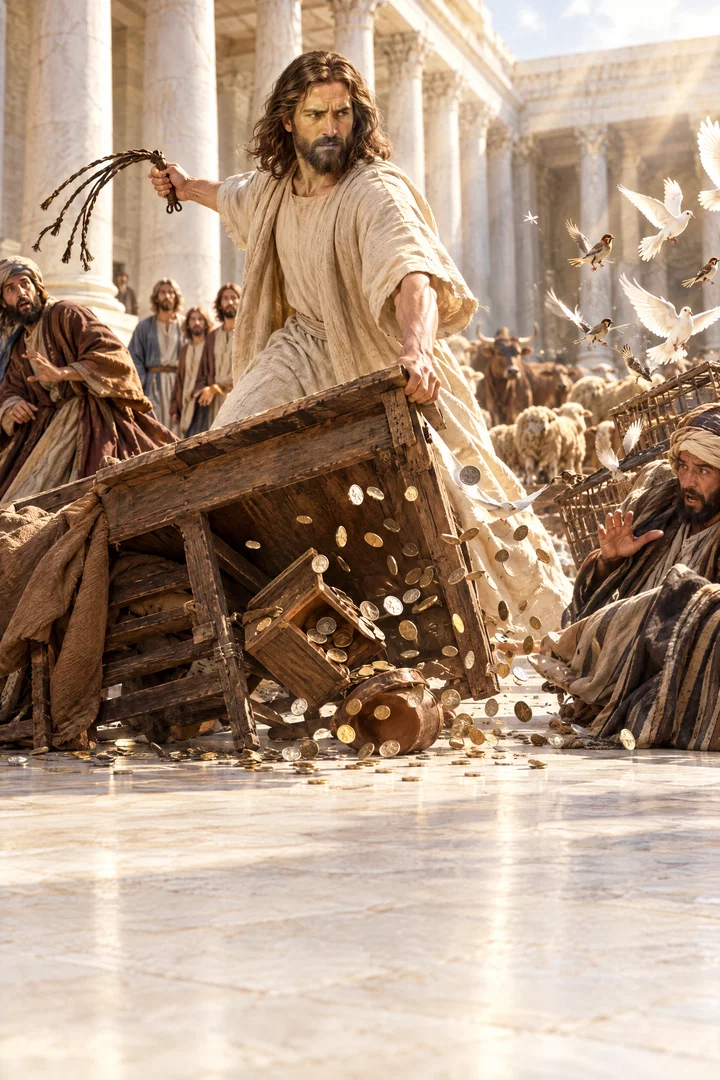
Jesus drives sellers and money changers from the temple, defending its sacred purpose.
- Matthew 21:12-13
And Jesus went into the temple of God, and cast out all them that sold and bought in the temple, and overthrew the tables of the moneychangers, and the seats of them that sold doves,
Jesus clears the temple and rebukes its misuse as a den of thieves.
- Luke 19:45-46
And he went into the temple, and began to cast out them that sold therein, and them that bought;
Jesus drives out the sellers and rebukes the temple’s misuse as a den of thieves.
- Jeremiah 7:11
Is this house, which is called by my name, become a den of robbers in your eyes? Behold, even I have seen it, saith the LORD.
Calls the defiled temple a den of robbers.
- 1 Kings 8:41-43
Moreover concerning a stranger, that is not of thy people Israel, but cometh out of a far country for thy name’s sake;
Solomon prays that foreigners who pray toward the temple will be heard.
- Psalms 69:9
For the zeal of thine house hath eaten me up; and the reproaches of them that reproached thee are fallen upon me.
The following scene connects Jesus’ cleansing of the temple with zeal for God’s house.
- Mark 11:11
And Jesus entered into Jerusalem, and into the temple: and when he had looked round about upon all things, and now the eventide was come, he went out unto Bethany with the twelve.
first temple visit the evening before
- Malachi 3:1-3
Behold, I will send my messenger, and he shall prepare the way before me: and the Lord, whom ye seek, shall suddenly come to his temple, even the messenger of the covenant, whom ye delight in: behold, he shall come, saith the LORD of hosts.
The coming Lord purifies his temple as a refiner.
- Matthew 23:37-38
O Jerusalem, Jerusalem, thou that killest the prophets, and stonest them which are sent unto thee, how often would I have gathered thy children together, even as a hen gathereth her chickens under her wings, and ye would not!
Jesus laments Jerusalem and declares its house desolate.
- Isaiah 1:11-12
To what purpose is the multitude of your sacrifices unto me? saith the LORD: I am full of the burnt offerings of rams, and the fat of fed beasts; and I delight not in the blood of bullocks, or of lambs, or of he goats.
God rejects sacrifices offered amid corruption.
- Isaiah 1:16-17
Wash you, make you clean; put away the evil of your doings from before mine eyes; cease to do evil;
True worship requires turning from evil and doing good.
- 1 Corinthians 3:16-17
Know ye not that ye are the temple of God, and that the Spirit of God dwelleth in you?
Both identify God’s temple as holy and warn against defiling it.
Commentary
Each commentary is drawn from primary sources: the writings of Ellen G. White and Adventist pioneers and periodicals. Each commentary is separate. Its own words are not a quotation; follow the references to read the source passages.
Ellen G. White
50 sources
God set apart His temple as a sacred house for prayer and worship, not for merchandise, traffic or personal gain.3SP 23.1–24.12SP 117.1–3DA 590.3–591.1 Its call to all nations meant its worship was universal, welcoming Gentiles who joined themselves to the Lord, served Him, loved His name, kept the Sabbath and held fast to His covenant to have their offerings accepted and hear truth taught.ST Jan 4, 18771RED 74.1–2RH Nov 30, 1905 Its courts had been turned into a noisy, disorderly market for animals and doves and money-changing, where exorbitant prices were exacted and priests, rulers and traders enriched themselves until greed made them thieves and robbers in God's sight.1MR 207.3–208.1DA 589.1–590.21RED 74.1–2ST Jan 4, 1877 Jesus asserted His divine authority and judgeship over the temple, and with majesty and power rebuked them, overthrew tables and seats, stopped the traffic and drove out buyers, sellers, moneychangers, priests and rulers.3SP 23.1–24.12SP 117.1–3DA 590.3–591.1 That cleansing announced His mission to cleanse the heart from sin, selfish desire and evil habit, for the unholy traffic pictures a heart defiled and made a den of thieves when it rejects His mercy.ST Feb 21, 1878RH Dec 31, 1908ST Aug 15, 1878 It also foreshadowed judgment, joined to the blighting of the barren fig tree as a symbol of the ruin of the Jewish nation and of the last day, and it requires the same cleansing of the body temple defiled by tobacco, of worship defiled by display and commerce, and of schools, publishing houses and other institutions devoted to gain.ST Feb 21, 1878ST Feb 15, 1899ST Jan 4, 1877STMW7 54.1–2ST Aug 4, 1909
Temple's Intended Purpose
The temple is God's own sacred house, set apart for prayer and worship, not for merchandise, traffic, or personal gain.3SP 23.1–24.12SP 117.1–3DA 590.3–591.11RED 76.1–34T 252.2 Buying and selling, money exchange, and dishonest gain had turned its court into a desecrated place like a cattle market, where sacred things were treated as having no sacredness and exploitation made the traffickers no better than thieves and robbers in God's sight.3SP 23.1–24.12SP 117.1–3DA 590.3–591.11RED 76.1–33SP 20.2 His words exposed their guilt and asserted His divine authority and judgeship over the temple, and He drove out those who profaned it and commanded them to leave, showing that love and mercy do not set aside stern justice.3SP 23.1–24.12SP 117.1–3DA 590.3–591.11RED 76.1–34T 252.2
The words of all nations declare that its purpose was universal and not limited to Israel.ST Jan 4, 18771RED 74.1–2RH Nov 30, 1905MH 20.2 People from other nations who joined themselves to the Lord, served Him, loved His name, kept the Sabbath, and held fast to His covenant were to be welcomed there and to have their offerings accepted.RH Nov 30, 1905 Christ taught in its outer court so that Gentiles could hear the words of truth.MH 20.2
The sacrificial service of the temple was meant to point people to the blood of Christ, the Lamb of God, but commercial use for gain obscured that purpose.DA 589.1–590.2 Greed made its leaders thieves in God's sight, and heartless religious service is warned against when it is put in place of repentance and obedience.DA 589.1–590.2
Desecration and Cleansing
The courts meant for prayer had become a noisy, disorderly market, like a cattle market and like an ordinary market day.ST Jan 4, 18773SP 20.23MR 61.4 Buying and selling of sacrificial animals and doves went on there, with money-changing, exchange of produce, and clamoring crowds.1RED 74.1–2ST Jan 4, 1877COS 99.13MR 61.4 Sacred things were treated as if they had no sacredness, while greed and avarice flourished in the place of worship.3MR 61.4
The traffic was extortionate and corrupt, with exorbitant prices exacted for beasts for sacrifice and for other offerings.1MR 207.3–208.11RED 74.1–2ST Jan 4, 1877 Priests, rulers and traders enriched themselves from the sale and exchange, turning religious office into a means of gain.DA 589.1–590.21RED 74.1–2ST Jan 4, 18773SP 20.2 Their greed made them thieves and robbers in God's sight, and their commercial use of the sacrificial service obscured its purpose.DA 589.1–590.22SP 117.1–31RED 76.1–3ST Mar 28, 18783SP 20.2
The noise, confusion and animal sounds disturbed worshipers and drowned out their prayers, so the sacred place was unlike a house of prayer.1RED 74.1–2ST Jan 4, 1877COS 99.1 Jesus exposed their guilt by His words and asserted His divine authority and judgeship over the temple as God's house.2SP 117.1–3DA 590.3–591.11RED 76.1–3 With majesty and power He rebuked them and commanded the traders to leave, overthrowing the tables of the moneychangers and the seats of those who sold doves.1MR 207.3–208.1DA 590.3–591.1 He stopped the traffic and drove out buyers, sellers, moneychangers, priests and rulers, and they fled from Him.3SP 23.1–24.1ST Feb 15, 1899
The crowd felt as standing before God's judgment, and the priests and rulers felt by His majesty and power that He was no ordinary man.2SP 117.1–3 His stern justice in cleansing did not set aside His love and mercy.3SP 23.1–24.1 His presence made the temple holy, silencing its noise and filling those present with awe.ST Jan 4, 1877ST Mar 28, 1878
Judgment on Israel and Last Days
The driving out of buyers and sellers from the courts, joined to the blighting of the barren fig tree, was a symbol of the future punishment and ruin of the Jewish nation and of Jerusalem.ST Feb 21, 1878ST Feb 15, 189912MR 406.2–3ST Jan 10, 1878 Its doom was to be as sudden and certain as that of the fig tree, coming upon it for wickedness and impenitence, for corrupting the people by false principles as representative men of the nation, and for rejecting warnings.ST Aug 4, 190912MR 406.2–3ST Jan 10, 1878 The temple had been desecrated by dishonest trading turned into a den of thieves instead of a house of prayer, and Christ's command to remove the traders displayed divine authority before priests and traffickers who fled from Him.ST Feb 15, 1899ST Aug 4, 1909 That condemnation of the leaders as hypocrites and robbers for corrupting true worship made their flight itself a symbol of the dispersion of the Jewish nation.ST Aug 4, 1909
The leafy fig tree with appearance but without fruit represents outward religion hiding hypocrisy, selfishness, and oppression.ST Feb 21, 1878 The same warning applies to professed Christians who claim godliness but bless no one through good works.ST Feb 21, 1878 The corruption of the courts by unholy traffic and confusion also pictures a rebellious heart made a den of thieves when desecrated by sin through rejecting Christ's mercy and persisting in disobedience, so that one purchased by Christ's death becomes like the withered fig tree under God's judgment.ST Aug 15, 1878
His words exposing guilt and asserting authority over the sacred temple made His presence make the temple holy, and His judgment there foreshadowed the judgment of the last day.ST Jan 4, 1877 His cleansing of the temple at both the beginning and the close of His ministry exposed sacrilegious trade and profit, with divine authority shining through humanity and His command to remove the trade foreshadowing the voice of judgment.STMW7 54.1–2 It points to a final warning that those who reject God's messages and offers of pardon will face solemn judgment, like the unready who have no oil of grace and cannot join the procession to the marriage supper of the Lamb.ST Jan 4, 1877STMW7 54.1–2 The cleansing at the beginning of public ministry and again near its end illustrates the final work of warning the world, a call to the churches through the second angel's message and a heavenly call for God's people to come out of Babylon because of her sins.STMW7 54.1–2STOM 31.1Lt 1f, 1890, par. 16–17
Christ and True Worship
The driving of buyers and sellers from the courts announced a mission to cleanse the heart from sin, selfish desires, sinful thoughts and evil habits.RH Dec 31, 1908ST Aug 15, 1878 The Jerusalem temple was meant to witness to the high destiny open to every soul, but unholy traffic and confusion made its courts represent a heart defiled by sinful desires and thoughts.RH Dec 31, 1908ST Aug 15, 1878 That corruption pictures a rebellious heart made a den of thieves when mercy is rejected and disobedience is persisted in, and one purchased by Christ's death then becomes like the withered fig tree under God's judgment.RH Dec 31, 1908ST Aug 15, 1878
Heartless religious service cannot take the place of repentance and obedience, for commercial use of the sacrificial service obscured its purpose to point people to the blood of Christ, the Lamb of God.ST Nov 17, 1881DA 589.1–590.24T 252.2 Those who profess to serve God while setting aside His express command to gain advantage for themselves are really serving mammon, keeping only a form of piety while giving the mind to temporal pursuits.ST Nov 17, 18814T 252.2 Such profaning of God's house of prayer for personal and worldly gain, as by merchandise and theft, makes it like a den of thieves and brings God's judgments and heaps future woe on the doers, whose greed makes them thieves in God's sight.ST Nov 17, 1881DA 589.1–590.24T 252.2
The verse therefore requires God's people to put God's law first and obey it in spirit and in letter, examining themselves closely lest by sacrificing religion for worldly gain they commit the same sin.ST Nov 17, 18814T 252.2 By expelling the worldly traffickers who were profaning sacred things, with stern rebuke driving buyers and sellers and priests and rulers from the courts, Christ teaches those who will make up His church on earth that name and position weigh as nothing against virtue and purity of character and honesty and righteous dealing.Lt 116, 1907, par. 6–7 The money taken by dealers for sacrificial offerings robbed the people through extortionate business, turning God's house into a robbers' shelter.Lt 116, 1907, par. 6–7
Defiling Body and Soul Temple
The body is to be God's temple for the dwelling of the Holy Spirit, and to defile it with tobacco is to pollute God's sanctuary.LC1 163.1RH Sep 8, 1874ST Aug 13, 18742RED 59.1–60.1 Such worship is not acceptable to God, for the tainted breath and the ejected tobacco defile the place set apart for prayer and are abhorred by Him.RH Sep 8, 1874ST Aug 13, 18742RED 59.1–60.1 To spend thousands of dollars to feed this unnatural appetite is to rob God's treasury.LC1 163.1RH Sep 8, 1874ST Aug 13, 18742RED 59.1–60.1 By that robbery the house set apart for prayer for all peoples is turned into a den of thieves.2RED 59.1–60.1
When truth occupies the soul and God is enthroned there, the Saviour finds no selfish buying and selling to condemn.Lt 102, 1905, par. 8–111MR 206.1–207.2 The soul temple must still be cleansed of buyers and sellers, with the entrusted goods of means and of physical and mental powers kept sacred and unmingled with worldly merchandise.Lt 102, 1905, par. 8–111MR 206.1–207.2 For the leaven of worldliness permeates the mind, and spiritual discernment is lost.Lt 102, 1905, par. 8–11 When that cleansing takes place, doing the Master's bidding and promoting His work becomes the one aim of life, the Holy Spirit works upon the heart to transform the character, and self is hid with Christ in God.Lt 102, 1905, par. 8–11
Fashionable dress and display likewise dishonor God's house when attention to clothing displaces thought of Christ and of the sermon, profaning what is devoted to worship.4T 642.4–643.1 The same condemnation falls on churches that conduct feasting and unholy commerce in religion.GC88 474.2 To seek money by appealing to appetite, gain and pleasure instead of love for Christ is a desecration that Christ would drive out and rebuke.4T 642.4–643.1GC88 474.2
Cleansing Church Institutions
As Christ cleansed the temple, so schools are to be cleansed of defiling influences.CT 25.2FE 174.2 Many books are to be removed from them.CT 25.2FE 174.2 In their place is to come sound knowledge with principles and precepts treasured in the heart that safely guide conduct.CT 25.2FE 174.2
Publishing houses were established for the sacred purpose of publishing present truth.Lt 140, 1901, par. 1–4 They are to be houses of prayer where God is present with workers both in religious exercises and in their work.Ms 101, 1901, par. 34 When managers devote them principally to commercial work and enter contracts to publish questionable matter merely for gain, the sense of sacredness is lost.Lt 140, 1901, par. 1–4 The work is then cheapened and the institutions are regarded as any other commercial enterprise.Lt 140, 1901, par. 1–4 Letting commercial work take priority displaces the sacred work.8T 92.4STGC 22.1Lt 140, 1901, par. 1–4
To make God's house a den of thieves is to betray its sacred purpose through corrupt use and misappropriation.8T 92.4STGC 22.1 In a publishing institution this means neglecting the publication of truth while misusing workers' time and talents and misappropriating money.8T 92.4STGC 22.1 It means using presses meant to spread truth to print false teachings.8T 92.4STGC 22.1 It means allowing injustice, selfish schemes, unprincipled conduct, unjust plans and fraudulent dealings that violate people's rights.Lt 83, 1896, par. 38–4018MR 218.1–3Lt 76, 1895, par. 9–11 Such schemes follow Satan's order, not Christ's.Lt 76, 1895, par. 9–11 Dishonorable gain is worse than loss.8T 92.4STGC 22.1
If He were present today He would likewise cleanse the publishing office of all defiling things.6MR 268.1–269.3 This includes literature that dishonors the Redeemer and unsettles faith in Christianity.6MR 268.1–269.3 It includes what gives a wrong tendency to youth and causes doubt and unbelief to spring up.6MR 268.1–269.3 It includes questioning of the authority and purity of the Old Testament Scriptures and the spread of infidelity such as the argument that Christ was only a man.6MR 268.1–269.3 Accepting, handling and publishing that class of matter brings in Satan and his sophistry and makes a house dedicated to God's work a den of thieves.6MR 268.1–269.3
The same rebuke applies to the Review office, where accepting commercial work and printing material that promoted false doctrines brought desecration like that of the temple.Lt 46, 1903, par. 9–10 It applies to Battle Creek, which as the temple was to be free of buyers, sellers and moneychangers was to be purified of corruption and practices that violate people's rights.Lt 83, 1896, par. 38–40 His servants are to be pious and devoted to holy work.Lt 83, 1896, par. 38–40
Physicians who claim to believe truth yet stretch religion to suit circumstances and charge exorbitant prices are in no better condition than the priests and rulers who exacted exorbitant prices for beasts for sacrifice.1MR 207.3–208.1 Medicine is under the Lord's jurisdiction and the standard of righteousness no less than farming, merchandising or ministry.1MR 207.3–208.1 What is required is pure religion in business, love and obedience to God, relieving the sick for Christ's sake, and dealing tenderly with His poor and justly with all in view of judgment.1MR 207.3–208.1
Jerusalem's corruption of the temple courts into selfish trade and robbery instead of honoring their sacred purpose warns churches and institutions that receive light but refuse to follow it.8T 67.2–3 Jerusalem's misuse of its sacred trust through merchandise, robbery and pursuit of gain repeats itself when God's counsel is rejected and selfishness, envy and strife are cherished.8T 67.2–3Lt 31, 1898, par. 9–12 That course brings Christ's sorrow and investigation and warning against refusing to follow light.8T 67.2–3Lt 31, 1898, par. 9–12
Sources
Pioneers and periodicals
60 sources
God's house was meant to be a place of reverent prayer open to people of every nation, including strangers, Gentiles, and the poor and needy.ST Oct 4, 1899ST Oct 11, 1899RH Nov 10, 1863RH May 14, 1867RH Dec 17, 1901 Its leaders had turned it into a den of thieves by filling it with buying and selling, money-changing and dishonest gain under the cover of religion.ST Mar 28, 1878ST Dec 16, 1886ST Sep 17, 1902ST Dec 29, 1887 Jesus with divine authority drove the traffickers out, stopped the misuse, and restored the temple to its sacred purpose.ST Sep 17, 1902ST Aug 20, 1894ST Dec 16, 1897ST Mar 23, 1915 That cleansing exposed fruitless outward religion and foreshadowed judgment on the nation, while picturing His work to cleanse the sinful heart from selfishness and evil.ST Feb 21, 1878ST Jan 4, 1877RH Dec 31, 1908ST Aug 15, 1878ST Aug 4, 1909 The same rebuke forbids turning church gatherings into places of commerce and money-making schemes, festivals, fairs and entertainments.ST Dec 16, 1897RH Sep 20, 1906ST Sep 9, 1889ST Mar 23, 1915
Words Setting and Occasion
The saying belongs to Jesus' second entry into Jerusalem in Passover week, on the day after He rode into Jerusalem and first looked around the temple and returned to Bethany.ST Oct 5, 1882 On that same morning He cursed the barren fig tree on the way, and after cleansing the temple He taught there until evening and then left the city again.ST Oct 5, 1882 This formed part of three full days after the feast at Bethany where Mary anointed Him.ST Oct 5, 1882 The cleansing took place on Monday, the third day before the Passover, on a common workday rather than the Sabbath, as shown by buying and selling going on.
The account stands in the triumphal entry also recorded in Matthew 21, Luke 19, and John 12, with Luke giving the fullest account, and comes before the institution of the Lord's Supper.ST It includes Christ's triumphant entrance into Jerusalem and entry into the temple, where with mighty power He drove out the money-changers and merchants.ST Feb 14, 1878 It is a similar cleansing to the one in John 2, in which Jesus drove out sellers and money-changers and objected to trade in the temple.ST Aug 20, 1894 It was a second cleansing about three years after the one at the beginning of His ministry, when the abuse had returned, and also near the close of His ministry.ST Oct 4, 1899ST Feb 13, 1893 Had the first cleansing been heeded, the temple would not have needed a second.ST Oct 4, 1899
House of Prayer for All
God's temple is meant to be a house of prayer, and God's house is meant to be a place of prayer, and this was Jesus' reason for cleansing the temple when the people and the leaders had corrupted its purpose and turned it into a den of robbers and thieves.ST Oct 4, 1899ST Oct 11, 1899ST Mar 3, 1909ST Mar 3, 1909 He taught during the cleansing that the temple was to be a house of prayer for all nations, not a place corrupted by buying and selling.ST Oct 4, 1899ST Oct 11, 1899ST Mar 3, 1909
The house of prayer is for all nations and all people, with Gentiles and strangers made welcome to come, pray, and offer acceptable worship there.RH Nov 10, 1863RH May 14, 1867RH Dec 17, 1901 Even the outer court assigned to Gentiles was still God's house of prayer for all nations and must not be profaned by trade, exploitation, buyers and sellers and money-changers.RH Nov 10, 1863 Its purpose was therefore not limited to Israel, for people from other nations who join themselves to the Lord, serve Him, love His name, keep the Sabbath and hold fast to His covenant are to be welcomed there and their offerings accepted.RH Nov 30, 1905RH Dec 17, 1901 It is not reserved for a favored class, since churches that exclude the poor and welcome fashion, wealth, prejudice or narrow proselytism fail its purpose, while the lowly spirit of truth should be welcomed.ST Mar 25, 1875 It is open to the poor and lowly, where the needy can come to God with confidence for mercy and pardon.RH May 14, 1867ST Mar 25, 1875 It is a place where people of all nations can pray, where travelers can hear God's word and carry it to all nations.RH May 14, 1867RH Dec 17, 1901ST Mar 18, 1875
The temple was designed as a dwelling place for God and a house of prayer, but greed and corrupted ceremonies had turned it into a den of thieves, so Jesus drove out those who profited from that corruption.RH Jun 6, 1907 It is a place for reverent worship, where irreverent behavior is unbecoming.RH Jun 23, 1868 The cleansing restored the temple court from corrupted buying and selling so Jesus could publicly confirm His Messiahship before the people.ST Oct 4, 1899
Den of Thieves Explained
Those in charge had corrupted its purpose and turned it into a den of thieves and robbers by buying and selling in its courts.ST Dec 16, 1886ST Sep 17, 1902RH Sep 16, 1902ST Sep 22, 1909 Buyers and sellers, money-changers, and sellers of sacrificial offerings including oxen and doves were driven out because their presence displaced worship.ST Sep 17, 1902ST Dec 29, 1887ST Nov 19, 1894ST Sep 22, 1909 Commerce carried on under the appearance of religious service profaned the temple when it displaced its sacred purpose, and even commerce connected with legitimate worship could do this.ST Dec 29, 1887ST Nov 19, 1894RH Sep 16, 1902 Trade that was decent and honorable and legitimate business elsewhere became thieving when carried on in the house of God.ST Dec 29, 1887ST Nov 19, 1894
The trade was dishonest and greedy, for greed and avarice flourished where prayer should have ruled.ST Mar 28, 1878 Priests and traders profited from money-changing and the sale of sacrificial animals, often at exorbitant prices, turning religious office into extortion for personal gain.ST Mar 28, 1878ST Jan 4, 1877 Sharp dealing with wrangling, bitter words and reckless oaths revealed its spirit, while traffic and animal noise disturbed worshipers and drowned out prayers.ST Jan 4, 1877ST Aug 20, 1894 The greed of the temple dignitaries made them no better than thieves in God's sight.ST Mar 28, 1878
The corruption and dishonor were chiefly the responsibility of Israel's priests, teachers and rulers.RH Mar 31, 1863ST Oct 5, 1904 They corrupted God's word and shut their eyes to signs being fulfilled before them, while approving and profiting from the unholy trade to uphold their prestige.RH Mar 31, 1863ST Oct 5, 1904 In the surrounding acted parable the leafy but fruitless fig tree represented those leaders and outward religion without spiritual fruit.ST Feb 21, 1878RH Jan 17, 1871 That show of leaves without fruit hid hypocrisy, selfishness and oppression, the same warning that applies to profession without good works.ST Feb 21, 1878RH Jan 17, 1871
Cleansing by Christ
Jesus drove out those who sold and bought in the courts, the money-changers and merchants, and expelled them from the temple to stop its desecration by buying and selling.ST Sep 17, 1902ST Dec 16, 1897ST Mar 23, 1915 He halted the traffic altogether and would permit no one to carry a vessel through it.ST Dec 16, 1897 By casting out the traders and driving the priests away from their commercial activity He exposed the defilement, restored the temple to its proper religious purpose as a house of prayer for all nations, and showed that a place dedicated to God as holy must be used for sacred purposes and not turned to worldly commerce.ST Sep 17, 1902ST Dec 16, 1897ST Mar 23, 1915
He spoke these words as teaching with divine authority in the very act of cleansing.ST Jan 4, 1877ST Aug 20, 1894 His authority did not rest on any formal position but was expressed through kingly bearing, majesty, power and decisive command to remove the traders.ST Feb 15, 1899 His presence silenced the noise of trade, filled those present with awe, made the temple holy, exposed guilt, and asserted His authority over the sacred house.ST Jan 4, 1877ST Mar 28, 1878 Traffickers, priests and rulers felt He was no ordinary man and fled from Him, while the fear and obedience of the people showed they recognized Him as Master and Judge.ST Feb 15, 1899ST Aug 20, 1894 His decisive expulsion stopped the traffic, and His judgment there foreshadowed the judgment of the last day.ST Jan 4, 1877
He thereby condemned the leaders as hypocrites and robbers for corrupting true worship with unholy traffic.RH Dec 31, 1908ST Aug 4, 1909 In that cleansing He announced His mission to cleanse the heart from sin, selfish desires, evil thoughts and habits.RH Dec 31, 1908 The Jerusalem temple had been meant to witness to the high destiny open to every soul.RH Dec 31, 1908
Judgment Prophecy and Types
The withering of the leafy but fruitless fig tree pronounced sentence and ruin upon the Jewish nation, and the cleansing belongs to that same account as its companion sign of Jerusalem's doom and coming destruction, the cleansing coming first and the tree then serving as its symbol.ST Feb 21, 1878ST Jan 10, 1878 The temple was to be a house of prayer for all nations, but its courts had been made a place of dishonest trade, and the words spoken there exposed guilt and asserted authority over the sacred house.ST Jan 4, 1877ST Aug 4, 1909 His presence made the temple holy, and His judgment in it foreshadowed the judgment of the last day.ST Jan 4, 1877 He condemned the leaders as hypocrites and robbers for corrupting true worship, and their flight from His rebuke symbolized the dispersion of the Jewish nation for wickedness and impenitence.ST Aug 4, 1909 The fig tree's show of leaves without fruit pictured outward religion hiding hypocrisy, selfishness and oppression, with the same warning reaching professed Christians who claim godliness yet bless no one by good works.ST Feb 21, 1878
A place or object is holy through God's presence, and when that presence departs it becomes common. The sacred purpose was corrupted when trust was placed in the material structure and its services rather than in Christ. The tearing of the veil at His death showed that the people had rejected Christ and that the glory had departed from the temple.
Driving the sellers from the courts fulfilled the faint type set by Nehemiah's prohibition of selling on ground consecrated to God.ST Nov 15, 1899 He had cleansed the temple at the beginning of His public ministry, and cleansed it again near its close, and that last cleansing is linked to the final warning to the world when the second angel's message and the call to come out of Babylon are given to the churches.ST Feb 13, 1893 The den of thieves also describes worldwide corruption in which those entrusted with law enforcement ally themselves with criminals, a wrongdoing growing worse across the world and bringing destruction upon nations that tolerate it.ST Dec 8, 1914 Since no uncorrupted part of the world remains able to reform the rest, the only hope is Christ's second coming.ST Dec 8, 1914
Doctrine Heart and Body
The driving of traders from the courts declares the purpose of the coming of Christ to cleanse the heart from sin, from selfish desires, from sinful thoughts and from evil habits.RH Dec 31, 1908ST Aug 15, 1878 The Jerusalem temple was intended to bear witness to the high destiny open to every soul, but unholy traffic and confusion desecrated its courts until they pictured a heart defiled by sin.RH Dec 31, 1908ST Aug 15, 1878 That desecrated heart becomes a den of thieves when mercy is rejected and disobedience is persisted in, and one bought by death then stands under judgment like the withered fig tree.RH Dec 31, 1908ST Aug 15, 1878
The same word calls professed people of God to close self-examination lest they repeat that sin by setting aside an express command in order to gain advantage for themselves.ST Nov 17, 1881 To sacrifice religion for worldly gain, to keep only a form of piety while the mind is given to temporal pursuits, is to profess to serve God while really serving mammon.ST Nov 17, 1881 Such a course brings divine judgments and heaps up future woe, for the law of God must have the first place and be obeyed both in spirit and in letter.ST Nov 17, 1881
The rebuke of turning the house of prayer into merchandise and corruption reaches those whose tobacco use pollutes the sanctuary of God.RH Sep 8, 1874ST Aug 13, 1874 The body is meant to be a temple of the Holy Spirit, but by that appetite it is defiled, so that the worship offered is not acceptable to God.RH Sep 8, 1874ST Aug 13, 1874 The money spent to gratify the appetite further robs the treasury of God.RH Sep 8, 1874ST Aug 13, 1874
The human body as the house of God has become a den of thieves instead of a house of prayer because sin has been chosen in place of Christ dwelling within.RH Sep 23, 1902 The one remedy for disease is to welcome Jesus into the bodily temple and let Him cleanse it, so that His house becomes a house of prayer again.RH Sep 23, 1902 By saving His people from their sins He saves them also from the consequence of sin in disease and premature death, and they know Him as Emmanuel, God with us dwelling in them.RH Sep 23, 1902
Practice for Church Today
God's house must not be turned to worldly pursuits and practices instead of its sacred purpose, for worldly church feasts and fashions disregard what is written about the house of prayer. Turning a place devoted to God into a place of commerce repeats the misuse of the temple, as when money is exchanged for entry cards and toys and goods are displayed inside beneath a sign declaring holiness to the Lord.ST Dec 16, 1897ST Aug 20, 1894 God's house is to be a house of prayer, but turning it to dishonest gain makes it a den of thieves, so raffles at social events are unfit for the church and should be confronted openly.RH Sep 20, 1906 Even decent and honorable and legitimate business anywhere except in the house of God makes it a den of thieves when carried on there, and raffling in church fairs is condemned far more because raffling is nothing but gambling and is thieving everywhere, so doing it in the house of God makes it even more a den of thieves.ST Dec 29, 1887 The temple including its courts was to be a place for reverent worship and prayer, but sharp dealing with wrangling, bitter words and reckless oaths revealed the spirit of the Passover marketplace trade, warning against using places dedicated to God's service for commerce as in practices likened to those of the Dark Ages and to modern church fairs and festivals.ST Aug 20, 1894
Using dancing parties, theatrical performances, or other questionable entertainments to raise church funds comes perilously near the Saviour's condemnation of turning the house of prayer into a den of thieves, and holding such events outside the church building does not remove the inconsistency. Church suppers, festivals, entertainments, social meetings with games and revelry, dancing parties, theatrical performances, bazaars, fairs, church fairs and festivals, sanctified lotteries and feasts, and makeshifts that eat out pure benevolence are condemned by the cleansing, for they have a downward tendency and money raised by unclean hands is unfit for holy service and must be refused.RH Sep 20, 1906ST Dec 29, 1887ST Aug 20, 1894 Places of merchandise, frivolity and cheating must not crowd out prayer, and Christians should take part in church gatherings only when their presence serves Christ.ST Aug 20, 1894RH Dec 31, 1914 Christ's cleansing by driving out robbers so the house could be a house of prayer applies to churches where money rules, protects wrongdoing, and defeats discipline, for such corruption makes the church a place in need of His cleansing.ST Sep 9, 1889 The church must abandon worldly money-making as a substitute for faith and seek God's mercy rather than treating such measures as faith.ST Dec 30, 1903
Ministers must be kept devoted to their spiritual duties rather than diverted into other pursuits, as illustrated by driving the priests away from their commercial activity and restoring the temple to its proper religious purpose.ST Mar 23, 1915 God's house is for worship and prayer, not for trivial business that takes up worship time and crowds out the preaching of the gospel.RH Dec 31, 1914 The temple is sacred and meant to be a house of prayer, not a place for predatory or corrupt people to exploit others, so those who invade it as birds of prey should be driven out with scorn. The house of prayer is a place for reverent worship, and irreverent behavior there is unbecoming.RH Jun 23, 1868
A worldly church turns God's house meant for prayer into a place of entertainment and display by building a costly and beautiful house like the world, with fine carpets, lace, and furniture, and filling it with purple and gold, then using it for fairs and shows with laughter and music and feasts, with cushioned pews where the rich and great sit in pomp and pride while the poor in shabby clothes are left to sit meekly outside.ST Jan 13, 1881 The cleansing by driving out peddlers for buying and selling proves care for what is done in His house and for poor brothers and sisters, set against rich worshipers brushing past starving, cold, and sick poor in costly finery to go and pray and then going home easy while leaving them to perish without thought or care, which would not be allowed if He were present listening.ST Aug 25, 1881 Worship crowded out by greed and self-interest is exposed when business in the courts stops at Jesus' arrival while the priests shrink away, when people hurry toward the temple but ignore a wounded woman, and when longing for money persists even by the treasury, betraying the temple's purpose as a place of worship.RH Nov 23, 1916
The call for God's house to be a house of prayer applies to a family home, where a man dedicates his household to God and begins praying with his wife and children.RH Mar 20, 1900 The house of prayer is a place for worship commending regular attendance, with the qualification that attendance should not disregard health or proper care of one's family.RH Apr 28, 1859 God's house is a place where people of all nations can pray, reflected in the appeal for a house for God in San Francisco where travelers can hear God's word and carry it to all nations.ST Mar 18, 1875 Enormous corruptions introduced into the church under the Papacy must be exposed and removed as far as possible, including stripping churches of images and pictures, pulling down monasteries, and destroying all instruments employed to foster idolatry and image-worship, because the magnificence of temples and splendid apparatus of worship fascinates the senses and imaginations of the people and must be taken away to keep false worship from returning.
Uniting Protestant churches to perpetuate a Roman Catholic institution is evidence that the temple is in need of cleansing.RH May 23, 1912 Driving the money-changers and tricksters from the temple is an example of divine power able to confront corruption, applied to political corruption which no human power can successfully overcome, requiring appeal to God to quicken minds and hearts so the needs of the time can be seen and met. God's house is a house of prayer for all nations, and turning it into a den of thieves also describes courts of justice corrupted by the license system, exposing institutions that should serve the public as places of injustice.ST Jul 22, 1886
Sources