Translations
I am the true vine, and my Father is the farmer.
King James Version, KJV Cambridge Paragraph Bible, Webster Bible, Revised Version, American Standard Version, Darby Translation
I am the true vine, and my Father is the husbandman.
'I am the true vine, and my Father is the husbandman;
I, am the real vine, and, my Father, is, the husbandman.
Berean Standard Bible, Majority Standard Bible
“ I am the true vine, and My Father is the keeper of the vineyard.
“ I am the true vine, and my Father is the farmer.
I am the true vine and my Father is the gardener.
I Am that true vine, and my Father is that husband man.
Douay-Rheims (Challoner revision)
I am the true vine; and my Father is the husbandman.
Pictures
Cross-references 20 of 46
- John 15:5
I am the vine, ye are the branches: He that abideth in me, and I in him, the same bringeth forth much fruit: for without me ye can do nothing.
Christ’s followers are branches who bear fruit by abiding in him.
- Galatians 5:22-23
But the fruit of the Spirit is love, joy, peace, longsuffering, gentleness, goodness, faith,
Names the spiritual fruit borne by Christ’s branches.
- John 15:8
Herein is my Father glorified, that ye bear much fruit; so shall ye be my disciples.
Bearing much fruit glorifies the Father and identifies Christ’s disciples.
- Romans 11:17-24
And if some of the branches be broken off, and thou, being a wild olive tree, wert graffed in among them, and with them partakest of the root and fatness of the olive tree;
The olive-tree image shows branches broken off and Gentiles grafted in by faith.
- John 15:7
If ye abide in me, and my words abide in you, ye shall ask what ye will, and it shall be done unto you.
Abiding in Christ and his words is linked to answered prayer.
- Isaiah 5:1-7
Now will I sing to my wellbeloved a song of my beloved touching his vineyard. My wellbeloved hath a vineyard in a very fruitful hill:
Both depict God’s people as a vine expected to bear good fruit.
- Revelation 14:18-19
And another angel came out from the altar, which had power over fire; and cried with a loud cry to him that had the sharp sickle, saying, Thrust in thy sharp sickle, and gather the clusters of the vine of the earth; for her grapes are fully ripe.
The earthly vine is gathered and cast into the winepress of God’s wrath, contrasting with Christ’s true vine.
- John 15:10
If ye keep my commandments, ye shall abide in my love; even as I have kept my Father’s commandments, and abide in his love.
Keeping Christ’s commandments is the way to abide in his love.
- Matthew 7:16-17
Ye shall know them by their fruits. Do men gather grapes of thorns, or figs of thistles?
Both use the vine or tree’s fruit to reveal its character.
- Colossians 2:19
And not holding the Head, from which all the body by joints and bands having nourishment ministered, and knit together, increaseth with the increase of God.
The body receives nourishment and growth from its Head, as branches do from the vine.
- John 15:6
If a man abide not in me, he is cast forth as a branch, and is withered; and men gather them, and cast them into the fire, and they are burned.
Branches that do not abide in Christ are cast out, wither, and burn.
- Psalms 80:8-16
Thou hast brought a vine out of Egypt: thou hast cast out the heathen, and planted it.
Describes God planting a vine that is later trampled and exposed to harm.
- John 15:16
Ye have not chosen me, but I have chosen you, and ordained you, that ye should go and bring forth fruit, and that your fruit should remain: that whatsoever ye shall ask of the Father in my name, he may give it you.
Christ appoints his disciples to bear fruit through their work.
- Luke 13:6-9
He spake also this parable; A certain man had a fig tree planted in his vineyard; and he came and sought fruit thereon, and found none.
The vineyard parable illustrates the demand for fruit and patience with the unfruitful.
- Jeremiah 11:16
The LORD called thy name, A green olive tree, fair, and of goodly fruit: with the noise of a great tumult he hath kindled fire upon it, and the branches of it are broken.
Both texts use a tree or vine image for God’s people.
- John 6:56-57
He that eateth my flesh, and drinketh my blood, dwelleth in me, and I in him.
Eating Christ brings abiding union with him and life by him.
- Galatians 2:20
I am crucified with Christ: nevertheless I live; yet not I, but Christ liveth in me: and the life which I now live in the flesh I live by the faith of the Son of God, who loved me, and gave himself for me.
Christ living in the believer gives vine-life.
- John 17:21
That they all may be one; as thou, Father, art in me, and I in thee, that they also may be one in us: that the world may believe that thou hast sent me.
Christ’s prayer for believers’ oneness reflects their union with Him and the Father.
- James 5:7
Be patient therefore, brethren, unto the coming of the Lord. Behold, the husbandman waiteth for the precious fruit of the earth, and hath long patience for it, until he receive the early and latter rain.
The Father is the Husbandman who patiently waits for the vine’s fruit.
- Matthew 3:10
And now also the axe is laid unto the root of the trees: therefore every tree which bringeth not forth good fruit is hewn down, and cast into the fire.
Fruitless growth faces judgment and is cast into the fire.
Commentary part 1 of 2
Each commentary is drawn from primary sources: the writings of Ellen G. White and Adventist pioneers and periodicals. Each commentary is separate. Its own words are not a quotation; follow the references to read the source passages.
Ellen G. White
158 sources
Christ is the true living vine and his Father is the wise cultivator who owns, watches and tends every branch.ST Sep 14, 1882SG4 246.3–4RH Aug 29, 1907Ms 7, 1900, par. 8–9Ms 142, 1899, par. 10 Branches draw all life, strength, nourishment and fruitfulness from him, and cut off from him they can do nothing but wither like sapless twigs.SG4 246.3–4ST Dec 10, 1896Ms 87, 1902, par. 1–2SLP 131.1–3 There can be an outward fastening by profession and church connection without living union, but true branches are grafted fiber by fiber by living faith, obedience and renouncing self, and are known by character and conduct.Ms 140, 1909Ms 97, 1909, par. 1–2Ms 85, 1901, par. 1–3Lt 31, 1891, par. 31–34Ms 139, 1909, par. 4 Every fruit-bearing branch the Father prunes and cleanses so it will bear more and abiding fruit, cutting trailing tendrils loose from earth and removing overgrowth to make room for light, often through painful trials that are merciful discipline and not forsakenness.RH Aug 29, 1907Ms 92, 1908, par. 1–2Ms 87, 1902, par. 1–2Ms 114, 1909, par. 1–2Ms 70, 1911, par. 1 Branches that bear no fruit and refuse to abide are taken away as withered branches for burning, while those that abide bring forth much fruit to the glory of the Father.RH Aug 29, 1907Ms 92, 1908, par. 1–2Ms 87, 1902, par. 1–2Ms 18, 1913, par. 1–2Ms 8a, 1888, par. 1–3 That fruit is Christlike character in love, patience, purity and obedience to his commandments, shown also in unselfish labor to win souls, and branches joined to the same vine are joined to one another in fellowship and love while each keeps its own place.Ms 1, 1891, par. 1–3Ms 146, 1903, par. 1–2Ms 8a, 1888, par. 1–3Ms 43, 1894, par. 1–4Ms 17, 1912, par. 1–3
Verse Wording and Setting
The declaration names Jesus as the true vine and the Father as the husbandman or vine-dresser who owns, cultivates, watches and tends it.ST Sep 14, 1882SG4 246.3–4RH Aug 29, 1907ST Dec 10, 1896Ms 56, 1890, par. 1–2 The vine is Christ as root and believers as its branches, and the Father's tending means life, strength and nourishment flow only through remaining joined to him by faith.SG4 246.3–4RH Aug 29, 1907ST Dec 10, 1896Ms 7, 1900, par. 8–9
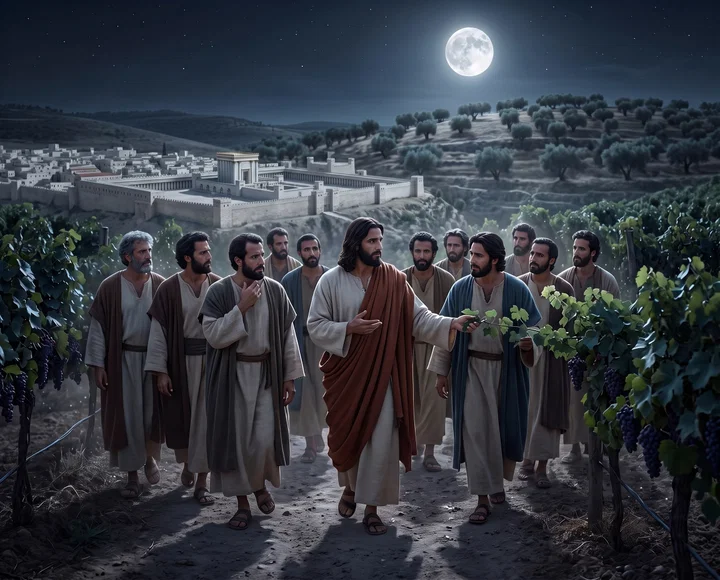
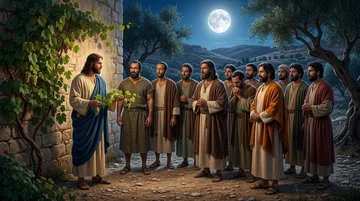
These words were given to the disciples just before entering Gethsemane and the crucifixion, when cruel death was just before him and the cup of suffering trembled in his hand.Ms 56, 1890, par. 1–2Ms 170, 1907, par. 19–23Lt 24, 1912, par. 3Ms 140, 1909, par. 14–17 Judas had left the upper chamber, and Jesus was leading the remaining disciples from the upper room through the city toward the Mount of Olives after the teaching of John 14, when they admired a beautiful vine they passed.Ms 118, 1904, par. 1–2 They belong to his comfort, counsel and prayer before separation from them, full of hope to bring comfort and courage, simple enough for every believing soul.RH Nov 4, 1902Lt 24, 1912, par. 3 They were meant to prepare them for hatred, trial and temptation with promise of the Comforter, to rest their work and ministry on the divine source, and to instruct in preparing to meet him at his coming with joy, and they were fully understood only after the resurrection.RH Nov 4, 1902Ms 170, 1907, par. 19–23
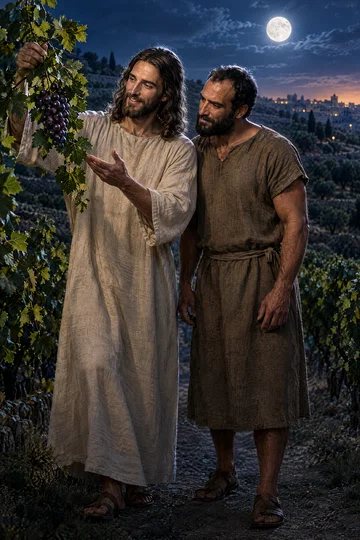
He illustrated the saying by a flourishing grapevine pointed out in Gethsemane and visible in the moonlight.ST Sep 14, 1882ST May 23, 18785RED 10.1–11.1 He chose not the self-supporting palm, cedar or oak but the familiar vine with clinging tendrils that entwines its support and the trellis to climb heavenward, showing that believers do not stand alone but entwine themselves about God.Ms 67, 1897, par. 3–4 Nature was used as a mirror of divinity and divine truth, clear enough to leave hearers without excuse, so that whenever they saw a vine they would recall the lesson of connection with him and with one another.Ms 67, 1897, par. 3–4Ms 78, 1898, par. 1–23MR 345.3–5 By his own humanity's dependence he showed that of himself he could do nothing, needing divine power.DA 674.2–675.3
The Jews prized the vine as noble, beautiful, powerful, excellent and fruitful, even displaying a golden vine at the temple for prosperous Israel.Ms 56, 1890, par. 1–2RH Nov 18, 19095T 229.4–230.3 The vine they prized so highly was a symbol while Christ is the reality the symbol pointed to, the true vine and not Israel, whom as sinners they should prize above all things earthly.AAP 13.4RH Nov 18, 1909AAP 14.1DA 674.2–675.3 In contrast stands a counterfeit vine or bramble, known by harmful fruit and by profession without practical unselfish love and self-sacrifice.Lt 34, 1894, par. 13–22
The saying belongs to the instruction of John 13-17, with John 14-16 and John 14-15 in particular, expressing God's will and what he desires to do for the human race.Lt 23, 1900, par. 2Ms 71, 1902, par. 5–8Ms 136, 1899, par. 1–2Lt 16j, 1892, par. 321MR 346.1–3 It is full of encouragement and hope for the church under trial through unconverted believers, giving courage to stand fast in the most trying hour with strength and assurance as long as time lasts.Ms 71, 1902, par. 5–8 It requires careful study and earnest practice, with its conditions followed and its duties as Substitute and Surety not neglected, and lived out in practical life before others and in every church and Christian home.Lt 288, 1907, par. 9Lt 16j, 1892, par. 321MR 346.1–3 So lived it brings unity with one another and with Christ and helps overcome dissension, and with receiving the Holy Spirit it opens blinded eyes.Ms 136, 1899, par. 1–221MR 346.1–3
The Father planted this goodly vine on the hills of Palestine, and many were attracted by its beauty and heavenly origin.DA 674.2–675.3 Though leaders in Israel saw it as a root out of dry ground, humble and unremarkable, bruised and trampled it to destroy it forever and thought they had killed it when wicked men crucified the Lord of glory, and though Satan worked through religious bigotry to uproot it, shut out the love of God and crush all hope, the heavenly husbandman never lost sight of it and the divine One could not be destroyed.DA 674.2–675.3Ms 67, 1897, par. 9–10Ms 40a, 1890, par. 63–64Ms 90, 1897, par. 15 After men thought they had killed him he replanted it beyond assault and beyond reach of earth and hell on the other side of the wall, where the stock and root are hidden from assault and strike deep and cannot be torn up, while its branches hang over the wall into this world for passers-by to pluck and its fruit is visible.DA 674.2–675.3Ms 67, 1897, par. 9–10Ms 40a, 1890, par. 63–64 As a vine takes grafted branches into itself, Christ by taking human nature, giving his life and bearing the responsibility of redemption unites sinful human beings to himself, joining humanity to his divine life vein by vein and fiber by fiber so dry, sapless branches grafted into the precious stock partake of his nature through the Spirit and bear rich clusters.STMs 40a, 1890, par. 63–64ST Mar 5, 1896
Vital Union with Christ
Christ is the source of life, strength and nourishment, and branches joined to him receive grace to bear fruit, while separated from him they are helpless and can do nothing.SG4 246.3–4ST Dec 10, 1896Ms 87, 1902, par. 1–2Ms 46, 1890, par. 3–4Ms 145, 1906, par. 1–2 Cutting off leaves them powerless, withered like sapless twigs or dead sticks, dry and fruitless through pride and self-sufficiency, and open to Satan's control as a body is without its head.SG4 246.3–4ST Oct 15, 1885 A claim to believe without doing his works is fruitless, and selfish efforts for temporal advantage work against his life, so those who belong to God glorify him in daily work by bearing fruit of the right quality.Ms 145, 1906, par. 1–2Ms 29, 1887, par. 24 Practical knowledge of him belongs to those truly united as branches to the parent vine, drawing nourishment and bearing fruit like the parent stock.Ms 46, 1890, par. 3–4 Whoever abides in him and he in them brings forth much fruit, but whoever abides not is cast forth as a withered branch to be gathered and burned.Ms 87, 1902, par. 1–2
There may be only apparent connection by profession, church place, repeated ordinances or outward fastening without vital union by living faith.Ms 140, 190921MR 227.3–228.121MR 228.2–3 Being in him can include all within the bounds of mercy encircling the whole race by covenant of promise, yet standing in indifference without acknowledging him as Saviour and without partaking of the divine nature bears no fruit and lets worldly influences carry one away.Ms 85, 1901, par. 1–3 Spurious fruitless branches that never knit to him die and are taken away, while a professing believer who does not meet the conditions of discipleship grows farther from him and bears no righteousness.Ms 140, 1909Ms 97, 1909, par. 1–221MR 228.2–3 The difference is as between casual contact of the crowd and genuine contact that receives healing power, as when the woman touched his garment in faith.Lt 130, 1898, par. 2–3 True branches are grafted fiber by fiber, entwine about God, receive his words, renounce self and obey, and character and conduct show whether the connection is real and the relation to God is right.Ms 140, 1909TBC1882 20.5–22.2RH Nov 18, 1909
As sap ascends from root and is diffused to sustain growth, blossom and fruit, so the life-giving power of the Holy Spirit proceeding from the Saviour pervades the soul.SLP 131.1–3RH Aug 31, 1911HSP 16.11 It renews motives, affections and even secret thoughts, brings them into obedience to the will of God, and enables the receiver to bear the precious fruit of holy deeds.SLP 131.1–3RH Aug 31, 1911HSP 16.11 This fruit is evidence of union, and the Spirit's work agrees with Scripture through the means God provides, including the bread of life, the waters of salvation, watchfulness, prayer, work and obedience.SLP 131.1–3 Believers must daily draw this nourishment, for one meal does not satisfy forever and a religion of mere excitement cannot sustain fruit.Ms 60, 1901, par. 8–9ST Oct 2, 1879 Workers must depend on him, since without him they can do nothing, and followers dependent on him for life flourish as vital sap nourishes branches to imitate his self-denial and sacrifice.ST Oct 15, 1885ST Oct 2, 1879
Abiding is living by faith upon the Son of God, feeding on him to maintain spiritual life and health just as bodily life is kept by eating and drinking temporal food.Ms 60, 1901, par. 8–9Ms 35, 1897, par. 31–32 It means daily eating the Word as daily food, receiving and appropriating it, studying it and doing what he commands, so that neglect brings spiritual starvation.Ms 60, 1901, par. 8–9Ms 35, 1897, par. 31–32Lt 23, 1896, par. 22–23 This is the same lesson as eating his flesh and drinking his blood in John 6 and as the bread of life: his words taken into the heart and obeyed bring life, elevate character, and are connected with eternal life.Lt 23, 1896, par. 22–23Lt 98, 1896, par. 30–32Ms 72, 1895, par. 13–15 To abide in him is to abide in his Word and bring heart and character into conformity with his commands, with Christ formed within as the hope of glory in fruit-bearing branches who glorify the Father by bearing much fruit.Ms 60, 1901, par. 8–9SW 70.1 Christ, not others' faults, is to be the focus of life and conversation, and the union brings kind words, unselfish actions, compassion and love as branches remain healthy by receiving and sharing his grace.Lt 98, 1896, par. 30–32Ms 72, 1895, par. 13–15
Christ bears and sustains the believer, not the believer the vine, for branches cannot draw life from one another but receive life and sustenance from the living vine.TBC1882 20.5–22.25T 47.3 The union is organic, with fibers almost identical, unobstructed and constant communication of life, strength and fruitfulness from trunk to branches as the root sends nourishment through the branch.RH Nov 18, 19095T 47.3 It is entered by self-renunciation, faith and obedience and maintained through continual communion, faith and effort, with heart united to his heart, will submerged in his will and mind one with his mind.TBC1882 20.5–22.2RH Nov 18, 1909 Nothing including affliction, storm, tempest, persecution, life or death can separate the living branch, which dismisses the enemy's suggestions and puts away enmity, criticism, evil speaking and false witness.Ms 62, 1904, par. 16TBC1882 20.5–22.2 Abiding draws nourishment so the true believer cannot live separated from him, bears the fruit he bore including the fruit of the Holy Spirit in purity, holiness and fragrant abundance, and thereby glorifies the Father and proves discipleship.Lt 31, 1891, par. 31–34TBC1882 20.5–22.2RH Nov 18, 1909
Father's Tending and Pruning
The Father is the owner and cultivator of the vine, watching and working over every branch as a wise husbandman tends a large vineyard.Ms 7, 1900, par. 8–9Ms 142, 1899, par. 10 Christ is the root and true vine, believers are the branches, and through the redeeming power of grace they are to bear fruit while God as the source of every blessing reveals His grace and love through them.Ms 7, 1900, par. 8–9Ms 130, 1909, par. 12–19 Father and Son work in partnership as husbandman and vine, carrying on their work through the branches and making everything serve growth, with believers called to live out Christ's teachings in truth and righteousness.Ms 130, 1909, par. 12–19DA 676.5–6 He shapes lives for growth and fruit-bearing, prunes away what draws workers toward undesirable things, and conforms them day by day to Christ's image for faithful service.8T 186.1–2Lt 215, 1899, par. 22–26 He removes selfishness and plans that obstruct His purpose, requiring workers to yield to His direction rather than their own judgment, and He presides where principles of truth are kept pure while tending all churches alike without favoritism.8T 186.1–2Lt 215, 1899, par. 22–26
Every branch in Christ that bears no fruit is taken away, and every fruit-bearing branch is purged so it may bring forth more fruit.Ms 92, 1908, par. 1–2Ms 87, 1902, par. 1–2Ms 18, 1913, par. 1–2 Those who are clean through obedience to the word cannot bear fruit of themselves unless they abide in the vine, for without Christ nothing can be done, while he who abides in Christ brings forth much fruit.Ms 87, 1902, par. 1–2Ms 8a, 1888, par. 1–3 He who abides not is cast forth as a withered branch to be gathered and burned, and refusing chastening leads to fruitlessness.Ms 87, 1902, par. 1–2Ms 8a, 1888, par. 1–3 Being within the bounds of mercy that encircles the whole race does not excuse fruitlessness, for those who stand in indifference without acknowledging Christ as Saviour and fail to partake of the divine nature let worldly influences carry them away and are removed as unfruitful branches.Ms 85, 1901, par. 1–3Ms 81, 1910, par. 4–8 Pruning by trial and affliction draws minds to God and heavenly things into right relation with Him, warning each person to maintain living connection lest he be removed from God's people.Ms 92, 1908, par. 1–2Ms 81, 1910, par. 4–8
Every fruitful branch is purged, pruned, stirred, cleansed and purified so it brings forth more and abiding fruit.Ms 92, 1908, par. 1–2Ms 87, 1902, par. 1–2Ms 114, 1909, par. 1–2 The Father's purposeful care removes what hinders spiritual growth, for disciples cannot bear fruit independently of Christ and must remain in Him.Ms 114, 1909, par. 1–2Ms 37, 1908, par. 1–4Ms 18, 1913, par. 1–2 When they abide with His words abiding in them, their requests arise from pure and holy desires rather than selfish motives and are requests God can grant.Ms 87, 1902, par. 1–2Ms 37, 1908, par. 1–4 Branches abiding in Christ bear much fruit including the graces of the Spirit, represent the vine by reflecting light to the world, and though differing share life in one vine in unity of fruit-bearing.Ms 18, 1913, par. 1–2Ms 1, 1891, par. 1–3 Trailing tendrils fastened to earthly supports must be cut loose to reach heavenward and find support in God, and excessive foliage and overgrowth that draw the life current away from fruit must be cut out to give room for the healing beams of the Sun of Righteousness so fruit is richer and more abundant.Ms 114, 1909, par. 1–2DA 676.5–6 Words and attitudes contrary to Christ's mind and will are removed that branches become more fruitful.Ms 139, 1909, par. 1DA 676.5–6
Purging means permitting painful trials such as disappointment, loss, bereavement, suffering and reproach that weaken attachment to earth, prosperity, ease, luxury, self-gratification and worldly treasure and strengthen devotion to God.RH Aug 29, 1907Ms 81, 1910, par. 4–8RH Jan 27, 1916 Such pruning is sometimes the means that leads earnestly to seek the Lord, brings closer knowledge of Him, and yields improved spiritual experience and right relation with God.RH Aug 29, 1907Ms 70, 1911, par. 1Ms 81, 1910, par. 4–8 Trials are not abuse, wantonness, indifference or forsakenness but skillful and merciful correction serving growth and usefulness, teaching resistance to the devil and dependence on Christ.Ms 73, 1910, par. 10–11Lt 16, 1875, par. 10–11DA 676.5–6 Even the Living Vine feels pain when the knife cuts, for the Father applies it with no wanton hand or indifferent heart.Lt 16, 1875, par. 10–11DA 676.5–6 Those who share suffering now will share glory hereafter, and a person must leave inherited tendencies and passionate disposition to learn meekness and lowliness in order to meet Him in peace.Ms 73, 1910, par. 10–11DA 676.5–6
Through pruning the Father corrects errors and shows what must be done to please Jesus.Ms 77, 1910, par. 30Ms 19, 1909, par. 1–2 He removes useless growth, selfish plans, worldly interests and un-Christlike traits, calling for self-examination and removal of anything left undone or obstructing right relation with God so light may be received by meeting His conditions.Ms 139, 1909, par. 1Ms 19, 1909, par. 1–2 In mercy He lops branches of one shut up to self, cold, unsympathizing, conformed to the world and bearing nothing but leaves, so roots may strike deeper, the person may be drawn to Himself and die to self, and the wall of selfishness shutting away light and love may be broken down.8T 186.1–23T 534.1–2 He shapes workers day by day into Christ's likeness as partakers of the divine nature, that good fruit of disinterested love for souls, usefulness as co-workers with Christ, and melting love reflected in looks, tones and acts may abound to God's glory.8T 186.1–23T 534.1–2 Fruitlessness leaves one accountable for entrusted talent, while pruning aims at abundant fruit rather than rejection.Ms 19, 1909, par. 1–23T 534.1–2
Pruning is not misfortune nor a sign of being cast aside, unappreciated or opposed by God, but is done to help bear fruit in saving one's own soul and the souls of others.Ms 79, 1909, par. 1–2Ms 19, 1909, par. 1–2Ms 75, 1910, par. 17–18 Though the pruning that hurts is meant to perfect Christian character, those pruned may be thankful because even severe pruning prepares for the King's coming and for translation.Ms 73, 1910, par. 15Ms 119, 1909, par. 47–49 Fruit-bearing must take place now in the time given before Christ's return ends opportunity.Ms 73, 1910, par. 15Ms 119, 1909, par. 47–49 It is a test through which God has a place for the person, a disciplinary benefit bringing improved experience rather than rejection.Ms 70, 1911, par. 1Ms 75, 1910, par. 17–18
Fruitfulness Proves Discipleship
The whole purpose of being a branch is to bear fruit, much fruit, and fruit of ever better quality, and to bear it now in the time given before Christ's return.Ms 45, 1908, par. 1–21MR 376.1–377.118MR 95.4–96.2 Jesus expects far more fruit than He now receives, fruitful branches are to be improved while fruitless ones are cut away, and bearing much fruit glorifies the Father and proves true discipleship.RH Aug 29, 1907Ms 8a, 1888, par. 1–3Lt 10, 1890, par. 9–14Ms 45, 1908, par. 1–218MR 95.4–96.2 Cleansing for this fruitfulness comes through the word He has spoken, and no branch can bear fruit of itself unless it abides in the vine, for without Him nothing can be done.Ms 8a, 1888, par. 1–3Lt 10, 1890, par. 9–14 Those who do not abide are cast forth as a withered branch to be gathered and burned, while those who abide with His words abiding in them receive what they ask and gain full assurance of faith in coming to God, because fruit testifies to a change wrought by grace and to fellowship with Him.RH Aug 29, 1907Ms 8a, 1888, par. 1–3
The fruit to be borne is Christlike character, the fruit of the Spirit — love, joy, peace, long-suffering, patience, forbearance, hope, gentleness, goodness, faith, meekness, temperance and self-control — in contrast to the works of the flesh which bar from the kingdom.Ms 1, 1891, par. 1–3Ms 8a, 1888, par. 1–3Ms 43, 1894, par. 1–4STBk 47.1–48.1 It appears in kindly words and deeds, wise and kind speech, compassion, lowliness, humility, purity and holiness, and in a life turned from self and false gods to love for Jesus and for all people, which is precious to God and reflects light to the world.Ms 1, 1891, par. 1–3Ms 8a, 1888, par. 1–3SW 71.15MR 333.1–2STBk 47.1–48.1 Those united to Him by faith that works through love bear fruit like His own, so that His patience, meekness, humility and love appear in their character and works even through affliction and loss, showing they are connected to Him and sustained by His grace.Ms 43, 1894, par. 1–4SW 71.15MR 333.1–2 Abundant fruit is joined with Christlike lowliness, makes a clear difference between obedience and disobedience, and though branches differ their life in one vine brings unity in fruit-bearing.Ms 1, 1891, par. 1–35MR 333.1–2
Fruit is also earnest, untiring labor to win souls, living and laboring for others in following His sacrifice and service.Ms 146, 1903, par. 1–2Ms 17, 1912, par. 1–3 It means disinterested benevolence and self-denying good to the needy, missionary service, sharing the Bible and books with people nearby, settling in neglected places, letting the light shine before the world, and giving to sustain good works, rather than indifference, carelessness, self-serving or self-indulgence.Ms 17, 1912, par. 1–3Ms 79, 1910, par. 31–32Ms 79a, 1910, par. 40–41ST Feb 20, 1896ST Apr 29, 1875 Good fruit in wise words and efforts to win others to Christ is evidence of connection with Him, while evil fruit shows separation from Him, and each person must choose whether to accept the gift of eternal life offered in Christ, believe it, and live it out daily.Ms 146, 1903, par. 1–2Ms 17, 1912, par. 1–3 Following His unselfish example rather than judging worth by wealth, education or social standing harmonizes with His mission to serve and restore the meek, brokenhearted, captive and mourning, gives full assurance of faith, qualifies workers for difficult responsibilities, and shows whether they can be trusted with heaven's eternal riches.Ms 8a, 1888, par. 1–3ST Feb 20, 1896ST Apr 29, 1875
Fruit, not words or profession alone, reveals what a person is and whether the connection is living.Ms 146, 1903, par. 1–2Ms 77, 1910, par. 1Ms 116, 1894, par. 1–3 Leaves of profession, feeling and excitement without fruit are worthless like the cursed fig tree, and knowing Christ personally must be lived out to bring glory to Him rather than to self.Ms 77, 1910, par. 15T 540.3 A branch connected to Christ produces fruit like His character, especially unselfish love, and this fruit is evidence of living connection; profession without practical love and self-sacrifice does not show it.Lt 34, 1894, par. 13–22Ms 116, 1894, par. 1–3 Those who bear none have not been truly converted or sanctified through the truth, cherish sin or live for self, prove departure from the vine, are cut away for lack of vital union, and risk being bound up with the tares, with persecution revealing whether they are truly attached or will abandon the faith.5T 540.3Ms 116, 1894, par. 1–3Ms 78, 1897, par. 42–43
The Jewish nation as a fruitless branch was to be separated from Christ for rejecting Him, while the Gentiles were to be grafted into the living vine and share its life.ST Sep 14, 1882ST May 23, 18785RED 10.1–11.13SP 89.3–90.2 Jesus illustrated this with a flourishing grapevine seen in the moonlight at Gethsemane, showing that life and fruitfulness come through connection with Him by faith, and that the Father prunes fruitful branches so they bear more.ST Sep 14, 1882ST May 23, 18783SP 89.3–90.2 Those who disconnected themselves and were cut off through impenitence are given the privilege of being grafted back into the parent stock upon standing humbly on the right platform through repentance and belief in the gospel, to bear fruit to God's glory with peace with God, a sanctified conscience, unity, transformed character and good works through the Spirit.Ms 145, 1906, par. 16Ms 129, 1907, par. 32–37
Abiding in His love is joined to keeping His commandments, including the seventh-day Sabbath, as He kept His Father's commandments.RH Aug 29, 190718MR 95.4–96.2Lt 23, 1900, par. 2 Obedience is the Bible test of love and of having received light, and only in perfect goodness in obedience to all His commandments is much fruit borne, becoming Christlike with an influence like the Redeemer's.18MR 95.4–96.2Ms 72, 1902, par. 19–21Lt 23, 1900, par. 2 Keeping His commandments is part of being living, fruit-bearing branches who bring light to those around them, and obedience to them is a test to be faced by believers in every age, including those living near the end of the world, who become fruitful and learn to overcome as they partake of the divine nature.Ms 72, 1902, par. 19–21Ms 154, 1904, par. 32Ms 97, 1909, par. 21 As He kept His Father's commandments, so abiding in His love by keeping His keeps His joy remaining full.18MR 95.4–96.2
Unity Without Uniformity
Branches are joined to one another only through common union with the vine, for every member must draw life and strength from the same source rather than from one another.RH Aug 29, 1907Ms 1, 1891, par. 1–36MR 104.1–27T 171.1–25T 47.3 That shared life in one vine brings unity in fruit-bearing, with fellowship, sympathy, tenderness and love flowing among those who abide.Ms 1, 1891, par. 1–36MR 104.1–25T 47.3RCOC 9.1–5Lt 37a, 1900, par. 18–20 This oneness reflects Christ's own unity with the Father, and when diverse branches bear the Spirit's fruit in unity it testifies to the gospel's power, showing that God sent His Son and convicting unbelievers unto conversion.5T 47.3ST Mar 3, 1898CE 75.2
Each branch retains its own individuality, identity and distinct place rather than blending into another, so unity does not require uniformity, merging, or becoming identical in everything.6MR 104.1–27T 171.1–2Lt 112, 1907, par. 13–145MR 362.2–363.1Ms 66, 1897, par. 26 Consecrated diversity remains, with different gifts, work, talents and dispositions individually responsible under one head and one Spirit, the vine's life shown through each branch in different ways.Ms 1, 1891, par. 1–36MR 104.1–27T 171.1–2Lt 56, 1894, par. 1–7 Their common source and vitalizing power preserve love and oneness without erasing distinctness.6MR 104.1–25MR 362.2–363.1Ms 66, 1897, par. 26
For God's workers this means drawing strength from the same vine and laboring together in harmony, each doing its appointed, God-given line of work without seeking to work alone or claiming all the credit.18MR 168.1–169.1Lt 112, 1907, par. 13–14Ms 139, 1902, par. 2STMW8 13.2Ms 103, 1903, par. 2–7 Distinct institutions such as the two publishing houses must stay centered in the vine without being merged, each receiving nourishment from the same source and doing its appointed work as God's instrument.Lt 64, 1896, par. 3–67T 171.1–2Lt 112, 1907, par. 13–14 Different lines of work thus united produce the best quality of fruit to God's glory, for human workers may plant and water but God alone gives the increase.18MR 168.1–169.1Ms 139, 1902, par. 2Ms 103, 1903, par. 2–7Ms 176, 1901, par. 8
Believers of every race, rank, wealth and nationality share this same source of life and belong to one spiritual family, so racial divisions and claims of superiority are contrary to Christ's likeness.SW 77.1ST Mar 3, 1898 Living branches stay in sympathy with those of like faith, acting toward one another with love, compassion and unselfish tenderness in practical mission to save souls from sin.Ms 73, 1899, par. 20RCOC 9.1–5Lt 37a, 1900, par. 18–20Lt 56, 1894, par. 1–7 That shared life removes pride, vanity, selfishness, rivalry, discord, faultfinding and variance, freeing the soul from whatever deforms Christian character.CE 75.2Ms 20, 1892, par. 57–60Ms 36, 1892, par. 2–5 Branches do not quarrel, sustain one another independently, or exalt self, but encourage one another, cultivate esteem for differing dispositions, and bear fragrant fruit in harmony.7T 171.1–2STMW8 13.2Ms 176, 1901, par. 8 The church as branches is founded and joined on Christ the true vine as foundation and chief cornerstone, not on Peter or any other creature, and its members include more than ministers.Ms 129, 1907, par. 38–40
Obedient Daily Christian Living
Union with the true vine tended by the Father as husbandman must be kept by abiding in Christ through living faith with Christ abiding in the heart, living by faith upon him day by day, listening to him daily, feeding upon him, praying in faith, and praying until blessing rests and peace takes possession of the heart.Ms 20, 1888, par. 1–7Ms 119, 1909, par. 11–15Ms 240, 1902, par. 17Ms 192, 1899, par. 18Ms 42, 1890, par. 58–59 No work for the Master can be done without that living connection, for without him nothing can be done and those who do not abide wither like branches, and no one is complete or capable apart from him.Ms 20, 1888, par. 1–7Ms 119, 1909, par. 11–15Ms 240, 1902, par. 17 Keeping prayerful and holding fast to God maintains right relation to him so that his power combined with human effort accomplishes the work given to do in the world and enables believers to see his salvation, receive heaven's light and reveal it so others see they have been with Jesus and learned from him.Ms 20, 1888, par. 1–7Ms 119, 1909, par. 11–15Ms 119, 1909, par. 20–22 That connection calls church members who have had light to awake from heavy slumber, seek earnestly the promised baptism of the Holy Spirit instead of neglecting it, cut away every needless hindering thing, empty self and hereditary wrong tendencies, wear his yoke, and let the Spirit flow in rich currents bringing all other blessings in its train.Ms 20, 1888, par. 1–7Ms 240, 1902, par. 17Ms 192, 1899, par. 18 It applies both to those who have never surrendered the heart to God and to those being overcome with temptation, calling them to come forward, confess need, stay joined to Christ, and dismiss the enemy's suggestions, and it produces constant growth as faithful witness, guide and example in self-denial, cross-bearing and prompt vigorous action, tempered character working as Christ worked, strong faith, complete consecration and love for souls that qualifies workers together with God to be trusted with difficult and perilous responsibilities to bring truth before the world in clear bright rays, with the eye kept single to glorify God not self, self not prominent, criticism and evil speaking put away, love abounding more and more with approval of excellent things and fullness of the fruits of righteousness, blessing and peace.Ms 20, 1888, par. 1–7Ms 119, 1909, par. 11–15Ms 192, 1899, par. 18Ms 42, 1890, par. 58–59Ms 119, 1909, par. 20–22
Whoever abides in Christ with his words abiding in him asks what is in harmony with his will and receives answer, for cleansing comes through obedience to the word spoken and those clean through the word bear fruit as the branch cannot bear of itself except it abide in the vine.Ms 87, 1902, par. 1–2Ms 37, 1908, par. 1–4Ms 8a, 1888, par. 1–3 Their requests arise from pure, holy, unselfish desires rather than selfish motives and are requests God can grant, and the Father is glorified when they bear much fruit proving them Christ's disciples.Ms 87, 1902, par. 1–2Ms 37, 1908, par. 1–4Ms 8a, 1888, par. 1–3 Bearing that fruit gives full assurance of faith in coming to God, because it testifies to a change wrought by grace and to fellowship with Christ.Ms 8a, 1888, par. 1–3 The fruit to be borne is kindly words and deeds, the fruit of the Spirit — love, joy, peace, long-suffering, gentleness, goodness, faith, meekness, temperance — in contrast to the works of the flesh which bar from the kingdom, while he who abides not is cast forth as a withered branch to be gathered and burned.Ms 87, 1902, par. 1–2Ms 8a, 1888, par. 1–3
The parable of the vine and branches explains genuine sanctification and makes known the mystery of the Christian life, showing how fully believers may live in Christ with his goodness, mercy, compassion and love appearing in life and character and will brought into harmony with his.Ms 73, 1899, par. 1Ms 73, 1899, par. 20 It was given to impress the necessity of having the moral excellence revealed in Christ's own character, to call disciples to learn of him and to create in them desire for the Holy Spirit, reproving dullness of comprehension and lack of spiritual intuition by which many truths were lost until after the resurrection he opened understanding to see Moses and the prophets fulfilled in his suffering, death and rising the third day.Ms 73, 1899, par. 11–12 Closely united to the Living Vine as John was, the believer becomes a partaker of the divine nature having escaped the corruption in the world through lust, transformed from proud, ambitious, easily offended character to meekness and humility through communion, with love for Christ springing from Christ's love.BS 46.1–47.1Lt 297, 1904, par. 15Ms 139, 1909, par. 13 Sinners must have that living abiding connection by coming just as they are and giving themselves unreservedly, and by virtue of the blessed union they are justified and made fruitful branches, for Christ sees the human agent striving, praying and believing and bestows his own divine efficiency, making it possible for humanity to grasp divinity and for divinity to lift humanity to oneness with God, a privilege to be claimed by taking hold of the divine nature.Lt 297, 1904, par. 15Ms 139, 1909, par. 13
The verse plainly outlines God's will for those who minister in word and doctrine acquainted with present truth, reveals the philosophy of genuine missionary work, and calls ministers to conversion because they do not understand it, making it their privilege and duty to believe every word and live it out before fellow ministers.Ms 139, 1902, par. 1 Those joined to him are to be joyful and claim whole salvation through his whole sacrifice, laying the whole burden on him by faith and resisting Satan's claim they cannot be saved, so that bearing much fruit glorifies the Father and proves discipleship, his joy remaining in them and their joy full in love for one another without feeling bondage to the law.Ms 9, 1886, par. 14–16 To work in harmony with the vine people must be in right relation to God, for Christ works through followers giving the Holy Spirit's power to save souls, and lessons for co-working with him are practiced by opening the door to one who confesses and pleads for another trial and working to save that soul rather than closing hope.Ms 140, 1909, par. 18–20Ms 12d, 1896, par. 1–4 Those grafted into the living vine must bear fruit of the same quality as the vine — goodness, mercy, compassion, tenderness, loving-kindness — so character and works reflect God and truly represent Christ, while messengers especially must show the vine's worth, for harshness and coarseness fail to represent him, ministers not joined to him lack spiritual knowledge and are dry and Christless, and even good words are powerless without transformed hearts.Ms 139, 1902, par. 1Ms 140, 1909, par. 18–20STA 12.1STOM 9.2
Parents are to teach children while they work, using the vine image to help them understand that obedience to Christ's word cleanses and prepares to bear fruit, with fruitful branches pruned by the Father to bear more.Ms 57, 1910, par. 8–9 They are to teach children submission to them while they themselves submit to God, so the whole household is consecrated to him and glorifies and honors God through connection to Christ.Ms 81, 1910, par. 9–10 Remaining as branches means from this hour onward ceasing faultfinding, complaining and unfaithfulness to him who gave his life to save souls, opening the heart to God, studying this chapter and carrying out Christ's words to the letter, beginning at once to work for neighbors and perishing souls by opening the Scriptures, growing in experience through that work, teaching others what it means to be a branch, and by the Holy Spirit bearing fruit to God's glory, with the end that the faithful meet in the city of God where parents and children are united because parents did their duty.Ms 140, 1909, par. 33–37 Fruit-bearing families as branches are to settle and work in spiritually neglected places, sow truth, visit people in spiritual darkness and bring souls to God.Ms 81, 1910, par. 9–10Ms 140, 1909, par. 33–37Lt 384, 1908, par. 12
Abiding in him is possible and heeding this teaching is of vital consequence, for the words spoken shortly before the crucifixion are instruction for preparing to meet him at his coming with joy.Ms 119, 1909, par. 1Ms 170, 1907, par. 19–23 Abiding is essential for spiritual growth and preparation for his coming, and abiding in his love is joined to keeping his commandments.RH Aug 29, 1907 God works through the fruitful branch to perfect Christian character, enabling believers to endure suffering and respond to abuse without retaliation in Christlikeness, and the pruning that hurts is meant to perfect that character.Ms 73, 1910, par. 7Ms 73, 1910, par. 15 Fruit-bearing must take place now during the time given before his return ends opportunity, for mere outward appearance is not enough and God requires fruit, with unfruitful branches removed and fruitful ones sometimes pruned through trials that lead them to seek him earnestly so they bear more, glorifying the Father and marking disciples.RH Aug 29, 1907Ms 73, 1910, par. 15 Connection with God is weakened when branches yield to the world, with spiritual strength, faith and zeal diminishing and little fruit borne, and refusing its conditions leaves one unworthy and unable to face him, while keeping attention on Calvary amid discouragement and persecution brings overcoming.Ms 170, 1907, par. 19–23Ms 73, 1910, par. 7TBC1882b 6.2–7.1
The subject of the vine and branches teaches practical godliness and the importance of bearing fruit to God's glory, with centering affections in Jesus and depending on God in childlike trust enabling faithful living and help to others.Ms 84, 1893, par. 16–20GW 202.2 The Lord's vineyard work includes not only gathering fruit but digging around plants, watering and pruning them, lifting drooping vines and guiding tendrils to a firm trellis, and all who perform these supporting tasks are essential workers who cannot be spared.1T 518.2–3 The vineyard is to be cultivated as a whole under God's care as wise husbandman who oversees it so every part bears fruit, with resources used to build up the work in many places rather than concentrated in a few, and he presides over the work when its living principles of truth are kept pure and upholds those steadfast to them, including in sharing the message of Christ's coming.7T 91.1–2CH 558.36T 289.3 Talents are to be improved for service and thoughts disciplined and freed from unsuitable attachments to deepen devotion rather than self-exaltation.Ms 84, 1893, par. 16–20GW 202.21T 518.2–3
Sources