John 18:21
Why askest thou me? ask them which heard me, what I have said unto them: behold, they know what I said.
Translations
Why ask you me? ask them which heard me, what I have said to them: behold, they know what I said.
King James Version, KJV Cambridge Paragraph Bible
Why askest thou me? ask them which heard me, what I have said unto them: behold, they know what I said.
Why dost thou ask me? ask them who heard me, what I have said to them: behold, they know what I have said.
Revised Version, American Standard Version
Why askest thou me? ask them that have heard me, what I spake unto them: behold, these know the things which I said.
why me dost thou question? question those having heard what I spake to them; lo, these have known what I said.'
Why demandest thou of me? Demand of those who have heard, what I have spoken to them; behold, they know what I have said.
Why questionest thou me? question them who have heard, what I spake unto them. See! these, know what, I, said.
Berean Standard Bible, Majority Standard Bible
Why are you asking Me? Ask those who heard My message. Surely they know what I said.”
Why do you ask me? Ask those who have heard me what I said to them. Behold, they know the things which I said.”
Why are you questioning me? put questions to my hearers about what I have said to them: they have knowledge of what I said.
Why askest thou mee? aske them which heard mee what I sayde vnto them: beholde, they knowe what I sayd.
Douay-Rheims (Challoner revision)
Why asketh thou me? ask them who have heard what I have spoken unto them: behold they know what things I have said.
Pictures
Cross-references
- Matthew 26:57-75
And they that had laid hold on Jesus led him away to Caiaphas the high priest, where the scribes and the elders were assembled.
Parallel account of Jesus before the authorities and Peter’s denial.
- Mark 14:53-72
And they led Jesus away to the high priest: and with him were assembled all the chief priests and the elders and the scribes.
A parallel account of Jesus’ hearing and Peter’s denial.
- Luke 22:66-71
And as soon as it was day, the elders of the people and the chief priests and the scribes came together, and led him into their council, saying,
Jesus answers the council’s questioning about his identity.
- John 18:37
Pilate therefore said unto him, Art thou a king then? Jesus answered, Thou sayest that I am a king. To this end was I born, and for this cause came I into the world, that I should bear witness unto the truth. Every one that is of the truth heareth my voice.
Jesus says he came to bear witness to the truth.
- Isaiah 53:7
He was oppressed, and he was afflicted, yet he opened not his mouth: he is brought as a lamb to the slaughter, and as a sheep before her shearers is dumb, so he openeth not his mouth.
assigned for memorization on Jesus' silence
- John 18:12-14
Then the band and the captain and officers of the Jews took Jesus, and bound him,
Sets the arrest and leading to Annas as the setting.
- John 18:15-16
And Simon Peter followed Jesus, and so did another disciple: that disciple was known unto the high priest, and went in with Jesus into the palace of the high priest.
John present in hall to hear trial
Commentary
Each commentary is drawn from primary sources: the writings of Ellen G. White and Adventist pioneers and periodicals. Each commentary is separate. Its own words are not a quotation; follow the references to read the source passages.
Ellen G. White
16 sources
Bound and brought first to Annas, Jesus was questioned about His followers and His teaching and answered by pointing His examiner to those who had heard Him.Lt 100, 1910, par. 12–15Ms 104, 1897, par. 1–2ST Jun 13, 1878 His words declare that His teaching had nothing hidden or secret, for He had spoken openly to the world in the synagogue and in the temple where the people always gathered.3SP 113.3–114.1COS 125.2–126.1Ms 51, 1897, par. 4–5 He would not bear witness about Himself in a secret examination, but required lawful testimony from public witnesses who knew what He had said and done.Lt 100, 1910, par. 12–1519MR 162.1ST Jun 13, 1878 The answer rebuked the injustice of the proceeding, setting His open manner against a secret seizure and questioning designed to entrap Him and gain by unfair means a charge to use against Him.3SP 113.3–114.1Ms 51, 1897, par. 4–5Ms 91, 1909, par. 11–15ST Jun 13, 18785RED 33.3–34.1
Examination Before Annas
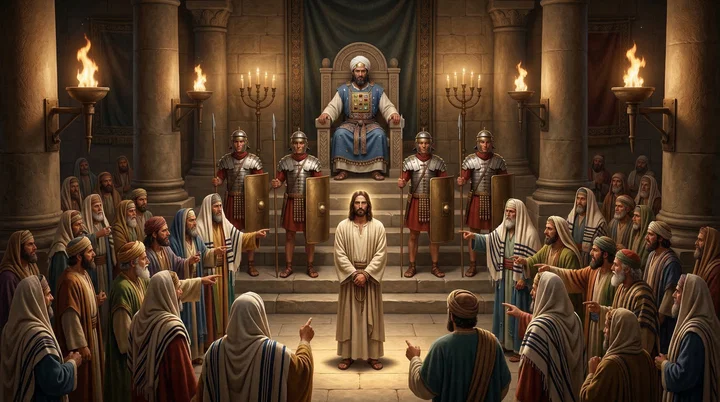
Bound and led away first to Annas, the father-in-law of Caiaphas who was high priest that year, Jesus was questioned about His disciples and His doctrine, and the reply was given then.Ms 104, 1897, par. 1–2ST Jun 13, 1878 It belongs to the examination before Annas and the court of Caiaphas, where He was questioned and accused by His persecutors.DA 6983SP 107.1 In that examination His testimony concerned the truth.Lt 100, 1910, par. 12–15
During this same examination Peter denied Him.Lt 54, 1874, par. 15–163SP 107.1 That denial caused Him a deeper pang than the insults of His enemies.3SP 107.1 Peter later repented with deep sorrow and was reconverted, and thereby became able to sympathize with the weak and erring, to warn the presumptuous, and to strengthen his brethren.Lt 54, 1874, par. 15–16
John was in the judgment hall as one able to hear and see all that transpired at the trial of his Lord.5RED 32.1 He had entered openly as a follower without concealing it, without mixing with those insulting and mocking Jesus and without assuming a false character.5RED 32.1 He sought a retired corner secure from the mob yet as near Jesus as possible.5RED 32.1 The reply was part of a trial in which He spoke only what was essential and maintained dignity despite insults and torture.Ms 95, 1897, par. 10–12 Yet He was treated as unjust despite no fault being found in Him.Lt 100, 1910, par. 12–15
Public Teaching Exposes Injustice
His teaching and purposes had no secret character, for He taught openly to the world in the synagogue and in the temple where the Jews always gather, with no secret purpose or doctrine and nothing concealed in what He said.3SP 113.3–114.1COS 125.2–126.1Ms 51, 1897, par. 4–5Ms 104, 1897, par. 1–2ST Jun 13, 1878 He had spoken openly in public places and not in secret, so those who heard Him could testify to what He said.3SP 113.3–114.1COS 125.2–126.1Ms 104, 1897, par. 1–2Ms 91, 1909, par. 11–15DA 698.1–700.5 He therefore refused to testify about Himself in a secret examination and directed His questioner to ask those who heard Him, because they knew what He had said.Lt 100, 1910, par. 12–1519MR 162.1ST Jun 13, 18785RED 32.1Ms 95, 1897, par. 10–12 Lawful testimony about His teaching and works must come from those public witnesses rather than from Himself under such questioning.ST Jun 13, 18785RED 33.1
The priests and rulers already had such witnesses, for they had sent spies and observers to follow Him, watch every movement, be present at every gathering, hear and report His words and deeds, and had hunted Him for months.3SP 113.3–114.1COS 125.2–126.1DA 698.1–700.5ST Jun 13, 18785RED 33.3–34.1 His answer rebuked Annas and challenged the fairness of questioning Him without witnesses when people who had heard His teaching were available.3SP 113.3–114.1Ms 91, 1909, par. 11–15ST Jun 13, 18785RED 33.3–34.1 It contrasted His public manner of teaching with the accusers' secret seizure and abuse of Him, exposing their hypocrisy.Ms 51, 1897, par. 4–5ST Jun 13, 1878 It exposed an attempt to entrap Him through a secret tribunal where the people had no voice, seeking to extract a statement that could be used against Him and to gain by perjury what could not be gained by fair means, rather than establish a charge by fair means.3SP 113.3–114.1ST Jun 13, 18785RED 33.3–34.1 The leaders kept the trial secret and made it only a pretense of legal process so the people could not testify to His mighty works and vindicate Him, which could have turned public anger against the Sanhedrin and led to His release and renewed honor.5RED 33.1 It also exposed the design to draw out some statement that could make the Roman authorities believe He was leading a secret society to set up a new kingdom, and its closeness made Annas feel his soul was being read.ST Jun 13, 1878
Sources
Pioneers and periodicals
21 sources
Jesus taught openly in the synagogues and the temple with no secret purpose or teaching kept back for a chosen few.ST May 3, 1899ST May 6, 1897ST Apr 15, 1897 He therefore told the high priest to ask those who had heard Him what He had said, since they knew and could testify to His words.ST May 3, 1899ST May 6, 1897ST Apr 15, 1897 Annas questioned Him about His teaching and followers to get material for His condemnation, but He refused to supply evidence against Himself in a secret examination, for lawful testimony had to come from public witnesses.ST Jan 17, 1900ST Jun 13, 1878ST May 3, 1899ST Jun 14, 1899 His answer silenced His interrogator and rebuked priests and rulers who had set spies to watch Him and hunted Him for months to entrap Him before a tribunal where the people had no voice.ST Jan 17, 1900ST Jun 13, 1878 While He spoke calmly and faithfully, Peter stood nearby following afar off and denied being His follower, putting Himself in the way of temptation by concealing his identity and adding to His Master's humiliation.ST Jun 7, 1899ST Nov 1, 1910ST Mar 14, 1906RH Jul 13, 1911
Open Teaching at Trial
Jesus had taught openly in synagogues and in the temple, not in secret, with no secret purpose, doctrine, or teaching reserved for an inner circle.ST Jan 17, 1900ST May 3, 1899ST May 6, 1897ST Apr 15, 1897ST May 6, 1897 Those who had heard Him could therefore testify to what He taught, because His teaching was public rather than hidden.ST Jan 17, 1900ST May 3, 1899ST May 6, 1897ST Mar 13, 1901ST May 6, 1897 For that reason He told the high priest to ask those who heard Him what He had said unto them, since behold they knew what He said and could bear witness instead of His being asked to repeat it Himself.ST May 3, 1899ST May 6, 1897ST Jun 7, 1899ST Mar 13, 1901ST May 6, 1897
The saying belongs to His being led away to the house of Caiaphas the high priest, and to His questioning before Annas, where the scribes and elders were gathered.ST Mar 6, 1901ST Dec 24, 1912ST Oct 18, 1905 Peter followed afar off while the council sought false witness against Him to put Him to death.ST Mar 6, 1901 Condemning a prisoner at night was contrary to Jewish law, and Annas condemned Him despite having no power to judge Him.ST Dec 24, 1912 It is part of the trial account to be read carefully together with Matthew 26:57-75, Mark 14:53-72, and Luke 22:54-62.ST Mar 6, 1901
The questioning before the high priest belongs to the last scene of Jesus' life on earth among the steps of sacrifice He endured for fallen humanity, leading to His crucifixion and death.RH Jun 10, 1862 That path led through mockery and cruelty as He stood before Pilate and Herod and finally suffered crucifixion.RH Jun 10, 1862 In that public judgment-hall setting Jesus remained Himself just as in the market, in private conversation, and in other places.RH Dec 3, 1861
The verse is set at Christ's arraignment in Judea where Caiaphas had urged that one man should die for the nation.ST Oct 14, 1889 The scene serves as an example of authorities treating an individual's sacrifice as acceptable for a supposed public good.ST Oct 14, 1889 It belongs also to Jesus' conversation with Pilate, in which Pilate found no evidence that Jesus had committed a crime.ST Oct 27, 1898 Jesus' dignified, unresentful bearing showed Pilate he stood before more than an ordinary man and appealed to him to do what was right despite the consequences.ST Oct 27, 1898
Unlawful Examination Exposed
Annas and the high priest questioned Jesus about his teaching and his followers in order to secure material for his condemnation, but his answer directing them to those who had heard him silenced his interrogator.ST Jan 17, 1900ST Jun 13, 1878 He refused to help condemn himself through his own testimony in a secret examination, for making a prisoner supply evidence for his own indictment is contrary to law and justice.ST Jun 13, 1878ST May 3, 1899ST Jun 14, 1899 Lawful testimony had to come from public witnesses who had heard his open teaching, and his judges had to bring an accusation or let him go.ST Jun 13, 1878ST May 3, 1899ST Jun 14, 1899
The answer was a pointed rebuke exposing that priests and rulers had set spies to watch every movement, had been present at every gathering to report every word and deed, and had hunted him for months to entrap him.ST Jun 13, 1878 They sought to bring him before a secret tribunal where the people had no voice, seeking by perjury what could not be gained by fair means.ST Jun 13, 1878 It also exposed the design to draw out some statement that could be used to make the Roman authorities believe he was leading a secret society to set up a new kingdom, and its closeness made Annas feel his soul was being read.ST Jun 13, 1878
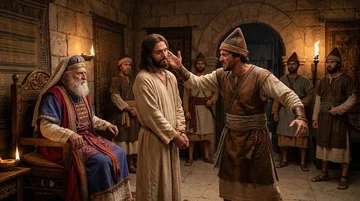
His rejection by the religious leaders fulfilled Scripture, though they had no excuse for rejecting him, for their rejection came from replacing God's Word with human traditions.ST Jun 7, 1899 Rejecting him under the greater light of the last days carries still greater responsibility.ST Jun 7, 1899 His teaching was for all people, without secret doctrine reserved for an inner circle, though its deepest words are shared with loving hearers so they can be proclaimed publicly.ST Jun 14, 1899 His reply models truthful, public witness and does not answer violence with violence, remaining calm and composed even when an officer struck him without cause.ST Apr 15, 1897ST Mar 14, 1906
Contrasting Denial with Faithfulness
John 18:21 sets the calm answer of Jesus under questioning beside the denial of Peter, who listened nearby and followed afar off while his Master was on trial.ST Jun 7, 1899ST Mar 14, 1906RH Jul 13, 1911 Peter denied being a follower after deciding he would avoid identification with Jesus, separating himself from his Master and mixing with unbelievers and thereby putting himself in the way of temptation.RH Jul 13, 1911 That setting underscores the contrast between the public words of Jesus and the concealment of identity by Peter, and the denial added to the humiliation Jesus endured.ST Jun 7, 1899RH Jul 13, 1911
Peter had gone onto forbidden ground where Christ would not hold him up, and he was left there to get the sharp lesson he needed.ST Nov 1, 1910 His bitter cry at the foot of the stairs shows how awful his fall was, and many such falls with such bitter cries rise daily into God's listening ears.ST Nov 1, 1910
The judgment-hall scene warns that people deny the Lord not only by spoken words but also by fearful silence when reproach calls for a faithful response.ST Oct 24, 1911 Peter's situation when Christ was on trial was a particular incident that could occur only once and can never be exactly repeated, yet Christ is still on trial before the world and needs the testimony of his friends. To repudiate Christ by spoken words is to deny him, but to be silent when he should be defended is also to deny him, for to defend one who is attacked proves friendship and to stand up for one in peril at sacrifice proves love. Love for Christ therefore requires testifying for him, springing to his defense when assailed, declaring his exalted character and wonderful love with boldness and fervor, and confessing him cheerfully before men.
Sources