John 18:22
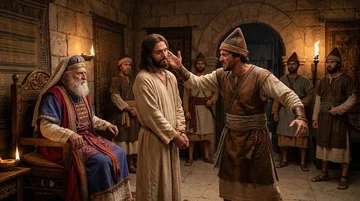
And when he had thus spoken, one of the officers which stood by struck Jesus with the palm of his hand, saying, Answerest thou the high priest so?
Translations
And when he had thus spoken, one of the officers which stood by struck Jesus with the palm of his hand, saying, Answer you the high priest so?
And when he had thus spoken, one of the officers which stood by struck Jesus with the palm of his hand, saying, Answerest thou the high priest so?
And when he had thus spoken, one of the officers which stood by stroke Jesus with the palm of his hand, saying, Answerest thou the high priest so?
And when he had thus spoken, one of the officers who stood by, struck Jesus with the palm of his hand, saying, Answerest thou the high priest so?
Revised Version, American Standard Version
And when he had said this, one of the officers standing by struck Jesus with his hand, saying, Answerest thou the high priest so?
And he having said these things, one of the officers standing by did give Jesus a slap, saying, 'Thus dost thou answer the chief priest?'
But as he said these things, one of the officers who stood by gave a blow on the face to Jesus, saying, Answerest thou the high priest thus?
And, when, these things, he had said, one of the officers who was standing by, gave a smart blow to Jesus, saying—Thus, answerest thou, the High-priest?
Berean Standard Bible, Majority Standard Bible
When Jesus had said this, one of the officers standing nearby slapped Him in the face and said, “ Is this how You answer the high priest?”
When he had said this, one of the officers standing by slapped Jesus with his hand, saying, “ Do you answer the high priest like that?”
When he said this, one of the police by his side gave him a blow with his open hand, saying, Do you give such an answer to the high priest?
When he had spoken these thinges, one of the officers which stoode by, smote Iesus with his rod, saying, Answerest thou the hie Priest so?
Douay-Rheims (Challoner revision)
And when he had said these things, one of the servants standing by, gave Jesus a blow, saying: Answerest thou the high priest so?
Pictures

Cross-references
- Matthew 26:67
Then did they spit in his face, and buffeted him; and others smote him with the palms of their hands,
Jesus is struck and mocked during his trial.
- Mark 14:65
And some began to spit on him, and to cover his face, and to buffet him, and to say unto him, Prophesy: and the servants did strike him with the palms of their hands.
Jesus is struck and mocked before the council.
- Luke 22:63-65
And the men that held Jesus mocked him, and smote him.
The guards mock Jesus and strike him.
- 1 Peter 2:23
Who, when he was reviled, reviled not again; when he suffered, he threatened not; but committed himself to him that judgeth righteously:
Jesus endured insult without retaliating, providing an example of patient forbearance.
- John 19:1
Then Pilate therefore took Jesus, and scourged him.
Jesus is scourged during the trial proceedings despite his innocence.
- Luke 22:54-62
Then took they him, and led him, and brought him into the high priest’s house. And Peter followed afar off.
Both recount Jesus being taken away and Peter denying him.
Commentary
Each commentary is drawn from primary sources: the writings of Ellen G. White and Adventist pioneers and periodicals. Each commentary is separate. Its own words are not a quotation; follow the references to read the source passages.
Ellen G. White
19 sources
During an unlawful, secret early-morning examination at the high priest's palace before Annas, also called Caiaphas, before any guilt had been proved, Jesus was kept under only a pretense of legality lest the people learn of it and vindicate Him.DA 698.1–700.5Ms 51, 1897, par. 33–343SP 107.1 One of the officers standing by struck Him in the face with the palm of his hand for supposed disrespect in answering the high priest, invoking the dignity of the office.Ms 104, 1897, par. 1–2Ms 91, 1909, par. 11–15DA 698.1–700.5 The blow came after Jesus stated plainly that He had taught openly in synagogue and temple with nothing in secret and told Annas to ask those who heard Him, laying bare months of spying and entrapment by a secret tribunal.DA 698.1–700.5COS 126.2–6ST Jun 13, 1878 He did not retaliate but calmly and meekly kept His dignity, exposing the wrong by requiring witness of evil if He had spoken evil, though He could have summoned legions of angels and instead endured insult and blows in human weakness as humanity's substitute and surety unto a shameful death.Lt 100, 1910, par. 12–15Ms 104, 1897, par. 1–2Ms 91, 1909, par. 11–15DA 698.1–700.53SP 114.2–115.1 By so enduring unjust shame and violence with nothing proven against Him, He left an example of patient forbearance that His followers must be prepared to share for His name's sake.Lt 100, 1910, par. 12–15DA 698.1–700.519MR 162.13SP 114.2–115.14RED 102.2–103.1
Setting and Meaning of Blow
The blow fell during an unlawful preliminary examination in the early morning at the high priest's palace before Annas, also called Caiaphas, before Jesus had been accused or proved guilty and before He was brought to Pilate.DA 698.1–700.5Ms 51, 1897, par. 33–343SP 107.1 It belonged to a mock trial that kept only a pretense of legality and was carried on in great secrecy, lest the people learn what was being done and come forward with testimony and mighty works in vindication of Jesus, bringing indignation upon the Sanhedrin, condemning their acts, liberating Jesus, and giving Him new honor.3SP 107.15RED 33.1 Amid that hurried proceeding He was insulted and mocked, coarsely accused, sneeringly questioned, and reviled by the assembly.3SP 107.1
One of the officers or servants of Annas and the high priest, standing by, struck Jesus in the face with the palm of his hand.Ms 104, 1897, par. 1–2Ms 91, 1909, par. 11–15DA 698.1–700.5Ms 51, 1897, par. 6COS 126.2–6 He did so saying, Answerest thou the high priest so, invoking the dignity of the office and rebuking Him as though He had shown disrespect and lacked due respect.Ms 51, 1897, par. 6COS 126.2–619MR 162.1 The stroke came because the officer objected to Jesus answering the high priest as He had.Ms 104, 1897, par. 1–2Ms 91, 1909, par. 11–15
It followed Jesus answering directly about His teaching and disciples, stating plainly that He had taught openly in the synagogue and temple with nothing said in secret and demanding that Annas ask those who heard Him.DA 698.1–700.5COS 126.2–6ST Jun 13, 1878 That answer rebuked Annas for hunting Him for months with spies at every gathering and seeking to entrap Him before a secret tribunal by perjury to stir the Roman authorities with a charge of secret conspiracy for a new kingdom.ST Jun 13, 1878 Annas himself felt his soul read and hid his hatred until a fitter opportunity, while his servant acted at once with insulting challenge.ST Jun 13, 1878
John was close enough to see and hear what happened, and Peter as well as John witnessed much of the trial.Lt 54, 1874, par. 15–165RED 32.15RED 33.1 Amid these indignities Jesus felt a keener pang in hearing His beloved disciple deny Him.3SP 107.1 Peter saw the raised hand and the blow to the face and, overwhelmed by the dishonor he had also brought on Jesus, fled the hall heartbroken and in grief, in the hour when Peter denied Jesus.Lt 54, 1874, par. 15–163SP 109.3–110.15RED 29.3–30.1
Endurance and Example for Believers
The blow was unjust shame, violence, and humiliation inflicted while Jesus was being questioned and betrayed and condemned, though no sin had been proven against Him.Lt 100, 1910, par. 12–15DA 698.1–700.54RED 102.2–103.1Lt 100, 1910, par. 16 He did not retaliate but calmly, mildly, and meekly met the insult, keeping His dignity and enduring without answering more than was needed, speaking only what tended to glorify God.DA 698.1–700.5Ms 51, 1897, par. 63SP 114.2–115.1ST Jun 13, 1878 He exposed the wrong by requiring that if He had spoken evil the officer should bear witness to it, but if He had spoken well and rightly there was no cause to strike Him.Ms 104, 1897, par. 1–2Ms 91, 1909, par. 11–15Ms 51, 1897, par. 63SP 114.2–115.1ST Jun 13, 1878
Though He could have summoned angels and legions of angels to protect Him, His mission in human nature as a passive prisoner was to endure taunts, insults, and blows patiently in human weakness.3SP 114.2–115.15RED 34.2–35.1 His submission to this treatment was part of bearing humanity's guilt as its substitute and surety, and led to His shameful death by crucifixion.Lt 100, 1910, par. 12–15 His captors treated His helplessness as permission for further abuse.3SP 114.2–115.1
By enduring, He left an example of patient forbearance.3SP 114.2–115.15RED 34.2–35.1 The abuse He endured shows what His followers must be prepared to endure for His name's sake.19MR 162.1 The account is meant to speak to believers' hearts and strengthen those who suffer for faith, for whom the disciples had been prepared by such insults and by the fickleness of those who had once followed Him.4RED 102.2–103.1Lt 100, 1910, par. 16 Remembering Jesus' agony in Gethsemane and His humiliation when struck, Peter became truly repentant and was converted, which humbled him and fitted him to pity the tempted, caution the presumptuous, and strengthen his fellow believers.Lt 54, 1874, par. 15–16
Sources
Pioneers and periodicals
20 sources
During His examination before the high priest about His disciples and His teaching, Jesus answered that He had taught openly with nothing hidden and told him to ask those who heard Him, and one of the officers standing by struck Him in the face with his open hand for answering in that way.ST Jun 13, 1878ST May 6, 1897ST Apr 15, 1897 He bore the unjust blow calmly and without returning violence, asking for witness if He had spoken wrongly and why He was struck if He had spoken rightly.ST Jun 13, 1878ST Jan 17, 1900ST Apr 15, 1897 The strike was unlawful against an uncondemned prisoner who had not been tried, since no charge had been proved by competent witness.ST Jan 17, 1900ST Dec 24, 1912ST May 3, 1899 His humiliation fulfilled that He came to His own and His own received Him not, and His questioning and suffering before the priests were steps in His sacrifice for fallen humanity.ST Jun 7, 1899RH Jun 10, 1862 His patient dignity under abuse teaches His followers to bear shame and suffering without retaliation, and warns them not to deny Him by silence or fear as Peter did in the judgment hall when he followed at a distance.ST Jan 17, 1900ST Oct 24, 1911RH Mar 26, 1861
Trial Setting and Blow
During the ecclesiastical examination the high priest questioned Jesus about His disciples and His teaching.ST Jun 13, 1878ST May 6, 1897 Jesus answered that He had spoken openly to the world in synagogues and in the temple where the Jews gather, with nothing spoken in secret, and told him to ask those who heard Him.ST Jun 13, 1878ST May 6, 1897 This occurred after the disciples fled when Jesus was bound and taken to Annas, the former high priest and father-in-law of Caiaphas, who then held the office.ST Mar 14, 1906 It stands at the beginning of His trials and persecution before the high priest and Pilate, facing leaders uniting against Him.ST Sep 24, 1912ST Mar 14, 1906 It is connected with His later arraignment as a malefactor before Pilate and the people when Caiaphas counseled that one man should die rather than the whole nation perish.ST Oct 14, 1889
One of the officers standing by then struck Jesus with the palm of his hand in the face.ST Jun 13, 1878ST Jan 17, 1900ST May 6, 1897RH Feb 11, 1862ST Mar 14, 1906 He did so in anger and without provocation while Jesus spoke calmly.ST Jan 17, 1900ST Mar 14, 1906 He challenged Him for answering the high priest in that manner and treated His answer as disrespectful, supposing his master had not been given due respect.ST Jun 13, 1878ST Jan 17, 1900ST May 6, 1897ST Apr 15, 1897RH Feb 11, 1862 His plain statement that He had taught openly with nothing said in secret rebuked the seeking to entrap Him before a secret tribunal by perjury to stir Roman authorities with a charge of secret conspiracy for a new kingdom after hunting Him for months with spies at every gathering.ST Jun 13, 1878
Jesus met the blow with mildness and without returning violence.ST Jun 13, 1878ST Jan 17, 1900ST Apr 15, 1897 He called for witness if He had spoken evil and asked why He was struck if He had spoken well.ST Jun 13, 1878ST Jan 17, 1900RH Aug 21, 1866 By this He showed by example not to meet smiting with smiting.ST Apr 15, 1897 The blow was unlawful because Jesus was an uncondemned prisoner who was not to be insulted before being tried.ST Jan 17, 1900ST May 3, 1899 Annas had no authority to judge Him and condemning a prisoner at night was contrary to Jewish law, just as trying Him at night was unlawful.ST Dec 24, 1912ST May 3, 1899 If He had done wrong the officer or a competent witness should have testified to it, making the strike as unjustified as the later abuse from the soldiers of Pilate and Herod.ST May 3, 1899
These incidental details of the trial fit the customs and circumstances of the time.RH Feb 11, 1862 They belong to the mutually consistent Gospel record of His suffering.RH Feb 11, 1862RH Aug 21, 1866
Rejection and Redemptive Witness
The striking of Jesus by an officer after His answer to the high priest was public rejection and humiliation fulfilling the Scripture that He came to His own and His own received Him not.ST Jun 7, 1899 The leaders rejected the One to whom their offerings pointed, having replaced God's Word with human traditions.ST Jun 7, 1899 Peter's denial added to that humiliation, and those who reject Jesus despite the greater light of the last days are without excuse.ST Jun 7, 1899 The account in John 18 belongs to the evidence that Christ, our Passover, was sacrificed on the fourteenth day of the first month, fulfilling the Passover type at its appointed time.RH Dec 15, 1868
The questioning before the high priest, when Jesus was struck by an officer, was part of the cruelty and humiliation He endured before His crucifixion.RH Jun 10, 1862 His trials before Annas and Caiaphas were steps in His sacrifice for fallen humanity.RH Jun 10, 1862
The blow for His answer to the high priest was one of the indignities and insults He bore with dignified bearing, unresentful, unresisting, and without retaliation, trusting in a power higher than Pilate knew.ST Oct 27, 1898 Together with the scourging, beating, bruising, and bleeding that followed, it presented the gospel in glorious perfection before Rome as represented by Pontius Pilate.ST Oct 27, 1898 It convinced Pilate that before him stood One more than man and appealed to him to do right whatever the consequences as part of God's effort to save him.ST Oct 27, 1898 The scene shows Christ humble before the authorities.ST Oct 27, 1898RH Dec 21, 1911
Patient Example and Warning
The blow fell in the judgment hall during the trial before the high priest, after Jesus answered Annas, when an officer struck Him in anger and rebuked Him for speaking to the high priest in that way.ST Jan 17, 1900RH Mar 26, 1861 The strike was without provocation while Jesus spoke calmly, and it was unlawful because no one was to be insulted before being tried.ST Jan 17, 1900ST Mar 14, 1906 He met the abuse calmly without retaliating, answering that the officer should identify any wrong in His words, and His patient, gentle dignity stood out against the anger around Him.ST Jan 17, 1900 That treatment teaches His followers not to shrink from suffering, shame, or loss, but to learn from Him to bear the cross.RH Mar 26, 1861
The verse belongs to the judgment-hall scene surrounding Peter's denial of Jesus, in the account of His trial in which Peter follows at a distance.ST Oct 24, 1911ST Jan 31, 1911 Peter witnessed the cruel act while Jesus spoke calmly but tried to appear indifferent, and his anxiety led others to question whether he was Jesus' disciple.ST Mar 14, 1906 The scene shows Peter failing to stand by his Lord when fear and pressure confront him.ST Oct 24, 1911
Fear can lead Jesus' friends to hide their loyalty and leave others thinking His friendship is not worth having.ST Jan 31, 1911 Denying Jesus can take the form of silence as well as spoken words.ST Oct 24, 1911 Although the incident happened once, the setting shows Christ still on trial before the world, so His followers can deny Him by silence when others attack or ridicule His character, life, or teaching. Loyalty to Christ calls for openly defending Him, even at personal cost, and confessing Him before others. Peter's denial added to Jesus' humiliation, and those who reject Jesus despite the greater light of the last days are without excuse.ST Jun 7, 1899
Sources