John 2:3
And when they wanted wine, the mother of Jesus saith unto him, They have no wine.
Translations
And when they wanted wine, the mother of Jesus says to him, They have no wine.
King James Version, KJV Cambridge Paragraph Bible
And when they wanted wine, the mother of Jesus saith unto him, They have no wine.
And when they wanted wine, the mother of Jesus saith to him, They have no wine.
Revised Version, American Standard Version
And when the wine failed, the mother of Jesus saith unto him, They have no wine.
and wine having failed, the mother of Jesus saith unto him, 'Wine they have not;'
And wine being deficient, the mother of Jesus says to him, They have no wine.
And, wine falling short, the mother of Jesus saith unto him—Wine, have they none!
Berean Standard Bible, Majority Standard Bible
When the wine ran out, Jesus’ mother said to Him, “ They have no more wine.”
When the wine ran out, Jesus’ mother said to him, “ They have no wine.”
When they had not enough wine, the mother of Jesus said to him, They have no wine.
Nowe when the wine failed, the mother of Iesus saide vnto him, They haue no wine.
Douay-Rheims (Challoner revision)
And the wine failing, the mother of Jesus saith to him: They have no wine.
Pictures
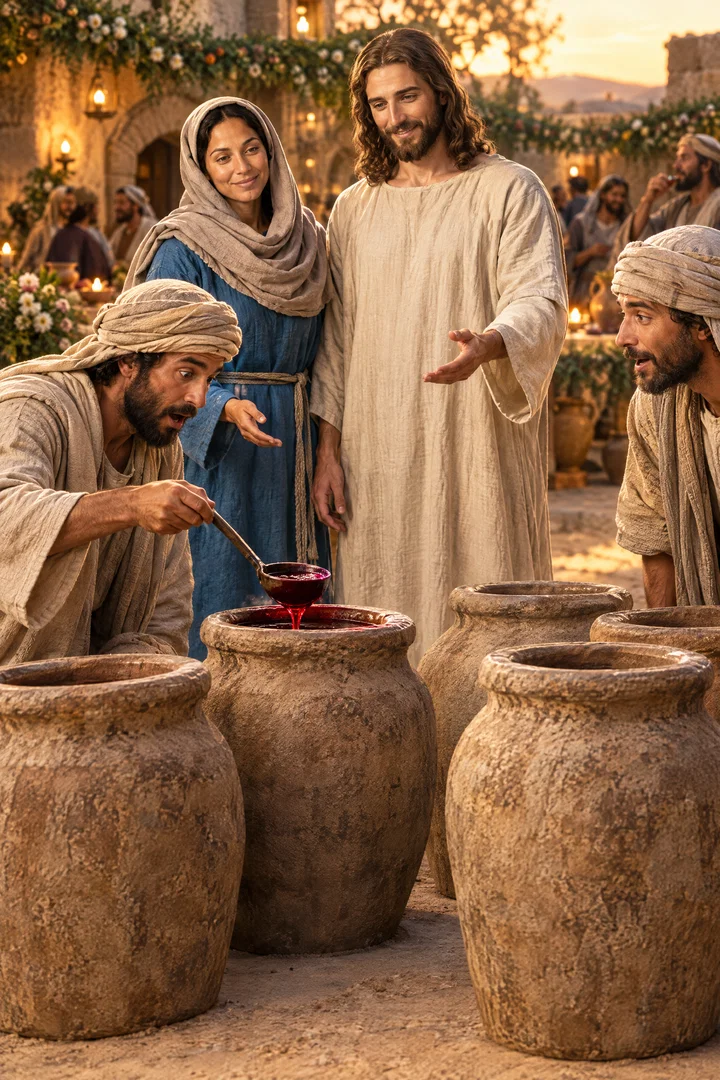
Cross-references
- John 2:9-10
When the ruler of the feast had tasted the water that was made wine, and knew not whence it was: ( but the servants which drew the water knew;) the governor of the feast called the bridegroom,
Jesus turns water into wine, supplying the feast with the best wine last.
- John 4:46-54
So Jesus came again into Cana of Galilee, where he made the water wine. And there was a certain nobleman, whose son was sick at Capernaum.
The healing is Jesus’ second sign in Cana, following the wedding miracle that prompted the father to seek him.
- John 2:11
This beginning of miracles did Jesus in Cana of Galilee, and manifested forth his glory; and his disciples believed on him.
The Cana sign was Jesus’ first miracle and led his disciples to believe in him.
- John 2:10
And saith unto him, Every man at the beginning doth set forth good wine; and when men have well drunk, then that which is worse: but thou hast kept the good wine until now.
The feast ruler praises the wine produced from the water.
- John 2:8
And he saith unto them, Draw out now, and bear unto the governor of the feast. And they bare it.
The servants carry out Jesus’ instruction after the wine runs out.
- John 21:2
There were together Simon Peter, and Thomas called Didymus, and Nathanael of Cana in Galilee, and the sons of Zebedee, and two other of his disciples.
Nathanael is identified as being from Cana, where the wedding took place.
- John 19:26-27
When Jesus therefore saw his mother, and the disciple standing by, whom he loved, he saith unto his mother, Woman, behold thy son!
Jesus provides for his mother while on the cross.
Commentary
Each commentary is drawn from primary sources: the writings of Ellen G. White and Adventist pioneers and periodicals. Each commentary is separate. Its own words are not a quotation; follow the references to read the source passages.
Ellen G. White
72 sources
At a wedding feast at Cana the wine gave out before the festivities ended, causing embarrassment and failure of hospitality, and Mary, who had an active part in arranging the feast, told Jesus of the need in an indirect request for help.Ms 36, 1899, par. 1–33RED 5.1–6.1Ms 79, 1900, par. 20–252SP 100.2–101.1 She had long believed He was the Messiah and longed for His glory to be revealed, trusting His wisdom and power to act only as was best.Ms 126, 1903, par. 5–810MR 204.1–206.2DA 144.3–145.12SP 103.1–2 His presence there showed His sympathy with ordinary human joy and sanctioned marriage as a sacred divine institution He Himself had established.DA 144.1COS 57.5–62SP 110.1Ms 16, 1899, par. 5–9MH 356.1 The wine that failed and that He supplied was pure unfermented juice of the grape, wholesome and harmless, for He did not make, serve, or endorse intoxicating drink contrary to all His teachings.ST Sep 6, 18993RED 5.1–6.1ST Apr 8, 1886ST Apr 8, 1886HL 113.1 That need occasioned His first miracle, which revealed Him as the promised Messiah, confirmed the disciples' faith, and symbolized His blood shed as abundantly as forgiveness for the purification of the world from sin.3RED 7.2–8.32SP 103.3–104.23RED 9.1–2ST Sep 6, 18992SP 152.1–153.1
Setting at Cana Wedding
The want of wine belongs to a wedding feast at Cana where the changing of water into wine was the first miracle, marking the beginning of the public ministry.ST Sep 6, 1899Ms 16, 1899, par. 5–93RED 9.1–2MH 356.1Ms 146, 1899, par. 5–6 Jesus was present with His newly made disciples, meeting Mary again after separation during His baptism and wilderness temptation.ST Apr 8, 1886Lt 66, 1878, par. 7Lt 2, 1878, par. 6–8 She saw He was still tender and dutiful, yet bearing marks of conflict and divine dignity.ST Apr 8, 1886 His gracing the feast with His presence showed He took part in ordinary social life and entered the homes of those who invited Him.Lt 66, 1878, par. 7Lt 2, 1878, par. 6–8
The festivities lasted several days, and the supply failed before the end, from some cause, when more was called for.3RED 5.1–6.1Ms 79, 1900, par. 20–252SP 100.2–101.1Ms 126, 1903, par. 5–8ST Apr 8, 1886 At so late an hour more could not be obtained or provided, and to go without was unusual on such an occasion.3RED 5.1–6.12SP 100.2–101.1ST Apr 8, 1886 The lack threatened to appear inhospitable, a serious failure of hospitality and apparent disgrace, bringing perplexity, regret, and embarrassment.3RED 5.1–6.1Ms 79, 1900, par. 20–25Ms 126, 1903, par. 5–8DA 145.4–146.1 Mary spoke to Jesus because she thought He who could do all things might suggest relief for the want.Ms 79, 1900, par. 20–252SP 100.2–101.1Ms 126, 1903, par. 5–8DA 145.4–146.1ST Apr 8, 1886
She was present not merely as a guest but as a relative of the parties, who had helped arrange the feast and had a prominent, active part in it, speaking as one having authority.Ms 79, 1900, par. 20–252SP 100.2–101.1Ms 126, 1903, par. 5–810MR 204.1–206.2DA 145.4–146.1 Because of that relationship and responsibility the shortage troubled her and she brought the problem to Him expecting help.Ms 79, 1900, par. 20–2510MR 204.1–206.2DA 145.4–146.1 The need led into a miracle whose superior quality the guests afterward remarked on.DA 149.5 The servants' account amazed the company, who at first overlooked Jesus, and He left so quietly that even His disciples did not notice.DA 149.5
Mary's Request and Faith
When the supply gave out, Mary turned to Jesus with the simple report that there was no wine left, and those few words carried a hidden appeal that He who could do all things should use His power to meet the need.3RED 5.1–6.1Ms 79, 1900, par. 20–252SP 100.2–101.1DA 145.4–146.1ST Apr 8, 1886 She brought the shortage to His attention because the failure troubled her and she looked to Him for relief.Ms 36, 1899, par. 1–3Ms 79, 1900, par. 20–25DA 145.4–146.1 Her statement was not a mere observation but an indirect asking, a suggestion that He might supply what was lacking for the guests.3RED 5.1–6.12SP 100.2–101.1ST Apr 8, 1886
She had long believed that Jesus was the Messiah and cherished the hope that His glory would be revealed, and at this feast she longed for Him to show that He was honored by God.DA 144.3–145.1 She spoke because she believed He had the wisdom and power to help and thought He might suggest something to relieve the embarrassment of the moment.Ms 126, 1903, par. 5–82SP 103.1–2 She expected Him to help, yet she submitted to His will and trusted Him to act only if it was best.Ms 126, 1903, par. 5–810MR 204.1–206.22SP 103.1–2
Jesus answered that His hour had not yet come, making clear that Mary could no longer direct Him as a mother, for His divine mission and the Father's will, not earthly ties or personal requests, governed the use of His power.2SP 100.2–101.1ST Apr 8, 1886 Mary was not discouraged by that reply but told the servants to do whatever He said.Ms 79, 1900, par. 20–25
Christ's Sympathy and Example
The setting at Cana shows sympathy for people and desire to minister to their happiness, using divine power to add to the joy of the feast and hallowing the relations of human life.DA 144.1COS 57.5–62SP 109.1–2MYP 384.13RED 13.3–14.1 It is right to gather for a pleasant occasion, for innocent happiness is welcomed, ordinary human joys are shared, people are wanted to be happy, and thoughts are turned from cares toward God's goodness and love.DA 144.1COS 57.5–62SP 109.1–2MYP 384.13RED 13.3–14.1 From this the disciples learned sympathy and humanity.2SP 109.1–23RED 13.3–14.1
Presence at the marriage feast was a deliberate step toward breaking down social barriers and bringing people together as one family, beginning to break down Jewish exclusiveness, prejudice and narrowness.2SP 109.1–22SP 106.1–107.2DA 150.23RED 13.3–14.13RED 11.2–12.1 It showed close sympathy with humanity and a mission extending beyond the Jewish people to all classes and to the world as Redeemer, seeking opportunities in ordinary social settings to reach people, do good, enlighten and benefit them.2SP 109.1–22SP 106.1–107.2DA 150.23RED 13.3–14.13RED 11.2–12.1
Ordinary social gatherings were not shunned, and there was no seclusion like the Pharisees with their narrow, self-righteous, restrictive ideas and austere separation, but people were met where they were in homes, at daily work and at feasts.GW92 319.2–320.1GW 334.4–335.116MR 318.2–319.1Ms 146, 1899, par. 5–6Lt 2a, 1878, par. 8–10 Attendance was not worldly conformity but generous, gracious, genial and beneficent conduct with precious teaching that gave those honored an opportunity to know character, to become acquainted with God made human, and to be drawn to know Him, in contrast to Pharisaical teaching.GW92 319.2–320.1GW 334.4–335.116MR 318.2–319.1Lt 2a, 1878, par. 8–1015MR 132.2–3 Such mingling revealed character and used the occasion for instruction.GW92 319.2–320.116MR 318.2–319.1Ms 146, 1899, par. 5–6Lt 2a, 1878, par. 8–1015MR 132.2–3
Disciples through all time are taught by this example not to exclude themselves from society, renounce social communion, seek strict seclusion, or hide religion within stone walls to escape contamination of the world, for that loses golden opportunities to enlighten and benefit humanity.ST Apr 8, 1886 To reach all classes they must meet people where they are, since people will seldom seek them on their own, and hearts are not touched by divine truth from the pulpit alone.ST Apr 8, 1886 Interest is awakened by going among people as one who desires their good, seeking them in public streets, in private houses, on boats, in the synagogue, by the shores of lakes, at daily work and at marriage feasts, showing unfeigned interest in their temporal affairs and carrying instruction into households to bring whole families under the influence of divine presence.ST Apr 8, 1886
Joining the solemn and impressive Jewish marriage occasion, whose pleasure and joy were not displeasing, sanctioned the social gathering and social communion with no shadow of worldly levity.ST Apr 8, 1886ST Apr 8, 18863RED 10.1 That sanction gave no license to scenes of dissipation and revelry, while presence rebuked intemperance, self-indulgence, folly, pretentious piety and senseless exactions, and showed greatest veneration for the law of God and obedience to its precepts, leaving a perfect pattern of inward character unlike the seclusion of Pharisees and other dignitaries.ST Apr 8, 1886ST Apr 8, 18863RED 10.1 Attendance permits young people's innocent pleasures but gives no approval to theaters, parties, or dancing.Lt 35, 1878, par. 9–10
Marriage Honored by Christ
By His presence and His action at the marriage festival in Cana, where the wine failed, Christ began His public ministry and set His sanction upon marriage as a sacred institution established by God Himself.Ms 16, 1899, par. 5–9MH 356.1Ms 36, 1899, par. 6 That institution is His own appointment, in which a man and a woman unite to build a family, and by attending the wedding He gave it high endorsement and marked respect.MH 356.1Ms 170, 1905, par. 10Ms 36, 1899, par. 610MR 179.1–181.2 He honored the marriage relation itself and accepted the ordinance of marriage by being present to take part in it.2SP 110.1Ms 170, 1905, par. 1010MR 179.1–181.2
He honored the marriage ceremony by His presence and showed active interest in it, expressing sympathy with and approval of those being married.Ms 126, 1903, par. 23–24Ms 22, 1898, par. 41 He came not to cast a cloud over the happiness of the family and guests but in full sympathy with pure joy.Ms 126, 1903, par. 23–24 He did not come to forbid marriage or to destroy family relationships, and the miracle of supplying the need proved that marriage is not forbidden by God.Ms 16, 1899, par. 25Ms 22, 1898, par. 41 He enforced celibacy upon no class, but came to exalt marriage, to restore it to its original sanctity, and to restore and ennoble pure affection.Ms 126, 1903, par. 23–24Ms 22, 1898, par. 41
His presence gives sanction to every gathering that is pure and lovely and of good report.Ms 126, 1903, par. 23–24 He looks with pleasure upon the family where sacred and unselfish love rules.Ms 126, 1903, par. 23–24 In this way the earthly family is to symbolize the family in heaven.Ms 22, 1898, par. 41 Throughout His later ministry He treated the marriage covenant with marked respect, using it to illustrate many important truths.2SP 110.1ST Apr 8, 1886
Wine Was Pure Grape Juice
The wine that ran out at Cana and the wine afterward supplied in its place was the pure juice of the grape in its natural state, unfermented, clarified and refined, wholesome, refreshing, harmless and safe, wholly unlike fermented wine and strong drink.ST Sep 6, 18993RED 5.1–6.1ST Apr 8, 1886ST Apr 8, 1886HL 113.1 It was only the fresh product of the grape, with not one particle of fermentation in it.2SP 103.3–104.2MH 333.2–3Ms 230, 1902, par. 32–33 Christ did not make, serve, or endorse intoxicating drink.ST Sep 6, 1899ST Apr 8, 1886HL 113.1Ms 126, 1903, par. 15 To have made intoxicating wine would have been contrary to all His teachings and example.ST Sep 6, 1899HL 113.1ST Aug 29, 1878 He would not provide what would tempt men, cloud reason, becloud judgment, and benumb spiritual perception.HL 113.1MH 333.2–3Ms 106, 1903, par. 8–11
He had just come from His long fast and suffering in the wilderness to break the power of appetite over man, including the appetite leading to free use of intoxicating drink.ST Apr 8, 1886ST Aug 29, 1878 He is the Angel who led Israel in the wilderness and spoke the law from Sinai, who prohibited those in holy office from using wine so they might have clear judgment to distinguish between the common and the sacred, do justice to the fatherless and widows, teach His statutes and laws, and accept no bribes.ST Aug 29, 1878 He is the One who told the wife of Manoah to drink no wine or strong drink because her son should be a Nazarite from birth, and who told Zacharias that the unborn John should drink no wine or strong drink.ST Aug 29, 1878 Such a One would not make wine rendered intoxicating by fermentation or adulteration for a wedding feast.ST Apr 8, 1886ST Aug 29, 1878
The verse therefore gives no sanction for keeping or using fermented wine or liquor in the house.Ms 126, 1903, par. 15Ms 230, 1902, par. 32–33 Only fresh grape juice is to be used, because intoxication confuses the brain and causes accidents and loss of self-control, while God demands clear minds and full strength to honor and glorify Him.Ms 230, 1902, par. 32–33 Intoxicating wine is not a fitting beverage or symbol of Christ's blood at the Lord's table.HL 113.1 The wine provided at Cana was the same kind He gave His disciples as a symbol of His own blood, with no fermentation in the wine just as there was to be no leaven in the bread.HL 113.1Ms 106, 1903, par. 8–11
One object of the miracle was to restore perverted taste to a healthy condition by leading the governor of the feast to acknowledge this wine superior in quality to any he had tasted, thus bringing taste into harmony with healthful appetite.ST Apr 8, 1886ST Aug 29, 1878 The charge that Christ was a wine-bibber and Sabbath-breaker is false.ST Aug 29, 1878 He kept His Father's commandments, and His whole life was temperance and self-denial to break the power of appetite.ST Aug 29, 1878Ms 106, 1903, par. 8–11 Had He been a wine-bibber He could not have been a perfect offering, and the virtue of His blood would have been of no avail.ST Aug 29, 1878
Miracle's Meaning and Effects
The lack of wine recorded here occasioned the first display of miraculous power, by which He was revealed and men were led to consider that He was the promised Messiah.3RED 9.1–22SP 152.1–153.1 The abundant supply He then provided symbolized salvation, the water standing for baptism into His death and the wine for His blood shed to purify the world from sin, given as abundantly as forgiveness itself is given.3RED 7.2–8.32SP 103.3–104.2
The wine He made astonished the guests because it surpassed in quality what had been served first.Ms 16, 1899, par. 22 That miracle confirmed the faith of the disciples and testified to them that He was the world's Redeemer.ST Sep 6, 1899Ms 16, 1899, par. 22 It gave them opportunity to acknowledge their faith in Him and kindled hope that God had raised up a deliverer for His people.ST Sep 6, 1899DA 149.6–150.1
Reports of the miracle spread through all that region even to Jerusalem.ST Apr 8, 1886 There priests and elders searched the prophecies pointing to Christ with new interest and intense anxiety to know the aim and mission of this unassuming Teacher who did what no other man had done.ST Apr 8, 1886 The report prepared the way for His warm and cordial reception in Galilee, where many hoped He was the promised Deliverer.3RED 14.2–15.1ST Feb 3, 18812SP 151.2ST Feb 1, 1877
In particular, the report of changing water into wine encouraged the nobleman to believe that Jesus could also restore his dying son to health.3RED 15.2–16.1ST Feb 3, 1881ST Feb 1, 1877 The same miracle illustrates Christ working through a mother's loving ministry.GW 206.2–3 As He turned water into wine, so He turns the common water of daily home life and ordinary experiences into the wine of heaven, transforming a God-fearing mother's ordinary work of home care into a ministry of infinite worth and lasting spiritual blessing that makes the home a Bethel.GW 206.2–3RH Jan 24, 1907Ms 43, 1900, par. 50
Lessons for Daily Living
The shortage of wine belongs to instruction that temperance in all things is duty and that life must be brought into harmony with the laws of health.STBk 126.2STA 127.1 Conscience must be aroused to practice the principles of true reform, and the subject must be kept fresh line upon line and precept upon precept.STBk 126.2 Its principles are to be taught to others by precept and by quiet, consistent example that arouses intellect and conscience, for without true temperance there is no susceptibility to the sanctifying influence of truth.STBk 126.2STA 127.1
The running out of wine was a real, practical need on a particular occasion, brought to Jesus, and met by His provision.7T 114.3CH 599.1–2Ms 81, 1902, par. 14GW 362.2–363.1 As with the feeding of the multitude, that supply teaches that the Lord provides for human needs.CH 599.1–2Ms 81, 1902, par. 14GW 362.2–363.1 He guides His people in preparing suitable, wholesome food for different times and occasions, and will not leave them in ignorance but teaches them how to prepare the best foods for all times and occasions.7T 114.3CH 599.1–2Ms 81, 1902, par. 14GW 362.2–363.1 The food business itself is one of His own instrumentalities for supplying need.Ms 81, 1902, par. 14
Sources
Pioneers and periodicals
116 sources
At Cana of Galilee a marriage was held where the mother of Jesus was present and Jesus with his newly made disciples was an invited guest, early in his public work after his baptism and temptation.ST Apr 8, 1886ST Jul 9, 1896ST Dec 22, 1898ST Jul 9, 1896
When the supply failed about the midst of the feast, bringing threatened disgrace to the hosts and ruler of the feast, Mary noticed the need and brought it to Jesus out of care for the friends and guests.ST Sep 17, 1894ST Feb 15, 1899ST Feb 15, 1899ST Jul 26, 1910ST Jan 11, 1905
Her report that there was no wine carried a hidden appeal for him to whom all things are possible to relieve the want and spare embarrassment, in tender confidence that he would act at the proper time.ST Apr 8, 1886ST Feb 15, 1899ST Oct 14, 1913ST Dec 30, 1880ST Jul 26, 1910
The wine that had run out and the wine he then supplied by miraculous creative power was pure unfermented juice of the grape, made in a moment from water without ferment or time for fermentation.ST Sep 6, 1899RH Jun 25, 1914ST Dec 5, 1892ST Jul 13, 1882ST Jun 30, 1881
By his presence and help he honored marriage as a divine institution, showed sympathy for ordinary human need and lawful joy, and opened his miracle-working career to manifest his glory and bring belief, giving no sanction to intoxicating drink or dissipation.ST Nov 10, 1914ST Sep 17, 1894ST Sep 16, 1886RH Jul 28, 1903
Wedding Setting and Sequence
On the third day there was a marriage in Cana of Galilee, where the mother of Jesus was present and Jesus with his newly made disciples was present as invited guests.ST Jul 9, 1896ST Dec 22, 1898ST Jul 9, 1896RH May 19, 1863 The mother prepared to go to the Cana gathering as one belonging to it, and the Lord was there not as an intruder but as one invited.ST Jul 9, 1896RH May 19, 1863
That third day was the third day after John bore witness to Jesus a second time.ST Aug 13, 1896 It came a little while after Satan tempted Jesus in the wilderness and after his baptism, when Mary was again with him after separation and saw him still tender and dutiful yet bearing marks of conflict and the dignity of divine mission.ST Apr 8, 1886 It belongs to his earlier work leading up to the beginning of his ministry recorded in Matthew 4:17-25.ST Dec 23, 1897
The want of wine opens the account of his first miracle early in his public ministry.ST Sep 16, 1886ST Oct 18, 1905ST Nov 10, 1914 It marks both the place where that first miracle took place and the beginning of his miracle-working career and divine mission, his first wonder-working act done as a social act at a village wedding.ST Sep 16, 1886RH Jul 28, 1903RH Jul 28, 1903ST Oct 18, 1905 That beginning through changing water into wine displays creative power, not merely mental healing.RH Jun 18, 1914
The report is a brief, simple, natural record of one simple fact that the feast had run out of wine.ST Mar 10, 1887ST Sep 29, 1898 The shortage was real and led into the miracle, not a plan to conceal extra wine brought by Jesus and his disciples.ST Mar 10, 1887 The record moves from this need through the six stone waterpots and their filling with water and the drawing out of wine for the governor of the feast, to manifested glory that brings belief for life in his name.ST Sep 29, 1898
The failure was found about the sixth hour when the table was spread and the guests had seated themselves, through a strange and unaccountable mistake.ST Jul 26, 1910 It was hidden from the bridegroom, who did not know of it at the time and was not told of it until many hours afterward.ST Jul 26, 1910 Running out in the midst of the feast threatened disgrace on those hosting it and embarrassment to host and family, bridegroom, guests, and ruler of the feast, since to lack provision would reflect badly and leave mortification.ST Feb 15, 1899ST Jan 11, 1905ST Jan 26, 1882ST Apr 5, 1905ST Sep 15, 1898
Jesus and especially his disciples had likely been invited late, so their presence had not been allowed for when the feast supplies were prepared.ST Jan 11, 1905 Mary lived in Nazareth eight or nine miles distant, so her presence means the wedding was at the house of an intimate friend or relative.ST Dec 22, 1898 Her knowing that the wine had failed before the ruler of the feast knew it means she was acting in some responsible station in connection with the feast, evidently a near relative or special friend with a prominent part to perform and sharing the concern of the family.ST Apr 8, 1886ST Jan 11, 1905ST Dec 22, 1898
Cana is the place where the marriage took place, not the bride's name, whose name is not given.ST Jul 13, 1882 The wedding was not polygamous, and the claim that a Jewish wedding of this account was polygamous is false and unsupported.ST Oct 2, 1884 Travelers pass through Cana going from Nazareth to Tiberias. The miracle became known through his friends and new disciples shortly before his going to Nazareth, and it prepared the way for his cordial reception and welcome in Galilee.ST Feb 3, 1881ST Feb 1, 1877ST May 6, 1886
That changing of water into wine bore witness to his divine identity and was remembered by the Galileans as a sign of his power and evidence that the Messiah had come.ST Aug 16, 1910ST Dec 17, 1885ST Apr 12, 1905 The report of the power shown at Cana encouraged the nobleman to believe Jesus could restore his dying son to health.ST Feb 3, 1881ST Feb 1, 1877ST May 6, 1886 Those who opposed him dismissed the miracle of the wine as a trick or sorcery.ST Aug 16, 1910
Mary's Words and Motives
When the wine ran out Mary noticed the shortage and told Jesus they had no wine, bringing the household trouble and the hosts' need to his attention.ST Sep 6, 1899ST Sep 17, 1894ST Feb 15, 1899ST Dec 5, 1892ST Jan 11, 1905 Her notice grew out of concern for the guests and the hosts and friends, and out of close care for Jesus himself.ST Sep 6, 1899ST Sep 17, 1894ST Apr 5, 1905 The wedding setting shows his regard for marriage, which he honored by his presence, and his response to the lack leads to the miracle in which he supplied a temporal need and revealed his character, teaching that he will use his power to meet spiritual needs as well.ST Sep 17, 1894 The wine he later supplied was pure unfermented grape juice, not intoxicating drink, consistent with his mission to heal, free captives, and save the lost, and the ruler's calling it good wine supports that conclusion.ST Sep 6, 1899ST Dec 5, 1892 Her expectation was that he would manifest his mission as the Messiah.ST Apr 5, 1905
Her statement carried a hidden request and suggestion that he to whom all things are possible should relieve the want.ST Apr 8, 1886ST Feb 15, 1899ST Dec 30, 1880 It was an appeal for him to remedy the problem and spare embarrassment, since disgrace threatened those hosting the feast and her concern was that the feast be properly ordered and honored.ST Feb 15, 1899ST Aug 13, 1894 At that late hour more pure grape juice could not be obtained, though it was unusual to dispense with wine on such an occasion, and the wine needed at a Jewish wedding was fresh grape juice while fermented wine was forbidden.ST Apr 8, 1886ST Feb 15, 1899ST Dec 30, 1880 She acted from a prominent part as a relative of the hosts, which explains why she knew of the failure and spoke.ST Apr 8, 1886ST Dec 30, 1880
She knew his accommodating disposition and thought he might suggest a way to relieve the host's embarrassment, and she did not expect him to work a miracle.ST Mar 15, 1905ST Jan 11, 1905 The failure was embarrassing for the host and family, and because Jesus and especially his disciples had likely been invited late their presence had not been allowed for when the supplies were prepared, so Mary as evidently a near relative or special friend shared their concern and her words were an appeal for Jesus to suggest how the difficulty could be relieved.ST Mar 15, 1905ST Jan 11, 1905 Those who describe her wish for him to turn water into wine as curiosity connect it with his reply about his mission.
Her appeal showed tender love and confidence and trust that he would act at the proper time.ST Oct 14, 1913ST Jul 26, 1910 Her words lead into his reply and her instruction to the servants to do whatever he told them, and she accepted his response.ST Oct 14, 1913ST Jul 26, 1910 Her request did not make her the guide or ruler of his work, and he needed no intermediary to address human need.ST Oct 14, 1913 Divine authority belonged to him, not to her, as his reply to his mother reveals when he begins his ministry through this social act of his first wonder-working at a village wedding.ST Oct 14, 1913RH Jul 28, 1903
At her request Jesus wrought his first miracle as proof of his divinity.ST Mar 30, 1876RH May 12, 1874 This is taken to prove Mary has great power with God as Mother of the Redeemer and advocate with her divine Son.ST Mar 30, 1876 It gives reason to confide in her next to the Saviour and to seek her intercession.ST Mar 30, 1876
Kind of Wine Involved
The wine that failed and the wine supplied in its place was unfermented, pure, sweet, healthful fresh juice of the grape, the pure blood of the grape, not intoxicating liquor or strong drink.ST Sep 6, 1899ST Apr 8, 1886ST Aug 29, 1878RH Jun 25, 1914ST Dec 5, 1892 The guests were not habitual users of intoxicating liquor, and the householder was not setting a condemned drink before them, and the stumbling over the incident comes from giving the Bible word wine the modern English meaning of intoxicating beverage.RH Jun 25, 1914ST Jul 1, 1897ST Feb 7, 1878 He had just come from the long fast and suffering in the wilderness to break the power of appetite over man, including the appetite that leads to the free use of intoxicating drink, so what He made was clarified and refined pure juice whose effect brings the taste into harmony with a healthful appetite.ST Apr 8, 1886ST Aug 29, 1878ST Dec 5, 1892 He is the Angel who led Israel and spoke the law from Sinai prohibiting those in holy office from wine for clear judgment to distinguish sacred from common, do justice, teach statutes and accept no bribes, who commanded Manoah's wife to drink no wine or strong drink because her son should be a Nazarite from birth and told Zacharias the unborn John should drink no wine or strong drink, and His object was to bring the governor's perverted taste to health by leading him to acknowledge this wine superior to any he had tasted.ST Aug 29, 1878ST Feb 7, 1878 To charge Him with making an intoxicating beverage and adding to intoxication is utterly unjustifiable and wrongs Him and the cause for which He gave His life, for the Bible does not encourage or condone alcoholic drinks, to make intoxicating wine would have been contrary to all His teachings and example and His mission to heal, free captives and save the lost, and the charge that He was a wine-bibber and Sabbath-breaker is false, since He kept His Father's commandments in temperance and self-denial and had He been a wine-bibber He could not have been a perfect offering and His blood would avail nothing.ST Aug 29, 1878RH Jun 25, 1914ST Dec 5, 1892ST Feb 7, 1878
What the ancients called best wines were not fermented at all, but fresh grape juice boiled down to a thick sweet syrup and stored in jars, then mixed with water hot or cold and sometimes with spices for the ordinary table drink, or eaten spread on bread.RH Jun 25, 1914 The wine then provided was rare, purple, rich and sweet, new and unfermented, not the maddening wine that fills the drunkard's cup, but pure and healthful, the same kind the Bridegroom will give His guests to drink new at the marriage supper of the Lamb in the Father's kingdom, leaving no one the worse.RH Jun 25, 1914 It was good because created instantly from pure water with no time for fermentation, drawn from the stone pots as soon as they were filled.ST Jul 13, 1882ST Jun 30, 1881ST Aug 19, 1889ST Aug 13, 1894 Without introducing leaven or ferment it was not a product of decomposed juice or rottenness in the first stage of decay, but the ripe wholesome product of growth and the life of the grape produced instantly by creative power rather than through the slower process of nature, healthful and refreshing.ST Jul 13, 1882ST Jun 30, 1881ST Aug 19, 1889ST Aug 13, 1894
Fermented liquor of any kind comes under leaven which is forbidden at Passover, and as an observant Jew He would not drink fermented wine at Passover nor keep Passover where everything fermented had not been removed, so the wine made at Cana was unfermented and non-intoxicating and the only kind fitting for the Lord's table.ST Feb 7, 1878 This accords with the custom of Israel ancient and modern never to use any kind of fermented drink for sacred purposes including the marriage feast, but to employ in oblations and libations fresh grapes, unfermented grape juice and raisins as the symbol of benediction, since fermentation is always a symbol of corruption, decay and rottenness.ST Feb 7, 1878 The ruler's description of it as good wine supports that conclusion, for the Greek word kalon connects with the description of a tree bearing good fruit.ST Dec 5, 1892ST Mar 6, 1893 It is called the fruit of the vine, understood as fresh non-intoxicating grape juice rather than liquor, a delicious healthful food-drink that makes glad the heart and contains a blessing, the same kind used in the Lord's Supper and to be drunk new in the Father's kingdom, and the same kind commended for a little use for the stomach and infirmities.ST Dec 5, 1892ST Mar 6, 1893
Both fermented and unfermented wine were known to the Jews, and the verse is cited as an example of wine the Lord permits in contrast with harmful wine, without specifying in that teaching which kind is meant here.RH Jun 25, 1914ST Jul 1, 1897
Christ's Character and Power
By attending the wedding at Cana He honored marriage by His presence and blessing, sanctioning holy wedlock and family life as a divine institution He Himself had established and ordained for men and women to unite and rear families, with His goodness, life and blessing present in it.ST Nov 10, 1914ST Apr 8, 1886ST Sep 17, 1894STST Apr 5, 1905 His response to the lack of wine supplied a temporal need and revealed His character, teaching that He will use His power to meet spiritual needs as well.ST Sep 17, 1894 The need passed by murmuring from lip to lip until it reached Him, and His answer was the command to fill the water vessels to the brim. Throughout His later ministry He gave marriage marked respect by using the marriage covenant to illustrate many important truths.ST Apr 8, 1886
His presence showed He was social in nature and approved innocent happiness and ordinary social life, with the pleasure and joy of the solemn and impressive Jewish marriage occasion not displeasing to Him.ST Apr 8, 1886ST Jul 9, 1896RH Jul 28, 1903ST Dec 30, 1880RH Aug 26, 1902 He took pleasure in innocent joy without indulging Himself or lowering His conduct, and He did not bid sweet affection die, forbid daily joy, turn His followers from earthly happiness to bead and crucifix, or bid them hide religion within walls.ST Apr 8, 1886 Though He came as guest He served as Master, smiling on the hearts that loved and making them doubly blessed, gladdened in His children's joy and saddened in their pain, still walking where men walk in homeliest household care. The wedding was a solemn, joyful gathering of relatives, and His joining the guests there marked the beginning of His work to break down Jewish exclusiveness and encourage freer mingling with others.ST Jul 9, 1896ST Dec 30, 1880RH Aug 26, 1902
He responded to a social occasion and a matter of custom, not necessity, showing care for human relationships and approval of ordinary social life.ST Feb 7, 1911RH Jul 28, 1903 The shortage was a household trouble brought to Him in trust that He would act at the proper time, and His help shows tender care for ordinary human needs, practical conveniences, lawful happiness and comforts, sympathy and humanity, and dignity given to common life.ST Feb 7, 1911RH Jul 28, 1903ST Jan 2, 1912ST Jan 26, 1882RH Oct 28, 1909 He provides temporal blessings to the extent they will not harm spiritually or materially, spares His host embarrassment, and the rich new wine images His love.ST Jan 2, 1912RH Sep 3, 1903ST Jan 26, 1882 The miracle that followed, in which water becomes wine, illustrates spiritual transformation by which what is simple and lower is raised and given a new character, as natural instincts are sanctified into human love.RH Jul 28, 1903
He met the lack by miraculous creative power beyond the ordinary processes of nature, changing water directly into excellent wine openly before the servants, His mother and His disciples, so that the company came to know of it.ST Apr 5, 1905ST Jul 26, 1910ST Aug 5, 1897ST Oct 28, 1880 It was His first miracle and a great miracle, astonishing the guests, confirming the disciples' faith, leading them to believe in Him, and testifying to them that He was the world's Redeemer.ST Sep 6, 1899ST Apr 5, 1905ST Aug 5, 1897 The change also illustrates how He can transform a weak, characterless human heart into one desirable and full of blessing.ST Apr 5, 1905 That instant transformation shortened the ordinary process by which moisture drawn into a vine becomes wine over months in a vineyard, accomplishing in a moment what normally takes much longer.ST Aug 26, 1880RH Aug 20, 1908RH Apr 9, 1901 Its wonder lay not in producing unfamiliar things but in the power behind their transformation, making visible His working in nature.RH Apr 9, 1901RH Mar 4, 1902 He is the source of ordinary provision as well as miraculous provision, for food and wine produced through sunshine, rain, growing crops and harvest ultimately come from Him, and by making wine directly from water He demonstrated that the things from which provision comes belong to Him and that He can bring about immediately what ordinarily happens gradually.RH Feb 8, 1906RH Mar 4, 1902
The change was an acceleration of natural law rather than its suspension, bringing together in a moment without a vine the elements that ordinarily produce grape juice, without violating nature's laws.RH May 29, 1900RH Jan 28, 1902 The wine at Cana had no more divinity in it than the wine produced by grapes today, for both are products of God's life-giving power and the ordinary process is a continuing divine miracle.RH Jan 28, 1902 This extraordinary act established no new or better way of obtaining wine, and men still till the soil and grow vines as before.RH Jun 22, 1916 Men assisted Him by first filling the stone water-pots with water and then bearing to the guests what had blushed into wine at the sight of its Lord, but the excellent wine served last came from the Lord's power alone while the men were only helpers with Him, so all praise belongs to the Lord and none to the human helpers.ST Jan 9, 1907 The event displays creative power, not merely a process of mental healing, and shows Jesus could provide when the ordinary supply had run out, demonstrating that God's power and resources do not depend on natural conditions or changing supplies.RH Jun 18, 1914RH Oct 7, 1902
His joining the mixed festal gathering with no shadow of worldly levity sanctioned the social gathering with His presence, unlike the austere seclusion of the Pharisees and other dignitaries.ST Apr 8, 1886 His presence rebuked intemperance, self-indulgence, folly, pretentious piety and senseless exactions, gave no license to scenes of dissipation and revelry, showed greatest veneration for the law of God and obedience to its precepts, and left a perfect pattern of inward character.ST Apr 8, 1886ST Apr 8, 1886 By attending He broke down Jewish exclusiveness to open the way for freer mingling with other peoples, showing He came as Redeemer of the world as well as Messiah of the Jews, and the miracle challenged Jewish prejudice and taught His disciples sympathy and humanity.ST Jul 9, 1896ST Dec 30, 1880RH Oct 16, 1913 He was present to manifest His saving power and bear witness to present truth, and that work, together with everything He did until His death on Calvary, was a revelation of the wisdom, power and love of God, showing Him as the Faithful and True Witness of what the Father is, flowing from His consecration in emptying Himself so the Father could fill Him.RH Feb 25, 1904ST Sep 15, 1898 His word alone changed the water into wine, which should have taught the disciples that He could also supply food for the hungry multitude from Heaven's boundless resources, though they were slow to grasp it.ST Mar 11, 1908 That wedding occasion was not where He most fully showed humility and submission to His Father, unlike His agony in the garden where He prayed for the bitter cup to be removed if possible and submitted His will to His Father's.RH Apr 7, 1868
Symbolism and Scripture Links
The want travels by murmuring from lip to lip until it reaches Him, whose answer is the command to fill the water vessels to the brim. The lack pictures life when its wine seems spent and only empty vessels of tears and discontent remain. The lesson is to fill those vessels full with fresh sap from the living Vine and trust Him to turn life's water into wine before the feast is done. In the same turning of water into wine is seen God changing what is lacking and lowly into something better.RH May 12, 1863
The wine supplied was pure, unfermented grape juice, not intoxicating.ST Jul 9, 1896ST Jan 11, 1905 It symbolized His blood shed to cleanse the world from sin and salvation through that shedding, with its ample provision for the guests illustrating the abundant provision for blotting out human iniquity.ST Jul 9, 1896ST Jan 11, 1905ST Jul 9, 1896 The water represented baptism into His death.ST Jul 9, 1896 Ceremonies have value only when they receive life and power from Christ, and the miracle points to God's power to create, cleanse, and raise the dead.ST Jul 9, 1896 That sudden change illustrates exceptional transformation, as with the thief on the cross receiving salvation in a short time, unlike ordinary Christian character which develops through a lifetime of growth.RH Jan 28, 1902
The change of water into wine illustrates the divine transformation Christ brings, by which ordinary things and human life are lifted into better, spiritual use.RH Jul 28, 1903RH Jul 28, 1903 Through His power what is simple and lower is raised and given a new character, as natural instincts are sanctified into human love.RH Jul 28, 1903 It shows how He can transform a weak, characterless human heart into one that is desirable and full of blessing.ST Apr 5, 1905 Even everyday work can thus be understood as cooperation with God.RH Jul 28, 1903 This was His first miracle, marking the beginning of His work, performed openly before servants, mother, and disciples by creative power beyond ordinary processes, so that the disciples believed in Him.RH Jul 28, 1903ST Apr 5, 1905
The wine He provided was rare, purple, rich and sweet, new and unfermented, pure and healthful rather than the maddening wine of the drunkard's cup. It is the same fresh, unfermented kind the Bridegroom will give His guests to drink new at the marriage supper of the Lamb in the Father's glorious kingdom in heaven.RH Dec 24, 1901 The Cana wedding also serves as an image of the inspired Scriptures, whose richest truths are kept until the end like the best wine saved for the last part of the feast.ST Jun 26, 1907 A small act of kindness, such as giving food, is compared to a cup of cold water offered in love, whose value is remembered in heaven.ST Mar 10, 1909 Though He turned water into wine in a moment, that instant miracle is not a model for ordinary growth or preparation and does not remove the need for patient cultivation over time.RH Aug 21, 1913 The promise of greater works means more miracles of grace upon the hearts of men, women, and children, which is greater than outward physical miracles like turning water to wine, raising the dead, healing paralytics, stilling stormy seas, and blighting the fig tree.RH Aug 7, 1913
Temperance and Daily Application
To charge Jesus with making an intoxicating beverage at Cana and adding to the intoxication of the guests is utterly unjustifiable and wrongs him and the cause for which he gave his life.RH Jun 25, 1914 The Bible does not encourage or condone the use of alcoholic drinks.RH Jun 25, 1914 What the ancients called best wines were not fermented at all, but fresh grape juice boiled down to a thick sweet syrup and stored in jars, then mixed with water, hot or cold, and sometimes with spices, for the ordinary table drink, or eaten spread on bread.RH Jun 25, 1914 The guests were not habitual users of intoxicating liquor, and the householder was not setting a condemned drink before them.RH Jun 25, 1914 The stumbling over this incident comes from giving the Bible word wine the modern English meaning of intoxicating beverage.RH Jun 25, 1914 The event is distinct from the modern liquor trade and is no defense of breweries or distilleries.ST Jan 16, 1912
Making fermented wine would have been contrary to all his teachings and example, and to his mission to heal the broken-hearted, to free captives, and to save the lost.ST Aug 29, 1878ST Dec 5, 1892 He had just come from the wilderness fast to break the power of appetite, and he would not create what enslaves and destroys.ST Dec 5, 1892 He himself inspired the warning that wine is a mocker and strong drink is raging and whoever is deceived thereby is not wise, and the warning not to look upon red wine when it gives its color in the cup and moves itself aright because at the last it bites like a serpent and stings like an adder, so he would not make the kind of wine his own Word condemns. The wine he provided was rare, purple, rich and sweet, new and unfermented, pure and healthful, not the maddening wine that fills the drunkard's cup, leaving no one the worse for drinking it. The ruler's description of it as good wine supports that it was this wholesome kind.ST Dec 5, 1892
He is the Angel who led Israel in the wilderness and spoke the law from Sinai, who prohibited those in holy office from using wine so they might have clear judgment to distinguish between the common and the sacred, do justice to the fatherless and widows, teach his statutes and laws, and accept no bribes.ST Aug 29, 1878 He is the one who told the wife of Manoah to drink no wine or strong drink because her son Samson should be a Nazarite from birth, and who told Zacharias that the unborn John should drink no wine or strong drink, appointing them lifelong abstainers.ST Aug 29, 1878 He would not make intoxicating wine for a wedding feast.ST Aug 29, 1878 Had he been a wine-bibber he could not have been a perfect offering and the virtue of his blood would have been of no avail, so the charges that he was a wine-bibber and a Sabbath-breaker are false.ST Aug 29, 1878 He kept his Father's commandments, and his whole life was temperance and self-denial.ST Aug 29, 1878
His object in the miracle was to bring the perverted taste of the governor of the feast to a healthy condition by leading him to acknowledge this superior wine in quality to any he had tasted.ST Aug 29, 1878 The harmless wine he made would have caused no harm if wine like it were the only kind used, in contrast with intoxicating wine that Proverbs warns against.ST Feb 24, 1881 It was not the intoxicating kind condemned by the warning against giving a neighbor drink, and the wedding account supports the distinction between wholesome wine and fermented wine.ST Dec 5, 1892 The miracle thus set an example of temperance and showed that Christ did not make or endorse fermented wine.ST Sep 6, 1899ST Aug 29, 1878
Jesus really made wine because it was wanted, but this does not require a Christian to drink it nor settle what wine is fit to drink.ST Jan 24, 1878ST Jan 12, 1882ST Jan 12, 1882ST Jan 24, 1878 As he miraculously fed five thousand with barley loaves yet people may set barley aside because they dislike it, so his providing wine does not make drinking obligatory.ST Jan 12, 1882ST Apr 22, 1889 The Bible speaks of two different wines, and the wine he made was the blessing kind that will be drunk new in the kingdom of heaven, not the mocker kind that is the wine of the wrath of God.ST Jan 12, 1882ST Jan 24, 1878ST Apr 22, 1889 Even where drinking might be counted lawful there remains full permission to give up wine entirely, for abstaining to avoid leading a weaker person into harm fulfills Christ's law of bearing another's infirmity.ST Jan 24, 1878ST Jan 12, 1882ST Apr 22, 1889ST Jan 12, 1882ST Jan 24, 1878
Even an ordinary emergency may be brought to him, for the shortage threatened embarrassment to his friends and his first miracle met this need.ST Jan 2, 1912ST Jan 26, 1882 He cares about lawful happiness and comforts and about ordinary troubles and the mortification they cause, sparing his host disgrace before the guests.ST Jan 2, 1912ST Jan 26, 1882 He provides temporal blessings to the extent that they will not harm spiritually or materially.ST Jan 2, 1912 The wine also serves as an image of the rich new wine of his love.ST Jan 2, 1912
His presence at the marriage shows him meeting people in ordinary social settings without sacrificing principle, and teaches his disciples through all time not to exclude themselves from society, renounce social communion, or seek strict seclusion.ST Apr 8, 1886 To reach all classes they must meet people where they are, since people will seldom seek them on their own, awakening interest by going among them as one who desired their good.ST Apr 8, 1886ST Oct 29, 1885 Hearts are not touched by divine truth from the pulpit alone; he sought men at their daily work, showed unfeigned interest in their temporal affairs, carried instruction into households to bring whole families under his divine presence, and sought them in public streets, in private houses, on boats, in the synagogue, by the shores of lakes, and at marriage feasts.ST Apr 8, 1886 Hiding religion within stone walls to escape contamination loses golden opportunities to enlighten and benefit humanity.ST Apr 8, 1886
His gracious service at the feast is an example of true courtesy grounded in unselfishness.ST Oct 6, 1887 His conduct there exemplifies calm self-possession and repose in God amid life's circumstances.ST Jul 29, 1886 The turning of water into wine was one of the ways he used his power to do good for others, and his good influence led people to believe in him, as in casting bread upon the waters by giving to others. His work among people in this setting draws spiritually hungry souls to him.ST Oct 31, 1916
The miracle illustrates how Christ works with a God-fearing mother who has a close connection with him, transforming her ordinary work of care in the home into a ministry with lasting spiritual results.RH Jan 24, 1907 As he turned water into wine, he turns the common water of daily home life and home care into the wine of heaven, giving her loving ministry infinite worth and making the home a Bethel.RH Jan 24, 1907 His presence by his Spirit blesses and sanctions marriage celebrated with candor and sobriety, since marriage is one of heaven's earliest institutions.RH Dec 10, 1867 His blessing rests especially where husband and wife are of one faith, one hope, one heart and purpose to glorify God, so choosing a life companion of the same faith is far better than choosing one of opposite faith or no faith, which is not marrying in the Lord.RH Dec 10, 1867
His honoring the wedding with his presence proves he wishes his people to be happy and to overflow with joy and does not discredit social gatherings of a pure and refined nature, but it gives no sanction to the modern dance in which pure girls are embraced in the arms of libertines and to voluptuous music dance into the small hours of the morning.RH Jul 20, 1916 The occasion also gives the rule for dress when meeting the Lord: neatness, propriety, and simplicity, with frippery, finery, and extravagance put away, and the meek and quiet spirit worn as the real ornament of great price with God.RH May 19, 1863
Sources