John 4:12
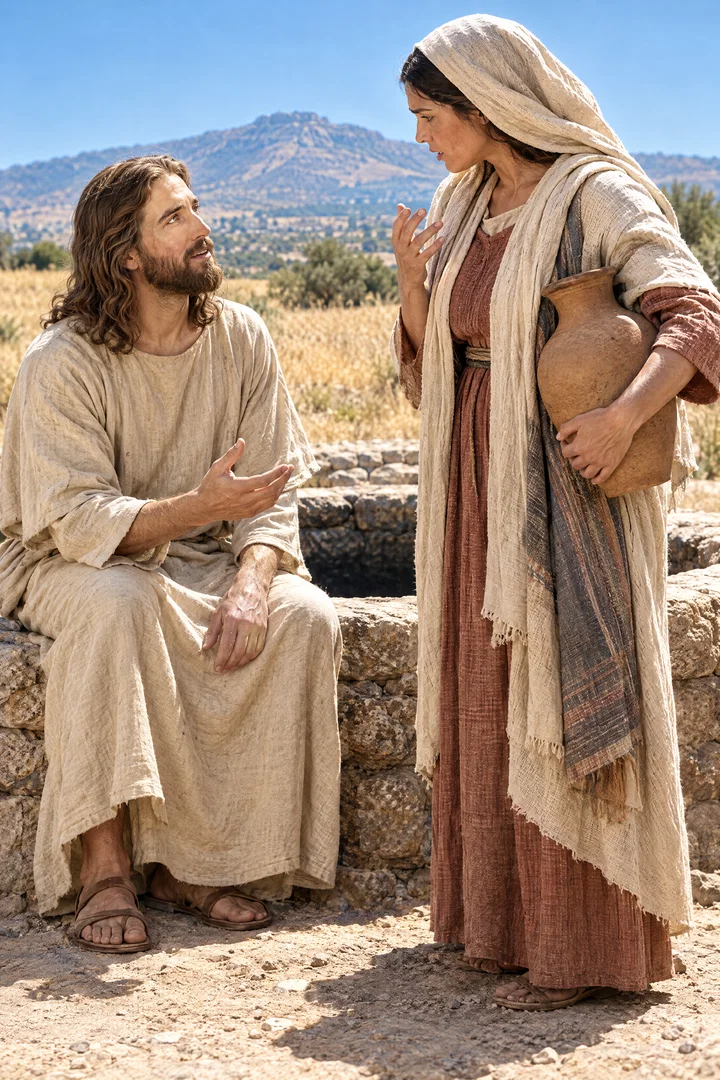
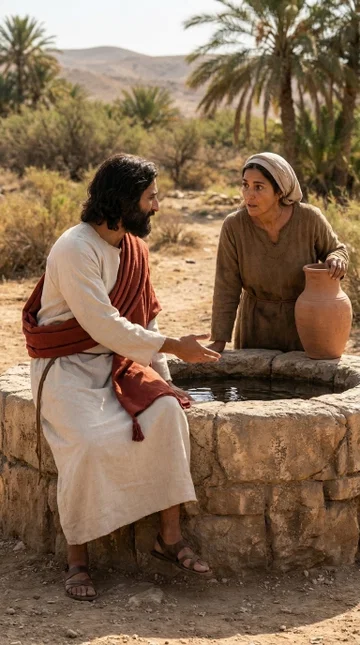
Art thou greater than our father Jacob, which gave us the well, and drank thereof himself, and his children, and his cattle?
Translations
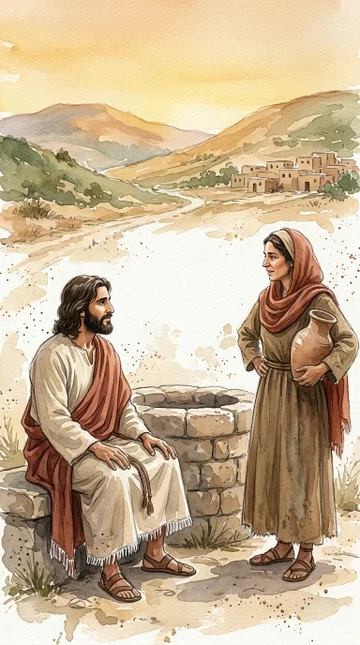
Are you greater than our father Jacob, which gave us the well, and drank thereof himself, and his children, and his cattle?
King James Version, KJV Cambridge Paragraph Bible
Art thou greater than our father Jacob, which gave us the well, and drank thereof himself, and his children, and his cattle?
Art thou greater than our father Jacob, who gave us the well, and drank of it himself, and his children, and his cattle?
Art thou greater than our father Jacob, which gave us the well, and drank thereof himself, and his sons, and his cattle?
Art thou greater than our father Jacob, who gave us the well, and drank thereof himself, and his sons, and his cattle?
Art thou greater than our father Jacob, who did give us the well, and himself out of it did drink, and his sons, and his cattle?'
Art thou greater than our father Jacob, who gave us the well, and drank of it himself, and his sons, and his cattle?
Art, thou, greater than, our father Jacob, who gave us the well,—and, himself, out of it drank, and his sons, and his flocks?
Berean Standard Bible, Majority Standard Bible
Are You greater than our father Jacob, who gave us this well and drank from it himself, as did his sons and his livestock?”
Are you greater than our father Jacob, who gave us the well and drank from it himself, as did his children and his livestock?”
Are you greater than our father Jacob who gave us the fountain and took the water of it himself, with his children and his cattle?
Art thou greater then our father Iacob, which gaue vs the well, and hee himselfe dranke thereof, and his sonnes, and his cattell?
Douay-Rheims (Challoner revision)
Art thou greater than our father Jacob, who gave us the well, and drank thereof himself, and his children, and his cattle?
Pictures
Cross-references 20 of 26
- John 7:37-38
In the last day, that great day of the feast, Jesus stood and cried, saying, If any man thirst, let him come unto me, and drink.
Christ offers life-giving water to those who come to him.
- John 4:39-42
And many of the Samaritans of that city believed on him for the saying of the woman, which testified, He told me all that ever I did.
The woman’s testimony and Jesus’ own words lead many Samaritans to believe in him.
- Jeremiah 2:13
For my people have committed two evils; they have forsaken me the fountain of living waters, and hewed them out cisterns, broken cisterns, that can hold no water.
God’s living water contrasts with earthly wells that cannot satisfy.
- Revelation 22:17
And the Spirit and the bride say, Come. And let him that heareth say, Come. And let him that is athirst come. And whosoever will, let him take the water of life freely.
The thirsty are invited to take the water of life freely.
- Isaiah 55:1
Ho, every one that thirsteth, come ye to the waters, and he that hath no money; come ye, buy, and eat; yea, come, buy wine and milk without money and without price.
The thirsty are invited to receive water freely, echoing Jesus’ living-water promise.
- John 6:35
And Jesus said unto them, I am the bread of life: he that cometh to me shall never hunger; and he that believeth on me shall never thirst.
Christ meets hungry and thirsty souls as the Bread of Life and living water.
- Genesis 33:19
And he bought a parcel of a field, where he had spread his tent, at the hand of the children of Hamor, Shechem’s father, for an hundred pieces of money.
Jacob bought the parcel of ground associated with the well.
- John 4:6
Now Jacob’s well was there. Jesus therefore, being wearied with his journey, sat thus on the well: and it was about the sixth hour.
Jesus rests at Jacob’s well, where he meets the Samaritan woman.
- John 4:7
There cometh a woman of Samaria to draw water: Jesus saith unto her, Give me to drink.
Jesus asks the Samaritan woman at the well for a drink.
- John 4:28-29
The woman then left her waterpot, and went her way into the city, and saith to the men,
She leaves the well and invites others to come and see Jesus.
- John 4:26
Jesus saith unto her, I that speak unto thee am he.
Jesus identifies himself to the woman as the Christ.
- John 7:38
He that believeth on me, as the scripture hath said, out of his belly shall flow rivers of living water.
Believers become channels through whom living water flows.
- 1 Corinthians 10:4
And did all drink the same spiritual drink: for they drank of that spiritual Rock that followed them: and that Rock was Christ.
Christ is the spiritual Rock who provided drink in the wilderness.
- Revelation 7:17
For the Lamb which is in the midst of the throne shall feed them, and shall lead them unto living fountains of waters: and God shall wipe away all tears from their eyes.
Living fountains answer the thirst for life-giving water.
- Exodus 17:6
Behold, I will stand before thee there upon the rock in Horeb; and thou shalt smite the rock, and there shall come water out of it, that the people may drink. And Moses did so in the sight of the elders of Israel.
smitten Rock gives water
- John 7:39
( But this spake he of the Spirit, which they that believe on him should receive: for the Holy Ghost was not yet given; because that Jesus was not yet glorified.)
Identifies the living water with the Spirit received by believers.
- Psalms 36:8
They shall be abundantly satisfied with the fatness of thy house; and thou shalt make them drink of the river of thy pleasures.
God provides a river for people to drink from.
- Acts 7:16
And were carried over into Sychem, and laid in the sepulchre that Abraham bought for a sum of money of the sons of Emmor the father of Sychem.
Cited in identifying Shechem and Sychar.
- Genesis 32:24
And Jacob was left alone; and there wrestled a man with him until the breaking of the day.
both give example of blessing while alone
- Genesis 32:26
And he said, Let me go, for the day breaketh. And he said, I will not let thee go, except thou bless me.
Jacob persists in seeking a blessing from God.
Commentary
Each commentary is drawn from primary sources: the writings of Ellen G. White and Adventist pioneers and periodicals. Each commentary is separate. Its own words are not a quotation; follow the references to read the source passages.
Ellen G. White
119 sources
At Jacob's well the Samaritan woman asks Jesus if he claims to be greater than their ancestor Jacob who gave them the well that supplied himself, his family and his livestock with ordinary water.DA 183.1–36T 64.1Lt 82, 1895, par. 1–2Ms 6, 1893, par. 3–4Lt 19g, 1874, par. 3 She asks this because she sees only a weary traveler with nothing to draw with, does not yet recognize who stands before her, and takes his offer of living water to mean literal water from the deep well.DA 183.1–3ST Feb 20, 1912Lt 89, 1899, par. 3–5Lt 155, 1901, par. 8–9 He is in fact greater than Jacob, for as the Son of God and the living fountain himself he offers water infinitely better than Jacob's gift, water that quenches thirst forever and becomes an inner spring leading to everlasting life.Ms 12, 1901, par. 1–3ST Feb 20, 19126T 64.1ST Apr 22, 1897 That living water is his grace, his truth, and his Spirit received by drinking daily through personal faith, which purifies the soul, satisfies its deepest thirst, and flows out again to refresh others.Ms 12, 1901, par. 1–3Ms 27, 1900, par. 9–11Lt 155, 1901, par. 8–9Lt 200, 1899, par. 7–9DA 194.3–195.1
Setting at Jacob's Well
The question was asked in the conversation at Jacob's well at Sychar, where Jesus rested, weary after coming from Judea, and asked a Samaritan woman who had come to draw ordinary water for a drink.GW 195.1–3ST Aug 11, 1914MH 27.1GW 194.2–4DA 194.3–195.1 He offered her the water of life in contrast to water that must be drawn repeatedly, and the encounter led her to bring others to Him.Lt 48, 1897, par. 3–10GW 195.1–3ST Aug 11, 1914MH 27.1GW 194.2–4
The well was Jacob's familiar gift to his descendants, supplying water that Jacob himself drank with his children, family, descendants, and cattle or livestock.6T 64.1Lt 19g, 1874, par. 3Ms 79a, 1910, par. 28–32DA 488.4–6Ms 27, 1889, par. 18 It was only temporal, ordinary, physical provision, set against the far greater gift of living water which springs up into everlasting life.6T 64.1Ms 79a, 1910, par. 28–32Ms 27, 1889, par. 18 Jesus used the well as a parable of the Fountain of Life, pointing to the living water He gives as a source of life extending to the close of time.Ms 72, 1895, par. 25–26
The meeting crossed the prejudice and separation between Jews and Samaritans, a people the Jews thoroughly despised and hated.Ms 173, 1897, par. 20–216MR 323.32MR 109.1 Though a Jew, Jesus set aside Pharisaic customs of separation, mingled freely, and did not create separating barriers by constantly thrusting upon the people that they were wrong.Ms 87, 1907, par. 36MR 323.32MR 109.1 He accepted Samaritan hospitality, slept under their roofs, ate with them at their tables partaking of food prepared and served by their hands, taught in their streets, and shared their homes and food.Ms 87, 1907, par. 36MR 323.32MR 109.1 He treated them with the utmost kindness, courtesy, sympathy and social kindliness, recognizing the dignity of humanity, and His words fell upon thirsty souls with blessed, life-giving power.Ms 87, 1907, par. 36MR 323.32MR 109.1 His care was not limited by race or nation and He did not share Jewish intolerance, preaching salvation to Samaritans and crossing social and religious barriers, while His divine grace brought them the salvation which the Jews rejected.Ms 87, 1907, par. 36MR 323.3DA 402.2AA 19.2–20.1
The talk stands at the commencement of His mission work with His positive, authoritative teachings, showing that no soul needs to remain in ignorance and doubt whether mercy and grace and salvation can be found in God.Ms 173, 1897, par. 20–21 It was an earnest, eloquent talk showing how much interest He had in one soul and His readiness to instruct wherever hearts are open to receive truth.MH 28.1MH 28.23T 322.2–3 He gave personal instruction to a despised, humble woman and recognized her receptive spirit, addressing people individually and sharing rich spiritual truth with those whose hearts were open.3T 322.2–3ED 231.2–232.1Lt 55, 1897, par. 12–15 He used no parables but spoke plainly, revealing the Father and the service acceptable to Him who reads the heart, and declaring Himself with, I that speak unto thee am He, though He did not reveal Himself so plainly to the learned Jews.MH 28.2Lt 55, 1897, par. 12–15
Woman's Question About Jacob
The woman appeals to Jacob as their father and ancestor who gave the well, honoring and revering him for providing water from which he himself drank with his children and his cattle.DA 183.1–3Lt 82, 1895, par. 1–2Ms 6, 1893, par. 3–4DA 488.4–6Ms 77, 1898, par. 1–5 She cherishes the natural feeling that no other well could equal the one provided by the fathers.DA 183.1–3DA 184.1–3 She does not yet recognize anything remarkable in the one before her, and her question contrasts reliance on Jacob's well with the living water that springs up into everlasting life.DA 183.1–3Lt 82, 1895, par. 1–2Ms 6, 1893, par. 3–4
She sees before her only a thirsty, wayworn, dusty, weary traveler with nothing to draw with, and seeing that the well is deep she does not understand how he can give the living water he speaks of.DA 183.1–3ST Feb 20, 1912Lt 89, 1899, par. 3–5Lt 200, 1899, par. 7–9DA 184.1–3 She does not recognize that the Messiah, the hope of the fathers, stands beside her, and so she asks whether he claims to be greater than Jacob.DA 183.1–3ST Feb 20, 1912Lt 82, 1895, par. 1–2Ms 6, 1893, par. 3–4DA 184.1–3 Her question grows from his lack of visible means to draw and the depth of the well, since he has offered water without a way to obtain it.ST Feb 20, 1912Lt 89, 1899, par. 3–5Lt 200, 1899, par. 7–9Lt 82, 1895, par. 1–2
She takes his offer to mean literal water from the well before them, failing to discern his meaning and supposing he speaks of ordinary water to be drawn.Lt 155, 1901, par. 8–9Lt 200, 1899, par. 7–92SP 140.2–141.34RED 24.1–25.3DA 184.1–3 Her light, bantering manner begins to change as she feels the solemn import of his words.DA 184.1–3 In surprise and controversy that a Jew would ask drink of a Samaritan, a people thoroughly despised, she tries to enter into controversy with him.Lt 89, 1899, par. 3–5Ms 173, 1897, par. 20–21Lt 200, 1899, par. 7–9
She was looking backward to the fathers and forward to the Messiah's coming while the Hope of the fathers, the Messiah himself, stood beside her unknown.DA 184.1–3 This means thirsting souls today stand close by the living fountain yet look far away for the wellsprings of life.DA 184.1–3 Her appeal to Jacob and her withholding of the well's water represents many who withhold from him the recognition, sympathy, and love he hungers and thirsts for in response to his great love, while he withholds his grace and love from no one.ST Apr 22, 1897
Some accounts place the setting and the contrast between water that must be drawn repeatedly and the spiritual gift he offers without explaining the comparison with Jacob.Lt 48, 1897, par. 3–10AA 19.2–20.1Ms 54, 1886, par. 4–7 The setting is the conversation at Jacob's well where the woman came to draw ordinary water and Jesus offered the water of life, an episode showing him preaching salvation to Samaritans and crossing social and religious barriers.Lt 48, 1897, par. 3–10AA 19.2–20.1 The living water is there presented as a gift people need and are to be led to receive.Lt 48, 1897, par. 3–10Ms 54, 1886, par. 4–7
Jesus Greater Than Jacob
Jesus is greater than Jacob, for he is the only-begotten Son of God who existed before Abraham.ST Feb 20, 1912ST Apr 22, 1897 When asked whether he claimed to be greater than Jacob who gave the well and whose family and cattle drank from it, he could have answered with that greatness, yet he did not assert it directly to her.ST Feb 20, 1912ST Apr 22, 1897 Seeing that he had no bucket and the well was deep, she did not understand how he could give the living water he spoke of.ST Feb 20, 1912ST Apr 22, 1897
He does not disparage Jacob's well and does not reprove her for drawing from it.Ms 12, 1901, par. 1–3Ms 79, 1910, par. 43–44 Instead he offers something infinitely better and of far greater value, explaining that his water gives everlasting life, satisfies mind and heart, and brings the joy and hope of the gospel as a spring welling up within.Ms 12, 1901, par. 1–3ST Feb 20, 1912ST Apr 22, 1897Ms 79a, 1910, par. 28–32Ms 79, 1910, par. 43–44 He used the well as a comparison to present the fountain of living waters.Ms 79a, 1910, par. 28–32Ms 79, 1910, par. 43–44 He answers by contrasting Jacob's water, which leaves drinkers thirsting again, with the water he gives, which quenches thirst forever and becomes in the receiver a well springing up into everlasting life.ST Apr 22, 1897
He himself is greater because he is the water of life, the living Rock, and the fountain of living water from whom all who thirst may come and drink as the spiritual source of life.ST Feb 20, 1912Ms 69, 1912, par. 191RED 100.1–102.1 Jacob's well was only temporal provision, while Christ was the invisible leader of God's ancient chosen people through their travels in the wilderness, enriching them with precious truth as the river of God and supplying them with the dews and showers of grace.ST Feb 20, 1912 He was just as truly the water of life to Abel, Seth, Enoch, Noah and all who received his instruction then as he is now to everyone who asks him for the refreshing draft.ST Feb 20, 1912 The rock was to be struck once, representing his once-for-all sacrifice, and people receive this water by speaking to him and asking him.Ms 69, 1912, par. 19
He is the smitten Rock that follows his people and a river of water in a dry place.Lt 74, 1906, par. 4–5 Anxious and troubled souls are invited to come to him because he understands them, and after doing their best to clear their own souls they are to trust fully and drink of the water of life he gives and be refreshed.Lt 74, 1906, par. 4–5 He was stricken, smitten of God, and afflicted, bearing the wrath of an offended God so that even the worst sinner may receive pardon, and he gives wisdom whose right hand holds length of days and whose left hand holds riches and honor, whose ways are pleasantness and whose paths are peace.Lt 74, 1906, par. 4–5
His work at the well in offering the water of life fulfilled God's promise in Eden that the Seed of the woman should bruise the serpent's head, and he will continue that work until every soul has been tested and tried.ST Apr 22, 1897ST Feb 20, 1912 That grace is often nearer than thought, comes unexpectedly like rain before it is seen, and surprises the seeker as it surprised the woman, yet his blessings are often overlooked while men take the glory to themselves.ST Feb 20, 1912
Contrast of Two Waters
Water from Jacob's well is ordinary, temporal water that must be drawn repeatedly and leaves all who drink thirsty again, while the water Christ gives quenches thirst forever, ends thirst, and becomes in the receiver an inner well or spring leading to everlasting and eternal life.Ms 12, 1901, par. 1–36T 64.1Lt 155, 1901, par. 8–9Lt 200, 1899, par. 7–9ST Apr 22, 1897 The question measures his claim against Jacob's well, which Jacob himself provided and from which he drank with his children and his cattle, and it is asked because he stands with nothing to draw with and the well is deep, so that how he can give the living water he speaks of is not understood.Ms 12, 1901, par. 1–3ST Feb 20, 1912Lt 155, 1901, par. 8–9Lt 200, 1899, par. 7–9ST Apr 22, 1897 He does not disparage that well and does not assert directly that he is greater than Jacob, though he is the only-begotten Son of God who existed before Abraham, but instead he offers something infinitely better and of far greater value that satisfies mind and heart and brings the joy and hope of the gospel.Ms 12, 1901, par. 1–3ST Feb 20, 1912ST Apr 22, 1897 What he offers is to be prized more highly than Jacob's well, for it is received by depending on the Holy Spirit rather than working in human might, and one draft is not enough but it must be drunk constantly to give satisfaction.Lt 155, 1901, par. 8–9Lt 200, 1899, par. 7–9
The contrast shows how worthless are the hopes of this world and how necessary the water of life is.Ms 27, 1900, par. 9–11 Earthly blessings, however great or numerous, can never satisfy the mind or cleanse the soul, for whoever drinks that water thirsts again.Ms 27, 1900, par. 9–11 Every want is satisfied by the water of life imparted to the truly penitent who receive the Word of God as thirsty men receive water, with the truth of God in them as a well of water springing up into everlasting life, as bread is to the hungry and water to the thirsty to those who love him.Ms 27, 1900, par. 9–11
Ordinary water cannot meet the lasting need of the soul, while Christ is the water of salvation and the source of spiritual life.Lt 3, 1882, par. 10–12Ms 69a, 1896, par. 23Lt 74, 1892, par. 6 Without Christ a person remains spiritually hungry and thirsty whatever possessions he has.Ms 69a, 1896, par. 23 Failing to receive his living water leaves people vulnerable to the pleasure-loving spirit of the age, while closeness to him deepens hunger and thirst for righteousness.Lt 3, 1882, par. 10–12 The people's hunger and thirst for that salvation reflect their need for the living water he offers in contrast with ordinary well water.Lt 74, 1892, par. 6
The thirsty soul must drink from Christ, the living source, rather than turn to human channels or lesser sources.Lt 49, 1901, par. 1Ms 17, 1894, par. 17–19 His spiritual water stands in contrast with murky water, with turbid streams, and with ordinary well water that Jacob, his family, and his cattle drank.Lt 49, 1901, par. 1Ms 17, 1894, par. 17–19 The water Jesus gives is the water of life.Lt 49, 1901, par. 1Ms 17, 1894, par. 17–19
Providing physical food alone in restaurant work does not give people the bread of life or the water of salvation, which are distinct from temporal food as spiritual sustenance.Ms 45, 1903, par. 5 The water of salvation is spiritual sustenance set against Jacob's well and the water Jesus offers.Ms 45, 1903, par. 5
Nature of Living Water
The living water is the Holy Spirit, who purifies, refreshes, and invigorates the soul.Lt 155, 1901, par. 8–9Lt 200, 1899, par. 7–9 It is received by depending on the Spirit rather than working in human might, and it begins to spring up as the Spirit works with saving power in the heart.Lt 200, 1899, par. 7–9Lt 76, 1894, par. 12 It is daily appropriated through converting power that gives fresh spiritual strength and expels selfishness and worldly ambition.Ms 94, 1899, par. 3–4 Receiving it requires self to die, seeking him, yielding self, and a heart subdued by the Spirit with an eye single to God's glory, after which a flood of heavenly light pours upon the soul.Lt 234, 1907, par. 315MR 23.4
It is the grace of Christ, the religion of Christ in the heart, and the experience of the gospel bringing joy and hope.Ms 12, 1901, par. 1–3Ms 18, 1895, par. 7Ms 174, 1897, par. 53–54 It is Christ himself satisfying soul thirst with peace and life, and God himself longed for with the whole being.CH 213.3–4RH Jan 10, 1856 Keeping religion far from the soul temple means faith is not in Jesus and keeps Lord and Saviour in the outer court, while the heavenly Guest must occupy the throne, control every impulse, and bring thoughts into subjection.Ms 174, 1897, par. 53–54 Human ambition and invention cannot satisfy this thirst, and the water is prepared at immense cost.Ms 12, 1901, par. 1–3SG1 102.2
It is the truth of the Word of God that warms and invigorates the soul.Ms 27, 1900, par. 9–11Ms 77, 1897, par. 23–24 Believed and lived, his words are spiritual food and living water that sustain spiritual life, give eternal life, produce spiritual strength and fruits of the Spirit, and shape believers to show unselfishness, integrity, kindness, and love.ST Oct 3, 1900 Drinking means receiving his grace, feeding on his words, learning from him and in his school, and receiving the life-giving teaching through Scripture and the Saviour.ST Oct 3, 1900Lt 19g, 1874, par. 3Ms 35, 1896, par. 16Ms 35, 1896, par. 18 Every want is satisfied by the water imparted to the truly penitent who receive the Word as thirsty men receive water, with the truth in them as a well springing up into everlasting life.Ms 27, 1900, par. 9–11
That water is the word of life and the truths he spoke, more valuable than gold.Lt 329a, 1905, par. 11–14 If received it changes human nature from darkness to light and the heart from pollution to purity, dawning on darkened understanding as light and life, and leads to purification through obedience to the truth.Ms 35, 1896, par. 16Lt 329a, 1905, par. 11–14 It comes from an inexhaustible, unfailing source that can be drawn from without diminishing the supply.Ms 27, 1889, par. 188MR 274.2 He has an inexhaustible supply for each member of the human family, a living spring that never empties and has been the fountain ever since the fall, and access is open to all to drink repeatedly.ST Apr 22, 1897Ms 140, 1902, par. 1817MR 198.1
One draft is not enough but must be drunk constantly, continually, and every day, together with eating the bread of life every day, as fitting for translation so life will measure with the life of God.Lt 155, 1901, par. 8–9Ms 159, 1904, par. 22Lt 23, 1888, par. 33 Those who do not drink are in the godless position of Sardis, and those whose minds the Lord has impressed long for richer and deeper draughts.Ms 159, 1904, par. 22Ms 29a, 1890, par. 14–18 This water is an unfailing supply of grace that strengthens the believer.Ms 94, 1899, par. 3–4Ms 140, 1902, par. 18 It must be sought personally and known through personal faith; no one can obtain it for another but each must plunge for it himself, and a person must choose to receive it because God does not force anyone to drink.CET 125.1–3Ms 182, 1898, par. 44Ms 163, 1898, par. 16–17
Its pure streams refresh and heal the one who drinks, bring life, strength, grace, peace, comfort, and rest amid suffering and in sorrow and pain.Lt 37, 1887, par. 18–1915MR 23.4Lt 40a, 1878, par. 2–4Ms 230, 1902, par. 54–55 They take away relish for what is low, commonplace, and transient and create preference for better things, and those who know him can return again and again for help.Lt 40a, 1878, par. 2–49MR 373.5–374.1Lt 131, 1904, par. 19 Drinking it quenches the desire to have one's own wisdom regarded as superior, is pictured as drinking deeply in the rich current of love, and gives strength to work with God.Lt 116, 1901, par. 5–7Lt 120, 1898, par. 1Lt 51a, 1895, par. 22
He gives the poor and needy spiritual life received through faith, bringing gladness and the dignity of God's children, and he gives the soul the water of life with the eternal riches of heaven, offered freely to those who come and receive.Lt 113, 1901, par. 8–12Lt 25c, 1895, par. 17–18Ms 80, 1903, par. 40–41 The living water contrasted with Jacob's well is received freely through Jesus as part of God's abundant gift of grace, and receiving it produces a genuine Christian life that reflects Christ's character and transforms the believer.Lt 158, 1896, par. 5–9
Receiving and Sharing Water
She came on a literal errand to draw water and had purposed to supply His thirst from the well, but after hearing of living water her soul earnestly desired it above the well's water, so she left her waterpot and forgot both her errand to the well and His thirst.DA 191.2–3 Leaving the pot proved the effect of His words, and with heart overflowing with joy and gladness she hastened to the city to impart to others the precious light she had received, calling friends to come see the man who told her all she had done and asking if He was the Christ.MH 28.1DA 191.2–3 Beneath her natural thirst He saw a deeper thirst of soul for the water of life, and her coming for natural water led her to that thirst of soul.ST Apr 22, 1897 Though she made no request to satisfy her spiritual wants, He offered her an abundant supply for her soul's great need.ST Apr 22, 1897 Drinking that living water aroused her moral nature, awakened her sense of higher need, aroused her slumbering conscience, quickened her spiritual perceptions, and brought conviction of sin and belief in the truth, so that forgetting her errand she left her waterpot and the water of life flowed through her words to many other thirsting souls.ST Apr 22, 1897
Her testimony led many Samaritans of that city to hear Him and believe, and through her many were reached.ST Aug 11, 19143T 217.3–4GW92 186.2–3 She listened and accepted without miracles because she believed His word alone, was glad for the light, published it to neighbors, carried His message to her countrymen, and many believed He was the Christ, the Saviour of the world.Ms 2, 1890, par. 4–5Ms 77, 1898, par. 1–5 The influence of those words has kept working for the saving of souls ever since.MH 28.1 Though hated by the Jews, the Samaritans received the light with a teachable spirit emptied of prejudice and so knew the doctrine, in contrast to the Jews who saw His majesty and grace in mighty healings and the mighty outpouring of His Spirit yet would not recognize Him, because prejudice ruled their hearts so that even the mightiest miracles did them no good.Ms 2, 1890, par. 4–5 Those who have never heard the truth have hearts more susceptible than those who have been in the truth with evidences yet remain in unbelief.Ms 2, 1890, par. 14 He found a place for truth in her sinful heart as a new bottle for new wine, unlike the scribes and Pharisees who were like old dried-up skin bottles that could not hold it.13MR 53.2–55.1Lt 83, 1890, par. 13–18
Those who receive become a source of life to others, for the living water was within Him and must also be within His followers, springing up to refresh those they influence.DA 194.3–195.13T 322.2–3 It continually overflows in blessings and is to be as freely imparted as it was freely received, in helpful and blessing speech that leads minds to God and sows truth and righteousness, in testimony of mercy and hope, in words, prayer, and song.RH Feb 19, 1901Ms 77, 1897, par. 23–24Lt 77, 1895, par. 12–14 Those who have drunk from the fountain should bring others to Him and share His words with others.Ms 18, 1895, par. 27ST Sep 9, 1889 Receiving means seeking God and being refreshed by Christ, feeding on the Bread of life in prayer and faith, and then leading others including children and family to drink.Lt 60, 1894, par. 8–11Lt 61, 1895, par. 24–25Lt 94, 1893, par. 8Lt 10, 1886, par. 8–11 Sharing Christ crucified wins hearts more effectively than formal arguments alone, and the same words He spoke He speaks again through humble, faithful followers as with humble prayer and unselfish work they carry truth to those in need.Lt 77, 1895, par. 12–14Ms 55, 1908, par. 7
Workers must understand these words more clearly so they will drink deep from the fountain and be worked by the Holy Spirit instead of offering weak, common matter.Lt 89, 1899, par. 3–5 Those who would refresh thirsting souls must themselves first drink of that water of life, drawing daily from the living fountain to give fresh nourishment to those they teach.19MR 272.3–273.18MR 105.2Lt 98a, 1897, par. 43–44 Ministers need time to receive this spiritual refreshment and consolation and must themselves be spiritually quickened and thirst for and receive His life and Spirit, otherwise their words are dry and uninteresting, restless, and without saving influence.GW 271.2Lt 1a, 1896, par. 1–2 Those who serve others will themselves drink, turning interest from exciting amusements to saving the perishing.Ms 58, 1896, par. 32 Those who would guide others to the fountain must first drink deeply themselves, for Christ as the Fountain of life must be drunk deeply to teach truth with saving influence, to keep the mind from restlessness, to live in harmony, and to keep from mistaking error for new light.ST Apr 15, 191314MR 180.1–3
Leading thirsting, sick souls to Him is the object of establishing sanitariums, giving the water of salvation for rich and poor, high and low, together with healing of the body.CH 213.3–4Lt 17, 1905, par. 17–18STB 601.2Ms 59, 1908, par. 27 This soul-winning work is to be done not by expensive, mammoth buildings or massive institutions in a city but by many small, homelike institutions in pleasant places out of the city that shine as lights in a dark place, where workers reflect Christ, keep their savor as salt, teach sound habits, and extend true, pure religion.CH 213.3–4Lt 17, 1905, par. 17–18 Agencies planted at much expense separate the sick for a time from harmful surroundings and give health-restoring treatments and wise instruction from Christian nurses and physicians.Ms 59, 1908, par. 27 A soul that does not hunger for righteousness or thirst for this life turns instead to empty sources, passing pleasures, and muddy, turbulent streams of earth that cannot satisfy.Lt 14, 1885, par. 38–39Ms 70, 1894, par. 6–7Lt 131, 1904, par. 19 Drinking the pure fountain through true communion takes away relish for what is low, commonplace, and transient and creates preference for better things, while world lovers who cling to earth receive only temporal, artificial satisfaction and are deemed unworthy of the life that measures with the life of God.9MR 373.5–374.1Lt 131, 1904, par. 19
The soul has infinite worth because Christ died for it, and its true need is not selfish worldly gain but the bread of life and the water of salvation; those who profess faith must lay aside selfish, worldly principles, realize the value of souls, live up to their profession, and purify their souls through obedience.20MR 151.5 Some received this water while others refused it, rejecting the healing and converting power they could have received.Ms 49, 1898, par. 21–22 Those who drink are healed, while those who refuse remain filled with disaffection and keep a harmful influence they do not recover from, and they ought to be ashamed because they might have been healed.21MR 31.4–32.3
Sources
Pioneers and periodicals
121 sources
The woman takes his offer of living water literally and asks, as an ordinary weary Jewish traveler with nothing to draw with beside a deep well, whether he claims to be greater than their father Jacob who gave them the well and drank from it with his children and cattle.ST Sep 3, 1894ST Jan 11, 1899ST Sep 3, 1894ST Jan 11, 1899ST Jan 25, 1905
He is in fact greater than Jacob, for he is the only-begotten Son of God who was before Abraham.ST Feb 20, 1912ST Apr 22, 1897
Jacob's well gives only temporal water that leaves the drinker thirsting again, while Christ himself is the water of life that quenches thirst forever and becomes within the receiver a well springing up to eternal life.ST Jan 27, 1881ST Dec 12, 1906
That living water is spiritual refreshing through receiving the Holy Spirit, Christ himself as the full and unfailing fountain of life, and his life-giving truth in the Scriptures and Gospel, freely offered to everyone who thirsts.RH Feb 19, 1901ST Oct 3, 1900ST Mar 26, 1896RH Oct 1, 1861RH Sep 30, 1902
He opens the way by tactfully asking her for a drink and turning the talk to salvation without arguing, until she is convicted, believes, leaves her waterpot and brings her townspeople to recognize him as Saviour of the world.ST Aug 11, 1914RH Nov 28, 1912RH Nov 19, 1908ST May 12, 1914ST Jun 22, 1904
Well and Meeting Place
John 4:12 belongs to the conversation at Jacob's well near Sychar, also called Shechem or Nablous, set in the valley between Mounts Gerizim and Ebal.ST Sep 8, 1898ST Jul 2, 1885ST Feb 14, 1884 It is a real place in Palestine where Jesus taught the Samaritan woman and spoke wondrous words that revealed God to Samaria and to the world.ST Sep 8, 1898ST Feb 14, 1884RH Sep 3, 1908 The well was given by Jacob the father to his descendants and to the Samaritans, and the woman's question whether Jesus is greater than Jacob belongs to that scene with his teaching about the water of life.ST Sep 3, 1894ST Sep 8, 1898ST Feb 14, 1884 The scene is set as Jesus sat there during the noontime heat while the woman came from the city to draw water in the continuing custom of women coming to draw.ST Jul 17, 1901ST Jul 2, 1885
The well has a circular carved mouth in a large slab of stone, with a ledge beside it where Jesus sat and rested during the conversation.ST May 22, 1884 Grooves worn in the stone by ropes for drawing up water pots show its long use for drawing water.ST May 22, 1884 It now lies in a vaulted chamber beneath the surface of the ground amid ruins, stones and rubbish, appearing as a dark irregular hole until cleared.ST May 22, 1884 That same well still stands as a place of pilgrimage where thousands come and draw physical water, but drawing from its store gives no spiritual benefit, and since Jesus sat by its brink the multitudes who have drawn there have gained nothing from the water itself.ST Jul 17, 1901 The well also serves as an image of spiritual depths that require effort to reach, for the deepest and most precious waters are found by searching diligently rather than stopping at a superficial understanding.ST Nov 8, 1910
Jacob gave the well to those who came after him, and he himself drank from it with his children and his cattle.ST Sep 3, 1894RH Nov 11, 1873ST May 22, 1884 It remained a blessing to them for thousands of years and remained a gathering place where people came to hear Jesus and seek the living water he offers.RH Nov 11, 1873ST Dec 3, 1894 At this well Jesus spoke with one Samaritan woman beside the physical supply, and her response brought many from Samaria to hear him as the call to seek the fount of living light pointed beyond what the well supplies.RH Nov 11, 1873RH Jan 24, 1871ST Apr 10, 1879
The meeting happened as Jesus, weary and faint and thirsty, sat resting beside the well, and an ordinary visit to draw water became an encounter with the Saviour.ST Oct 19, 1888RH Apr 8, 1909ST Apr 15, 1897 His weariness and his request to a Samaritan woman placed him under an apparent obligation to one who would naturally have avoided speaking because of nationality, and this circumstance became a means of bringing the gospel to a thirsty sinner.ST Mar 8, 1899 There he refreshed himself by revealing the fountain of living waters to a poor sinner, giving the woman who came to draw the water of life.ST Oct 19, 1888ST Apr 15, 1897 There he is remembered as sitting by the well of Samaria as the good Shepherd seeking the lost sheep, to be remembered for peace and joy in believing, yet not by confining the view to Christ on earth alone but by joining it with looking to the same Saviour yesterday, today and forever at the right hand of God who is able to save to the uttermost all who come to God by him.RH Aug 1, 1854
Woman's Question Meaning
She sets Jesus beside their father Jacob, who gave them the well and drank from it himself with his children and his cattle, and asks whether he is greater than Jacob.ST Sep 3, 1894ST Jan 11, 1899ST Sep 3, 1894ST Jan 11, 1899ST Jun 16, 1898 She recalls Jacob, his sons and his livestock as users of the well he provided, and her question measures his offer of living water against that gift and challenges his authority in light of it.ST Jan 11, 1899ST Jun 16, 1898ST Mar 15, 1905 She does not at first grasp the deep spiritual meaning of living water as divine grace, but takes his words literally as talk of well water in a material, physical sense.ST Feb 7, 1900ST Feb 7, 1900ST Jun 16, 1898 Her response shows she does not yet understand the spiritual gift he has offered.ST Mar 8, 1899
Seeing he has nothing to draw with and the well is deep, she asks how he could supply such living water and where it would come from.ST Feb 20, 1912ST Apr 22, 1897ST Jan 11, 1899ST Jan 11, 1899 She holds up the well Jacob gave and used with his children and cattle as the best water, sure he can give nothing better.RH Aug 25, 1868 She regards him as an ordinary Jewish traveler, a weary stranger and obscure man, and her question disputes his implied superiority to Jacob.ST Jan 27, 1881ST Jan 25, 1905ST Jan 25, 1905ST Jan 25, 1905 She contrasts the venerable patriarch with this traveler who asks for a drink from Jacob's well while offering water that becomes a living spring within its recipient.
Her appeal reflects the Samaritans' claim of descent from Jacob as their ancestor and of close relationship with him through possession of land he had owned.ST Jan 25, 1905ST Jan 17, 1900ST Jan 25, 1905 Her measuring of Jesus against the revered patriarch shows a common hindrance to receiving new truth through attachment to familiar beliefs and history. Her appeal to Jacob as authority, treating his connection to the well as reason to question Jesus, parallels treating inherited forms and human creeds as the final word in controversy, whereas inherited forms and human creeds cannot give spiritual life apart from following Christ, drinking from the living Fountain, and being guided by God's Word and Spirit.RH Aug 25, 1868ST Jun 13, 1900ST Feb 17, 1898
Christ Greater Than Jacob
Yes, he is greater than Jacob, for he is the only-begotten Son of God who existed before Abraham.ST Feb 20, 1912ST Apr 22, 1897 He could have answered the question about being greater than Jacob by declaring this identity, but he did not assert it directly.ST Feb 20, 1912ST Apr 22, 1897 Instead he answered by explaining that his water gives everlasting life, contrasting water that leaves drinkers thirsting again with water that quenches thirst forever and becomes in the receiver a well springing up into everlasting life.ST Feb 20, 1912ST Apr 22, 1897ST Jan 27, 1881
Jacob's well gives only temporal, ordinary water that must be drunk again and leaves drinkers thirsting, though it served Jacob himself and his children and his cattle.ST Jan 27, 1881ST Dec 12, 1906RH Nov 18, 1915ST Jun 16, 1898 That familiar earthly well, meeting physical thirst only temporarily, is set against the source of life that satisfies the soul's thirst.RH Nov 18, 1915ST Jun 16, 1898 Christ himself is greater because he is the water of life, and what he gives becomes a source of life within a person leading to everlasting life.ST Jan 27, 1881ST Feb 20, 1912 Those united with him draw continually from an inner fountain of strength and grace, producing righteous words and deeds and sustaining hope of heaven unto eternal life.ST Jan 27, 1881
He was the invisible leader of God's ancient chosen people through their travels in the wilderness, enriching them with precious truth as the river of God and supplying them with the dews and showers of grace.ST Feb 20, 1912 He was just as truly the water of life to Abel, Seth, Enoch, Noah and all who received his instruction then as he is now to everyone who asks for the refreshing draft.ST Feb 20, 1912 He has been the fountain of living water ever since the fall of Adam, a living spring that never empties, supplying spiritual refreshment as the bread of life to be eaten every day and the water of life to the parched soul.ST Apr 22, 1897 That grace is often nearer than thought, comes unexpectedly like rain before it is seen, and surprises the seeker as it surprised the woman of Samaria, yet his blessings are often overlooked while men take the glory to themselves.ST Feb 20, 1912
His work at the well in offering the water of life to the woman of Samaria fulfills the promise in Eden that the Seed of the woman should bruise the serpent's head.ST Apr 22, 1897ST Feb 20, 1912 He will continue that work until every soul has been tested and tried.ST Apr 22, 1897ST Feb 20, 1912
Living Water Gift
The living water is the river of God's pleasures flowing out of the throne of God and of the Lamb, for with God is the fountain of life, and it is taken by receiving the Holy Spirit.ST Mar 26, 1896 It represents the spiritual refreshing God gives through His Spirit, and the water from the living fountain serves as an illustration of the Holy Spirit.RH Jan 11, 1912RH Feb 19, 1901 It also represents the experience of a thankful heart, continually overflowing in blessings for others.RH Feb 19, 1901
Jesus Himself is the sole, full and unfailing fountain of living water, with power to give it freely and meet every need.RH Sep 30, 1902 He is the Redeemer who suffered for all mankind, and all who drink find true refreshment in water that flows pure and free.RH Oct 7, 1902 His power to give comes from His divine nature united with perfect humanity, from God's purpose for Him, from the anointing of the Holy Spirit, from His redeeming work, and from His intercession at God's right hand, so that He now has all power and remains able and willing to bless.RH Sep 30, 1902 He alone can give that water, and He is a spring of life for those who drink from Him and the source of life beyond what the physical well supplies.RH Mar 21, 1912ST Jul 14, 1914ST Apr 10, 1879 Drinking deep of Him gives spiritual food and drink as essential for growth in grace and as necessary for strength to perform spiritual labor as daily food and cool water are for the tired, thirsty body.ST Nov 8, 1883
The living water is also life-giving truth from Scripture, and the Bible is a spring from which preaching draws to refresh and cleanse hearts.RH Oct 1, 1861ST Jun 28, 1899 It is the words of God in the Holy Scriptures, received through the Gospel and the Bible, which saves the soul and is treasure for the next life that earthly money and checks cannot buy.RH Apr 22, 1915RH Dec 30, 1915 Becoming acquainted with the Saviour comes by studying the Scriptures and filling the whole heart with God's words, for Bible study is daily food necessary to spiritual life, to be read every day, kept close, read at every opportunity, with its texts fixed in memory.RH Dec 30, 1915 The Father guides sinful youth to the brink of those living fountains clear so they may drink of the waters.RH Dec 11, 1856
It is freely offered to everyone who thirsts to drink freely, and it satisfies the soul's thirst and turns people from sinful, selfish things that cannot satisfy.ST Mar 26, 1896ST Jun 16, 1898 The ordinary water from the well meets physical thirst only temporarily, while the living water Jesus offers becomes a source of life within a person and leads to everlasting life. Those who receive His gift gain eternal life, and the woman longed for this life, received it, and told others who also came and drank.ST Jun 22, 1904 The fountain's supply never diminishes, and all who thirst are invited to receive it, for within the believer it becomes a spring of everlasting life continually overflowing in blessings for others.RH Feb 19, 1901ST Jun 22, 1904
Beneath her natural thirst Christ saw a deeper thirst of soul for the water of life, and her coming for natural water led her to that thirst of soul.ST Apr 22, 1897 Though she made no request to satisfy her spiritual wants, Christ offered her an abundant supply for her soul's great need.ST Apr 22, 1897 Drinking that living water aroused her moral nature, awakened her sense of higher need, aroused her slumbering conscience, quickened her spiritual perceptions, and brought conviction of sin and belief in the truth.ST Apr 22, 1897 Forgetting her errand she left her waterpot, and the water of life flowed through her words to many other thirsting souls, as she with joy urged others to come and see Him after being brought to see her own sin and then to see who He is.ST Apr 22, 1897RH Sep 30, 1873 His words awakened her conscience and led her to drink the water of life, and seeing her receive life from Him satisfied His hunger and thirst, since ministering to those who hunger and thirst for spiritual life brought Him greater joy than food or drink.RH Dec 17, 1914 The account illustrates the universal human cry for redemption, which people may try to silence through fleshly lusts and worldly sins but which remains within them.RH Jan 2, 1913 The same water still offered to sinful people brings blessing, assurance of acceptance, peace of heart never known before, conviction of sin, and turning from saloon drinking and neglect of family.ST Dec 13, 1905
Drinking means believing, and believing takes away fear, lifts the eyes above, and brings rejoicing in a Saviour's love.RH Dec 11, 1856 Believers drink when they look to Him in prayer, and drinking brings streams of mercy, peace and love flowing from the Fount of Grace above.ST Feb 27, 1893 It keeps believers by His sustaining power, guides them by the Holy Spirit hour by hour in His service, joins them to Him as branches to the Vine so that living in Him they bear fruit, and brings them to the rich eternal harvest.ST Feb 27, 1893 The water He gives answers spiritual thirst and comes through faith, unlike human counterfeits that promise salvation but cannot give life, and here the water of life is identified with faith itself.ST Feb 27, 1907RH Sep 29, 1874 Faith brings the heart to Jesus where its pollutions are washed away, and the heart remains pure when it stays continually in this flowing source rather than returning to worldly life and being defiled again.RH Oct 28, 1873
Jacob's well and all earthly wells picture the world's fountains, and no earthly well can satisfy the soul that has become a partaker of the heavenly nature.ST Mar 24, 1898 Honor, wealth and the pleasures of this world will not satisfy those who, having tasted the water of life, have gone astray seeking refreshment at the world's fountains, for earthly wells get dry and cannot quench spiritual thirst.ST Mar 24, 1898 His living springs are a source of spiritual good, unlike the fouled pools of human associations, and unlike stagnant water from a broken cistern He gives solid, lasting satisfaction from God.ST Mar 10, 1887ST Jan 11, 1899 Inherited forms and human creeds cannot give spiritual life, but people find life by following Christ, drinking from the living Fountain, and being guided by God's Word and Spirit, in contrast to counterfeit sources that cannot satisfy and to mere outward profession.ST Oct 23, 1893ST Feb 17, 1898ST Sep 8, 1898
Jesus turns a request for a drink at Jacob's well into an opportunity to teach about salvation, so that ordinary circumstances of life serve as signs pointing to eternal truth.RH Jun 11, 1872 An ordinary visit to draw water becomes an encounter with the Saviour, and the well is a fitting reminder of the spiritual provision people need where ordinary water for bodily thirst is contrasted with living water that quenches spiritual thirst.RH Apr 8, 1909RH Jan 1, 1901 He uses the familiar experience of drawing water to teach about the water of life, and the everyday illustration helps make spiritual truth clear and memorable.ST Jul 21, 1881 In this way He uses earthly water to lift thoughts to Himself, the Fountain of life.ST Jun 16, 1898
The living water flows ceaselessly as a sign of God's peaceful thoughts toward people.ST Jul 17, 1907 The water of life He gives brings neither headache nor heartache and is offered as an alternative to alcohol's harm.ST Nov 10, 1898 It is ever-extending life with God Himself, pure and sweet and flowing from inexhaustible sources, and the streams in God's world interpret its purity, sweetness and inexhaustible supply, so that opening oneself to the beauties of God's world and God's Word gives larger ability to lead others into that life.ST Oct 6, 1909 Its image as water flowing from His gospel brings liberty to the soul, refreshes the way-worn follower with God's eternal love, and feeds God's people with sweet living waters and living bread on the way to heaven.ST Apr 22, 1880ST Jul 6, 1904 It is also spiritual help carried to people who are thirsty in soul.ST Apr 22, 1880
He makes Himself known as sent to give eternal life to men, as sent by the Father coming out of heaven bringing a new source of life from the Father into the world.ST Sep 24, 1896 He is the bread of life because in Him God gives Himself to men so that by His life they may live, and those who receive Him are satisfied in the longing of the human soul.ST Sep 24, 1896 The soul that drinks from Him receives spiritual life and strength, and the living-fountain image describes the heavenly nourishment the soul needs.RH May 8, 1866 His words are spiritual food and living water which, believed and lived, sustain spiritual life and give eternal life, producing spiritual strength and fruits of the Spirit and shaping believers to show His unselfishness, integrity, kindness and love.ST Oct 3, 1900
Example for Personal Work
Jesus did personal missionary work by tactfully asking for a drink to open conversation, enlisting interest without arguing, turning the request into teaching about salvation, and leading one soul to accept the gospel.RH Nov 28, 1912RH Nov 19, 1908ST May 12, 1914ST May 16, 1878ST Apr 9, 1894 Resting at the well in Samaria He found opportunity to lead a soul to God, making time to speak personally with one soul even when tired and weary.ST May 16, 1878RH Apr 27, 1916 His ministry to her was no less earnest and full of truth and sympathy than His ministry to a multitude, and through her He saw many people accepting the truth.ST May 12, 1914
Speaking the gospel to one listener shows a small audience is worthy of attention and not beneath dignity, for teaching one person can be important work even when it appears small.RH May 13, 1873RH Feb 9, 1911RH Oct 11, 1870 A solitary listener, even a poor and despised Samaritan woman, is worthy of a minister's attention.RH May 13, 1873RH Oct 11, 1870ST Jul 8, 1886 True gospel work values the worth of the soul, individualizes people rather than grouping them in masses, and brings the gospel into direct contact with each heart one at a time until renewed by the Holy Spirit and salvation is made a personal concern.RH Jun 12, 1856 Some of His greatest sermons were preached to one soul as the congregation, giving saving instruction alone and showing the value of a single soul, and true conversion then produces interest in another soul.ST Jul 8, 1886
He gave the same interest and attention to Samaritans as to Jews, speaking openly among ordinary people and going among different backgrounds.ST May 12, 1914ST Oct 29, 1885 His willingness to speak with her and work among the Samaritans rejected the customary barrier between Jews and Samaritans and showed salvation offered to all without respect of persons, despite national prejudice that forbade Him to address her and despite opponents condemning dealings with Samaritans.ST May 12, 1914ST May 24, 1910ST Aug 16, 1910 He treated her with love despite religious differences, ministering kindly despite prejudices and divisions surrounding her.RH Jun 2, 1904RH Mar 24, 1910
He met her with honor and courtesy, chastity and earnest bearing, patience, pity, helpfulness, sympathy and words of eternal life, without coarse speech or lowering His conduct.ST Jan 20, 1914ST Oct 15, 1902ST Jun 19, 1907ST Apr 21, 1898 His pure life and speech expressed pity and helpfulness, showing that reaching people does not require imitating their wrongs or weaknesses, and kindness toward people who may avoid or distrust can overcome prejudice and build respect and confidence needed to help them spiritually.ST Oct 15, 1902RH Oct 28, 1915 He dealt gently with the erring woman to win her, not harshly denouncing her in public or private though He knew her unsavory record, teaching her kindly until she was won and convinced He was Christ, giving the pattern for placing oneself in the circumstances of the discouraged and having charity for the tempted.ST Mar 10, 1909 His personal attention met her spiritual need and helped lead her to invite her townspeople to meet Him.ST Jan 20, 1914ST Jun 19, 1907
Though Himself thirsty and hungry, weary and faint beside the well, He forgot His own need while offering living drink to another.ST Oct 19, 1888 Doing God's will may mean setting aside ordinary bodily comfort such as a meal to serve someone in need, and He refreshed Himself by revealing the fountain of living waters to a poor sinner.ST Oct 19, 1888 Seeing her receive life and drink the water of life satisfied His hunger and thirst, for ministering to people who hunger and thirst for spiritual life brought Him greater joy than food or drink.RH Dec 17, 1914 Filling a neighbor's life with love and giving good to those who have it not makes one's own needs and miseries shrink to nothing, so that who gives most blessing gains the greatest bliss.
The conversation led to her conversion and following Him, bringing spiritual life and strong hope, awakening her conscience to drink the water of life.RH Nov 28, 1912ST Aug 31, 1915RH Dec 17, 1914 She longed for this life unlike the water from the well, received it, left her waterpot, invited her townspeople, and told others who also came and drank.ST Jun 22, 1904ST Jan 20, 1914 Her personal testimony soon led others to want to hear the message of salvation, and her bringing her countrymen to hear Him led to the conversion of many associates, many neighbors, and a whole city recognizing Him as Christ and Saviour of the world.ST Aug 11, 1914RH Nov 28, 1912ST Aug 31, 1915
As the good Shepherd seeking lost sheep He sought one straying, fallen, sinful, burdened and miserable woman, sitting by the well to seek peace and joy in believing for souls, reaching her though she seemed uninteresting or repugnant, healing her and gathering her among His own whom He loves.ST Apr 10, 1907ST Jan 17, 1900RH Aug 1, 1854 He kindly spoke to her as if she alone of all the world had deepest need, with no thought but to reclaim His sheep, showing those who love Him how to feed His sheep.ST Apr 9, 1894 That journey through which one soul acknowledged Him as Master teaches teachers to seek out and lovingly encourage each individual pupil, especially one shy or disheartened, moved by love for the person and concern for the soul without respect for background or circumstances, and shows being alone can bring nearness to Christ.RH Oct 8, 1908 The same Saviour yesterday, today and forever is now at the right hand of God able to save to the uttermost all who come to God by Him, so faith must not be confined to Christ on earth in that scene.RH Aug 1, 1854
The visit to Samaria marked the beginning of a wider work extending beyond one city or nation, as firstfruits of the gospel's spread among the Gentile nations.RH Dec 7, 1905 His work with her brought truths that spread through Samaria and, through the Gospel of John, enlightened people across the ages.RH Jul 4, 1907
Sharing the Water Today
One who receives Christ promptly shares Him, becoming a channel through whom others are reached, for after finding the Saviour at Jacob's well the woman brought others to Him so that a whole city came to hear Him.ST Sep 9, 1889ST Jan 5, 1915 The Gospel is a living stream to be shared rather than kept, or it becomes like stagnant water instead of a source of life. Christ is the fountain of living waters and the Water of Life who makes the sick and wounded whole, gives strength to fainting children and guidance to tottering footsteps, and those who have drunk must bring others to Him and carry Him by telling of Him to thirsty, parched souls.ST Sep 9, 1889ST Feb 6, 1896ST Sep 10, 1896 Workers for Christ should therefore know where the wells of salvation are and draw from them to help others, and after touching Christ the believer becomes a channel through whom a wider district is reached.ST Sep 10, 1896ST Jan 5, 1915
Christ's ambassadors and those who would guide others to the fountain must first drink of it themselves in vital connection with God learned by experience, leaning upon Christ and being constant learners in His school to obtain lessons to impart to others.ST Oct 4, 1883ST Apr 15, 1913 Drinking means personal experience of the spiritual life Christ gives, with faith, self-denial, self-control, tact and energy, and serving others requires that experience with the Spirit and power of God.ST Oct 4, 1883ST Apr 15, 1913 Without such Christian experience professed teachers lack strength and their influence is fatal to the prosperity of the church, while with it their testimony cuts to the heart of those who hear.ST Oct 4, 1883 Workers should know where the wells of salvation are and draw from them to help others.ST Sep 10, 1896
Workers for Christ should feed His sheep with care for the one, as He on a toilsome way on a sultry day kindly spoke to one straying woman as if she alone of all the world had deepest need, with no thought but to reclaim His sheep.ST Apr 9, 1894 Service should reach people who may seem uninteresting or repugnant, without respect for background or circumstances, moved by love for the person and concern for the soul in doing God's will and giving oneself for another. His method of personal work was to spend time with individuals and develop sermons from such private interviews, and this encounter is the great example for those preparing for ministry, teaching them to meet people at their homes and do systematic personal work.RH Aug 26, 1902 Thirst for living water expresses longing to hear the truth and hunger for God's word and the way of salvation, received through the Gospel and daily Bible study with texts fixed in memory.RH Feb 22, 1912RH Dec 8, 1874
The living water He offered her is still offered to sinful people, and those who desire and receive it obtain blessing, assurance that the Lord has accepted them, peace of heart never known before, conviction of sin, and turning from drinking and neglect of family.ST Dec 13, 1905 Spiritual refreshment and opportunities to serve lie nearby where one already is, through kind words, sharing literature, and visiting neighbors and the sick, finding life-giving water by dipping down where one is.
Sources