John 4:15
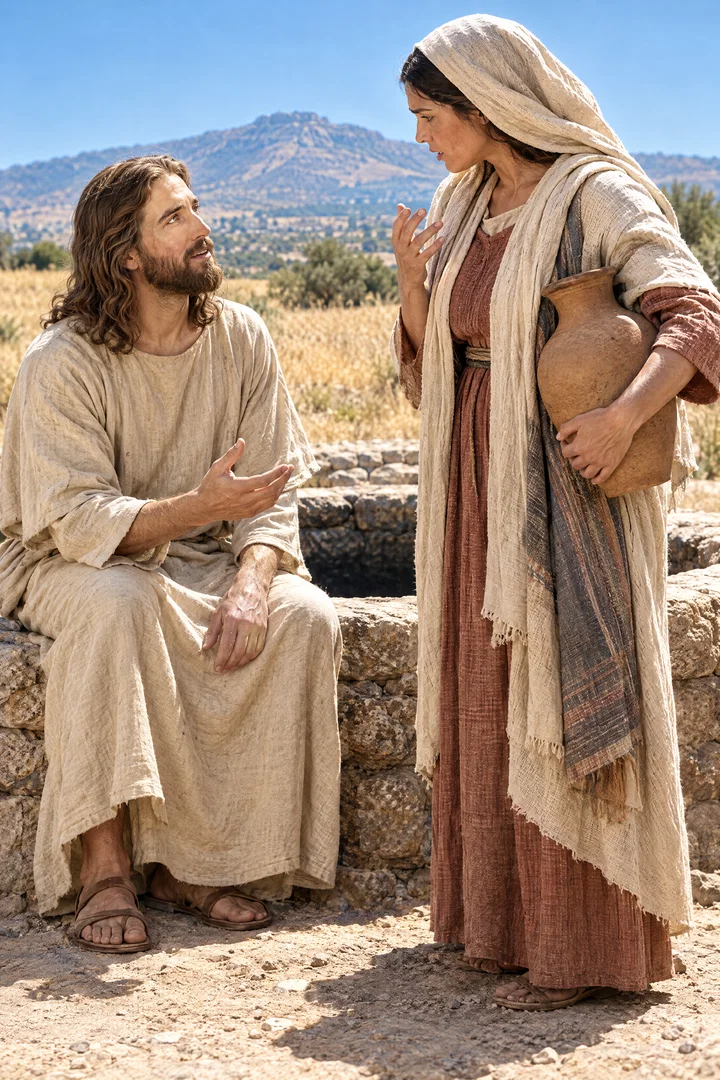
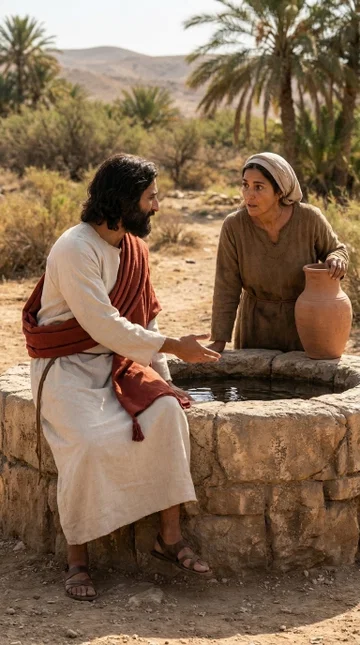
The woman saith unto him, Sir, give me this water, that I thirst not, neither come hither to draw.
Translations
The woman says to him, Sir, give me this water, that I thirst not, neither come here to draw.
King James Version, KJV Cambridge Paragraph Bible
The woman saith unto him, Sir, give me this water, that I thirst not, neither come hither to draw.
The woman saith to him, Sir, give me this water, that I may not thirst, neither come hither to draw.
Revised Version, American Standard Version
The woman saith unto him, Sir, give me this water, that I thirst not, neither come all the way hither to draw.
The woman saith unto him, 'Sir, give me this water, that I may not thirst, nor come hither to draw.'
The woman says to him, Sir, give me this water, that I may not thirst nor come here to draw.
The woman saith unto him—Sir! give me this water, that I thirst not, neither be coming hither to draw.
Berean Standard Bible, Majority Standard Bible
The woman said to Him, “ Sir, give me this water so that I will not get thirsty and have to keep coming here to draw water.”
The woman said to him, “ Sir, give me this water, so that I don’ t get thirsty, neither come all the way here to draw.”
The woman said to him, Sir, give me this water, so that I may not be in need again of drink and will not have to come all this way for it.
The woman said vnto him, Syr, giue me of that water, that I may not thirst, neither come hither to drawe.
Douay-Rheims (Challoner revision)
The woman saith to him: Sir, give me this water, that I may not thirst, nor come hither to draw.
Pictures
Cross-references
- John 4:39-42
And many of the Samaritans of that city believed on him for the saying of the woman, which testified, He told me all that ever I did.
The woman’s testimony leads many Samaritans to hear Jesus and believe.
- John 4:28-30
The woman then left her waterpot, and went her way into the city, and saith to the men,
After meeting Jesus, she tells her townspeople about him and brings them to meet him.
- John 7:37-38
In the last day, that great day of the feast, Jesus stood and cried, saying, If any man thirst, let him come unto me, and drink.
Jesus invites the thirsty to come to him and drink living water.
- John 4:10
Jesus answered and said unto her, If thou knewest the gift of God, and who it is that saith to thee, Give me to drink; thou wouldest have asked of him, and he would have given thee living water.
Jesus offers the living water the woman requests.
- Isaiah 55:1
Ho, every one that thirsteth, come ye to the waters, and he that hath no money; come ye, buy, and eat; yea, come, buy wine and milk without money and without price.
The thirsty are invited to receive water freely.
- Revelation 22:17
And the Spirit and the bride say, Come. And let him that heareth say, Come. And let him that is athirst come. And whosoever will, let him take the water of life freely.
The thirsty are invited to take the water of life freely.
- 1 Corinthians 10:4
And did all drink the same spiritual drink: for they drank of that spiritual Rock that followed them: and that Rock was Christ.
The wilderness rock that supplied water is identified as Christ.
- Exodus 17:6
Behold, I will stand before thee there upon the rock in Horeb; and thou shalt smite the rock, and there shall come water out of it, that the people may drink. And Moses did so in the sight of the elders of Israel.
The wilderness rock’s water represents Christ as the source of life.
- John 4:7
There cometh a woman of Samaria to draw water: Jesus saith unto her, Give me to drink.
Jesus asks the woman for a drink, beginning their conversation about water.
- John 6:35
And Jesus said unto them, I am the bread of life: he that cometh to me shall never hunger; and he that believeth on me shall never thirst.
Jesus promises lasting satisfaction through the bread of life and life-giving water.
- John 4:6
Now Jacob’s well was there. Jesus therefore, being wearied with his journey, sat thus on the well: and it was about the sixth hour.
The conversation at Jacob’s well concerns the living water Jesus offers.
- 2 Kings 17:24-41
And the king of Assyria brought men from Babylon, and from Cuthah, and from Ava, and from Hamath, and from Sepharvaim, and placed them in the cities of Samaria instead of the children of Israel: and they possessed Samaria, and dwelt in the cities thereof.
Explains the Samaritans’ origins and mixed religion.
- Isaiah 58:11
And the LORD shall guide thee continually, and satisfy thy soul in drought, and make fat thy bones: and thou shalt be like a watered garden, and like a spring of water, whose waters fail not.
Its unfailing water is linked with Jesus’ living water.
- John 4:9
Then saith the woman of Samaria unto him, How is it that thou, being a Jew, askest drink of me, which am a woman of Samaria? for the Jews have no dealings with the Samaritans.
The conversation takes place amid the divide between Jews and Samaritans.
- John 4:26
Jesus saith unto her, I that speak unto thee am he.
Jesus shows himself to the woman.
- John 4:39
And many of the Samaritans of that city believed on him for the saying of the woman, which testified, He told me all that ever I did.
Many Samaritans believe through the woman's testimony.
- Isaiah 12:3
Therefore with joy shall ye draw water out of the wells of salvation.
The lesson’s image of drawing from salvation’s wells echoes this verse.
- John 6:27
Labour not for the meat which perisheth, but for that meat which endureth unto everlasting life, which the Son of man shall give unto you: for him hath God the Father sealed.
Both contrast perishable needs with what endures to everlasting life.
- John 4:23-24
But the hour cometh, and now is, when the true worshippers shall worship the Father in spirit and in truth: for the Father seeketh such to worship him.
The lesson draws from the same encounter the principle of worshiping God in spirit and truth.
Commentary
Each commentary is drawn from primary sources: the writings of Ellen G. White and Adventist pioneers and periodicals. Each commentary is separate. Its own words are not a quotation; follow the references to read the source passages.
Ellen G. White
36 sources
At Jacob's well the Samaritan woman answers the promise of water that ends thirst forever by asking for it in plain, practical terms, hoping she will never thirst again and never need to come to draw.Ms 6, 1893, par. 3–4Ms 18, 1895, par. 15–16Lt 48, 1897, par. 3–10ST Apr 22, 1897ST Feb 20, 1912 Though she does not yet fully understand, her wondering attention and earnest desire show awakened faith, for she perceives He means more than the water she drinks only to thirst again.4RED 24.1–25.3DA 187.1–4 The water He offers is His grace and truth and life-giving words meeting the soul's deepest need, springing up within into everlasting life.Ms 6, 1893, par. 3–4Ms 18, 1895, par. 15–16Lt 48, 1897, par. 3–10 Once received it becomes an unfailing inner well that purifies, refreshes and strengthens, so the receiver thirsts no more for the riches, honors and pleasures of the world and in turn flows out in good works to refresh others.Ms 18, 1895, par. 15–164RED 24.1–25.3DA 194.3–195.1DA 187.1–4ST Jun 3, 1886
Wellside Setting and Request
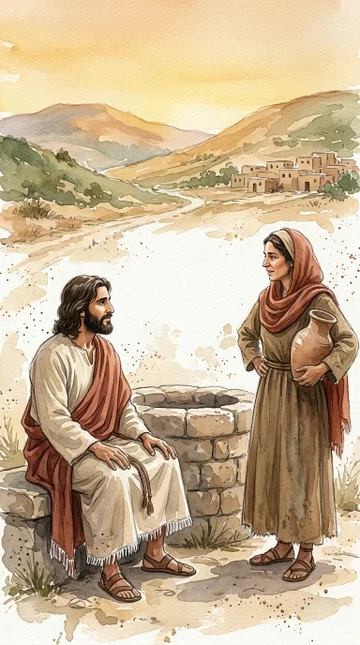
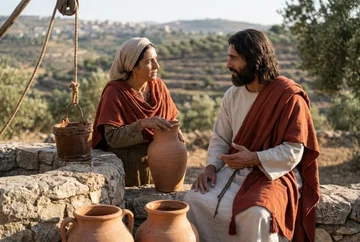
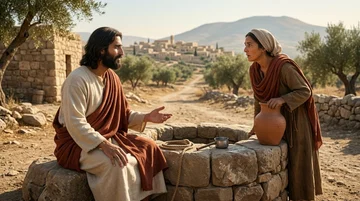
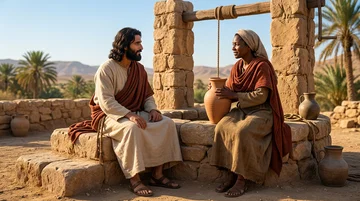
The meeting happened at Jacob's well at noon, when Jesus sat faint from hunger and thirst after a long morning journey, with cool water close by yet out of reach because the well was deep and He had neither rope nor water-jar, and at that moment a woman of Samaria came with her pitcher to draw and He asked her for a drink.DA 183.1–3 Jews and Samaritans were bitter enemies who avoided social intercourse, the Jews thoroughly despising the Samaritans and refusing to borrow from them or to receive bread or water from their hands, so that hatred withheld kindness and even His disciples did not think to ask a favor of Samaritans or to seek to benefit them.DA 183.1–3Ms 173, 1897, par. 20–21 In the East water was called the gift of God and to give a drink to a thirsty traveler was held a sacred duty, yet with tact born of divine love Jesus asked rather than offered a favor, because an offer might have been rejected while trust awakens trust.DA 183.1–3
He who made the ocean and controls the waters of the deep and opened the springs and channels of the earth rested weary and depended on a stranger's kindness for even a drink, coming as the King of heaven to an outcast soul and asking a service at her hands in order to find the key to her heart.DA 183.1–3 When He spoke of water that ends thirst, she answered in practical, literal terms, hoping it would keep her from thirsting and spare her repeatedly coming to the well to draw.Ms 6, 1893, par. 3–4Ms 18, 1895, par. 15–16Lt 48, 1897, par. 3–10DA 194.3–195.1LC1 91.4 The same request was ready on the lips of many who later heard Him invite the thirsty to drink, longing for living water that satisfies beyond the things of this world.LC1 91.4DA 453.3–454.1
Astonished by the promise of water that ends thirst forever, she rested her pitcher on the well and forgot her own errand to draw and forgot the Stranger's thirst and His request for drink, lost in earnest desire to hear every word.ST Apr 22, 1897ST Feb 20, 1912 Her interest was aroused and she looked on with wondering attention, perceiving He meant more than the water of Jacob's well which she used continually only to drink and thirst again.4RED 24.1–25.3DA 187.1–4 Her asking therefore shows remarkable faith and awakened desire for the gift He offered, though she did not yet fully understand it.4RED 24.1–25.3DA 187.1–4
Living Water Gift
The living water Jesus offers is His grace and truth and life-giving words, meeting spiritual and not merely temporal needs and meeting the soul's deepest need, and it springs up within the believer into everlasting life.Ms 6, 1893, par. 3–4Ms 18, 1895, par. 15–16Lt 48, 1897, par. 3–10ST Apr 22, 1897GW92 337.2 It is spiritual refreshment and grace for every soul, satisfying spiritual thirst so that the one who receives it need not thirst again or return elsewhere for satisfaction.ST Apr 22, 1897ST Sep 23, 1897 Her response was given during a personal conversation rather than a public gathering, as she answered His words with desire for the water that gives everlasting life.GW92 337.2ST Sep 23, 1897
It becomes in the receiver an inexhaustible inner well continually supplied, giving strength and grace sufficient for every need, purifying, refreshing and invigorating the soul where the fountains of this world leave people unsatisfied and thirsting again.Ms 18, 1895, par. 15–16DA 187.1–4ST Apr 22, 1897 Those united with Christ have within them a living source of strength and grace for every need, with Christ Himself the unfailing source of the fountain.4RED 24.1–25.3DA 187.1–4 It is an inexhaustible supply that believers can continually receive and share.Ms 18, 1895, par. 15–16ST Apr 22, 1897
One who tastes the love of Christ continually longs for more of Him, no longer attracted by the riches, honors and pleasures of the world, and no longer left with emptied cisterns and dry pools.DA 187.1–4 Love for God and the satisfying hope of heaven spring up in good works leading to eternal life, so that righteous words and deeds flow out to refresh both self and others.4RED 24.1–25.3DA 187.1–4 Whoever receives it becomes a source of life, for the living water must also be within His followers, springing up to refresh those they influence, so the receiver becomes a giver and a missionary and Christ's love received in the heart becomes a spring of everlasting life.DA 194.3–195.13T 322.2–3ST Jun 14, 1877Lt 55, 1897, par. 12–15
The satisfaction it gives means the one who receives it need not thirst again, expressing the longing of people who recognize their spiritual need and want the satisfaction Jesus offers, a wellspring of life that endures forever.ST Jun 3, 1886ST Sep 23, 1897ST Jun 14, 1877 His words are the water of life, satisfying the soul in a way that worldly pleasures and outward festivities cannot, reflecting the soul's longing for what satisfies beyond the things of this world.DA 187.1–4ST Jun 14, 18772SP 345.2–346.1 Her asking pictures thirst for truth asking without yet knowing who gives it, for she did not know that Christ, the Truth able to enlighten her, stood beside her.ST Apr 22, 1897 It pictures thirsting souls today who sit close by the living fountain yet look far away and, though told the refreshing water is close by, will not believe, and it also represents people who fail to give Christ the recognition, sympathy and love He longs for.ST Apr 22, 1897ST Apr 22, 1897
The conversation stands among many positive invitations of mercy and goodness by which Christ speaks with authority and cuts away doubt and questioning whether the Lord will hear prayer and give mercy and favor and grace and salvation, and here His mission work commenced.Ms 173, 1897, par. 20–21 The same desire was ready to be expressed by many who later heard Jesus invite the thirsty to drink at the temple and at the feast, longing for the living water that satisfies beyond the things of this world and meets the soul's need and gives everlasting life.1RED 91.2–3DA 453.3–454.1
Christ's Outreach and Witness
Though a Jew, He mingled freely with the despised Samaritans in the face of prejudice and set at naught the Pharisaic customs and prejudices of His nation.6MR 323.3Ms 87, 1907, par. 32MR 109.1 He accepted the hospitality of this despised people, slept with them under their roofs, ate with them at their tables partaking of food prepared and served by their hands, taught in their streets, and treated them with the utmost kindness and courtesy.6MR 323.3Ms 87, 1907, par. 32MR 109.1 While He drew their hearts to Him by the tie of human sympathy, His divine grace brought to them the salvation which the Jews rejected.6MR 323.3Ms 87, 1907, par. 3
His words fell upon their thirsty souls with blessed, life-giving power, awakening new impulses and opening to these outcasts of society the possibility of a new life.2MR 109.1 In this He recognized the dignity of humanity, and His willingness to offer grace at Sychar shows that His love and gifts are not limited to one race or nation.2MR 109.1DA 402.2 His work was not to create separating barriers or constantly thrust upon people the fact that they were wrong.6MR 323.3Ms 87, 1907, par. 3
His love for the Samaritans remained unchanged despite their rude treatment of Him.DA 488.4–6 Even while weary He used a personal conversation with one person rather than a public gathering to open precious spiritual truths about His spiritual kingdom.3T 217.3–4ED 231.2–232.13T 322.2–3GW92 337.2GW92 186.2–3 He saw her as receptive, and here His mission work commenced.Ms 173, 1897, par. 20–21ED 231.2–232.1
He found a place for His truth in the heart of the Samaritan woman even though she was a sinner.Lt 83, 1890, par. 13–1813MR 53.2–55.1 She represents those who hear and believe with practical faith, and the episode shows that people despised as unworthy of salvation could hunger for the light of truth.AA 19.2–20.1Lt 55, 1897, par. 12–15 With a teachable spirit emptied of prejudice she accepted Him without any miracle because she believed His word, and was glad for the light.Ms 2, 1890, par. 4–5
She became a new bottle into which He could pour the new wine of His kingdom, unlike the scribes and Pharisees who were like old dried-up skin bottles that could not hold it.Lt 83, 1890, par. 13–1813MR 53.2–55.1 Her faith stands in contrast to those who saw mighty healings and the mighty outpouring of His Spirit and grace yet would not recognize Him because prejudice reigned in their hearts.Ms 2, 1890, par. 4–5 This proves that miracles cannot convince hearts closed by prejudice, and those who have never heard the truth have hearts more susceptible to receive it than those who have long been in the truth and had the evidences yet excuse unbelief.Ms 2, 1890, par. 4–5Ms 2, 1890, par. 14
After speaking with Him she went into the city and published the light to her neighbors and countrymen and brought others to meet Him.GW 195.1–3ST Aug 11, 1914Ms 2, 1890, par. 4–5 Her testimony helped bring many Samaritans to come out and hear and believe for themselves.3T 217.3–4GW92 186.2–3Ms 2, 1890, par. 14 Whoever receives the living water becomes a source of life, so that the receiver springs up to refresh others as a giver and a missionary.DA 194.3–195.13T 322.2–3Lt 55, 1897, par. 12–15 The visit to Samaria helped prepare the disciples to carry the gospel to them.DA 488.4–6
Sources
Pioneers and periodicals
72 sources
At the well Jesus promises water that ends thirst forever, and the woman takes it for ordinary well water that would free her from thirst and from coming again to draw and carry.ST Mar 8, 1899ST Jan 11, 1899ST Jan 11, 1899ST Sep 3, 1894ST Feb 7, 1900 She does not yet see his meaning, looking only with physical eyes and wondering how he can draw without anything to draw with.ST Apr 22, 1897ST Feb 20, 1912ST Jan 11, 1899ST Feb 7, 1900ST Mar 8, 1899 The water he offers is divine grace and pardoning love received in the heart, Christ himself as the Fountain of life freely given to quench spiritual thirst so the soul no longer seeks satisfaction in sin and selfishness.ST Apr 22, 1897ST Sep 17, 1894ST Jan 17, 1900ST Mar 17, 1898 To drink it is not one draught only but to be united with him in a continuing, inexhaustible spring within that flows up into everlasting life in love to God and good works.ST Apr 22, 1897ST Apr 22, 1897ST Jan 17, 1900 Before she can receive it he awakens thirst for righteousness by laying open her past life, and as she drinks she recognizes him as prophet, Messiah and Saviour and leaves her jar to bring her city to him.ST Feb 7, 1900RH Oct 10, 1907RH Aug 25, 1868ST Jul 17, 1901ST Feb 7, 1900
Setting at Jacob's Well
The request belongs to the conversation about the water of life between Jesus and the woman of Samaria at Jacob's well.ST Sep 8, 1898ST May 22, 1884ST Jul 17, 1901 The well stands near Sychar, also called Shechem, now Nablous, between Mounts Gerizim and Ebal, where Abraham and Jacob had been.ST Sep 8, 1898ST Feb 14, 1884 It was the place where Jesus sat to rest and where water pots were drawn up, and the truths recorded in the chapter were spoken there.ST Sep 8, 1898ST May 22, 1884 The well still stands as a place of pilgrimage sought by thousands, but drawing its literal water gives no spiritual benefit, no more now than for the many who have drawn from it through the centuries since Jesus was there.ST Jul 17, 1901 His precious teachings spoken there revealed God to Samaria and to the world, and their glory fills the earth though the glory of Samaria has departed, while in that once favored land they are little known, known only in a glossed and perverted form.ST Feb 14, 1884ST Jul 17, 1901
The meeting took place at noon, when the Samaritan woman came to draw water and spoke with Jesus as a weary Jewish traveler and teacher.ST Jul 17, 1901ST May 16, 1878 He tactfully opened the way by asking her for a drink, and that personal approach led to her conversion and later to the conversion of many of her associates.RH Nov 28, 1912 Though tired and weary He took time to speak personally with one soul, showing care for an individual and the value of bringing people to Him one by one.ST May 16, 1878 The discourse at Jacob's well was delivered to a single listener, a poor despised Samaritan woman, and it was Gospel truth and wondrous words, showing that such truth may be shared with one person as well as with a crowd.RH May 13, 1873RH Oct 11, 1870
The mission in Samaria stirred the region.ST Oct 4, 1899 The encounter led the Samaritans to ask Jesus to stay with them for two days.ST Jan 18, 1899 His visit and teaching there was a first step toward the gospel reaching the Gentile nations.RH Dec 7, 1905
Woman's Literal Request
She takes his offer of living water as ordinary, material water, asking him to give it to her so she will thirst no more and will be spared the burden and journey and repeated trip of coming to the well to draw and carry water.ST Mar 8, 1899ST Jan 11, 1899ST Sep 3, 1894ST Sep 3, 1894ST Feb 7, 1900 She expects it to end her thirst and free her from having to return daily to draw.ST Jan 11, 1899ST Jan 17, 1900 She still understands the promise in earthly, practical, physical terms as relief from thirst and from coming all the way to draw.ST Feb 7, 1900ST Jul 17, 1901ST Feb 7, 1900
She does not yet understand his meaning, for she sees only with physical eyes and thinks of well water, even the well water she drank regularly, yet cannot see how he could draw it without anything to draw with.ST Feb 7, 1900ST Mar 8, 1899ST Jul 17, 1901 His promise identifies a different water, one that becomes within the drinker a spring leading to everlasting life.ST Apr 22, 1897ST Jan 11, 1899 Astonished by the promise of water that ends thirst forever, she rests her pitcher on the well and is lost in earnest desire to hear every word.ST Apr 22, 1897ST Feb 20, 1912 In that eagerness she forgets her own errand to draw and forgets the stranger's thirst and his request for drink.ST Apr 22, 1897ST Feb 20, 1912
Before he could give her the water of life, he had to reveal her condition and awaken in her a thirst for righteousness.ST Feb 7, 1900ST Feb 7, 1900 Her literal response, persistently understanding the promised water only as physical benefit, caused him to take another approach and by a direct question telling her to call her husband to open the way to her inner life and show her her great spiritual need.ST Feb 7, 1900ST Jul 17, 1901 He first brought her to see herself, in which she found no rest, and then showed her himself.RH Sep 30, 1873
Meaning of Living Water
The living water is divine grace, spiritual refreshment, the gospel and sin-pardoning love, even Christ's love received in the heart.ST Apr 22, 1897ST Sep 23, 1897ST Jan 17, 1900ST Jun 22, 1904 Jesus takes the familiar earthly water of the well to lift thought to himself as the Fountain of life.ST Sep 23, 1897ST Jun 16, 1898 His gift is freely offered to all, and it quenches spiritual thirst and satisfies the soul.ST Apr 22, 1897ST Jun 22, 1904ST Jun 16, 1898 The one who drinks no longer thirsts for the earthly pools of sin and selfishness, nor needs to seek satisfaction elsewhere.ST Sep 23, 1897ST Jun 16, 1898
Receiving it is being united with Christ, not merely receiving one satisfying draught. It is a continuing, inexhaustible source of strength and grace for every need, which believers can continually receive and share.ST Apr 22, 1897 Within the drinker it becomes a well springing up into everlasting life.ST Apr 22, 1897ST Jun 3, 1886ST Jan 17, 1900 That inward spring rises up in love to God and in good works unto eternal life, and moves the receiver to share that life with others.ST Jan 17, 1900ST Jun 22, 1904
Her willingness to receive truth through the source God sends illustrates salvation through him.ST Sep 17, 1894 His grace flows freely to people of every nation who come to him.ST Mar 17, 1898 Christian workers are therefore to know where the wells of salvation are and to draw from them to give others the water of life.ST Sep 10, 1896
Christ's Personal Ministry Example
This request at the well belongs to Christ's personal work with an individual as part of what He did for the people.RH Nov 19, 1908ST May 12, 1914ST May 16, 1878RH May 13, 1873RH Feb 9, 1911 Though tired and weary amid demanding work, He took time to speak personally with one soul, delivering Gospel truth and the same care, truth and sympathy to a single listener, a poor despised Samaritan woman, that He would give to a crowd.ST May 12, 1914ST May 16, 1878RH May 13, 1873RH Jun 12, 1856 Winning souls means working one at a time, bringing the gospel into direct contact with each individual heart because of the worth of the soul, until that heart is renewed by the Holy Spirit and salvation becomes a personal concern.ST May 16, 1878RH Jun 12, 1856 Speaking with a single person and winning that person for Christ is meaningful work and not a small thing, and an earnest one-to-one appeal can reach someone broad public teaching may not reach.ST May 12, 1914RH Feb 9, 1911ST Mar 30, 1882 Such personal labor for one individual soul, with the work for Nicodemus, Cornelius, the Ethiopian treasurer and the Philippian jailer as hand-picked fruit better gathered than fruit shaken from the tree in mass, is the best work described in the New Testament, including doing God's will and giving Himself for another's sake.ST Mar 30, 1882
His method there was not a sermon but quiet talk, personal contact, and going about doing good continually, meeting the deeper hunger of the soul and opening the door for His work in Samaria.RH Feb 26, 1914ST Oct 31, 1916ST Jun 14, 1905 He used their meeting at the well and a woman's ordinary request for water to lead her to God, showing that ordinary encounters and everyday conversation can become openings to teach salvation and help someone spiritually.RH Apr 27, 1916RH Jun 11, 1872 It shows ministry by personal visiting and quiet talks that reach hearts rather than by preaching several sermons a week alone, by meeting people at their homes, by systematic personal work with periodicals and small books, and by each Spirit-quickened church member making an assault of love upon unconverted friends to win them to Christ and supplement the pastor's labors.ST Mar 30, 1882RH Feb 26, 1914 That teaching in Samaria shows Christ as a city missionary, with skill in drawing people to Himself so that His appeal brings a soul into the gospel.ST Oct 31, 1916ST Jun 14, 1905
His manner was tactful, courteous, respectful, patient and gentle toward a woman regarded as an outcast, straying, fallen and of questionable reputation.RH Nov 28, 1912ST Apr 9, 1894ST Oct 15, 1902ST Mar 10, 1909 The conversation was begun when He tactfully asked her for a drink, and this personal approach opened the way to speak with her and led to her conversion and later the conversion of many of her associates.RH Nov 28, 1912 His talk was chaste and earnest, kind and compassionate despite knowing her troubled past, and His friendly willingness to speak with one who may have been prejudiced against Him shows that gaining people's respect and confidence is important for helping them spiritually.RH Oct 28, 1915ST Mar 10, 1909 He set aside ordinary bodily comfort, including a meal, to do God's work for her, spoke kindly to her as one straying person who deeply needs to be reclaimed, and did not crush even a small beginning of faith, and His respectful manner helped make the teaching that follows possible.ST Apr 9, 1894ST Oct 15, 1902
He treated the Samaritan woman with as much interest as the Jewish people, teaching her freely and crossing the traditional boundary between Jews and Samaritans to bring the offer of salvation to all.ST May 24, 1910ST Oct 29, 1885 He preached to Samaritans as well as Jews and despised no one, mingling with people of every class and going among people regardless of circumstances to labor to save them.RH Jan 8, 1914RH Jun 16, 1868 This shows that the work of saving souls is not confined to one class of people, nation or locality, and illustrates care shown to an individual who might otherwise be overlooked, leading one soul to acknowledge Him as her Master.RH Oct 8, 1908ST Oct 29, 1885 In loving treatment of one called a heretical Samaritan He saw and loved what was good in someone others might reject because of religious difference.RH Jun 2, 1904
Fruit and Present Application
Through the talk at Sychar she came to see herself as a sinner and to recognize him as a prophet, the Son of God, the Messiah, her Saviour and Master.RH Oct 10, 1907RH Aug 25, 1868ST Jan 17, 1900ST Mar 10, 1909 After her request he spoke to her of her sins and past life, taught her the way of life and won her.RH Aug 25, 1868ST Mar 10, 1909 As she drank the living water he offered, his own hunger and thirst were satisfied by ministering to her.RH Oct 10, 1907RH Dec 17, 1914 She drank the water and became his disciple.ST Jul 29, 1913 Receiving it made her a source of life and blessing to others and a channel through whom Samaria was stirred to come to him.ST Jan 5, 1915
As a woman-evangelist who served the Lord, together with many other named and unnamed women favored by Christ, she shows that woman occupies a conspicuous place in the primitive church. She left her water jar, went joyfully to the city, and invited the people to come and see and hear Jesus.ST Aug 11, 1914ST May 12, 1914RH Nov 11, 1873 Through her testimony and personal work many of her associates, townspeople and neighbors came to accept the truth and to recognize him as the Christ, the Saviour of the world.ST May 12, 1914RH Nov 11, 1873ST Jul 29, 1913 That private interview brought spiritual life and strong hope into her life, and the truths taught in it brought light to Samaria and, through the Gospel of John, to the world.ST Jan 17, 1900RH Nov 11, 1873ST Aug 31, 1915
Her asking pictures thirst without yet knowing who gives it, for she did not know that Christ, the Truth able to enlighten her, stood beside her.ST Apr 22, 1897 It pictures thirsting souls today who sit close by the living fountain yet look far away and, though told the refreshing water is close by, will not believe.ST Apr 22, 1897ST Apr 22, 1897 It illustrates the world's inward cry for redemption, a longing present in every person even when silenced by satisfying bodily desires and pursuing sin.RH Jan 2, 1913 Her words also express the longing of people who recognize their spiritual need and want the satisfaction Jesus offers, a wellspring of life that endures forever and frees from needing to seek satisfaction elsewhere.ST Jun 3, 1886ST Sep 23, 1897ST Jun 14, 1877
Her request is an invitation to seek what Jesus offers, and those who responded to her story experienced blessing and peace, with one resolving to leave behind drinking and gambling.ST Dec 13, 1905 This shows the need of villagers and others to hear the message of life in order to take their stand for the Saviour.ST Dec 13, 1905RH May 13, 1915 Her salvation proves power to save even the most degraded, fallen outcast, so that no outcast is beyond rescue and transformation.ST Jan 17, 1900 Her meeting alone with Jesus shows that being alone need not remove religious privilege or spiritual life but can bring direct personal encounter with Christ.ST Apr 10, 1907RH Mar 25, 1902 His words reaching her conscience are an example for Christians, whose speech should represent him and make personal faith in him known to others.ST Oct 28, 1889
Sources