2 Kings 5:10
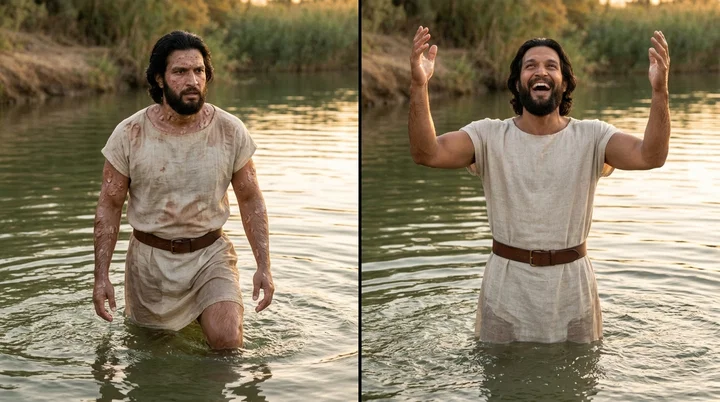
And Elisha sent a messenger unto him, saying, Go and wash in Jordan seven times, and thy flesh shall come again to thee, and thou shalt be clean.
Translations
And Elisha sent a messenger to him, saying, Go and wash in Jordan seven times, and your flesh shall come again to you, and you shall be clean.
King James Version, KJV Cambridge Paragraph Bible
And Elisha sent a messenger unto him, saying, Go and wash in Jordan seven times, and thy flesh shall come again to thee, and thou shalt be clean.
And Elisha sent a messenger to him, saying, Go and wash in Jordan seven times, and thy flesh shall come again to thee, and thou shalt be clean.
And Elisha sent a messenger unto him saying, Go and wash in Jordan seven times, and thy flesh shall come again to thee, and thou shalt be clean.
And Elisha sent a messenger unto him, saying, Go and wash in the Jordan seven times, and thy flesh shall come again to thee, and thou shalt be clean.
and Elisha sendeth unto him a messenger, saying, 'Go, and thou hast washed seven times in Jordan, and thy flesh doth turn back to thee — and be thou clean.
And Elisha sent a messenger to him, saying, Go and wash in the Jordan seven times, and thy flesh shall come again to thee, and thou shalt be clean.
and Elisha sent a messenger unto him, saying,—Go and bathe seven times in the Jordan, so shall thy flesh come back to thee, and be thou clean.
Berean Standard Bible, Majority Standard Bible
Then Elisha sent him a messenger, who said, “ Go and wash yourself seven times in the Jordan, and your flesh will be restored, and you will be clean.”
Elisha sent a messenger to him, saying, “ Go and wash in the Jordan seven times, and your flesh shall come again to you, and you shall be clean.”
And Elisha sent a servant to him, saying, Go to Jordan, and after washing seven times in its waters your flesh will be well again and you will be clean.
And Elisha sent a messenger vnto him, saying, Go and wash thee in Iorden seuen times, and thy flesh shall come againe to thee, and thou shalt be clensed.
Douay-Rheims (Challoner revision)
And Eliseus sent a messenger to him, saying: Go, and wash seven times in the Jordan, and thy flesh shall recover health, and thee shalt be clean.
Pictures


Cross-references
- Luke 4:27
And many lepers were in Israel in the time of Eliseus the prophet; and none of them was cleansed, saving Naaman the Syrian.
Jesus cites Naaman’s cleansing to contrast Israel’s unbelief with a foreigner receiving God’s favor.
- 2 Kings 5:14
Then went he down, and dipped himself seven times in Jordan, according to the saying of the man of God: and his flesh came again like unto the flesh of a little child, and he was clean.
Naaman obeys Elisha’s instruction and is cleansed.
- John 9:7
And said unto him, Go, wash in the pool of Siloam, ( which is by interpretation, Sent.) He went his way therefore, and washed, and came seeing.
The blind man obeyed Jesus’ command to wash and received healing.
- 2 Kings 5:27
The leprosy therefore of Naaman shall cleave unto thee, and unto thy seed for ever. And he went out from his presence a leper as white as snow.
Gehazi receives Naaman’s leprosy after pursuing the rejected gift.
- 2 Kings 5:1
Now Naaman, captain of the host of the king of Syria, was a great man with his master, and honourable, because by him the LORD had given deliverance unto Syria: he was also a mighty man in valour, but he was a leper.
Introduces Naaman and his leprosy, the condition addressed in the verse.
- 2 Kings 5:3
And she said unto her mistress, Would God my lord were with the prophet that is in Samaria! for he would recover him of his leprosy.
The captive maiden points Naaman toward healing.
- Joshua 3:16
That the waters which came down from above stood and rose up upon an heap very far from the city Adam, that is beside Zaretan: and those that came down toward the sea of the plain, even the salt sea, failed, and were cut off: and the people passed over right against Jericho.
The Jordan is miraculously stopped for the ark-bearers.
- 2 Kings 2:8
And Elijah took his mantle, and wrapped it together, and smote the waters, and they were divided hither and thither, so that they two went over on dry ground.
recalls Elijah parting the Jordan
- 2 Kings 5:15
And he returned to the man of God, he and all his company, and came, and stood before him: and he said, Behold, now I know that there is no God in all the earth, but in Israel: now therefore, I pray thee, take a blessing of thy servant.
After his cure, Naaman offers Elisha a gift.
- Matthew 8:2-3
And, behold, there came a leper and worshipped him, saying, Lord, if thou wilt, thou canst make me clean.
The leper asks Jesus to cleanse him, and Jesus immediately does so.
- 2 Kings 2:14
And he took the mantle of Elijah that fell from him, and smote the waters, and said, Where is the LORD God of Elijah? and when he also had smitten the waters, they parted hither and thither: and Elisha went over.
recalls Elisha parting the Jordan
- Zechariah 13:1
In that day there shall be a fountain opened to the house of David and to the inhabitants of Jerusalem for sin and for uncleanness.
The opened fountain is named as the spiritual cleansing represented by Naaman’s washing.
- 1 John 1:7
But if we walk in the light, as he is in the light, we have fellowship one with another, and the blood of Jesus Christ his Son cleanseth us from all sin.
Walking in the light is linked with cleansing.
- Luke 4:25-26
But I tell you of a truth, many widows were in Israel in the days of Elias, when the heaven was shut up three years and six months, when great famine was throughout all the land;
Naaman’s healing parallels Elijah’s help to a foreign widow.
Commentary
Each commentary is drawn from primary sources: the writings of Ellen G. White and Adventist pioneers and periodicals. Each commentary is separate. Its own words are not a quotation; follow the references to read the source passages.
Ellen G. White
22 sources
Elisha sent word to Naaman, the honored Syrian captain who was a leper, to wash in the Jordan seven times with the promise that his flesh would be restored and he would be clean.PK 244.1Lt 123, 1904, par. 37–40PK 244.2PK 246.4
The simple and specific direction tested his pride and faith, for he raged at being told to wash in a humble river instead of the rivers of Damascus and expected the prophet to heal him in a striking and dignified way.Lt 123, 1904, par. 37–40PK 246.4PK 246.5–249.32T 309.2–310.1Lt 29, 1879, par. 8–9
When persuaded to do the small thing commanded, he submitted and washed and was made whole, showing that God requires humble, exact obedience even in littles.Lt 123, 1904, par. 37–40PK 246.4PK 246.5–249.32T 309.2–310.1
His cleansing also brought him to know the true God, for though a heathen foreigner he followed the light he had and stood more righteous before God than those with greater light who misuse it in pride and unbelief.DA 238.2–239.14RED 5.3–7.1SLP 229.1–230.2ST Feb 17, 18812SP 112.2–113.1
He was the only leper cleansed in Elisha's time while many lepers in Israel were passed by, because Israel rejected God's warnings in hardness of heart.DA 238.2–239.12SP 113.2–3ST Feb 17, 1881LC1 53.2–54.1
The Command and Setting
Naaman was captain of the host of the king of Syria, a great man with his master and honorable because through him deliverance had been given to Syria, a mighty man in valor, but a leper.PK 244.1 Elisha sent the instruction to him through a messenger, to go and wash in the Jordan seven times, with the promise that his flesh would come again and be restored and that he would be clean and healed of his leprosy.Lt 123, 1904, par. 37–40PK 244.2PK 246.4PK 246.5–249.32T 309.2–310.1 The command was simple and specific, and healing was to come through following the prophet's directions exactly as given.PK 246.4PK 246.5–249.3Lt 29, 1879, par. 8–9
This episode is the setting for the captive maid's faith that Elisha could recover Naaman through Heaven's power.PK 244.2 God sent the little Israelite maiden to help Naaman the Syrian captain, and for that reason feet are directed toward a place because at that very place there is someone in need of the help and divine guidance that person can give.MH 472.4–473.1 Work that is not of one's own choice is to be accepted as God's choice, and whether pleasing or unpleasing the duty that lies nearest is to be done.MH 472.4–473.1 God still sends men and women and youth today as His representatives to those in need in the same way.MH 472.4–473.1
Humility Tested by Obedience
The instruction sent by messenger was simple and specific — go wash in the Jordan seven times — with the promise that his flesh would be restored and he would be clean and healed of leprosy, and that plainness tested his pride and faith and his willingness to obey rather than follow his own expectations.Lt 123, 1904, par. 37–40PK 246.4PK 246.5–249.3 He did not obey at once but murmured, mortified and disappointed, and in passion and rage refused the humble course as beneath his dignity, resenting the lowly requirement.2T 309.2–310.1Lt 29, 1879, par. 8–9 He had expected Elisha himself to come out to him and stand and call on the name of the Lord his God and strike his hand over the place to cure him, and he counted Abana and Pharpar, rivers of Damascus, better than all the waters of Israel.2T 309.2–310.1
The Jordan was a humble river, while the rivers he desired were beautified with surrounding trees and groves where idols were placed and where many flocked to worship idol gods, so washing there would have cost him no humility.2T 309.2–310.1 Washing in the rivers of Damascus would not meet the specific direction given through Elisha, and following the specified directions would humble his proud and lofty spirit.PK 246.5–249.32T 309.2–310.1 Persuaded by his servant to do the merely small thing commanded, he repented, submitted, and obeyed the prophet’s directions by washing.Lt 123, 1904, par. 37–40PK 246.4PK 246.5–249.32T 309.2–310.1Lt 29, 1879, par. 8–9 His faith was honored: he was made whole, his flesh was restored, and healing and blessing followed willing obedience.Lt 123, 1904, par. 37–40PK 246.4PK 246.5–249.32T 309.2–310.1Lt 29, 1879, par. 8–9
The verse means that God requires humble, exact obedience in small things.2T 309.2–310.1 It applies to perfecting Christian character by condescending to be faithful in the littles, which alone pleases God and wins love.2T 309.2–310.1
Grace Beyond Israel
Naaman's washing in the Jordan brought more than bodily cleansing, for the Syrian nobleman was also enlightened in divine truth and came to know the true God.DA 238.2–239.14RED 5.3–7.12SP 112.2–113.12SP 113.2–3ST Feb 17, 1881 Though a heathen and a foreigner, he lived up to the light he had received, recognized his need, did what he knew was right, and remained open to divine instruction and help.4RED 5.3–7.1SLP 229.1–230.2ST Feb 17, 18812SP 113.2–3ST Feb 17, 1881 For that faithfulness he was counted more righteous and stood in a more favorable position before God than those who possessed greater light.SLP 229.1–230.2ST Feb 17, 18812SP 113.2–3DA 239.2–240.1Ms 8, 1888, par. 9–14
A person's standing before God depends not on how much light has been received but on how it is used.DA 238.2–239.1ST Feb 17, 18812SP 113.2–3Ms 40, 1887, par. 8–11Ms 8, 1888, par. 9–14 Those with less light who follow it faithfully may receive favor, while people with greater light, privileges, and claims to godliness may be rejected when they persist in unbelief, contradict those claims by their lives, misuse God's blessings, and become proud and self-sufficient, closing the way for Him to help them.ST Feb 17, 18812SP 113.2–3ST Feb 17, 1881Ms 40, 1887, par. 8–11Ms 8, 1888, par. 9–14 While many lepers were in Israel in the time of Elisha, none of them was cleansed except Naaman the Syrian, because the people had rejected God's warnings in unbelief and hardness of heart.DA 238.2–239.1ST Feb 17, 1881LC1 53.2–54.1Ms 40, 1887, par. 8–11Ms 8, 1888, par. 9–14 Jesus cited that fact in the synagogue at Nazareth on the Sabbath, that Naaman was the only leper cleansed during Elisha's time, to show that no prophet is accepted in his own country and that God's blessing passed by unbelieving Israel to an outsider.DA 238.2–239.1LC1 53.2–54.1ST Jun 23, 1909
God's power was not worked for the salvation of an unbelieving, hard-hearted people in Israel, but was given especially to one who had a heart that could feel and faith that would grasp the evidences God was pleased to give.2SP 112.2–113.1LC1 56.1 Christ used that history as a severe rebuke that opened corrupt lives and struck home wicked unbelief in those who scorned Him because He came in meekness and lowliness, in poverty and sorrow, as a common man, while they would have no king without riches and splendor and a grand and imposing army.LC1 56.1 That cleansing of Naaman was the only cleansing of a leper known since Elisha's time.DA 262.4–264.2 That precedent made the lepers cautious about expecting Jesus to heal them, though one began to trust that Jesus could do what had not been seen since the days of Elisha.DA 262.4–264.2
Sources
Pioneers and periodicals
83 sources
Elisha did not go out to Naaman himself but sent a messenger telling the Syrian captain to wash seven times in the Jordan, with the promise that his leprous flesh would be restored and he would be clean.RH Sep 25, 1860ST Oct 12, 1904ST Aug 20, 1902ST Oct 12, 1904ST Sep 10, 1885 The cure depended on obeying that exact direction completely, for one dipping would not do and washing in the Abana and Pharpar or any other water he thought better would not have cleansed him.RH May 6, 1858ST Jul 6, 1915ST Feb 4, 1897ST Apr 1, 1880RH Jul 20, 1876 The simple command tried his pride and faith, since he wanted honor to his rank and some great or dramatic act, yet he was healed only by humble obedience to the prophet's word and not by any power in the river or in the act itself.ST Oct 12, 1904ST Aug 4, 1898ST Feb 11, 1889RH Nov 21, 1865 The healing came by God's power alone blessing the means He appointed, showing that Naaman must use what God provided and cooperate rather than expect healing while refusing to act.RH May 6, 1858ST Feb 11, 1886ST Apr 1, 1880 As Naaman was cleansed by obeying God's appointed way, so sinners are cleansed from spiritual leprosy not by human methods or great works but by faith in Christ and washing in the fountain opened for sin, a mercy here given to a believing Syrian while lepers in Israel remained unhealed through unbelief.RH Jul 12, 1906ST Oct 18, 1877ST Feb 19, 1894
Naaman Story and Setting
Naaman was a Syrian captain, highly honored and brave, a man of standing who came with horses and chariot and rich presents of silver and gold to be cured of fatal, loathsome leprosy, and his story stands amid Syria's long conflict and dealings with Israel.ST Sep 10, 1885RH Jul 23, 1872RH Oct 8, 1872 Elisha did not meet Naaman in person but sent a messenger with a simple direction for cleansing.ST Oct 12, 1904ST Sep 10, 1885 The instruction was to go and wash seven times in the Jordan, with the promise that his diseased flesh would be restored and he would be clean.RH Sep 25, 1860ST Oct 12, 1904ST Aug 20, 1902RH Jun 10, 1902 Naaman was cured of leprosy before he offered a present.RH Sep 25, 1860ST Oct 3, 1878
The Abana and Pharpar were clear, cool, swiftly flowing mountain streams rising near the source of the Jordan and flowing through a pleasant, fertile country made beautiful like the garden of Eden, while the Jordan commanded was a deep, rolling river.ST Apr 1, 1880RH Jul 23, 1872 That Jordan was the river that stopped at overflow time when the ark-bearers' feet touched its brink, the waters below rushing toward the Dead Sea while those above stood as a massive wall, and that was twice stopped to leave a dry passage from shore to shore by the mantle.ST Apr 1, 1880RH Jul 23, 1872 When he obeyed he was wholly restored, his flesh coming back like that of a little child and as in the bloom of youth.ST Jul 7, 1909RH Jun 16, 1903ST Oct 22, 1902 The command to wash seven times is one instance of the emphasis attached to the number seven in Scripture.RH Jan 22, 1857
Naaman's healing made Elisha renowned throughout Syria and known to the Syrians.ST Oct 19, 1904 The account further manifests the selfish disposition of Gehazi, the same disposition he showed when he tried to prevent the Shunammite woman from making her wishes known to the prophet.ST Jul 28, 1898 The Jordan's waters could cleanse Naaman's leprosy, but they cannot cleanse money gained through sin or injustice.ST Nov 2, 1882
Exact Obedience Commanded
The promise was tied to doing exactly what was commanded, completely and without alteration.RH May 6, 1858ST Feb 4, 1897RH Jul 20, 1876ST Mar 3, 1909 One dipping would not do, and if he had gone home after six dips he would still have been a leper.RH May 6, 1858ST Feb 4, 1897 He had no claim on the promise before he fulfilled the whole condition, but after the seventh washing the word was verified.RH May 6, 1858
He had to wash in the Jordan that was specified, not in any river or water of his own choosing.RH May 6, 1858ST Jul 6, 1915ST Apr 1, 1880RH Jul 23, 1872RH Jul 20, 1876 Washing in the Abana and Pharpar, the waters of Damascus, or other waters he considered better or more convenient would not have cleansed him, because it was not in accordance with God's command.RH May 6, 1858ST Jul 6, 1915ST Apr 1, 1880RH Jul 23, 1872RH Jul 20, 1876 The blessing was tied to obedience, not to his own judgment about which water was best, and the instruction is a picture of humbly accepting the means God provides rather than choosing other waters.ST Jul 6, 1915RH Jul 20, 1876RH Jul 23, 1861
Honesty does not excuse disobedience to a plain Thus saith the Lord even in a small matter.ST Apr 1, 1880RH Jul 23, 1872 The apparent equality or superiority of other waters makes no difference when God has spoken, and sincerity in choosing a different way does not bring blessing.ST Apr 1, 1880RH Jul 23, 1872RH Jul 23, 1872 Naaman first objected and wanted a substitute, but then discovered his mistake, turned from his mistaken course, quickly retraced his steps, and obeyed.ST Apr 1, 1880RH Jul 23, 1872 His return to follow the instruction shows the need to turn from a mistaken course and act according to God's command.ST Apr 1, 1880
His servants urged him to accept the instruction humbly and obey.RH Mar 4, 1902RH Jun 16, 1903RH Jan 22, 1867 He had first rejected the simple instruction, thinking the rivers of his own country could do as much and expecting a more impressive act, and he was willing to do something great but resisted this plain direction because it fell short of his expectations.RH Nov 21, 1865RH Jan 22, 1867 After he did what he had been told and went to the Jordan, he emerged healed and was made whole, for there was no cleansing in disobedience.RH Nov 21, 1865RH Mar 4, 1902 The required act was small and humble and tested his willingness to obey, though he considered it too insignificant to heal his leprosy.RH Jan 22, 1867ST Jul 2, 1902
Faith Pride and Humility
The simple direction tested both faith and pride, for the great captain grew angry and nearly lost the blessing because he had expected deference to his rank and a dramatic ceremony suited to his status.ST Oct 12, 1904ST Aug 4, 1898ST Feb 11, 1889ST Sep 10, 1885 He had looked for the prophet himself to come out to him, to call on the name of God, to strike his hand over the place and pray over him, rather than to receive a word by a messenger bidding him wash.ST Oct 12, 1904ST Aug 4, 1898ST Feb 11, 1889RH Mar 4, 1902ST Sep 10, 1885 When the promised cleansing was tied only to following that plain instruction, his pride rose against it and he first turned away in refusal.ST Oct 12, 1904ST Aug 4, 1898ST Feb 11, 1889RH Mar 4, 1902
He judged obedience to that exact word to be blind foolishness, despised the Jordan, and wanted some great thing instead.ST Apr 19, 1910ST Mar 25, 1897RH Nov 21, 1865ST Feb 17, 1888 Worldly wisdom and human reasoning told him there was a better way, and he preferred the clear rivers of his own country, the waters of Damascus, as cleaner and more worthy.ST Apr 19, 1910ST Mar 25, 1897RH Nov 21, 1865ST Oct 18, 1877 The simplicity of the appointed means offended him, so he reasoned that those rivers could do as much and that a more impressive or personally preferred course should serve as well.ST Mar 25, 1897RH Nov 21, 1865ST Feb 17, 1888ST Oct 18, 1877
Healing came only through humble obedience to the word given, not through the grandeur of the river or of the act.RH Nov 21, 1865RH Mar 4, 1902RH Jul 20, 1876 Its power lay not in any visible display, not in a prophet's touch, not in any special power in the river itself or in the number of dips, and not in his own judgment about which water was best.RH Nov 21, 1865RH Mar 4, 1902ST Oct 22, 1902 Blessing was tied to doing what he had been told in the Jordan specified, rather than choosing another stream he considered better or more convenient.RH Nov 21, 1865RH Mar 4, 1902RH Jul 20, 1876ST Oct 22, 1902
He was healed through a very simple act because he obeyed the direction of a prophet of Jehovah, and his obedience showed his faith.ST Dec 7, 1904ST Mar 5, 1902ST Aug 21, 1901 That obedience is the proof of belief in God, so that righteousness consists in obeying His voice.ST Dec 7, 1904ST Mar 5, 1902ST Aug 21, 1901 The command was an apparently small thing, yet it called for a far greater exercise of faith than doing some notably conspicuous thing.ST Aug 21, 1901 In this it proves that the Lord has greater delight in obeying His voice than in burnt offerings and sacrifices.ST Aug 21, 1901
Faith therefore required him to obey God's instruction rather than judge its importance or sense.ST Oct 24, 1900ST May 28, 1894 He was called to trust and act even when no particular reason was given, even when the direction appeared insignificant, foolish, or unreasonable beside the cleaner rivers of Damascus.ST Oct 24, 1900ST May 28, 1894 A believing attitude does not make the particular requirements of God's command optional, for grace is received through obedience, not by replacing the command with a preferred alternative such as choosing another river or substituting sprinkling for going to the Jordan and washing as commanded.ST Mar 10, 1881 God's power accompanied the word Elisha sent, and the word carried power to accomplish what it promised when he obeyed, while disbelief and refusal left him leprous with no cleansing in disobedience.RH Mar 4, 1902ST Oct 17, 1895
Healing Through Divine Power
God's word itself supplied the divine remedy and cure for leprosy in this case, directing washing seven times in the Jordan with the promise of cleansing. The healing did not come from any efficacy in the waters of the Jordan, from any special power in the river, or from the number of dips, but from the power of God alone acting when the command was obeyed.RH May 6, 1858ST Apr 1, 1880ST Oct 22, 1902ST Oct 12, 1904 No washing in any earthly river could by itself heal physical leprosy, and still less spiritual leprosy, so the cure of body and soul rested on God alone and not on the Jordan being better than the rivers of Damascus.ST Apr 1, 1880ST Oct 12, 1904 It came only because the command of God was joined to the washing, proving that obedience to a plain Thus saith the Lord is what matters.ST Apr 1, 1880ST Oct 22, 1902
Washing was nevertheless a means provided to be used, and without using the means there would have been no healing, for restoration came through God's blessing on the use of the means.ST Feb 11, 1886 That use of means was sanctioned even in an incurable case where the healing was miraculous, although the baths had no apparent power to cure.ST Feb 11, 1886 The direction therefore presents proper bathing as a God-given means of relief that should not be despised, since to expect miraculous restoration while rejecting such means is futile.ST Nov 19, 1902 Water served as the material means and treatment through which cleansing came, and baths are recognized as a remedial agency to be used alongside prayer and reliance on God.RH Aug 27, 1901ST Dec 23, 1913ST Sep 21, 1915
Healing was connected with following the instruction to wash, showing that people should not expect God to heal them while they make no effort to cooperate and continue in transgression.ST It was connected with faith in God's direction, illustrating faith's place and power in the treatment of disease. The miracle stands alongside Jesus' healing of the man born blind, in that both accounts use outward means in restoring a person.ST Nov 26, 1896 The cleansing shows that the Lord's presence and power were available through the prophet God had appointed, and it rested on faith in God's word and power rather than on a record of earlier healings, for the young captive girl had never seen such a healing before yet trusted, and others in Israel might likewise have been cleansed had they recognized the Lord's presence in His accredited prophet.ST Jul 13, 1904
The same Spirit that moved the Israelite maid-servant to speak of the prophet in Samaria moved the prophet to have Naaman sent to him and to send the command to wash.ST Oct 12, 1904 That command aimed beyond the mere physical healing of the Syrian captain, so that Naaman, and others through him, would know that there was a prophet in Israel and through that knowledge would find salvation.ST Oct 12, 1904
Cleansing From Sin
Naaman's cleansing presents a divine cure received through faith as the pattern for the removal of sin in the same way. As his cleansing came through obeying the instruction to wash in the Jordan seven times, sin is healed through God's appointed way of salvation by faith in the crucified and risen Christ, not by human methods such as education or environment put in place of the new birth.RH Jul 12, 1906 Human power and rich religious offerings cannot cleanse the soul from sin, but salvation and inner healing come through the gospel and Christ the greater Prophet.RH Jul 12, 1906
The command illustrates the simple remedy for sin, that cleansing comes by washing in the fountain opened for sin and uncleanness and not by doing some great work or human achievement.ST Oct 18, 1877ST Jul 7, 1909 The Jordan points beyond itself to that pure and inexhaustible fountain, and the leper's cleansing shows that Jesus willingly cleanses those who come to him.ST Jul 7, 1909 Those who held the contrast taught that Jordan's flood healing leprosy when washed in by command is not like the fountain of Jesus' blood, because that blood is a crimson sea that washes guilt and filth away in the heart.RH Jan 21, 1858 The sin-sick person must yield to God in trust and surrender and accept Jesus and His way to receive cleansing and peace.ST Dec 24, 1896
Pride obstructed Naaman because he expected display and personal attention suited to his status and preferred the rivers of Damascus, and so pride obstructs acceptance of the simple remedy for cleansing from sin.ST Feb 17, 1888 No washing in any earthly river could heal physical leprosy and still less spiritual leprosy, for cure of body and soul came from the power of God alone, and proud sinners lose eternal life unless they lay aside pride and accept humble conditions by observing the simple commandments and ordinances of God.ST Oct 12, 1904 Unconverted sinners outside the church and in it show a propensity to have their own way, willing to receive the Lord's benefits only in a manner they dictate that will not mar their pride or interfere with worldly interests and enjoyments.RH Oct 8, 1872 When required to deny self, reform the life, and be governed by the rules of pure morality in the straight testimony of the word, they invent some addition to or diminution from it that leaves what they trust for salvation lifeless, while the means of conversion are in the perfect law that converts the soul and the means of salvation in the gospel of Jesus Christ.RH Oct 8, 1872
The word Naaman was called to obey had power not in visible display, a prophet's touch, or the river itself, and it could save from both physical and spiritual leprosy, since disbelief and refusal left him leprous and there was no cleansing in disobedience.RH Mar 4, 1902 In one application seven times means to keep canvassing until the work is done, so that schools would be freed from debt and people from sin, especially inactivity and criticism, by obeying the plan to sell the books.RH Mar 4, 1902 The lesson applies to people living hypocritically and unholy lives, whose spiritual malady is incurable unless the Great Physician heals them.RH Apr 23, 1908 Anger is compared to Naaman's leprosy clinging to him as a harmful condition to be overcome.
As Naaman's obedience was necessary for cleansing, obedience to God's counsel including temperance and reform is necessary for cleansing from filthiness of flesh and spirit and for perfecting holiness.RH Mar 19, 1867 Naaman's anger at the simple instruction illustrates how people may resist health reform because daily self-denial and control of appetite seem difficult, even while they would eagerly undertake a dramatic sacrifice.RH Jun 14, 1867 The Jordan's waters could cleanse Naaman's leprosy, but they cannot cleanse money gained through sin or injustice.ST Jan 19, 1882ST Nov 2, 1882
Gentiles Beyond Israel
Jesus pointed to Naaman's cleansing to show that in Elisha's time no leper in Israel was cleansed, while Naaman the Syrian was, the sole and only leper cleansed then.ST Jun 23, 1909ST Mar 22, 1899ST Feb 19, 1894ST Mar 22, 1899 The contrast belongs to the account of Elisha directing the Syrian leper to wash in the Jordan seven times and be cleansed.ST Mar 22, 1899ST Feb 19, 1894
Naaman was cleansed because he believed, while the lepers in Israel were not healed because they lacked faith.ST Feb 17, 1881ST Jun 16, 1887ST Feb 19, 1894 Israel had many lepers, but their unbelief and misuse of privileges closed them off from the good God offered.ST Feb 17, 1881ST Jun 16, 1887ST Feb 19, 1894
Though a heathen and a Syrian nobleman, Naaman lived by the light he had, did what he knew was right, recognized his need, was faithful to the light, and was open to divine instruction, so he received God's favor and blessing.ST Feb 17, 1881ST Feb 17, 1881ST Jun 16, 1887 His faithfulness to the light, awareness of need, and openness made him receptive to help through God's power and to enlightenment in divine truth.ST Feb 17, 1881ST Jun 16, 1887 By contrast, people with greater light and claims to godliness may be rejected when their lives contradict those claims and they persist in unbelief.ST Feb 17, 1881ST Feb 17, 1881
His healing shows that God offers blessing without distinction between Jew and Gentile, and that salvation is received by faith.ST Feb 19, 1894 God's mercy reaches people beyond Israel, for there are precious souls in every nation, and a prophet's ministry was not limited to people of Israel.ST Dec 23, 1889 The Jews were favored so they could share God's light and privileges with the whole world, not claim that God loved them more than others.ST Nov 7, 1895
The account illustrates that a prophet may be rejected by his own people while God's mercy reaches beyond them.ST Mar 22, 1899 People may reject God's message because of the messenger, while those outside their own nation may receive it, as Elisha was rejected in Israel while the foreigner Naaman received the word to wash in the Jordan seven times with the promise of cleansing.ST Mar 22, 1899ST Sep 24, 1894 Israel had been given lessons, including Naaman's case, showing that God's salvation and light were not limited to the Jews but were for all peoples, and that Israel's calling was to share that message with the world.ST Nov 7, 1895ST Jan 22, 1894
The healing showed that Israel's God had power to cure disease.RH Jun 10, 1902 Naaman's recovery led him to acknowledge that there was no God in all the earth but in Israel and to worship the Lord.RH Jun 10, 1902
Sabbath Doctrine and Life
The wording points to dipping as the method used on that occasion, since he dipped himself in the river, yet wash names the action itself rather than one exclusive method, for washing may be done by dipping or by pouring and is not identical with either alone.ST Apr 22, 1880 Grace was received by going to the Jordan and washing as commanded, not by choosing another river or by substituting sprinkling, and a believing attitude does not make the particular requirements of the command optional.ST Mar 10, 1881
As he had no claim on the promise before he fulfilled the whole condition exactly, so the sinner has no claim on pardon and redemption by belief and repentance alone while one more required step remains.RH May 6, 1858 Healing did not come from any efficacy in the waters of the Jordan but from the power of God acting after the seventh dipping; if he had gone home after six dips he would still have been a leper, and God was not bound to heal him if he washed in the Abana and Pharpar instead of the Jordan.RH May 6, 1858 Only after complying with all the precise conditions laid down, including baptism, does it devolve upon God to remit sins, just as God verified His word after Naaman washed the seventh time.RH May 6, 1858
The Jordan washing is compared with observing the seventh day because God has designated it as the Sabbath.RH Nov 26, 1857 Elisha specified the Jordan as the place where Naaman was to wash seven times and be cleansed, and although the Jordan was a stream of water, substituting another river would not have obeyed the command.RH Jul 31, 1866 The required act included the place named, and obedience meant following the specific instruction given; the Jordan was essential to the command just as the particular day God set apart is essential to the Sabbath command, and replacing it with something similar does not obey it.RH Jul 31, 1866 Cleansing depended on following the instruction exactly — washing seven times in the Jordan, not in the waters of Damascus that he preferred — and obedience to God's command must be complete rather than replaced by what people consider equally suitable.ST Mar 3, 1909
The same rule holds for keeping the seventh-day Sabbath with its given reason and its sign between God and His people instead of Sunday, for believing the soul is mortal and the dead are asleep at rest knowing nothing until the resurrection instead of consciousness, and for expecting, believing, and watching for the soon coming of the Lord instead of treating its time as a hidden mystery.RH Jul 23, 1872 Cleansing came only by obeying God's exact command to wash in Jordan seven times, and sincerity in choosing a different way does not bring blessing; he first objected and wanted a substitute, but then discovered his mistake, quickly retraced his steps, obeyed, and built on the sure foundation of truth that alone will stand the final test.RH Jul 23, 1872 As he looked for great acts instead of simply obeying a plain direction, the same spirit appears when the holy Sabbath draws a straight line and many try to climb up some other way rather than simply obeying God.RH Jan 20, 1853 Patiently enduring trials and keeping God's commandments and the faith of Jesus in the third angel's message is the one appointed way of escape from death, and to seek some greater act is to despise the day of small things and to miss the weight of simply obeying God.RH Jan 20, 1853
Christians who sigh for opportunities of usefulness while never taking hold of those close at hand act like Naaman of old despising the simple waters because he wanted some great thing.ST Jan 28, 1875 God gives blessing through a humble, ordinary command, and pride rejects it while looking for something greater; the lesson is not to look further than the everyday walk and path for means of usefulness, since life is made up of little things and the daily consecration of these little things brings great results, like small seeds scattered bringing a great harvest.ST Jan 28, 1875 He resisted the simple instruction because he expected some greater action, but was persuaded to give up that expectation and obey, teaching that small, humble acts should be done willingly when great things are not possible.
He faced leprosy as an incurable disease with the prospect of increasing suffering and death, and his courage did not rest on hope of recovery; his example shows that when a burden cannot be removed, life still carries a duty to bear it bravely.ST Jun 7, 1910 He was given a simple instruction to wash in the Jordan to be healed, a procedure he was tempted to scorn but that proved a boon when put to the test.RH Dec 17, 1903
Sources