John 9:2
And his disciples asked him, saying, Master, who did sin, this man, or his parents, that he was born blind?
Translations
American King James Version, King James Version, KJV Cambridge Paragraph Bible
And his disciples asked him, saying, Master, who did sin, this man, or his parents, that he was born blind?
And his disciples asked him, saying, Master, who sinned, this man, or his parents, that he was born blind?
And his disciples asked him, saying, Rabbi, who did sin, this man, or his parents, that he should be born blind?
And his disciples asked him, saying, Rabbi, who sinned, this man, or his parents, that he should be born blind?
and his disciples asked him, saying, 'Rabbi, who did sin, this one or his parents, that he should be born blind?'
And his disciples asked him, saying, Rabbi, who sinned, this [ man] or his parents, that he should be born blind?
And his disciples questioned him, saying—Rabbi! who sinned, this man or his parents, that, blind, he should be born?
Berean Standard Bible, Majority Standard Bible
and His disciples asked Him, “ Rabbi, who sinned, this man or his parents, that he was born blind?”
His disciples asked him, “ Rabbi, who sinned, this man or his parents, that he was born blind?”
And his disciples put a question to him, saying, Master, was it because of this man's sin, or the sin of his father and mother, that he has been blind from birth?
And his disciples asked him, saying, Master, who did sinne, this man, or his parents, that he was borne blinde?
Douay-Rheims (Challoner revision)
And his disciples asked him: Rabbi, who hath sinned, this man, or his parents, that he should be born blind?
Pictures
Cross-references
- John 9:6-7
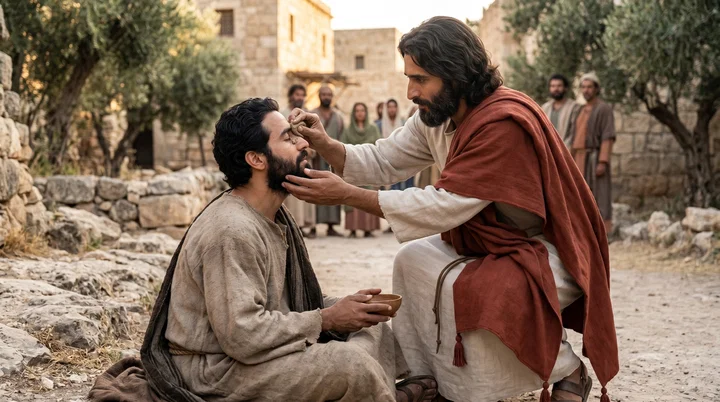
When he had thus spoken, he spat on the ground, and made clay of the spittle, and he anointed the eyes of the blind man with the clay,
Jesus applies clay and sends the man born blind to wash, restoring his sight.
- John 9:25
He answered and said, Whether he be a sinner or no, I know not: one thing I know, that, whereas I was blind, now I see.
The healed man testifies that he once was blind and now sees.
- John 9:35-38
Jesus heard that they had cast him out; and when he had found him, he said unto him, Dost thou believe on the Son of God?
Jesus reveals himself to the healed man, who believes and worships him.
- John 9:21
But by what means he now seeth, we know not; or who hath opened his eyes, we know not: he is of age; ask him: he shall speak for himself.
parents refuse to explain his healing
- John 9:33
If this man were not of God, he could do nothing.
miracle proves Jesus is of God
- Ezekiel 18:19-20
Yet say ye, Why? doth not the son bear the iniquity of the father? When the son hath done that which is lawful and right, and hath kept all my statutes, and hath done them, he shall surely live.
It states that a child does not bear a parent’s iniquity.
- John 9:24
Then again called they the man that was blind, and said unto him, Give God the praise: we know that this man is a sinner.
The Pharisees respond to the blind man’s healing by opposing Jesus.
- John 9:14
And it was the sabbath day when Jesus made the clay, and opened his eyes.
The healing took place on the Sabbath.
- Luke 13:2-5
And Jesus answering said unto them, Suppose ye that these Galilæans were sinners above all the Galilæans, because they suffered such things?
Jesus rejects the idea that those who suffered calamity were greater sinners.
- Jeremiah 31:29-30
In those days they shall say no more, The fathers have eaten a sour grape, and the children’s teeth are set on edge.
The sour-grapes saying gives way to each person bearing responsibility for their own iniquity.
- John 9:22-23
These words spake his parents, because they feared the Jews: for the Jews had agreed already, that if any man did confess that he was Christ, he should be put out of the synagogue.
The man’s parents fear synagogue expulsion, and the healed man is cast out.
Commentary
Each commentary is drawn from primary sources: the writings of Ellen G. White and Adventist pioneers and periodicals. Each commentary is separate. Its own words are not a quotation; follow the references to read the source passages.
Ellen G. White
12 sources
The disciples asked whether the man was born blind because he himself had sinned or because his parents had sinned, assuming that blindness from birth must be punishment for sin.DA 470.1–471.3DA 471.4–6ST Jul 19, 1905 Their question reflected the teaching that sickness and distress are always evidence of God's anger toward the transgressor for sin.2SP 293.1ST Oct 16, 1879 Jesus corrected the error without explaining the cause of the affliction, directing them not to debate who had sinned but to see how God's power and works would be made manifest in his healing.DA 470.1–471.3DA 471.4–6ST Jul 19, 1905 The restoration of his sight showed that the healing power was in Christ Himself, not in the clay or the pool, and stood as convincing evidence of His divine mission.DA 470.1–471.3 The verse rebukes treating another person's suffering as proof that God is judging him for personal or parental sin, a judgment that only adds to the burden of the sick, while the healing reveals Christ's compassion and tender regard for the despised and suffering, even those who did not yet know Him.ST Nov 20, 1893TCBMP 102.1–2ST May 8, 1907Lt 20, 1895, par. 13T 87.1–88.3
Question and Its Setting
The disciples asked whether the man born blind was blind because he himself had sinned or because his parents had sinned.DA 470.1–471.3DA 471.4–6ST Jul 19, 1905 Behind the question lay the assumption that blindness from birth must be punishment for sin, whether his own or his parents'.DA 470.1–471.3DA 471.4–6 Hardship and calamity were thus taken as proof that suffering was caused by personal wrongdoing.ST Jul 19, 1905
The healing took place just after Jesus left the temple when the Pharisees tried to stone Him for saying Before Abraham was, I AM.14MR 22.5 He blinded their eyes so they could not see Him as He went out through their very midst.14MR 22.5 As He passed through the multitude or crowd He saw the man who had been blind from birth or from his youth and healed him.14MR 22.5Lt 119, 1895, par. 12–18
The question reflected the Pharisaic custom and teaching that sickness and distress are always evidence of God's anger toward the transgressor for sin.2SP 293.1ST Oct 16, 1879 Those who held this view condemned sufferers as receiving just punishment.2SP 293.1ST Oct 16, 1879 They held themselves aloof from the sick and needy, pronounced them incurable, withheld sympathy, and told them they were only suffering God's righteous retribution for misdeeds.ST Oct 16, 1879 Those judges did so even though they were often themselves more corrupt in heart and life than those they judged.2SP 293.1ST Oct 16, 1879
Bodily affliction can indeed be the penalty for transgression of God's law through dissipation and love of the pleasures of sin.ST Oct 16, 1879 That truth was misapplied as a universal rule to condemn poor sufferers.ST Oct 16, 1879
Christ's Correction and Compassion
Jesus corrected the disciples' error without explaining the cause of the man's affliction from birth.DA 470.1–471.3DA 471.4–6 They were not to debate or determine whether he or his parents had sinned, but to see how God's power, works, and mercy would be made manifest in his healing.DA 470.1–471.3DA 471.4–6 Hardship and calamity can become occasions for God's work to be seen, and even people in misery still have possibilities for redemption and growth.ST Jul 19, 1905
The restoration of his sight showed that the healing power was in Christ Himself, not in the clay nor in the pool of Siloam.DA 470.1–471.3 That healing was convincing evidence of His divine mission. It revealed His compassion toward a poor blind man whom the self-righteous Pharisees despised and treated as fit only for sneers and hatred, while the Lord sought to save him as a lost sheep.ST Nov 20, 1893ST May 8, 1907
The healing also showed Jesus' deep sympathy for human suffering and tender regard for people, including those who did not yet know Him.Lt 20, 1895, par. 1 The man learned who Jesus was only when Jesus revealed Himself to him as the Son of God, and then he worshiped Him.Lt 20, 1895, par. 1 In contrast, the Pharisees' response to the healing showed spiritual blindness caused by prejudice and unbelief.
Looking to Christ and the cross reveals God's love for fallen people, moves sinners to repentance, and changes their character.ST Nov 20, 1893 The verse rebukes wrongly connecting another person's suffering with personal or parental sin and treating sickness as proof that God is judging the sufferer.TCBMP 102.1–23T 87.1–88.3 That misjudgment adds to the burden of those already sick and suffering, and is applied to merciless judgment toward them.TCBMP 102.1–23T 87.1–88.3
Sources
Pioneers and periodicals
74 sources
The disciples asked whether the man was born blind because of his own sin or because of his parents' sin.ST Aug 8, 1900ST Feb 22, 1899ST Mar 8, 1905 Their question reflected the common belief that sickness and calamity are direct punishments from God for particular wrongdoing.ST Oct 23, 1893ST Aug 8, 1900ST Mar 8, 1905 Jesus rejected both explanations, answering that neither the man nor his parents had sinned in a way that caused the blindness.ST Oct 23, 1893ST Feb 22, 1899RH Jan 30, 1872 The blindness had been allowed so that the works of God should be made manifest in him, as Jesus relieved his suffering and revealed God's mercy and power.ST Jun 24, 1886ST Mar 8, 1899RH Jan 30, 1872 Affliction is therefore no proof of special guilt or divine disfavor, and the sight of suffering is a call to help rather than to assign blame.ST Oct 2, 1901ST Jul 9, 1894ST May 16, 1911ST Nov 26, 1896RH Aug 21, 1900
Setting and Circumstances
The man was a poor, unlearned, humbly born beggar, blind from birth, who sat begging beside the way and in the porch of the temple at Jerusalem.RH Mar 30, 1876RH Nov 13, 1860ST Apr 14, 1881 His healing was a work only divine power could do, and it took place on the Sabbath as one of seven Sabbath miracles recorded in the ministry of Jesus.RH Nov 13, 1860ST Apr 14, 1881 The disciples put their question about his blindness in a solemn moment when Jesus had stopped to notice and help him, while he himself was unaware that Jesus was looking at him.ST Aug 14, 1901
Moved with compassion at the sight of him, Jesus moistened clay and anointed his sightless eyes and sent him to wash in the pool of Siloam, whose name means Sent.ST Nov 11, 1897RH Feb 11, 1862ST May 22, 1901 He anointed the eyes on the Sabbath and told him to wash, and the man received the blessing by doing what Jesus directed and returned able to see.RH Feb 11, 1862ST May 22, 1901ST Aug 12, 1889 The healing showed Jesus doing the works of God, and it was followed by strife among the Jews.ST Nov 11, 1897 The act was worthy of the Sabbath and of its Lord and was no violation of it.RH Feb 11, 1862
His blindness was congenital; he had been blind from birth and had never looked on his friends nor seen the beauties of creation, which adds force to the miracle.ST Feb 11, 1886ST Nov 26, 1896 His case was beyond human skill, where ordinary means could not provide a cure, so that opening his eyes was a miracle and blessing never heard of before.ST Feb 11, 1886 After he who was blind now saw, he was questioned over and over by the Sanhedrin about who he was and what he had become, and he answered with unshaken certainty that he is the same man who once was blind but now sees.RH Mar 30, 1876 His parents, fearful of being disfellowshipped, would say only that he was their son born blind, that they did not know how he now saw or who had opened his eyes, and that being of age he should speak for himself. The Jews had agreed that anyone who confessed Jesus was Christ would be put out of the synagogue, so rather than displease their religious leaders and be turned out of the church they refused to acknowledge Christ and his power to heal, though it would have been better to be turned out of the synagogue than to be turned out of heaven.ST Nov 19, 1896
Because of his belief in Christ the healed man was cast out, illustrating the synagogue exclusion practiced among the Jews.RH Oct 8, 1908ST Oct 18, 1905 Jesus did not leave him after the miracle but returned and sought him out with the care of a humble teacher, found him when men had cast him out and persecuted him, and taught him privately the highest truth of his Messiahship.RH Nov 13, 1860 This shows the lowliness of Christ and his attention to humble people and small occasions in the work of redemption.RH Nov 13, 1860 The man depended wholly on Jesus and his word, receiving sight by doing what Jesus directed, in mercy giving sight to one born blind so that he could see his mother's loving face.ST Aug 12, 1889RH Jun 13, 1871
Disciples' Question About Sin
The disciples asked whether the man's blindness from birth was caused by his own sin or by his parents' sin.ST Aug 8, 1900ST Feb 22, 1899ST Mar 8, 1905ST Jun 24, 1886RH Jan 30, 1872 Jesus answered that neither he nor his parents had sinned to cause it, but the blindness was allowed so that God's works might be made manifest in him.ST Feb 22, 1899ST Jun 24, 1886RH Jan 30, 1872ST Oct 2, 1901 Their mistaken assumption was that blindness from birth must have resulted from sin, either his own before birth or his parents' sin.ST Mar 8, 1905ST Oct 2, 1901ST Jul 4, 1905 The question therefore sought the cause of the calamity, while the answer directed attention to the good God could bring from it.ST Jun 24, 1886
The question reflected the belief that sickness and affliction were direct punishments for wrongdoing.ST Oct 23, 1893ST Aug 8, 1900ST Jul 4, 1905 It reflected the common Jewish belief that suffering, calamity, poverty and incurable illness were direct punishments and judgments from God.ST Oct 23, 1893ST Mar 8, 1905ST Jun 24, 1886 That included the belief that a child might bear a parent's guilt and that parents' sins could affect their children.ST Jun 24, 1886ST Mar 4, 1913 The disciples thought all disease and suffering comes from sin, so that a man born blind must himself be a great sinner or have sinning parents.ST Oct 23, 1893ST May 17, 1905
Because the man was blind from birth, they also wondered whether sin could have acted before birth.ST Jun 24, 1886ST Oct 2, 1901 This meant asking whether his blindness was punishment for his own sin in a pre-existent life or for sin committed by his parents.ST Jun 24, 1886ST Dec 22, 1881 It reflected Jewish views that an unborn child might bear a stain of sin or even sin before birth.ST Mar 4, 1913RH Sep 25, 1913 One reading takes this to reflect belief in transmigration of souls, in which a soul entered another body to suffer punishment for an earlier sin.ST Dec 22, 1881
The question does not show that they believed he had lived before birth, since it could mean whether he sinned and became blind or his parents sinned so that he was born blind.ST Mar 4, 1913 Drawing the doctrine of transmigration of souls from it is an inference no stronger than other unsupported doctrines drawn from isolated Bible statements.ST Mar 4, 1913RH Feb 3, 1852RH Jun 24, 1852 The verse is cited as an example of Jesus sometimes addressing people within their mistaken beliefs rather than correcting every error directly.RH Sep 25, 1913 The verse exposes the cruel error that a child could be guilty before birth and afflicted as God's judicial punishment.ST May 17, 1905 The general link between suffering and sin is true, but it is error to suppose that everyone who suffers greatly has sinned greatly, outward suffering cannot be used as a fixed measure of character, and though affliction may result from transgression it is not proof that God is punishing the afflicted person for sin.ST Oct 23, 1893ST Aug 8, 1900ST May 17, 1905 The form of the question is also used sarcastically to describe spiritual blindness, saying theological training rather than sin by the man or his parents caused it.RH Jun 23, 1874
Jesus' Answer and Purpose
Jesus answered that neither the blind man nor his parents had sinned in a way that caused his blindness from birth, rejecting both alternatives the disciples proposed.ST Feb 22, 1899RH Jan 30, 1872ST Mar 24, 1914ST Oct 2, 1901RH Oct 10, 1912 The disciples had assumed that great suffering must mean great sin, either by the man himself or by sinning parents, but it is error to suppose that everyone who suffers greatly has sinned greatly.ST Oct 23, 1893ST Oct 2, 1901RH Oct 10, 1912 Bodily affliction is not proof of personal guilt or divine disfavor, and physical consequences follow natural causes regardless of motives so that blindness does not establish anyone's moral guilt.ST Mar 24, 1914RH Oct 10, 1912 Suffering is not necessarily a direct punishment for a particular offense, and an afflicted person can instead become a means through which God's work is made known.ST Oct 2, 1901ST Jul 9, 1894ST May 16, 1911
The answer does not deny that sin brings suffering in a general sense, for pain and death are consequences of sin and sickness and death sometimes come as the allowed harvest of transgression by individuals or their ancestors.ST Oct 23, 1893ST Mar 10, 1881ST Nov 26, 1896RH Jun 6, 1912 Individual or hereditary sin does bring suffering, yet some suffering is not evidence of special wrongdoing but is permitted for wise and good reasons that will one day be comprehended.ST Mar 10, 1881ST Nov 26, 1896ST Nov 26, 1896 Calamity such as being born blind does not prove that he or his parents sinned in a special way to cause it, and sickness may have causes other than a person's particular sin.ST Jul 9, 1894ST May 16, 1911RH Oct 10, 1912RH Jun 6, 1912 God can be honored and glorified by healing people who trust in him from sin's consequences, and he may permit those he loves to face trials so they can learn trust and faith and grow in knowledge of his character.ST Mar 10, 1881ST May 16, 1911
The blindness was allowed and permitted so that the works of God should be made manifest in him, his condition becoming an occasion for Jesus to relieve suffering and reveal God's mercy, compassion, power and glory.ST Jun 24, 1886ST Mar 8, 1899RH Jan 30, 1872ST Mar 24, 1914RH Oct 10, 1912 That purpose was fulfilled when Jesus opened his eyes, a thing never heard of before, which proved the power of God and that Jesus was his Son.RH Jan 30, 1872ST Nov 26, 1896 The man's lifelong affliction was not punishment and not his fault, but was ordered in God's providence to glorify God and his Son, and the joy of receiving sight atoned for all he had suffered.RH Jan 30, 1872 In the same way very many sorrows, trials and adversities are ordered in God's providence, and the day of Judgment will reveal their purpose.RH Jan 30, 1872ST Nov 26, 1896
Suffering results from sin in a general sense but it cannot atone for sin; it may instead bring the sufferer to the One who can heal both body and soul.ST Mar 8, 1899 That manifestation comes not only through healing but through character developed under trial, as God allows earthly supports to be taken away so the soul learns to trust him.ST Mar 10, 1881 He fills every emptiness he permits with his own presence, becoming more than husband to the widow and more than father to the fatherless and carrying his people even to old age. Jesus did not call for debate about who had sinned or satisfy idle, morbid curiosity intruding on a solemn moment, but answered in a practical way by healing the man to prove that healing virtue was in Christ and not in the clay or in the pool of Siloam.ST Oct 23, 1893ST Aug 14, 1901 Attention is turned from the past to the future, from how he got into difficulty to how he can be helped out of it, for no matter what caused suffering its presence is material and opportunity for a work of God, a platform on which grace and power manifest with each new phase of evil leading to new forthcoming of God's heart.ST Jun 24, 1886ST Nov 26, 1896ST Nov 26, 1896 Believers must therefore be at hand at all costs to manifest those works before nightfall, causing sufferers to feel that God is thinking of them and has sent help through human hands, since those led to believe in the love of fellow men are well on the road to belief in the love of God, responding to need with help rather than focusing on blame and pointing to Satan as the one whose sin brought suffering and debt into the world.ST Nov 26, 1896RH Jul 4, 1912
Sabbath Healing and Controversy
The healing that follows the question was performed on the Sabbath day, as John explicitly states in John 9:14, when Jesus anointed the blind man's eyes with moistened clay and sent him to wash in the pool of Siloam, whose name means Sent, and the man received sight.ST Nov 11, 1897RH Feb 11, 1862ST May 22, 1901ST Sep 18, 1884ST May 19, 1909 He was moved with compassion toward the man in doing it, and the healing showed Him doing God's works, yet it was followed by strife among the Jews.ST Nov 11, 1897RH Feb 11, 1862 It was one of many cures Jesus performed on the Sabbath that caused crowds to resort to Him on that day, and the lesson reckoning identifies this cure as occurring on the Sabbath.ST May 19, 1909 The cure at Siloam opened his eyes and displayed Jesus taking human infirmities and bearing sicknesses.ST May 22, 1901
It is counted as one of seven Sabbath miracles recorded in Jesus' ministry.ST Apr 14, 1881 It is also counted as one of three miracles around which the controversy between Christ and the Jews gathered, raising the question of what constitutes proper Sabbath-keeping.ST Aug 20, 1896 The man healed in this account sat begging in the porch of the temple at Jerusalem.ST Apr 14, 1881
The act was worthy of the Sabbath and of its Lord and was no violation of the Sabbath.RH Feb 11, 1862RH May 5, 1874 Only the enemies of the Lord then and the opponents of the Sabbath now see in it even the slightest violation.RH Feb 11, 1862 The law never prohibited healing on the Sabbath, for the Sabbath forbids servile work, meaning grasping after wealth by trading and worldly business, but it requires attention to the soul, reflection, and beneficial help for neighbors, so that healing on the Sabbath fulfills the law rather than making it void and relieves suffering and honors God.RH May 5, 1874
The healing was treated by the Pharisees as Sabbath breaking, though Jesus kept the Sabbath according to God's meaning rather than their rules, and His Sabbath work caused division among the people, with many believing in Him.ST Jul 8, 1897 They called Jesus a sinner because He did not observe their rules, not because He violated God's Sabbath, while they sought to kill Him for disregarding their mode of Sabbath-keeping.ST Jul 8, 1897 The Jews regarded the act as unlawful work on the Sabbath, connected with their refusal to heal the sick on that day and their burdening the Sabbath law with restrictions beyond its proper scope.ST Mar 4, 1889 Works of necessity and mercy are more important than all narrow human traditions about Sabbath-keeping.
Jesus performed such merciful works with evident design to correct false notions about the Sabbath, to exalt true Sabbath-keeping, and to determine what is lawful on the Sabbath.ST Sep 15, 1909 This plain enunciation of gospel Sabbath truth brought upon Him the opposition that sought His death.ST Sep 15, 1909 Yet His words and deeds remove nothing of the sanctity of the seventh day and destroy not one jot or tittle of the law.
The man's condition was not an immediate danger to his life, and he was not expecting to be healed, yet Jesus gave him health without delay even though the healing took place on the Sabbath and risked increasing the rulers' hostility.ST May 22, 1901ST Nov 11, 1897 Doing the miracle on the Sabbath fulfilled a double purpose of mercy, opening blind eyes while rebuking the Pharisees whose superstitious exactions made God's holy day a burden instead of holy and honorable and a delight.ST May 22, 1901 The Pharisees' refusal to accept the reproof intensified their hatred of Jesus and brought persecution on Jesus and on anyone confessing Him as Christ.ST May 22, 1901 That persecution gave the healed man opportunity to show unusual faith and courage before the Sanhedrin, holding to what he knew that though blind now he saw and that Jesus must be of God to do such a work, and braving excommunication for truth.ST May 22, 1901
Divine Power and Witness
Opening blind eyes from birth, a thing never heard of before, was a creative act displaying divine power, the direct energy of Jehovah.RH Jan 30, 1872ST May 6, 1913 It was allowed and fulfilled so that the works of God should be made manifest, proving the power of God and that Jesus was His Son.RH Jan 30, 1872 The miracle revived true faith in Jehovah and turned the mind to a great first cause above every physical object, rather than trusting the sun's rays upon vegetation as the benefactor of mankind.ST May 6, 1913
The healing was convincing evidence of Christ's divine mission and of His identity as Israel's promised Deliverer.ST Feb 22, 1899 It was an act of divine benevolence and a sign confirming that mission, publicly known and appealed to as proof that Jesus was not mad and did not have a devil.RH Dec 8, 1859ST Dec 17, 1896 In giving sight Jesus was taking human infirmities and bearing sicknesses, come to destroy sin with all its physical as well as moral effects.ST May 22, 1901
The power to restore sight shows His power to forgive sins, for He healed the man and forgave his sins and led him to worship the Saviour.ST Apr 10, 1893RH Apr 7, 1903ST Sep 28, 1904ST Aug 20, 1902 So also a blind woman trusted, washed, received her sight, and in gratitude believed in Him.RH Apr 7, 1903 Christ healed by the indirect method of covering the eyes with clay and sending the man to wash, thus working through natural agency.ST Aug 12, 1889ST Mar 31, 1898 That clay possessed real medicinal and restorative virtue, for otherwise the act would have been senseless, and a cure wrought through means is as truly a manifestation of divine power as a cure wrought directly, proving it right to employ means and agencies in combating disease.ST Mar 31, 1898 The man received the blessing by doing what Jesus directed.ST Aug 12, 1889ST Mar 31, 1898
The wonder the healing causes shows how readily bodily miracle is recognized while conversion and the new birth are treated as natural, though the new birth is the greater miracle.ST Jun 13, 1900 The healing illustrates certainty of acceptance by Christ, as the man knew he had once been blind and now could see, so a changed person can know Christ has changed him.RH Nov 9, 1911 The account shows Christ's mission reaching the poor through healing, giving special attention to one others might regard as hopeless.ST Jun 14, 1905RH Nov 23, 1911 It was compassion toward one the self-righteous despised as fit only for sneers and hatred, and in His lowliness He attended to humble people and small occasions, returning to seek out the man when men cast him out, finding him and teaching him privately the highest truth of His Messiahship.ST Nov 20, 1893ST May 8, 1907RH Nov 13, 1860 Looking to Christ and the cross thus reveals God's love for fallen people, seeks the lost sheep, moves sinners to repentance, and changes character, even giving the healed man sight of his mother's loving face.ST Nov 20, 1893RH Jun 13, 1871 Healing, whether through physical laws or miraculous action, comes from God, and this healing stands as an example of miraculous healing.ST Aug 20, 1902
Spiritual Meaning and Connections
The healing illustrates spiritual blindness as well as bodily blindness, for sin blinds people to the beauty of God's works and still more deeply to the beauty of holiness and of Christ's character.ST May 17, 1905 The eyes of the heart need Christ's touch and creative power in order to see the goodness of humility and self-denial and obedience to God's righteousness.ST May 17, 1905 Being born blind is connected with the spiritual blindness of humanity, since all are born in sin and sin has plunged the whole race into spiritual blindness.ST Nov 11, 1913 Christ's opening of the born-blind man's eyes therefore gives hope and assurance to those who are spiritually blind.ST Nov 11, 1913
The blindness pictures being spiritually born blind on the fourth commandment and the Sabbath question until the third angel's message brings the commandments of God and the faith of Jesus.ST Apr 21, 1881 Receiving sight pictures saying whereas I was blind now I see about the Sabbath, acknowledging Christ by acknowledging present truth.ST Apr 21, 1881 It pictures going on the way rejoicing even as an excommunicant, leaving timid parents who seek human praise behind, cutting loose from opposing influences, leaning on Christ for support, and rejoicing to suffer shame for his name.ST Apr 21, 1881
The disciples' assumption is the same mistaken judgment as Job's friends viewing his losses and afflictions as judgments, reflecting the Jewish belief that calamities, especially poverty and incurable illness, were direct judgments from God.ST Feb 22, 1899 It is the same error described in Isaiah 53:4, where people wrongly regarded Christ's suffering as a blow from God.ST Feb 22, 1899 The question, asked with guileless simplicity whether the blindness came from the man's own sin or his parents' sin, reveals the common human habit of being sure that trouble proves fault. It judges one in affliction as smitten of God and getting what he deserved, no different from the Maltese calling Paul a murderer when trouble came upon him.
Compassionate Response to Suffering
The answer warns against curious and uncharitable scrutiny of a life to find the cause of misfortune, and against probing another's misfortune to assign blame for blindness from birth to his own sin or his parents' sin.ST Nov 26, 1896ST Nov 26, 1896 The Pharisaic custom held that sickness and distress are always evidence of God's anger toward the transgressor, so its followers held themselves aloof from the sick and needy, pronounced them incurable, withheld sympathy, and told them they were only suffering righteous retribution for misdeeds.ST Oct 16, 1879 That judgment misapplied as a universal rule what is true in part, since bodily affliction can be the penalty of transgression through dissipation and love of sinful pleasure, yet it was used to condemn poor sufferers even by men more corrupt in heart and life than those they condemned.ST Oct 16, 1879
No matter what caused the suffering, its presence is material and opportunity for a work of God, a platform on which the grace and power of God manifest themselves.ST Nov 26, 1896 Each new phase of evil leads to some new forthcoming of the heart of God, and suffering is permitted for wise and good reasons that will one day be comprehended even when it is not evidence of special wrongdoing.ST Nov 26, 1896 Believers must therefore be at hand at all costs to manifest those works before nightfall, turning attention from the past to the future, from how he got into difficulty to how he can be helped out of it.ST Nov 26, 1896 By such help sufferers are caused to feel that God is thinking of them and has sent help through human hands, for if men are led to believe in the love of fellow men they are well on the road to belief in the love of God, and the unique work of healing blindness and enriching beggary is confined to earth and must be hastened.ST Nov 26, 1896
Christ helped the man while others criticized him and debated who was the greater sinner, so that his condition became a call for God's works of compassion and help to be made manifest.RH Aug 21, 1900 Seeing someone in need is itself an opportunity and a call to help that person, responding to need with help rather than focusing on blame, with Satan pointed to as the one whose sin brought suffering and debt into the world.RH Jul 4, 1912ST Aug 28, 1901 The same lesson applies to people born with mental defects: they are not responsible for their weak points and should receive sympathy and help, not condemnation.RH Aug 21, 1900 Hardship and calamity are possible occasions for God's work to be seen, and people in misery still have possibilities for redemption, growth, and character developed under trial.ST Jul 19, 1905 God sometimes permits affliction so His glory may be made manifest not only through healing but through character formed when earthly supports are taken away so the soul learns to trust Him, and He fills every emptiness He permits with His own presence, becoming more than husband to the widow and more than father to the fatherless and carrying His people even to old age.
Sources