Translations
American King James Version, King James Version, KJV Cambridge Paragraph Bible
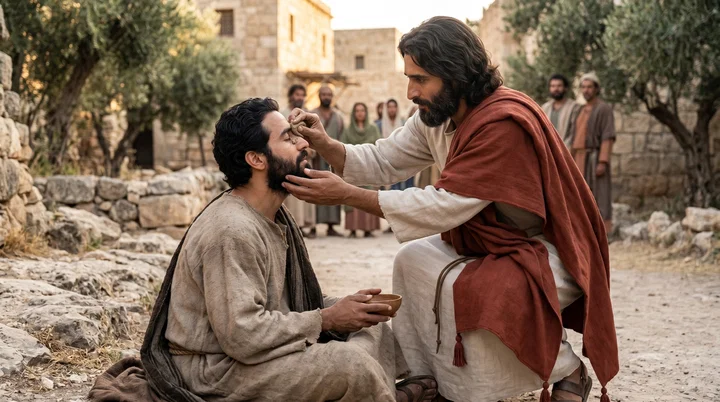
And as Jesus passed by, he saw a man which was blind from his birth.
And as Jesus passed by, he saw a man who was blind from his birth.
Revised Version, American Standard Version
And as he passed by, he saw a man blind from his birth.
And passing by, he saw a man blind from birth,
And as he passed on, he saw a man blind from birth.
And, passing along, he saw a man, blind from birth.
Berean Standard Bible, Majority Standard Bible
Now as Jesus was passing by, He saw a man blind from birth,
As he passed by, he saw a man blind from birth.
And when he went on his way, he saw a man blind from birth.
And as Iesus passed by, he sawe a man which was blinde from his birth.
Douay-Rheims (Challoner revision)
And Jesus passing by, saw a man, who was blind from his birth:
Pictures
Cross-references 20 of 22
- John 9:6-7
When he had thus spoken, he spat on the ground, and made clay of the spittle, and he anointed the eyes of the blind man with the clay,
Jesus sends the man born blind to wash at Siloam, and he returns seeing.
- John 9:25
He answered and said, Whether he be a sinner or no, I know not: one thing I know, that, whereas I was blind, now I see.
The healed man testifies that he was blind and now sees.
- John 9:14
And it was the sabbath day when Jesus made the clay, and opened his eyes.
Jesus healed the blind man on the Sabbath, dividing the Pharisees.
- John 9:35-38
Jesus heard that they had cast him out; and when he had found him, he said unto him, Dost thou believe on the Son of God?
Jesus finds the healed man after his expulsion, and the man believes and worships him.
- John 9:34
They answered and said unto him, Thou wast altogether born in sins, and dost thou teach us? And they cast him out.
The healed man is cast out after defending Jesus.
- John 8:59
Then took they up stones to cast at him: but Jesus hid himself, and went out of the temple, going through the midst of them, and so passed by.
After leaving the hostile crowd, Jesus passes by and sees the blind man.
- John 9:8-11
The neighbours therefore, and they which before had seen him that he was blind, said, Is not this he that sat and begged?
The healed man identifies himself and tells how he received sight.
- John 9:32
Since the world began was it not heard that any man opened the eyes of one that was born blind.
The healed man says no one had ever opened the eyes of someone born blind.
- John 9:21
But by what means he now seeth, we know not; or who hath opened his eyes, we know not: he is of age; ask him: he shall speak for himself.
parents feared excommunication and would not speak
- Mark 8:22-25
And he cometh to Bethsaida; and they bring a blind man unto him, and besought him to touch him.
Jesus heals a blind man and restores his sight.
- Matthew 9:27-31
And when Jesus departed thence, two blind men followed him, crying, and saying, Thou Son of David, have mercy on us.
Jesus heals two blind men and restores their sight.
- Matthew 12:22
Then was brought unto him one possessed with a devil, blind, and dumb: and he healed him, insomuch that the blind and dumb both spake and saw.
Jesus heals a blind man.
- Isaiah 42:7
To open the blind eyes, to bring out the prisoners from the prison, and them that sit in darkness out of the prison house.
The prophecy foretells opening blind eyes.
- Luke 4:18
The Spirit of the Lord is upon me, because he hath anointed me to preach the gospel to the poor; he hath sent me to heal the brokenhearted, to preach deliverance to the captives, and recovering of sight to the blind, to set at liberty them that are bruised,
Jesus’ work includes giving sight to the blind.
- John 9:24
Then again called they the man that was blind, and said unto him, Give God the praise: we know that this man is a sinner.
The Pharisees pressured the healed man to call Jesus a sinner.
- Luke 18:35-43
And it came to pass, that as he was come nigh unto Jericho, a certain blind man sat by the way side begging:
Jesus heals a blind man near Jericho.
- Matthew 20:30-33
And, behold, two blind men sitting by the way side, when they heard that Jesus passed by, cried out, saying, Have mercy on us, O Lord, thou Son of David.
Jesus responds to blind men who ask him to open their eyes.
- John 9:38
And he said, Lord, I believe. And he worshipped him.
The healed blind man worships Jesus after coming to believe.
- John 9:33
If this man were not of God, he could do nothing.
The healed man defends Jesus as being of God.
- Matthew 11:5
The blind receive their sight, and the lame walk, the lepers are cleansed, and the deaf hear, the dead are raised up, and the poor have the gospel preached to them.
The blind receive sight among the signs of Jesus’ work.
Commentary
Each commentary is drawn from primary sources: the writings of Ellen G. White and Adventist pioneers and periodicals. Each commentary is separate. Its own words are not a quotation; follow the references to read the source passages.
Ellen G. White
10 sources
This verse belongs with John 8:12-59 and the rest of John 9 in the account of Jesus as the Light of Life.DA 463 It takes place as Jesus left the temple and passed through the multitude and onward while escaping those enraged by His declaration of His existence before Abraham and seeking to stone Him, and in that passing He saw a man blind from youth and healed him.14MR 22.5Lt 119, 1895, par. 12–18 As He passed through their very midst, He veiled Himself so that His pursuers should not see Him.14MR 22.5
The verse shows Jesus seeing and noticing a man who had been blind from his birth as He passed by, illustrating that Christ sees people in affliction and recognizes their possibilities and need for mercy.DA 470.1–471.3DA 471.4–6ST Jul 19, 1905 The disciples' question about whether the man or his parents had sinned reflects the mistaken belief that affliction proves personal guilt, a belief also shown when suffering people were blamed for their afflictions as the result of their sins and of divine judgment, which added to their suffering.DA 470.1–471.33T 87.1–88.3 Jesus rejects that blame and explains that the man's condition would become an occasion for God's works to be shown.DA 470.1–471.3
With compassion Jesus restored the man's sight by His own healing power, not by the clay or the pool, and the restoration was convincing evidence of His divine mission showing that His work came from God.DA 470.1–471.3ST May 8, 1907ST Nov 20, 1893Lt 20, 1895, par. 1 Because the healing was performed on the Sabbath, it became the subject of dispute.DA 471.4–6 The healed man testified plainly to what had been done for him, while jealousy, prejudice and unbelief led his opponents to reject the evidence, accuse Jesus and try to silence the man, and by refusing spiritual light they became more blind.
The man did not know who Jesus was when he was helped, and only after Jesus revealed Himself as the Son of God did the man recognize Him and worship Him.Lt 20, 1895, par. 1 The man represents the lost sinner whom the Shepherd seeks to save, showing that as the eternal One Jesus recognized and valued him and seeks to save with compassion people whom the self-righteous treat with sneers, hatred and contempt, in contrast between such contempt and Christ's mercy toward those in need.ST May 8, 1907ST Nov 20, 1893Lt 119, 1895, par. 12–18
Sources
Pioneers and periodicals
67 sources
As Jesus was leaving the temple at Jerusalem during the Feast of Tabernacles, he saw a poor beggar who had been blind from his birth and had never seen light, nature, or friends.ST Mar 8, 1905ST Aug 8, 1900ST Jun 24, 1886ST Dec 22, 1881ST Aug 14, 1901 His lifelong blindness was not a punishment for his own sin or his parents' sin, but was allowed in providence so that the works and glory of God might be made manifest in him.ST Oct 23, 1893ST Aug 8, 1900RH Jan 30, 1872ST Jun 24, 1886ST May 16, 1911 Moved with compassion, Jesus restored his sight by a creative act of divine power, anointing his eyes with clay and sending him to wash in Siloam, which he obeyed in faith though there was no healing virtue in the clay or water itself.ST Oct 23, 1893ST Aug 8, 1900RH Feb 11, 1862 He did this merciful work on the Sabbath, which in no way broke God's law but honored its Lord, deliberately correcting narrow rabbinical traditions and provoking the Pharisees to call him a Sabbath-breaker and persecute him and those who confessed him.ST Aug 8, 1900RH Feb 11, 1862ST Jul 8, 1897 The man who had been blind now saw, testified fearlessly that he was blind and now sees, refused to deny his Healer before threats and excommunication, and worshiped Christ with opened spiritual eyes, while the Pharisees who rejected the evidence remained in spiritual blindness.ST Jun 14, 1905RH Mar 30, 1876ST May 16, 1911ST May 17, 1905
Time, Place, and Person
As Jesus passed by he saw a man blind from birth at Jerusalem during the Feast of Tabernacles.ST Mar 8, 1905ST Aug 8, 1900ST Feb 22, 1899 He met him as he was leaving the Jews who had opposed him, passing by them after he was driven from them and in doing so finding the blind beggar and giving him light.ST Nov 26, 1896ST Nov 26, 1896 The verse belongs closely to the close of chapter 8 and must not be separated from it.ST Nov 26, 1896
The man was a beggar, commonly at the temple entrance or on the temple mount where he begged, in the porch of the temple, beside the way.ST Jun 24, 1886ST Aug 14, 1901RH Mar 30, 1876 He was poor, unlearned, and humbly born.RH Mar 30, 1876ST May 16, 1911 From his birth he had never seen the light of day or the beauties of nature, never looked on his friends nor seen the beauties of the Creator's works spread out around him.RH Mar 30, 1876ST May 16, 1911 He had never seen Jesus but had heard his name.ST Dec 22, 1881
He is the only person in the Gospel accounts of Jesus' healings specifically said to have been born blind, and among the blind men Christ healed he alone is described as having been born blind.ST Mar 8, 1905ST Mar 15, 1905 Among the six New Testament miracles involving blindness, this is the only case identified as congenital blindness.ST Feb 22, 1899 His lifelong, congenital blindness was then considered beyond human skill except in cases of congenital cataract, with no one ever known to open the eyes of someone born blind, and the rarity of such blindness in the East made his condition especially notable.ST Feb 11, 1886ST Feb 22, 1899ST Nov 26, 1896
As Jesus passed by with his disciples he saw the man.ST Aug 8, 1900ST May 17, 1905ST Nov 11, 1897 The verse thus introduces the healing and the disciples' question about whether the man or his parents had sinned as the cause of his blindness.ST Aug 8, 1900ST Jun 24, 1886ST Aug 8, 1900
Cause and Purpose of Affliction
The man’s blindness from birth was not caused by any sin of his own or by any sin of his parents, and it is not proof that he or his parents had committed some special or particular sin.ST Aug 8, 1900RH Jan 30, 1872ST May 17, 1905ST Oct 2, 1901ST Jul 9, 1894 It was not a judicial punishment inflicted by God upon them, nor a sign of His displeasure against them.ST May 17, 1905ST Jul 9, 1894 Suffering may at times result from wrongdoing, but it is not necessarily a sentence imposed for personal sin.ST May 17, 1905 Calamity is not necessarily punishment for a specific sin.ST Jul 9, 1894
The disciples’ question whether he or his parents had sinned reflected the common belief that affliction is smitten by God as punishment for personal or parental guilt, even to the point of speculating about sin committed before birth.ST Jun 24, 1886ST Jul 4, 1905RH Sep 25, 1913 Many Jews took marks upon the body as proofs of sin in the soul.ST Dec 22, 1881 The Pharisees held the doctrine of transmigration of souls, a belief general also among Greeks and Asiatics, with the Pythagoreans teaching that souls were sent into other bodies to punish sin committed in a pre-existent state, and on that ground the question arose whether he had sinned before birth and was punished with blindness in this body or whether his parents had sinned and were plagued in their offspring.ST Dec 22, 1881 Jesus did not stop to correct every mistaken popular belief, as in the disciples’ assumption of antenatal sin.RH Sep 25, 1913
All disease and suffering are the result of sin in a general way, yet great suffering does not mean great personal sin.ST Oct 23, 1893 Affliction and death can sometimes follow as the consequence of sin, whether a person’s own or an ancestor’s. Suffering does not atone for sin, but it may lead a person to Christ, who can heal both body and soul.ST Mar 8, 1899 God can be honored and glorified by healing those who trust in Him from its consequences.ST May 16, 1911
His blindness came in the ordinary course of divine providence, appointed in the ordering of the Lord and allowed so that the works of God and His glory would be made manifest in him.RH Jan 30, 1872ST Jun 24, 1886ST Dec 22, 1881 It would now become the instrument of salvation to his soul, edification to others, and glory to God.ST Dec 22, 1881 That glory may appear not only through healing but also through growth of character amid hardship, and even suffering could make an otherwise obscure person a co-worker with God.ST Oct 2, 1901 What was a deplored calamity was turned into a joyful day that made up for all he had suffered, though many such sorrows look dark until God explains them and their purpose will be made plain in the day of judgment.RH Jan 30, 1872
Jesus Seeing in Compassion
As He passed by He saw a man blind from birth whom others would have passed by, recognizing in affliction both need and possibility and need for mercy.ST Jul 19, 1905ST Aug 14, 1901 He sees those who cannot see Him, and His seeing reaches them in trial and discouragement.ST Aug 14, 1901
He noticed the beggar even while leaving the temple with an angry mob nearby and His disciples hurriedly fleeing, and even while they were distracted by a question about his condition.ST Aug 14, 1901ST Aug 14, 1901 To see him was to see work to do, a sacred opportunity brought by divine providence calling for personal service and bringing the needy one to Jesus.ST Aug 28, 1901ST Aug 14, 1901 He stopped and gave help without delay, though the man's life was not in danger and the man had not expected healing.ST Nov 11, 1897ST Aug 14, 1901 He acted knowing that healing would bring opposition and accusation, because to pass by might have lost the miracle and its lessons.ST Nov 11, 1897ST Aug 14, 1901ST Aug 21, 1901 Having His mind and anointed eyes means discerning day by day at their dawn the opportunities heaven designs, embracing them early for the greatest good and for development of mind, body, and soul instead of letting harvest pass.ST Aug 21, 1901
Moved with compassion He restored sight, joining temple worship with helpful ministry to the blind beggar.RH Feb 11, 1862 The man was a lost sinner valued by the Shepherd, while the self-righteous Pharisees treated him with sneers and hatred and contempt.ST May 8, 1907ST Nov 20, 1893 Special attention to one regarded as hopeless shows serving those in greatest need and bringing hope to the hopeless.ST May 8, 1907ST Nov 20, 1893RH Nov 23, 1911 By mercy He gave the helpless man sight to see his mother whose loving care had watched over him while blind.RH Jun 13, 1871
When the healed man was cast out and persecuted for confessing his Healer, Jesus sought him out and found him.ST May 16, 1911RH Nov 13, 1860 He came to him with comforting words and with the lowliness and personal attention of a humble teacher.ST May 16, 1911RH Nov 13, 1860 Found thus, the man was taught privately the highest truths of His Messiahship, discerning spiritual truth while those who closed their eyes to God's Word remained blind.ST May 16, 1911RH Nov 13, 1860
Healing by Divine Power
Jesus moistened clay with spittle, anointed the blind man's eyes, and sent him to wash in the pool of Siloam, and he washed and received sight.ST Aug 8, 1900ST Nov 11, 1897RH May 5, 1874ST Aug 12, 1889 There was no healing virtue in the clay, the pool, or the water, but virtue and power were in Christ and his word.ST Oct 23, 1893 The man received sight by depending wholly on Jesus and obeying his command to go and wash, through the obedience of faith.ST Aug 12, 1889 The use of a physical agency does not lessen the divine character of the cure and shows that employing means to combat disease is right.ST Oct 23, 1893RH May 5, 1874
His condition was beyond human skill, a work transcending all but divine power, never before heard of for one born blind.RH Jan 30, 1872ST Feb 11, 1886 Giving sight to one born blind was a creative act and re-creation that demonstrated divine power, character, and creative power above physical objects.ST May 22, 1901 It showed Jesus is literally the light of the world whose word is a lamp and light, taking human infirmities and bearing sicknesses to destroy sin with all its physical as well as moral effects.ST Nov 11, 1897ST May 22, 1901 All healing, whether through physical laws or miracle, comes from God because only divine power can create.ST May 22, 1901
The opening of his eyes proved the power of God and that Jesus was His Son, giving convincing evidence of his divine mission, benevolence, and mercy as the promised Deliverer and his mighty works.RH Jan 30, 1872ST Feb 22, 1899RH Dec 8, 1859 That restoration of sight to the blind is also associated with those who gathered around the cross.RH Aug 21, 1860 His opponents ask whether a devil could open the eyes of the blind.ST Dec 17, 1896
The healing shows Christ's power to restore sight and to forgive sins, leading the healed man to believe and worship him and to be trusted rather than any other support.ST Apr 10, 1893RH Apr 7, 1903ST Sep 28, 1904ST Aug 20, 1902 The story inspired a blind woman to pray to Jesus, follow the use of clay and washing, and trust him to heal and forgive her.ST Apr 10, 1893ST Aug 20, 1902 Another woman who had lost sight washed, received sight, gave thanks, and believed.RH Apr 7, 1903 It offers a blind suffering child hope that the Saviour who healed the blind beggar cares for him too, though it does not promise restoration of sight in every case now.ST Apr 10, 1893RH Apr 7, 1903
The miracle gives hope and assurance to doubters, for as the man knew that he could see, those who receive spiritual sight and acceptance by Christ can know it.ST Nov 11, 1913RH Nov 9, 1911 His lifelong blindness illustrates humanity's spiritual blindness from birth as a result of sin, prompting comparison with the miracle of conversion and the new birth.ST Jun 13, 1900ST Nov 11, 1913 Faith opening blind eyes is applied to faith overcoming ignorance.
Sabbath Mercy and Opposition
The healing that follows was done on the Sabbath, one of seven recorded miracles performed on that day.ST Aug 8, 1900ST Nov 11, 1897ST May 19, 1909ST Apr 14, 1881 It is the second of three miracles around which the controversy with the Jews gathered over what constitutes proper Sabbath-keeping.ST Aug 20, 1896 The Sabbath healing stirred strife and led the Pharisees to dispute whether Jesus was from God.ST Aug 8, 1900ST Nov 11, 1897
It was a merciful act alike worthy of the Sabbath and its Lord, fitting and proper to that day.RH Feb 11, 1862RH May 5, 1874ST Sep 18, 1884 As a work of necessity and mercy it was more important than all narrow human traditions, relieving suffering and honoring God rather than violating His law.RH May 5, 1874ST Mar 4, 1889 In healing on the Sabbath nothing of the sanctity of the seventh day was removed, not one jot or tittle of the law. Only enemies of Christ then and opponents of the Sabbath now would call it a violation.RH Feb 11, 1862 The law commands abstaining from servile work of grasping wealth by trading and worldly business, while calling for reflection and beneficial priestly help to neighbors.ST Mar 4, 1889ST Sep 18, 1884
Jesus deliberately chose to do this merciful work on the Sabbath to correct false rabbinical notions and to exalt true Sabbath-keeping.ST Jul 8, 1897ST Sep 15, 1909 Human traditions had loaded down God's law and turned the Sabbath from a blessing into a curse, and He purposed to settle what is lawful on the Sabbath and show that doing good belongs to its true observance.ST Sep 15, 1909 By healing He revealed God's idea of the Sabbath as holy, honorable, and a delight.ST Jul 8, 1897ST May 22, 1901 The act fulfilled a double purpose of mercy, opening blind eyes and rebuking superstitious exactions that made God's holy day a burden.ST May 22, 1901
The Sabbath-day miracle drew people to believe and come to Him, while provoking opposition. The Pharisees judged Him not of God, a sinner and Sabbath-breaker according to their own rules, though He acted according to God's understanding of the commandment.ST Jul 8, 1897 When no other objection could be made He was persecuted for healing on the Sabbath, for persecution is the final argument of truth's opponents.ST Mar 15, 1905 The rebuke intensified bitter hatred and brought persecution not only on Jesus but on anyone confessing Him, with expulsion from the synagogue used against believers.RH Oct 8, 1908ST May 22, 1901 This plain teaching of Sabbath truth brought bitter opposition and was counted as the reason He should be put to death, so that from that work the shadow of the cross fell across His path.ST Sep 15, 1909
Witness and Spiritual Sight
The sight he received gave him firsthand ground to testify that the healing was divine, in the simple fact he was blind and now sees, which his opposers could not overturn.ST Jun 14, 1905 He would not deny his own experience nor condemn Jesus as a blasphemer, but held fast that a prophet had touched his sightless eyes with clay and made him see.ST Jun 14, 1905RH Mar 30, 1876ST May 22, 1901 He stood fearless before the scowling rabbis of the Sanhedrin, unmoved by questioning, threats, fury, sneers at Jesus and boasts of Moses.RH Mar 30, 1876ST May 22, 1901 He defended Jesus as from God and braved excommunication rather than yield.ST May 22, 1901
His parents, from fear of being disfellowshipped, would only admit he was their son born blind and left him to speak for himself.ST Nov 19, 1896 To acknowledge Christ and His power is a duty on which eternal life depends, and to refuse to confess Him for fear of displeasing religious leaders and being put out of the synagogue is to reject Him for fear of men.ST Apr 21, 1881ST Nov 19, 1896 So those spiritually born blind on the fourth commandment until the commandments of God and the faith of Jesus come in the message of the third angel can, when they receive Sabbath light, testify from experience touching the Sabbath question.ST Apr 21, 1881 They acknowledge Christ by acknowledging present truth, cut loose from opposing influences and timid family ties, lean upon Christ for support, and go on their way rejoicing to suffer shame for His name though cast out.ST Apr 21, 1881ST Nov 19, 1896
His healing was both physical and spiritual, for his bodily blindness was removed and his spiritual eyes were opened so that he saw Christ, discerned spiritual truth that condemned the proud, and worshiped Him.ST May 16, 1911ST May 16, 1911 He represents the true follower who with undaunted courage confesses his Healer before frowning Pharisees even at the cost of excommunication.ST May 16, 1911ST May 16, 1911ST Oct 2, 1901 Cast out of the synagogue for his belief in Christ and for refusing to submit to its authority, he became a faithful follower and a missionary to the poor.ST Jun 14, 1905ST Oct 2, 1901ST Oct 18, 1905
The healing applies to spiritual blindness, for sin, greed, pleasure, and ambition keep people from seeing the beauty of God's works and the beauty of holiness.ST May 17, 1905 Heart and soul need Christ's touch to recognize the beauty of God's righteousness and Christ's humble, self-giving life, and Christ has creative power to give that sight.ST May 17, 1905 The Pharisees who closed their eyes to God's Word were as blind spiritually as he had been physically.ST May 16, 1911 Their jealousy, prejudice, and unbelief in rejecting the evidence, accusing Jesus, and trying to silence the man made them more blind, while his sight and growing discernment of spiritual truth exposed their pride and opposition.ST May 16, 1911
Seeing a person in need calls for personal service and for bringing that person to Jesus.ST May 17, 1905ST Aug 28, 1901 The man's need gave opportunity for God's works to be made visible through healing and through compassionate service to those who suffer, so that even an otherwise obscure sufferer may become a co-worker with God.ST May 17, 1905ST Oct 2, 1901 The lesson is to come to Christ for life, to have eyes opened to God's truths, to forsake all that would keep one from the kingdom, and to know duty, for Christ is the Way, the Truth, and the Life and His Word is the unfailing Guide-Book to fearing God and keeping His commandments.ST May 16, 1911 With the mind of Christ and anointed eyes one sees day by day the opportunities heaven designs at their dawn, embracing them early for the greatest good of others and for the development of mind, body, and soul instead of letting the harvest pass and the opportunities be lost.ST Aug 28, 1901ST Aug 21, 1901
Sources