Jonah 1:13
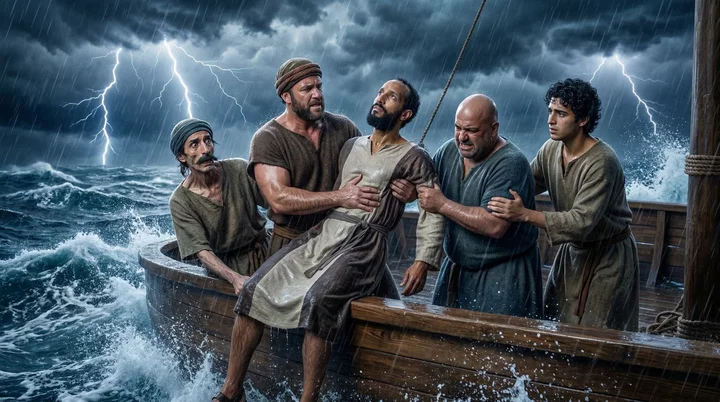
Nevertheless the men rowed hard to bring it to the land; but they could not: for the sea wrought, and was tempestuous against them.
Translations
Nevertheless the men rowed hard to bring it to the land; but they could not: for the sea worked, and was tempestuous against them.
King James Version, KJV Cambridge Paragraph Bible, Webster Bible
Nevertheless the men rowed hard to bring it to the land; but they could not: for the sea wrought, and was tempestuous against them.
Revised Version, American Standard Version
Nevertheless the men rowed hard to get them back to the land; but they could not: for the sea grew more and more tempestuous against them.
And the men row to turn back unto the dry land, and are not able, for the sea is more and more tempestuous against them.
But the men rowed hard to regain the land; but they could not; for the sea grew more and more tempestuous against them.
Nevertheless the men, wrought hard, to bring it back unto the land, but could not,—for, the sea, was raging over them more and more.
Berean Standard Bible, Majority Standard Bible
Nevertheless, the men rowed hard to get back to dry land, but they could not, for the sea was raging against them more and more.
Nevertheless the men rowed hard to get them back to the land; but they could not, for the sea grew more and more stormy against them.
And the men were working hard to get back to the land, but they were not able to do so: for the sea got rougher and rougher against them.
Neuerthelesse, the men rowed to bring it to the lande, but they coulde not: for the sea wrought, and was troublous against them.
Douay-Rheims (Challoner revision)
And the men rowed hard to return to land, but they were not able: because the sea tossed and swelled upon them.
Pictures
Cross-references
- Jonah 1:17
Now the LORD had prepared a great fish to swallow up Jonah. And Jonah was in the belly of the fish three days and three nights.
The Lord prepares the fish to preserve and deliver Jonah after he is thrown overboard.
- Jonah 1:4
But the LORD sent out a great wind into the sea, and there was a mighty tempest in the sea, so that the ship was like to be broken.
The storm threatens the ship and its crew.
- Jonah 1:7
And they said every one to his fellow, Come, and let us cast lots, that we may know for whose cause this evil is upon us. So they cast lots, and the lot fell upon Jonah.
The lot identifies Jonah as responsible for the storm.
- Psalms 107:25
For he commandeth, and raiseth the stormy wind, which lifteth up the waves thereof.
Both describe a stormy sea resisting human efforts.
- Jonah 1:5
Then the mariners were afraid, and cried every man unto his god, and cast forth the wares that were in the ship into the sea, to lighten it of them. But Jonah was gone down into the sides of the ship; and he lay, and was fast asleep.
The sailors pray during the storm.
- Matthew 8:24
And, behold, there arose a great tempest in the sea, insomuch that the ship was covered with the waves: but he was asleep.
Both describe violent sea storms that overwhelm those aboard.
Commentary
Each commentary is drawn from primary sources: the writings of Ellen G. White and Adventist pioneers and periodicals. Each commentary is separate. Its own words are not a quotation; follow the references to read the source passages.
Ellen G. White
3 sources
The sailors exerted themselves strenuously at the oars to drive the ship toward shore rather than throw Jonah into the sea.RH Dec 4, 1913PK 267.3–268.4RH Dec 4, 1913 They rowed with all their strength and in desperation to reach land.RH Dec 4, 1913PK 267.3–268.4RH Dec 4, 1913 Yet they could not gain the shore, for the sea kept working and raging tempestuously against them.RH Dec 4, 1913PK 267.3–268.4RH Dec 4, 1913 The violence of the storm rendered their efforts unsuccessful and impossible to overcome.RH Dec 4, 1913PK 267.3–268.4RH Dec 4, 1913
Sources
Pioneers and periodicals
19 sources
The sailors strained with all their strength to row the ship to shore instead of throwing Jonah overboard, but they could make no headway because the sea raged tempestuously against them and only grew stronger.RH Dec 4, 1913RH Dec 4, 1913ST Sep 9, 1913 This came after the lot had exposed Jonah and he had frankly owned himself the cause of the storm and bidden them cast him into the sea, so their struggle to save themselves without obeying him proved futile until at last at his own desire they cast him in.ST Sep 9, 1913ST Oct 29, 1885ST Dec 10, 1894 They rowed all the harder out of admiration for his willing self-sacrifice and reluctance to take his life, yet God overruled the angry waves against them until Jonah was cast overboard, and the failure drove them to pray to Jehovah not to lay his guilt upon them.ST Dec 11, 1901ST Mar 23, 1904RH May 9, 1912 His flight from the duty of warning Nineveh thus brought mortal peril on all with him, proving that trouble cannot be escaped by running from the post assigned by God's providence but must be manfully met and overcome.RH Sep 17, 1901RH Dec 3, 1867 The account in Jonah 1:1-17 is literal history to be believed and not allegory to be ridiculed, its truthfulness having been affirmed by Christ and the apostles, so that to dismiss it is practical infidelity under the name of higher criticism.ST May 6, 1897ST Mar 9, 1888ST Jan 30, 1901
Sailors' Failed Rowing Effort
The men rowed hard with all their strength to bring the ship to land rather than throw Jonah into the sea, but they could not reach land because the sea raged and was tempestuous against them.RH Dec 4, 1913RH Dec 4, 1913ST Oct 29, 1885ST Sep 17, 1896ST Mar 23, 1904 The storm was too strong for them and grew stronger against them, so that their hard rowing could not overcome the raging sea.RH Dec 4, 1913ST Sep 9, 1913ST Oct 29, 1885ST Sep 17, 1896ST Mar 23, 1904 Their attempt to save themselves without casting him overboard was futile.ST Oct 29, 1885
This came after the decision by lot exposed Jonah, when he admitted he was at fault for the storm and told the sailors to throw him overboard.ST Sep 9, 1913ST Sep 3, 1896 After failing to bring the ship to land they eventually had to follow his instruction and at his own desire cast him into the sea.ST Oct 29, 1885ST Dec 10, 1894RH Sep 17, 1901 God had seen the rebellion from its first beginning and had prepared the fish beforehand and had it at hand in the tempest to catch him when the men cast him in, thus preserving the rebellious prophet in mercy as a lesson of mercy for Jonah and for all mankind.ST Dec 10, 1894 The sailors' struggle to save themselves failed, showing the danger his disobedience brought upon those with him.RH Sep 17, 1901
They rowed all the harder because they were impressed by the greatness of soul in his willing self-sacrifice after he frankly told them he was to blame.ST Dec 11, 1901 They honestly and reluctantly made a strong effort against the angry waves to save Jonah and bring him to shore.ST Dec 11, 1901ST Mar 23, 1904RH May 9, 1912 But God overruled the storm and prevented their effort from succeeding until Jonah was cast in.RH May 9, 1912 The experience led them to pray to Jehovah and to ask the Lord who made the sea not to hold Jonah's sin against them.ST Dec 11, 1901ST Mar 23, 1904
The verse belongs to a violent, mighty tempest with a great wind sent by the Lord on the sea off the coast of Joppa in the Mediterranean during Jonah's flight from the duty God gave him to warn Nineveh.RH Aug 29, 1871ST Feb 2, 1915 The storm threatened the lives of the crew, who were eventually compelled to throw Jonah into the sea.ST Feb 2, 1915 Such great winds and mighty tempests still arise there today, so that sea with the Dead Sea and the Sea of Galilee makes the seas of the Holy Land witnesses to Bible truth.RH Aug 29, 1871
Lessons and Historicity Affirmed
Jonah's flight from the duty to warn Nineveh brought mortal danger upon all who sailed with him, for the storm that endangered the ship and the sailors' failed struggle to save themselves show the peril his disobedience created for others.RH Sep 17, 1901 It is impossible to escape trouble by running away from duty, and his experiment in fleeing ended where the course of all who imitate him will end.RH Dec 3, 1867 The difficulties and trials of the post assigned by God's providence must therefore be manfully met and overcome instead of fled.RH Dec 3, 1867 Ministers likewise face the same temptation when they try to avoid confronting sin and calling people to repentance.
The rowing that could not bring the ship to land exposes Jonah choosing his own way instead of walking in God's way, and that self-chosen path sent him overboard into the raging sea.RH Jan 27, 1874 The real conflict of life is between following the path that seems more pleasant to self, whose end is ruin, and obeying and trusting God step by step.RH Jan 27, 1874 His trouble at sea proves the ruin of wilfulness, while his afterward taking God's way that led him to Nineveh on a mission of love proves the safety and purpose found in obedient trust.RH Jan 27, 1874
The tempestuous sea and the imperiled ship became the trial that proved his heart was true toward God despite disobedience.ST Feb 4, 1903 He had petulantly refused to go to Nineveh and had run away without denying God, yet when the ship was imperiled on his account he came forward nobly, acknowledged his fault, and told the shipmen to cast him overboard, facing what to him meant certain death bravely.ST Feb 4, 1903 His faithfulness in that test where great moral principle was involved showed his heart was perfect toward God, and God showed Himself strong on his behalf.ST Feb 4, 1903 God had seen the rebellion from its first beginning and had prepared the fish beforehand and had it at hand in the tempest to catch him when at his own desire the men cast him in, thus preserving the rebellious prophet in mercy as a lesson of mercy for Jonah and for all mankind.ST Feb 4, 1903ST Dec 10, 1894
The rowing against the storm belongs to the account in Jonah 1:1-17 that is literal true history to be believed and a true Old Testament narrative not to be ridiculed, rejected, or called an allegory.ST May 6, 1897ST Mar 9, 1888ST Jan 30, 1901 Its truthfulness and importance were affirmed by Christ and the apostles.ST Mar 9, 1888 To dismiss it as an absurd and idiotic story a hundred years behind the times in the century of Humboldt, Darwin, Huxley, Spencer, and Haeckel puts self upon the throne invested with all needful knowledge and wisdom and exalts self rather than God, which is the characteristic of heathenism and all false religions.ST May 6, 1897 Denial of it by professedly orthodox ministers and theological teachers who call Jonah an allegory, just as they call Genesis a myth and question the miracles of the Son of God, is practical infidelity under the name of new learning and higher criticism and shows loss of faith in the whole Bible.ST Jan 30, 1901
Sources