Jonah 1:4
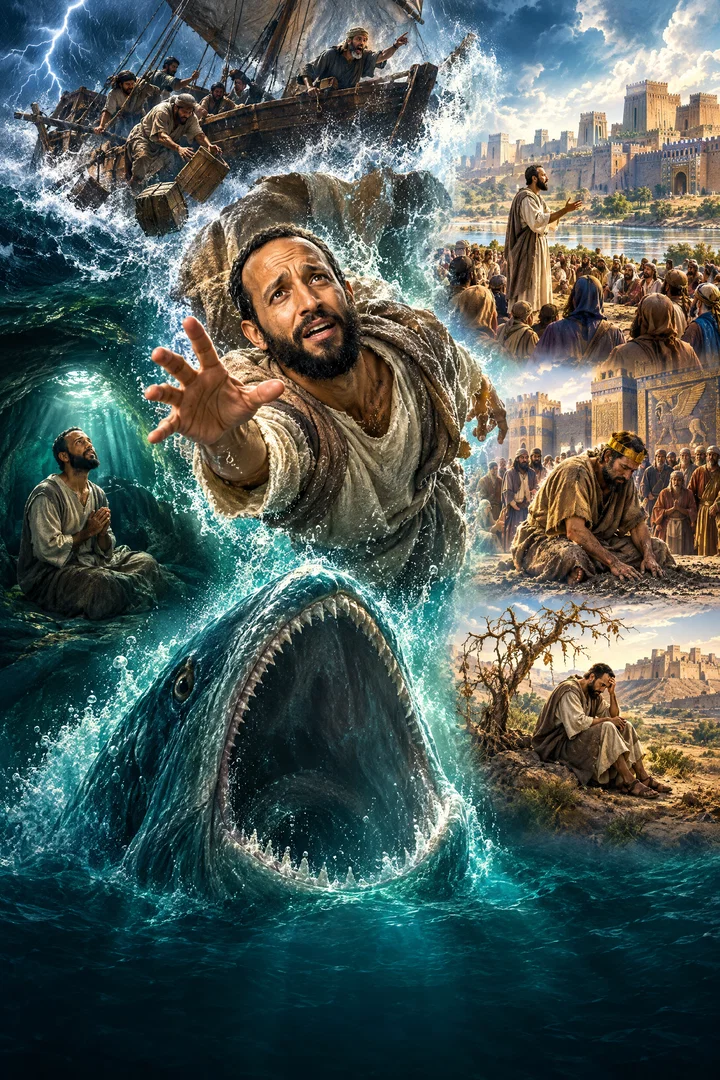
But the LORD sent out a great wind into the sea, and there was a mighty tempest in the sea, so that the ship was like to be broken.
Translations
American King James Version, King James Version, Revised Version
But the LORD sent out a great wind into the sea, and there was a mighty tempest in the sea, so that the ship was like to be broken.
But the Lord sent out a great wind into the sea, and there was a mighty tempest in the sea, so that the ship was like to be broken.
But the LORD sent out a great wind into the sea, and there was a mighty tempest in the sea, so that the ship was in danger of being broken.
But Jehovah sent out a great wind upon the sea, and there was a mighty tempest on the sea, so that the ship was like to be broken.
And Jehovah hath cast a great wind on the sea, and there is a great tempest in the sea, and the ship hath reckoned to be broken;
But Jehovah sent out a great wind upon the sea, and there was a mighty tempest upon the sea, so that the ship was like to be broken.
But, Yahweh, hurled a great wind against the sea,—and, there arose a mighty tempest in the sea,—and, the ship, thought to be broken in pieces,
Berean Standard Bible, Majority Standard Bible
Then the LORD hurled a great wind upon the sea, and such a violent storm arose that the ship was in danger of breaking apart.
But the LORD sent out a great wind on the sea, and there was a mighty storm on the sea, so that the ship was likely to break up.
And the Lord sent out a great wind on to the sea and there was a violent storm in the sea, so that the ship seemed in danger of being broken.
But the Lord sent out a great winde into the sea, and there was a mightie tempest in the sea, so that the ship was like to be broken.
Douay-Rheims (Challoner revision)
But the Lord sent a great wind into the sea: and a great tempest was raised in the sea, and the ship was in danger to be broken.
Pictures
Cross-references
- Jonah 1:12
And he said unto them, Take me up, and cast me forth into the sea; so shall the sea be calm unto you: for I know that for my sake this great tempest is upon you.
Jonah identifies himself as the cause of the storm and tells the sailors to cast him overboard.
- Jonah 1:15
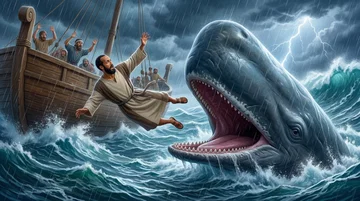
So they took up Jonah, and cast him forth into the sea: and the sea ceased from her raging.
The storm ceases after Jonah is thrown overboard.
- Psalms 107:25
For he commandeth, and raiseth the stormy wind, which lifteth up the waves thereof.
The Lord raises a storm at sea.
- Jonah 2:6-7
I went down to the bottoms of the mountains; the earth with her bars was about me for ever: yet hast thou brought up my life from corruption, O LORD my God.
Jonah remembers the Lord and is brought up from the depths.
- Matthew 8:24
And, behold, there arose a great tempest in the sea, insomuch that the ship was covered with the waves: but he was asleep.
same sudden Galilee storms terrifying fishermen
- Jonah 1:13
Nevertheless the men rowed hard to bring it to the land; but they could not: for the sea wrought, and was tempestuous against them.
The sailors row harder to save Jonah despite the raging sea.
- Mark 4:39
And he arose, and rebuked the wind, and said unto the sea, Peace, be still. And the wind ceased, and there was a great calm.
Jesus quiets the wind and sea.
- Exodus 14:21
And Moses stretched out his hand over the sea; and the LORD caused the sea to go back by a strong east wind all that night, and made the sea dry land, and the waters were divided.
both show the sea obeying its Master
- Luke 11:29-30
And when the people were gathered thick together, he began to say, This is an evil generation: they seek a sign; and there shall no sign be given it, but the sign of Jonas the prophet.
Christ identifies Jonah as a sign to his generation.
- Jonah 1:17
Now the LORD had prepared a great fish to swallow up Jonah. And Jonah was in the belly of the fish three days and three nights.
God provides a great fish to deliver Jonah after the storm and his descent into the sea.
- Jonah 1:8-10
Then said they unto him, Tell us, we pray thee, for whose cause this evil is upon us; What is thine occupation? and whence comest thou? what is thy country? and of what people art thou?
Jonah confesses flight from God of Israel
- Acts 27:14
But not long after there arose against it a tempestuous wind, called Euroclydon.
Paul’s ship was struck by a similar violent wind.
Commentary
Each commentary is drawn from primary sources: the writings of Ellen G. White and Adventist pioneers and periodicals. Each commentary is separate. Its own words are not a quotation; follow the references to read the source passages.
Ellen G. White
6 sources
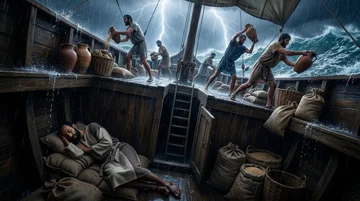
The Lord sent out a great wind that raised a violent storm at sea to interrupt Jonah's flight from Him and from the responsibility entrusted to him, directing it against the ship he had taken while fleeing his charge.PK 267.1–2RH Dec 4, 1913RH Dec 4, 1913 The storm was so severe that the ship was in danger of breaking apart.PK 267.1–2RH Dec 4, 1913RH Dec 4, 1913 It brought the sailors to fear for their lives, so that each cried to his own god and they threw cargo overboard to lighten the ship.RH Dec 4, 1913 Meanwhile Jonah slept below deck until the shipmaster roused him and urged him to call on his God in hope they might be spared.RH Dec 4, 1913
The storm began the sequence that led to Jonah being cast into the sea, and it ceased once he was thrown overboard.PK 268.6–269.1RH Dec 4, 1913 His subsequent peril in the deep and his deliverance show that salvation belongs to the Lord.PK 268.6–269.1 In providence God used this severe affliction as one of the trials through which He led Jonah, to teach him the lesson of obedience so he could fulfill God's purpose for the inhabitants of Nineveh.RH Oct 18, 1906RH Dec 4, 1913 The experience recorded in the first and second chapters of Jonah is worthy of most careful study.RH Oct 18, 1906
As part of the history of Nineveh, the verse teaches duty toward people who are ignorant and morally defiled and need help, a lesson that applies to service among the people of the Southern States.SW 112.1
Sources
Pioneers and periodicals
36 sources
The Lord sent a great wind over the sea that raised a violent tempest threatening to break apart the ship as Jonah fled by sea toward Tarshish from his command to warn Nineveh of coming judgment.ST Mar 8, 1883ST Sep 9, 1913ST Mar 11, 1897ST Mar 14, 1878ST Jan 30, 1901 The storm was a supernatural intervention to stop him from reaching Tarshish, to break up his enjoyment of his wrong course, and to teach him obedience and the seriousness of disobedience so he could fulfill God's purpose for Nineveh.RH Dec 4, 1913RH Oct 18, 1906ST Mar 11, 1897ST Mar 23, 1904RH Feb 10, 1903 It shows the Lord controls the winds and waves and can raise a tempest and quiet it again, and that Jonah could not escape God at sea because every creature is seen and known in God's universal presence.ST Nov 12, 1885ST Aug 27, 1896ST Dec 10, 1894 His careless disobedience put the whole ship's company in danger of sinking and a watery grave while he slept unaware below, teaching that the way of the transgressor is hard and it is impossible to escape trouble by running away from duty.ST Nov 12, 1885RH Apr 1, 1902ST Oct 29, 1885ST Mar 23, 1904RH Dec 3, 1867 The episode belongs to the inspired story and prophecy of Jonah which Christ accepted as true and connected with His death, and to reject it as impossible is to reject salvation itself, since there is no salvation without a miracle and no miracle greater than the new birth.ST Dec 11, 1893ST Mar 9, 1888ST May 6, 1897RH Feb 10, 1903
Wording and Historical Setting
The Hebrew word roo-agh in the verse means wind, for the Lord sent a great wind over the sea that produced a violent storm threatening to break the ship apart.ST Mar 11, 1897ST Mar 14, 1878ST Jan 30, 1901 That sending was a supernatural act of God and a divine intervention in Jonah's voyage.ST Mar 11, 1897ST Jan 30, 1901 It was an act beyond the ordinary course of nature, belonging to a miraculous account of being swallowed by a fish and cast out again alive.RH Feb 10, 1903
The voyage was Jonah's flight from the presence of the God of Israel toward Tarshish.ST Mar 18, 1913 It was attempted on the Mediterranean Sea from Joppa toward Tarshish.ST Feb 2, 1915 Off the coast of Joppa the Lord sent a great wind that raised a mighty tempest at that time, and the same kind of great winds and mighty tempests still arise there today, so the seas themselves confirm the truth of the account.RH Aug 29, 1871
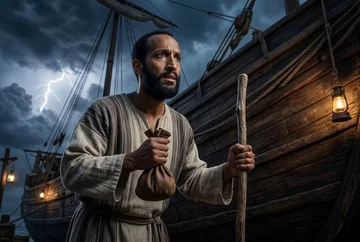
The setting was flight from the command to go to Nineveh.ST Sep 9, 1913 That command was to warn Nineveh of coming judgment, for God gives warning before bringing judgment.ST Mar 8, 1883 It was a hard mission to go to a strange people in the greatest city on earth at that time and rebuke them for their sins.ST Dec 15, 1909 Jonah's name means dove though his disposition was fiery, and outside his book he is known for predicting to Jeroboam II his victories over the Assyrians.ST Dec 15, 1909
The Lord sent the great storm and fierce tempest because Jonah was fleeing from Him and from his charge.RH Dec 4, 1913RH Dec 4, 1913 Black heavens and a mighty shrieking wind came upon the sea against that flight while the weary prophet slept below deck, and the ship was tossed about until close to breaking apart and in great danger of sinking.RH Dec 4, 1913ST Mar 23, 1904ST Mar 18, 1913 The experienced seamen bravely struggled to keep her afloat yet feared for their lives.RH Dec 4, 1913ST Mar 18, 1913ST Feb 2, 1915 Each cried to his own god, because they did not know the God of heaven, and they threw cargo and valuable merchandise overboard bale by bale to lighten the ship, but neither crying to gods nor lightening the ship availed as the storm increased in fury.RH Dec 4, 1913ST Mar 23, 1904ST Mar 18, 1913 The shipmaster held the evil to the sin of someone aboard, woke Jonah below, and urged him to call upon his God that they perish not.RH Dec 4, 1913ST Mar 18, 1913 The pressing peril then drove them to cast lots to find the cause, with the lot guided to fall on the son of Amittai.ST Mar 18, 1913ST Feb 2, 1915 The storm ceased after Jonah was thrown into the sea, followed by three days and nights in the fish.RH Dec 4, 1913
Divine Purpose and Lessons
The Lord was watching Jonah after he fled toward Tarshish from the duty given him to Nineveh, and while he lay asleep below feeling he had escaped his unwelcome mission the Lord sent a great wind that raised a mighty tempest to break up his enjoyment of his wrong course.RH Dec 4, 1913ST Mar 23, 1904RH Nov 25, 1858ST Sep 17, 1896 The tempest was sent to stop him and prevent him from reaching Tarshish, and in providence to teach him obedience and the seriousness of disobedience so he could fulfill God's purpose for Nineveh.RH Dec 4, 1913RH Oct 18, 1906ST Sep 17, 1896RH May 9, 1912 The experience recorded in the first and second chapters of Jonah is worthy of most careful study.RH Oct 18, 1906
The verse shows the Lord controls the winds and waves, that he can raise a tempest and quiet it again, and that those who oppose him face tempests on land or sea while those on his side are harmed or hindered by a tempest only as he directs it for their true good.ST Nov 12, 1885 The sea, though filled with ruined hopes and wrecked lives, still has a Master who preserves his servant alive in its depths.ST Aug 27, 1896 Jonah could not escape God by fleeing to the sea, for even there God's universal presence reached him and found him, a presence in which every creature is seen and known but which by itself is not a saving presence.ST Sep 11, 1893 God had prepared the fish beforehand and had it at hand in the tempest to catch Jonah when at his own desire the men of the ship cast him into the sea, and in mercy preserved the rebellious prophet for three days until he cried to heaven in faith and pleaded for mercy and for power to help and deliver him, as part of a lesson of mercy prepared for Jonah and for all mankind.ST Dec 10, 1894
The storm warns against defying the Lord and against doubting him, and illustrates that the way of the transgressor is hard.ST Nov 12, 1885ST Mar 23, 1904 It shows that it is impossible to escape trouble by running away from duty, for Jonah made the experiment of fleeing the post assigned to him by providence and the great wind and mighty tempest brought him into trouble where all his imitators will in the end find themselves.RH Dec 3, 1867 The lesson is that difficulties and trials belonging to one's assigned place should be manfully met and overcome instead of fled.RH Dec 3, 1867
Jonah's neglect of his commission and careless disobedience put himself and the whole ship's company in danger of destruction, bringing innocent people and heathen sailors into distress and peril of sinking and a watery grave.RH Apr 1, 1902ST Oct 29, 1885ST Mar 23, 1904RH Sep 17, 1901 Even as the danger grew near and the sailors were terrified, Jonah slept below deck unaware through the peril facing him.RH Apr 1, 1902RH Jul 1, 1862 Neither the sailors crying every one to his god nor throwing the cargo overboard to lighten the ship availed anything as the storm increased in fury.ST Mar 23, 1904
God used the flight and the danger at sea to confront Jonah and to turn people back to him, bringing the experienced sailors who feared for their lives to seek help and ultimately to salvation of souls.RH Mar 5, 1914RH Sep 17, 1901ST Sep 17, 1896 The trial was a test where great moral principles were involved, stripping away pride and irritation from one who had petulantly refused a great foreign mission that promised him no glory, though his character held elements the Spirit could mightily use.ST Dec 11, 1901ST Feb 4, 1903 When the danger came Jonah frankly owned he was at fault and nobly told the sailors to cast him overboard, facing what to him meant certain death bravely, which proved his heart was after all true and perfect toward God.ST Dec 11, 1901ST Feb 4, 1903 That self-sacrifice so impressed the ignorant heathen sailors that they strove all the harder to save him and were led to pray to the great Jehovah, showing that God shows himself strong on his behalf and gives victory over all that hides a noble soul to him who cooperates with divine power.ST Dec 11, 1901ST Feb 4, 1903
Truth and Present Warning
The storm belongs to the inspired and graphically told story and prophecy of Jonah, accepted as true and connected with death as the sign of Jonah.ST Dec 11, 1893ST Mar 9, 1888ST Nov 13, 1893 Its truthfulness and importance were affirmed by Christ and the apostles.ST Mar 9, 1888 It is to be believed rather than dismissed as an implausible story, or as absurd and idiotic.ST May 6, 1897ST Nov 13, 1893 To reject it is to put human knowledge and wisdom on the throne and to exalt self instead of God, which is heathenism and the character of all false religion.ST May 6, 1897
The verse reveals a God altogether unlike man who acts beyond the ordinary course of nature.RH Feb 10, 1903 That miraculous character is why it is rejected as impossible and unworthy of belief.RH Feb 10, 1903 Yet only a God altogether unlike man can save, and the miracles are the very parts of God's Word most needed for salvation.RH Feb 10, 1903 There can be no salvation without a miracle, and no miracle is greater than the miracle of the new birth.RH Feb 10, 1903 A god who cannot perform miracles cannot save, without faith in the miraculous power of God there can be no new birth, and every true prayer for salvation is a prayer for God to perform a miracle, so to reject this miracle is to reject salvation itself.RH Feb 10, 1903
To make the story a subject of jesting and comedy brings ridiculous associations to mind and diminishes reverence for Scripture.ST Oct 13, 1881 Choosing one's own way ends in being sent overboard into the raging sea, while taking God's way leads to Nineveh on a mission of love.RH Jan 27, 1874 The flight to Tarshish, going down into the vessel and sleeping, pictures theologians fleeing duty while Satan gathers followers through Spiritualism instead of warning people with the Bible.ST Nov 16, 1882 The sending of Jonah to warn Nineveh of coming judgment shows that God gives warning before bringing judgment.ST Mar 8, 1883
Sources