Jonah 1:14
Wherefore they cried unto the LORD, and said, We beseech thee, O LORD, we beseech thee, let us not perish for this man’s life, and lay not upon us innocent blood: for thou, O LORD, hast done as it pleased thee.
Translations
Why they cried to the LORD, and said, We beseech you, O LORD, we beseech you, let us not perish for this man’s life, and lay not on us innocent blood: for you, O LORD, have done as it pleased you.
King James Version, Revised Version
Wherefore they cried unto the LORD, and said, We beseech thee, O LORD, we beseech thee, let us not perish for this man’s life, and lay not upon us innocent blood: for thou, O LORD, hast done as it pleased thee.
Wherefore they cried unto the Lord, and said, We beseech thee, O Lord, we beseech thee, let us not perish for this man’s life, and lay not upon us innocent blood: for thou, O Lord, hast done as it pleased thee.
Wherefore they cried to the LORD, and said, We beseech thee, O LORD, we beseech thee, let us not perish for this man's life, and lay not upon us innocent blood: for thou, O LORD, hast done as it pleased thee.
Wherefore they cried unto Jehovah, and said, We beseech thee, O Jehovah, we beseech thee, let us not perish for this man’s life, and lay not upon us innocent blood; for thou, O Jehovah, hast done as it pleased thee.
And they cry unto Jehovah, and say, 'We pray Thee, O Jehovah, let us not, we pray Thee, perish for this man's life, and do not lay on us innocent blood, for Thou, Jehovah, as Thou hast pleased, Thou hast done.'
And they cried unto Jehovah and said, Ah, Jehovah, we beseech thee, let us not perish for this man's life, and lay not upon us innocent blood: for thou, Jehovah, hast done as it pleased thee.
Then cried they unto Yahweh, and said, Ah now, Yahweh, pray let it not be that we perish for this man’s life, neither lay upon us innocent blood,—for, thou, O Yahweh, as thou hast pleased, hast ever done.
Berean Standard Bible, Majority Standard Bible
So they cried out to the LORD: “ Please, O LORD, do not let us perish on account of this man’s life! Do not charge us with innocent blood! For You, O LORD, have done as You pleased.”
Therefore they cried to the LORD, and said, “ We beg you, LORD, we beg you, don’t let us die for this man’s life, and don’t lay on us innocent blood; for you, LORD, have done as it pleased you.”
So, crying to the Lord, they said, Give ear to our prayer, O Lord, give ear, and do not let destruction overtake us because of this man's life; do not put on us the sin of taking life without cause: for you, O Lord, have done what seemed good to you.
Wherefore they cryed vnto the Lord, and said, We beseech thee, O Lord, we beseech thee, let vs not perish for this mans life, and lay not vpon vs innocent blood: for thou, O Lord, hast done, as it pleased thee.
Douay-Rheims (Challoner revision)
And they cried to the Lord, and said: We beseech thee, O Lord, let us not perish for this man’s life, and lay not upon us innocent blood: for thou, O Lord, hast done as it pleased thee.
Pictures

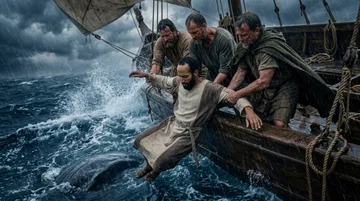
Cross-references
- Jonah 1:3
But Jonah rose up to flee unto Tarshish from the presence of the LORD, and went down to Joppa; and he found a ship going to Tarshish: so he paid the fare thereof, and went down into it, to go with them unto Tarshish from the presence of the LORD.
Jonah’s flight to Tarshish follows his refusal to go to Nineveh.
- Jonah 1:7
And they said every one to his fellow, Come, and let us cast lots, that we may know for whose cause this evil is upon us. So they cast lots, and the lot fell upon Jonah.
lots expose Jonah as cause of storm
- Jonah 2:1-9
Then Jonah prayed unto the LORD his God out of the fish’s belly,
Jonah prays to the Lord for deliverance after being swallowed by the fish.
- Genesis 9:5
And surely your blood of your lives will I require; at the hand of every beast will I require it, and at the hand of man; at the hand of every man’s brother will I require the life of man.
both use nephesh for life required of man
- Jonah 1:4
But the LORD sent out a great wind into the sea, and there was a mighty tempest in the sea, so that the ship was like to be broken.
shares the great wind and mighty tempest off Joppa
- Job 2:4
And Satan answered the LORD, and said, Skin for skin, yea, all that a man hath will he give for his life.
both use nephesh for a man's life
Commentary
Each commentary is drawn from primary sources: the writings of Ellen G. White and Adventist pioneers and periodicals. Each commentary is separate. Its own words are not a quotation; follow the references to read the source passages.
Ellen G. White
4 sources
This cry belongs to the record of Jonah's experience in Jonah 1-2, when he was bidden to cry against Nineveh but rose up to flee unto Tarshish from the presence of the Lord by ship from Joppa.RH Oct 18, 1906 In providence God taught him by severe affliction the lesson of obedience that enabled him to fulfill God's purpose in behalf of the inhabitants of Nineveh.RH Oct 18, 1906 It is a record worthy of most careful study.RH Oct 18, 1906
It was prayed just before Jonah was cast into the sea, after the sailors had tried unsuccessfully to row the ship to land while the storm grew worse and worse against them.RH Dec 4, 1913PK 267.3–268.4 In it they cried unto the Lord and begged Him not to let them perish on account of Jonah's life.RH Dec 4, 1913RH Dec 4, 1913PK 267.3–268.4 They pleaded further that He would not lay upon them or hold them guilty for shedding innocent blood by putting Jonah to death.RH Dec 4, 1913RH Dec 4, 1913PK 267.3–268.4 At the same time they acknowledged that the Lord Himself had brought about the whole situation as it had pleased Him.RH Dec 4, 1913RH Dec 4, 1913PK 267.3–268.4
Sources
Pioneers and periodicals
26 sources
Caught in a mighty tempest on the voyage from Joppa toward Tarshish, the terrified sailors cried to Jehovah before reluctantly casting Jonah overboard at his own request when they could not bring the ship to land.RH Dec 4, 1913ST Mar 23, 1904 They begged not to perish on account of taking his life and not to be charged with shedding innocent blood, regarding him as innocent and acting without malice.RH Dec 4, 1913ST Nov 11, 1908RH May 9, 1912 They confessed that the storm, the peril, and what befell Jonah were under the Lord's control, who had brought it about and acted as it pleased Him.RH Dec 4, 1913RH Dec 4, 1913ST Nov 11, 1908 Those heathen sailors were so impressed by Jonah's frank confession of guilt and willingness to die to save them that they strove harder to save him, and when the sea calmed they feared the Lord, offered a sacrifice, and made vows.ST Oct 29, 1885ST Dec 11, 1901ST Feb 4, 1903 The word rendered life in their plea is the Hebrew nephesh, meaning life or existence as breath or creature life, giving no ground for inferring a never-dying existence or an immortal soul.ST Jun 28, 1899ST Jun 6, 1878 Preserving the rebellious prophet in the depths showed God's wonderful mercy and mastery over the sea, teaching that trouble cannot be escaped by fleeing duty but peace and safety come by trusting and obeying.ST Dec 10, 1894ST Aug 27, 1896RH Dec 3, 1867
Words and Storm Setting
The plea not to perish for this man's life uses the Hebrew word nephesh for life, meaning life or existence in the same sense as breath, creature, or animal life, and it gives no ground for inferring a never-ending existence or an immortal soul.ST Jun 28, 1899 The same word is translated soul in many other Old Testament passages.ST Jun 28, 1899ST Jun 6, 1878
The verse belongs to the attempted voyage from Joppa to Tarshish on the Mediterranean Sea, when a raging storm threatened the lives of all on board.RH Aug 29, 1871ST Sep 17, 1896ST Feb 2, 1915 The tempest terrified everyone aboard, and they prayed and cast lots to determine who was responsible for it.ST Sep 17, 1896ST Feb 2, 1915 The lot identified Jonah as the cause, and he was thrown into that same sea and swallowed by a great fish.ST Sep 17, 1896ST Feb 2, 1915 Casting lots by which Jonah was singled out and then cast into the sea was an ancient custom practiced among many nations.ST Sep 3, 1896 Off the coast of Joppa great winds and mighty tempests still arise just as then, so that the seas of the Holy Land boom forth their testimony with mighty voices, alongside the Dead Sea lying as a tell-tale of Jehovah's anger and the Sea of Galilee still subject to sudden storms.RH Aug 29, 1871
Jonah was the son of Amittai, a prophet of God.ST Sep 9, 1913 His name means dove though his disposition was fiery, and he had predicted Jeroboam II's victories over the Assyrians.ST Dec 15, 1909 He was bidden to cry against Nineveh, then the greatest city on earth, with the hard mission to go to a strange people to rebuke them for their sins, but he rose up to flee unto Tarshish from the presence of the Lord by ship from Joppa.RH Oct 18, 1906ST Dec 15, 1909 God in providence used the record of Jonah 1-2, worthy of most careful study, to teach him by severe affliction the lesson of obedience that enabled him to fulfil God's purpose in behalf of the inhabitants of Nineveh.RH Oct 18, 1906 He was not the most agreeable servant, enduring in the great tests of life while finding fault over small things like the withering of the little gourd that left him in the hot sun instead of the shade, and there are such characters now.ST Sep 9, 1913
In the wonderful test at sea Jonah acknowledged he was the one at fault for refusing to obey God and go to Nineveh and told the sailors to throw him overboard.ST Sep 9, 1913 At his own desire the men of the ship cast him into the sea in the tempest, after which the storm ceased and they continued their voyage.ST Dec 10, 1894 God saw his rebellious heart from its first inception and in mercy had prepared the fish beforehand and had it at hand in the tempest to catch him when cast.ST Dec 10, 1894 In this God preserved the rebellious prophet as a lesson of mercy and preserved Jonah in the sea's depths and brought him back, showing that the sea, though a symbol of the lost, is under God's mastery and can become the place from which he rescues his servants.ST Dec 10, 1894ST Aug 27, 1896
Sailors' Plea and Faith
Unable to row the ship to land as the storm grew ever worse, the men cried to the Lord before they would do what Jonah had asked and throw him into the sea.RH Dec 4, 1913ST Mar 23, 1904 Their cry was reluctant, made only when no effort to save the ship could succeed and they were about to cast him overboard.RH Dec 4, 1913ST Mar 23, 1904
They begged not to perish on account of this man's life and not to have innocent blood laid upon them.ST Nov 11, 1908RH May 9, 1912ST Jan 30, 1901 They regarded Jonah as innocent and feared to be held guilty for his death and for shedding innocent blood.ST Nov 11, 1908RH May 9, 1912ST Jan 30, 1901 Their plea not to perish and not to be charged with innocent blood shows they acted without malice.RH Dec 4, 1913RH May 9, 1912 They asked the Lord not to let them die for throwing Jonah overboard.RH Dec 4, 1913ST Nov 11, 1908
They acknowledged that the storm, the peril, and Jonah's fate were under the Lord's control and that He had brought the situation about and acted as it pleased Him.RH Dec 4, 1913RH Dec 4, 1913ST Nov 11, 1908ST Mar 23, 1904 He was the God who made sea and dry land, whom Jonah had named to them, and they prayed to Him as the One who had sent the storm.ST Nov 11, 1908RH May 9, 1912 Events were proceeding according to His will, and the outcome rested with Him.RH Dec 4, 1913RH May 9, 1912ST Mar 23, 1904
These ignorant heathen sailors were led to pray to the great Jehovah because Jonah's greatness of soul impressed them.ST Oct 29, 1885ST Dec 11, 1901 The severe test of the storm removed his pride and irritation, so that he frankly told them he was to blame and that casting him overboard would save them.ST Dec 11, 1901ST Feb 4, 1903 His willingness to face what he believed would be certain death showed his heart was true to God.ST Dec 11, 1901ST Feb 4, 1903 That self-sacrifice so impressed them that they strove all the harder to save him instead, and were led to call on Jehovah.ST Dec 11, 1901 After the sea calmed they feared the Lord, offered a sacrifice, and made vows, so that through Jonah's rebellion the Lord taught people who had not known Him about Himself, and God showed Himself strong on Jonah's behalf.ST Oct 29, 1885ST Feb 4, 1903
Truth, Mercy, and Duty
The account is true and to be believed, not to be rejected as absurd and idiotic in an age of human learning.ST May 6, 1897 It is a miraculous narrative of being swallowed by a fish and cast out again alive, revealing a God altogether unlike man.RH Feb 10, 1903 Its miraculous character is itself the reason it must be believed, for the God who can save must be able to perform miracles, every prayer for salvation asks for a miracle, and no miracle is greater than the miracle of the new birth.RH Feb 10, 1903 The taking was really inside the belly, with the word into meaning really inside, not merely left close by or near nor merely carried ashore riding on the back.RH Jan 10, 1871 To reject it puts human knowledge and wisdom on the throne and exalts self instead of God, which is the character of heathenism and all false religion.ST May 6, 1897
The book presents God's wonderful mercy and what thorough repentance ought to be.ST Sep 9, 1913 The casting into the sea in the tempest was at his own desire, yet God saw the rebellious heart from its first inception and in mercy prepared the fish beforehand and had it at hand in the tempest to catch him when cast, preserving the rebellious prophet as a lesson of mercy for him and for all mankind.ST Dec 10, 1894 God thus preserved him in the sea's depths and brought him back, showing that the sea, though a symbol of the lost, is under God's mastery and can become the place from which He rescues His servants.ST Aug 27, 1896
The record of the experience in Jonah 1-2 is worthy of most careful study, showing how, when bidden to cry against Nineveh but rising to flee unto Tarshish from the presence of the Lord by ship from Joppa, God in providence taught by severe affliction the lesson of obedience that enabled fulfillment of God's purpose in behalf of the inhabitants of Nineveh.RH Oct 18, 1906 It was an experiment in escaping trouble by running away from duty, and the experiment failed, leaving him where all who imitate him will in the end find themselves.RH Dec 3, 1867 Trouble cannot be escaped by fleeing duty, and the difficulties and trials of the post assigned by God's providence must be manfully met and overcome.RH Dec 3, 1867 He chose his own way and was thrown overboard into the raging sea, but when he afterward followed God's way he went to Nineveh on a mission of love, illustrating the danger of resisting God's direction and the peace and safety found in trusting and obeying Him.RH Jan 27, 1874 The casting overboard, after which the storm ceased and the voyage continued, is treated as a real story that also teaches lessons rebuking ministers who evade difficult duties and criticize Scripture. His warning was needed by Nineveh, linking the verse with the need for prophecy to show people coming events with grave consequences.RH Jun 8, 1911
Sources