Translations
American King James Version, King James Version, KJV Cambridge Paragraph Bible, Revised Version, American Standard Version
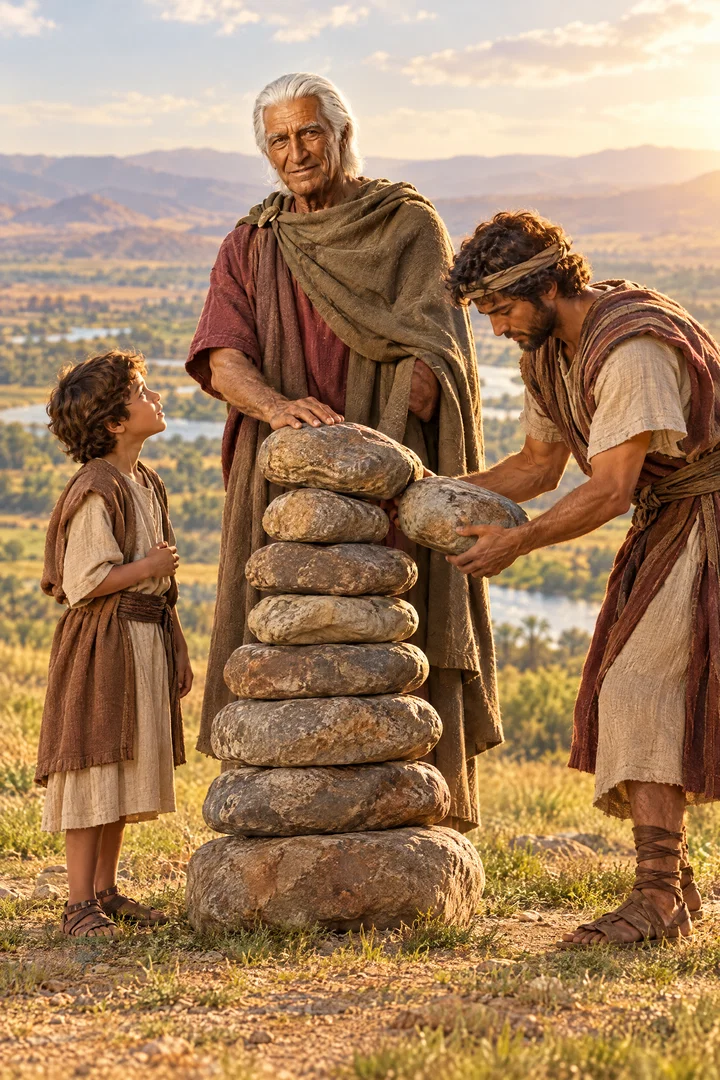
Take you twelve men out of the people, out of every tribe a man,
Take you twelve men from the people, from every tribe a man,
'Take for you out of the people twelve men, one man — one man out of a tribe;
Take you twelve men out of the people, one man out of every tribe,
Take unto you, from among the people, twelve men, one man severally from each tribe;
Berean Standard Bible, Majority Standard Bible
“ Choose twelve men from among the people, one from each tribe,
“ Take twelve men out of the people, a man out of every tribe,
Take twelve men from the people, a man for every tribe,
Take you twelue me out of the people, out of euery tribe a man,
Douay-Rheims (Challoner revision)
Choose twelve men, one of every tribe:
Pictures
Cross-references
- Joshua 4:6-7
That this may be a sign among you, that when your children ask their fathers in time to come, saying, What mean ye by these stones?
The stones remind future generations that the Jordan waters were cut off before the ark.
- Joshua 3:17
And the priests that bare the ark of the covenant of the LORD stood firm on dry ground in the midst of Jordan, and all the Israelites passed over on dry ground, until all the people were passed clean over Jordan.
The priests stood on dry ground while all Israel crossed the Jordan.
- Joshua 4:21-24
And he spake unto the children of Israel, saying, When your children shall ask their fathers in time to come, saying, What mean these stones?
The stones prompt children to ask about the crossing and learn of God’s mighty hand.
- Exodus 14:21-22
And Moses stretched out his hand over the sea; and the LORD caused the sea to go back by a strong east wind all that night, and made the sea dry land, and the waters were divided.
The Jordan crossing recalls Israel’s passage through the divided sea.
- Joshua 3:13
And it shall come to pass, as soon as the soles of the feet of the priests that bear the ark of the LORD, the Lord of all the earth, shall rest in the waters of Jordan, that the waters of Jordan shall be cut off from the waters that come down from above; and they shall stand upon an heap.
The Jordan’s waters stop when the priests’ feet rest, allowing Israel to cross.
- Psalms 114:3
The sea saw it, and fled: Jordan was driven back.
It recalls the Jordan turning back when Israel left Egypt.
- Joshua 4:18
And it came to pass, when the priests that bare the ark of the covenant of the LORD were come up out of the midst of Jordan, and the soles of the priests’ feet were lifted up unto the dry land, that the waters of Jordan returned unto their place, and flowed over all his banks, as they did before.
waters returned when priests came up
- 1 Kings 18:31
And Elijah took twelve stones, according to the number of the tribes of the sons of Jacob, unto whom the word of the LORD came, saying, Israel shall be thy name:
Elijah takes twelve stones, one for each tribe of Israel.
Commentary
Each commentary is drawn from primary sources: the writings of Ellen G. White and Adventist pioneers and periodicals. Each commentary is separate. Its own words are not a quotation; follow the references to read the source passages.
Ellen G. White
8 sources
Joshua 4:2 belongs to the account of Israel preparing to cross the Jordan into the promised land, an experience recorded as a lesson to be kept fresh in memory through careful study.Lt 292, 1908, par. 18 By the Lord's direction Joshua chose twelve men, one from each tribe of Israel, in connection with that crossing.4T 158.2PP 484.3ST Apr 7, 1881RH Sep 25, 1913PP 613.3–614.2
The men were to take stones from the Jordan riverbed where the priests had stood with the ark and carry them to dry land on the western side, setting up twelve stones at Gilgal.4T 158.2PP 484.3ST Apr 7, 1881ST Jul 27, 1882PP 613.3–614.2 The stones were a memorial of God's miraculous deliverance in bringing Israel across on dry ground.4T 158.2PP 484.3ST Apr 7, 1881ST Jul 27, 1882PP 613.3–614.2 For future generations the memorial recalled that the waters of the Jordan were cut off before the ark of the Lord's covenant as Israel crossed over.ST Apr 7, 1881
Such memorials were to keep the history of God's care and deliverance before the people, so parents could explain their meaning to their children and the account would remain remembered and fresh.Lt 292, 1908, par. 18Lt 33, 1890, par. 7–9 The twelve stones later used to rebuild the altar recalled the covenant the Lord made with Israel at the Jordan crossing and represented the tribes descended from Jacob.RH Sep 25, 1913
Sources
Pioneers and periodicals
17 sources
The Lord commanded that twelve men be chosen, one from every tribe, to take part in the crossing of the Jordan.ST Apr 7, 1881ST Feb 3, 1904RH Aug 1, 1907 They were to lift twelve stones from the dry riverbed from the spot where the priests bearing the Ark stood firm, and carry them to dry land to be set up at Gilgal.ST Apr 7, 1881RH Apr 21, 1851RH Aug 1, 1907 The stones were set up as a sign and memorial that the waters of the Jordan were cut off before the Ark of the covenant, to remind Israel and their children how God had led them and to prompt children to ask their meaning so parents could teach them His mighty act.ST Apr 7, 1881RH Apr 21, 1851RH Sep 19, 1912ST Feb 3, 1904RH Aug 1, 1907 The command was given after all the people had passed over on dry ground behind the Ark, which held the law and was the strength and glory of Israel, when the waters parted as the priests' feet rested in the river and stood firm in the midst until all had crossed.RH Apr 21, 1851 Taking one man from every tribe shows that God wants all His people represented in carrying on His work, and in leading Israel through the Jordan Joshua was a type of the Lord bringing His people out of the wilderness of sin through the judgment into the heavenly Canaan.ST Mar 25, 1913ST Oct 1, 1902ST Mar 15, 1910
Setting of the Command
The command came after all Israel had passed over the Jordan on dry ground behind the Ark of the covenant, which contained the law and was the strength and glory of Israel.RH Apr 21, 1851 When the soles of the priests' feet rested in the water, God parted the Jordan before the Ark of the Lord of all the earth.RH Apr 21, 1851 The priests bearing the Ark stood firm on dry ground in the riverbed until all the people had passed over, and the waters rolled back only after the priests came up onto the bank.RH Apr 21, 1851
The command belongs to the preparation for passing over the Jordan and the crossing at full flood recorded in Joshua 1-4.ST Mar 25, 1913 That crossing took place about 1451 B.C. in the same year Moses died.ST Mar 25, 1913 It was Israel's impressive crossing of the Jordan from the wilderness into the promised land and part of the people's reconsecration to God.ST Mar 15, 1910
Joshua, whose name means saviour and signifies the same as Jesus in Greek, was one of the two of his generation who wholly followed the Lord.ST Mar 21, 1911ST Mar 25, 1913 At about eighty years of age he entered upon his greatest work in leading the children of Israel through the Jordan.ST Mar 21, 1911 In that work he divided the land for them and set them on the way to conquer all their foes and find the promised rest, with the Captain of Jehovah's hosts with him in victory.ST Mar 21, 1911
The verse directs that twelve men, one from each tribe, were chosen at the Lord's command to take part in the Jordan crossing.ST Apr 7, 1881ST Feb 3, 1904RH Aug 1, 1907ST Jul 21, 1909RH Dec 7, 1916 Joshua was to choose the twelve men, one from each tribe, for the memorial connected with Israel's passage through the Jordan.ST Feb 3, 1904RH Aug 1, 1907ST Jul 21, 1909RH Dec 7, 1916ST Mar 11, 1880
Memorial of Twelve Stones
The twelve men were to lift twelve stones from the midst of the Jordan, from the dry riverbed at the very spot where the priests' feet had stood firm, and carry them to dry land to be set up at Gilgal.ST Apr 7, 1881RH Apr 21, 1851RH Aug 1, 1907ST Jul 21, 1909RH Dec 7, 1916 Twelve men, one from each tribe, were chosen at the Lord's command to take the stones from the channel where the priests stood, and the stones were borne out as the appointed share of those men in the crossing.ST Apr 7, 1881ST Jul 27, 1882RH Aug 1, 1907ST Jul 21, 1909RH Dec 7, 1916 The stones were set up as a sign and memorial that the waters of the Jordan were cut off before the ark of the covenant of the Lord as Israel crossed over.ST Apr 7, 1881RH Apr 21, 1851RH Aug 1, 1907 They were to remind their children how God had led and provided for them, and to teach future generations to revere His mighty act in bringing Israel over on dry ground.ST Apr 7, 1881ST Feb 3, 1904RH Aug 1, 1907
The memorial was made to cause children to ask what the stones meant, giving parents occasion to tell how God opened the river before Israel.RH Sep 19, 1912ST Feb 3, 1904RH Aug 1, 1907 In this way the people would remember those experiences and hand them down to their children.ST Feb 3, 1904RH Aug 1, 1907RH Dec 26, 1907 A sign is a memorial, for the work of the twelve men in taking up the stones formed a lasting reminder of what God had done.RH Jul 1, 1873 This proves that the Sabbath being called a sign means it is a memorial of creation.RH Jul 1, 1873 The stones for such a memorial were established at the time of the event they commemorated.ST Mar 11, 1880
The twelve stones with which Elijah rebuilt the altar recalled the covenant the Lord made with Israel at the Jordan crossing.RH Sep 25, 1913 They represented the tribes descended from Jacob.RH Sep 25, 1913
Representation, Type, and Lesson
God desires the whole of His people to be represented in the carrying forward of His work, and therefore one man was taken from every tribe for a share in what was done at the Jordan.ST Oct 1, 1902 Spiritual authority is never to rest upon a single man, so that if matters should ever come to one-man rule in spiritual things it would prove that only one man was loyal to the truth.ST Oct 1, 1902 Whoever claims such sole authority makes himself a judge, and he is not recognized by God at all.ST Oct 1, 1902
In leading Israel, Joshua was a type of the Lord, for his name signifies the same as Jesus in Greek, Saviour.ST Mar 25, 1913 His work belongs to the preparation for passing over the Jordan and the crossing of the river at full flood recorded in Joshua 1-4, which took place about 1451 B.C. in the same year Moses died.ST Mar 25, 1913 That leading of Israel across the Jordan from the wilderness into the promised land is a type of Jesus bringing His people out of the wilderness of sin, through the judgment, and into the heavenly Canaan.ST Mar 25, 1913ST Mar 15, 1910
The account of Israel's crossing of the Jordan was given for learning rather than merely to inspire wonder or curiosity.RH Dec 9, 1902 It shows the acts of the living God, whose power bears upon daily life.RH Dec 9, 1902
Sources