Joshua 8:35
There was not a word of all that Moses commanded, which Joshua read not before all the congregation of Israel, with the women, and the little ones, and the strangers that were conversant among them.
Translations
American King James Version, King James Version, KJV Cambridge Paragraph Bible, Webster Bible
There was not a word of all that Moses commanded, which Joshua read not before all the congregation of Israel, with the women, and the little ones, and the strangers that were conversant among them.
There was not a word of all that Moses commanded, which Joshua read not before all the assembly of Israel, and the women, and the little ones, and the strangers that were conversant among them.
There was not a word of all that Moses commanded, which Joshua read not before all the assembly of Israel, and the women, and the little ones, and the sojourners that were among them.
there hath not been a thing of all that Moses commanded which Joshua hath not proclaimed before all the assembly of Israel, and the women, and the infants, and the sojourner who is going in their midst.
There was not a word of all that Moses had commanded which Joshua read not before the whole congregation of Israel, and the women, and the children, and the strangers that lived among them.
Them was not a word of all that Moses commanded,—which Joshua read not before all the convocation of Israel, with the women and the little ones, and the sojourner who was going on in their midst.
Berean Standard Bible, Majority Standard Bible
There was not a word of all that Moses had commanded that Joshua failed to read before the whole assembly of Israel, including the women, the little ones, and the foreigners who lived among them.
There was not a word of all that Moses commanded which Joshua didn’t read before all the assembly of Israel, with the women, the little ones, and the foreigners who were among them.
Reading to all the meeting of Israel, with the women and the children and the men from other lands who were living among them, every word of the orders which Moses had given.
There was not a worde of all that Moses had commanded, which Ioshua read not before all the Congregation of Israel, as well before the women and the children, as the stranger that was conuersant among them.
Douay-Rheims (Challoner revision)
He left out nothing of those things which Moses had commanded, but he repeated all before all the people of Israel, with the women and children and strangers that dwelt among them.
Pictures
Cross-references
- Deuteronomy 27:11-13
And Moses charged the people the same day, saying,
Moses assigns the tribes to Mount Gerizim and Mount Ebal for Israel’s covenant ceremony.
- Deuteronomy 31:12
Gather the people together, men, and women, and children, and thy stranger that is within thy gates, that they may hear, and that they may learn, and fear the LORD your God, and observe to do all the words of this law:
Commands the law to be read to all, including women, children, and resident strangers.
- Deuteronomy 27:8
And thou shalt write upon the stones all the words of this law very plainly.
Joshua carries out the command to write the law plainly on stones.
- Exodus 24:7
And he took the book of the covenant, and read in the audience of the people: and they said, All that the LORD hath said will we do, and be obedient.
The covenant book was read publicly before Israel pledged obedience.
- Deuteronomy 28
And it shall come to pass, if thou shalt hearken diligently unto the voice of the LORD thy God, to observe and to do all his commandments which I command thee this day, that the LORD thy God will set thee on high above all nations of the earth:
all blessings and curses recited
- Deuteronomy 11:19
And ye shall teach them your children, speaking of them when thou sittest in thine house, and when thou walkest by the way, when thou liest down, and when thou risest up.
God’s words are to be taught to children.
- Exodus 21:1
Now these are the judgments which thou shalt set before them.
Introduces the judgments Moses commanded and had read before Israel.
- Joshua 1:8
This book of the law shall not depart out of thy mouth; but thou shalt meditate therein day and night, that thou mayest observe to do according to all that is written therein: for then thou shalt make thy way prosperous, and then thou shalt have good success.
Joshua was commanded to study the law and obey it.
- Genesis 12:6-7
And Abram passed through the land unto the place of Sichem, unto the plain of Moreh. And the Canaanite was then in the land.
The passage recalls God’s covenant with Abraham in connection with Shechem.
- Exodus 23
Thou shalt not raise a false report: put not thine hand with the wicked to be an unrighteous witness.
Contains laws that Joshua read to the congregation.
Commentary
Each commentary is drawn from primary sources: the writings of Ellen G. White and Adventist pioneers and periodicals. Each commentary is separate. Its own words are not a quotation; follow the references to read the source passages.
Ellen G. White
6 sources
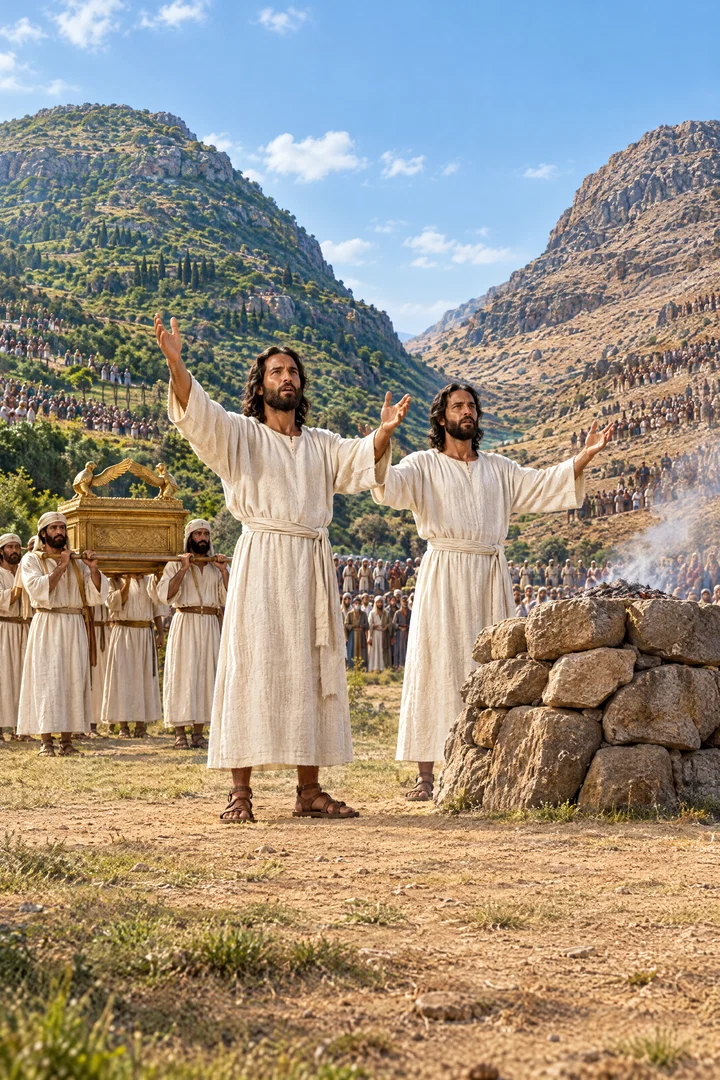
Joshua left out nothing of all Moses had commanded but read every word of the law aloud, including its statutes and judgments.PK 464.2–465.2PP 500.3PP 500.4 He read it before the whole congregation of Israel, with the women and the little children and the strangers and resident foreigners living among them, so that the entire community was taught and heard the law together.PK 464.2–465.2PP 499.2–3PP 500.3PP 500.4PP 522.4 This was the covenant ceremony on Mount Ebal and Mount Gerizim at Israel's entrance into Canaan, a solemn recognition of God's law and renewal of the covenant before Israel took possession of its inheritance.PP 499.2–3PP 522.4Ms 135, 1899, par. 7
The public reading made the covenant's requirements and terms known to everyone, so the people could accept them and assent to the blessings for obedience and the curses for neglect.PP 500.3PP 500.4 The law was also written publicly on memorial stones as well as preserved in the ark.PP 500.4 Joshua read it again only weeks after Moses had delivered Deuteronomy to the people.PP 500.4 Israel's duty to God thus came before the military campaign and settlement of the land, and while the people remained faithful God protected them even among unconquered enemies.PP 499.2–3
Ebal and Gerizim stood as silent witnesses of the solemn vows made there.Ms 135, 1899, par. 7 The later gathering at Shechem before Joshua's death renewed those same entrance vows and recalled the vows of Ebal and Gerizim, with Joshua recounting God's works so Israel would recognize His love and mercy and serve Him sincerely and truthfully.PP 522.4Ms 135, 1899, par. 7 Shechem was fitting for that renewal because it carried minds back to God's covenant with Abraham and Jacob and to the entrance vows, while the land Israel possessed without laboring for it and the cities they did not build and the vineyards and oliveyards they did not plant stood on every side as evidence of what God had done for them.Ms 135, 1899, par. 7
Sources
Pioneers and periodicals
15 sources
Soon after entering the promised land and just after the taking of Ai, Joshua gathered all Israel in fulfillment of Moses' directions for Ebal and Gerizim.RH Apr 29, 1875 In the valley between Mount Ebal, the mount of cursing, and Mount Gerizim, the mount of blessing, with the ark standing midway, half the tribes stood facing Gerizim for the blessings and half facing Ebal for the curses.ST Sep 3, 1894RH Apr 29, 1875ST Sep 8, 1898 There Joshua read every word of all that Moses commanded, the blessings and the cursings according to all written in the book of the law, omitting not one word.RH Jul 28, 1863ST Dec 16, 1897 The law so read included not only the ten precepts spoken from Sinai but the moral, civil, and ceremonial laws communicated to Moses and written by him in a book.RH Jul 28, 1863ST Dec 16, 1897 It was set before the whole congregation with the women and the little ones and the resident strangers present, so that even small children were brought to hear and learn.RH Oct 28, 1902RH Jul 28, 1863 God thus places a very high value on His law, commanding that it be read publicly before all that all might know its precepts and do them, and the altar set on Ebal denotes that Israel had justly incurred His wrath by transgression, which would at once fall except for the atonement of Christ represented by the sacrifice.ST Jan 17, 1884
Assembly at Ebal and Gerizim
The gathering took place soon after Israel entered the promised land, just after the taking of Ai, in fulfillment of the directions Moses had twice given for Ebal and Gerizim.RH Apr 29, 1875 It stood in the valley of Sychar a short distance east of Shechem, between Mount Gerizim, the mount of blessing, and Mount Ebal, the mount of cursing.RH Apr 29, 1875ST Sep 8, 1898 The ark stood midway in the valley held by its bearers, with priests and Levites near, and the Shekinah light resting over it upon the cherubim and the pure gold of the mercy-seat.RH Apr 29, 1875
Mount Ebal is 3,077 feet high and barren from its base, while Mount Gerizim is 2,848 feet high and green with verdure at its foot.ST Sep 8, 1898 From the summit of Ebal the view extends across the hills of Samaria to the Mediterranean, to the site of Caesarea in clear weather, to Mount Carmel, the hills of Galilee, Mount Hermon, and the long range of hills east of the Jordan reaching to the Dead Sea, and the view from Gerizim is nearly as extensive.ST Sep 8, 1898 Half the tribes were ranged on each hand, six facing Gerizim for blessings and six facing Ebal for curses.RH Apr 29, 1875ST Sep 8, 1898 All but two of Leah's sons stood on Gerizim, along with the sons of Rachel excepted with Zebulun and Reuben, and all the rest stood on Ebal.RH Apr 29, 1875 The women and the little ones with the strangers conversant among them were present before the whole congregation.ST Sep 3, 1894RH Apr 29, 1875
Beside the assembly stood a monument of great stones plastered and inscribed very plainly with the law, and an altar of whole unhewn stones over which no iron had been lifted, built with a stone for each tribe, where burnt-offerings and peace-offerings were offered.RH Jan 4, 1912 The law was thus set out before the assembled people, and its blessings and curses were proclaimed from Gerizim and Ebal. The priests recited all the blessings and all the curses promised in the law, turning first to Gerizim with blessing and then northward to Ebal with curse.RH Apr 29, 1875 The tribes on each mountain answered each word with a loud, deep amen in fear and awe, and the children listening and gazing on the imposing array never forgot that scene to their dying day.RH Apr 29, 1875
The account in chapters 7 and 8 shows the awful results of even one sin and one sinner among God's people, coming after the lesson of Achan's sin and its fearful consequences.ST Mar 17, 1909 It belongs to the conquering of the Canaanites and the division of the land, in which Israel was humbled at Ai through self-sufficiency and then triumphed over Ai by faith.ST Mar 17, 1909RH Apr 20, 1911 Joshua's building of an altar and writing upon it after Israel crossed the Jordan is distinct from the events at Mount Sinai discussed in 2 Corinthians 3.ST Oct 16, 1884 Shechem was also the place where Joshua later gathered Israel for his final admonitions.ST Sep 8, 1898 The reading of blessings at Mount Gerizim is connected with the place the Samaritans regarded as a place of worship, where their ancestors worshiped for more than four hundred years before Christ.ST Sep 3, 1894ST Sep 3, 1894 From Mounts Ebal and Gerizim God honored mountains above other forms of nature by pronouncing His curses upon the disobedient and His blessings upon the faithful.ST Aug 27, 1896
Law Read and Applied
Joshua read every word of the law, the blessings and the cursings, according to all that was written in the book of the law, omitting not one word of all that Moses had commanded.RH Jul 28, 1863 The law so read was not the ten precepts alone spoken from Sinai and engraved on stone but also the laws communicated to Moses and written by him in a book. That book of the covenant contained laws of moral, civil, and ceremonial kinds, given to regulate the Jewish theocracy.ST Dec 16, 1897
The law was set out before the assembled people, and its blessings and curses were proclaimed from Gerizim and Ebal. The proclamation was made before all the congregation of Israel, including women, little ones, and resident strangers conversant among them.RH Oct 28, 1902RH Jul 28, 1863 Even small children were brought to hear the law of Moses and were not left at home.RH Oct 28, 1902
God places a very high value on His law, commanding through Moses and Joshua that it be read publicly at stated periods before all the people.ST Jan 17, 1884 The purpose was that all might become familiar with its precepts and put them into practice.ST Jan 17, 1884 Those who did so received the exalted privilege of being counted as sons and daughters of the Most High and could trust in Him as dear children.ST Jan 17, 1884 Children are therefore to be present when God's word is read so they may hear and learn, and leaving children home from meeting on the ground that they cannot understand is rebuked.RH Oct 28, 1902
The altar stood on Mount Ebal, the mountain of the curse, denoting that Israel had justly incurred God's wrath by transgression of His law. That wrath would at once have fallen except for the atonement of Christ represented by the altar of sacrifice. The curses pronounced from Mount Ebal over Israel at Shechem have been fulfilled literally.ST Sep 8, 1898 This is seen in the land around Shechem between Ebal and Gerizim, where the valley opening east of Jacob's well is fertile but now indifferently cultivated.ST Sep 8, 1898
Sources