Judges 11:34
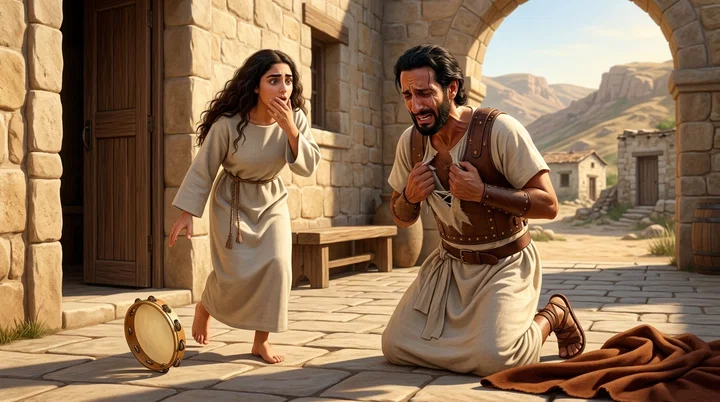
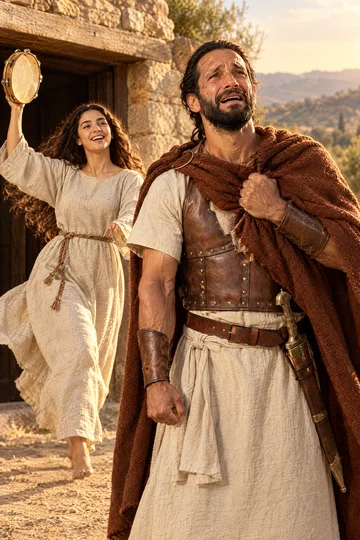
And Jephthah came to Mizpeh unto his house, and, behold, his daughter came out to meet him with timbrels and with dances: and she was his only child; beside her he had neither son nor daughter.
Translations
And Jephthah came to Mizpeh to his house, and, behold, his daughter came out to meet him with tambourines and with dances: and she was his only child; beside her he had neither son nor daughter.
And Jephthah came to Mizpeh unto his house, and, behold, his daughter came out to meet him with timbrels and with dances: and she was his only child; beside her he had neither son nor daughter.
And Jephthah came to Mizpeh unto his house, and behold, his daughter came out to meet him with timbrels and with dances: and she was his only child; beside her he had neither son nor daughter.
And Jephthah came to Mizpeh to his house, and behold, his daughter came out to meet him with timbrels and with dances: and she was his only child; beside her he had neither son nor daughter.
And Jephthah came to Mizpah unto his house, and, behold, his daughter came out to meet him with timbrels and with dances: and she was his only child; beside her he had neither son nor daughter.
And Jephthah came to Mizpah unto his house; and, behold, his daughter came out to meet him with timbrels and with dances: and she was his only child; besides her he had neither son nor daughter.
And Jephthah cometh into Mizpeh, unto his house, and lo, his daughter is coming out to meet him with timbrels, and with choruses, and save her alone, he hath none, son or daughter.
And Jephthah came to Mizpah to his house, and behold, his daughter came out to meet him with tambours and with dances; and she was an only child: besides her he had neither son nor daughter.
Then came Jephthah towards Mizpah, unto his own house, and lo! his daughter, coming forth to meet him, with timbrels, and with dances,—and, she, was none other than his only child, he had not, besides her, either son or daughter.
Berean Standard Bible, Majority Standard Bible
And when Jephthah returned home to Mizpah, there was his daughter coming out to meet him with tambourines and dancing! She was his only child; he had no son or daughter besides her.
Jephthah came to Mizpah to his house; and behold, his daughter came out to meet him with tambourines and with dances. She was his only child. Besides her he had neither son nor daughter.
Then Jephthah came back to his house in Mizpah, and his daughter came out, meeting him on his way with music and with dances; she was his only child; he had no other sons or daughters.
Nowe when Iphtah came to Mizpeh vnto his house, beholde, his daughter came out to meete him with timbrels and daunces, which was his onely childe: he had none other sonne, nor daughter.
Douay-Rheims (Challoner revision)
And when Jephte returned into Maspha to his house, his only daughter met him with timbrels and with dances: for he had no other children.
Pictures
Cross-references
- Judges 11:39-40
And it came to pass at the end of two months, that she returned unto her father, who did with her according to his vow which he had vowed: and she knew no man. And it was a custom in Israel,
Her lifelong virginity and Israel’s yearly remembrance are described.
- Leviticus 27:2-8
Speak unto the children of Israel, and say unto them, When a man shall make a singular vow, the persons shall be for the LORD by thy estimation.
It gives the rules for valuing a person included in a vow.
- Judges 11:40
That the daughters of Israel went yearly to lament the daughter of Jephthah the Gileadite four days in a year.
Israel’s daughters annually honored and comforted Jephthah’s daughter.
- Judges 11:29
Then the Spirit of the LORD came upon Jephthah, and he passed over Gilead, and Manasseh, and passed over Mizpeh of Gilead, and from Mizpeh of Gilead he passed over unto the children of Ammon.
The Spirit comes upon Jephthah as he is commissioned to deliver Israel.
- Hebrews 11:32
And what shall I more say? for the time would fail me to tell of Gedeon, and of Barak, and of Samson, and of Jephthae; of David also, and Samuel, and of the prophets:
Invoked in describing the moral character of faithful people.
Commentary
Each commentary is drawn from primary sources: the writings of Ellen G. White and Adventist pioneers and periodicals. Each commentary is separate. Its own words are not a quotation; follow the references to read the source passages.
Pioneers and periodicals
22 sources
After his victory Jephthah returned to his house at Mizpeh, and his daughter, his only child, came out to meet him with timbrels and with dances.ST Nov 8, 1910RH Nov 27, 1913ST She was his sole child beside whom he had neither son nor daughter, and his only hope of continuing his family line.ST Apr 4, 1911ST May 6, 1886ST Mar 24, 1909 She was not put to death as a burnt sacrifice, for human sacrifice was forbidden and offensive to God, but was devoted to lifelong service to the Lord to remain unmarried and perpetually virgin.ST Nov 8, 1910RH Nov 27, 1913STST May 6, 1886ST Mar 24, 1909 Her perpetual virginity destroyed his house in Israel and left his name without posterity or descendants, a loss she nobly accepted and which was mourned.ST Nov 8, 1910ST Apr 4, 1911STST May 6, 1886 Her coming out to meet him shows the grave, unforeseen sorrow of a rash oath that binds one to an outcome one cannot control, and lays no obligation to take life, for a prior obligation to God precludes an unlawful vow.RH Oct 7, 1858ST Sep 15, 1909ST Mar 3, 1898RH Jan 13, 1863
Meeting at Mizpeh
At Mizpeh after his victory Jephthah's only child, his daughter, came out to meet him with timbrels and with dances.ST Nov 8, 1910RH Nov 27, 1913STRH Jan 13, 1863 She was his sole child, beside whom he had neither son nor daughter, and therefore dedicating her to the Lord to remain unmarried and perpetually virgin and celibate meant giving up all hope of descendants and ending his family line.ST Nov 8, 1910RH Nov 27, 1913ST This explains his grief and her mourning, which was over her virginity and never becoming a mother in Israel rather than over being put to death or offered as a burnt sacrifice.ST Nov 8, 1910RH Nov 27, 1913ST She was not killed, for human sacrifice is in the highest degree offensive to God and the vow could only be fulfilled as circumstances permitted, but she was set apart to God for religious duties in her unmarried state and remained unaffianced for the rest of her life.RH Jan 13, 1863 Since she was his only child, her seclusion destroyed her hope of establishing a household, ranking among the mothers of Israel, and sharing in the ancestry of the promised Messiah, which is why her companions visited her yearly to show sympathy for her seclusion and esteem for her filial obedience.RH Jan 13, 1863
Her dancing was a religious act and a demonstration of joy for victory and mercy.ST Jun 3, 1880 It was done in the daytime by women by themselves apart from men, with no promiscuous dancing of the two sexes together.ST Jun 3, 1880 It therefore gives no sanction for promiscuous dancing of the sexes together as amusement as practiced at the present time.ST Jun 3, 1880
She came out in customary celebration as the victim claimed by his vow.RH Jan 13, 1863ST May 6, 1889 Hers is a story of vow, victim, and vengeance that holds stirring and absorbing contemporaneous interest.ST May 6, 1889
Virginity Not Sacrifice
She was his only child, beside whom he had neither son nor daughter, and the only hope of continuing his family line.ST Apr 4, 1911ST May 6, 1886ST Mar 24, 1909ST May 6, 1886 Her coming out to meet him therefore fixed the full weight of what followed, for what touched her touched the whole future of his house.ST Mar 24, 1909ST May 6, 1886
She was not put to death or offered as a burnt sacrifice.ST Mar 24, 1909ST Mar 1, 1877RH Jan 13, 1863ST May 6, 1886 Human sacrifice was forbidden by the law and in the highest degree offensive to God, and the vow could only be fulfilled as circumstances permitted.ST Mar 24, 1909RH Jan 13, 1863 Her being his sole child explains his grief, for under his vow she was dedicated to the Lord and would never marry, rather than being slain.RH Nov 27, 1913ST
She was instead devoted to lifelong service to the Lord, probably at the tabernacle, set apart for religious duties to remain unmarried, unaffianced, and perpetually virgin and celibate.ST May 6, 1886ST Mar 24, 1909ST Mar 1, 1877RH Jan 13, 1863ST May 6, 1886 She was the offering intended by his vow, yet the offering was made in this consecrated seclusion for the rest of her life.ST Mar 1, 1877RH Jan 13, 1863 Because she was his sole child, her perpetual virginity ended any hope of his family continuing, destroyed his house in Israel, and left his name without posterity or descendants.ST Nov 8, 1910STST May 6, 1886ST Mar 24, 1909ST May 6, 1886 He gave her up to perpetual celibacy, and the cost was that he had no hope of descendants through her.ST Nov 8, 1910STST May 6, 1886
She nobly accepted the consequence, giving up hope of establishing a household, becoming a mother in Israel and ranking among its mothers, and sharing in the ancestry of the promised Messiah.ST Apr 4, 1911STST May 6, 1886ST Mar 1, 1877RH Jan 13, 1863 Her virginity and loss were mourned, for her grief was over remaining unmarried and never becoming a mother, not over being killed.ST Nov 8, 1910STST May 6, 1886 Her companions visited her yearly to show sympathy for her seclusion and esteem for her obedience to her father.ST Mar 1, 1877RH Jan 13, 1863
Vow's Warning and Echoes
The meeting at Mizpeh shows the grave, unforeseen sorrow that follows a rash oath, when binding oneself to an outcome one cannot control brings a terrible consequence upon one's own house.RH Oct 7, 1858ST Sep 15, 1909 The vow was a folly of the same kind as Herod's oath that led to the beheading of John the Baptist, and together they stand as warnings against making rash vows or promises.ST Mar 3, 1898 It was a godless and reckless gamble with a child's life, staking her future on one cast of the dice.ST Sep 4, 1901 The innocent daughter suffered for that impulsiveness, coming out in customary celebration only to become the beginning of a sad and painful event.ST Sep 15, 1909
Yet the coming of the daughter to meet him placed Jephthah under no obligation to take her life in order to fulfill his vow.RH Jan 13, 1863 Men stand under a prior obligation to God that precludes any right to make unlawful vows or oaths, and no one is at liberty to perform an unlawful act merely because he has bound himself by a vow.RH Jan 13, 1863 The sin lies in making an unlawful vow, not in breaking it, and God accepts no act done to fulfill an unrighteous vow when it comes charged with the murder of other duties.RH Jan 13, 1863
He had time to reconsider his vow before acting, and his moral insight would have kept him from a barbarous act.ST May 6, 1886 A good person may do wrong impulsively, but not after time for reflection in a religious state of mind.ST May 6, 1886
Her meeting him after his victory made her the precious thing he surrendered, giving her up to perpetual celibacy.ST She was his only child, so the vow cost him the possibility of any further descendants and left his name without posterity.ST That surrender of an only child may remind readers of God giving up His only Son at Calvary.ST
This true Old Testament occurrence of devoting his daughter became the foundation for the monstrous heathen story of Agamemnon sacrificing his daughter Iphigenia.RH Mar 26, 1861 The borrowing shows how the heathen took images and events from Scripture into their own system of religion.RH Mar 26, 1861 Jephthah himself stands as an example of one who was alone when God commissioned him to deliver Israel.ST Nov 24, 1887
The account of the vow and of the daughter coming out to meet him as its victim makes a story of vow, victim, and vengeance that holds stirring and absorbing contemporaneous interest.ST May 6, 1889 It raises the puzzling question whether he sacrificed his daughter, a question that continues to draw close attention to Judges 11:30-40.ST May 6, 1889RH Apr 2, 1914
Sources