Judges 11:35
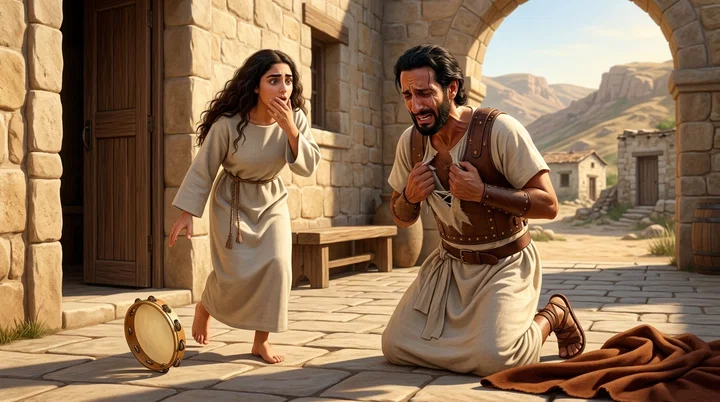
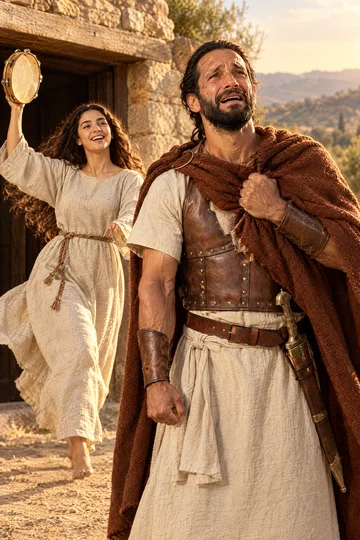
And it came to pass, when he saw her, that he rent his clothes, and said, Alas, my daughter! thou hast brought me very low, and thou art one of them that trouble me: for I have opened my mouth unto the LORD, and I cannot go back.
Translations
And it came to pass, when he saw her, that he rent his clothes, and said, Alas, my daughter! you have brought me very low, and you are one of them that trouble me: for I have opened my mouth to the LORD, and I cannot go back.
King James Version, Revised Version
And it came to pass, when he saw her, that he rent his clothes, and said, Alas, my daughter! thou hast brought me very low, and thou art one of them that trouble me: for I have opened my mouth unto the LORD, and I cannot go back.
And it came to pass, when he saw her, that he rent his clothes, and said, Alas, my daughter, thou hast brought me very low, and thou art one of them that trouble me: for I have opened my mouth unto the Lord, and I cannot go back.
And it came to pass, when he saw her, that he rent his clothes, and said Alas, my daughter! thou hast brought me very low, and thou art one of them that trouble me: for I have opened my mouth to the LORD, and I cannot go back.
And it came to pass, when he saw her, that he rent his clothes, and said, Alas, my daughter! thou hast brought me very low, and thou art one of them that trouble me; for I have opened my mouth unto Jehovah, and I cannot go back.
And it cometh to pass, when he seeth her, that he rendeth his garments, and saith, 'Alas, my daughter, thou hast caused me greatly to bend, and thou hast been among those troubling me; and I — I have opened my mouth unto Jehovah, and I am not able to turn back.'
And it came to pass, when he saw her, that he rent his garments, and said, Alas, my daughter! thou hast brought me very low, and thou art one of them that trouble me; for I have opened my mouth to Jehovah, and I cannot go back.
And it came to pass, when he saw her, that he rent his clothes, and said—Alas! my daughter, Thou hast, brought me low, Even, thou, hast come to be among them who trouble me,—Yet, I, opened wide my mouth unto Yahweh, and cannot go back.
Berean Standard Bible, Majority Standard Bible
As soon as Jephthah saw her, he tore his clothes and said, “ No! Not my daughter! You have brought me to my knees! You have brought great misery upon me, for I have given my word to the LORD and cannot take it back.”
When he saw her, he tore his clothes, and said, “Alas, my daughter! You have brought me very low, and you are one of those who trouble me; for I have opened my mouth to the LORD, and I can’t go back.”
And when he saw her he was overcome with grief, and said, Ah! my daughter! I am crushed with sorrow, and it is you who are the chief cause of my trouble; for I have made an oath to the Lord and I may not take it back.
And when hee sawe her, hee rent his clothes, and saide, Alas my daughter, thou hast brought me lowe, and art of them that trouble me: for I haue opened my mouth vnto the Lord, and can not goe backe.
Douay-Rheims (Challoner revision)
And when he saw her, he rent his garments, and said: Alas! my daughter, thou hast deceived me, and thou thyself art deceived: for I have opened my mouth to the Lord, and I can do no other thing.
Pictures
Cross-references
- Judges 11:31
Then it shall be, that whatsoever cometh forth of the doors of my house to meet me, when I return in peace from the children of Ammon, shall surely be the LORD’s, and I will offer it up for a burnt offering.
Jephthah laments the cost of the vow he cannot revoke.
- Leviticus 27:2-8
Speak unto the children of Israel, and say unto them, When a man shall make a singular vow, the persons shall be for the LORD by thy estimation.
Sets valuations for persons dedicated by vow, rather than requiring human sacrifice.
- Judges 11:40
That the daughters of Israel went yearly to lament the daughter of Jephthah the Gileadite four days in a year.
Israelite women yearly honored and comforted Jephthah’s daughter.
- Judges 11:39
And it came to pass at the end of two months, that she returned unto her father, who did with her according to his vow which he had vowed: and she knew no man. And it was a custom in Israel,
Her father fulfilled his vow, and she remained unmarried.
- Deuteronomy 23:21-23
When thou shalt vow a vow unto the LORD thy God, thou shalt not slack to pay it: for the LORD thy God will surely require it of thee; and it would be sin in thee.
The passage treats Jephthah’s vow and its fulfillment.
- Hebrews 11:32
And what shall I more say? for the time would fail me to tell of Gedeon, and of Barak, and of Samson, and of Jephthae; of David also, and Samuel, and of the prophets:
Used to describe the moral insight of people of faith.
- 1 Samuel 14:24
And the men of Israel were distressed that day: for Saul had adjured the people, saying, Cursed be the man that eateth any food until evening, that I may be avenged on mine enemies. So none of the people tasted any food.
Saul’s oath is cited as another example.
- Matthew 5:33-37
Again, ye have heard that it hath been said by them of old time, Thou shalt not forswear thyself, but shalt perform unto the Lord thine oaths:
Jesus’ teaching against swearing is the argument’s context.
- Matthew 23:16-22
Woe unto you, ye blind guides, which say, Whosoever shall swear by the temple, it is nothing; but whosoever shall swear by the gold of the temple, he is a debtor!
Jesus rebukes traditions about oath-taking.
- Mark 6:14-29
And king Herod heard of him; ( for his name was spread abroad:) and he said, That John the Baptist was risen from the dead, and therefore mighty works do shew forth themselves in him.
Herod's oath likened to Jephthah's vow
- Luke 9:7-9
Now Herod the tetrarch heard of all that was done by him: and he was perplexed, because that it was said of some, that John was risen from the dead;
parallel account of Herod and John linked to Jephthah's vow
- Matthew 14:1-12
At that time Herod the tetrarch heard of the fame of Jesus,
Herod's oath likened to Jephthah's vow
Commentary
Each commentary is drawn from primary sources: the writings of Ellen G. White and Adventist pioneers and periodicals. Each commentary is separate. Its own words are not a quotation; follow the references to read the source passages.
Pioneers and periodicals
19 sources
When he returned victorious over the Ammonites and his only daughter came out to meet him, he tore his clothes and cried out in grief that she had brought him very low and troubled him because his spoken vow to the LORD bound him and he could not go back.RH Nov 27, 1913ST Mar 3, 1898ST Mar 24, 1909 He did not put her to death as a burnt offering, for human sacrifice was forbidden by the law and would have been sin in the highest degree offensive to God, but he fulfilled his vow by devoting her to the LORD for lifelong virginity and seclusion, unmarried and childless and set apart for religious duties.ST Nov 8, 1910RH Nov 27, 1913ST His lament that she had brought him very low was over the loss of all hope of descendants and the ending of his family line, and his sorrow was over her lifelong loss of establishing a household and becoming a mother in Israel.ST Nov 8, 1910ST Apr 4, 1911STST Jul 13, 1904ST Mar 1, 1877 Those who held the opposite held that he actually devoted her as a sacrifice in fulfillment of his vow.RH Mar 26, 1861 The verse stands as an example of a rash oath, showing the distress and folly of binding oneself to an outcome one cannot control, where unforeseen circumstances turn the vow into grief.RH Oct 7, 1858ST Sep 15, 1909ST Mar 3, 1898 Feeling bound does not permit doing what is unlawful, for a higher obligation to God takes away the right to make an unlawful vow so that the sin is in making it and not in breaking it, while his self-denial in giving up his only child to perpetual celibacy and ending his posterity reminds of God's giving of His only Son at Calvary.STRH Jan 13, 1863ST May 6, 1886
Meaning of Jephthah's Lament
The lament records Jephthah tearing his clothes and crying out in grief when his only daughter came out to meet him after his victory over the Ammonites.RH Nov 27, 1913ST Mar 3, 1898ST Mar 24, 1909RH Jan 13, 1863ST May 6, 1886 He told her she had brought him very low and was among those troubling him, because he had opened his mouth with a spoken vow to the LORD and could not go back or withdraw it.RH Nov 27, 1913ST Mar 3, 1898RH Jan 13, 1863ST May 6, 1886 His vow bound him to give to God whatever first came out in whatever manner circumstances permitted, and her arrival made its fulfillment painful to him.ST Mar 24, 1909RH Jan 13, 1863 His words that she had brought him very low describe his loss of all hope of descendants and the ending of his family line, not trouble caused by her being put to death.ST Nov 8, 1910ST Her coming meant she would remain unmarried and childless for life, so that his line would end with her.ST Nov 8, 1910ST
He did not offer her as a burnt offering or human sacrifice, for human sacrifice was forbidden by law and would have been unlawful sin in the highest degree offensive to God.ST Nov 8, 1910STST Jul 13, 1904ST Mar 24, 1909RH Jan 13, 1863 His lament was therefore not because she was to be killed, but because the vow required dedicating her to the LORD and giving up all hope of posterity.ST Nov 8, 1910RH Nov 27, 1913ST Jul 13, 1904 He fulfilled the vow by devoting her to the LORD for lifelong virginity and celibacy, to remain unmarried, unaffianced, childless and set apart for religious duties, service and seclusion.ST Nov 8, 1910STST Jul 13, 1904ST Mar 1, 1877RH Jan 13, 1863 She was dedicated to remain unmarried for the rest of her days, so that he died without posterity and his line was wiped out in Israel.ST Nov 8, 1910RH Nov 27, 1913STST Mar 24, 1909ST Mar 1, 1877
His sorrow was over her lifelong loss of establishing a household and of becoming a mother in Israel and ranking among the mothers of Israel and among the progenitors of the promised Messiah.ST Apr 4, 1911ST Jul 13, 1904ST Mar 1, 1877RH Jan 13, 1863 That loss of marriage and motherhood explains his grief at seeing his only child devoted in this way.ST Jul 13, 1904ST Mar 1, 1877ST May 6, 1886 Her companions honored the loss by visiting her yearly in sympathy for her seclusion and in esteem for her filial obedience.ST Mar 1, 1877RH Jan 13, 1863 His daughter nobly accepted the vow and its consequence, acknowledging that the LORD had given him victory over the Ammonites and giving up her hope of becoming a mother in Israel.RH Nov 27, 1913ST Apr 4, 1911
Those who held the opposite reading taught that the verse records Jephthah actually devoting his daughter as a sacrifice in fulfillment of his vow.RH Mar 26, 1861 This true Old Testament occurrence became the foundation for the monstrous heathen story of Iphigenia being sacrificed by her father Agamemnon.RH Mar 26, 1861 The account in Judges 11:30-40 to which the verse belongs raises the puzzling question whether Jephthah sacrificed his daughter.RH Apr 2, 1914
Lessons and Connections
The verse stands as an example of a rash oath, showing the distress of one who binds himself by a vow to an outcome he cannot control.RH Oct 7, 1858ST Mar 3, 1898 It is the folly of making rash vows or promises, where unforeseen circumstances turn the vow into grief.RH Oct 7, 1858ST Sep 15, 1909ST Mar 3, 1898 Like Herod's oath to give the daughter of Herodias whatever she asked, which led to the beheading of John the Baptist at age 33 in the fortress of Machaerus during Herod's birthday feast, it warns against such binding promises.ST Mar 3, 1898 Herod's action also shows the danger of deciding while partaking freely of intoxicating wine.ST Mar 3, 1898
The vow was godless, a gamble staked on one cast of the dice.ST Sep 4, 1901 It belongs to a sorrowful incident in which an innocent person suffered through yielding to social fashion.ST Sep 15, 1909 Feeling bound by the words spoken does not permit doing what is unlawful, for a prior and higher obligation to God takes away the right to make an unlawful vow or oath.RH Jan 13, 1863 The sin is therefore in making such a vow and not in breaking it, and God accepts no act that comes to Him at the cost of murdering other duties.RH Jan 13, 1863 Although a good person may do wrong impulsively under passion, Jephthah had time to consider his vow and was in a religious frame of mind, so his moral sense would have prevented him from sacrificing her.ST May 6, 1886
His words of grief express the cost of surrender, for he gave up his only child to perpetual celibacy and ended his line of posterity.ST That self-denial is a reminder of God's giving of His only Son at Calvary.ST Jephthah belongs with Gideon, David, Joshua and Barzillai among the mighty men of war raised up from time to time to deliver Israel.RH Sep 23, 1862 With Daniel overseeing Babylon including its military interest, his example raises whether Sabbath-keepers in the strength God gives to those who keep His statutes may enter the ranks to strike the treason and slavery of the rebellion.RH Sep 23, 1862
Sources