Judges 15:8
And he smote them hip and thigh with a great slaughter: and he went down and dwelt in the top of the rock Etam.
Translations
And he smote them hip and thigh with a great slaughter: and he went down and dwelled in the top of the rock Etam.
King James Version, KJV Cambridge Paragraph Bible
And he smote them hip and thigh with a great slaughter: and he went down and dwelt in the top of the rock Etam.
And he smote them hip and thigh with a great slaughter. And he went down and dwelt in the top of the rock Etam.
Revised Version, American Standard Version
And he smote them hip and thigh with a great slaughter: and he went down and dwelt in the cleft of the rock of Etam.
And he smiteth them hip and thigh — a great smiting, and goeth down and dwelleth in the cleft of the rock Etam.
And he smote them hip and thigh with a great slaughter. And he went down and dwelt in the cleft of the cliff Etam.
So he smote them, leg on thigh, with a great smiting,—and went down and dwelt in a cleft of the crag Etam.
Berean Standard Bible, Majority Standard Bible
And he struck them ruthlessly with a great slaughter, and then went down and stayed in the cave at the rock of Etam.
He struck them hip and thigh with a great slaughter; and he went down and lived in the cave in Etam’s rock.
And he made an attack on them, driving them in uncontrolled flight, and causing great destruction; then he went away to his safe place in the crack of the rock at Etam.
So hee smote them hippe and thigh with a mightie plague: then hee went and dwelt in the top of the rocke Etam.
Douay-Rheims (Challoner revision)
And he made a great slaughter of them, so that in astonishment they laid the calf of the leg upon the thigh. And going down he dwelt in a cavern of the rock Etam.
Pictures
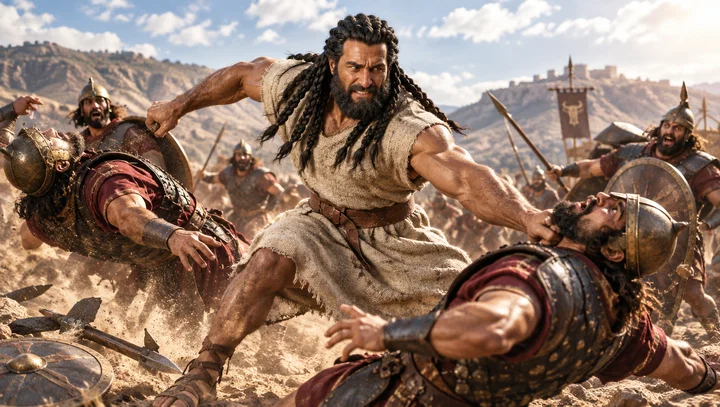
Cross-references
- Judges 14:6
And the Spirit of the LORD came mightily upon him, and he rent him as he would have rent a kid, and he had nothing in his hand: but he told not his father or his mother what he had done.
Samson’s Spirit-given strength is shown when he tears apart the lion.
- Judges 14:19
And the Spirit of the LORD came upon him, and he went down to Ashkelon, and slew thirty men of them, and took their spoil, and gave change of garments unto them which expounded the riddle. And his anger was kindled, and he went up to his father’s house.
Earlier killing of thirty men of Ashkelon and display of prodigious strength.
- Judges 13:5
For, lo, thou shalt conceive, and bear a son; and no razor shall come on his head: for the child shall be a Nazarite unto God from the womb: and he shall begin to deliver Israel out of the hand of the Philistines.
Samson’s Nazarite consecration is the source of his strength in battle.
- Judges 13:24-25
And the woman bare a son, and called his name Samson: and the child grew, and the LORD blessed him.
Introduces Samson, whose story is recommended.
- Judges 15:15
And he found a new jawbone of an ass, and put forth his hand, and took it, and slew a thousand men therewith.
Samson’s jawbone attack continues the slaughter of the Philistines.
- Judges 16:30
And Samson said, Let me die with the Philistines. And he bowed himself with all his might; and the house fell upon the lords, and upon all the people that were therein. So the dead which he slew at his death were more than they which he slew in his life.
Samson dies while striking Israel’s enemies.
Commentary
Each commentary is drawn from primary sources: the writings of Ellen G. White and Adventist pioneers and periodicals. Each commentary is separate. Its own words are not a quotation; follow the references to read the source passages.
Ellen G. White
3 sources
This verse belongs to the story of Samson, the promised son given to Manoah to serve as judge and deliverer of Israel.PP 562.2–563.1 His extraordinary physical strength came not from well-knit sinews but from his condition as a Nazarite from birth, symbolized by his unshorn hair.PP 562.2–563.1 Just as he was entering manhood and the time to carry out his divine mission, when above all others he should have stayed true to God, he mingled on friendly terms with the Philistines near Zorah and formed intimacies that darkened his whole life.PP 562.2–563.1 He insisted on marrying a Philistine woman from Timnath because she pleased him, against the dissuasion of his God-fearing parents.PP 562.2–563.1
He was a man of extraordinary physical strength but weak in self-control, giving in to passion, and his choices led to shame, disaster, and death.ST Oct 13, 1881 In this verse he attacks the Philistines in anger over the barbarous murder of his wife, smiting them with a great slaughter.PP 563.4–564.1 Afterward he withdraws to the top of the rock Etam in the tribe of Judah to find a safe retreat from his enemies.PP 563.4–564.1
Sources
Pioneers and periodicals
11 sources
The great slaughter came after the catching of the three hundred animals, a work not done alone or in a single day, for a man is credited with what he employs agents to do, and the work probably took several days.RH Sep 11, 1860 The Hebrew word shualim means both foxes and jackals, creatures between the wolf and the fox, called the wolf-fox, very numerous in Palestine and gathering in herds of two or three hundred, with the context deciding which is meant.RH Sep 11, 1860 The firebrands were made as a torch of resinous wood that would not go out when trailed through the fields.RH Sep 11, 1860 He did not use his own hands but chose mean and weak instruments to put signal contempt upon his enemies, mingling ridicule with revenge.RH Sep 11, 1860
The attack was retaliation in anger after the Philistines barbarously murdered his wife.ST Sep 27, 1910ST Oct 6, 1881 After the great slaughter he withdrew to the strong rock Etam in Judah, in the tribe of Judah, seeking a safe retreat to escape the Philistines and fearing to trust and avoiding reliance on his own countrymen.ST Sep 27, 1910ST Oct 6, 1881 The rock Etam was a cave on the way from Jerusalem to Jaffa, from which he came forth to trouble the Philistines.RH Jul 28, 1904
The verse belongs to the account of Samson's checkered career and judgeship in the fearfully checkered time of Israel's history.ST Apr 4, 1911ST Mar 24, 1909 Samson was a man of extraordinary physical strength who was morally weak, very weak in character and self-control, and gave in to passion.ST Oct 13, 1881ST Apr 4, 1911ST Mar 24, 1909 His character combined selfishness, sensuality and carnality with impulsive good and indulgent evil, and he was deeply selfish and sensuous.ST Apr 4, 1911ST Apr 2, 1912ST Mar 24, 1909 By his choices he squandered his opportunities, leading to shame, disaster and death.ST Oct 13, 1881ST Apr 4, 1911
Yet he believed in God, in Israel's mission and in God's leading, showing strong faith and serving as an example of faith.ST Apr 2, 1912ST God did not use him because of his selfishness, carnality or sins but in spite of them, using the very best material He could find when His children had departed far from Him in order to save His people amid the circumstances of Israel and the Philistines.ST Apr 2, 1912ST Mar 24, 1909 Samson was willing in the end to give his life to avenge his people's foes.ST The verse belongs to Old Testament Scriptures that are true, important and fully stand together with the account of creation and the fall, the story of Jonah and the teachings of Christ and the New Testament.ST Mar 9, 1888
Faith in Christ requires believing it rather than ridiculing or rejecting it as improper, obsolete or unreliable, because Christ and the apostles appealed to these ancient Scriptures and held firm faith in their truthfulness.ST Mar 9, 1888 The image of striking hip and thigh with a great slaughter applies to forceful opposition to sin, urging preachers to expose it and strike hard at every iniquity with the word of God.ST Feb 6, 1893
Sources