Judges 17:5
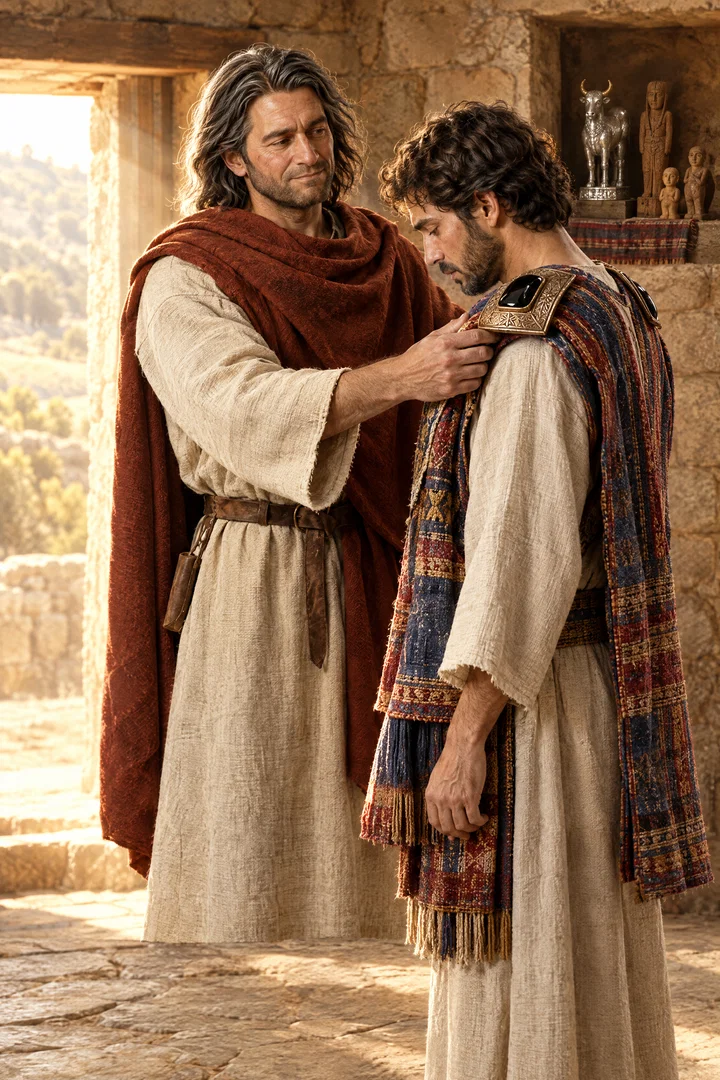
And the man Micah had an house of gods, and made an ephod, and teraphim, and consecrated one of his sons, who became his priest.
Translations
American King James Version, King James Version
And the man Micah had an house of gods, and made an ephod, and teraphim, and consecrated one of his sons, who became his priest.
KJV Cambridge Paragraph Bible, Webster Bible
And the man Micah had a house of gods, and made an ephod, and teraphim, and consecrated one of his sons, who became his priest.
And the man Micah had an house of gods, and he made an ephod, and teraphim, and consecrated one of his sons, who became his priest.
And the man Micah had a house of gods, and he made an ephod, and teraphim, and consecrated one of his sons, who became his priest.
As to the man Micah, he hath a house of gods, and he maketh an ephod, and teraphim, and consecrateth the hand of one of his sons, and he is to him for a priest;
And the man Micah had a house of gods, and made an ephod and teraphim, and consecrated one of his sons, who became his priest.
Now, the man Micah, had a house of gods,—and he made an ephod, and teraphim, and installed one of his sons, who became his priest.
Berean Standard Bible, Majority Standard Bible
Now this man Micah had a shrine, and he made an ephod and some household idols, and ordained one of his sons as his priest.
The man Micah had a house of gods, and he made an ephod, and teraphim, and consecrated one of his sons, who became his priest.
And the man Micah had a house of gods; and he made an ephod and family gods and put one of his sons in the position of priest.
And this man Michah had an house of gods, and made an Ephod, and Teraphim, and cosecrated one of his sonnes, who was his Priest.
Douay-Rheims (Challoner revision)
And he separated also therein a little temple for the god, and made an ephod, and theraphim, that is to say, a priestly garment, and idols: and he filled the hand of one of his sons, and he became his priest.
Pictures
Cross-references
- Judges 18:30-31
And the children of Dan set up the graven image: and Jonathan, the son of Gershom, the son of Manasseh, he and his sons were priests to the tribe of Dan until the day of the captivity of the land.
The Danites take Micah’s idols and continue their worship.
- Hosea 3:4
For the children of Israel shall abide many days without a king, and without a prince, and without a sacrifice, and without an image, and without an ephod, and without teraphim:
Both texts mention teraphim among objects associated with idolatry.
- 1 Kings 12:28-30
Whereupon the king took counsel, and made two calves of gold, and said unto them, It is too much for you to go up to Jerusalem: behold thy gods, O Israel, which brought thee up out of the land of Egypt.
Jeroboam establishes calf worship at Dan, where idolatrous worship was already established.
- Zechariah 10:2
For the idols have spoken vanity, and the diviners have seen a lie, and have told false dreams; they comfort in vain: therefore they went their way as a flock, they were troubled, because there was no shepherd.
Teraphim are associated with false oracles.
Commentary
Each commentary is drawn from primary sources: the writings of Ellen G. White and Adventist pioneers and periodicals. Each commentary is separate. Its own words are not a quotation; follow the references to read the source passages.
Pioneers and periodicals
11 sources
Micah, an Ephraimite, set up a household shrine with an ephod and teraphim and installed one of his sons as its priest, making his home a center of idolatrous worship.RH May 28, 1901ST Apr 5, 1905 It belongs to the closing chapters of Judges, which though placed last describe events early in the judges' history when there was no king and everyone did what was right in his own eyes, showing how low Israel had sunk before Samuel was called.STST Apr 4, 1911ST Mar 24, 1909 The shrine stood as a rival to God's sanctuary, set up in opposition to it as part of the effort to tread it under foot.RH Nov 10, 1863 It exposes a merely outward religion that supposes idolatry with images becomes acceptable when joined to religious forms, even to keeping a priest in the house.ST Aug 17, 1882RH Jul 3, 1856 That self-justifying excuse for actual transgression belongs to the long record of backsliding followed by suffering and deliverance, which displays God's long-suffering toward His lapsing people and warns none to repeat their course with impunity.STRH Jul 3, 1856
Setting and Meaning
The verse stands in the closing portion of Judges, chapters 17-21, and in the Judges 17-19 section, within the survey of Judges 1-21 concerning the leaders God raised up in national crisis and called saviours, the last of whom was Samuel. Although placed at the end of the book, the real story ends with chapter 16, while the events of chapters 17-21 occurred in the early part of the history of the judges. This chapter with chapters 18-21 is therefore earlier in chronological order than chapters 11-16, and shows how low Israel had fallen before the call of Samuel the prophet.ST Apr 4, 1911ST Mar 24, 1909
Its setting is the time when there was no king in Israel but every man did what was right in his own eyes.RH May 28, 1901 The statement about there being no king, read with Judges 18:1, 31, places the writing of the book about the time that there was a king in Israel, possibly by Samuel or Nathan. It must be read against the awful moral surroundings of Israel and the demoralizing influences of the tribes Israel permitted to remain in the land of promise.ST
The verse means that Micah, an Ephraimite, established a house of gods or household shrine and made an ephod and teraphim and consecrated one of his sons to be its priest, making his home a center of idolatrous worship.RH May 28, 1901ST Apr 5, 1905ST Jul 2, 1885 The images were statues or standing pillars, and together with the teraphim and ephod they were used as oracles for divination or interpreting dreams.RH Dec 22, 1910 This account introduces the later arrangement in which a Levite became priest in Micah's household.RH Dec 22, 1910
Backsliding, Idolatry, and Lessons
Judges 17:5 belongs to a record of backsliding that brings disgrace and punishment, showing religious practice corrupted by sin in Micah's establishment of a household shrine and appointment of his son as priest.ST Apr 5, 1905 It exposes the perversity and unbelief of the people amid the awful moral surroundings of Israel and the demoralizing influences of the tribes Israel permitted to remain in the land of promise.ST It belongs to the composite record of Judges 3 to 17 showing backsliding from God followed by suffering, oppression, captivity and servitude, and returning to God followed by forgiveness and deliverance.ST It thereby exposes the long-suffering and goodness of God and His effort to restore His constantly lapsing people.ST It belongs to chapters 17-21, whose events occurred in the early part of the history of the judges though the real story of the book ends with chapter 16, including the sanctuary at Dan and two stories of awful idolatry in the latter part of Judges showing the sad record of God's people's transgressions and constant lapsing into idolatry. Israel's backsliding gives no thought that one can do the same with impunity.
Micah's house of gods, with its ephod and teraphim and consecrated son as priest, was Satan's rival sanctuary in the days of the Judges and Samuel, set up in opposition to God's sanctuary as part of Satan's work through paganism to tread God's sanctuary under foot.RH Nov 10, 1863 The chapter shows the first apostasy associated with the tribe of Dan, which is suggested as a reason Dan was omitted from the tribes listed among the 144,000 in Revelation 7.ST Jun 26, 1907 The verse illustrates a merely outward, incomplete religion, for Micah thought himself religious because he had a priest in his house, though this did not make his worship genuine.ST Aug 17, 1882 He held the idea that even idolatry with molten images would be acceptable to God if attended with the ordinances of religion, as seen when he set up molten images and obtained a true Levite as priest for them in Judges 17:1-13.RH Jul 3, 1856 That justification of idolatry is an excuse for an actual transgression committed, a sin of commission, and exemplifies the evasive nature of the human heart that justifies wrongdoing instead of acknowledging its full enormity and seeking pardon.RH Jul 3, 1856
Micah, an Ephraimite, had a house of gods and made an ephod and teraphim and consecrated one of his sons, who became his priest, and this belongs to the olden time when there was no king in Israel but every man did that which was right in his own eyes.RH May 28, 1901 It pictures the condition of Adventists after the close of the prophetic period on Oct. 22, 1844, until they got an understanding of the real event to occur at the end of the days.RH May 28, 1901 Then they were like sheep without a shepherd in great confusion and opposed to organization, though not in every respect just like the ancients.RH May 28, 1901
Sources