Translations
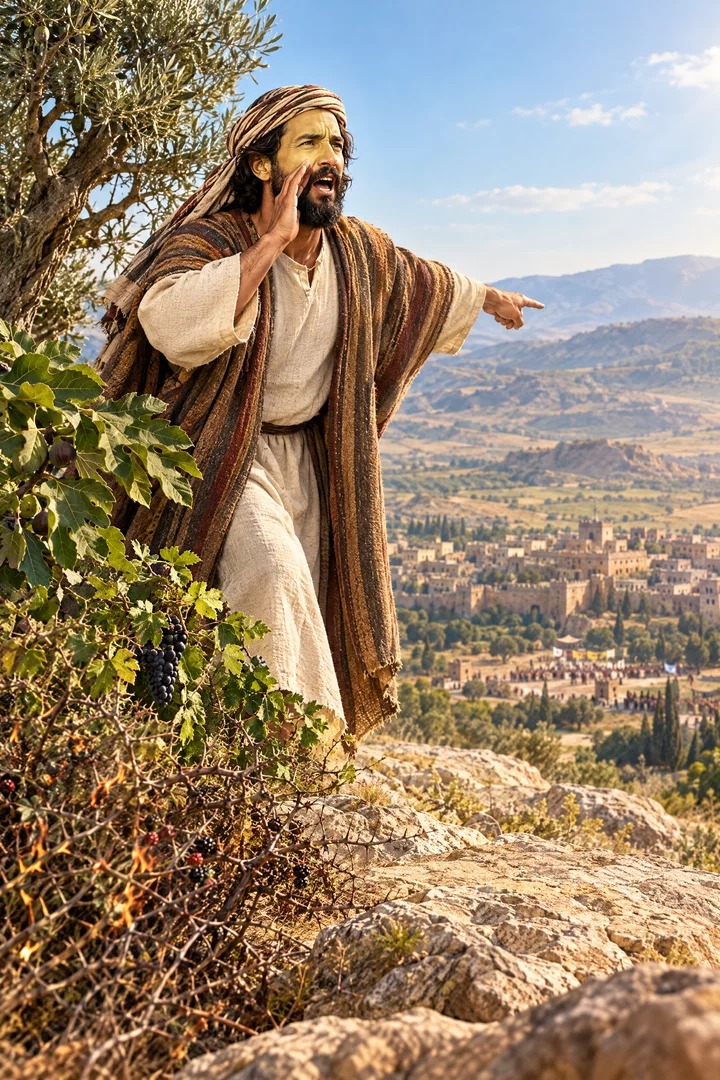
And the trees said to the fig tree, Come you, and reign over us.
King James Version, KJV Cambridge Paragraph Bible, Revised Version
And the trees said to the fig tree, Come thou, and reign over us.
Webster Bible, American Standard Version
And the trees said to the fig-tree, Come thou, and reign over us.
And the trees say to the fig, Come thou, reign over us.
And the trees said to the fig-tree, Come thou, reign over us.
Then said the trees unto the fig-tree,—Come! thou reign over us.
Berean Standard Bible, Majority Standard Bible
Then the trees said to the fig tree,
‘ Come and reign over us.’“ The trees said to the fig tree, ‘ Come and reign over us.’
Then the trees said to the fig-tree, You come and be king over us.
Then the trees sayde to the fig tree, Come thou, and be King ouer vs.
Douay-Rheims (Challoner revision)
And the trees said to the fig tree: Come thou and reign over us.
Pictures
Cross-references
- 2 Kings 14:9
And Jehoash the king of Israel sent to Amaziah king of Judah, saying, The thistle that was in Lebanon sent to the cedar that was in Lebanon, saying, Give thy daughter to my son to wife: and there passed by a wild beast that was in Lebanon, and trode down the thistle.
A thistle speaks to a cedar in a parable.
- Judges 9:14-15
Then said all the trees unto the bramble, Come thou, and reign over us.
The bramble’s grasp for honor contrasts with Abimelech’s ambition.
- Judges 9:19-20
If ye then have dealt truly and sincerely with Jerubbaal and with his house this day, then rejoice ye in Abimelech, and let him also rejoice in you:
prophecy of mutual destruction fulfilled
- 1 Chronicles 16:33
Then shall the trees of the wood sing out at the presence of the LORD, because he cometh to judge the earth.
both given as trees speaking or singing
- 2 Chronicles 25:18
And Joash king of Israel sent to Amaziah king of Judah, saying, The thistle that was in Lebanon sent to the cedar that was in Lebanon, saying, Give thy daughter to my son to wife: and there passed by a wild beast that was in Lebanon, and trode down the thistle.
The same parable has the thistle address the cedar.
Commentary
Each commentary is drawn from primary sources: the writings of Ellen G. White and Adventist pioneers and periodicals. Each commentary is separate. Its own words are not a quotation; follow the references to read the source passages.
Ellen G. White
2 sources
The verse belongs to Jotham's parable in which the trees are seeking a king and come to the fig tree with the call to reign over them.ST Aug 4, 1881ST Aug 4, 1881 In that parable the fig tree stands for the unselfish and upright leaders who do not seek rank or power but live to bless others.ST Aug 4, 1881ST Aug 4, 1881 Such leaders claim no kingly honors and do not aspire to place or authority, making it their work to do good to their fellow men.ST Aug 4, 1881
Moses and Joshua are living illustrations of this character and of what a leader of Israel should be, giving themselves in self-sacrificing devotion to the welfare of others.ST Aug 4, 1881 That devotion stands in striking contrast to Abimelech, the worthless bramble who grasped honor for himself through treachery, violence, and bloodshed.ST Aug 4, 1881 That Israel was willing to place such a despot and murderer as commander-in-chief shows how low the nation had fallen.ST Aug 4, 1881
Sources
Pioneers and periodicals
22 sources
The verse is part of Jotham's parable of the trees holding an imagined council and election to seek a king, in which they make speeches and invite the fig tree to reign over them.ST Oct 1, 1902ST Dec 4, 1884ST May 20, 1886 It is personification in which trees that cannot speak or rule are pictured as reasoning and talking, a fictitious story whose imagined speech is a legitimate way to set truth before the mind in a vivid picture.ST Aug 19, 1880ST Dec 4, 1884ST Jun 30, 1881RH Sep 25, 1913ST Mar 15, 1877 The invited fig tree stands for upright, unselfish leaders such as Moses and Joshua, who claim no kingly honors and seek no rank or power but give themselves to bless others, in striking contrast to Abimelech the worthless bramble who grasped rule over Shechem by treachery, violence and bloodshed.ST Aug 4, 1881ST Aug 4, 1881ST Oct 1, 1902 Those doing the most valuable work do not seek authority over their brethren, and ambition to be exalted over others shows a person unfit to rule.ST Oct 1, 1902 The talking trees are figurative speech assigned to inanimate things, not proof that trees think or speak, just as the speaking dead in hades and the speech in the parable of the rich man and Lazarus do not prove that men go to their reward at death or are conscious in death.ST Aug 25, 1881RH Jan 7, 1902ST Jun 30, 1881RH Mar 28, 1865ST Mar 27, 1879
Form and Historical Setting
Judges 9:10 belongs to Jotham's parable, apologue, or fable of the trees seeking a king.ST Oct 1, 1902ST Dec 4, 1884ST May 20, 1886ST Mar 28, 1906RH Mar 28, 1865 In that imagined scene the trees hold a council and an election, make speeches, and invite the fig tree to reign over them.RH Aug 7, 1916RH Mar 16, 1916ST Mar 15, 1877ST Mar 27, 1879RH May 12, 1874 The parable is said to tell of the work of a king.ST Mar 28, 1906
The literary device at work is personification, in which inanimate objects are represented as animated and given personality and the powers of reason and speech.ST Jun 30, 1881RH Sep 25, 1913ST Mar 15, 1877 Trees, which are inanimate and cannot actually speak or rule, are represented as living beings that speak, hold an election, and ask the fig tree to rule them.ST Jun 30, 1881ST Mar 15, 1877RH Mar 28, 1865ST Mar 27, 1879RH May 12, 1874 Personification is the giving to an inanimate being the sentiments, actions, and language of a rational being.RH Sep 25, 1913RH May 12, 1874
As a fictitious story, this imagined speech of trees that cannot actually speak or reign does not make the words false.ST Aug 19, 1880ST May 20, 1886 Such figurative speech is a legitimate feature of parables, an apologue or fictional device meant to impress a moral truth.ST Aug 19, 1880ST May 20, 1886ST Aug 19, 1880 This imagined speaking and choosing of a king conveys truth in a striking way, using a vivid picture to enforce a moral point.ST Dec 4, 1884ST May 20, 1886ST Aug 19, 1880
In its setting the parable reproves the men of Shechem for choosing Abimelech as king.ST Oct 1, 1902ST Aug 19, 1880 Abimelech, the son of Gideon's maid, had Gideon's sons slain so he himself might become ruler, gathered worthless followers, and utterly destroyed Shechem.ST Oct 1, 1902ST Jun 29, 1904 Shechem was the very ancient stopping-point of Jacob when he returned from Padan-aram to Canaan.ST Jun 29, 1904
Meaning and Moral Lesson
The fig tree invited to reign represents the unselfish, upright leaders who did not seek rank or power but lived to bless others.ST Aug 4, 1881 Its refusal represents noble, upright leaders such as Moses and Joshua, living illustrations of what a leader of Israel should be, who claim no kingly honors and do not aspire to rank or power but make it their work to bless their fellow men through self-sacrificing devotion.ST Aug 4, 1881 That devotion stands in striking contrast to Abimelech, the worthless bramble who grasped honor through treachery, violence and bloodshed, having his brothers slain and gathering worthless followers, at a time when Israel had fallen so low as to place a despot and murderer as commander-in-chief, exposing the folly of Shechem's choice.ST Aug 4, 1881ST Oct 1, 1902
Those doing the most valuable work in the Lord's cause do not seek authority over fellow believers, and ambition to be exalted over others shows a person is unfit to rule.ST Oct 1, 1902 The trees' search for a ruler is applied to churches competing to bear the best fruit rather than to be the most unprofitable, and the parable is said to tell of the work of a king.ST Mar 28, 1906RH May 17, 1864 The fable contrasts people, who can choose and are accountable for their choices, with trees, which do not literally elect a ruler.RH Feb 15, 1870
Light on State of Dead
The invitation to the fig tree to take kingship belongs to a parable in which trees speak, and speech put into the mouth of an inanimate object does not mean it has conscious intelligence.ST Aug 25, 1881RH Jan 7, 1902ST Jun 30, 1881 The scene is figurative rather than literal, not evidence that trees can think or speak, possess consciousness or human speech, or exercise rule.ST Aug 25, 1881RH Jan 7, 1902ST Jun 30, 1881RH Aug 7, 1916RH Mar 16, 1916 The trees are imagined as holding a council and speaking to teach a lesson, with personified trees acting and speaking as though alive, so their conversation is not an account of trees actually talking.RH Aug 7, 1916RH Mar 16, 1916RH Mar 28, 1865
Scripture in this manner makes inanimate things speak and act as if they were alive.RH Mar 28, 1865ST Mar 27, 1879RH May 12, 1874 The trees hold an election, make speeches, and invite the fig tree to reign though trees cannot speak or rule, by giving to an inanimate being the sentiments, actions, and language of a rational being.ST Mar 27, 1879RH May 12, 1874 The dead in hades are made to speak and act in the same way as though they were alive.RH Mar 28, 1865RH May 12, 1874
It is the same kind of figurative language as Christ used in the parable of the rich man and Lazarus, or Dives and Lazarus, to rebuke covetousness and to urge heeding the word of God.RH Sep 25, 1913RH May 12, 1874 Just as the speaking trees do not prove trees possess consciousness or human speech, so the speech of Dives and Lazarus does not prove that the dead are conscious.ST Aug 25, 1881RH Jan 7, 1902RH May 12, 1874 Such speech does not prove that men go to their reward at death or that the dead are conscious.RH Sep 25, 1913RH May 12, 1874
Sources