Leviticus 2:9
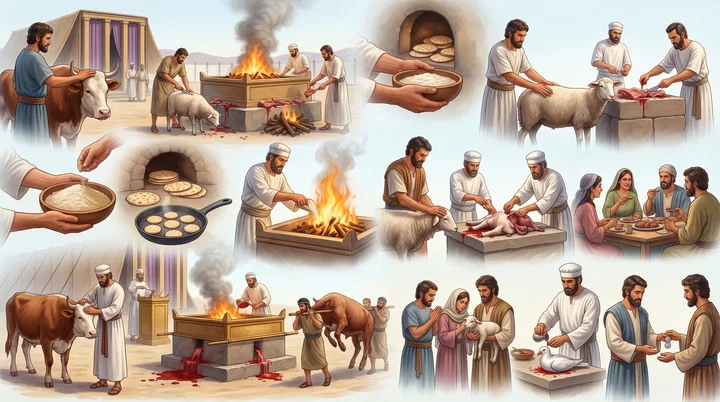
And the priest shall take from the meat offering a memorial thereof, and shall burn it upon the altar: it is an offering made by fire, of a sweet savour unto the LORD.
Translations
And the priest shall take from the meat offering a memorial thereof, and shall burn it on the altar: it is an offering made by fire, of a sweet smell to the LORD.
And the priest shall take from the meat offering a memorial thereof, and shall burn it upon the altar: it is an offering made by fire, of a sweet savour unto the LORD.
And the priest shall take from the meat offering a memorial thereof, and shall burn it upon the altar: it is an offering made by fire, of a sweet savour unto the Lord.
And the priest shall take from the meat-offering a memorial of it, and shall burn it upon the altar: it is an offering made by fire, of a sweet savor to the LORD.
And the priest shall take up from the meal offering the memorial thereof, and shall burn it upon the altar: an offering made by fire, of a sweet savour unto the LORD.
And the priest shall take up from the meal-offering the memorial thereof, and shall burn it upon the altar, an offering made by fire, of a sweet savor unto Jehovah.
and the priest hath lifted up from the present its memorial, and hath made perfume on the altar, a fire-offering of sweet fragrance to Jehovah;
And the priest shall take from the oblation a memorial thereof, and shall burn it on the altar, an offering by fire to Jehovah of a sweet odour.
Then shall the priest uplift out of the meal-offering, a memorial thereof, and make a perfume at the altar,—an altar-flame of a satisfying odour unto Yahweh.
The priest is to remove the memorial portion from the grain offering and burn it on the altar as an offering made by fire, a pleasing aroma to the LORD.
The priest is to remove the memorial portion from the grain offering and burn it on the altar as a food offering, a pleasing aroma to the LORD.
The priest shall take from the meal offering its memorial, and shall burn it on the altar, an offering made by fire, of a pleasant aroma to the LORD.
And he is to take from the meal offering a part, for a sign, burning it on the altar; an offering made by fire for a sweet smell to the Lord.
And the Priest shall take from the meate offring a memoriall of it, and shall burne it vpon the altar: for it is an oblation made by fire for a sweete sauour vnto the Lord.
Douay-Rheims (Challoner revision)
And when he hath offered it, he shall take a memorial out of the sacrifice, and burn it upon the altar for a sweet savour to the Lord.
Pictures
Cross-references
- Hebrews 8:1-5
Now of the things which we have spoken this is the sum: We have such an high priest, who is set on the right hand of the throne of the Majesty in the heavens;
Earthly sanctuary service is a pattern of Christ’s ministry in heaven.
- Hebrews 9:26
For then must he often have suffered since the foundation of the world: but now once in the end of the world hath he appeared to put away sin by the sacrifice of himself.
Christ’s once-for-all sacrifice puts away sin.
- Hebrews 9:8-12
The Holy Ghost this signifying, that the way into the holiest of all was not yet made manifest, while as the first tabernacle was yet standing:
Earthly sanctuary offerings prefigure Christ’s greater priestly ministry and sacrifice.
- Leviticus 1:5
And he shall kill the bullock before the LORD: and the priests, Aaron’s sons, shall bring the blood, and sprinkle the blood round about upon the altar that is by the door of the tabernacle of the congregation.
Both describe the priest’s role in presenting an offering at the altar.
- Leviticus 3:5
And Aaron’s sons shall burn it on the altar upon the burnt sacrifice, which is upon the wood that is on the fire: it is an offering made by fire, of a sweet savour unto the LORD.
Cited as another regulation for burning offerings on the altar.
- Leviticus 2:16
And the priest shall burn the memorial of it, part of the beaten corn thereof, and part of the oil thereof, with all the frankincense thereof: it is an offering made by fire unto the LORD.
Cited alongside it among the laws for burning offerings on the altar.
- Leviticus 3:16
And the priest shall burn them upon the altar: it is the food of the offering made by fire for a sweet savour: all the fat is the LORD’s.
Cited with it as a rule concerning offerings burned on the altar.
- Numbers 28:5-6
And a tenth part of an ephah of flour for a meat offering, mingled with the fourth part of an hin of beaten oil.
Describes daily offerings with a flour-and-oil meal offering and a sweet savour.
- Hebrews 10:1
For the law having a shadow of good things to come, and not the very image of the things, can never with those sacrifices which they offered year by year continually make the comers thereunto perfect.
Earthly offerings are shadows of the good things to come.
- Hebrews 10:3-4
But in those sacrifices there is a remembrance again made of sins every year.
Repeated sacrifices recalled sin but could not take it away.
Commentary
Each commentary is drawn from primary sources: the writings of Ellen G. White and Adventist pioneers and periodicals. Each commentary is separate. Its own words are not a quotation; follow the references to read the source passages.
Ellen G. White
1 source
The offering in view was prepared from flour mingled with oil rather than from the flesh of an animal.CTBH 169.5 For that reason the word rendered meat does not denote animal flesh at all in this ordinance.CTBH 169.5 It is used in its older and broader sense of food or provisions in general.CTBH 169.5
Sources
Pioneers and periodicals
17 sources
The word meat means food in general rather than animal flesh, so the offering was made from plant food such as fine flour mixed with oil or green ears of grain, of which the priest burned a small memorial portion with all the frankincense upon the altar as a most holy offering made by fire, a sweet savor to the Lord.RH Jul 22, 1902ST Apr 8, 1875ST Jun 5, 1901ST Jan 31, 1911ST Aug 1, 1911 It belongs to the special individual offerings brought during the year within the daily ministration and yearly cycle of the earthly sanctuary, to be burned only on the lawful altar through the Levitical priests.ST Jan 31, 1911RH Mar 8, 1870ST May 6, 1886 As an earthly pattern of the heavenly sanctuary and Christ's priestly work there, the fine flour typifies Christ as the bread of life, the oil represents the influence of the divine Spirit, and the frankincense symbolizes grateful prayer, with the food given to God and to Aaron and his sons representing God and the church feeding on Christ.ST Jun 19, 1907ST Feb 3, 1909ST Feb 13, 1912ST Jun 5, 1901ST Aug 1, 1911 It belongs to individual atonement for forgiveness of a single person or of the whole congregation when collectively guilty, distinct from the yearly national atonement for blotting sins out, requiring confession of the sin and restitution of the trespass with its principle plus the fifth part, figuring the transfer of the penitent's sins to the sanctuary to remain until the yearly cleansing through faith in the Redeemer to come, while Christ's priestly service thus typified was offered once for all.ST Feb 3, 1909ST Nov 28, 1895STST Apr 2, 1912 The grain offering is an act of worship in which a life wholly given to God and consumed on the altar rises as a sweet savor to Him, so that a life renewed by Jesus and surrendered to God's love becomes a revelation of God through which others see Christ and through Christ find the Father.ST Jan 31, 1911ST Jan 31, 1911
Wording and Offering Procedure
The word meat in the verse means food in general, not animal flesh, while animal food is denoted by flesh.RH Jul 22, 1902ST Apr 8, 1875RH Aug 1, 1871RH Mar 4, 1875 The meat offering was therefore made from plant food, such as fine flour mixed with oil or green ears of grain and other plant products.RH Jul 22, 1902ST Apr 8, 1875RH Aug 1, 1871RH Mar 4, 1875
The priest takes a small memorial portion of the fine-flour offering with oil and frankincense and burns it completely on the altar as an offering made by fire, of a sweet savour unto the Lord.ST Jun 5, 1901ST Jan 31, 1911ST Aug 1, 1911 The frankincense is all burned because it is not food for the priest.ST Aug 1, 1911 The offering is counted among the most holy offerings made by fire to the Lord.ST Aug 1, 1911
The verse belongs to the instructions for offerings in the first chapters of Leviticus, the first four chapters and, more broadly, the first seven chapters concerning offerings.ST Jan 31, 1911ST It concerns special individual offerings brought by people during the year, including those burdened with sin, within the daily ministration of the earthly sanctuary and its yearly cycle.RH Mar 8, 1870STST Apr 2, 1912 Such offerings were to be burned on the lawful altar through the Levitical priests, so no offering such as a human sacrifice could lawfully be made outside that prescribed system.ST May 6, 1886
Atonement and Heavenly Typology
The sanctuary service set out in Leviticus is an earthly pattern and object lesson pointing to the heavenly sanctuary and to priestly work carried on there.ST Jun 19, 1907 Within that service this memorial burning stands as one of the different kinds of sacrifices, and like every sacrifice it holds something in type concerning the work of Jesus Christ.ST Jun 19, 1907ST Feb 13, 1912 The grain offering itself is a type pointing to Jesus Christ.ST Feb 3, 1909 Its fine flour typifies Christ as the bread of life, its oil represents the influence of the divine Spirit, and its frankincense symbolizes grateful prayer producing a sweet fragrance acceptable to God.ST Aug 1, 1911
The priest took a small portion of the fine-flour offering, with oil and frankincense, and burned it completely on the altar as its memorial.ST Jun 5, 1901ST Aug 1, 1911 The offering contained no animal flesh, for its ingredients came from the ground.ST Aug 1, 1911 The frankincense was all burned because it was not food for the priest, while the food portion was given to God and to Aaron and his sons, representing God and the church feeding on Christ.ST Jun 5, 1901ST Aug 1, 1911 It was counted among the most holy offerings made to the Lord by fire.ST Aug 1, 1911
This offering belongs to individual atonement for the forgiveness of sins, made for a single person or for the whole congregation when collectively guilty of some sin.RH Sep 16, 1852 It stands with the burnt offering, peace offering, sin offering and trespass offering as distinct from the yearly national atonement for blotting sins out.RH Sep 16, 1852 Its atonement requires confession of the sin and restitution of the trespass with its principle plus the fifth part before it can be made.RH Sep 16, 1852 An offering made in faith figured the transfer of a penitent person's sins to the sanctuary through the sacrifice's blood or the priest's person, where the forgiven sins were represented as remaining until the yearly cleansing.ST Such individual offerings brought by people burdened with sin expressed faith in the Redeemer to come, and they teach that God hates sin and that sin demands its penalty.ST Feb 3, 1909ST Apr 2, 1912
The sanctuary service to which this offering belonged was repeated through the year within its yearly cycle.ST Nov 28, 1895ST Apr 2, 1912 That repeated yearly service typified priestly service which was offered once for all.ST Nov 28, 1895
Worship and Christian Living
The grain offering is an act of worship in which the priest takes a memorial portion and burns it on the altar as an offering made by fire of sweet savor.ST Jan 31, 1911ST Jan 31, 1911 It belongs to a chapter about offerings, within the first four chapters that give instruction concerning offerings.ST Jan 31, 1911ST Jan 31, 1911 The types set forth there chiefly relate to worship.ST Jan 31, 1911ST Jan 31, 1911
The meat offering presents a life wholly given to God and consumed upon the altar, rising to Him as a sweet savor. In spiritual application a life renewed by Jesus and surrendered to God's love becomes a revelation of God. Through such a life others can see Christ, and through Christ find the Father.
Sources