Leviticus 2:10
And that which is left of the meat offering shall be Aaron’s and his sons’: it is a thing most holy of the offerings of the LORD made by fire.
Translations
American King James Version, King James Version
And that which is left of the meat offering shall be Aaron’s and his sons’: it is a thing most holy of the offerings of the LORD made by fire.
And that which is left of the meat offering shall be Aaron’s and his sons’: it is a thing most holy of the offerings of the Lord made by fire.
And that which is left of the meat-offering shall be Aaron's and his sons': it is a thing most holy, of the offerings of the LORD made by fire.
And that which is left of the meal offering shall be Aaron’s and his sons’: it is a thing most holy of the offerings of the LORD made by fire.
And that which is left of the meal-offering shall be Aaron’s and his sons’: it is a thing most holy of the offerings of Jehovah made by fire.
and the remnant of the present [is] for Aaron and for his sons, most holy, of the fire-offerings of Jehovah.
And the remainder of the oblation [ shall be] Aaron's and his sons': [ it is] most holy of Jehovah's offerings by fire.
But the remainder of the meal-offering pertaineth to Aaron and to his sons,—most holy from among the altar-flames of Yahweh.
But the remainder of the grain offering shall belong to Aaron and his sons; it is a most holy part of the offerings made by fire to the LORD.
But the remainder of the grain offering shall belong to Aaron and his sons; it is a most holy part of the food offerings to the LORD.
That which is left of the meal offering shall be Aaron’s and his sons’. It is a most holy part of the offerings of the LORD made by fire.
And the rest of the meal offering will be for Aaron and his sons; it is most holy among the Lord's fire offerings.
But that which is left of the meate offring, shalbe Aarons and his sonnes: for it is most holy of the offrings of the Lord made by fire.
Douay-Rheims (Challoner revision)
And whatsoever is left, shall be Aaron’s, and his sons’, holy of holies of the offerings of the Lord.
Pictures
Cross-references
- Leviticus 6:17
It shall not be baken with leaven. I have given it unto them for their portion of my offerings made by fire; it is most holy, as is the sin offering, and as the trespass offering.
Both describe the priests’ portion of the offering as most holy.
- Leviticus 24:9
And it shall be Aaron’s and his sons’; and they shall eat it in the holy place: for it is most holy unto him of the offerings of the LORD made by fire by a perpetual statute.
Both offerings are most holy and belong to Aaron and his sons.
- Leviticus 2:3
And the remnant of the meat offering shall be Aaron’s and his sons’: it is a thing most holy of the offerings of the LORD made by fire.
Both identify the priests’ share of the meat offering as most holy.
- Numbers 18:8-10
And the LORD spake unto Aaron, Behold, I also have given thee the charge of mine heave offerings of all the hallowed things of the children of Israel; unto thee have I given them by reason of the anointing, and to thy sons, by an ordinance for ever.
both call offerings most holy
- Leviticus 21:22
He shall eat the bread of his God, both of the most holy, and of the holy.
Both describe offerings as holy food eaten by the priests.
- Leviticus 22:10-12
There shall no stranger eat of the holy thing: a sojourner of the priest, or an hired servant, shall not eat of the holy thing.
Specifies who may eat the holy offerings reserved for priests.
- Numbers 18:19
All the heave offerings of the holy things, which the children of Israel offer unto the LORD, have I given thee, and thy sons and thy daughters with thee, by a statute for ever: it is a covenant of salt for ever before the LORD unto thee and to thy seed with thee.
Both passages assign holy offerings to Aaron and his sons; Numbers calls this a covenant of salt.
- Exodus 29:37
Seven days thou shalt make an atonement for the altar, and sanctify it; and it shall be an altar most holy: whatsoever toucheth the altar shall be holy.
both call offerings most holy
- Hebrews 8:4-5
For if he were on earth, he should not be a priest, seeing that there are priests that offer gifts according to the law:
Earthly priestly service follows a pattern of Christ’s heavenly ministry.
- Hebrews 9:6
Now when these things were thus ordained, the priests went always into the first tabernacle, accomplishing the service of God.
Describes the sanctuary service performed by priests.
Commentary
Each commentary is drawn from primary sources: the writings of Ellen G. White and Adventist pioneers and periodicals. Each commentary is separate. Its own words are not a quotation; follow the references to read the source passages.
Ellen G. White
1 source
The term rendered meat signifies food in general rather than animal flesh.CTBH 169.5 The second chapter of Leviticus establishes that the Jewish meat offerings were prepared from flour and oil.CTBH 169.5 The portion of that flour-and-oil offering that remained was assigned to Aaron and his sons.CTBH 169.5
Sources
Pioneers and periodicals
16 sources
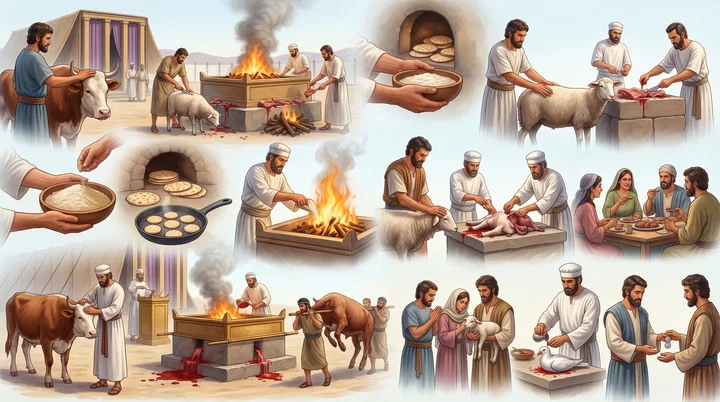
The word meat means food in general, for the offering was made of fine flour mingled with oil and sometimes of green ears of corn, and after a small memorial portion with all the frankincense was burned by fire the remainder belonged to Aaron and his sons to eat as a thing most holy.RH Jul 22, 1902ST Apr 8, 1875RH Aug 28, 1853RH Aug 1, 1871ST Aug 1, 1911
It belongs to the individual offerings of Leviticus 1-7 that were part of the continual daily ministration in the first apartment of the earthly sanctuary by the Levitical priesthood as the example and shadow of Christ's ministry in the true tabernacle.RH Feb 3, 1853RH Mar 8, 1870ST Nov 28, 1895
Those offerings were brought by people burdened with sin in faith in the Redeemer to come, figuring the transfer of the penitent's sins to the sanctuary and showing God's hatred of sin and that sin requires a penalty.ST Feb 3, 1909STST Apr 2, 1912ST Feb 13, 1912
The giving of the offering to God and to Aaron and his sons represents God and the church feeding on Christ, with the flour representing Christ as the bread of life, the oil the influence of the divine Spirit, and the incense grateful prayer.ST Jun 5, 1901ST Aug 1, 1911
Its being called most holy does not make it more holy than the seventh-day Sabbath, which is blessed and sanctified with solemn command to keep it holy, for the two are not compared and that one holy day is much more holy than the various things called most holy.RH Jun 10, 1862
Terms and Sanctuary Setting
The word meat means food in general and not the flesh of animals, for the meat offering is a food or grain offering and not an offering of animal flesh.RH Jul 22, 1902ST Apr 8, 1875RH Aug 1, 1871RH Mar 4, 1875 Those offerings were usually made of fine flour mingled with oil, and sometimes of green ears of corn.RH Jul 22, 1902ST Apr 8, 1875RH Aug 1, 1871RH Mar 4, 1875
A small handful of the flour and oil, with all the frankincense, was burned by fire as a memorial portion.ST Aug 1, 1911 That which was left afterward belonged to Aaron and his sons as food to eat.RH Aug 28, 1853ST Aug 1, 1911 What remained was most holy among the offerings made to the Lord by fire, while the offering itself was holy to the Lord.RH Aug 28, 1853ST Aug 1, 1911
The verse belongs to Leviticus 1-7, which gives the instructions for the particular individual offerings presented through the year as persons brought their own offerings.RH Feb 3, 1853RH Mar 8, 1870 That work was part of the continual daily ministration in the first apartment of the earthly sanctuary, performed by the Levitical priesthood.RH Feb 3, 1853RH Mar 8, 1870 The yearly round of Levitical offerings and priestly rites was the example and shadow of Christ's ministry in the true tabernacle and heavenly sanctuary, even His once-for-all ministry there.RH Feb 3, 1853ST Nov 28, 1895
The chapter to which the verse belongs describes the salt of the covenant.ST Aug 10, 1904 Salt was used to make the covenant effective, and it signified the preserving, uncorrupting nature of the covenant.ST Aug 10, 1904 The verse concerns holy food for the priests, not the two apartments of the tabernacle, for no bread pertained to or was offered in the most holy place.RH Aug 28, 1853 Therefore the holy and the most holy that a blemished priest could still eat means this bread of the meat offering and like holy food, not entrance into the holy places.RH Aug 28, 1853
Typology Doctrine and Application
The instructions for the offerings are types pointing to Jesus Christ as the great substance they foreshadow.ST Feb 3, 1909ST Feb 13, 1912 Every one of the different kinds of sacrifices holds something in type concerning the work of Jesus Christ.ST Feb 3, 1909ST Feb 13, 1912 These offering laws show God's hatred of sin and that sin requires a penalty.ST Feb 3, 1909
Leviticus 2 belongs among the chapters describing individual offerings brought by people burdened with sin.STST Apr 2, 1912 Those offerings were made in faith, and together with the daily offering they figured the transfer of the penitent's sins to the sanctuary.ST They expressed faith in the Redeemer who was to come.ST Apr 2, 1912
The meat offering was given to God and to Aaron and his sons, representing God and the church feeding on Christ.ST Jun 5, 1901 Its flour, oil, and frankincense were pure products of the ground with spiritual meaning.ST Aug 1, 1911 The flour represents Christ as the bread of life, the oil represents the influence of the divine Spirit, and the incense represents grateful prayer.ST Aug 1, 1911 A small handful of flour and oil with all the frankincense was burned as a memorial, while the unburned remaining portion belonged to Aaron and his sons as food and was holy to the Lord.ST Aug 1, 1911
The remainder belonging to Aaron and his sons is called most holy of the offerings made by fire, yet that superlative does not make the meat offering more holy than the seventh-day Sabbath.RH Jun 10, 1862 The Sabbath is called holy and is blessed and sanctified by God with a solemn command to keep it holy.RH Jun 10, 1862 The two are not compared with each other, so no difference in holiness can be drawn from positive against superlative.RH Jun 10, 1862 The superlative is not applied to the Sabbath because God has only one Sabbath, only the seventh day, which cannot be compared in degrees.RH Jun 10, 1862 That one holy day is much more holy than the various things called most holy.RH Jun 10, 1862
Sources