Luke 12:27
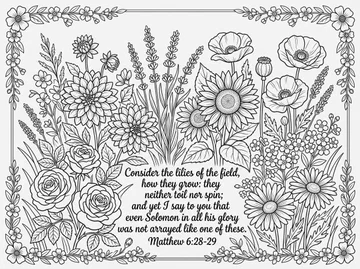
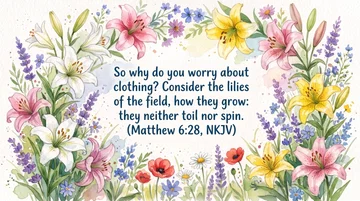
Consider the lilies how they grow: they toil not, they spin not; and yet I say unto you, that Solomon in all his glory was not arrayed like one of these.
Translations
Consider the lilies how they grow: they toil not, they spin not; and yet I say to you, that Solomon in all his glory was not arrayed like one of these.
King James Version, KJV Cambridge Paragraph Bible
Consider the lilies how they grow: they toil not, they spin not; and yet I say unto you, that Solomon in all his glory was not arrayed like one of these.
Consider the lilies how they grow: They toil not, they spin not; and yet I say to you, that Solomon in all his glory was not arrayed like one of these.
Revised Version, American Standard Version
Consider the lilies, how they grow: they toil not, neither do they spin; yet I say unto you, Even Solomon in all his glory was not arrayed like one of these.
'Consider the lilies, how do they grow? they labour not, nor do they spin, and I say to you, not even Solomon in all his glory was arrayed as one of these;
Consider the lilies how they grow: they neither toil nor spin; but I say unto you, Not even Solomon in all his glory was clothed as one of these.
Consider well the lilies, how they grow: they toil not, neither do they spin, and yet I say unto you—Not even Solomon, in all his glory, was arrayed like one of these.
Berean Standard Bible, Majority Standard Bible
Consider how the lilies grow: They do not labor or spin. Yet I tell you, not even Solomon in all his glory was adorned like one of these.
Consider the lilies, how they grow. They don’ t toil, neither do they spin; yet I tell you, even Solomon in all his glory was not arrayed like one of these.
Give thought to the flowers: they do no work, they make no thread; and still I say to you, Even Solomon, in all his glory, was not clothed like one of these.
Consider the lilies howe they growe: they labour not, neither spin they: yet I say vnto you, that Salomon himselfe in all his royaltie was not clothed like one of these.
Douay-Rheims (Challoner revision)
Consider the lilies, how they grow: they labour not, neither do they spin. But I say to you, not even Solomon in all his glory was clothed like one of these.
Pictures
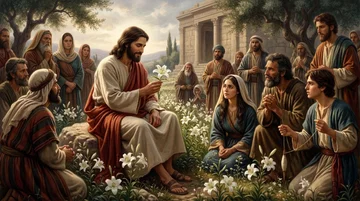
Cross-references
- Matthew 6:28-30
And why take ye thought for raiment? Consider the lilies of the field, how they grow; they toil not, neither do they spin:
Lilies and Solomon’s clothing illustrate God’s care and call for trust.
- Matthew 6:31-33
Therefore take no thought, saying, What shall we eat? or, What shall we drink? or, Wherewithal shall we be clothed?
Trusting God’s provision for life’s needs accompanies seeking his kingdom.
- Luke 12:31
But rather seek ye the kingdom of God; and all these things shall be added unto you.
Seeking God’s kingdom comes first, with trust that he will provide.
- Hosea 14:5
I will be as the dew unto Israel: he shall grow as the lily, and cast forth his roots as Lebanon.
Israel’s growth like a lily echoes the picture of growth and flourishing.
- Matthew 10:29-31
Are not two sparrows sold for a farthing? and one of them shall not fall on the ground without your Father.
God watches over sparrows and assures people they are worth more than many sparrows.
- Luke 12:6-7
Are not five sparrows sold for two farthings, and not one of them is forgotten before God?
God notices sparrows and values people, inviting trust in his care.
- Luke 12:22-23
And he said unto his disciples, Therefore I say unto you, Take no thought for your life, what ye shall eat; neither for the body, what ye shall put on.
The lilies illustrate Christ’s counsel not to worry about food or clothing.
- Matthew 6:8
Be not ye therefore like unto them: for your Father knoweth what things ye have need of, before ye ask him.
The Father knows his people’s needs and provides for them.
- Luke 12:33-34
Sell that ye have, and give alms; provide yourselves bags which wax not old, a treasure in the heavens that faileth not, where no thief approacheth, neither moth corrupteth.
Trust in God leads to giving and placing one’s treasure in heaven.
- Matthew 6:26
Behold the fowls of the air: for they sow not, neither do they reap, nor gather into barns; yet your heavenly Father feedeth them. Are ye not much better than they?
God feeds the birds, assuring people of his care.
- Matthew 6:34
Take therefore no thought for the morrow: for the morrow shall take thought for the things of itself. Sufficient unto the day is the evil thereof.
Both teach against worrying about tomorrow.
- Matthew 6:19-21
Lay not up for yourselves treasures upon earth, where moth and rust doth corrupt, and where thieves break through and steal:
Christ contrasts trust in God’s provision with pursuing earthly wealth and urges treasure in heaven.
- Philippians 4:6
Be careful for nothing; but in every thing by prayer and supplication with thanksgiving let your requests be made known unto God.
God’s provision frees people from anxiety about their needs.
- Psalms 50:10-12
For every beast of the forest is mine, and the cattle upon a thousand hills.
God owns all creation and is able to provide.
Commentary
Each commentary is drawn from primary sources: the writings of Ellen G. White and Adventist pioneers and periodicals. Each commentary is separate. Its own words are not a quotation; follow the references to read the source passages.
Ellen G. White
24 sources
The lilies grow without toiling or spinning to make their own clothing, but live and are clothed by receiving what God provides, and their God-given loveliness surpasses Solomon in all his glory, beyond anything human care or art can equal.Ms 83, 1909, par. 4–7Ms 73, 1893, par. 4–8Ms 65, 1902, par. 2–5Lt 20, 1897, par. 5–7Ms 42, 1886, par. 12 The lesson therefore rebukes anxious worry and distrust about food and clothing and daily needs, since if God so clothes the temporary grass of the field He will far more care for human beings made in His image.Ms 83, 1909, par. 4–7Ms 73, 1893, par. 4–8Ms 65, 1902, par. 2–5DA 313.2–3CTBH 70.1–2 Those who put His kingdom first may rest in His care and cast their cares upon Him, never absent from His mind.Ms 83, 1909, par. 4–7DA 313.2–3Ms 108, 1905, par. 8–10 As flowers grow not by their own anxious effort, so spiritual life and character come by receiving Christ as light and rain, until God imparts His own beauty to the soul that yields to His free grace.SC 67.3DA 313.2–3ST Mar 10, 1909 This calls for simplicity and modesty rather than pride and display, dressing and living without costly adornment, and finding influence in kindness and a meek and quiet spirit.Lt 20, 1897, par. 5–7STSE 52.1Ms 83, 1909, par. 8
Lilies' Beauty and Setting
The lilies grow without toiling or spinning and without making their own clothing, living and becoming clothed by receiving what God provides for their life.Ms 83, 1909, par. 4–7Ms 65, 1902, par. 2–5Lt 100, 1898, par. 10–18SC 67.3 Their growth is a lesson against anxious striving, showing that God clothes simply and beautifully without human toil or display.Ms 65, 1902, par. 2–5Lt 20, 1897, par. 5–7Lt 100, 1898, par. 10–18 Flowers do not grow through their own care, anxiety, or effort, but by receiving light, rain, and living water from God.Ms 83, 1909, par. 4–7SC 67.3
Their God-given beauty and perfection surpass Solomon in all his glory.Ms 83, 1909, par. 4–7Ms 73, 1893, par. 4–8Ms 42, 1886, par. 12STSE 52.1CTBH 70.1–2 Even when people care greatly and toil with weariness to make themselves objects of admiration by outward decoration, all their valued artificial adornments will not bear comparison in natural loveliness with the simple flowers of the field.Ms 73, 1893, par. 4–8STSE 52.1Lt 45, 1877, par. 2–3 No human art, skill, care, or splendor people can create or wear can equal the delicate colors, forms, and natural loveliness of flowers with God's adornment.Ms 73, 1893, par. 4–8STSE 52.1CTBH 70.1–2Lt 45, 1877, par. 2–3
The lilies and grass are temporary field growth, today beautiful and tomorrow cut down and burned, and their beauty lasts though they are cut down in a day.Ms 83, 1909, par. 4–7Ms 73, 1893, par. 4–8Ms 21, 1889, par. 93–94 They spring from the cold, dark earth or from the mud of the river bed, from a rough, brown bulb where no beauty would be expected.ST Mar 10, 1909 Yet they unfold in loveliness and fragrance when the life of God hidden within unfolds at His call in the rain and the sunshine.ST Mar 10, 1909
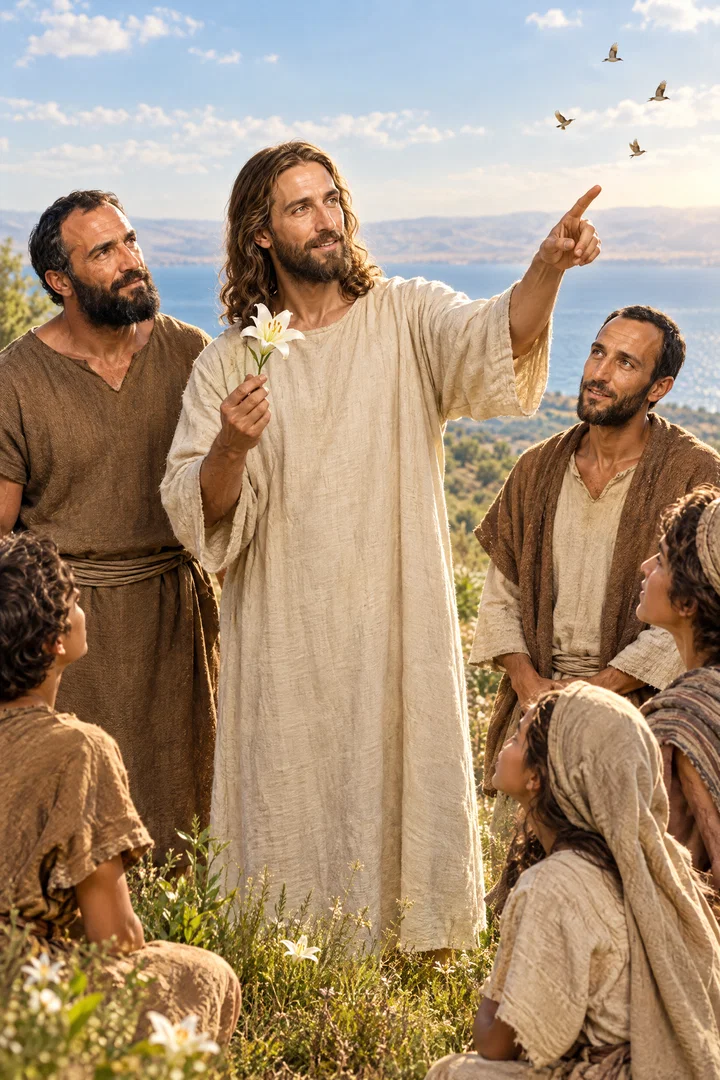
Jesus taught this lesson outdoors in the open air, generally choosing the groves and the seaside where no walls enclosed the multitude and He had a commanding view of landscape and scenery.Ms 73, 1893, par. 4–8RH May 30, 1871 He used objects and scenes familiar to humble life to make His lessons plain, simple, and interesting, such as birds caroling without care, valley flowers growing in beauty, the lily resting and reposing in spotless purity on the bosom of the lake, lofty trees, cultivated lands, waving grain, barren soil, fruitless trees, everlasting hills, bubbling streams, and the setting sun tinting and gilding the heavens.Ms 73, 1893, par. 4–8STSE 52.1RH May 30, 1871 He even placed a beautiful lily in the hands of children and youth while they looked into His own youthful face, pointing to something familiar in creation so that even children can learn spiritual truth in simplicity of natural beauty and loveliness.STE 68.3Lt 223, 1905, par. 8–10 He connected God's works in the heavens and on earth with the words of life to lead the mind out to the open fields of nature, first to nature and then up through nature to nature's God who upholds the worlds by His power.Ms 73, 1893, par. 4–8RH May 30, 18713MR 333.2–3 In this way daily life and landscape would remind hearers of immortal truth and the spiritual and unseen, and landscape, trees, birds, valley flowers, hills, lake, and heavens would be associated in their minds with sacred truths and bring His lessons fresh to memory.RH May 30, 18713MR 333.2–3Lt 45, 1877, par. 2–3 At the same time He regarded surroundings and the bodily needs of a tired, hungry throng, even feeding five thousand so they could receive spiritual benefit.RH May 30, 1871
Trust in God's Provision
Every lofty tree, shrub, blooming flower, lily of the field, and the earth clothed with living green is kept in order in its time and season to bear testimony that God loves man.Ms 73, 1893, par. 4–8 If He gives such great attention to grass and flowers that neither toil nor spin nor make their clothing, clothing them with a beauty and perfection surpassing Solomon in all his glory which no human art can equal, He will give far more to human beings formed in His image and likeness.Ms 73, 1893, par. 4–8DA 313.2–3CTBH 70.1–21T 19.1–4FE 159.2–3 God as Master-Artist gives the lilies their beauty, makes them good, tends them and watches over them, and displays in them His care and love for what He has made.DA 313.2–3CTBH 70.1–21T 19.1–4 His care for flowers shows His loving care for His creatures, so people made in His image may have still greater confidence in His care, and those who suffer or feel discouraged can take courage and hope in Jesus as a sympathetic friend and bring all troubles and griefs to Him.1T 19.1–4Lt 45, 1877, par. 4 The value of the human soul and heaven's attention to man cannot be exaggerated, removing doubtful worry about what to eat, drink and wear.Ms 73, 1893, par. 4–8
The lilies' growth without toiling or spinning is a lesson against anxious striving for food, clothing, dress and other daily needs, rebuking ingratitude, distrust, lack of faith and doubtful worry.Ms 83, 1909, par. 4–7Ms 65, 1902, par. 2–5Lt 100, 1898, par. 10–18Ms 108, 1905, par. 8–10Ms 83, 1909, par. 8 It exposes the smallness of faith that lets concern for earthly needs dominate, though people have higher powers than other creatures and have chosen disobedience to their Creator.Ms 65, 1902, par. 2–5Ms 108, 1905, par. 8–10 Consideration of this natural provision teaches that God clothes even temporary field grass and will care for His people's needs, helping people reason from what they see in nature to the importance of heavenly things.Ms 83, 1909, par. 4–7Lt 100, 1898, par. 10–18
Those who put Christ's kingdom first and seek it can rest in God's care for every need of this life, trusting Him rather than worrying.Ms 83, 1909, par. 4–7DA 313.2–3 They are never absent from His mind.DA 313.2–3 They are called to cast their cares on Him and live by heaven's principles.Ms 108, 1905, par. 8–10
As flowers grow not by their own care, anxiety or effort but by receiving what God provides for life, spiritual growth cannot be secured by anxiety or human effort but comes by receiving Christ who supplies life as light, rain and living water.SC 67.3 As sunlight gives flowers their colors, God longs to impart the beauty of His own character to people.DA 313.2–3 The life of God hidden within the rough brown bulb where no beauty would be expected unfolds in loveliness and fragrance at His call in rain and sunshine, springing even from cold dark earth or river mud, and in the same way the life of God will unfold in every human soul that yields itself to the ministry of His grace.ST Mar 10, 1909 The same word of God that creates the flowers will produce in the yielded soul the graces of His Spirit, for grace comes free as sunshine and rain with blessing to all.ST Mar 10, 1909
Considering the lilies directs attention to God's care and beauty and should awaken reverence and love for God.Lt 100, 1898, par. 10–185MR 20.1 Reading nature rightly so that earthly forms and images help grasp eternal realities requires natural simplicity, spirituality and faith and honors the God of nature.5MR 20.1
Simplicity for Daily Living
The lily rebukes the pride of life, living to please self, and courting human praise and honor, yet it does not condemn grace and natural beauty but commends simplicity, natural loveliness, modesty and lowliness.Lt 20, 1897, par. 5–7STSE 52.1Ms 83, 1909, par. 8Lt 223, 1905, par. 8–10 Even when men and women care greatly and toil with weariness to make themselves objects of admiration by outward decoration, all their valued artificial adornments cannot bear comparison in natural loveliness with the simple flowers of the field, which with God's adornment outvie in loveliness even the gorgeous apparel of Solomon in all his glory, like the lily resting in spotless purity on the bosom of the lake.Lt 20, 1897, par. 5–7STSE 52.1 God clothes simply and beautifully without human toil or display, better than Solomon, so His people are to trust Him and live simply and dress modestly, without relying on jewelry, expensive clothes, needless adornment or ostentation for influence.Lt 20, 1897, par. 5–7Ms 83, 1909, par. 8Lt 223, 1905, par. 8–10 Kindness, forethought, and a meek and quiet spirit are more precious and give true influence in Christ's service.Ms 83, 1909, par. 8
That trust means moving out by faith without debt, with self hidden and the heart guarded, hungering and thirsting after righteousness in lowliness and self-abasement through sanctification of the Spirit.Lt 20, 1897, par. 5–7 As pilgrims and strangers whose citizenship is above, believers are to build only plain tabernacles, neat, tasteful, well built, and dedicated free from debt.Lt 20, 1897, par. 5–7
Christ points to something familiar in creation so that even children can learn spiritual truth from it, for the lily's beauty surpasses Solomon's royal splendor and displays God's artistry in nature.Ms 42, 1886, par. 12CTBH 70.1–2FE 159.2–3Lt 223, 1905, par. 8–10 Children and youth are thus taught to turn from artificial display to value God's natural creation, to enjoy its beauty, to love what He has made, and to give Him their deepest affections.CTBH 70.1–2FE 159.2–3Lt 223, 1905, par. 8–10 The lily's purity also teaches them to keep themselves uncontaminated by impurity.Ms 42, 1886, par. 12
The flowers display God's skill, loving care, generosity and tender protection without human labor, for He made them good and tends and watches over them.1T 19.1–4 His care for flowers assures His children, made in His image, of still more tender protection, since He values people even more.1T 19.1–4 Their purity and natural simplicity teach trust in God and call attention to the loveliness of Christlike character, showing a loving care and generosity that should awaken gratitude rather than be treated as chance or taken for granted.
The verse belongs to a message to a large congregation blessed with great light, including unbelievers and students, calling those who strive in a tame, listless way without religious interest to put the whole heart into the service of Christ through daily prayer and watchfulness.Ms 185, 1898, par. 7–10 It calls them not only to claim to believe the truth but to live and practice the truth.Ms 185, 1898, par. 7–10 Those who suffer or feel discouraged can take courage and hope in Jesus as a sympathetic friend and bring all their troubles and griefs to Him.Lt 45, 1877, par. 4
Sources
Pioneers and periodicals
63 sources
God clothes the lilies without their toiling or spinning with a beauty greater than Solomon in all his royal glory, which proves his care and that he will much more clothe and feed people with food, drink and clothing.ST Jul 2, 1894ST Feb 2, 1882ST Aug 9, 1899 Anxiety about daily needs shows little faith like the nations who live in careful suspense, whereas the Father knows what his children need and they are to seek the kingdom of God first and all these things will be added to them.ST Aug 9, 1899RH Nov 12, 1857 This does not forbid work or reasonable care to provide for oneself, family and those in need, but warns against making anxious accumulation and self-gratification the chief work of life while neglecting salvation.ST Oct 21, 1886RH Jul 22, 1902RH Apr 28, 1868 As God gives the lily wind, sunlight, showers and daily care, so he makes people beautiful by the Holy Spirit and his grace, clothing them from within with royal beauty of character and the robe of righteousness rather than outward adornment put on from outside.ST Mar 16, 1904ST Apr 16, 1896ST Aug 14, 1901ST Aug 14, 1901 That trust applies to those waiting for Christ's return, who are to center their interests in heaven by giving to God's cause and providing treasure beyond this world's fire, and to be ready when the Lord comes instead of being absorbed in worldly provision.RH Aug 1, 1854ST Dec 24, 1894RH Jun 17, 1873
Words and Literary Setting
To consider means to apprehend from within, to perceive and understand.ST Jul 2, 1894 The lily is taken as a type of all flowers, just as the raven is taken as a type of all birds.ST Apr 16, 1896 To consider the lilies therefore teaches that God reveals himself in all creation, and not only in his word, his church, or miracles of power and grace.ST Apr 16, 1896
The verse belongs to teaching spoken to the disciples in the presence of a multitude, setting the confidence of willing faith in widest contrast with the fear of unbelief.ST Jan 22, 1880ST Oct 3, 1878 That discourse closes with the call to be ready for the unexpected coming of the Son of man.ST Feb 16, 1882 It stands with Matthew 24 and 25, Mark 13, and Luke 21 as an exhortation to watch connected with the signs of the second advent and applying to a certain period just before that event.RH Oct 15, 1872
The verse commands attention to how plants develop as the direction for all plant study.ST Nov 6, 1901 All life originates in God, in whom is the fountain of life, who not only created everything but keeps everything alive by the word of his power.ST Nov 6, 1901 Sunshine and shower, soil and care can be seen and handled, while life itself is unseen and easily forgotten, so faith is needed to remember this.ST Nov 6, 1901 Life depends on growth, and when growth ceases life ceases; life in the true sense exists only while developing, and to cease developing is to begin to cease living, continually urging on to mental and spiritual growth.ST Nov 6, 1901
Jesus taught divine truth through familiar nature, generally choosing the open air, the groves and the seaside, where no walls enclosed the multitude and he had a commanding view of landscape and scenery.RH May 30, 1871 He did not hold himself aloof but came where people were, to make his lessons plain, simple and interesting with objects and scenes familiar to humble life.RH May 30, 1871 He used caroling birds without care, valley flowers growing in beauty, and the lily reposing in purity upon the bosom of the lake, with lofty trees, cultivated lands, waving grain, barren soil, fruitless trees, everlasting hills, bubbling streams, and the setting sun tinting and gilding the heavens, to impress hearers with divine truth and extol God's wisdom in creation.RH May 30, 1871 He connected God's works in heaven and on earth with the words of life and directed minds through nature up to nature's God, regarding his surroundings and the bodily needs of a tired, hungry throng, even feeding five thousand so they could receive spiritual benefit.RH May 30, 1871 Landscape, trees, birds, valley flowers, hills, lake and heavens would thus be associated in their minds with sacred truths and bring his lessons fresh to memory as hallowed after his ascension to heaven.RH May 30, 1871
God's Care Teaches Trust
The lilies grow without toiling or spinning, yet God clothes them with a beauty greater than Solomon in all his royal glory and splendor, and their clothing proves his care for his creatures.ST Jul 2, 1894ST Feb 2, 1882ST Aug 9, 1899ST Aug 14, 1901 Because he so arrays them, he will much more clothe people and provide food, drink and clothing for them, and they should trust him rather than worry about their support.ST Jul 2, 1894ST Feb 2, 1882ST Aug 9, 1899ST Oct 21, 1886 The example is given to inspire implicit trust in his care.ST Oct 21, 1886
The lilies serve as teachers of the way of life, offering simple lessons with profound wisdom, and as a natural sign pointing to spiritual truth.ST Aug 14, 1901 The following verse applies God's clothing of the grass that is today in the field and tomorrow is cast into the oven to assure people of his still greater care and to call them to faith.RH Aug 25, 1904 Because he cares for these short-lived, soulless creatures that will eventually fade, people of little faith can trust that he will care for them who have eternal life.RH Aug 25, 1904
Anxiety about clothing and daily needs reflects little faith and the way of the nations who live in careful suspense, whereas the Father knows his children's needs.ST Aug 9, 1899RH Nov 12, 1857ST Apr 8, 1886 They are not to seek anxiously what they shall eat or drink nor be anxiously preoccupied with life's material needs, but to seek the kingdom of God first, and all these things shall be added to them.RH Nov 12, 1857ST Apr 8, 1886 Real trust is shown when the supply seems exhausted, and trusting God for eternal life, which matters more than physical life, makes it possible to trust him for lesser needs.ST Jul 2, 1894 The lily's growth connects also with flourishing in Hosea and with righteousness springing up before the nations in Isaiah.ST Jul 2, 1894
The verse teaches implicit, quiet dependence on God rather than fear, discontent, over-anxiety and restless dissatisfaction.ST Oct 21, 1886RH Nov 5, 1872 It exposes how little anxious care achieves and how selfishness creates artificial necessities for itself and becomes miserable in proportion to worry over imagined wants.RH Jul 22, 1902RH Nov 5, 1872 It does not forbid work or reasonable care in providing food and clothing for oneself, family and those in need, but warns against making anxious accumulation and self-gratification the chief work of life while neglecting salvation and the kingdom of God.RH Apr 28, 1868 All things, including the lily, are under the watch-care of God's omnipotent hand, so nature reveals the principles of his kingdom.ST Feb 3, 1904ST Jul 30, 1912 Because he feeds the ravens and clothes the grasses, he will all the more care for those he loves in both great and small troubles, giving reason to bring trials, sorrows, wounds, weakness and daily bread to him in prayer rather than be anxious about what they will wear.RH Jan 14, 1909ST Apr 8, 1886ST Jul 29, 1913ST Feb 3, 1904
Readiness and Heavenly Treasure
The lilies grow without toiling yet surpass Solomon in royal splendor, and that trust in God's care for clothing and daily needs belongs to those waiting for Christ's return, who are to seek God's kingdom rather than be absorbed in worldly provision and to be ready when the Lord comes, for to continue ordinary pursuits in unbelief instead of heeding the warning brings judgment as in Noah's day.RH Aug 1, 1854 The verse stands in Christ's instruction in Luke 12:22-37 to His disciples, the little flock who wait for the Lord to return from the wedding, commanding them to sell what they have, not a part of it or a portion of income, and give alms to provide treasure in heaven. Interests are to be centered in heaven rather than on earthly possessions, since nothing can be carried into the promised land.ST Dec 24, 1894 The command means everyone who keeps the Sabbath, professes present truth, and professes to look for the Lord, and to deny that it applies is hypocrisy, for all its requirements must be obeyed to stand in the judgment and be acquitted.
Selling means selling from surplus property to help fund the work of spreading Bible truth, not rashly selling a poor person's only home and leaving him in want.RH Nov 10, 1859 Profession without works agreeing with faith is dead faith that will do no good amid the awful scenes soon to burst upon the world. What is sacrificed or invested in God's cause from a pure motive to glorify God is not lost but saved.RH Jun 17, 1873 Giving means, reputation, life, health, houses, lands and earthly friends to Christ and the gospel transfers them from mortal life to the immortal shore and secures treasure in heaven beyond the reach of this world's fire, where a poor mortal life laid down will be exchanged for immortal health in the kingdom of glory.RH Jun 17, 1873
Sabbath Work and Daily Provision
The verse answers the excuse that keeping the seventh-day Sabbath will interfere with supporting a family or carrying on business.ST Jul 18, 1878RH Apr 4, 1865RH Sep 17, 1857RH Feb 7, 1916 The God who clothes the lilies without their toiling or spinning, with a beauty beyond even Solomon's royal clothing, will feed and clothe those who put obedience to Him before business.RH Apr 4, 1865RH Sep 17, 1857RH Feb 7, 1916 Anxiety about livelihood and material security is therefore no excuse for breaking the Sabbath, because trust in God's provision is to govern choice rather than concern for family support and business.ST Jul 18, 1878RH Apr 4, 1865RH Sep 17, 1857RH Feb 7, 1916 Those who seek His kingdom first may trust that the Father who provides for the grass will provide for them.RH Sep 17, 1857
Luke 12:22-31 encourages trust for temporal necessities such as food, drink, clothing, bread and a living.RH Jul 1, 1902 Asking for daily bread is according to His will, and He is able to provide because the earth and all it contains belong to Him.RH Jul 1, 1902 The encouragement includes the warning against anxious suspense, given in the marginal reading of verse 29, and gives assurance that in keeping the Sabbath a person can safely trust Him to direct so as still to obtain a living.RH Jul 1, 1902 The verse is part of the promise that God will provide food and clothing even in famine or poverty caused by persecution for righteousness' sake.RH Dec 5, 1854
Because God clothes the lilies and the short-lived grass of the field with a beauty beyond Solomon in all his glory even though they do not toil or spin, His people should not fear about provision but trust His care instead of relying on life insurance.RH Jan 7, 1902 Poor people toiling day by day under heavy burdens, even in sickness, should take courage from nature and not murmur or complain while looking on nature, hearing birds sing and seeing flowers bloom. If God so adorns short-lived, soulless flowers that have eternal life less than people do, how much more will He clothe those of little faith.RH Aug 25, 1904 They should not anxiously seek what they shall eat or drink nor live in careful suspense like the nations of the world, because their Father knows they need these things, but rather seek the kingdom of God and all these things shall be added to them. Freedom from anxious care about food and clothing makes faith, hope, courage and peace in God and Jesus a remedy for worry and its effects on health.
Growth in Grace and Character
The lily grows without human labor or craft, by God's power and at His word, and close attention to this one work reveals the Creator's perfection.ST Nov 18, 1897ST Apr 21, 1898 Its hidden bulb patiently rests through cold and darkness, trusting that it has a place in the Creator's purpose and care, not fretting over its condition but awaiting the time when God calls it into new life.ST Nov 18, 1897 It grows as God gives wind, sunlight, showers, dew and daily care, and in the same way God makes people beautiful by the Holy Spirit, His favor and grace, not by breaking or beating them.ST Mar 16, 1904
Though lilies differ in kind and place of growth, they share the same source of life and display different aspects of their Creator's character.ST Apr 21, 1898ST Apr 21, 1898 Likewise God can create a tender heart anew and make Christ's life and glory grow in human beings, who may differ from one another while revealing different aspects of God.ST Apr 21, 1898ST Apr 21, 1898 That growth illustrates absolute dependence and trust, calling people to stop resisting and struggling against God and to rely wholly on His strength.ST Aug 14, 1901 Its example teaches trust in a loving Father, using the gifts of nature to His glory and committing the future to His care.ST Aug 14, 1901ST Nov 18, 1897
From a seed fallen into common dirt, watered by common rain, warmed by common sun and fanned by common winds, God grows a lovely lily telling His love and power, though it is little, frail and comparatively unimportant.ST Apr 16, 1896 In the same way He longs to take people from among the common things of this sin-cursed earth, implant the incorruptible seed within them, make them new creatures, and clothe them with His own royal beauty of character, the garments of salvation and the robe of righteousness, in answer to simple faith.ST Apr 16, 1896 As the lily unfolds in loveliness and fragrance from a rough brown bulb in cold dark earth or river mud at God's call in rain and sunshine, so the life of God hidden within will unfold in every soul yielded to grace, which comes free as sunshine and rain with blessing to all, and the same word that creates flowers will produce the graces of the Spirit.ST Mar 10, 1909 The pond lily shows purity as well as beauty, with waxen white petals and broad living green leaves spread on the water, yet with roots deep in oozy mire and sometimes foul water.ST Apr 16, 1896 Its life is from God, and the power of His word transmutes what is base and vile into living beauty, bringing the pure flower out of foul water and fouler mire, leaving it unstained, pure and radiant even when storms stir the pool and wash over it, a witness to His power, love and wisdom.ST Apr 16, 1896
The lily's beauty comes from within as part of what it is rather than being put on from outside.ST Aug 14, 1901ST Aug 14, 1901 Solomon's royal garments could outshine ordinary lilies, yet they remained external and separate from him, while even a modest lily's dress was its own growth.ST Aug 14, 1901 Therefore clothing of real value is inward character formed in the heart, especially the meek and quiet spirit, rather than outward adornment, for God does not despise outward beauty but real beauty must arise from within as the lasting adornment.ST Aug 14, 1901ST Aug 14, 1901 The lily's simple, effortless beauty surpassing Solomon's glory teaches purity and abiding peace, and points to a heart seeking what is pure and holy amid temptation.STST Jan 15, 1885 Its modest beauty is an emblem of Christian humility, encouraging meekness of heart and humbleness before God, while its blossom as an emblem of purity and love and an outgrowth of divine grace points to holiness and lasting righteousness growing within.ST Aug 14, 1901ST Nov 18, 1897ST Jan 15, 1885 Even rising from filthy surroundings, it teaches contentment with the place God has given each person.ST Apr 21, 1898
One lily is singled out to show God's personal attention, for He brings each lily to perfection as if there were no others, and the perfection of the whole field depends on the perfection of each one.RH Mar 25, 1909 So no person is lost in the great mass of mankind, for each is unlike any other in features, figure, voice and powers of body and mind, specially understood and loved, with One giving Himself for each to bring that one to perfection.RH Mar 25, 1909 Each lily is the work of divine power, made and adorned more beautifully than Solomon, expressing something of Christ's mind, so that it takes every lily in the world to express His thought about lilies.ST Sep 21, 1915 Its beauty surpasses Solomon's splendor because the flower reflects its Maker's glory while Solomon displayed his own magnificence.ST Sep 10, 1885 True glory belongs to what expresses God's purpose and is true to the nature He gave, pointing toward Christ who manifested God in humanity.ST Sep 10, 1885
Nature Beauty Future Hope
Flowers were not required for human work or material need, yet they were made to delight people, beautify the earth and give pleasure, especially to pure hearts with heavenly spirits who find deeper enjoyment in contemplating divine works.RH Sep 28, 1905ST Oct 3, 1878RH Oct 21, 1858 Their varied colors and finely scalloped edges, unneeded for usefulness, display a splendor higher than royal glory and reveal the Creator's goodness, skill, power, loving care and personal attention in clothing even grass and giving beauty to every leaf and opening bud.ST Oct 3, 1878RH Oct 21, 1858ST Feb 3, 1904 Though sin has marred the earth, divine goodness remains written upon it, and its meaning opens with new beauties never seen before to moral vision healed by Christ as the light of the world, by which the moral worth of earthly things is discerned.ST Apr 16, 1896 Their beauty comforts when faith is dim and whispers hope, while their tenderness and generosity rebuke hardness, selfishness and neglect of beauty.RH Sep 28, 1905ST Feb 3, 1904 The snowdrop and the crocus show this care appearing even when hearts are faint, with leaves rejoicing without dwelling on past troubles, teaching trust in divine goodness and calling for praise and prayer.
The lily of the field is a natural image that gives beauty and force to the truths taught, illustrating the beauties of religion and the glories of the church.RH Jan 9, 1872 Present beauty in a thousand species decking hills and dales, blossoming by the wayside, in fields, beside cottages, in greenhouses and in woods, often unseen except by fragrance burdening the air around, pictures the pure Christian life.RH Jun 20, 1871 That beauty was created for human happiness and offers a glimpse of creation's former glory. It stands as a token of Eden lost and a pledge that God will restore humanity's original happiness and dominion and keep His promise to make the wilderness and solitary place glad and the desert rejoice and blossom as the rose in the new earth wherein dwells righteousness.RH Jun 20, 1871 The delicate beauty of lilies points beyond themselves to their Maker and speaks of heaven, Jesus, perfection, love and the hope of sharing glory above, prompting thought of the heavenly home where they will be seen.ST Feb 20, 1912
Even the smallest flower is made by God Himself with neatness and care, laying each seed neatly in the ripening pod and forming each tiny cell soft and polished with room enough, closing its sides against wind and rain so the seed can grow again and leaving no disorder anywhere, so that children learning from Him must gain neat habits in their own work or they will waste precious time and work in vain.RH Jul 14, 1863 The same comparison is echoed when the autumn colors of maples are called more splendid than Solomon's glory, for even Solomon in all his glory was not dressed as beautifully as one lily growing without toil or spinning.ST Dec 3, 1894 The words also apply to women raised in idleness and luxury who cannot toil or spin, whose dependence on costly fashion and idle self-indulgence that neglects duty leaves them vulnerable to temptation, in contrast to the Lord's delight in the lilies and with judgment awaiting such a course.RH Sep 4, 1866ST Jul 29, 1880 They apply ironically to the dram-shop keeper, who receives money and wears fine clothes without doing useful work, unlike workers who produce something of value, so that the lilies' effortless beauty exposes his unearned appearance of prosperity and challenges him to show what his trade produces.ST Nov 18, 1886
Sources