Luke 12:28
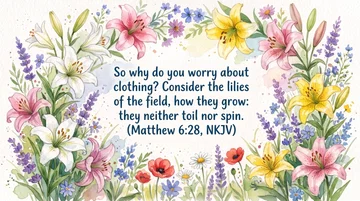
If then God so clothe the grass, which is to day in the field, and to morrow is cast into the oven; how much more will he clothe you, O ye of little faith?
Translations
If then God so clothe the grass, which is to day in the field, and to morrow is cast into the oven; how much more will he clothe you, O you of little faith?
King James Version, KJV Cambridge Paragraph Bible
If then God so clothe the grass, which is to day in the field, and to morrow is cast into the oven; how much more will he clothe you, O ye of little faith?
If then God so clothe the grass, which is to-day in the field, and to-morrow is cast into the oven; how much more will he clothe you, O ye of little faith?
But if God doth so clothe the grass in the field, which today is, and tomorrow is cast into the oven; how much more shall he clothe you, O ye of little faith?
But if God doth so clothe the grass in the field, which to-day is, and to-morrow is cast into the oven; how much more shall he clothe you, O ye of little faith?
and if the herbage in the field, that to-day is, and to-morrow into an oven is cast, God doth so clothe, how much more you — ye of little faith?
But if God thus clothe the grass, which to-day is in the field and to-morrow is cast into [ the] oven, how much rather you, O ye of little faith?
But, if God thus adorneth, the grass, which is, in a field, to-day, and, to-morrow, into an oven, is cast, how much rather you, O little-of-faith?
Berean Standard Bible, Majority Standard Bible
If that is how God clothes the grass of the field, which is here today and tomorrow is thrown into the furnace, how much more will He clothe you, O you of little faith!
But if this is how God clothes the grass in the field, which today exists and tomorrow is cast into the oven, how much more will he clothe you, O you of little faith?
But if God gives such clothing to the grass in the field, which today is living, and tomorrow will be burned in the oven, how much more will he give clothing to you, O men of little faith?
If then God so clothe the grasse which is to day in the field, and to morowe is cast into the ouen, howe much more will he clothe you, O yee of litle faith?
Douay-Rheims (Challoner revision)
Now if God clothe in this manner the grass that is today in the field, and tomorrow is cast into the oven; how much more you, O ye of little faith?
Pictures

Cross-references
- Matthew 6:30
Wherefore, if God so clothe the grass of the field, which to day is, and to morrow is cast into the oven, shall he not much more clothe you, O ye of little faith?
Jesus uses God clothing the grass to teach trust in his care and provision.
- Luke 12:24
Consider the ravens: for they neither sow nor reap; which neither have storehouse nor barn; and God feedeth them: how much more are ye better than the fowls?
God feeds the ravens, and people are worth more.
- Matthew 10:29-31
Are not two sparrows sold for a farthing? and one of them shall not fall on the ground without your Father.
God watches sparrows and values people, so they can trust his care.
- Matthew 6:31-33
Therefore take no thought, saying, What shall we eat? or, What shall we drink? or, Wherewithal shall we be clothed?
Promises God’s care for necessities and calls believers to seek his kingdom first.
- Psalms 37:3
Trust in the LORD, and do good; so shalt thou dwell in the land, and verily thou shalt be fed.
Both encourage trusting God for his care and provision.
- Luke 12:7
But even the very hairs of your head are all numbered. Fear not therefore: ye are of more value than many sparrows.
God’s knowledge of each person’s hairs shows his attentive care.
- Luke 12:32
Fear not, little flock; for it is your Father’s good pleasure to give you the kingdom.
God’s care and clothing promise lead to assurance of the Father’s gift of the kingdom.
- Matthew 6:26
Behold the fowls of the air: for they sow not, neither do they reap, nor gather into barns; yet your heavenly Father feedeth them. Are ye not much better than they?
God feeds the birds and values people more.
- Luke 12:22-23
And he said unto his disciples, Therefore I say unto you, Take no thought for your life, what ye shall eat; neither for the body, what ye shall put on.
Jesus warns against anxiety about food and clothing, assuring his disciples of God's care.
- Matthew 6:8
Be not ye therefore like unto them: for your Father knoweth what things ye have need of, before ye ask him.
God knows what his people need before they ask.
- 1 Peter 5:7
Casting all your care upon him; for he careth for you.
Both texts urge trust in God’s care and provision.
- Matthew 6:19-20
Lay not up for yourselves treasures upon earth, where moth and rust doth corrupt, and where thieves break through and steal:
Contrasts earthly concerns with heavenly treasure.
- Luke 12:16-21
And he spake a parable unto them, saying, The ground of a certain rich man brought forth plentifully:
The rich fool illustrates hoarding for self while neglecting God.
- Matthew 5:45
That ye may be the children of your Father which is in heaven: for he maketh his sun to rise on the evil and on the good, and sendeth rain on the just and on the unjust.
God’s provision of sunshine and rain for all shows his goodness.
- Luke 12:33-34
Sell that ye have, and give alms; provide yourselves bags which wax not old, a treasure in the heavens that faileth not, where no thief approacheth, neither moth corrupteth.
Freedom from earthly anxiety leads to giving and laying up unfailing heavenly treasure.
- Romans 8:32
He that spared not his own Son, but delivered him up for us all, how shall he not with him also freely give us all things?
God’s gift of his Son assures that he will give all things.
- Psalms 50:10-12
For every beast of the forest is mine, and the cattle upon a thousand hills.
shows God is able to supply temporal needs
- Philippians 4:6
Be careful for nothing; but in every thing by prayer and supplication with thanksgiving let your requests be made known unto God.
Both texts urge trust in God rather than anxiety about daily needs.
- Luke 11:13
If ye then, being evil, know how to give good gifts unto your children: how much more shall your heavenly Father give the Holy Spirit to them that ask him?
God gives the Holy Spirit to those who ask.
Commentary
Each commentary is drawn from primary sources: the writings of Ellen G. White and Adventist pioneers and periodicals. Each commentary is separate. Its own words are not a quotation; follow the references to read the source passages.
Ellen G. White
36 sources
God clothes the short-lived grass that is beautiful in the field today and is cut down for fuel tomorrow.Ms 73, 1893, par. 4–8Ms 83, 1909, par. 4–7Ms 65, 1902, par. 2–5 Since He gives such care to grass and flowers that last only a little while, He will far more surely clothe human beings made in His image whose worth cannot be overstated.Ms 73, 1893, par. 4–8CTBH 70.1–2DA 313.2–3 The question of how much more He will clothe them rebukes little faith and anxious worry over food, drink, and clothing.Ms 83, 1909, par. 4–7Ms 65, 1902, par. 2–5Ms 178, 1897, par. 8 Because the Father knows these needs, people are to put His kingdom first and rest in the promise that all needed things will be added.Ms 73, 1893, par. 4–8DA 313.2–3Ms 95, 1898, par. 1 This trust frees them from letting concern for necessities become an absorbing burden and calls them to fill their appointed place by active work.Ms 178, 1897, par. 8Lt 100, 1898, par. 10–18Lt 103, 1900, par. 9
Illustration From Nature
The grass stands alive and beautiful today in the field, and tomorrow it is cut down and cast into the oven as fuel, yet God clothes it.Ms 73, 1893, par. 4–8Ms 83, 1909, par. 4–7Ms 65, 1902, par. 2–5Ms 178, 1897, par. 8Lt 100, 1898, par. 10–18 Its clothing is an array that surpasses Solomon in all his glory, showing the simplicity of natural beauty and loveliness in a flower that toils not nor spins.Ms 73, 1893, par. 4–8STE 68.3
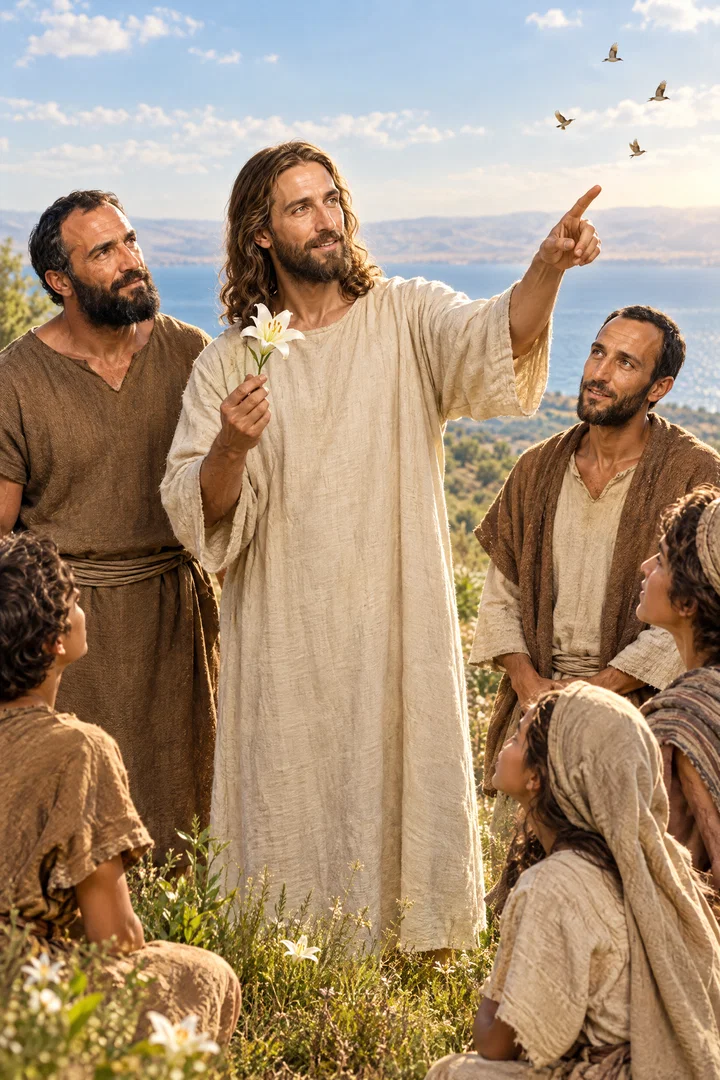
Jesus taught this lesson in the open air, choosing groves and seaside and commanding views of landscape and scenery so He could use objects humble hearers knew to make important truth plain and simple and memorable.STE 68.3RH May 30, 1871 He pointed to birds caroling without care, flowers of the valley growing in beauty, the lily on the lake, trees, cultivated lands, waving grain, hills, streams, and the setting sun, joining the works of God in nature in heaven and earth with words of life.RH May 30, 1871 He illustrated it by plucking a beautiful lily and placing it in the hands of children and youth while they looked into His face.STE 68.3
The lilies spring from the cold dark earth or the mud of the river bed and from a rough brown bulb that holds no promise of beauty.ST Mar 10, 1909 Yet they unfold in loveliness and fragrance when the hidden life of God within answers His call in the rain and the sunshine.ST Mar 10, 1909 The verse belongs to the instruction in Luke 12:22-40.Ms 178, 1897, par. 16Ms 41, 1900, par. 6 That instruction includes the parable of the lilies given alongside the parable of the foolish rich man.Ms 95, 1898, par. 1
Even short-lived grass has an appointed work, for the springing grass clothes the fields with beauty and silently fulfills its purpose though here today and used as fuel tomorrow.LSEGW 87.2 In its brief life it lives under a law of obedient action in constant silent ceaseless activity, doing its appointed errand together with the restless ocean, the wind-moved leaves, and the sun, moon, and stars fulfilling their missions.Lt 103, 1900, par. 9 Familiar things in nature are thus used to teach about God and spiritual truth.3MR 333.2–3 The natural objects around should recall and repeat the teaching, so that afterward when hearers look on those same birds, flowers, hills, lake and heavens the lessons come fresh to memory.RH May 30, 1871Lt 45, 1877, par. 2–3
Greater Care for People
Human life hangs on God for every breath, with beating heart and pulse and nerve and muscle held in order by infinite power, and Christ first turns the mind to nature and then leads it up through nature to nature's God who upholds the worlds.Ms 73, 1893, par. 4–8 Great attention is given to the grass and to every lofty tree and shrub and blooming flower and lily of the field and opening bud, and to the earth clothed in living green and kept in order in time and season, and to little birds, with rain and sunshine sent upon just and unjust, good and evil, thankful and unthankful.Ms 73, 1893, par. 4–8 Such care bears testimony that God loves man and confirms His unsurpassed goodness.Ms 73, 1893, par. 4–8
Care is measured in proportion to rank in creation, so His clothing of temporary grass proves far greater care for human beings formed in His image and likeness.Ms 73, 1893, par. 4–8CTBH 70.1–2DA 313.2–31T 19.1–4Ms 108, 1905, par. 8–10 The flowers live only briefly before they disappear, yet God's care for them is evidence that He will care for people who are of greater consequence and worth.CTBH 70.1–2FE 159.2–3Ms 108, 1905, par. 8–1015MR 99.1–100.1Ms 142, 1897, par. 24–25 His eye is upon the flowers He made and adorned with beauty, and His loving care still more tenderly surrounds those formed in His image.DA 313.2–31T 19.1–4Ms 142, 1897, par. 24–25 The worth and value of the soul cannot be exaggerated.Ms 73, 1893, par. 4–815MR 99.1–100.1 People are of greater value because made in God's image to reflect His character.DA 313.2–3
Heaven attends to humanity, and those who choose God's service are never absent from His mind.Ms 73, 1893, par. 4–8DA 313.2–31T 19.1–415MR 99.1–100.1 People are to reason from what God does in the natural world to the greater importance of heavenly things, rather than becoming anxious or doubtful about material needs which their Father already knows.Lt 100, 1898, par. 10–18 Nature is a book through which faith can grasp eternal realities shown in earthly forms, leading minds through nature up to nature's God.RH May 30, 18715MR 20.1 Familiar things in nature are joined with words of life to extol the wisdom of God in creation and to lead people to magnify and reverence Him.RH May 30, 18715MR 20.1
The flowers display His skill and His love of beauty and goodness.FE 159.2–3Ms 142, 1897, par. 24–25 As the word of God creates the flowers, that same hidden life of God unfolds in every human soul that yields itself to the ministry of His grace.ST Mar 10, 1909 That grace comes as freely as sunshine and rain with blessing for all, producing in people the graces of His Spirit as rain and sunshine call loveliness and fragrance from the rough bulb in cold dark earth or river mud.ST Mar 10, 1909 Because the Father knows human need for food and drink and clothing, people are to make the kingdom of heaven the first consideration and seek it first.Ms 73, 1893, par. 4–8DA 313.2–3Ms 95, 1898, par. 1 Then all these needed things shall be added, and those who put Christ's kingdom first can rest in His care, trusting Him for the blessings needed in this life.Ms 73, 1893, par. 4–8DA 313.2–3 From the lily Christ draws a lesson of simplicity as well as trust in God.Lt 223, 1905, par. 8–10
Call to Confident Trust
The question of how much more God will clothe His people is a rebuke to little faith, distrust, doubt, and anxious worry over food, drink, clothing, and the other needs of life.Ms 83, 1909, par. 4–7Ms 65, 1902, par. 2–5Ms 178, 1897, par. 8Lt 100, 1898, par. 10–18STE 68.3 The God who clothes the short-lived grass will care all the more for His people and provide what they need, so worry about necessities is itself evidence of little faith.Ms 65, 1902, par. 2–5Ms 178, 1897, par. 8Ms 108, 1905, par. 8–10 Nature is given as the proof, calling for reasoning from what God does in the natural world to the greater importance of heavenly things, and for trusting Him rather than becoming anxious or doubtful about material needs which the Father already knows.Lt 100, 1898, par. 10–18STE 68.3Ms 108, 1905, par. 8–10 To dishonor the Creator by departing from His purpose through distrust is contrary to the lesson Christ taught with the lilies, whose simplicity of natural beauty that toils not nor spins surpasses even Solomon in all his glory.STE 68.3Ms 108, 1905, par. 8–10
Trust in the heavenly Father's care and provision means not letting concern for food and clothing become an absorbing burden.Ms 178, 1897, par. 8Lt 100, 1898, par. 10–18Ms 21, 1889, par. 93–94 It means trusting Him rather than departing from His purpose or being of little faith.Ms 178, 1897, par. 8Ms 108, 1905, par. 8–10Ms 21, 1889, par. 93–94 That trust is shown in a simple life and modest, becoming dress, for costly clothing and jewelry do not give true influence, while a meek and quiet spirit, kindness, and forethought for others are precious to God.Ms 83, 1909, par. 8 In hardships faced while serving God and standing for the truth, believers and their families need not fear being left without care, because God knows their needs.Ms 83, 1909, par. 4–7
The afflicted can therefore take courage and the desponding can hope, bringing all troubles and griefs to Jesus in sympathy, since He cares for little birds and flowers and still more for people made in His image.Lt 45, 1877, par. 4 Patients given opportunity in outdoor life in nature can recognize God's love in the flowers and be encouraged to trust His loving care, assured that He who cares for the flowers will care for them even more.CH 171.1CH 173.1 Children too can learn from flowers and birds to see God's love in nature and to trust His care, for His care for the flowers despite their brief life is evidence that He will care for people who are of greater consequence and worth.CTBH 70.1–2FE 159.2–3 From the same flowers they learn His love of beauty and goodness, to value His natural gifts over artificial display, and to give Him their deepest affections.FE 159.2–3
Those blessed with great light are to leave tame, listless striving and put the whole heart into the service of Christ, living and practicing the truth and not only claiming to believe it, through daily prayer and watchfulness with supreme love to God and to those for whom Christ died.Ms 185, 1898, par. 7–10 As part of Luke 12:22-40, the verse calls every son and daughter of God to be intensely in earnest and to take up appointed work, because believers are now the church militant and not yet the church glorified.Ms 41, 1900, par. 6 The chapter's lesson supports moving forward by faith in providing a plain, appropriate church building, even accepting freely given help, while using the Lord's money carefully and avoiding needless expense and unnecessary spending.Lt 20, 1897, par. 5–716MR 46.1 It calls believers to trust God and put His work before accumulation of earthly goods.Lt 147, 1899, par. 2
The verse warns against giving first place to houses, property, business interests, and other worldly concerns instead of trusting God and using entrusted resources to advance the gospel.Ms 108, 1905, par. 11–15 Like the grass filling its appointed place by active work under God's law of obedient action in constant, silent, ceaseless activity, clothing the fields with beauty together with the restless ocean, the wind-moved leaves, and the sun, moon, and stars fulfilling their missions, human beings with mind and body created in God's likeness must fill their place by active work and not be idle, since idleness is sin.Lt 103, 1900, par. 9 The rebuke calls present believers to have hearts worked by the Holy Spirit, to come just as they are without delay, to call on Him in faith to work for them, and to expect Him to manifest His power by multiplying workers and sending men and women of faith and prayer to work even without wages when there is no money to pay them, trusting that God lives and reigns and will provide.Lt 12, 1900, par. 3 That same rebuke of little faith applies to those who have lost time through insufficient faith, recalling God's care and encouraging trust in His provision.STB 128.1–129.1
Sources
Pioneers and periodicals
52 sources
God himself clothes the frail field grass that is alive today and burned as fuel tomorrow, and he will much more clothe his people with food and clothing and all they need for this life.ST Aug 9, 1899ST Feb 2, 1882RH Aug 1, 1854ST Jan 22, 1880ST Oct 21, 1886 He does so because people are far more precious to him than grass, loved and watched over by a Father who knows what they need.ST Aug 9, 1899ST Jun 24, 1889RH Jan 14, 1909 Anxious worry about clothing and support is little faith, and his question rebukes it and calls for confident trust in his care.ST Aug 9, 1899ST Feb 2, 1882ST Jul 2, 1894 That trust seeks his kingdom and his will first, doing known duty and leaving him to add what is needed instead of living absorbed in suspense about eating and drinking.ST Sep 19, 1878RH Nov 12, 1857ST Jun 24, 1889 Because he cares for this brief life, his people need not cling to possessions but are to give alms and lay up treasure in heaven, waiting ready like servants for their Lord's return.ST Dec 24, 1894ST Mar 20, 1907RH Dec 9, 1852RH Oct 15, 1872
Words and Context
The grass is short-lived field grass, alive in the field today and tomorrow cast into the oven as fuel, yet clothed by God with beauty and delight before it soon disappears and perishes.ST Jan 22, 1880ST Oct 21, 1886ST Jul 1, 1889 Its brief life of only a day, ending in burning, measures the force of the promise that God will much more clothe and provide clothing for his people.ST Jan 22, 1880ST Oct 21, 1886ST Jul 1, 1889 The closing address to those of little faith rebukes lack of trust and calls for confident trust in the Father who knows what is needed, forbidding anxiously absorbed and suspenseful worry over what to eat and drink.ST Jan 22, 1880ST Oct 21, 1886ST Jul 1, 1889 That trust is to seek the kingdom of God first with assurance that all needed things will be added, to be of good courage under heavy burdens and toil and poverty, not to murmur when sickness comes, and to learn trust by looking at singing birds and blooming flowers as visible reminders of spiritual truth.
The oven is the Greek klibanos, a covered earthen vessel narrower at the top than at the bottom in which bread was baked by placing hot coals around it.ST Jul 2, 1894 That word is distinct from the word for a regular oven.ST Jul 2, 1894
The verse belongs to a practical sermon addressed to the disciples in the presence of a vast crowd and multitude.ST Jan 22, 1880ST Jan 22, 1880ST Oct 3, 1878 In widest contrast it holds up the confidence of willing faith against the fear of unbelief.ST Jan 22, 1880ST Jan 22, 1880ST Oct 3, 1878 It teaches trust not in riches but in the living God.ST Oct 3, 1878
It stands in Luke 12:22-37 among instructions to the little flock waiting for the Lord to return from the wedding, with commands to sell what they have and give alms to provide treasure in heaven. Everyone who keeps the Sabbath, professes present truth, and professes to look for the Lord is in that waiting company, so the word means him; to claim to have all on the altar while property increases and to refuse the command is hypocrisy, and profession without works agreeing with faith is dead faith that cannot stand in the judgment, be acquitted by a just God, and hear well done, good and faithful servants. It stands also among exhortations to watch given in connection with the signs of the second advent, applying to the period just prior to that event and teaching watchfulness and readiness for his return.ST Mar 20, 1907RH Oct 15, 1872
Jesus taught this trust in the open air, choosing groves and the seaside for discourse so as to have a commanding view of landscape and scenery.RH May 30, 1871 He used familiar things humble people knew — birds caroling without care, flowers of the valley growing in beauty, the lily on the lake, trees, cultivated lands, waving grain, hills, streams and setting sun — to make important truth plain and simple and interesting.RH May 30, 1871 He joined God's works in nature in heaven and earth with words of life to extol God's wisdom in creation and to lead minds through nature up to nature's God, caring for bodily needs as well as spiritual benefit.RH May 30, 1871 Afterward, when hearers looked on those same birds, flowers, hills, lake and heavens, his lessons would come fresh to memory and remain hallowed after his ascension to heaven.RH May 30, 1871
God's Care Promised
God himself clothes the frail, common grass and flowers of the field, the hedgerow and pasture that are today alive and tomorrow are gone, with beauty and delight by his own skill and power.ST Aug 9, 1899ST Jan 22, 1880ST Oct 3, 1878ST Feb 3, 1904 Though temporary, soon disappearing and cast aside to be used as fuel, they are decked and adorned with careful tenderness, showing him gracious, pitiful, patient and tender.ST Jan 22, 1880ST Oct 3, 1878ST Feb 3, 1904 That clothing is both proof and pledge of his tenderness, putting the beauty of the Lord upon them, and it brings delight, beauty, comfort and hope when faith is dim, though flowers are not needed for human labor or material wants.RH Sep 28, 1905ST Feb 3, 1904 No one who comes to him with trials for his sympathy, sorrows for his love, wounds for his healing, weakness for his strength, and emptiness for his fullness is ever disappointed.ST Feb 3, 1904
Since God so clothes grass that lasts only briefly, he will much more clothe his people and provide food, clothing and other temporal necessities for life.ST Aug 9, 1899ST Feb 2, 1882ST Jul 2, 1894ST Aug 14, 1901 His care for the grass and lilies is assurance against anxiety about what to eat, drink and wear, calling for trust instead of little faith.ST Aug 9, 1899ST Feb 2, 1882RH Aug 1, 1854ST Jul 2, 1894ST Aug 14, 1901 The lilies are thus appointed as teachers in the way of life, whose growth gives lessons of wisdom.ST Aug 14, 1901
His greater care for people rests on their greater value, for they are loved by him and more precious to him than grass.ST Aug 9, 1899ST Jun 24, 1889RH Jan 14, 1909ST May 22, 1884RH Feb 4, 1909 His watchful kindness extends over all, so that nothing escapes his care, and as a Father he knows what they need, feeding the ravens and clothing the grasses from his ample store.ST Jun 24, 1889RH Jan 14, 1909ST May 22, 1884ST Apr 8, 1886 Those who seek his kingdom and will first by doing the duty made known to them can trust him to provide and prosper them as he sees fit while they work industriously.ST Jun 24, 1889RH Feb 4, 1909 As those who have eternal life they can be sure he will not ignore their cries.ST Aug 9, 1899RH Jan 14, 1909ST May 22, 1884RH Feb 4, 1909ST Apr 8, 1886
Faith Over Anxiety
Anxiety about clothing, food, support and the future is little faith, and the question how much more will he clothe you rebukes that lack of trust and calls for confident trust in God's care and provision.ST Aug 9, 1899ST Feb 2, 1882ST Jul 2, 1894ST Jan 22, 1880 God clothes the short-lived grass with beauty though it is here today and is used as fuel tomorrow, soon disappearing and being burned, so he will care for and provide clothing and other needs for his people all the more because they are of greater value.ST Aug 9, 1899ST Feb 2, 1882ST Jul 2, 1894ST Jan 22, 1880ST Oct 21, 1886 This greater care for people than for grass is reason to trust God for clothing and other necessities rather than give in to anxiety.ST Aug 9, 1899ST Feb 2, 1882ST Jul 2, 1894ST Oct 21, 1886
Believers are not to be anxiously absorbed in the needs of this life or to worry with anxious, suspenseful care over what to eat and drink, but to seek God's kingdom and righteousness and his will first, trusting their Father who knows what they need to add all needed things.ST Sep 19, 1878RH Nov 12, 1857ST Jun 24, 1889RH Feb 4, 1909 Those who seek in this way by doing the duty made known to them can trust God to provide what they need, working industriously while trusting him to provide and prosper them as he sees fit.ST Sep 19, 1878ST Jun 24, 1889RH Feb 4, 1909RH Apr 28, 1868 The warning against anxious care is not a command to neglect work or to refuse to provide food and clothing for family or those in need, and it gives no license for idleness or presumption without corresponding work, but warns against making the pursuit and hoarding of wealth for self-gratification the chief aim of life while neglecting to seek God's kingdom and become rich toward God.ST Jun 24, 1889RH Apr 28, 1868 Toiling poor people under heavy burdens can therefore be certain of clothing all the more by learning trust from singing birds and blooming flowers, being of good courage and not murmuring when sickness comes.ST Jun 24, 1889
Trust in God is tested when food and clothing seem scarce, not only when supplies are abundant.ST Jul 2, 1894 Since eternal life matters more than physical life, those who trust God for what is greatest can trust him for what is least, so anxious care over necessities is inconsistent with Christian trust.ST Jul 2, 1894 Worry itself cannot secure what is needed, and even in great or small troubles his children can rely on his care which provides for them even more than he clothes grass that soon withers.ST Jul 29, 1913ST Jul 2, 1894
Kingdom Giving and Readiness
God's care for temporary earthly life is reason not to cling to earthly possessions but to give freely and give alms and lay up treasure in heaven with the heart set on heaven, instead of grasping after the world, in trust in his care and provision.ST Dec 24, 1894RH Dec 9, 1852 Since he provides even for field grass whose life is brief, he will much more provide for his people, and the surrounding command to sell what is possessed supports giving from surplus in faith.RH Nov 10, 1859 That giving transfers means from mortal life to the immortal shore beyond the reach of this world's fire, and it does not rashly require a poor person to sell a modest home and become needy.RH Nov 10, 1859
Giving means, reputation, health and life to God's cause from a pure motive to glorify him does not lose them but saves them.RH Jun 17, 1873 Houses, lands and everything this world calls dear so given are placed beyond the reach of this world's fire and secured as treasure in heaven, transferred from mortal life to the immortal shore to be exchanged for immortal health in the kingdom of glory.RH Jun 17, 1873 Even when his people give all they have to support his cause they should trust him to provide rather than fear lack, for such fear shows little faith.RH Feb 7, 1854
The instruction belongs to the little flock waiting for the Lord to return from the wedding, commanded to sell and give alms to provide treasure in heaven, and everyone who keeps the Sabbath and professes present truth and professes to look for the Lord is in that waiting company, so the word means him. To claim to have all on the altar while property increases and to refuse the command is hypocrisy, and profession without works agreeing with faith is dead faith that cannot stand in the judgment, be acquitted by a just God, and hear well done, good and faithful servants. The direction applies to those awaiting Christ's second coming to seek God's kingdom and trust his care and not let ordinary business or material concerns keep them from obeying the final warning, and not to be anxious about food or clothing.RH Aug 1, 1854 They are to be like men who wait for the coming of their Lord, stepping out upon the truth with the whole soul and leaning upon God's mighty arm which never lets those who trust him fall, laying aside love of earthly inheritance and the world so works no longer deny faith, in readiness for his appearing.
Lessons From Nature
Lilies and grass are appointed as teachers in the way of life, and nature stands as a visible reminder of spiritual truth.ST Aug 14, 1901 The way plants gather and direct water to their roots shows provision has been made for their life and care, giving reason to trust still greater care for people.ST Jun 16, 1914 The changing snowdrop and crocus show God at work, calling for trust when faith feels weak, with praise and prayer. The flowers of the meadow teach trust in divine wisdom, goodness, love, care and providence instead of little faith, bringing delight, beauty, comfort and hope when faith is dim.RH Sep 28, 1905ST Dec 16, 1913
The lilies and the sparrow are object lessons of the same omnipotent hand that clothes the grass and watches over people.ST Jul 30, 1912 Flowers were made for human happiness though not needed for labor or material wants, and their exceptional beauty assures that the promises to restore humanity's original happiness and dominion will be fulfilled.RH Sep 28, 1905
The clothing promised reaches beyond outward appearance to spiritual clothing.ST Apr 16, 1896ST Feb 3, 1904ST Aug 14, 1901 With only common dirt, rain, sun and wind, frail and unimportant lilies and the common flower of hedgerow and pasture, the grass of the field which today is and tomorrow is gone, are clothed with care and skill in beauty greater than Solomon's glory.ST Apr 16, 1896ST Feb 3, 1904 The lily's glory is greater than Solomon's because the flower reflects its Maker's glory, while Solomon's splendor was his own magnificence, for true glory belongs to what expresses God's purpose and is true to the nature given it.ST Sep 10, 1885 So people are taken from among the common things of this sin-cursed earth, have the incorruptible seed implanted within, are made new creatures, are decked and adorned in beauty with God's own royal beauty of character, and have put upon them the garments of salvation and the robe of righteousness as bride and bridegroom are adorned, given in answer to the prayer of simple faith for the beauty of the Lord to be upon them.ST Apr 16, 1896ST Feb 3, 1904 That clothing is proof and pledge of tenderness, showing graciousness, pity, patience and tenderness toward His children.ST Feb 3, 1904
Real beauty is formed from within, as the lily's beauty grows from the lily itself.ST Aug 14, 1901 God's provision therefore includes inward beauty, inner purity and a meek and quiet spirit, which outward adornment alone cannot supply.ST Feb 3, 1904ST Aug 14, 1901 All are invited to take trials to His sympathy, sorrows to His love, wounds to His healing, weakness to His strength, and emptiness to His fullness, with assurance that no one who comes is ever disappointed.ST Feb 3, 1904
As the lily springs from cold dark earth or river mud and from a rough brown bulb holding no promise of beauty, yet unfolds in loveliness and fragrance when the life of God hidden inside answers His call in rain and sunshine, so the life of God unfolds in every soul yielding to grace that comes as free as sunshine and rain with blessing for all, and the word of God that creates flowers produces in people the graces of His Spirit.ST Mar 10, 1909 The pond lily is clothed by having life given from God Himself by the power of His word, bringing a waxen white pure radiant flower with broad green leaves out of roots deep in oozy mire and foul water full of impurities and noisome vapors.ST Apr 16, 1896 That clothing transmutes the base and vile into living beauty, so that when storm agitates the filthy pool and foul water washes over the face of the flower it leaves it unstained and pure, a witness to power and love and wisdom.ST Apr 16, 1896
Even the smallest flower is clothed with careful orderly work, with seeds laid neatly within the ripening pod, each tiny cell made soft or polished with room enough for each seed, and its sides closed against wind and rain so the seeds are not left exposed but can grow again.RH Jul 14, 1863 There is no disorder in what the Father does, and His condescending care for such small things teaches children to gain neat habits, or they will waste much precious time and do their work in vain.RH Jul 14, 1863 Toiling poor people under heavy burdens can therefore learn trust by looking at singing birds and blooming flowers, be of good courage, not murmur when sickness comes, and be certain all the more that clothing will be provided.
Trust in Daily Needs
The need to support a family and keep business prospering gives no valid excuse for refusing to keep the seventh-day Sabbath.ST Sep 30, 1880RH Apr 4, 1865RH Sep 17, 1857RH Feb 7, 1916 Those whom the Lord asks to keep the Sabbath can safely trust him to direct them in such a way that they may obtain a living.ST Sep 30, 1880RH Apr 4, 1865RH Jul 1, 1902 Trust in the one who clothes the temporary grass of the field rather than anxious care about material needs is the answer to fear that obedience will interfere with livelihood.ST Sep 30, 1880RH Apr 4, 1865RH Jul 1, 1902 Worldly security is not to be put first, and a living is not to be saved by disobedience.ST Sep 30, 1880RH Sep 17, 1857RH Feb 7, 1916 Unbelief in his ability to provide for bread and clothing and other temporal necessities is without excuse, with heed to the warning against a doubtful and suspenseful mind.RH Jan 7, 1902RH Jul 1, 1902
God will feed and clothe his people in famine or when persecution for righteousness' sake reduces them to poverty.RH Dec 5, 1854 The same care calls for trust when poverty and other hardships threaten.RH Jul 16, 1857 Trust for clothing and provision for the future is to replace securing the future by life insurance.RH Jan 7, 1902
The warning against anxious care is not a command to neglect work or to refuse to provide food and clothing for family or for those in need.RH Apr 28, 1868 Work is to be done industriously while trusting God to provide and to prosper as he sees fit, with God known to understand what is needed and with his kingdom and will sought first.ST Jun 24, 1889 What is warned against is making the pursuit and hoarding of wealth for self-gratification the chief aim of life while neglecting to seek God's kingdom and become rich toward God.RH Apr 28, 1868 The teaching gives no license for idleness or for presumption without corresponding work.ST Jun 24, 1889RH Apr 28, 1868
Restful faith in God and his Son brings peace of mind and serves as a remedy for worry and its effects on health. Worry cannot secure what is needed, while trust in his care provides for his children even more than for grass that soon withers.ST Jul 29, 1913 That reason to trust holds through affliction and in facing an unknown tomorrow without fear, in great troubles and in small ones.ST Jul 29, 1913ST Oct 31, 1906 The words O ye of little faith also rebuke discouragement and lack of trust in missionary effort, calling for faith instead of expecting results from small effort or losing heart when results are not immediate.RH May 3, 1860
Sources