Matthew 6:28
And why take ye thought for raiment? Consider the lilies of the field, how they grow; they toil not, neither do they spin:
Translations
And why take you thought for raiment? Consider the lilies of the field, how they grow; they toil not, neither do they spin:
King James Version, KJV Cambridge Paragraph Bible
And why take ye thought for raiment? Consider the lilies of the field, how they grow; they toil not, neither do they spin:
And why are ye anxious for raiment? Consider the lilies of the field how they grow? they toil not, neither do they spin?
Revised Version, American Standard Version
And why are ye anxious concerning raiment? Consider the lilies of the field, how they grow; they toil not, neither do they spin:
and about clothing why are ye anxious? consider well the lilies of the field; how do they grow? they do not labour, nor do they spin;
And why are ye careful about clothing? Observe with attention the lilies of the field, how they grow: they toil not, neither do they spin;
And, about clothing, why are ye anxious? Consider well the lilies of the field, how they grow,—they toil not neither do they spin;
Berean Standard Bible, Majority Standard Bible
And why do you worry about clothes? Consider how the lilies of the field grow: They do not labor or spin.
Why are you anxious about clothing? Consider the lilies of the field, how they grow. They don’ t toil, neither do they spin,
And why are you troubled about clothing? See the flowers of the field, how they come up; they do no work, they make no thread:
And why care ye for raiment? Learne howe the lilies of the fielde doe growe: they are not wearied, neither spinne:
Douay-Rheims (Challoner revision)
And for raiment why are you solicitous? Consider the lilies of the field, how they grow: they labour not, neither do they spin.
Pictures




Cross-references
- Luke 12:27-28
Consider the lilies how they grow: they toil not, they spin not; and yet I say unto you, that Solomon in all his glory was not arrayed like one of these.
Lilies illustrate God’s care and teach trust rather than anxiety about clothing.
- Matthew 10:29-31
Are not two sparrows sold for a farthing? and one of them shall not fall on the ground without your Father.
God’s care for sparrows and people assures them of their value to him.
- Matthew 6:33
But seek ye first the kingdom of God, and his righteousness; and all these things shall be added unto you.
Seeking God’s kingdom first accompanies trust that necessities will be provided.
- 1 Peter 5:7
Casting all your care upon him; for he careth for you.
Both urge entrusting cares to God because he cares for his people.
- Matthew 6:19-21
Lay not up for yourselves treasures upon earth, where moth and rust doth corrupt, and where thieves break through and steal:
Contrasts earthly concerns with setting the heart on heavenly treasure.
- Matthew 6:34
Take therefore no thought for the morrow: for the morrow shall take thought for the things of itself. Sufficient unto the day is the evil thereof.
The lilies illustrate the instruction not to worry about tomorrow.
- Luke 12:24
Consider the ravens: for they neither sow nor reap; which neither have storehouse nor barn; and God feedeth them: how much more are ye better than the fowls?
Ravens illustrate God’s provision and care for his children.
- Luke 12:31-34
But rather seek ye the kingdom of God; and all these things shall be added unto you.
Urges trust in God over anxiety about earthly needs and wealth.
- 1 Timothy 6:8
And having food and raiment let us be therewith content.
Both teach contentment with food and clothing.
- Matthew 10:30-31
But the very hairs of your head are all numbered.
God’s care for the lilies extends to people, whose worth exceeds that of sparrows.
- Philippians 4:6-7
Be careful for nothing; but in every thing by prayer and supplication with thanksgiving let your requests be made known unto God.
Both urge freedom from anxiety through prayerful trust in God, bringing His peace.
- Hosea 14:5
I will be as the dew unto Israel: he shall grow as the lily, and cast forth his roots as Lebanon.
Both compare growth to the lily.
- Psalms 145:16
Thou openest thine hand, and satisfiest the desire of every living thing.
God satisfies every living thing, grounding trust against anxiety.
- Luke 12:6-7
Are not five sparrows sold for two farthings, and not one of them is forgotten before God?
God attends to sparrows and numbers each person’s hairs.
- Matthew 6:8
Be not ye therefore like unto them: for your Father knoweth what things ye have need of, before ye ask him.
God already knows what people need.
- Job 38:41
Who provideth for the raven his food? when his young ones cry unto God, they wander for lack of meat.
Both show God providing for creatures that cannot provide for themselves.
- Luke 9:3
And he said unto them, Take nothing for your journey, neither staves, nor scrip, neither bread, neither money; neither have two coats apiece.
The disciples travel without provisions, trusting God to provide.
Commentary part 1 of 2
Each commentary is drawn from primary sources: the writings of Ellen G. White and Adventist pioneers and periodicals. Each commentary is separate. Its own words are not a quotation; follow the references to read the source passages.
Ellen G. White
180 sources
In the Sermon on the Mount Christ forbids anxious worry about clothing, bidding hearers look at real field flowers that grow without laboring to adorn or clothe themselves.CTBH 141.1Ms 94, 1899, par. 25–26Lt 175, 1896, par. 19–23Lt 53, 1898, par. 27–28Ms 21, 1899, par. 35 God Himself gives them life, nourishment and surpassing beauty through soil, dew, rain and sunshine, and since He so clothes short-lived grass He will much more clothe human beings formed in His image and supply food, drink and all needed things.13MR 337.2–3Lt 43, 1896, par. 3Ms 139, 1897, par. 3–5Lt 70, 1893, par. 29–33Lt 79, 1900, par. 23–26 His people are therefore to cast care upon Him, seek first His kingdom and righteousness with promise that all these things shall be added, and rest instead of fearing want or serving self.Ms 139, 1897, par. 3–5Lt 70, 1893, par. 29–33MH 289.2–4CE 54.4–55.1SC 85.4–86.1 The simple loveliness that outshines Solomon's glory rebukes pride, extravagance and slavery to fashion, and points to the inward beauty of a pure Christlike character that God desires to unfold in the soul as freely as sunshine and rain unfold the flower.SC 123.2Ms 14, 1889, par. 4ST Feb 7, 187818MR 3.1–33T 375.2 Christ thus used the familiar lily to make divine truth plain to child and learned alike, a lesson mothers, teachers and healers are to repeat from nature to lead hearts from created beauty to trust in the Creator.3MR 114.2–4CT 178.3–179.1Lt 53, 1898, par. 27–28MH 265.3–266.1CT 261.1
Words and Setting
The saying belongs to the sermon on the mount, spoken on a mountainside to the disciples and the gathered multitude.DA 298.2–3DA 299.3 There the foundation principles and the conditions of entrance into God's kingdom were taught, correcting false ideas of worldly greatness.DA 299.3 That teaching opposed the self-righteous scribes and Pharisees and corrected their stern picture of God as without compassion, mercy, or love.FE 309.1 Its lessons are to be shown in the way people live.6T 472.1 It sets forth the far-reaching principles of God's law, showing that the state of the heart regulates life and character, so that teaching the claims of the law requires having its spirit in the heart and impressing its far-reaching principles, without which labor is lost.Lt 7, 1886, par. 34 It is part of the pure gospel given upon the mount that explains God's holy law and sets the holy standard of character, requiring love to God with the whole heart and love to neighbor, with right and holy methods in business, forbidding the mingling of human wisdom with the divine and the unjust acquiring of means at another's expense to please lust for gain and power, so that those who practice such methods prove they have not yet learned this teaching and need cleansing of the soul temple.Ms 26, 1899, par. 29–30
The question about raiment forbids anxious thought about clothing.CTBH 141.1Ms 94, 1899, par. 25–26Lt 175, 1896, par. 19–23Lt 43, 1896, par. 3Ms 24, 1895, par. 15 To consider the lilies is to consider how God makes them grow.Ms 94, 1899, par. 25–26Lt 175, 1896, par. 19–23Lt 391, 1907, par. 13–16 They grow without human labor, without toil or spinning, without effort to adorn themselves or to make clothing for themselves.CTBH 141.1Ms 94, 1899, par. 25–26Lt 175, 1896, par. 19–23Lt 43, 1896, par. 3Ms 24, 1895, par. 15 Their growth and beauty show God's care, giving reason to trust that He will provide what His children need.Ms 94, 1899, par. 25–26Lt 175, 1896, par. 19–23Lt 43, 1896, par. 3Lt 391, 1907, par. 13–16 Their beauty and variety of color display His skill and care and His love for human beings, surpassing even Solomon's splendid clothing.Lt 175, 1896, par. 19–23Ms 24, 1895, par. 15
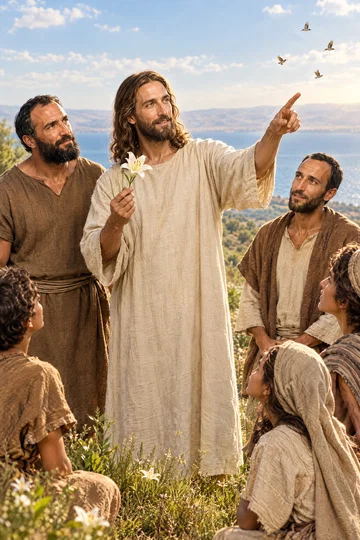
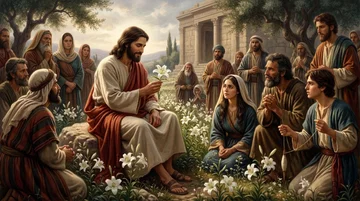
The lilies are real field flowers, familiar sights from daily life.Lt 53, 1898, par. 27–28Ms 21, 1899, par. 35RH Jul 9, 1901ST Mar 10, 1909RH May 30, 1871 Christ pointed to bright flowers on hillsides and fields in the dewy freshness of the morning, to lilies opening their buds on the bosom of the lake and to the lily resting on the lake, plucking a lily in glowing beauty and placing lilies in the hands of children and youth.Lt 53, 1898, par. 27–28Ms 21, 1899, par. 35RH Jul 9, 1901ST Mar 10, 19093MR 85.1 He delighted in the beautiful things of nature and drew His illustration from things most familiar to people, using household ties, life experience, and tender associations so that the beauty and purity of the lily would impress the teaching on hearers' minds and keep it fresh in memory.Lt 53, 1898, par. 27–28Ms 21, 1899, par. 35RH May 30, 1871 The call to consider them in natural simplicity and loveliness without labor was spoken to children and youth and also to everyone whose life is full of worry and perplexity and who is bowed down with disappointment and sorrow, calling them away from anxious thought about raiment to learn from how God clothes nature.Lt 53, 1898, par. 27–28 Parents are thus to use the verse to lead children's minds from the artificial to the natural, taking them into the open air to trace God's wonderful power and love in each leaf and in the colors His hand paints on every flower, and taking them to the lake to contemplate His handiwork instead of man-made pictures.RH Jul 9, 19013MR 85.1
The verse does not teach that Christians must stop working or neglect the temporal needs of themselves and their families, and taking thought about those needs is not a sin.AA 348.1 It must not be used to justify refusing labor, nor does God's provision excuse idleness.AA 348.1Ms 8b, 1894 [Copy 2], par. 26–27 People are to work diligently, using their abilities to cultivate the soil, while trusting God who gives rain and sunshine and sustains the worker through the earth's harvest.Ms 8b, 1894 [Copy 2], par. 26–27 It supports leaving to God the cares and work beyond one's ability after faithfully doing duty, rather than becoming overanxious.Lt 18, 1912, par. 10
The concern with clothing belongs to the chapter's lesson that attention to worldly needs, including dress, should not displace serving God with humility and prayer and should not occupy the mind at the expense of serving Him, turning attention from worldly concerns toward the lasting value of eternal things.AFUP 8.3–4AFUP 9.1 It is part of the command beginning with laying up no treasures on earth but treasure in heaven, sown as seeds of truth for believers and unbelievers, including fishermen, and for youth and children in simple language inviting them to give their young hearts to the Saviour who loves them and is pleased when they love Him.Ms 73, 1894, par. 1–3Ms 182, 1898, par. 58–60 It belongs to Christ's teaching that food, drink, and clothing should not become the chief objects of concern, with the example of the lilies pointing away from needless anxiety about clothing and warning that excessive dress and luxury are sinful wastes of time, money, and strength among the marked sins of the last days and a sign of soon coming.ST Sep 2, 1875 It rebukes anxious thought about clothing and exposes the dangers and unbelief of the present time in order to call to walk by faith in God's care.Ms 73, 1894, par. 1–3 It means believers must guard against having more anxiety than faith about material means, so that when the time to advance has fully come they must advance and not hold back from fear of lack, trusting God to provide while they deny self and give to carry the work forward.Lt 21, 1900, par. 4–6
God's Care for Creation
God Himself makes the lilies grow and clothes them, giving nourishment, beauty and life suited to their growth through soil, air, dew, rain, sunshine and His own life-giving power.Ms 31, 1901, par. 25–28ST Mar 10, 1909 Their growth requires no toil or spinning, and their rich clothing finer than kings' robes teaches provision for human need and rebukes distrust and anxious care.13MR 337.2–3Ms 139, 1897, par. 3–5 Human skill may copy their graceful forms, delicate hues and colors, but no touch can impart life to even one flower or blade of grass.ST Mar 10, 1909HL 291.2–293.1 Every wayside blossom owes its being to the same power that set the starry worlds on high and the stars in place, and through all created things thrills one pulse of life from the great heart of God.ST Mar 10, 1909HL 291.2–293.1
God as the great Master Artist paints the lily with delicate and beautiful tints, colors and pure simple loveliness that outvie the glory of Solomon, the greatest king that ever wielded a scepter.Lt 79, 1900, par. 23–26Lt 4, 1896, par. 6–817MR 182.3–183.2 He makes the grass a beautiful carpet for the earth, and the vivid living loveliness of the flowers is divine workmanship in perfection that no human artist can match.Lt 4, 1896, par. 6–817MR 182.3–183.2Ms 28, 1889, par. 5–7Ms 75, 1886, par. 5 This displays His skill, care, wisdom and love of beauty, enlarging views of His goodness from the works of His hands and awakening gratitude that draws from nature to its Creator.Lt 175, 1896, par. 19–23Lt 79, 1900, par. 23–26Ms 28, 1889, par. 5–7 The contrast is between the natural and the artificial, for the lilies growing without toil or spinning surpass even Solomon's costly robes, magnificent surroundings and artificial royal display.ST Feb 7, 1878Ms 28, 1889, par. 5–7Ms 75, 1886, par. 5
The measure of divine attention and blessing is proportionate to the rank an object holds in the scale of creation.Lt 79, 1900, par. 23–26Lt 4, 1896, par. 6–817MR 182.3–183.2 Such care is given to short-lived grass of the field that today is and tomorrow is cast into the oven and withers in a day, yet is clothed more gloriously than Solomon was arrayed.Lt 70, 1893, par. 29–33Lt 79, 1900, par. 23–26ST Oct 10, 1900 Since man was formed in God's image with intellect to comprehend greater things than nature and to be led higher into the divine mind and truth, God's regard for human beings, His purchased heritage, is immeasurably greater.Lt 79, 1900, par. 23–26Lt 4, 1896, par. 6–817MR 182.3–183.2 This care for the flowers gives reason to trust God for clothing rather than worry, for His children are more valuable and precious to Him than flowers.Lt 43, 1896, par. 3ST Oct 10, 1900ST Nov 19, 1896
He who gave life knows the need of food to sustain it, and He who created the body knows the need of raiment, so He who bestowed the greater gift will bestow what is needed to make it complete.ST Mar 10, 1909HL 291.2–293.1 The heavenly Father knows all need for food, drink and clothing, holds the future in His care, and can be trusted for temporal needs as well as for redemption of souls and eternal interests.Lt 70, 1893, par. 29–33HL 291.2–293.1Lt 16, 1892, par. 29–303SP 48.1
Every human being has a page in the volume or book of providence containing every particular and the events of life history, never absent from God's mind for a moment even to the numbering of the hairs of the head.Lt 79, 1900, par. 23–26Lt 4, 1896, par. 6–817MR 182.3–183.2 Though men and women have sinned grievously they are not forsaken, and the hand that upholds the world upholds and strengthens His weakest child.Lt 79, 1900, par. 23–26DA 313.2–3 God's care for those who choose His service is greater still because they bear His image, giving the soul the beauty of His own character.Lt 79, 1900, par. 23–26DA 313.2–3
The giving of singing birds and gentle blossoms beyond all that was needed for mere existence, with every opening bud, lofty trees, springing grass, running brooks, stones, sunshine and pure air, proves the overflowing love of a Father's heart to brighten and gladden life.17MR 349.1–5ST Mar 10, 1909Ms 142, 1897, par. 22–23 Everything God does is for the happiness of man to fill hearts with delight, bring joy to sad hearts, give pleasure, and remind of the Giver.17MR 349.1–5Ms 142, 1897, par. 22–23Ms 100, 1898, par. 2 The pure and lovely heavens and colors presented to the senses, and the beauty of all created things, are but a gleam from the shining of His glory and faint representations of the far greater glories of the paradise of God.ST Mar 10, 19095MR 20.2
Nature's beauty directs people from created things to the Creator and preserves a glimpse of the beauty first seen in Eden, pointing minds upward to Him.Ms 154, 1903, par. 14–1517MR 349.1–5Ms 154, 1903, par. 16–18 But God is not personally present in trees, leaves, flowers or grass, and His works are not God and are not to be worshiped.Ms 154, 1903, par. 14–15Lt 230, 1903, par. 7–921MR 172.1–2 Trees and leaves have no soul and are not part of Him, and created things pass away, so they point to God rather than being objects of worship.Ms 154, 1903, par. 16–18Lt 230, 1903, par. 7–921MR 172.1–2
Trust Instead of Anxiety
The call to consider the lilies is spoken to those bowed down with worry, perplexity, disappointment, sorrow, toil, deprivation, fear of want and fear of loss, bidding them behold how the field flowers grow in abundance and simple beauty without toiling or spinning.SC 123.2ST Jan 19, 1915Lt 53, 1898, par. 27–28COL 51.2ST Feb 2, 1915 It enlarges the view of divine goodness drawn from the works of His hands, for God as great Master Artist clothes the lily with delicate tints outvying Solomon's glory though it is grass that today is and tomorrow is cast into the oven and withers in a day.SC 123.2Lt 79, 1900, par. 23–26ST Mar 10, 1909 On their petals is written a message the heart can read only as it unlearns distrust and selfishness and corroding care, learning more of divine wisdom from nature's loveliness than schoolmen know.ST Mar 10, 1909Lt 91, 1887, par. 2 The giving of singing birds and gentle blossoms beyond mere necessity proves an overflowing Father's love to brighten life, and the rebuke falls on anxious worry, perplexity, doubt, distrust, corroding care and little faith.SC 123.2ST Mar 10, 1909Lt 91, 1887, par. 2
If God so clothes the grass of the field, He will much more clothe His people and give every other needed blessing, for He who clothes the short-lived grass more gloriously than Solomon in all his glory was arrayed knows the need for food, drink and clothing.Ms 139, 1897, par. 3–5Lt 70, 1893, par. 29–33ST Jul 2, 1894MH 289.2–4Ms 108, 1905, par. 11–15 That provision is suitable, comfortable, neat and warm clothing without extravagance, resting on faith in the Creator's care who colors and clothes the lilies.MH 289.2–4Ms 43a, 1894, par. 36–38 Anxious asking what shall be eaten or drunk or worn is the way Gentiles seek, forgetting the heavenly Father knows the need.Ms 139, 1897, par. 3–5Lt 70, 1893, par. 29–33Ms 108, 1905, par. 11–15
Trust brings rest of soul, for God sustains all things and tenderly watches over every person great and small in every circumstance.CE 54.4–55.1SC 85.4–86.1 The burden of life's cares is to be cast upon Christ so He can carry it, with no class free from worldly care, the poor through toil and deprivation and fear of want and the rich through fear of loss and anxious cares.COL 51.2ST Feb 2, 1915 Cares are to drive to the Saviour for help and comfort instead of separating the soul from Him, for when they are not taken to Him they separate from Him and choke the growing spiritual seed.COL 51.2ST Feb 2, 1915
Instead of fearing want or fearing to give to God's cause, believers are to seek first the kingdom of God and His righteousness with promise that all needed things shall be added.Ms 139, 1897, par. 3–5Lt 70, 1893, par. 29–33MH 289.2–4 They are to lay up treasure in heaven as the only saving bank that never fails, serve as His almoners with entrusted means, take no thought for the morrow, and turn from earthly concerns to eternal interests and purification.Ms 139, 1897, par. 3–5Lt 70, 1893, par. 29–33AFUP 9.1 This trust means seeking God's kingdom first rather than being ruled by worry or self-seeking, directing minds beyond common matters toward eternal things and not letting ordinary concerns occupy and narrow the mind.Ms 61b, 1895, par. 16–19Lt 166, 1903, par. 11–13AFUP 9.1
The verse rebukes a self-serving life in professed disciples who give first thought to houses, lands and business interests and practice greed, selfishness and dishonest sharp dealing.Ms 108, 1905, par. 11–15STB 354.1–2MWISDAP 10.4–11.2 Those who keep seeking as Gentiles do will be punished as Gentiles with greater severity for greater light, bringing rebuke and stern judgments unless there is thorough conversion and repentance.Ms 108, 1905, par. 11–15STB 354.1–2 Such methods prove they have not learned the pure gospel standard given upon the Mount, which requires loving God with the whole heart and neighbor as self and requires right and holy methods in business, forbidding mingling human wisdom with the divine and unjustly acquiring means at another's expense to please lust for gain and power.Ms 108, 1905, par. 11–15STB 354.1–2Ms 26, 1899, par. 29–30
The flowers growing and obeying the orders of God's will stand as admonition and reproof for human ingratitude, distrust, disobedience and unbelief of the present time.STB 353.1–3Ms 108, 1905, par. 8–10MWISDAP 10.1–3 Though gifted with higher nobler powers than lower orders, human beings have chosen to disobey, departing from God's plan and lowering themselves to acts dishonoring their Maker while flowers obey.STB 353.1–3Ms 108, 1905, par. 8–10 The invitation is to learn unquestioning faith, to cast all care upon Him because without His help life's heavy burdens cannot be carried aright, and to reveal the pure unselfish love Christ manifested in clothing divinity with humanity to become one with humanity.STB 353.1–3Ms 108, 1905, par. 8–10 By living pure holy lives through His grace and obeying heaven's principles, people may become partakers of the divine nature, escape corruption through lust, become one with Him and thus one with God, with welcome into the heavenly courts.STB 353.1–3
The plain lesson is accessible to limited intellects as well as the learned, directing the heart toward heavenly things and away from worldly desires.Ms 61b, 1895, par. 16–19RH Mar 29, 1870 Sincere faith and trust matter more than brilliance or learning, and faith grows strong through exercise and earnest study of Scripture, especially what must be done to be saved.Ms 61b, 1895, par. 16–19RH Mar 29, 1870
The verse holds lessons still not learned about trust for raiment and provision, teaching that every gift comes from God and calling for gratitude for His goodness that brings a heavenly atmosphere to surround the soul.STB 823.2–3Ms 15, 1912, par. 1–2 It calls for ordering life by the truth of God found in His Word, and for diligent study of the Scriptures not as make-believe but as truth of the living God, foundation of faith and assurance on which hope of eternal life in the kingdom of heaven is built.STB 823.2–3Ms 15, 1912, par. 1–2
Christ's Use of Nature
Jesus as Maker taught divine truth through nature, using the known and familiar to illustrate the unknown and sacred so that it speaks to the heart.CT 178.3–179.1RH May 30, 18712T 579.2–580.2Ms 16, 1897, par. 3–5ED 102.3–4 Nature holds divine truth like the Old Testament, put in new light as a new revelation bound up with natural beauty.CT 178.3–179.1 The lily contains a lesson of truth about growing in simplicity of natural beauty and loveliness without toiling or spinning, and the lesson was given with the lily placed in the hands of children and youth as they looked into His youthful face fresh with the sunlight of His Father's countenance.CT 178.3–179.1Lt 53, 1898, par. 27–28 The beauty and purity of the lily helped impress His teaching on hearers' minds and keep it fresh in their memories, so that seeing such works of God could bring their minds back to those lessons.RH May 30, 18712T 579.2–580.2ST Jun 4, 1874 The flowers can remind people of God's love and wisdom and help them recognize the unseen through the things they see.ED 102.3–4
He delighted in the beautiful things of nature and drew His illustration from things most familiar to people, from daily life, household ties and affections, and life experience, by the pathway of familiar associations, hallowed recollections and tender sympathies.Lt 53, 1898, par. 27–2816MR 98.5–99.11MR 21.4–22.2Ms 53, 1900, par. 8–9 He chose the simple lily in its freshness and beauty to reach the inner soul and the inner temple of the soul while breaking up accustomed thinking as little as possible and without confusing minds.16MR 98.5–99.11MR 21.4–22.2Ms 53, 1900, par. 8–9 His language was adapted to the opening intellect of child-life, and every point was made clear and distinct in simple plain direct authoritative language instead of bringing many things at once.Lt 223, 1905, par. 8–103MR 343.2–31MR 21.4–22.2 The call to consider how they grow in natural simplicity and loveliness without labor was spoken to children and youth and also to everyone whose life is full of worry and perplexity and who is bowed down with disappointment and sorrow, calling them away from anxious thought about raiment to learn from how God clothes nature.Lt 53, 1898, par. 27–28 He presented the lily as a lesson of the Master Artist, binding common duties of life with precious treasures of divine truth and representing the regenerating power of grace in figures all can comprehend.16MR 98.5–99.1
He used the lilies of the field as an illustration taken from the things of daily life, simple yet holding wonderful depth of meaning to teach immortal truth.CT 261.1DA 253.6–254.1CE 54.2 Afterward whenever hearers saw lilies they recalled His words so that truth became a living reality to them, with nature and the affairs of daily life ever repeating His teaching.CT 261.1ST Jun 4, 1874DA 253.6–254.11MR 21.4–22.2 He linked truths to things in nature so they could be recalled even amid the busy cares of daily toil.CE 54.2 His illustrations made daily life a reminder of spiritual and unseen things, so the daily task instead of mere toil is brightened and uplifted by constant reminders of the spiritual and the unseen, linking common duties with eternal interests and investing everything connected with common routine with solemn dignity related to eternal interests.Lt 223, 1905, par. 8–103MR 343.2–33MR 333.2–316MR 98.5–99.1
To consider the lilies means to learn more of the wisdom of God from the loveliness of nature than the schoolmen know.ST Mar 10, 1909 Reading aright the book of nature that God has opened requires greater natural simplicity and far more spirituality, and through faith the eternal that God has set before them in earthly forms and semblances is grasped so the depths of the soul are reached.Lt 223, 1905, par. 8–103MR 343.2–35MR 20.1 God Himself clothes the lilies in richer robes than earthly kings and has written a message on their petals that the heart can read only as it unlearns distrust and selfishness and corroding care.ST Mar 10, 1909 He brings hearers into contact with nature that they may listen to the voice speaking in all created things, and as hearts become tender and minds receptive He helps them interpret the spiritual teaching of what their eyes rest upon.Lt 223, 1905, par. 8–103MR 343.2–3 The beautiful flowers growing around people should awaken in their hearts not only reverence but love to God, magnifying and reverencing the God of nature.5MR 20.1
All true knowledge leads heavenward and, acted upon, leads heavenward as divine, and all nature's lessons rightly understood and interpreted are lessons of the Creator.Ms 21, 1899, par. 3516MR 98.5–99.1 Christ plucked a lily in glowing beauty to awaken interest and sympathy by drawing His illustration from the things of nature.Ms 21, 1899, par. 35 The lily teaches simplicity and trust in God and opens the true philosophy of nature's great lesson book, teaching how to distinguish the genuine from the artificial.Lt 223, 1905, par. 8–103MR 343.2–3 He met people where they are to carry them to a higher plane of thought and life, suggesting a new train of thought in harmony with transforming principles of truth and preparing hearts to receive light from the Light of the world.16MR 98.5–99.1
Simplicity Modesty and Dress
Christ warns against pride in outward display and pride of life, not against grace and natural beauty.Ms 14, 1889, par. 43T 375.2STSE 52.1RH Jan 6, 1916CT 303.3 By the glowing flowers of the field and the lily resting in spotless purity on the lake and unfolding in its purity, He sets forth the beauty heaven values as modest grace, simplicity, purity and appropriateness that makes attire pleasing to Him.3T 375.2RH Jan 6, 1916CT 303.3 Even great care and wearying toil to become an object of admiration by outward decoration cannot compare with God's adornment, for all highly valued artificial adornments are outvied in loveliness by simple flowers.3T 375.2STSE 52.1 The most beautiful dress is to be worn upon the soul.CT 303.3
Their simple natural loveliness surpasses Solomon in all his glorious apparel and splendid clothing, his costly robes and magnificent surroundings and artificial royal display.SC 123.2ST Feb 7, 1878Ms 14, 1889, par. 4Ms 35, 1899, par. 6–83T 375.2 No effort at display can bear comparison with one simple flower, and costly human adornment is not the measure of worth.CTBH 93.2–33T 375.2 Their simplicity and innocence are more pleasing to God than Solomon's costly outward display when it lacks the inward adornment of Christ's meekness and righteousness.2T 496.2 The verse directs attention away from fashion and toward the meekness and humility of Christ.CTBH 93.2–3
Riches, fine clothing and outward glory do not guarantee happiness or contentment, and seeking happiness in riches, intellectual achievement or outward display cannot bring contentment, peace or happiness without true godliness.ST Feb 7, 1878Ms 20, 1894, par. 15–19 What matters is beauty of character, especially a meek and quiet spirit, and peace with God, rather than outward appearance and material possessions making a person truly happy or valuable to God.Ms 33, 1889, par. 13–14 Solomon's preoccupation with display and extravagance and disobedience led him to sacrifice integrity, oppress the people, turn from God to worship idols, and bring hardship and sorrow.Ms 20, 1894, par. 15–194T 628.1–2
Lavish spending and thousands of dollars to satisfy the never-ending demands of fashion are forbidden while those for whom Christ died hunger and lack even cheap common clothing, and even professed children of God must not spend more than is necessary on dress.Lt 301, 1904, par. 19–21RH Feb 23, 1905 Dress is to be neat and tasteful with unnecessary trimmings left off, self-denial is to be taught to children, and the means thus saved laid aside to feed the hungry, clothe the naked, relieve the suffering, and advance the cause of God and proclaim present truth and support the spread of the gospel.Lt 301, 1904, par. 19–21RH Feb 23, 1905
To those who make His principles their guide, the question why be anxious concerning raiment is a precious promise that they need not be anxious saying wherewithal shall they be clothed.MH 289.2–4RH Jan 6, 1916 If God so clothes the grass of the field He will much more clothe them, for the Heavenly Father knows they have need of clothing, and if they seek first His kingdom and His righteousness all these things shall be added unto them.MH 289.2–4RH Jan 6, 1916 The God who puts tint and color on the lilies can provide suitable, comfortable, neat and warm clothing without extravagance.4MR 268.1–2 Contact with nature and observing the flowers of the field turns attention from clothing display toward the beauty of nature, so that extra ribbons and ruffles seem insignificant.ED 247.6
True comeliness in dress is like the flowers of the field, whose natural beauty does not depend on elaborate adornment.2MR 3.4MYP 353.1–2 A young woman who breaks away from slavery to fashion and is simple and unpretending in dress and manners shows she understands that a true lady is marked by moral worth, and her simplicity is charming and interesting and makes her an ornament in society.2MR 3.4 Simple, modest, appropriate and neat dress can be charming without fashion's needless display or extravagance, and neatness and good taste are not condemned.MYP 353.1–2Ms 1, 1877, par. 11RH Nov 17, 1904
There is no time now for anxious thought about what to eat and drink and what to wear.9MR 120.2Ms 83, 1909, par. 8 Believers are to live simply and work in simplicity, dressing in a modest, becoming way so they will be received wherever they go, without relying on jewelry or expensive dress for influence.9MR 120.2Ms 83, 1909, par. 8 Power with God comes from the ornament of a meek and quiet spirit that results from devotion to serving Christ, and kindness and forethought for others are precious in heaven's sight and must be gained at once because there is no time to lose.9MR 120.2Ms 83, 1909, par. 8
Food, drink and clothing should not become the chief objects of concern, and excessive dress and luxury are sinful wastes of time, money and strength among the marked sins of the last days and a sign of Christ's soon coming.ST Sep 2, 1875 Thoughts are not to be consumed by what to wear, since the lilies grow without toil or spinning, showing God's care in providing for life.Ms 21, 1897, par. 26 In Sabbath preparation clothing should be put in order beforehand rather than left neglected until the Sabbath, when doing that work dishonors God.Ms 21, 1897, par. 26
Character and Spiritual Growth
The lily is an emblem of purity, and its purity, simplicity and beauty point to the loveliness of Christlike character.ST Feb 7, 1878Ms 85, 1909, par. 7–9 God who gives beauty to flowers desires to clothe the soul with the beauty of His own character and of Christ's character, which is the pattern for the education of youth.Ms 85, 1909, par. 7–9Ms 137, 1908, par. 11–15ST Mar 10, 1909 The lilies grow without toil or spinning and show the value of simplicity and God's care, calling people to know Him and trust His love and attention rather than adopting the world's corrupting customs.ST Feb 7, 1878Ms 137, 1908, par. 11–15 Their beauty unfolds through God-given life even when springing from cold earth or river mud, testifying to His care and exposing lack of faith, for He adorns them with beauty surpassing Solomon's glory and cares still more for people.Ms 85, 1909, par. 7–9Ms 137, 1908, par. 11–15ST Mar 10, 1909
The lily strikes its roots down deep through mire into sand below to gain nourishment that sends up a pure beautiful blossom more glorious than Solomon in all his glory.3MR 114.2–4Ms 29, 1886, par. 6–8Ms 6, 1905, par. 10–11 It presses up through weeds and rubbish, refusing what would taint its beauty and gathering only what would develop the blossom and build true character.RH Jul 9, 19014MR 268.1–23MR 85.1 In the same way children and youth grow into pure noble people by rejecting what is impure and choosing what is pure, gathering only what builds true character and standing firm on principle amid evil influences.3MR 114.2–4Ms 29, 1886, par. 6–83MR 85.1 This is the lesson parents are to teach in field and garden from trees, shrubs, earth's green carpet and flowers, leading minds from the artificial to the natural and tracing God's power and love in each leaf and color to make children acquainted with the Creator and give them courage to resist evil and serve Him.3MR 114.2–4Ms 31, 1901, par. 25–28RH Jul 9, 1901 It is the pattern for educating youth to know God and Jesus Christ and the sacrifice made for them, drawing purity, virtue, grace, courtesy, love and forbearance from the Source of all power while refusing corruption around them.Ms 31, 1901, par. 25–28Ms 6, 1905, par. 10–114MR 268.1–2
Though surrounded by moral pollution and corrupting influences, those firmly rooted in God and in Christ can escape evil and share the divine nature.Ms 73, 1895, par. 8MYP 423.1–2ST Feb 7, 1878 Like the lily growing among filth yet gathering what develops it, a life connected to God can remain pure, refuse what would stain character, resist harmful associations, stand against Satan's temptations, and become a gracious influence on others.Ms 73, 1895, par. 8MYP 423.1–2ST Feb 7, 1878 Its pureness gathers up only properties essential to build itself to its height of purity, teaching not to be contaminated with impurity but to grow constantly in grace so as to make a good record and stand unafraid when the Son of man comes.Ms 73, 1895, par. 84MR 268.1–23MR 85.1 The lilies growing under God's laws and unfolding in beauty from life hidden in the earth illustrate how God's life unfolds in a soul yielding to grace coming freely like sunshine and rain.ST Mar 10, 1909ST Mar 10, 1909 The same word that creates flowers produces the graces of the Spirit in human hearts, and spiritual growth like natural growth depends wholly on the Lord.18MR 3.1–3ST Mar 10, 1909 No one can grow to full stature for another and taking thought cannot add a cubit to stature, so each must look to God for himself, trade with conscientious fidelity on talents given him, and reach individual measurement under God's supervision rather than leaning on man, wearing another's armor, or patterning after any man's character.18MR 3.1–3
As lilies and roses differ, God gives each person individual work and forms each character after the divine likeness, so people are not meant to become copies of one another.Ms 116, 1898, par. 10–11 Faithfulness in one's own sphere is required, and even humble everyday duties are part of the work entrusted and should be done faithfully.Ms 116, 1898, par. 10–11CE 217.1–218.1 Outward adornment does not give character its worth; what matters is beauty of character, inward meekness, quiet spirit and peace with God, prized more highly than any earthly advantage that outward adorning brings.Ms 46, 1902, par. 17–19Ms 33, 1889, par. 13–14Ms 4, 1873, par. 28–30 Time spent pursuing dress and display can take people from the work God has given and from eternal concerns, for God wants modesty and spiritual discernment instead, and heavenly attractions and grace are to be magnified above every earthly blessing.Ms 46, 1902, par. 17–19Ms 33, 1889, par. 13–14Ms 4, 1873, par. 28–30 The lesson about God's care supports seeking heavenly adornment, the robe of Christ's righteousness which all must wear to enter the New Jerusalem, and resting in His love clothed with His righteousness rather than doubting.Lt 84, 1900, par. 12–14Lt 43, 1896, par. 4
Because Christ gave the lily its delicate tints and robe of purity and loveliness and made human bodies fearfully and wonderfully, those belonging to Him owe efficiency and improvement of character, diligent use of time to improve the mind, exactitude and order and promptitude, and perfection as the Father in heaven is perfect, with no excuse for idleness or wasted time.Lt 68a, 1893, par. 26–28 The flowers also teach that people are not on earth merely to work for themselves and provide for self, but to make life joyful and beautiful through Christ's love, gladdening others by loving service like flowers bringing gladness.ST Mar 10, 1909 The teaching calls to contentment and yielding the will to the control of the Holy Spirit rather than being determined to be rich or striving for place, position, honor and recognition over others.AFUP 13.3STB 828.2–829.1Ms 15, 1912, par. 15–17 It rebukes strife for place and elbowing a fellow worker aside to make room for personal plans, directing ambition to honor Christ at every step and making the greatest desire to work in just the place God has assigned where He can look with approval.AFUP 13.3STB 828.2–829.1Ms 15, 1912, par. 15–17 God's clothing of grass that today is and tomorrow is cast into the oven proves He will not pass by those formed in His image and purchased with His blood nor pay no heed to suffering cries.Ms 26, 1899, par. 29–30Ms 90, 1894, par. 11 His care means He sees wickedness sustaining misery and crime and charges guilt to those whose influence opens temptation's door, requiring right and holy methods in business, forbidding unjust gain at another's expense to please lust for gain and power, and requiring cleansing of the soul temple from such defilement.Ms 26, 1899, par. 29–30Ms 90, 1894, par. 11
Teaching Children Bringing Healing
Mothers should teach children in field or garden from lofty trees, shrubs, the green carpet of earth, and flowers to point them to nature's God, make them acquainted with the Creator, give them courage to resist evil, and show them how best to serve and glorify God.3MR 114.2–4 The loveliness of lilies and roses and pinks is to be loved and learned from as God's great book of nature holding lessons of trust, and mothers should draw this lesson of trust for themselves and teach it to little children.Lt 4, 1903, par. 12 Their buds, blossoms, and beauty express God's love and display His artistic skill, and noticing them teaches appreciation of God and can help train children in simple habits.Ms 230, 1902, par. 34–35 The beauty of nature shows His love and teaches trust that He will provide what people need, and can guide parents as they teach children about God through the flowers and other things He has made.Ms 21, 1897, par. 24–25
The lesson can be learned from any flowers at hand, even common wild ones which hold beauties not seen until magnified.Ms 230, 1902, par. 24–26 Considering the flowers is meant to bring people to know God in nature and to know that God wants each person to be in health, for nature displays His wonderful works.Ms 230, 1902, par. 24–26 Parents are to use the verse to lead children's minds from the artificial to the natural, taking them into the open air to trace His wonderful power and love in each leaf and in the colors His hand paints on every flower, and to teach them about God by His created works.RH Jul 9, 1901 Christ pointed to lilies opening their buds on the bosom of the lake, pressing up through weeds, refusing what would taint their beauty and gathering only what would develop the blossom, growing without toiling or spinning, yet arrayed beyond Solomon in all his glory.RH Jul 9, 1901 If God so clothes the grass of the field that lives today and tomorrow is cast into the oven, He will much more clothe His children, so anxious thought for raiment and all effort and time spent striving for artificial adornment is unnecessary and useless, since human work cannot bear comparison with a simple flower of the field.RH Jul 9, 1901
Nature is to be contemplated instead of man-made pictures, and parents are to take children to the lake to show them God's handiwork in the lily of the lake as painted in beautiful colors by the true Artist, more beautifully arrayed than Solomon in all his glory.3MR 85.1 From its pureness in gathering up only the properties essential to build itself up to its height of purity, children are to learn not to be contaminated with impurity but to refuse what does not assist in building true character, to stand firm on principle amid evil influences, and to grow constantly in grace so as to make a good record and stand unafraid when the Son of man comes.3MR 85.1 The verse brings hearers into contact with nature so they hear the voice speaking in all created things, and with tender hearts and receptive minds learn to interpret spiritual teaching from the scenes their eyes rest upon, opening before the mind the true philosophy of nature's great lesson book.3MR 343.2–3 It shows openness to the influences of nature and delight in gathering spiritual teaching from the surroundings of daily life, using the lilies in their natural loveliness to illustrate a great truth in language suited to the opening mind of a child.3MR 343.2–3 The lily teaches simplicity and trust in God, and parents are to take time to teach children from it to distinguish between the genuine and the artificial.3MR 343.2–3
The lilies grow without toil or spinning as an example of God's care and beauty, and offer hope and comfort by pointing to God's love for children and adults alike.Lt 158, 1896, par. 11–12 Their beauty, colors, and forms can direct children's minds to God their Creator and awaken love for their heavenly Father.3T 137.2 God made every spire of grass and gave beautiful tints to every flower, and the flowers and leaves of trees are the expression of God's love and the voice of God speaking that He loves people.Ms 27, 1893, par. 22 Children should be shown the flowers and leaves and told this, and homes should be made attractive with sunlight and natural beauty to give peace and quiet, form beautiful characters in children, and keep them drawn to home.Ms 27, 1893, par. 22 Their beauty and growth without human labor teach that God's works reveal His love and provide a way to help children see Him as a tender, loving Father.RH May 30, 1871CH 179.1
Physicians and nurses should draw lessons of God from nature and point patients to Him through trees, grass, buds and flowers.MH 265.3–266.1 God made the lofty trees, the grass and the flowers and cares for the birds and the flowers, and every bud and flower is an expression of His love for His children.MH 265.3–266.1 Because He cares for birds and flowers He will care for human beings formed in His own image.MH 265.3–266.1CH 171.1CH 173.1 Nature diverts the sick from themselves and directs their thoughts to God, lifting minds from things that are seen to things that are unseen, and its beauty leads to thoughts of the heavenly home where nothing mars loveliness, nothing taints or destroys, and there is no disease or death.MH 265.3–266.1 Seeing flowers and other natural surroundings can bring rest, refreshment, and renewed spirits to the sick.MH 264.2–3
The growing flowers, every opening bud, the lofty trees, the springing grass, the running brooks and the stones are expressions of God's love made by His hand to bring joy to sad hearts and to point minds upward to Him.17MR 349.1–5 The verse is to be used with the sick, letting those in charge draw lessons from nature, especially where sanitariums in the country are surrounded by flowers and trees, orchards and vineyard, sunshine, pure air and beautiful surroundings that restore body and mind and fill hearts with joy and gladness as if the smile of God were upon them.17MR 349.1–5 When the sick are placed in the midst of beautiful objects of nature — warm sunshine, pure air, beautiful flowers and trees, orchards and vineyards, with outdoor life and exercise as health-giving medicine — they learn this lesson about the God of nature and acknowledge His care, becoming less discontented and repining and needing less nursing care.Ms 86, 1902, par. 4–6 This gives physicians and helpers opportunity to uplift the God of nature before those seeking restoration of health and to reach their souls.Ms 86, 1902, par. 4–6 God cares wonderfully for nature, and therefore He is willing to care for men and women formed in His own image.Ms 86, 1902, par. 4–6
The God of nature has provided abundantly the beauties of the natural world in flower and field, and looking from nature to God through that beauty diverts the mind from self and from aches and pains.STB 108.5–109.1 Placing the sick out of the city in the country where they can have the benefit of outdoor life, lie in the shade of trees, work among the flowers in the garden, gather flowers and fruit, and listen to the birds praising God brings blessing, with sorrows forgotten and melancholy and depression leaving.STB 108.5–109.1 Fresh air and sunshine and exercise taken bring life and vitality, the wearied brain and nerves find relief, and with good treatment and a wholesome diet the body is built up and strengthened so there is no need for health-destroying drugs or for intoxicating drink.STB 108.5–109.1 God made trees and flowers and birdsong to be appreciated and delighted in as His handiwork, and living in sunshine amid trees and flowers and listening to birds takes the mind of the sick away from self and greatly aids recovery of health without drugs.Lt 249, 1905, par. 5–6 Contact with nature prepares the mind to look from nature to nature's God and to realize God's loving care for fallen man.Lt 249, 1905, par. 5–6
Seeing nature's beauty can help diseased minds become healthy and prepare suffering people to receive care from a Christian physician who trusts in the One who gave His life for the world.Lt 71, 1902, par. 6–8 The flowers of the field, growing without toil or spinning, are signs of the heavenly Father's love for His children, and their beauty invites people to look through nature to God and give thanks for His tokens of love.Lt 168, 1902, par. 1 God brings beauty from the lilies' life without their toil or effort, and the lesson for parents is to nurture children with gentle, repeated care rather than force.DA 515.6 They are to protect and tend them as a gardener does delicate plants, so their characters may develop in the likeness of Christ.DA 515.6 Parents enlightened by the teaching about laying up treasure in heaven rather than on earth are not to scold and fret at their children or punish them harshly in anger, but to stand in God's place as teachers to act out His mind and will in every particular and to bring up their children in habits of strict temperance.Ms 187, 1898, par. 51–54
Gathering the lilies as fragrant, lovely flowers, with roses and pinks, instead of thistles and thorns means not putting on garments of heaviness and not hurting the soul by cherishing doubts and lack of confidence in brethren.STB 472.1 It means expressing their fragrance in words and acts as children of the same family with one heavenly Father striving for unity.STB 472.1 The flowers grow without toil or spinning and make a lesson in natural simplicity, for their loveliness is not achieved by anxious attention to outward appearance.ST Feb 7, 1878 The lily's purity and fragrance illustrate the inward purity and meekness that students should cultivate, rather than spending their probationary time, money, and thought on display.ST Feb 7, 1878 Like the lily growing among filth yet gathering what develops it, a life connected to God can remain pure and become a gracious influence on others.ST Feb 7, 1878
Studying the works of creation can teach trust in God's provision and bring a softening, humbling influence.STE 99.2 They do not toil or spin, yet God clothes them in beauty surpassing Solomon's royal splendor, and God's care for flowers shows His love and gives reason to trust that He will provide for people, who are of greater value, rather than live in anxious concern about clothing.STE 99.2 The flowers' quiet beauty is a lesson in God's care and a model for simple, pure character, for God wants people to appreciate the beauty of His works but values beauty of character above outward attractiveness.SC 85.3 Flowers in their natural loveliness are gifts from God that teach truths.Lt 187, 1909, par. 5–6 Their beauty is a gift meant to bring people pleasure and remind them of the Giver, as signs of God's tender love.Ms 100, 1898, par. 2
Their coloring teaches of the merciful Father who gives every ray of light, and the redeemed will understand these lessons of nature displaying the skill of the great Artist.RH Jan 3, 1907 Clothing and other ordinary needs must not become an absorbing source of worry, for Jesus points to the flowers which grow without labor or spinning and says their beauty surpasses Solomon's glory even though they last only briefly.Ms 21, 1889, par. 93–94 The flowers show God's care for His creation and assure people made in His image that He will care for them all the more.Ms 21, 1889, par. 93–94Ms 8, 1874, par. 11 God's care for the lilies, which grow without toil or spinning, assures humble, trusting people that He cares for them and will guide them and provide what they need as they do His will.Ms 8, 1874, par. 11 Trust in God frees people from anxious preoccupation with food and clothing, because Christ has promised to provide for those who trust Him.Ms 16, 1886, par. 14 Dwelling on such worldly concerns can dishonor Christ; believers should instead wait upon Him and turn their thoughts to God's paradise and the promised riches and glory of the saints.Ms 16, 1886, par. 14
People should not be anxious about clothing but should consider how God grows and clothes the lilies, which neither toil nor spin.4T 253.3–254.1 God's care for the flowers assures His faithful people, including those pressed by poverty, that He can provide for their needs, for anxiety about clothing reflects little faith.4T 253.3–254.1ST Nov 17, 1881 The One who cares for birds and flowers has even greater care and love for people who are made in His image.Lt 45, 1877, par. 4 The lesson gives courage to the afflicted and hope to the desponding, for Jesus is a sympathizing friend to whom they can bring all their troubles and griefs.Lt 45, 1877, par. 4 This care assures His children that He will guard them even more tenderly.LS 142.3–145.11T 19.1–4
The lilies of the field, which grow without toil or spinning, teach lessons of simplicity and faith, for their beauty shaped by God the Master Artist surpasses Solomon's artificial adornment and shows that people need not be anxious about clothing.Ms 35, 1899, par. 6–8 The lily is an emblem of purity, and its growth teaches that character can develop without adopting the world's corrupting customs, for God speaks through nature and considering the lilies points people to know Him and trust His love and attention.ST Feb 7, 1878 The lilies' growth without toil or spinning teaches simplicity and quiet trust in God, and their beauty shows God's care and love for what He has made.Lt 166, 1903, par. 11–13 If He clothes the grass and provides for the natural world, He will care for people's needs, and this trust means seeking God's kingdom and righteousness first rather than being ruled by worry or self-seeking.Lt 166, 1903, par. 11–13 Flowers offer a small taste of Eden and express God's love, and observing them can teach simplicity and purity and help parents point children from the flowers to the living God.Ms 10, 1903, par. 29–3012MR 30.3–31.1
Their beauty shows God's care and love for what He has made, and Christ uses the flowers, along with the birds, as evidence that God will care for people who are of greater consequence.CTBH 70.1–2 Attention is directed from artificial display to the beauty of nature, which God gives people to enjoy and through which they can learn to give Him their best and holiest affections.CTBH 70.1–2 Respecting perfection in the natural world, learning from any flowers, and contemplating nature as God's work belong to quiet trust.Ms 35, 1899, par. 6–8ST Feb 7, 1878Lt 166, 1903, par. 11–13Ms 10, 1903, par. 29–3012MR 30.3–31.1 Jesus as Maker taught divine truth through nature, using the known and familiar to illustrate the unknown and sacred so it speaks to the heart, and the lily contains a lesson of truth about growing in the simplicity of natural beauty and loveliness without toiling or spinning.CT 178.3–179.1 The lesson was given to children and youth with the lily placed in their hands as they looked into His youthful face, leading to the assurance that if God so clothes the short-lived grass of the field He will much more clothe His people, rebuking little faith and anxiety about raiment and showing that even Solomon in all his glory was not arrayed like the lily.CT 178.3–179.1
God clothes even grass that lasts only briefly, so He will much more provide for people, teaching trust in God rather than anxious concern for clothing and inviting people to learn from nature.Ms 8a, 1894, par. 22 Their growth and loveliness teach trust in God's care, for if God clothes the short-lived grass He will much more provide for people who should not be anxious or lacking in faith.Lt 4a, 1902, par. 12 God cares for and beautifully clothes what He has made, and the comparison shows that if God clothes grass that soon withers He will care much more for people, for worry reflects little faith.Ms 8, 1894 [Copy 1], par. 28–29 They grow without toil or spinning yet are clothed more splendidly than Solomon, and God will much more care for people who are of greater worth than grass that soon withers.Ms 44, 1894, par. 14–16 Considering them in nature directs children's minds to God the Creator.Ms 16, 1895, par. 11–13
The flowers of the field, which neither toil nor spin, teach people to trust God's care and to look through nature to its Creator.Ms 20, 1886, par. 3–9 Their simple beauty surpasses the splendor of the greatest king's clothing, and their brief life points to God's greater care for people made in His image.Ms 20, 1886, par. 3–9 The flowers also speak of God's love of beauty and of the eternal treasures represented by earthly things.Ms 20, 1886, par. 3–9 The lilies' growth without toil or spinning teaches that the natural world reveals God's care and love, and the flowers and other created things offer lessons that point people to their Creator.Ms 41, 1902, par. 4–7 Their purity, simplicity, and beauty are lessons from God who clothes the flowers and desires people to notice His goodness and respond with gratitude. They also point to the loveliness of Christlike character, for though God cares for them He values people more highly.
Each opening bud and blossoming flower expresses His love for His children, for their beauty and growth are works of His hand, and nature can therefore direct people to God and teach them of His care.7T 85.4 The natural beauty of the lilies, which grow without toil or spinning, surpasses even Solomon's artificial royal display.Ms 28, 1889, par. 5–7 The lilies show God's care and love in creation, and their beauty should awaken gratitude and draw people from nature to its Creator, contrasting what is natural with what is artificial.Ms 28, 1889, par. 5–7 Their natural beauty is a reason to value God's works in nature rather than labor to create artificial adornments, and their beauty should draw people outdoors to contemplate God's power and glory. The beauty and order of nature display God's care through lilies which do not toil or spin, and their brief life and the attention God gives them teach that He cares even more for people made in His image.15MR 99.1–100.1 This points from nature to the power and goodness of the God who sustains creation and affirms the great value of the human soul, revealing His skill and care and His love and long forbearance.15MR 99.1–100.1ST Nov 17, 1898
Sources