Luke 18:14
I tell you, this man went down to his house justified rather than the other: for every one that exalteth himself shall be abased; and he that humbleth himself shall be exalted.
Translations
I tell you, this man went down to his house justified rather than the other: for every one that exalts himself shall be abased; and he that humbles himself shall be exalted.
King James Version, KJV Cambridge Paragraph Bible, Webster Bible
I tell you, this man went down to his house justified rather than the other: for every one that exalteth himself shall be abased; and he that humbleth himself shall be exalted.
Revised Version, American Standard Version
I say unto you, This man went down to his house justified rather than the other: for every one that exalteth himself shall be humbled; but he that humbleth himself shall be exalted.
I say to you, this one went down declared righteous, to his house, rather than that one: for every one who is exalting himself shall be humbled, and he who is humbling himself shall be exalted.'
I say unto you, This [ man] went down to his house justified rather than that [ other]. For every one who exalts himself shall be humbled, and he that humbles himself shall be exalted.
I tell you—This one went down justified, unto his house, rather than that one; because, every one who exalteth himself, shall be abased, but, he that abaseth himself, shall be exalted?
Berean Standard Bible, Majority Standard Bible
I tell you, this man, rather than the Pharisee, went home justified. For everyone who exalts himself will be humbled, but the one who humbles himself will be exalted.”
I tell you, this man went down to his house justified rather than the other; for everyone who exalts himself will be humbled, but he who humbles himself will be exalted.”
I say to you, This man went back to his house with God's approval, and not the other: for everyone who makes himself high will be made low and whoever makes himself low will be made high.
I tell you, this man departed to his house iustified, rather then the other: for euery man that exalteth himselfe, shall be brought lowe, and he that humbleth himselfe, shalbe exalted.
Douay-Rheims (Challoner revision)
I say to you, this man went down into his house justified rather that the other: because every one that exalteth himself, shall be humbled: and he that humbleth himself, shall be exalted.
Pictures

Cross-references 20 of 54
- Matthew 23:12
And whosoever shall exalt himself shall be abased; and he that shall humble himself shall be exalted.
Both teach that the self-exalting are brought low and the humble exalted.
- Luke 18:1
And he spake a parable unto them to this end, that men ought always to pray, and not to faint;
Jesus teaches people to pray always and not lose heart.
- Matthew 5:3
Blessed are the poor in spirit: for theirs is the kingdom of heaven.
The poor in spirit are identified with the humble publican.
- Revelation 3:17
Because thou sayest, I am rich, and increased with goods, and have need of nothing; and knowest not that thou art wretched, and miserable, and poor, and blind, and naked:
Its claim to be rich and need nothing contrasts with the publican’s humility.
- Matthew 11:29
Take my yoke upon you, and learn of me; for I am meek and lowly in heart: and ye shall find rest unto your souls.
Christ is meek and lowly in heart, and teaches humility.
- Matthew 7:1-5
Judge not, that ye be not judged.
Humble justification forbids condemning others while overlooking one’s own faults.
- Matthew 6:5
And when thou prayest, thou shalt not be as the hypocrites are: for they love to pray standing in the synagogues and in the corners of the streets, that they may be seen of men. Verily I say unto you, They have their reward.
Both rebuke prayer offered for human notice.
- Luke 14:11
For whosoever exalteth himself shall be abased; and he that humbleth himself shall be exalted.
Both teach that the self-exalting are brought low and the humble exalted.
- Luke 18:9
And he spake this parable unto certain which trusted in themselves that they were righteous, and despised others:
The audience’s self-righteousness and contempt are condemned by the parable.
- Philippians 2:8-9
And being found in fashion as a man, he humbled himself, and became obedient unto death, even the death of the cross.
Christ humbled himself and was afterward exalted.
- Isaiah 57:15
For thus saith the high and lofty One that inhabiteth eternity, whose name is Holy; I dwell in the high and holy place, with him also that is of a contrite and humble spirit, to revive the spirit of the humble, and to revive the heart of the contrite ones.
God dwells with the humble and contrite to revive them.
- Proverbs 15:33
The fear of the LORD is the instruction of wisdom; and before honour is humility.
Both teach that humility comes before honor.
- 1 Samuel 16:7
But the LORD said unto Samuel, Look not on his countenance, or on the height of his stature; because I have refused him: for the Lord seeth not as man seeth; for man looketh on the outward appearance, but the LORD looketh on the heart.
God judges the heart rather than outward appearance.
- 1 Peter 5:6
Humble yourselves therefore under the mighty hand of God, that he may exalt you in due time:
Both join humility before God with being exalted.
- 1 Peter 5:5
Likewise, ye younger, submit yourselves unto the elder. Yea, all of you be subject one to another, and be clothed with humility: for God resisteth the proud, and giveth grace to the humble.
God resists the proud and gives grace to the humble.
- Isaiah 66:2
For all those things hath mine hand made, and all those things have been, saith the LORD: but to this man will I look, even to him that is poor and of a contrite spirit, and trembleth at my word.
God looks with favor on the humble and contrite.
- James 4:6
But he giveth more grace. Wherefore he saith, God resisteth the proud, but giveth grace unto the humble.
God resists the proud and gives grace to the humble.
- Proverbs 16:18
Pride goeth before destruction, and an haughty spirit before a fall.
Pride precedes a fall, while the humble are exalted.
- Philippians 2:3
Let nothing be done through strife or vainglory; but in lowliness of mind let each esteem other better than themselves.
Both teach humility by esteeming others above oneself.
- Romans 3:24
Being justified freely by his grace through the redemption that is in Christ Jesus:
Justification comes freely through God’s grace, not personal merit.
Commentary
Each commentary is drawn from primary sources: the writings of Ellen G. White and Adventist pioneers and periodicals. Each commentary is separate. Its own words are not a quotation; follow the references to read the source passages.
Ellen G. White
66 sources
Two men came to the same place to pray with opposite hearts, one full of self-praise as righteous and the other knowing himself a sinner with no claim to favor.COL 150.1–152.2ST Oct 21, 1897 The humble one who stood afar off, would not lift his eyes, and asked only for mercy went home justified rather than the self-righteous one whose prayer was of no value.COL 150.1–152.2ST Mar 23, 191521MR 60.5–61.1Ms 84b, 1897, par. 17–21RH Feb 28, 1907 God judges the heart and not outward appearance, rank, talent, or display of virtues, so pardon comes by sensed need, confession, and faith laying hold on mercy and the merits of a crucified and risen Saviour, not by fasting, tithing, or comparison with others.COL 150.1–152.2ST Oct 21, 1897ST Feb 26, 18853T 172.2ST Feb 20, 1896 The rule laid down is that everyone who exalts himself shall be abased and he who humbles himself shall be exalted, for God resists the proud and self-sufficient but dwells with and gives grace to the humble and contrite.21MR 60.5–61.1Ms 123, 1909, par. 11ST Mar 23, 1915RH Nov 26, 1914ST Feb 26, 1885 True humility therefore gives up self-glorification and self-trust, counts self as nothing, and lives in dependence on Christ alone with reverence, self-searching, and confession.Ms 84b, 1897, par. 17–21ST Mar 23, 1915COL 159.2Lt 40, 1899, par. 19RH Oct 30, 1900
Setting and Verdict
Two men came to the same place to pray and to meet with God with opposite attitudes, the Pharisee full of self-praise and considering himself righteous, while the publican recognized his own need and made no claim to mercy or approval.ST Oct 21, 1897 The humble publican who knew his sin, claimed no merit, and asked only for mercy went home justified rather than the self-righteous Pharisee, for his desire was for pardon and peace and he was blessed with justification.COL 150.1–152.2ST Mar 23, 1915ST Oct 21, 1897ST Oct 21, 1897 The self-important, self-righteous Pharisee's prayer was unanswered and of no value, in contrast to the humble publican's humility before God as opposed to haughty self-sufficiency and confidence in deeds, for those who exalt themselves will be brought low and those who humble themselves will be exalted.21MR 60.5–61.1ST Oct 21, 1897ST Oct 21, 1897 The humble sinner who recognizes unworthiness and seeks mercy is justified rather than the self-righteous person who confidently claims holiness, for the publican's posture shows humility while the Pharisee's self-confidence has no sound basis, and a sense of unworthiness brings a person nearer to God than claims of piety.RH Feb 28, 1907
God judges the heart rather than outward appearance, rank, talent, education, or position, and not as men judge.ST Oct 21, 1897Lt 35, 1885, par. 11–14 While men display virtues and friends may praise and flatter and think good work recommends a person to favor, God sees disobedience and serious faults and reads the intents and purposes of the soul.ST Feb 26, 1885Lt 35, 1885, par. 11–14 The parable was given to reveal how heaven regards the proud, pretentious boaster and how God looks upon the soul who feels true need, knows himself a sinner, and longs for greater nearness to God, for Christ came to lift up the fallen, and the humble penitent is accepted and made precious while the self-important man who esteems himself righteous is rejected.ST Feb 20, 1896 Value with God does not come from temporal wealth, greatness, or position, but from abiding in Christ, and the sinner who knows his need has more discernment of heavenly things than the man confident in himself, for the farther men separate from God and disobey His commandments the more self-confidence, selfish thought, and selfish action they develop.ST Feb 20, 1896 To exalt self is to think little of sins and much of virtues, to get high in one's own eyes, to be stirred and angry when spoken against instead of closely investigating, to turn away from reproof of sin as from a disagreeable picture while not ceasing to sin, and to cherish pride that makes deaf and blind to compassion, mercy, and truth, while to humble self is to learn meekness and lowliness of heart, to wear the yoke and lift the burdens and become one with Christ, to behold Christ in order to think little of self, and to submit to the unpleasant work of soul cleansing and bruising of self on which health of the soul depends.Lt 35, 1885, par. 11–14
The two men divide all worshipers into two classes, first seen in Cain and Abel.COL 150.1–152.2 Cain came self-righteous with only a thank-offering and was not accepted, while Abel came as a lost sinner trusting unmerited love through blood pointing to the Lamb and was respected.COL 150.1–152.2 The same division was later seen in Peter, who first boasted that he was not as other men and would not fall, then after denial repented bitterly like the publican and found mercy and pardon.COL 150.1–152.2
The humble, penitent sinner receives pity and forgiveness, while the proud person who feels no need of a Saviour receives no such response.3SP 137.1 Herod's pride and rejection of the knowledge he had received left him without the instruction and comfort offered to those who sought mercy.3SP 137.1
Humble Sinner Accepted
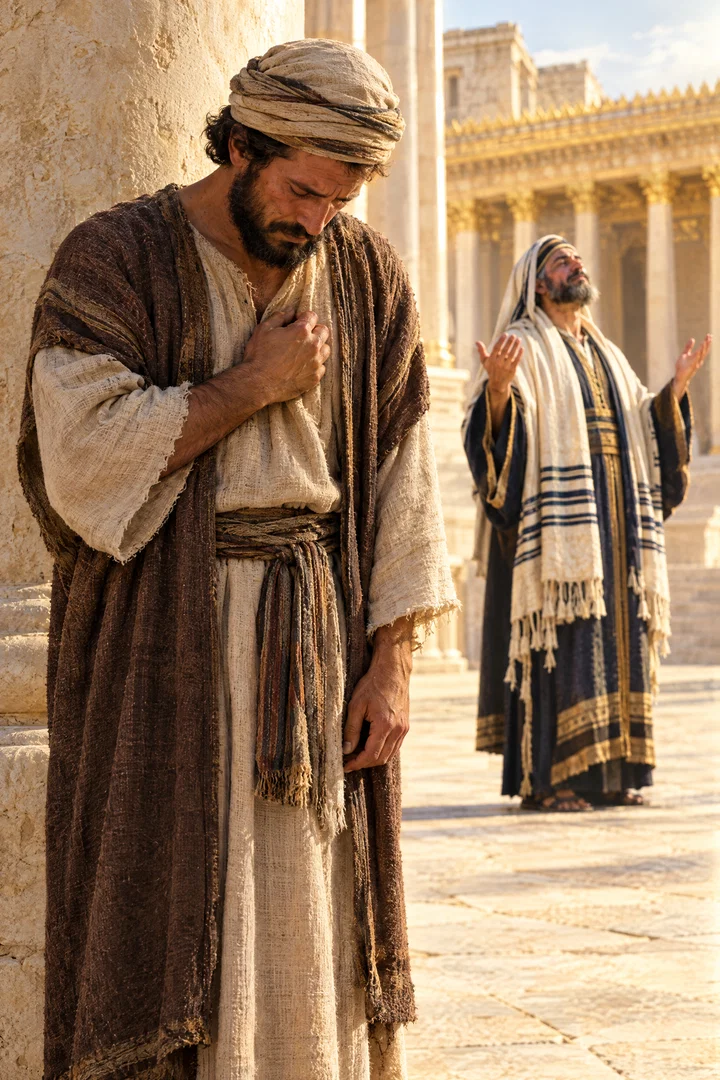
The tax collector stood at a distance as one unworthy, unwilling to lift his eyes toward heaven, beating his breast in anguish and self-abhorrence, knowing he had no merit of his own.COL 150.1–152.2Ms 84b, 1897, par. 17–21RH Feb 28, 1907 He made no comparison with others but stood as if alone before God, with only a desire for pardon and peace and only one plea as a sinner for mercy.COL 150.1–152.2Ms 84b, 1897, par. 17–21 His lowly posture showed humility before God in contrast to haughty self-sufficiency, and his prayer was offered in dependence on God rather than in pride over goodness.Ms 84b, 1897, par. 17–21RH Feb 28, 1907RH May 21, 1908 The humble and repentant one went home justified rather than the self-righteous one, for those who exalt themselves will be brought low and those who humble themselves will be exalted.COL 150.1–152.2Ms 84b, 1897, par. 17–21
His prayer showed a dependence reaching out to lay hold upon Omnipotence, for to him self appeared as nothing but shame.COL 159.2Lt 40, 1899, par. 19RH Oct 30, 1900 All who seek God must see self in the same way, letting self become nothing and recognizing their need rather than relying on self.COL 159.2RH Oct 30, 190021MR 44.3 Justification comes by a faith that renounces all self-trust, by which the needy suppliant lays hold upon infinite power.COL 159.2Lt 40, 1899, par. 19 Faith and prayer work together like arms by which the needy reach for infinite love, and faith sees the benefit and value of making peace with God.Lt 40, 1899, par. 1921MR 44.3 By contrast the prayer without such dependence has no value and is not heard.Lt 40, 1899, par. 19RH Oct 30, 190021MR 44.3
A sense of unworthiness brings a person nearer to God than confident claims of piety, holiness, or sinlessness, whose self-confidence has no sound basis.RH Feb 28, 1907RH May 21, 1908ST Feb 6, 1901 Justification rests on God's mercy rather than on such claims, and a claim to holiness does not establish standing before God.RH May 21, 1908ST Feb 6, 1901 The sinner who knows his need and longs for greater nearness to God has more discernment of heavenly things than the man confident in himself.ST Feb 6, 1901ST Feb 20, 1896 Christ came to lift up the fallen, so the humble penitent who feels his true need is accepted and made precious with God while the self-important man who esteems himself righteous is rejected.RH Feb 28, 1907ST Feb 20, 1896 The farther men separate from God and disobey His commandments the more they develop self-confidence, selfish thought, and selfish action, for value with God does not come from temporal wealth, greatness, or position but from abiding in Christ.ST Feb 20, 1896
Humility means giving up self-glorification and recognizing that sufficiency is in Christ alone.ST Mar 23, 1915 As Christian experience advances, repentance deepens and pride gives way to shame over sin and dependence on Christ, while the self-exalting will be brought low and the humble lifted up.ST Mar 23, 1915 Those who consider themselves sinless do not feel their need for wisdom, light, strength, forgiveness, and continuing growth in grace.LS 212.1 Recognizing unworthiness leads to grieving over sin and dependence on mercy, and the one who so grieved and pleaded went home justified rather than the one who boasted of goodness.LS 212.1
Proud Worship Rejected
The Pharisee came without feeling himself a sinner in need of pardon, trusting his fasting, tithing, prayer, and outward life as merit to recommend him to God and to win human esteem.COL 150.1–152.2 He judged himself by other men instead of by God's holy character, and sought to buy heaven by meritorious works of his own.COL 150.1–152.23T 172.2 This included self-imposed fasting and prayer carried even to the injury of health, which God has not required and which deceives those who practice it.3T 172.2Lt 8, 1867, par. 9–10
His self-trust made him despise, accuse, and condemn others and look down on those he considered sinners.COL 150.1–152.2Lt 12, 1890, par. 15–18 While displaying his virtues and congratulating himself on his goodness, he was blind to his own disobedience and greater faults.ST Feb 26, 188512MR 116.3–117.2 God sees the heart where men praise and flatter, and true righteousness does not produce such self-exaltation and contempt, which manifest a false righteousness and shut a person off from grace and communion with God.COL 150.1–152.2ST Feb 26, 188512MR 116.3–117.2Lt 12, 1890, par. 15–18
His upright posture expressed haughty self-sufficiency, self-congratulation, and spreading his virtues before God.Ms 84b, 1897, par. 17–21Lt 35, 1885, par. 11–14 To exalt self in this way is to think little of sins and much of virtues, to get high in one's own eyes, to be stirred and angry when spoken against instead of closely investigating, and to turn away from reproof of sin as from a disagreeable picture while not ceasing to sin.Lt 35, 1885, par. 11–14 Such proud, self-reliant prayer with little reverence and human superiority prepares no one to approach God, and the self-exalting Pharisee who praised himself was not heard.ST Mar 15, 1899Ms 93, 1898, par. 9–12
He is the picture of false sanctification, where religious duties such as fasting, prayer, and outward humility do not make a person accepted when the heart is proud and self-righteous.BS 9.215MR 271.1Ms 84, 1894, par. 16 Those who profess sanctification while entirely ignorant of the work of grace upon the heart depend wholly upon feelings and emotions once experienced, and stubbornly urge tenacious claims of holiness and sinlessness with many words, repeating that God leads and teaches them and that they live without sin, while bearing no precious fruit as proof.BS 9.2 These pretensions delude their own souls and lead astray many who earnestly desire to conform to the will of God, and speaking of personal spiritual poverty while feeling superior, together with refusing reproof, exposes the false humility and pride.BS 9.215MR 271.1
A prayer that tells the Lord of one's own devotion and prayerful life and what one has done, praising and adoring self in pride and self-sufficiency while despising others, has no value, is not heard or blessed, and does not justify.ST Mar 15, 1899Lt 204, 1900, par. 121MR 61.2Ms 93, 1898, par. 9–12 Recounting works before God proves the lack of blessing, and such self-exalting words with pomposity and irreverence should never be spoken again, for the humble publican went home justified while the self-righteous Pharisee did not.Lt 204, 1900, par. 121MR 61.2 The Pharisee goes home unjustified because he stays anchored and entrenched in self-righteousness as in a fortress where neither God nor man can do anything for him.Lt 52, 1886, par. 1–2 To be justified a person must break down the walls, surrender to God, seek the Lord, grasp the promises, and wrestle till victory is gained, for exalting self is talking of self and magnifying past deeds while excusing faults and keeping Jesus out, and failure leaves the soul enshrouded in dense darkness.Lt 52, 1886, par. 1–2
Becoming just in one's own eyes, wise in one's own opinion, and lifted up by past light and experience forfeits the humility that must mark followers.1T 330.3–331.2Ms 3, 1862, par. 6–7 Such ones think they need not be taught, think they know it all, despise instruction, and cast teaching behind them, while constantly pointing to personal righteousness, devotion, and prayerful life and depending on merits.1T 330.3–331.2Ms 3, 1862, par. 6–7 They are left to their own ways to be deceived about themselves, holding a hard spirit at war with God's work and without union with the meek spirit of Christ.1T 330.3–331.2Ms 3, 1862, par. 6–7
Religious profession without obedience and good fruits does not make a person right with God, and words and actions reveal the true condition despite boasting of goodness.1T 416.1–417.1 Those with greater light and greater knowledge are under increased accountability to advance that light by not only professing belief but practicing the truth, which is following the light by constantly elevating and becoming more spiritually minded.Lt 55, 1886, par. 1 Without this they remain self-righteous and unjustified, blind to wrongdoing, and face judgment if they reject the means God provides to correct them.1T 416.1–417.1Lt 55, 1886, par. 1
Cherishing a spirit of Pharisaism excludes Christ from the thoughts and keeps the heart from being bound up with His heart.Ms 103, 1901, par. 2 Refusing to relinquish a high estimate of self and to humble the heart before God and cast oneself wholly on Christ's mercy places a barrier between the person and the Saviour and shuts out the power out of and above self needed for spiritual life.Ms 103, 1901, par. 2 Such pride and self-righteousness shut the person off from grace and bar the way to heaven, while humble recognition of sin opens the way to seek pardon and receive Christ's righteousness.Lt 12, 1890, par. 15–18Ms 103, 1901, par. 217MR 312.2–3
Justification Through Faith Alone
The verdict turns not on merit, outward deeds, or comparison with others, but on sensed need, confession of sin, and plea for mercy.COL 150.1–152.2 The one came without feeling himself a sinner in need of pardon, trusting fasting, tithing, and outward life as merit to recommend him to God and win human esteem, judging himself by other men instead of by God's holy character.COL 150.1–152.2 His self-trust made him despise and accuse others, manifesting the spirit of Satan, leaving him destitute of divine blessing and unable to commune with God.COL 150.1–152.2 The other stood afar off as unworthy, would not lift his eyes, smote his breast in anguish and self-abhorrence, knowing he had no merit, making no comparison, standing as if alone before God with only desire for pardon and peace and only plea for mercy as a sinner crying for mercy, and he was blessed and justified.COL 150.1–152.2 The two divide all worshipers into two classes, first seen in Cain who came self-righteous with a thank-offering only and was not accepted and Abel who came as a lost sinner trusting unmerited love through blood pointing to the Lamb and was respected, and later seen in Peter who first boasted he was not as other men and would not fall, then after denial repented bitterly like the publican and found mercy and pardon.COL 150.1–152.2
Justification comes by faith that renounces all self-trust, by which the needy suppliant lays hold upon infinite power.COL 159.2Lt 40, 1899, par. 1921MR 44.3 His prayer showed dependence reaching forth to lay hold upon Omnipotence, while the other's prayer had no value.COL 159.2Lt 40, 1899, par. 1921MR 44.3 To him self appeared as nothing but shame, and all who seek God must see self in the same way, letting self become nothing and recognizing need.COL 159.2Lt 40, 1899, par. 1921MR 44.3 Faith and prayer work together like arms by which the needy reach for infinite love, and faith sees the benefit and value of making peace with God.COL 159.2Lt 40, 1899, par. 1921MR 44.3
It rests on God's mercy, divine grace, the atoning blood, and the merits of a crucified and risen Saviour alone, not on claims of holiness or sinlessness.RH May 21, 19083T 172.2ST Feb 26, 1885Ms 84, 1894, par. 16Lt 8, 1867, par. 9–10 A sense of unworthiness and reluctance to lift the eyes to heaven can accompany a heart nearer to God than confident claims of piety.RH May 21, 1908 Pharisaical righteousness springs from self and not from Christ, having its foundation in self alone, trusting in one's own good works for salvation and trying to buy heaven by meritorious works of one's own.3T 172.2Lt 8, 1867, par. 9–10 That includes self-imposed fasting and prayer carried to the injury of health and rigorous fasting which God has not required, which deceives those who practice it and leaves the soul unsustained.3T 172.2Lt 8, 1867, par. 9–10 Religious duties such as fasting, prayer, and outward humility do not make a person righteous when performed in a self-justifying spirit, and to consider oneself thereby entitled to heaven is deception, because works cannot purchase entrance there.Ms 84, 1894, par. 16 The lesson is to reject self-exaltation and seek salvation through Christ alone, relying on divine grace and the atoning blood, with reliance on the one great Offering sufficient for all who believe, the publican representing those whom God justifies and the self-righteous Pharisee representing those who exalt themselves, and humility being necessary for entering heaven.ST Feb 26, 1885Ms 84, 1894, par. 16 Christ and true godliness bring health to the body and strength to the soul.3T 172.2Lt 8, 1867, par. 9–10
Pardon and peace require a knowledge of self that results in contrition.COL 158.2 The Pharisee was not justified because he felt no conviction of sin, and his soul encased in self-righteous armor could not be reached by the Holy Spirit.COL 158.2 Only the one who knows himself to be a sinner can be saved by Christ who came to heal the brokenhearted, preach deliverance to captives, give sight to the blind, and set at liberty the bruised, while those who are whole need no physician.COL 158.2 A sinner must know his real condition to feel need of help, must understand his danger to flee to the refuge, and must feel the pain of his wounds to desire healing.COL 158.2 The humble confession of a sinner who takes responsibility for guilt without excuse or deception is acceptable to God, for whom blood is pleaded so that he is justified, while self-justification that shifts blame onto others or God is its opposite.5T 637.2
Humble Exalted, Proud Abased
The verse lays down the rule that pride ends in humiliation and humility ends in honor, that everyone who exalts himself shall be abased and he who humbles himself shall be exalted.21MR 60.5–61.1Ms 123, 1909, par. 11ST Mar 23, 1915ST Oct 21, 1897COL 163.2 The humble, repentant publican went home justified rather than the self-righteous Pharisee, whose haughty self-sufficiency and confidence in his own deeds stand in contrast to humility before God.21MR 60.5–61.1ST Oct 21, 1897COL 163.2 Its lesson is to humble ourselves and learn from the great Teacher, receiving instruction from Scripture as a privilege.Ms 123, 1909, par. 11 Humility means giving up self-glorification and recognizing that sufficiency is in Christ alone, and as Christian experience advances repentance deepens and pride gives way to shame over sin and dependence on Christ.ST Mar 23, 1915
God rejects the prayer of those exalted in their own eyes and accepts the prayer of the humble, so self-exaltation brings abasement and rejection and self-humbling brings exaltation and acceptance.1T 330.3–331.2 The self-righteous person who points to personal righteousness, devotion and prayerful life and enumerates good deeds is not regarded, while the sinner who pleads for mercy moves pity and goes justified.1T 330.3–331.2 Becoming just in one's own eyes, wise in one's own opinion, and lifted up by past light forfeits the humility that must mark followers, leaving such ones to be deceived about themselves.1T 330.3–331.2 Humility is necessary for receiving Christ's presence and God's blessings, for it is a heaven-born quality that must be present to enter heaven and will be seen in the church, the world, and heaven.RH Nov 26, 1914ST Feb 26, 1885Lt 260, 1906, par. 5 God gives grace to the humble while resisting the proud and self-sufficient, dwells with the humble and contrite to revive them, honor follows humility, the poor in spirit belong to the kingdom of heaven, and humility is a mark of excellence of spirit.RH Nov 26, 1914Lt 260, 1906, par. 5
Christ calls and justifies the humble, outcast sinner, even the despised of the nations, drawing him by loving-kindness to come, while He never countenances those who stand apart in self-esteem and look down upon others, welcoming sinners while rejecting the self-exalting attitude.MH 164.2Ms 198, 1905, par. 5 Spiritual success depends on present humility, and if people will not humble themselves under God's hand, painful providence may humble them.Lt 113, 1890, par. 17 Humility includes acknowledging guilt and shortcomings, confessing sins, seeking forgiveness from people harmed, and making the heart ready, and God works with those who clear away these obstacles through confession.Lt 113, 1890, par. 17 To exalt self is to think little of sins and much of virtues, to get high in one's own eyes, to be stirred and angry when spoken against instead of closely investigating, to turn away from reproof of sin while not ceasing to sin, and to cherish pride that makes deaf and blind to compassion, mercy, and truth, whereas God does not judge as men judge, for friends may praise and flatter and think good work recommends a person to favor, but God reads the intents and purposes of the soul.Lt 35, 1885, par. 11–14 To humble self is to learn meekness and lowliness of heart, to wear His yoke and lift His burdens and become one with Him, to behold Him in order to think little of self, and to submit to the unpleasant work of soul cleansing and bruising of self on which health of the soul depends, and if this is refused the Father must bring down into the valley of humiliation to give a proper estimate of self, for slumbering on in imperfection and human praise ends in the second death rather than being justified.Lt 35, 1885, par. 11–14
Humbling oneself before God is not a downward step but an upward one.Ms 36, 1885, par. 26 Those who accept true religion must step down from self-esteem and self-righteousness and humble themselves before God, and those who place themselves in connection with the living God as sons and daughters are taking steps upward.Ms 36, 1885, par. 26
Living Out Humility
Prayer is to be offered in dependence on God and not in pride over personal goodness, with lowly posture and plea for mercy showing humility before God rather than haughty self-sufficiency.Ms 84b, 1897, par. 17–21 Humble prayer, not pride and self-sufficiency, prepares a person to approach God, while the self-exalting prayer that praises self and looks down on others is not heard.ST Mar 15, 189921MR 61.2 Prayer that God accepts is made with humility of mind and reverence toward the living God, with careful searching of heart and with bringing soul, tongue, and words to God to glorify Him.Ms 93, 1898, par. 9–12 This includes putting right wrongs done by speech against others.Ms 93, 1898, par. 9–12 The proud, self-reliant prayer with pomposity and irreverence, with little reverence and human superiority while despising others, stands as a warning.21MR 61.2Ms 93, 1898, par. 9–12
The lesson is to humble ourselves and learn from the great Teacher, receiving instruction from Scripture as a privilege.Ms 123, 1909, par. 11 To humble self is to learn meekness and lowliness of heart in His school, to wear His yoke and lift His burdens and become one with Him.Lt 35, 1885, par. 11–14 It is to behold Him in order to think little of self, and to submit to the unpleasant work of soul cleansing and bruising of self on which health of the soul depends.Lt 35, 1885, par. 11–14
Humility includes acknowledging guilt and shortcomings, confessing sins, seeking forgiveness from people harmed, and making the heart ready.Lt 113, 1890, par. 17 God works with those who clear away these obstacles through confession, and spiritual success depends on present humility.Lt 113, 1890, par. 17 True humility leads to stopping evil and seeking reformation, for seeing self as God sees brings shame and sorrow over wrongs and their influence on others, whereas pride trusts its own ways and thinks confession humiliating.17MR 312.2–3
Humbling oneself before God in confession is honorable and leads to being exalted.5T 638.1 Confessing sin to the Maker and seeking forgiveness through the merits of the crucified and risen Savior lifts a person up before people and angels.5T 638.1 This is distinct from kneeling before a fallen human and disclosing secret thoughts to a priest, which dishonors and degrades the person.5T 638.1
Doing better than others is no reason for self-flattery, and treating oneself as righteous by favorable comparison with people who do wrong is warned against.ApY 68.113MR 35.1 The right response is to examine one's own heart and yield it to God with willingness to follow.ApY 68.113MR 35.1 High ambitions and desire to make a show reveal self-exaltation and need for conversion, while humility is part of character formed by receiving the word.Ms 31, 1897, par. 18 Workers who speak harshly or act with self-sufficiency need humility to recognize defects and walk rightly, humbly confessing faults before God rather than regarding themselves as righteous and condemning others.Ms 13a, 1891, par. 19–23
Those who learn meekness and lowliness do not flatter themselves that their own methods are best or criticize and depreciate their brethren by comparing work with their own, but esteem others.RCOC 74.3STMW7 15.1–16.1 Self-sufficiency, pride in personal righteousness and merits, and wanting to be first are opposed to the humility required, and the spirit of criticism, jealousy, and fault-finding exposes this pride rather than true righteousness.Lt 15, 1888, par. 10 Striving for superiority brings the Pharisee's sin and strengthens pride and hardness of heart, while God justifies and exalts the humble.STMW7 15.1–16.1Lt 110, 1893, par. 10
The humble who do not trust in their own importance or righteousness but wait on God in trusting faith are honored by Him.ST Oct 21, 1897 Humility should distinguish God's people from the world, and they should seek to be faithful servants rather than seek honor and position for themselves or strive to equal or surpass one another.ST Oct 21, 1897
The lesson is to reject self-exaltation and seek salvation through Christ alone, relying on divine grace and the atoning blood, with the humble penitent accepted while the self-important person who esteems himself righteous is rejected.ST Feb 20, 1896ST Feb 26, 1885 Value with God does not come from temporal wealth, greatness, position, or outward display, but from abiding in Christ and coming humble and contrite to a promise that will not fail.ST Feb 20, 1896Ms 37, 1890, par. 24 Humility is difficult to learn, especially for the rich and self-indulgent who treat wealth as proof of importance or as making them independent of God.7T 88.1 The farther people separate from God and disobey His commandments the more self-confidence, selfish thought, and selfish action they develop, while the sinner who knows need has more discernment of heavenly things than the person confident in himself.ST Feb 20, 1896
Holding to familiar beliefs while rejecting a message sent by God does not put anyone in safety, for the humble and not those who exalt themselves are exalted by God.Ms 27, 1889, par. 16 People who pride themselves on goodness and consider themselves better than others are spiritually blind.Lt 31a, 1893, par. 11–12 They must seek God as sinners rather than trust in standing, or they will fail to develop Christian character and be lost.Lt 31a, 1893, par. 11–12
Those who are self-righteous need their hearts softened and subdued by the Holy Spirit and brought to humble, sincere faith.ST Jan 19, 1882 This humility enables them to win children to Christ.ST Jan 19, 1882 Zeal that savors of Pharisaism is not of Christ, and extremes of false charity and unbending severity are to be avoided where kindness, mercy, and love would be effective.Ms 23b, 1896, par. 16
Sources
Pioneers and periodicals
90 sources
The parable was spoken to those who trusted in their own righteousness and despised others, and it contrasts two worshipers who went up to pray, with the repentant tax collector going home accepted as righteous rather than the self-praising Pharisee.ST Aug 27, 1894ST Apr 23, 1896ST Nov 27, 1901RH Dec 13, 1853ST Jun 11, 1896 To be justified in this saying means to be forgiven, pardoned, freed from sin and received as righteous before God.ST Jan 29, 1894ST Apr 21, 1881 That acceptance is given to humble confession and pleading for mercy through grace and faith in the atoning blood, not to outward obedience, amount of deeds, or measuring oneself against others.ST Oct 21, 1897ST Feb 19, 1885RH Feb 28, 1907ST Jan 29, 1894RH Aug 26, 1862 The saying lays down the abiding rule that everyone who lifts up himself will be brought low, and whoever lowers himself in unworthiness and dependence will be lifted up.ST Jul 23, 1885ST Aug 27, 1894ST Apr 23, 1896 Prevailing prayer therefore asks from felt need and unworthiness in brief sincere words rather than in self-display, and daily life must stop judging and exalting self over others and instead confess sin, forsake it, and walk humbly before God and men.RH Aug 11, 1904RH Jul 1, 1858RH Jul 27, 1876ST Nov 24, 1881RH Feb 1, 1912
Setting and Two Worshipers
The saying closes a parable aimed at those who trusted in themselves that they were righteous and despised others, setting two men who went up into the temple to pray side by side for contrast.ST Oct 21, 1897ST Apr 23, 1896RH Dec 13, 1853ST Jun 11, 1896ST Apr 23, 1896 Outward zeal for the law does not make a person righteous when love for God and neighbor is lacking, for obedience is to flow from love rather than from pride, self-reliance, or trusting the law as a source of self-righteousness.RH Dec 13, 1853RH Feb 17, 1852 The lesson is one of true humility in prayer, the same humble trust and confidence seen in the little children Christ blessed, laying down the general rule that everyone who exalts himself shall be abased and he who humbles himself shall be exalted.ST Oct 21, 1897ST Apr 23, 1896ST Jun 11, 1896ST Apr 23, 1896
The one worshiper prayed with himself rather than to God at all, in self-trust and self-praise, thanking God he was not extortionate, unjust, adulterous, or like other men, and boasting of fasting, tithing, and outward duties.RH Aug 11, 1904ST Nov 24, 1881ST Apr 1, 1897 Though his claims about outward performances were probably true, and though as men go the Pharisees were conscientious, scrupulously careful, respectable people, with Jesus deliberately choosing the classes that seemed best and worst in society, those making most pretensions to righteousness and those making none, the Pharisee measured himself against others instead of God's character and therefore could see only self.RH Aug 11, 1904ST Apr 1, 1897 He overlooked his own sin and faults, despised the publican, trusted in his creed, feelings and performances, and left his fluent address and list of merits as misplaced confidence that brought no justification from God beyond what self could give, leaving his prayer unanswered, spurned, and without blessing.ST Nov 24, 1881ST Apr 1, 1897 The same spirit appears in real attitudes of religious men thanking God for superiority to others, as in a rabbi who claimed he and his son were the world's only righteous men.
The other worshiper stood afar off, would not lift his eyes to heaven, smote his breast, and pleaded as a sinner for mercy, his plea carrying in Greek the definite personal sense of me, the sinner.RH Jul 1, 1858ST Nov 24, 1881ST Sep 18, 1901 His was a short, humble, heartfelt petition of six words centered on need for mercy, in contrast to the long, self-praising, self-displaying speech of the Pharisee about five times as long.RH Mar 22, 1870ST Nov 24, 1881 That plea for mercy was a request for atonement, not mercy apart from sacrifice, for having seen the temple lambs offered he looked beyond those legal sacrifices which prefigured the true offering to the promised atonement that could meet his guilt.RH Jul 30, 1861 It came from a genuine heart aware of sin and personal unworthiness, yet with faith in abundant pardon giving confidence to approach God, proving that prevailing prayer heard in heaven requires realizing dependence and desiring God's presence from the heart rather than impressive words or public display.RH Jul 1, 1858ST Sep 18, 1901
The verdict reverses human ranking, for the repentant sinner who humbly asked mercy as a sinner went down to his house justified, forgiven and blessed with pardon and peace, rather than the self-righteous, self-trusting, self-exalting worshiper.ST Mar 23, 1915ST Aug 27, 1894ST Nov 27, 1901ST Dec 2, 1886ST Apr 23, 1896 God regarded the publican's worship more favorably than the Pharisee's, accepting the one who came without claiming merit while the self-important prayer went unanswered.ST Mar 23, 1915ST Oct 21, 1897ST Dec 2, 1886 God judges the heart rather than outward appearance, wealth, rank, talent, education, reputation or position, humbling those who exalt themselves and exalting those who humble themselves.ST Oct 21, 1897ST Nov 27, 1901RH Dec 21, 1911
Meaning of Being Justified
To be justified in this verse means to be forgiven, pardoned, accepted as righteous, counted a just man and freed from sin.ST Jan 29, 1894ST Apr 21, 1881RH Nov 18, 1909ST Apr 23, 1896 The penitent who confessed his sin went home pardoned, accepted, saved and happy, while the self-righteous man who trusted in his own goodness was not received.ST Apr 21, 1881RH Aug 26, 1862RH Nov 18, 1909ST Apr 23, 1896 The publican received pardon because he felt his need of it, while the Pharisee did not seek pardon because he considered himself already righteous.ST Jan 29, 1894ST Apr 21, 1881RH Aug 26, 1862RH Nov 18, 1909
Justification is given to humble confession and appeal for mercy, not to outward obedience, amount of deeds, or comparison with others.ST Oct 21, 1897ST Feb 19, 1885RH Feb 28, 1907ST Feb 19, 1885ST Sep 22, 1881 Acceptance depends on the heart's spirit and motive, so the guilty publican who knew his need was accepted while the outwardly dutiful boaster was rejected.ST Oct 21, 1897ST Feb 19, 1885ST Feb 26, 1885ST Feb 19, 1885ST Sep 22, 1881 God judges the heart rather than outward appearance, wealth, rank, talent, education, reputation or position, and reverses human ranking by favoring the despised penitent over the publicly respected, self-satisfied claimant to holiness.ST Oct 21, 1897ST Feb 19, 1885RH Feb 28, 1907ST Feb 26, 1885ST Feb 19, 1885 Humility that confesses own sin without comparing with others, pleads for mercy alone, admits that punishment would be just for breaking the law in thought, word and deed, and fears the coming judgment is the course that secures pardon and peace with God.ST Oct 21, 1897RH Feb 28, 1907ST Feb 26, 1885ST Feb 19, 1885ST Sep 22, 1881
The publican's justification came by grace through faith in spilled blood and propitiation, trusting wholly in saving power and merits rather than personal worthiness, deeds, atonement for his own sins, or felt enjoyment.LS 212.1ST Jan 29, 1894RH Aug 26, 1862RH Nov 30, 1916RH Mar 13, 1866 It requires truly hating sin, desiring grace, sincerely entering upon the Christian race, and coming honestly as a needy beggar confessing unworthiness without pretending to be righteous or waiting until fit, since no one can make himself pure and blood alone cleanses for forgiveness and change.RH Aug 26, 1862RH Nov 30, 1916RH Mar 13, 1866RH Aug 27, 1857RH Sep 3, 1857 Those who consider themselves sinless feel no need for wisdom, light, strength, forgiveness and continuing growth in grace, while recognizing unworthiness leads to dependence on mercy.LS 212.1ST Jan 29, 1894RH Aug 26, 1862RH Nov 30, 1916RH Mar 13, 1866 Justification is not a claim to have become sinless, but requires continuing to acknowledge sin and rely on forgiving mercy rather than claiming freedom from sin and boasting in self.RH Feb 28, 1907LS 212.1RH May 21, 1908RH Sep 9, 1902RH Feb 23, 1905
Mere outward copying of the publican does not justify, for dressing as a publican, bowing down, groaning, smiting a hollow heart, owning unfelt sins and being proud of humility is still rejected hypocrisy.RH Feb 28, 1907RH May 21, 1908RH Sep 9, 1902RH Feb 23, 1905 Only truth pleases, whether in truthful tears or truthful thanks, and the shrinking back in shame, smiting the breast and honest owning of sin is commended while telling how good a life one led is spurned.RH Feb 28, 1907RH May 21, 1908RH Sep 9, 1902 True justification makes an altered man living a new life who can come with lifted head and joyful thanks.RH May 21, 1908RH Sep 9, 1902RH Feb 23, 1905 Even falling short in the measure of faith, godly sorrow and repentance does not shut out boldness, for there is no merit in those things and no fixed measure required of all, and sometimes felt enjoyment is withheld so faith will depend on nothing but free grace.RH Sep 9, 1902RH Aug 27, 1857RH Sep 3, 1857
Humility and Exaltation Principle
The verse lays down the general principle that everyone who exalts himself shall be abased and brought low, while he who humbles himself shall be exalted and lifted up.ST Jul 23, 1885ST Aug 27, 1894ST Apr 23, 1896ST Nov 27, 1901ST Dec 2, 1886 Of the two men who went up into the temple to pray, the humble publican who knew he was a sinner and pleaded for mercy went down to his house justified rather than the self-righteous Pharisee who trusted in his own righteousness, despised others and claimed to be faultless.ST Jul 23, 1885ST Aug 27, 1894ST Apr 23, 1896ST Nov 27, 1901 Those who recognize their need for saving grace may receive God's favor, while those who trust in their own goodness place themselves outside the Saviour's mission and are condemned and left without acceptance.ST Jul 23, 1885ST Aug 27, 1894ST Nov 27, 1901ST Dec 2, 1886
Humility means a low opinion of oneself with a deep sense of unworthiness, dependence and self-abasement before God, giving up self-glorification and recognizing that sufficiency is in Christ alone.ST Mar 23, 1915RH Nov 26, 1914ST Aug 25, 1881ST Jul 22, 1889ST Dec 16, 1880 As Christian experience advances repentance deepens and pride gives way to shame over sin and dependence on Christ, and walking humbly with God enables learning justice and mercy, for God regards and teaches the humble, gives grace to them, dwells with the humble and contrite to revive them, and grants peace to those who trust in him.ST Mar 23, 1915RH Nov 26, 1914ST Jul 22, 1889 The principle holds in worldly matters where the unostentatious are entrusted with responsibility, and preeminently in spiritual things where the humble are raised to heaven's honors to sit with Christ on his throne, even higher than angels who never fell, while those God abases suffer shame and everlasting contempt.RH Nov 26, 1914ST Dec 16, 1880 It is illustrated by Joseph, whose descent into slavery and prison led to the throne because he submitted to God and served rather than scheming to free himself, showing that true greatness is service and humble service can lead to honor.ST Nov 10, 1898ST Dec 16, 1880 It is illustrated also by Jesus humbling himself though sinless, by the rich man and Lazarus, and by little children, and by Peter, whose refusal to let Jesus serve him showed he still thought those in an exalted position should not stoop to serve inferiors and had not yet learned humility.ST Mar 29, 1899
Saying I am of no account while neglecting duty and resenting it when others agree is pride, as is displaying coarseness as proof of humility while finding fault with others and holding up self as a model of plainness.RH Feb 25, 1873 Mistaking self-esteem and self-complacency for holiness, boasting of one's own qualities and works to make others seem inferior and claim glory for oneself, being proud of humility, and using one's own religious activity as a reason to find fault with others as when a man boasts that he alone is awake praising God while fellow worshipers sleep, all repeat the self-righteous spirit of the Pharisee and stand opposed to humility before God.ST Aug 25, 1881RH Feb 25, 1873ST Mar 24, 1887RH Aug 6, 1872 Self-love can deceive people into thinking themselves free of selfishness while remaining selfish.ST Mar 24, 1887 At harvest the master esteems humility and exalts the truly humble who seek healthy growth in keeping with his will without envy toward those ahead and without hindering others, keeping them as good seed for new growth, while the falsely humble are rejected as worthless and trampled and the proudly humble are rejected as counterfeit and burned.RH Feb 25, 1873
True Versus False Prayer
Prevailing prayer heard in heaven requires realizing dependence on God and desiring His presence from the heart.RH Jul 1, 1858RH Jul 27, 1876RH Feb 1, 1912 The publican's earnest, fervent plea was answered because it came from a genuine heart, with awareness of sin and personal unworthiness leading to humility and faith in abundant pardon giving confidence to approach.RH Feb 1, 1912ST Feb 17, 1888 His brief prayer was heartfelt and sincere and received favor, while the Pharisee's boastful prayer did not.RH Jul 27, 1876RH Feb 1, 1912ST Feb 17, 1888 The Pharisee made no request because he felt no need or desire for anything, praised himself, prayed with himself in cold formal lip worship about fasting and tithing, and could see only self.RH Jul 1, 1858ST Feb 17, 1888RH Oct 24, 1912 Humility and sincere love and gratitude matter more than eloquent words meant to impress an audience, for the humble petitioner who recognizes weakness and depends on God for salvation and help through Jesus Christ is favored over the self-exalting petitioner, as a child's lowly prayer exemplifies trust.RH Jul 27, 1876RH Oct 24, 1912
Length does not determine acceptance, for the short, humble prayer centered on need for mercy went home justified rather than the long, self-praising prayer.RH Mar 22, 1870RH Jul 21, 1863ST Jan 11, 1877 The Pharisee's prayer was condemned not because it was longer than the publican's but because of its fault, and the publican's brief prayer was effective because it was the right kind of prayer that changed his prospects for eternity.RH Dec 11, 1860RH Jul 21, 1863ST Jan 11, 1877 Plain, brief, sincere words honestly expressing need are fitting before God, since being heard does not depend on many words and humility rather than show of words marks the prayer that seeks mercy.RH Mar 22, 1870RH Jul 21, 1863ST Jan 11, 1877 Ostentation in giving, prayer, and fasting is pride, not humility, for seeking public notice and praise for religious acts, praying to be seen and heard or to audiences, and exhibiting religion by public show harms character and brings reproach.ST Oct 29, 1902ST Dec 5, 1878 Pouring a large offering to be seen while easing conscience with ill-gotten gains, and display Christianity such as national Christianity put on exhibition before the world, fall short of the Christian standard and have no place in it.ST Oct 29, 1902ST Dec 5, 1878
The self-righteous spirit treats fasting as meritorious before God, thinking fasting earns favor, and God is not pleased with fasting offered in that spirit.ST Jun 14, 1883RH Feb 17, 1852 Such prayer is vain worship that breaks the third commandment, for every time God's name is spoken in it the name is taken in vain as empty, void, worthless, destitute of force and efficiency, to no purpose, fruitless and ineffectual to the petitioner.RH May 2, 1907 Trusting in the law as a source of self-righteousness, as though proud obedience were acceptable, is rebuked, since obedience is to flow from love and not from pride or self-reliance.RH Feb 17, 1852 Religious exercises do not make up for a selfish life, so outward Sabbath observance can produce the Pharisee's spirit rather than a true Christian's, and professed prayer gives no thought to relieving the poor or opposing surrounding wickedness.RH Sep 10, 1872
Faith Law and Salvation
Self-righteousness keeps a person from submitting to God's righteousness and receiving His acceptance, for the one who knew himself a sinner and pleaded for mercy went home accepted as righteous, while the one who claimed to be faultless and trusted in his own goodness was condemned.ST Jul 23, 1885RH Oct 10, 1871 Trust in personal goodness places a person outside the Saviour's mission, since only those who recognize their need for saving grace can receive divine favor.ST Jul 23, 1885ST Apr 20, 1915 The Pharisee's lack of humility and love left his sins unforgiven, for humility is necessary to forgiveness, and outward zeal for the law without love for God and neighbor does not make anyone righteous.RH Oct 10, 1871RH Dec 13, 1853 The law must expose sin and guilt and overturn confidence in personal righteousness, as seen when the Pharisee appeared holy and thanked God before sin and judgment were revealed to him.RH Dec 13, 1853ST Sep 14, 1888 Such self-trust and contempt for others are offensive to God, for while a person displays virtues God sees the heart with its disobedience and serious faults, and human righteousness is as filthy rags and outward profession without forsaking sin does not make anyone right.ST Feb 26, 1885ST Sep 14, 1888
Salvation from sin is offered to every kind of sinner, from the Pharisee at one end to the prodigal at the other.ST Jan 15, 1902ST Jan 29, 1902ST Feb 26, 1902ST Oct 23, 1901 Even the Pharisee type of sinner is included among those to whom deliverance is held out.ST Feb 26, 1902ST Nov 13, 1901ST Oct 23, 1901ST Dec 4, 1901
The verse was spoken against those who trusted in their own righteousness and despised others, and God accepts the humble publican who pleads for mercy as a sinner rather than the self-trusting worshiper, exalting the one who humbles himself and abasing the one who exalts himself.ST Jun 11, 1896ST Apr 20, 1915RH Nov 6, 1860 That same humble trust and confidence is seen in the little children Christ blessed, and in the poor in spirit who feel their poverty, ask God for mercy, and are met by heaven's response, since human effort and supposed excellence cannot save and deliverance requires help beyond oneself.ST Jun 11, 1896ST Apr 20, 1915 Its warning applies to the Laodiceans, who mistake gifts for grace and regard themselves as spiritually rich while self-deceived, in contrast to the shame and confession shown by Ezra and David, so that Christ now speaks plainly to warn that He will reject them.RH Nov 6, 1860 Peter lived out both sides, for at first like the Pharisee he was strong in his own estimation, confident he was not as other men and able to withstand temptation, and that self-confidence misled him to deny his Lord with cursing and swearing.ST Mar 5, 1912 When Christ looked on him with grieved compassion and love, Peter understood himself, came to the turning point, went out and wept bitterly, and like the publican in contrition and repentance found mercy and assurance of pardon. From then his self-confidence was gone and his boastful assertions were never repeated, and when tested he no longer exalted himself above his brethren but appealed to the One who reads the heart; the once restless, boastful, self-confident disciple became subdued and contrite, was restored to confidence, commissioned to feed the sheep and lambs, and made a partaker of Christ's sufferings and of His glory when He sits on the throne of His glory. The rich man and Lazarus illustrate the same saying, for the Pharisees prized wealth and justified themselves before people, but God knew their hearts and judged their values differently, so that earthly riches did not prove His favor, and the one who exalts himself is abased and shut out from communion with God while the one who humbles himself in contrition is pardoned.ST Mar 30, 1882
The verse condemns pride and claims of exceptional holiness and calls believers to the publican's humble spirit, to examine themselves and come humbly to the Lord with sincere repentance, confessing and forsaking sin with contrition.RH Mar 25, 1862ST May 31, 1905RH Jan 4, 1912 The person who humbly confesses wrong rather than protecting reputation will be exalted, while the one who exalts himself will be brought low, for humble full confession is God's way of healing and restoring those who have done wrong and can also restore the confidence of those they have injured.RH Jan 29, 1867ST May 31, 1905RH Jan 4, 1912 Conviction of sin and gratitude for mercy lead to deep love for the One who forgives, and such a person who admits wrongdoing and recognizes deserved punishment receives compassion and acceptance rather than condemnation and can be used in service to bring salvation to others.ST May 31, 1905RH Jan 4, 1912 God accepts the humble rather than the self-righteous and self-conceited, and those who submit to God and humble themselves for Christ's cause are fit for His service and are the ones He chooses to serve His cause, while those who seek their own importance and refuse humility have no place in it and the Pharisee's self-righteousness leaves him unfit.ST May 31, 1905ST Mar 24, 1887RH Jul 6, 1869
Warnings for Daily Living
The verse forbids judging, exposing the habit of overlooking one's own faults while seeing the faults of others as through a magnifying glass.ST Feb 26, 1885RH Aug 11, 1904ST Nov 24, 1881 It condemns measuring oneself against others and overlooking one's own sin, trusting in personal righteousness while despising others, and judging oneself by comparison with people rather than by God's law.ST Feb 26, 1885ST Nov 24, 1881RH Feb 18, 1858 That self-complacency keeps up a high opinion of merit by elevating self through depressing those claimed as inferior, being sharp-sighted to others' faults and admiring of supposed excellencies, contemplating others' failings with pity or derision and one's own doings with admiration.RH Feb 18, 1858RH Jun 3, 1858 It lives on whenever people loudly condemn a neighbor's faults so hearers will think them free, magnifying a neighbor's faults to lose sight of their own and make their shortcomings seem small by comparison, which is the secret of all gossip about scandals.ST Apr 27, 1882RH Jun 3, 1858 The same spirit prays for enemies while assuming oneself entirely right, and instead prayer should ask God to reveal one's own wrong and give grace to confess it.RH Aug 11, 1904ST Apr 27, 1882 Character is weighed by God's word and law as the only standard, not by being better than someone else, and pride that blinds to faults corrupts prayer and leaves satisfaction with outward religion instead of seeking growth.ST Nov 24, 1881RH Jun 3, 1858
Humility must mark daily walk, work and worship, for the humble rather than the self-righteous are justified, and self-exaltation leads to being brought low while humility leads to being lifted up.RH Sep 14, 1869RH Apr 1, 1862RH Sep 5, 1865 That humbling means confessing a wrong course and submitting to the judgment and experience of God's people when prejudice, self-righteousness and stubbornness have blinded to danger and led to justifying wrongs.RH Apr 1, 1862RH Dec 16, 1909 The Christian acknowledges personal weakness and dependence on God and regards others with respect and love, cultivating modesty and humility and avoiding pride and self-esteem.RH Nov 26, 1914RH Sep 5, 1865 God gives grace to the humble, honor follows humility, and God dwells with the humble and contrite to revive them, and the poor in spirit belong to the kingdom of heaven.RH Nov 26, 1914 That humility gives a test of the Spirit's presence with love, joy and peace, wins children to Christ, avoids pride over position, refuses to enforce respect or glorify human beings, leaves vindication to the Lord, lets go of grievances and claims of merit, and expresses gratitude without superiority.RH Nov 26, 1914RH Sep 14, 1869RH Apr 1, 1862RH Sep 5, 1865RH Dec 16, 1909 Receiving blessings or being without sin gives no reason for pride, and humble testimony does good to those who hear it.RH Nov 26, 1914RH Sep 14, 1869ST Dec 12, 1911
A church member who keeps the Sabbath, lives health reform, pays tithe and gives liberally yet exalts himself over others repeats the Pharisee, while an open sinner such as a saloon-keeper who confesses sin goes home justified rather than the boastful one.RH Aug 11, 1904 Outward religious practices do not make one right with God when living for self and neglecting the needs of neighbors, and professing Christians may pray while giving no thought to relieving the poor or opposing the wickedness around them.ST Dec 12, 1911 Religious exercises do not make up for a selfish life, so outward Sabbath observance can produce the spirit of the Pharisee rather than that of a true Christian.RH Sep 10, 1872 Humble giving is more precious to God than showy generosity, and the proud giver who pours in a large offering of gold to be seen and heard or eases conscience by giving from ill-gotten gains is not accepted.RH Jul 16, 1861RH Sep 23, 1873 True Christian helpfulness must join prayer, and using religious activity while fellow worshipers sleep to find fault repeats the same rejected pride.RH Aug 11, 1904RH Jul 16, 1861RH Sep 10, 1872RH Sep 23, 1873
Sources