Matthew 11:29
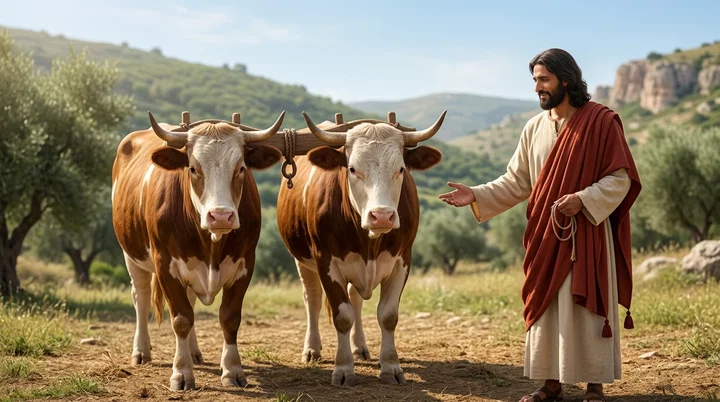
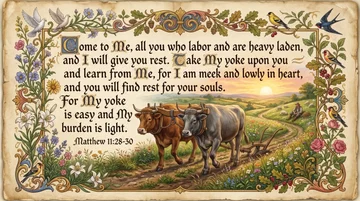
Take my yoke upon you, and learn of me; for I am meek and lowly in heart: and ye shall find rest unto your souls.
Translations
Take my yoke on you, and learn of me; for I am meek and lowly in heart: and you shall find rest to your souls.
King James Version, KJV Cambridge Paragraph Bible, Revised Version, American Standard Version
Take my yoke upon you, and learn of me; for I am meek and lowly in heart: and ye shall find rest unto your souls.
Take my yoke upon you, and learn from me: for I am meek and lowly in heart; and ye shall find rest to your souls.
take up my yoke upon you, and learn from me, because I am meek and humble in heart, and ye shall find rest to your souls,
Take my yoke upon you, and learn from me; for I am meek and lowly in heart; and ye shall find rest to your souls;
Take my yoke upon you, and learn of me,—because, meek, am I and lowly, in heart, and ye shall find rest unto your souls;
Take My yoke upon you and learn from Me; for I am gentle and humble in heart, and you will find rest for your souls.
Take My yoke upon you and learn from Me, for I am gentle and humble in heart, and you will find rest for your souls.
Take my yoke upon you and learn from me, for I am gentle and humble in heart; and you will find rest for your souls.
Take my yoke on you and become like me, for I am gentle and without pride, and you will have rest for your souls;
Take my yoke on you, and learne of me that I am meeke and lowly in heart: and ye shall finde rest vnto your soules.
Douay-Rheims (Challoner revision)
Take up my yoke upon you, and learn of me, because I am meek, and humble of heart: and you shall find rest to your souls.
Pictures


Cross-references 20 of 140
- Matthew 16:24
Then said Jesus unto his disciples, If any man will come after me, let him deny himself, and take up his cross, and follow me.
Christ calls his followers to deny themselves, take up the cross, and follow him.
- Philippians 2:7
But made himself of no reputation, and took upon him the form of a servant, and was made in the likeness of men:
Christ’s humble, servant-hearted meekness is the pattern for his followers.
- 1 Peter 2:21
For even hereunto were ye called: because Christ also suffered for us, leaving us an example, that ye should follow his steps:
Christ’s meekness and conduct under suffering are set as an example for believers to follow.
- Luke 9:23
And he said to them all, If any man will come after me, let him deny himself, and take up his cross daily, and follow me.
Following Christ involves daily self-denial and taking up the cross.
- Isaiah 57:15
For thus saith the high and lofty One that inhabiteth eternity, whose name is Holy; I dwell in the high and holy place, with him also that is of a contrite and humble spirit, to revive the spirit of the humble, and to revive the heart of the contrite ones.
God dwells with and revives the humble and contrite.
- Philippians 2:5
Let this mind be in you, which was also in Christ Jesus:
Learning from Jesus calls believers to have his humble, selfless mind.
- Matthew 5:5
Blessed are the meek: for they shall inherit the earth.
Christ’s meekness is linked with the blessing promised to the meek.
- 1 Peter 5:7
Casting all your care upon him; for he careth for you.
Both direct the burdened to entrust their cares to God, whose care brings relief.
- Hebrews 4:9-10
There remaineth therefore a rest to the people of God.
The Sabbath rest points toward the promised rest of God.
- Philippians 4:7
And the peace of God, which passeth all understanding, shall keep your hearts and minds through Christ Jesus.
Soul rest in Christ is peace beyond understanding that guards the heart.
- 1 Peter 3:4
But let it be the hidden man of the heart, in that which is not corruptible, even the ornament of a meek and quiet spirit, which is in the sight of God of great price.
Both value a meek spirit and inward character before God.
- Mark 8:34
And when he had called the people unto him with his disciples also, he said unto them, Whosoever will come after me, let him deny himself, and take up his cross, and follow me.
Following Christ entails self-denial and taking up the cross.
- Matthew 18:4
Whosoever therefore shall humble himself as this little child, the same is greatest in the kingdom of heaven.
Both texts present humility and meekness as the way to true greatness.
- Galatians 5:23
Meekness, temperance: against such there is no law.
Meekness is named among the Spirit’s fruits.
- Psalms 25:9
The meek will he guide in judgment: and the meek will he teach his way.
God guides and teaches the meek, echoing Christ’s call to learn from him.
- Philippians 2:3
Let nothing be done through strife or vainglory; but in lowliness of mind let each esteem other better than themselves.
Both call for humility and lowliness rather than self-exaltation.
- Isaiah 58:6
Is not this the fast that I have chosen? to loose the bands of wickedness, to undo the heavy burdens, and to let the oppressed go free, and that ye break every yoke?
Isaiah calls for breaking oppressive yokes, contrasting with Christ’s invitation to take his yoke.
- Micah 6:8
He hath shewed thee, O man, what is good; and what doth the LORD require of thee, but to do justly, and to love mercy, and to walk humbly with thy God?
Both connect walking humbly with God to faithful service.
- Numbers 12:3
(Now the man Moses was very meek, above all the men which were upon the face of the earth.)
Moses exemplifies the meekness Christ teaches.
- 1 John 2:6
He that saith he abideth in him ought himself also so to walk, even as he walked.
Those who abide in Christ should walk as he walked.
Commentary part 1 of 4
Each commentary is drawn from primary sources: the writings of Ellen G. White and Adventist pioneers and periodicals. Each commentary is separate. Its own words are not a quotation; follow the references to read the source passages.
Ellen G. White
337 sources
Christ calls all who are weary and weighed down with sin, care and toil to come to him, take his yoke, learn from his meek and lowly heart, and find rest for their souls because his yoke is easy and his burden is light.MH 71.1–26T 247.2RH May 9, 1907 The yoke is willing obedience and submission to God's will and law, found in the very act of taking it, with Christ himself bearing the weight and carrying the heavier end.Lt 58, 1902, par. 12Ms 80, 1903, par. 1812MR 232.3–4Lt 66, 1898, par. 11–14ST May 20, 1889 Learning from him means daily entering his school in the Word under the Holy Spirit, beholding him until self dies and his mercy, tenderness and unselfish service are copied in the life.Ms 31, 1897, par. 12Ms 73a, 1900, par. 1–29MR 70.1–3Ms 47, 1902, par. 43Ms 102, 1902, par. 9 The promised rest is present peace, trust and healing of mind, body and spirit in Christ himself amid duty and struggle, certain to faith and conditional on complete cheerful obedience, not idleness but earnest active service.9T 124.212MR 232.3–4Lt 191, 1901, par. 3SC 71.1ST Sep 4, 1901 He can give it because as divine Creator and Teacher he humbled himself to wear the same yoke in humanity, meet temptation and bear the weight of sin on Calvary, making rest a free gift.6T 247.2Ms 88, 1903, par. 76T 160.1–2STE 188.29MR 70.1–3
Words and Historical Setting
The invitation calls toiling, distressed and heart-burdened people whose hopes are blighted and who try to quiet the longing of the soul with earthly joys, bidding them take Christ's yoke upon them and learn from him because he is meek and lowly in heart, with the promise that they shall find rest unto their souls.MH 71.1–26T 247.2RH May 9, 19079T 265.1–4GW92 432.3 Wearing his yoke means learning his lessons in a pure, holy life free from sin, a way of self-denial and service that makes possible the establishing of gospel medical missionary work in many places.RH May 9, 1907CH 349.2 The path of obedience to God's commands entered by accepting the invitation is marked by righteousness, joy and peace in the Holy Spirit, bringing gladness, so that what first feels like a cross becomes a crown through experience.RH May 9, 1907GW92 432.3 Coming to him with a broken and contrite heart and praying for grace brings a living connection now, by which God's power subdues and tenderizes the heart and fills it with rest, peace and love.GW92 432.3
The call to labor and be heavy laden to take his yoke and learn from him and find rest, for his yoke is easy and his burden light, was spoken after rebuke of Chorazin, Bethsaida and Capernaum for not repenting though mighty works were done in them.9T 265.1–4 Judgment was declared more tolerable for Tyre, Sidon and Sodom than for those unrepentant cities.9T 265.1–4 The invitation followed thanks to the Father, Lord of heaven and earth, for hiding these things from the wise and prudent and revealing them to babes.9T 265.1–4 It followed the declaration that all things were delivered to the Son, who reveals the Father.9T 265.1–4
The invitation stands in contrast to man-made rules and burdensome ceremonies imposed by the priests, which left people restless, obscured God's commandments, hid the true significance of the Sabbath and made it a burden.ST Apr 28, 1898 The law had been turned into a yoke of bondage through traditions and human commandments, though heart obedience would have produced a different character, in contrast to Christ who is meek and lowly.ST Apr 28, 1898ST Feb 15, 1899 The Jews expected a Saviour and King who would come with worldly majesty, splendor, power and authority, displaying the greatness of worldly men and compelling the Gentiles to obey him.2SP 40.31RED 35.2SG4 116.3 Because he came in humiliation and suffering in the form of a servant, his humble appearance was a reproof to pride and self-righteousness, and his own highly favored people, trusting in promises and sure salvation as God's peculiar treasure brought out of Egypt, rejected and would not acknowledge him as Saviour of the world, though they would have received and worshiped him had he appeared in splendor.2SP 40.31RED 35.2SG4 116.3 His lowly coming was just as prophecy marked out for the coming of the Just One and the manner of his coming, giving sufficient grounds for faith to those who wished to believe, and his life and works revealed his divine character.SG4 116.3
His yoke is easy and his burden light because he himself bore their weight on the cross of Calvary.6T 247.2Lt 206, 1899, par. 13Ms 169, 1899, par. 16Ms 40a, 1890, par. 61–62Lt 187, 1902, par. 3 Coming to Christ and submitting to him and learning his meekness and lowliness of heart gives rest to the soul, satisfies every want, cleanses the heart and renews the mind.ST Dec 15, 1898 The rest is salvation offered freely and without price because Christ gave his life, yet many turn from the offer with disdain and give eternal interests only a passing thought, and so fail to rightly estimate the value of the heavenly treasure.ST Dec 15, 1898 The verse means men cannot accomplish God's assigned work in their own strength but must learn from Christ how to do it, since he came to show how that work is done.Ms 169, 1899, par. 16 Learning from Jesus by sitting at his feet and beholding his ways, works and self-denying life changes the learner, and his meekness and lowliness bring peace and rest, so that taking his yoke means serving with him as a learner who follows his direction, not as a dictator.Ms 40a, 1890, par. 61–62 His people can withstand every opposing influence when they turn from sin with humble, contrite hearts and claim God's promises in faith.Lt 187, 1902, par. 3
The gracious, kind, far-reaching invitation was given while he walked on earth and wherever he went scattering blessings, uplifting the weak, the halting, the suffering, and making glad the hearts of the desponding and discouraged.Ms 63, 1898, par. 23Lt 104, 1910, par. 11–12 His heart was ever touched by human woe, with tender, pitying love that rebukes all selfishness and heartlessness, patience that never wearies and love never repressed, and with earnest, untiring labor he sought to gain admission to hearts and to reach both the most lowly and those in higher positions.Ms 63, 1898, par. 23Lt 104, 1910, par. 11–12Lt 31, 1898, par. 2–4 He walked and worked in the streets of the cities teaching the weary, going about doing good in the temple, in the streets, in the field and by the wayside, speaking to souls about God, preaching the gospel and healing the sick, so that the light of the gospel shines to weary and oppressed souls and they find rest.Lt 104, 1910, par. 11–12Lt 31, 1898, par. 2–4 His entire lowly life fulfills what Isaiah predicted, for he is ever touched with human woe and ready to relieve those suffering and in need, choosing solitude over the praise and honor of men, and learning of him means reflecting his image in deeper lines and representing his work of love, compassion and grace.Ms 99, 1894, par. 10 For three years the disciples walked and talked with him day by day watching him cheer the weary and burdened with his words and help the sick and afflicted with his power, and having received his grace they were given power to do the work he had done and were sent to shed abroad the light of his gospel of love and healing.20MR 326.3–4 The invitation was one of every means he used to arrest the attention of the impenitent, showing how tender and considerate his dealings were with all, expressing his longing to break the spell of infatuation upon those deceived and deluded by satanic agencies and to give the sin-polluted soul pardon, peace and rest, and the rest he promises comes as his followers supply the necessities of others, for the more they impart the more they receive, and their own souls are refreshed and satisfied by his love.Ms 63, 1898, par. 23Lt 31, 1898, par. 2–420MR 326.3–4
The one who invites this learning is the greatest Teacher the world ever knew, the great Teacher come down from heaven, the greatest Author and standard Teacher who never mistakes, the great Fountain-head whence all wisdom flows, through whom is everlasting life, to whom all the treasures of heaven were committed to give to the diligent, persevering seeker.6T 160.1–29MR 70.1–3Ms 47, 1902, par. 43 He is the Creator of the heavens and the earth, the lofty trees, grass and shrubs, who set the stars in order and appointed the sun and moon to their work, so learning from him is drinking at the fountain of true knowledge, knowing God and the power of his grace.9MR 70.1–3 Taking his yoke means submitting to his teaching, entering his school and learning from his lips and from his Word as the lesson book the lesson of meekness and lowliness of heart that makes a person great in the eyes of the Lord.9MR 70.1–3Ms 47, 1902, par. 43Lt 288, 1908, par. 5 Learning of him means studying his lessons and the character of his teaching, its freedom from formalism and tradition, and its originality, authority, spirituality, tenderness, benevolence and practicability, and means more than reading, searching the Scriptures carefully and diligently by comparing one portion with another since Scripture unlocks Scripture, and reading and praying and studying with the Holy Spirit beside as divine Teacher enlightening the understanding to comprehend great truths, not going to infidel authors who look on his works yet say there is no God, nor to reputedly great authors and books containing suppositions, nor making boast of knowledge.6T 160.1–29MR 70.1–3Ms 47, 1902, par. 43 Those who daily take his yoke and learn Christ's lessons and live under his discipline are converted every day and become fruit-bearing branches in connection with the Vine, bearing rich clusters of love, joy, peace, long-suffering, gentleness, kindness, meekness, faith, temperance and godliness which are the fruits of his character, becoming imbued with his Spirit and by beholding changed into his likeness, teaching as disciples sitting at his feet and accustomed to learn of him, grounded and rooted in truth so that nothing moves the soul, and finding the promised rest unto souls which is true higher education.6T 160.1–2STE 188.29MR 70.1–3Lt 288, 1908, par. 54MR 156.1–2
Those Invited to Come
The invitation is open to every human being without exception, shutting no one out from care and love.DA 328.1–2ST Jun 12, 1907DA 328ST May 13, 1908 It reaches high and low, rich and poor, learned and unlearned, ignorant and educated, including those who do not feel their need.DA 328.1–2ST Jun 12, 1907ST Jun 29, 1904ST May 13, 1908 All are in fact weary and heavy laden with burdens only Christ can remove, whether they know it or not.ST Jun 29, 1904ST Aug 8, 1916 His yoke is love rather than bondage, so even the weakest can grow strong by grace in bearing it.ST Jun 12, 1907
It tenderly seeks toiling, distressed and heart-burdened people whose hopes are blighted and who try to quiet the soul's longing with earthly joys.MH 71.1–23MR 70.2–3Ms 158, 1904, par. 15 It calls the oppressed and discouraged, the sorrowing, perplexed, anxious, and those burdened by work, care, trial and heavy responsibility to find comfort and rest by coming in faith.3MR 70.2–3Ms 158, 1904, par. 155T 409.38T 123.4STGC 55.3–56.2 Trials reveal the need for divine help and draw them to Him, where fellowship with Him gives constant rest and peace amid counsel and perplexity.5T 409.38T 123.4 Taking His yoke by experience proves it easy and His burden light, while self-made yokes bring only difficulty.3MR 70.2–3Ms 158, 1904, par. 15
The heaviest burden is sin and guilt, which would crush sinners left to bear it alone.ST Jun 29, 1904Ms 52, 1898, par. 1ST Aug 8, 1916DA 328.5 The Sinless One took their place and bore their guilt and iniquity to lift the load from weary shoulders.ST Jun 29, 1904ST Aug 8, 1916DA 328.5 He also bears care and sorrow, carrying His people on His heart and bidding them cast all care upon Him.ST Jun 29, 1904DA 328.5 Rest means pardon for past guilt, peace, refreshment like living water to the thirsty, and clothing in pure righteousness that no one can manufacture, with guilt seen, pardon spoken, sin taken, remorse removed, the weakened will strengthened, self-respect restored by His blood, and step-by-step leading for those who put their hand in His.Lt 38, 1887, par. 7–11
It calls sinful, erring, weak, unworthy, needy and helpless souls to come just as they are for rest, healing and everlasting life.Lt 97, 1895, par. 20–21Ms 103, 1902, par. 9ST Jun 8, 1904ST Jul 23, 1896Lt 13, 1898, par. 11–12 Like bitten Israelites healed immediately by looking to the bronze serpent lifted on the pole, they are to take the Word exactly as bidden and look in faith to Jesus lifted on the cross, without reasoning how healing is possible or questioning where the power lies, for those who stop to reason die.Lt 97, 1895, par. 20–21ST Jul 23, 1896 The helpless sinner is to fall broken upon Him as the Rock, see self truly, plead with God, recognize defects of character as the enemy's spirit killing the soul, draw near with assurance God will draw near, and trust His defense when tempted.Lt 13, 1898, par. 11–12 No one comes on his own, for the Holy Spirit draws the sinner by convicting of sin while attracting by Christ's love and holiness, and coming does not require first producing repentance or waiting until sorrow feels deep or excited enough to merit forgiveness.RH Sep 3, 1901 The sinner must come in order to be enabled to repent, contemplating the love shown in giving His life for the unworthy until the hard heart breaks, softened by beholding that love into sincere repentance strengthened by virtue from Jesus to turn from sin and cleave to truth, for Christ exalted as Prince and Saviour gives both repentance and forgiveness, to be claimed by asking and believing unto salvation of the soul.Ms 103, 1902, par. 9RH Sep 3, 1901
It is addressed first to teachers and leaders, to men in business and high positions of trust, to men of large inventive faculties and scientific insight, to men of genius, and to gospel teachers whose minds have not grasped special present truth.COL 229.4–231.1 It calls the wealthy and high in rank to submit and learn meekness and lowliness of heart, especially the rich who trust in riches and feel not their danger, awakening them to responsibility as stewards of heaven's gifts who must give account to Him who shall judge living and dead, and turning the mind from perishing riches to enduring value and to goodness of greater worth than wealth.COL 229.4–231.1Ms 60, 1897, par. 6–8 Many in high social position are heart-sore, sick of vanity, hungering and thirsting for salvation and longing for a peace they have not, and learning of Him gives the peace and help they seek.COL 229.4–231.1 Rulers of nations, judges, lawyers, senators and all in responsibility are invited as subjects of the supreme Ruler to place themselves under His control, learn His humble gentle character, become His representatives, keep reason and self-control, set a right example, shun intoxicating liquor so as never to be found off guard, and acknowledge obligation to God as the condition of true success, for no one ignoring that obligation has succeeded or can succeed, while God's messengers and leading men with grave responsibility find rest by becoming conscientious humble minutemen in His likeness as Redeemer and example for citizens of the city of God.Lt 378, 1907, par. 1Lt 246, 1903, par. 12–133MR 38.3–4 Workers in the moral vineyard must likewise be trained to meekness and lowliness while reaching the highest standard, becoming fit to carry responsibilities, fill important trusts, meet men of higher class and reason from Scripture, so the work is not retarded when responsibilities pass to new hands.Lt 44, 1887, par. 20–21
It reaches laboring and burdened students, bidding them acknowledge Him in all ways so He directs their paths, heed His knocking at the heart's door and pause studies to listen when the Spirit moves, with angels present and unseen influence felt even without special human effort.CT 369.2–3 It calls those engaged in canvassing to give themselves wholly and unreservedly to God in taking His yoke.Ms 26, 1901, par. 3 Children are to be taught to accept His yoke and learn of Him, guided with patience, sympathy and love by parents and ministers amid temptation and difficulty.Ms 138, 1903, par. 13ST Jul 15, 1889 A mother is called just now to humble her heart, bring burdens and perplexities to Him, guard every step against alliance with worldly elements, realize accountability for the sacred trust of her children and awaken to solemn responsibility for their salvation, lest Satan manage her and through her manage them and separate them from blessings He yearns to give.Lt 18, 1899, par. 3–6 Newly converted souls, though weak and unpracticed, are called to take up His service at once, for taking the yoke is the science of soul saving: laboring for perishing souls by presenting converting truth, then speaking from a heart softened by grace rather than studied science, living in newness of life, studying Christ continually, reaching many by earnest experience, songs of joy and honest recital of grace, with voices tuned to triumphs of grace, coming into His likeness and fullness of joy with power attending testimony.Ms 130, 1906, par. 42–43
Meaning of the Yoke
The yoke is obedience itself, willing submission to the divine will and law, not binding or galling but bringing rest in spirit in the very act of taking it, a rest found in experience.Ms 80, 1903, par. 18Lt 66, 1898, par. 11–14ST May 20, 1889Ms 68, 1897, par. 33Lt 66, 1898, par. 10 It is not an oppressive burden devised by human minds but obedience shared with Christ in complete obedience, learned from his meek and lowly heart.Lt 66, 1898, par. 11–14Ms 68, 1897, par. 33Lt 66, 1898, par. 10 Laying aside the self-made yoke and accepting his brings his peace, which is the rest of faith, confidence and perfect trust, with peace, grace and assurance.Lt 66, 1898, par. 11–14ST May 20, 1889Lt 66, 1898, par. 10 Restlessness, self-pleasing and desire for amusement instead of doing God's will are contrary to wearing it, and professing faith while following one's own impulses dishonors the truth.FE 462.2–463.1
Taking it means giving up doing as one pleases and surrendering will, ways, plans and pleasures to God, to whom humanity belongs by creation and redemption.Ms 13, 1897, par. 14Ms 147, 1899, par. 1–3ST Apr 15, 1913 It is accepting restraint from self-exaltation, evil practices and evil, and from self when God's requirements oppose human will, purposes, inclinations and cherished desires, denying self, giving up darling desires and following in Christ's footprints.Lt 8, 1901, par. 6–7Ms 147, 1899, par. 1–3RH Oct 23, 1900 That full surrender is the same thing as taking up the cross, which cuts away self so a person can bear Christ's burdens, and separating from him in this leads to rebellion, fretting and complaint when the will is crossed, while submitting is the course for present and eternal good.Ms 147, 1899, par. 1–3RH Oct 23, 1900Ms 147, 1899, par. 10–11 Humility and diligent learning in his school cause meekness, lowliness, peace and rest to abide in the soul, with rest in daily life and continued growth in grace.Lt 8, 1901, par. 6–7ST Apr 15, 1913
Taking his yoke means doing only the work he specifies and refusing to gather burdens that have no special relation to God's work, so that true Christianity is represented in everything undertaken and the work everywhere is ordered in a way well pleasing to God.3MR 70.2–35MR 70.1–3Ms 73, 1906, par. 1–3 Learning is to be from him alone and from no one else, because he is gentle and humble, and brings blessed rest in the assurance of working in his lines as a sanctified people set apart for his service.5MR 70.1–3Ms 73, 1906, par. 1–3 Carrying self-imposed responsibilities and heavy burdens the Lord did not place is wearing and exhausting and brings constant perplexity and trial of mind, while his yoke is easy and his burden light.3MR 70.2–3Lt 323, 1905, par. 8–9Lt 185, 1900, par. 1 Putting off those self-imposed burdens and coming trustingly as children come to parents brings a personal experience of Jesus as helper, leaving unbelief, doubt, questioning and dark talk, refusing unbelieving talk, learning from faults seen in others without repeating them, refusing to plant unhappiness in any mind, holding the tongue in check and doing missionary work.Lt 323, 1905, par. 8–9Ms 194, 1907, par. 5
When yoked with him he carries the weight of the burden, indeed the heavier end, lifting together with the worker, so life's needful burdens joined with him in duty are carried lightly and joyfully, while without him they are heavy.Lt 58, 1902, par. 1212MR 232.3–4ST Jul 22, 1897Lt 134, 1901, par. 2–4Ms 100, 1899, par. 27–28 This rest through serving him is learned by experience and by the assurance of trying to please the Lord, even when diffident in a new country and work, because God is the same everywhere and works with every willing person through the Holy Spirit in rich measure.Lt 58, 1902, par. 12Lt 134, 1901, par. 2–4Ms 100, 1899, par. 27–28 In his school the yoke is not crushing, for he carries the load for those who bring him into their lives, and wearing it with submission means learning his meekness and lowliness, submitting the entire being to his control and obeying God's law.12MR 232.3–4Ms 8, 1886, par. 15 In proportion to that willing obedience comes rest of spirit with clear judgment and steadfast character through faith, and meekness and humility mark all who obey, bringing peace in God's service as transforming grace makes fallen sinners complete in him.12MR 232.3–4
Taking the yoke is entering a living sacred union, yoking up closely with him, walking humbly beside him and becoming laborers together with God in seeking and saving the lost, not remaining idle or indifferent while souls perish.Lt 38, 1893, par. 15–17STGC 55.3–56.2Ms 52, 1898, par. 7–9Ms 70, 1896, par. 31–34 It is cooperation between divine power and human effort in which God pledges himself to come under obligation to mankind with abundant promises of love and grace, with a father's pity, love and yearning toward those striving for the overcomer's reward.RH Aug 28, 1900 The yoke requires agreement, for two cannot walk together unless agreed, drawing together in sympathy and imparting his own individuality, and those who entrust their souls to him are kept by God's power.Lt 38, 1893, par. 15–17RH Aug 28, 1900Ms 70, 1896, par. 31–34 It is the work of perfect obedience, coming back to loyalty in keeping the holy law, a great honor requiring no apology to friends, relations or the world but only glad rejoicing, since he gave his precious life to make it possible to leave the side of the great apostate and stand by truth, growing in grace and knowledge and becoming partakers of the divine nature as he partook of human nature to escape corruption through lust.Ms 166, 1897, par. 4–5STGC 55.3–56.2RH Aug 28, 1900
That obedience means submission, restraint and service under his direction, learning from his meek and lowly character, giving the whole person — mind, heart, soul and physical strength — in God's service and faithfully doing the duties revealed in his Word.Lt 164, 1899, par. 10–12Ms 125, 1898, par. 418MR 269.1–3Lt 89, 1897, par. 30–33 Giving way to anger is not wearing it, and taking it means taking obedience to all the commandments and restraint from being a channel of sin and a wrong example that perpetuates sin, keeping from walking in sparks of one's own kindling while devising and planning for self.Ms 125, 1898, par. 4Ms 169, 1897, par. 10–11 Heeding the invitation is the way to keep God's law, and wearing that yoke gives rest and peace.Lt 164, 1899, par. 10–12Ms 169, 1897, par. 10–11 Together yoke and burden mean obedience and service, and his yoke is easy and his burden light.18MR 269.1–3Lt 89, 1897, par. 30–33
The yoke that binds to service is the law of God, the great law of love revealed in Eden, proclaimed at Sinai and in the new covenant written on the heart, binding the worker to the divine will throughout life.ST May 13, 1908DA 329.2–3ST Jun 29, 1904 As cattle are yoked for labor that they may labor effectually, so the call is to service as long as life lasts as co-laborers with him, patiently and wisely taking up the duties of service.ST Jun 29, 1904 God's will so revealed is high, noble and elevating, not degrading restraint, keeping people from following inclinations that would lead into Satan's service and snare and make them possessors of his attributes, guiding instead toward what is noble and uplifting.ST May 13, 1908DA 329.2–3ST Jun 29, 1904 He himself bore this yoke in humanity, delighting to do God's will, governed by love for God, zeal for his glory and love for fallen humanity, and his followers are to adopt that same principle.ST May 13, 1908DA 329.2–3 Misapprehending God as hard and exacting, watching to denounce and unwilling to help the sinner while there is legal excuse, leads to viewing that law as a burdensome yoke whose precepts cannot be obeyed and whose penalties are arbitrary, whereas it is meant for happiness and rest.RH Mar 18, 1915 One truly born of God, purchased by Christ's blood and bound to glorify God in body and spirit, has love of sin and self subdued, daily seeks to know and do the Lord's will in gratitude, never finds the yoke galling but counts the service truest freedom, delights in the law and strives to rise to its perfection rather than lowering it to fit deficiency.RH Nov 18, 1909
Wearing it means entering his service in the decisive struggle against sin and evil, first taking heed to self and to doctrine and watching for souls as those who must give an account.Ms 125, 1898, par. 8Lt 24, 1902, par. 6 It is the path of discipleship, self-denial and service in saving souls, carried forward without worldly display or oppressive demands in the self-sacrificing way he marked out, and the way to obtain the kingdom and crown.Lt 130, 1902, par. 21–25 It means becoming a co-worker with him in salvation, accepting his work and its burdens in cooperation with him, sharing his trials, humiliation, burden-bearing and reproach instead of staying at home in self-pleasing, engaging all powers in active vineyard labor, going forth in faith and hope and refusing to weaken burden-bearers by inconsistent conduct.6MR 21.2–22.1Ms 24, 1889, par. 50–52 Learning meekness and lowliness in this service means self-denial, a genuine burden for souls, and growing step by step through study and prayer to become skillful in the Scriptures, laying hold of God for the Holy Spirit to mold and make wise to win souls, harmonizing with him by ceasing to sin and accepting the everlasting righteousness he provides through his merits.6MR 21.2–22.1Ms 24, 1889, par. 50–52
The yoke must be placed by Jesus himself and taken directly from him, not fashioned by men to fit their own necks nor imposed by human authority, control or dictation.18MR 98.1–99.1Lt 344, 1907, par. 2Ms 49, 1902, par. 14 It is not a yoke of human manufacture, and taking it does not mean going to a far country or town or to the ends of the earth to ask human leaders what duty is, but coming directly to him, living as in God's presence, spreading the case before the Lord and bringing all burdens, anxieties, trials and cares public and private to him as Helper who knows best and will overrule all things.12MR 106.2Ms 15, 1897, par. 5–6Lt 4, 1893, par. 17–20 Bringing everything to Jesus, making him the dependence and trust, telling him failings and needs and receiving instruction from his words brings rest instead of seeking light through any human agent, for there is but one Mediator, the Lamb of God who takes away sin, in whom is all sufficiency.12MR 106.2Lt 4, 1893, par. 17–20 Taking all temporal concerns to him in prayer expresses confidence as a child trusts earthly parents, acknowledging God as Father, laying down all burdens at Jesus' feet and committing oneself without reserve into his care as one bought with a price, trusting his infallible wisdom, omnipotent power and infinite knowledge to give wisdom, brace the spirit for endurance and open the way out of embarrassment and difficulty.12MR 106.2Ms 15, 1897, par. 5–6 Accepting his invitation so commits the soul to God as faithful Creator, and those who accept find rest and learn by experience that his service is blessed.18MR 98.1–99.1Ms 49, 1902, par. 14
There is but one yoke for all, Christ's, which is easy with light burdens, requiring dying to self, giving up one's own ways, will and customs, following God's will and ways instead and respecting the judgment of others so that Christ in one responds to Christ in another.Ms 83, 1886, par. 27–289MR 258.2–259.1 It is to be taken and kept in the work the Lord gives, never unyoking from him, remaining under his direction continually and obeying his commands even in smallest matters, walking with God in all humility and trusting him who is true and faithful.Lt 151, 1897, par. 2–4Lt 151a, 1897, par. 19Lt 138, 1898, par. 23 It means not gauging actions by what others think or say but working faithfully with a single eye to God's glory in the work given to each, not turning to human broken cisterns that hold no water, with the result of being found of him, receiving his Spirit and being made strong.Lt 151a, 1897, par. 19 As soon as a person submits so, he finds by experience the yoke easy and the burden light, while manufacturing a yoke of one's own by following one's own will and ways proves heavy, grievous and galling.Lt 151, 1897, par. 2–4Ms 83, 1886, par. 27–289MR 258.2–259.1
Learning Meekness and Lowliness
Learning means entering his school and submitting to his teaching, studying the Word carefully as bread eaten and digested, comparing Scripture with Scripture with the Holy Spirit beside as divine teacher to enlighten understanding. Ms 31, 1897, par. 129MR 70.1–3Ms 47, 1902, par. 43 It requires laying aside cultivated fancies and tastes to walk and work with discretion as a co-laborer with him, so that his attributes are unmistakably revealed in followers. Ms 31, 1897, par. 129MR 70.1–3 It is more than reading, demanding diligent searching and prayerful study where Scripture unlocks Scripture and imparts the lessons every soul needs. Ms 31, 1897, par. 12Ms 47, 1902, par. 43 It is not learned from infidel authors who deny God or from boasting of knowledge, nor from reputedly great authors and their suppositions, but from his lips as Creator of heavens and earth, trees, grass, stars, sun and moon, drinking at the fountain of true knowledge. 6T 160.1–29MR 70.1–3 Looking always to Jesus, studying his life and practicing his virtues, beholding his spotless purity, wearing submission and obeying as a soldier obeys his commander, is what following him as a true Christian requires. Ms 158, 1902, par. 33Ms 102, 1902, par. 9 By that beholding the old disobedient self dies, Christ lives in the heart, the person is born again with a new nature, grasps what God is, holds truth as real truth after glimpsing his glory, and finds the light softened and tempered to suit his condition. Ms 158, 1902, par. 33Ms 102, 1902, par. 9
This learning is lifelong, beginning after conversion and continuing step by step in obedience, relying on his strength and grace and abiding in him to bear fruit and find rest. Ms 85, 1901, par. 14–169MR 370.3 It is daily work, asking every morning what the Lord wants done, sending prayer for light, going to him for orders, and gaining precious lessons each day in earnest struggle to control established habits, inclinations, inherited tendencies, keeping Jesus prominent and self out of sight. Ms 36, 1885, par. 27–294T 376.1 Like the training given to Moses it never reaches graduation in this life, never puffs up or exalts in self-opinion, but the more one learns the more one advances in meekness and lowliness, puts talents to best use for immortality, and keeps learning with Christ and redemption as the eternal theme even into eternity. Ms 36, 1885, par. 27–299MR 370.3
His meek and humble heart makes him a gentle, patient, loving and safe teacher in whom to confide, center thoughts and affections, seek counsel and help, and find true wisdom for present and everlasting good worth more than earthly riches. ST Jul 8, 1889ApM 31.2–32.1RH Dec 3, 1901 Learning from him in submission and obedience brings rest, and his loving presence is continually near as present help rather than far away, giving strength to overcome temptation and grace to the afflicted and distressed who bring cares and perplexities to him as the great Burden-bearer. RH Dec 3, 19017MR 77.25T 444.25T 597.2 Those who seek his help humbly receive strength, comfort, and rest for their souls under his easy yoke and light burden. ST Jul 8, 1889ApM 31.2–32.1
He wore the same yoke of submission he invites others to take, constantly wearing it while living and working on earth in human nature, meeting the difficulties and bearing the trials human beings must meet. Ms 88, 1903, par. 7Ms 64, 1895, par. 9–10 Though divine he humbled himself and came in humanity with a meek and lowly heart, and taking his yoke means entering his school to learn from his character, looking to Jesus until self-seeking is subdued and the believer is changed into his likeness. Ms 88, 1903, par. 7Ms 64, 1895, par. 9–10 Learning from his meekness and lowliness brings rest even when the enemy assaults with strong temptation as he assaulted Christ, because for everyone there is a way of escape, and he knows each person's temptations and strengthens those who walk with him rather than joining the enemy. Ms 88, 1903, par. 7Lt 118, 1897, par. 1–3 His yoke is marked by patience, gentleness and longsuffering, and learning is personal work no one else can do, placing oneself in his hands to be shown possibilities and directed to seek help from God rather than erring human beings, learning to love one another and refusing to criticize and condemn. Lt 118, 1897, par. 1–3Ms 118, 1904, par. 17
Though Prince of the heavenly host and Commander, he emptied himself, subordinated everything to his Father's will, served rather than demanded honor, lived simply and poorly, was tempted without sin, and gave himself even to death on the cross, calling learners to deny self and dethrone it from the soul. ST Mar 9, 1888Lt 145, 1904, par. 14–17 Taking his yoke and learning of him means living very near the Lord, talking with him in prayer, feeling need of him as wisdom, righteousness, sanctification and redemption, placing entire daily dependence on the Saviour for spiritual power and advancement in his work. Lt 25, 1902, par. 37–38Ms 60, 1898, par. 9–13 Bearing his yoke and lifting his burdens fills life with consciousness of his presence, makes doubts vanish, keeps from mistakes, and brings rest in present service, not only after heaven, by looking to Jesus to know how to act, seeking wisdom to know his will, and committing thoughts and soul-keeping to him for safe leading. Lt 25, 1902, par. 37–38Ms 60, 1898, par. 9–13Ms 15, 1897, par. 5–6 Taking all temporal concerns to him in prayer expresses confidence as a child trusts earthly parents, acknowledging God as Father, laying burdens at Jesus' feet, committing oneself without reserve to his care as one bought with a price, trusting his infallible wisdom, omnipotent power and infinite knowledge to give wisdom, brace the spirit for endurance, and open the way from embarrassment and difficulty. 12MR 106.2Ms 15, 1897, par. 5–6 Ministers who learn thus unite cheerfully, hopefully and trustfully with fellow ministers, talk little about self, cast cares on Jesus as faithful Creator and great burden-bearer, work temperately with calm self-control husbanding vital forces and calm nerves for candid reflection and forcible vindication of truth, instead of feeling the whole weight rests on them or wasting strength in protracted labor to the unreasonable limit. 12MR 106.2Lt 7, 1885, par. 14–16
His meekness returned good for evil when wrongfully treated, meeting mistreatment without retaliation, threats, railing accusation or combative spirit, even dealing with the powers of darkness without bringing a railing accusation against Satan though having every chance and material, and entrusting judgment to God. COS 64.4Lt 2, 1870, par. 14–15Lt 63, 1895, par. 42–45 Even when mocked, struck and cruelly treated he did not seek to crush or condemn his enemies, but came to save, heal, uplift and bless. COS 64.4RH Jan 23, 1900 Learning in his school lays aside sharp debating, love of controversy and striving for mastery, and instead presents heavenly light with new and forcible points, unites as far as possible, lives out truth in his Spirit, draws souls to him, and produces sanctified tongues and pens that lead to repentance, are a savor of life unto life, and need not be repented of. STMW6 25.1Lt 26, 1891, par. 3–9Lt 63, 1895, par. 42–45 It requires being daily subdued, softened and refined by the Holy Spirit, with thoughts brought into captivity to him, sitting like Mary at his feet to learn humility, keeping from opening the way for the enemy. Lt 2, 1870, par. 14–15Lt 63, 1895, par. 42–45
Learning copies his character of mercy, tenderness, compassion and unselfish service, doing good, comforting the sorrowing, helping the needy, lifting the bowed down, keeping his Father's commandments patiently and cheerfully amid trials and transgression. Ms 73a, 1900, par. 1–2ST Mar 10, 1898 It means accepting his law of service to promote temporal and spiritual interests of fellow men, connecting man to God and to fellow men as laborers together with God, following his example especially among the common people who heard him gladly, teaching in temple, streets and wayside, healing the sick, comforting mourners, bringing hope to the hopeless, healing scars of sin, going about doing good with sympathies drawn out for the oppressed even with no time for repose. ST Mar 10, 1898Ms 165, 1902, par. 6–7 To learn of him is to learn his self-forgetful life of benefiting others, feeding the hungry, healing the sick, comforting the downcast, letting none in need go without sympathy in word and deed, never thinking of himself or seeking his own interests, living as unwearied servant of man's necessity, smiling at gratitude for relief, finding joy in lifting burdens and being blessed in relieving others as his heart of love flows as a fountain of blessing. COS 42.1–43.2Ms 165, 1902, par. 6–7 His way is marked by kindness and care for every class, showing God loves them as children and calls them to become like him, while the rest he promises stands beside his own exhausted human nature crying for rest and sleep in a fisherman's boat after ceaseless toil. ST Mar 10, 1898COS 42.1–43.2
Beholding him changes learners into his likeness through the Spirit, as keeping eyes fixed on Jesus and contemplating his character, thinking much about his lovely meekness and lowliness, purifies the soul by obeying truth and reflects his divine image to those around. Ms 176, 1899, par. 15Ms 4, 1885, par. 7 Taking his yoke requires emptying the heart of self and presenting it to heaven to be molded after the divine pattern, keeping connection with the living channel of light and enduring as seeing him who is invisible. ST Jan 16, 1893RH Jan 7, 1902 His grace never makes proud or lifted up, but makes meek and lowly as it made Moses the meekest man, and learning this lesson takes long discipline as Moses spent forty years tending sheep learning to care for the weak, guide the wayward and seek the wandering, fitting him to lead Israel and picturing the follower watching for souls, nourishing the weak, instructing the wayward, bringing back the lost and helping others grow to full stature. Ms 4, 1885, par. 7ST Jan 16, 1893 Those who insist on their own way and refuse his yoke fail to find rest, while those who come learn meekness and lowliness and are changed into his image, showing a determined right life that helps others and shines as a bright light. Ms 176, 1899, par. 15RH Jan 7, 1902
True higher education is learning from him as the great Teacher come down from heaven, the greatest Author, Fountain-head of wisdom and standard Teacher who never mistakes, to whom all treasures of heaven were committed to give to diligent persevering seekers. 6T 160.1–220MR 202.4–203.3 Learning under his restraining discipline his meekness and lowliness rivets learners to the eternal Rock and gives promised rest, plain and simple yet beyond what human knowledge alone can supply, the alpha of education needed to constitute teachers and laborers together with God especially amid last-day perils. 20MR 202.4–203.3RH Jul 3, 1900 Entering his school requires willingness to be instructed as a little child, submitting heart and mind wholly to God, studying his lessons and the character of his teaching in freedom from formalism and tradition, originality, authority, spirituality, tenderness, benevolence and practicability, digging for treasures of truth in the Word. 6T 160.1–2RH Jul 3, 1900Ms 45, 1898, par. 14 Those who do this become imbued with his Spirit, changed by beholding into his likeness, taught as disciples at his feet, fitted to understand the essence of science, to sow seed of truth, to prepare students for the higher grade, and to daily fit themselves by cultivating heavenly graces to do the Lord's work intelligently, becoming molded after the divine similitude meek and lowly, pure and holy. 6T 160.1–2Ms 73, 1894, par. 4Lt 374, 1908, par. 7–8 Without it even years of study leave teachers unprepared, imperfect, weighed in the sanctuary balances and found wanting, unqualified to instruct youth and hindering their called work. 6T 160.1–220MR 202.4–203.3
Humility is the first great principle of true religion, and until it is learned people are unfit to teach the truth, since Jesus came to serve rather than seek honor and his self-giving life shows what this lowly spirit means. ST Mar 9, 1888Lt 197, 1902, par. 12–14 Christ's meekness and lowliness are precious Christian qualities more valuable than genius, wealth or anything created by human talent or intellect, and his peace cannot be bought or secured by talent but is God's gift. 4T 559.3CH 433.1 Power lies in meekness and lowliness learned by daily wearing his yoke, keeping workers trusting the Master's wisdom and able to bear responsibilities, giving true greatness and rest to the soul. Lt 197, 1902, par. 12–14Lt 209, 1899, par. 11–12 Those who take him as pattern practice his enjoined self-denial and self-sacrifice, make God their dependence, stand as faithful servants, and God works with them by his Spirit, while lifting up self, conforming to the world, aping others in dress and display, and assuming wealthy appearance for influence dishonor God, lessen power and produce the opposite effect. CH 433.1Lt 209, 1899, par. 11–12
Sources