Philippians 2:8
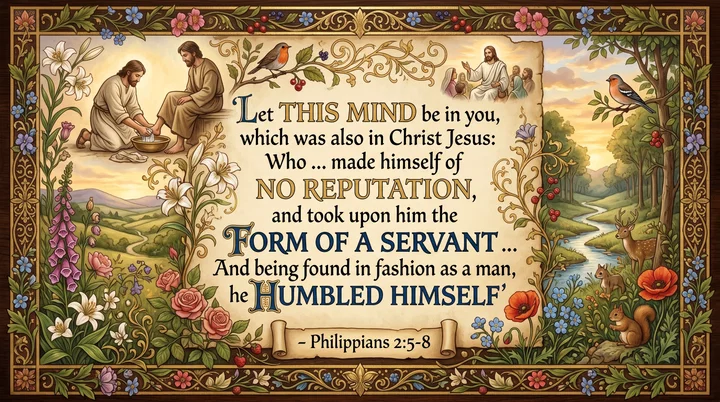
And being found in fashion as a man, he humbled himself, and became obedient unto death, even the death of the cross.
Translations
American King James Version, Webster Bible
And being found in fashion as a man, he humbled himself, and became obedient to death, even the death of the cross.
And being found in fashion as a man, he humbled himself, and became obedient unto death, even the death of the cross.
and being found in fashion as a man, he humbled himself, and became obedient unto death, even the death of the cross.
Revised Version, American Standard Version
and being found in fashion as a man, he humbled himself, becoming obedient even unto death, yea, the death of the cross.
and in fashion having been found as a man, he humbled himself, having become obedient unto death — death even of a cross,
and having been found in figure as a man, humbled himself, becoming obedient even unto death, and [ that the] death of [ the] cross.
And, in fashion, being found, as a man, humbled himself, becoming obedient as far as death, yea, death upon a cross.
Berean Standard Bible, Majority Standard Bible
And being found in appearance as a man,
He humbled Himself
and became obedient to death—
even death on a cross.And being found in human form, he humbled himself, becoming obedient to the point of death, yes, the death of the cross.
And being seen in form as a man, he took the lowest place, and let himself be put to death, even the death of the cross.
He humbled himselfe, and became obedient vnto the death, euen the death of the Crosse.
Douay-Rheims (Challoner revision)
He humbled himself, becoming obedient unto death, even to the death of the cross.
Pictures
Cross-references 20 of 238
- 2 Corinthians 8:9
For ye know the grace of our Lord Jesus Christ, that, though he was rich, yet for your sakes he became poor, that ye through his poverty might be rich.
Christ became poor for others’ sake so they might become rich.
- Hebrews 2:14-18
Forasmuch then as the children are partakers of flesh and blood, he also himself likewise took part of the same; that through death he might destroy him that had the power of death, that is, the devil;
Christ shared human nature, suffered and died to redeem humanity and help the tempted.
- John 1:14
And the Word was made flesh, and dwelt among us, ( and we beheld his glory, the glory as of the only begotten of the Father,) full of grace and truth.
The eternal Word became flesh, taking human nature.
- Hebrews 4:15
For we have not an high priest which can not be touched with the feeling of our infirmities; but was in all points tempted like as we are, yet without sin.
Christ shared human temptation and weakness, yet remained without sin.
- John 3:16
For God so loved the world, that he gave his only begotten Son, that whosoever believeth in him should not perish, but have everlasting life.
Christ’s coming and death express God’s love and give believers everlasting life.
- Isaiah 53:5-6
But he was wounded for our transgressions, he was bruised for our iniquities: the chastisement of our peace was upon him; and with his stripes we are healed.
Christ bears human sin and suffers in sinners’ place.
- 1 Peter 2:21
For even hereunto were ye called: because Christ also suffered for us, leaving us an example, that ye should follow his steps:
Christ suffered for us, leaving an example for believers to follow.
- Hebrews 12:2
Looking unto Jesus the author and finisher of our faith; who for the joy that was set before him endured the cross, despising the shame, and is set down at the right hand of the throne of God.
Christ endured the cross and its shame for the joy set before him.
- Romans 5:19
For as by one man’s disobedience many were made sinners, so by the obedience of one shall many be made righteous.
Christ’s obedience answers Adam’s disobedience and makes many righteous.
- Hebrews 2:14
Forasmuch then as the children are partakers of flesh and blood, he also himself likewise took part of the same; that through death he might destroy him that had the power of death, that is, the devil;
Christ took human nature so he could die and overcome death.
- 1 Timothy 3:16
And without controversy great is the mystery of godliness: God was manifest in the flesh, justified in the Spirit, seen of angels, preached unto the Gentiles, believed on in the world, received up into glory.
Both describe God manifested in human flesh.
- 2 Corinthians 5:21
For he hath made him to be sin for us, who knew no sin; that we might be made the righteousness of God in him.
The sinless Christ took sinners’ place, bearing sin so they might receive God’s righteousness.
- Matthew 26:39
And he went a little further, and fell on his face, and prayed, saying, O my Father, if it be possible, let this cup pass from me: nevertheless not as I will, but as thou wilt.
Christ submits to the Father’s will despite suffering, accepting the cup before the cross.
- Hebrews 1:3
Who being the brightness of his glory, and the express image of his person, and upholding all things by the word of his power, when he had by himself purged our sins, sat down on the right hand of the Majesty on high;
Christ’s divine glory makes his voluntary humiliation clear.
- Isaiah 53:3
He is despised and rejected of men; a man of sorrows, and acquainted with grief: and we hid as it were our faces from him; he was despised, and we esteemed him not.
Both describe Christ’s humble, sorrowful life and rejection by men.
- Matthew 16:24
Then said Jesus unto his disciples, If any man will come after me, let him deny himself, and take up his cross, and follow me.
Jesus’ call to take up the cross echoes his obedience unto death on the cross.
- Romans 5:8
But God commendeth his love toward us, in that, while we were yet sinners, Christ died for us.
Christ’s death for sinners demonstrates God’s love.
- Romans 8:3
For what the law could not do, in that it was weak through the flesh, God sending his own Son in the likeness of sinful flesh, and for sin, condemned sin in the flesh:
Christ took human likeness and condemned sin in the flesh through his obedience unto death.
- Matthew 11:29
Take my yoke upon you, and learn of me; for I am meek and lowly in heart: and ye shall find rest unto your souls.
Christ’s meekness and lowliness are qualities his followers learn from him.
- Galatians 3:13
Christ hath redeemed us from the curse of the law, being made a curse for us: for it is written, Cursed is every one that hangeth on a tree:
Christ bore the law’s curse on the cross to redeem others.
Commentary part 1 of 6
Each commentary is drawn from primary sources: the writings of Ellen G. White and Adventist pioneers and periodicals. Each commentary is separate. Its own words are not a quotation; follow the references to read the source passages.
Ellen G. White
188 sources
He descended step by step from being in the form of God and equal with God to taking the form of a servant, being made in human likeness, humbling himself, and becoming obedient unto the shameful death of the cross.ST Dec 9, 1897RH Sep 4, 1900RH Jun 15, 1905
To be found in fashion as a man means He was truly made like humanity in all things while remaining fully divine, veiling His glory, honor and tokens of deity and clothing divinity with humanity because sinful people could not have borne the sight of His unveiled glory.RH Sep 4, 1900RH Jun 15, 190517MR 338.3–339.1Lt 37, 1887, par. 22–23ST Feb 20, 1893
His humbling to the lowest place and His obedience unto death were wholly voluntary, accepting the most ignominious, cruel and agonizing death reserved for the basest criminals, beyond which no greater condescension was possible.RH Sep 4, 1900MH 501.2–3ST Sep 21, 1915DA 435.2–436.4AA 332.3–333.1
Though innocent He bore the world's accumulated sin, its penalty and wrath as substitute and surety to meet the law's demands, pay the ransom and open the way for fallen people to be restored, made partakers of the divine nature and exalted to share His throne, after which God highly exalted Him and gave Him a name above every name.ST Dec 9, 1897RH Sep 4, 1900Ms 129, 1907, par. 7–12Ms 17, 1911, par. 3–4DA 25.1–2
His self-giving obedience is the mind that must be in believers, the pattern to do nothing through strife or vainglory but in lowliness esteem others better than self, deny self, take up the cross and serve in unselfish ministry in contrast to Satan's pride and self-exaltation.JIOKP 32.2–33.2MH 501.2–39T 274.2–275.1DA 435.2–436.4Ms 67, 1898, par. 2–3
Verse Wording and Context
The verse traces a continuous descent from highest exaltation to lowest humiliation: being in the form of God and equal with God, taking the form of a servant, being made in the likeness of men, being found in fashion as a man, humbling himself, and becoming obedient unto death, even the death of the cross.ST Dec 9, 1897RH Sep 4, 1900RH Jun 15, 19058MR 271.4–272.3 Though equal with God and divine, he voluntarily took human nature, veiled his divine glory, lived among people as a member of the human family and as mortal, and freely laid down his life rather than being compelled to die.ST Dec 9, 1897RH Sep 4, 1900RH Jun 15, 1905 He was innocent and without corruption, yet bore the world's accumulated sin with its penalty and God's wrath against sin as the only one able to make propitiation for it, suffering to reconcile people to God and to meet the law's demands without giving permission to transgress the law.ST Dec 9, 1897RH Sep 4, 1900MH 501.2–3 He veiled his divinity in humanity because sinful people could not have borne his heavenly glory, yet remained divine while sharing the human experience from childhood to manhood in perfect obedience, and his obedience unto death on the cross made provision for the salvation of every person and opened the way to be raised from fallenness and become partakers of the divine nature.RH Sep 4, 1900RH Jun 15, 1905MH 501.2–3 That death was the most shameful, ignominious, revolting and agonizing death, and his mind in laying aside his position in heaven in the bosom of his Father as the Majesty of heaven, subjecting himself to the humbling conditions of human life and the responsibilities of a servant, and humbling himself in obedience to the cross, is the mind believers are to possess in looking also on the things of others, banishing selfishness, producing gratitude and love and the sense of not being one's own, and calling to self-denying service rather than grudging selfish service.JIOKP 32.2–33.2MH 501.2–39T 274.2–275.1 His humility and self-giving obedience are the pattern for believers' attitude toward one another in humility and concern for others.JIOKP 32.2–33.2MH 501.2–39T 274.2–275.1
To be found in fashion as a man means he was truly made in the likeness of men and in all things like unto humanity, while remaining fully divine with all resources of power.17MR 338.3–339.1Lt 37, 1887, par. 22–23ST Feb 20, 1893 He divested himself of the form of God, veiled the manifestations of Deity that commanded the homage and admiration of the universe, clothed his divinity with humanity, laid aside his glory and for human sake became poor so that through his poverty humans might be rich.17MR 338.3–339.1Lt 37, 1887, par. 22–23RH Feb 15, 1912 This is God becoming man as the eternal Word, the eternal Son consenting to take humanity and become one with the fallen race, a humility that amazed angels and cannot be described by tongue, portrayed by pen, or taken in by imagination.Lt 37, 1887, par. 22–23ST Feb 20, 1893ST Jul 12, 1899 His humbling to manhood meant poverty in a province of his own empire, unrecognized and unconfessed by the nation he came to bless and save, walking among men scattering blessing while curses and blasphemy filled the air instead of praise, with scarcely a voice calling him blessed, scarcely a hand stretched out in friendship, and scarcely a roof proffering him shelter, and going further still to die an ignominious death, revealing the great love of the infinite God and teaching humility and walking humbly with God.Lt 37, 1887, par. 22–23RH Feb 15, 19121RED 34.1–2 He voluntarily passed through human experiences without turning aside from the planned path by which salvation could come, knowing beforehand all the steps of humiliation and descending step by step to the depths of human woe to make expiation for a condemned perishing world.ST Feb 20, 1893ST Jul 12, 1899RH Feb 15, 1912 As the Majesty of heaven and Commander of the heavenly hosts he put off his crown and laid aside his royal robe to take human nature so that humanity might touch humanity, passing through all experiences human beings must pass through to do the greatest work for the race, shining as a beam of righteousness amid moral darkness to enlighten every person, suffering in man's stead and giving his life for the life of the world so that all who repent become his heritage, thereby proving God's administration without flaw and forever settling Satan's charge about justice and mercy so that every voice in and out of heaven will testify to God's justice, mercy and love.ST Jul 12, 1899RH Feb 15, 19121RED 34.1–2 Out of pity for pitiable fallen humanity he revealed God as love, mercy, tenderness and compassion, sweeping away the thick darkness enshrouding God's throne to manifest the Father as the Light of life, laying aside glory without being heralded by the heavenly host, born of humble parentage, brought up in obscurity at Nazareth in Galilee, beginning his work in poverty and without worldly rank, taking human nature to stand at the head of humanity while encircling the race with his human arm and grasping the throne of the Infinite with his divine arm.Lt 37, 1887, par. 22–23ST Jul 12, 1899RH Feb 15, 1912 He came with ordinary human appearance so that faith would rest not on outward attraction but on excellence of character and the evidence of prophecy, and through suffering endured Satan's temptations to become able to succor the tempted.ST Jul 12, 1899RH Feb 15, 19121RED 34.1–2
The chapter containing the verse is important instruction to be read, studied and obeyed, and is essential instruction for all workers calling for Christ's meek and lowly spirit and transformation of character.17MR 317.2–3Ms 27, 1889, par. 7–11Lt 190, 1905, par. 5–6 It is the best instruction for the present time, to be thankfully obeyed and fulfilled especially by leading brethren, with all of Philippians 2 and Philippians 3 to be read and studied.17MR 317.2–3Lt 190, 1905, par. 5–6 It presents him as the divine Son who came to live in the world he made, and his character and love in humbling himself and obeying even to death on the cross make him the central theme for preaching and contemplation.Ms 27, 1889, par. 7–118MR 271.4–272.312MR 99.4–100.1 His humiliation and obedient death, with the result that every knee will bow and every tongue confess that Jesus Christ is Lord to the glory of God the Father, is the grand and heavenly theme that revives and quickens to new life, to be lifted up before the people, contemplated and adored, with his powerful and essential name on every tongue.Ms 27, 1889, par. 7–118MR 271.4–272.3 His earthly work and final suffering had an appointed time, and in laying aside royal glory and taking humanity to work for salvation by joining divinity with humanity to draw divine strength against darkness, he withdrew from places of opposition until that time came for his final suffering.RH Apr 8, 1909
Eternal Plan and Prophecy
His willing self-humbling belongs to the plan of redemption devised before the world was made, in which before humanity was created He covenanted with the Father to bear the penalty if people transgressed.Lt 104, 1902, par. 8–15ST Feb 20, 1893DA 799.3ST Jun 13, 1900ST Jul 29, 1908 He did not count equality with God a thing to be desired while man was lost in sin and misery, but voluntarily chose to exchange heaven for earth, clothing divinity with humanity and coming as man's substitute and surety to bear the curse and results of transgression so man might escape eternal death.ST Feb 20, 1893CEv 37.3–38.1ST Jun 13, 1900 In that humbling He pledged to give His life as a ransom if people turned from loyalty, to maintain the sacred and exalted honor of His Father's law, to convince men of sin as transgression of the law, and to vindicate its binding claims and bring men back to obedience.ST Feb 20, 1893ST Jun 13, 1900 Though sinless and untouched by sin He bore guilty sinful people's guilt and penalty so they could stand justified, lived the law perfectly in human nature to show by example it could be obeyed, and had to die as every continuing transgressor must die, yet His death was to end not in defeat but in glorious eternal victory.CEv 37.3–38.1DA 799.3ST Jun 13, 1900ST Jul 29, 1908
His obeying to death was the cup of suffering apportioned to Him and the fulfillment of the covenant made before the foundation of the world, foretold by Old Testament types and prophecies as the very strongest evidence He is the world's Redeemer.AA 227.4ST Jul 29, 1908 He did not come as a temporal king to deliver from earthly oppressors according to human desire for throne and kingly power, but came down from the highest place to the lowest place that could be occupied, as a man among men to live poverty and humility and at last to be despised, rejected and slain, offering Himself as sacrifice in behalf of the fallen race and thus fulfilling every requirement of the broken law.AA 227.4ST Jul 29, 1908RH Sep 3, 1903 In Him the sacrificial types met their antitype and His death on the cross lent significance to the entire Jewish economy, for the sacrifices and priesthood of the Jewish system represented His death and mediatorial work, had no saving power apart from Him, and continued only until He came as the perfect Offering and Mediator.AA 227.42SP 10.3–11.1 By His own choice He died as both priest and victim, the Passover sacrificed, the Lamb slain from the foundation of the world, giving up His body to be rent, bruised and wounded for transgression and afterward rising triumphant to continue as true High Priest forever after the order of Melchizedek.2SP 10.3–11.1Ms 101, 1897, par. 35–36 His humiliation concealed His claims to deity and glorious character under the garb of humanity without outward display, which is why the nation did not acknowledge Him as the Prince of life, and this concealment kept men from taking Him by force to make Him king and thwarting His pathway to the cross, so that He could close His life by a solemn oblation of Himself with His whole life a preface to His death, a life of obedience to all the commandments and a living of the law in humanity as a sample for all men by which He redeemed Adam's transgression, disgraceful failure and fall.Ms 101, 1897, par. 35–36Lt 67, 1895, par. 4–5
Satan expected that by taking fallen man's nature Jesus could be overpowered and prevented from accomplishing salvation.EW 123.1LC1 131.2–132.1 Satan well knew Christ's heavenly position, excellency and inestimable worth of heaven from his own experience before losing it through rebellion, and was filled with apprehension and fear at this coming as a death-knell to his power and limitation of it, yet in selfishness could not comprehend such selfless love and benevolence for the deceived fallen race or the mystery of such sacrifice.LC1 131.2–132.1ST Apr 5, 18832RED 27.1–28.1 When Satan claimed the kingdoms of earth as his and offered them to Jesus without suffering if He would worship him, Jesus would bow only to His Father and would not depart from His Father's will.LC1 51.1Ms 72, 1902, par. 15 He steadfastly chose a life of suffering and dreadful death on the cross in the way appointed by His Father, working through human agents who opposed Him to bring Him to that death, so that by His own life He would redeem Satan's possessions and become their lawful heir to have them given into His hands as an everlasting possession.LC1 51.1Ms 72, 1902, par. 15 After a season all in heaven and earth will submit to Him, and Satan himself will be given into His hands to be destroyed by death, never more to trouble Jesus nor the saints in glory.LC1 51.1
More than eighteen hundred years ago He walked on earth as a man among men and found suffering and wretchedness everywhere, though He was in the form of God in heaven, rich and crowned with glory and honor as Lord of life and glory.2RED 73.2–3 He did not come with commands and threatenings but with love without parallel, and the love displayed on the cross woos and wins the sinner and binds him repenting to the cross in belief and adoration.2RED 73.2–3 He came to perfect a righteous character for many and to lift up and elevate the fallen race, but only a few of the millions will accept the righteousness and excellency of His character and fulfill the requirements given to secure their happiness.2RED 73.2–3 His humbling by leaving His Father's presence, choosing a life of suffering and anguish, and accepting an ignominious death to give life to others is self-denial and sacrifice, and the Father's giving up His beloved Son is great mercy and condescension.EW 122.1
Divinity Veiled in Humanity
Though fully divine, he veiled his divinity, glory and tokens of deity and laid aside honor, riches, royal robe, crown and high command, clothing divinity with humanity without giving up divinity and without appearing as God.RH Sep 4, 1900Ms 54, 1905, par. 11–12Ms 141, 1901, par. 12–13Ms 67, 1898, par. 8–915MR 25.3–26.1 He veiled that glory because sinful people could not have borne the sight of his heavenly glory without being destroyed.RH Jun 15, 1905Ms 54, 1905, par. 11–12 Remaining fully divine with all resources of power, he accepted poverty and lowliness as a real man, God in the flesh, a humility that amazes heavenly intelligences.Ms 67, 1898, par. 8–915MR 25.3–26.1 His humbling was great love, self-denial and self-sacrifice in becoming man and then humbling himself further to die an ignominious death on the cross.15MR 25.3–26.1
As Commander and Prince of heaven, the brightness of the Father's glory possessing all fullness and all resources of power, one with God in the Father's bosom, the Majesty of heaven worshiped by angels and rich in honor, he left heaven's power and glory, mansions, throne and high command.ST Dec 9, 18972T 200.115MR 25.3–26.1AA 332.3–333.1Lt 11, 1887, par. 15–19 He laid aside royal robe and kingly crown, stepped down from throne, crown and scepter, divested the form of God, veiled the demonstrations of deity, and clothed divinity with humanity.Ms 42, 1897, par. 31AA 332.3–333.1Lt 11, 1887, par. 15–19 Having entered the path of self-denial and sacrifice he turned not aside and found no rest between the throne and the cross until he had given his life in obedience to death on the cross.AA 332.3–333.1 This self-emptying from divine majesty, perfection and excellence to servant and cross lifts fallen man from degradation to hope and joy and heaven.2T 200.1AA 332.3–333.1
Before leaving heaven he was taller than any angel, majestic and lovely, but when ministry began he was only a little taller than common men then living, having laid aside his noble heavenly form.LC1 34.1–2 He veiled glory and shunned outward display and rude forbidding surroundings so minds would not be drawn by outward appearance and faith in him as Messiah would not rest on sight and personal attraction.LC1 34.1–2ST May 27, 19082SP 39.3 Faith was to rest on excellence of character never found in another, on the beauty of heavenly truth, and on prophecy foretelling his coming, since riches, worldly honor and human greatness can never save a soul from death.LC1 34.1–2ST May 27, 19082SP 39.3 His humiliation in a manger among animals did not lessen divine honor, and angels who had seen his heavenly majesty still bowed before him without disloyalty to Jehovah, heralding and ministering to him though not permitted to reveal their glory while heaven rejoiced and earth's great men knew nothing.1RED 16.1LC1 15.1–16.1 The Jews expected a king who would compel Gentiles to obey, so they did not recognize the meek lowly Saviour, yet they would have received and worshiped him had he appeared with worldly splendor and authority.2SP 40.3
By joining divinity with humanity he could draw on divine strength to resist the powers of darkness.RH Apr 8, 1909 Through that union of divine and human in him there is power for fallen humanity to touch his humanity and receive power to be partakers of the divine nature and to escape corruption through lust.ST Dec 20, 1905RH Jul 16, 1908 His merits, power and virtue can be claimed and pleaded by those who overcome as he overcame, and as they cooperate with him and live in harmony with his law he cleanses their natures from sin and imparts his righteousness.RH Jul 16, 1908 His humiliation and victory on every point over temptation give his followers power to overcome and to demonstrate that his religion conquers self, with God supplying the Holy Spirit and his fullness as they renounce self, pride and self-sufficiency and bring the will into conformity with God's will.STB 191.2–3ST Nov 21, 1892
As personal Saviour he veiled dazzling splendor to live as a man among men so sinful human beings could become acquainted with their Creator and receive all of God's personality and character they could bear without being consumed and destroyed, and he ascended on high and intercedes in the heavenly courts as a personal Saviour.Ms 13, 1884, par. 48–53ST May 19, 1909 His human nature made him the link between earth and heaven, restoring the way for people separated from God by sin to have communion with him.Ms 13, 1884, par. 48–53 Divinity needed humanity to afford a channel of communication between God and man, and humanity needed divinity so that power from above might restore man to the likeness of God, and for our sakes he became poor that through his poverty we might be made rich.ST Feb 20, 1893 Encircling the human race with his human arm while grasping the throne of the Infinite with his divine arm, he stood at the head of humanity to reveal God as love, mercy, tenderness and compassion.RH Feb 15, 1912
Turning attention from self to salvation's Author, his human nature stands alongside his divine nature.17MR 338.3–339.1 To be found in fashion as a man means he was truly made in the likeness of men and in all things like unto humanity, divesting the form of God and taking in its stead the form of man.17MR 338.3–339.1 Though he was God he did not appear as God but veiled the manifestations of Deity that commanded homage and admiration, laid aside glory and became poor so that through his poverty humans might be rich.17MR 338.3–339.1
Lowly Birth and Life
He entered human life as a helpless babe, subject to weakness and danger, born in a stable in Bethlehem and brought up in obscurity in despised Nazareth of poor parentage, though God the owner of the world was His Father.ST May 27, 19081RED 16.1STE 179.1–2 He chose the lowest humble walk shared by most people, with no luxury, ease, selfish gratification or indulgence, in continual self-denial and self-sacrifice, so the humblest and poorest would know He knew pinching poverty, would not shun Him, and all could be approached with truth alone making the impression.STB 187.2–3STE 179.1–2 The King of glory lay in a manger among animals, and His humiliation did not lessen divine honor, for angels who had seen His heavenly majesty still bowed without disloyalty.STB 187.2–31RED 16.1 He was heralded and ministered to by angels who were not permitted to reveal their glory, while heaven rejoiced and earth's great men knew nothing of His birth.STB 187.2–3ST May 27, 1908Lt 37, 1887, par. 22–23 He lived thirty years in lowly Nazareth subject to His parents, working as a carpenter, supporting His family, teaching diligence in labor and care, provision and training for the weak and ignorant.STB 187.2–33T 565.4–566.1
He dignified useful labor by precept and example, choosing a condition shared by the far greater number so even the poorest would know He understood hardship and the truth of heavenly origin He sowed would alone impress hearts rather than status.3T 565.4–566.1STE 179.1–2 Though divine He veiled glory and lived among people from childhood to manhood in perfect obedience, mortal yet freely laying down life, bearing the world's sins and penalty so humanity would not perish eternally.RH Sep 4, 1900RH Jun 15, 1905Ms 54, 1905, par. 11–12 His earthly life of poverty and labor displayed the self-sacrifice made for humanity, joining exalted pre-existence with fallen condition to meet man where he was and bring moral power to become sons and daughters of God.Ms 98, 1899, par. 7–9Ms 67, 1898, par. 8–9 Though taller than angels and majestic in heaven, at the opening of ministry He was only a little taller than common men then living, laying aside noble form and shunning outward display so faith would rest not on sight and personal attraction but on excellence of character never found in another and on prophecy.2SP 39.2LC1 34.1–2
He came not with Adam's innocence but after four thousand years of sin had weakened the race, accepting results of heredity to share human sorrows and temptations and give example of a sinless life, facing struggle as every person must with real risk of failure and eternal loss.ST May 27, 1908DA 48.5 He took human nature as it was at His advent, with infirmities, weakness, decreased size and strength, degeneracy and lowered moral worth upon Him, yet without evil propensity and knowing no sin, in sharp contrast to the first Adam who stood in Eden in perfect manhood without taint.ST Feb 18, 1913LC1 134.1–135.1 He descended to the lowest depths of human woe to reach fallen man where he was, to be made perfect through suffering, to endure Satan's strength, to know how to help the tempted, and to lift man from degradation, standing in Adam's place to bear the test Adam failed and overcome on every point where man can be assailed.LC1 34.1–2ST Feb 18, 1913LC1 134.1–135.1 This stooping so low to poverty and deepest abasement without losing an atom of dignity or glory, greater than finite man can comprehend, joined humanity to humanity and divinity to divinity so humanity might take hold upon divinity.Ms 143, 1897, par. 3–4
Though rich in heaven's treasure He became poor, having no place to lay His head, traveling place to place without a home including three years without a home, so that through His poverty believers might be made rich with heavenly treasure and eternal riches and inheritance, not with earthly treasure, houses and lands.Ms 12, 1900, par. 24–27Ms 12a, 1900, par. 18–21RH May 15, 1900ST Feb 20, 1912ST Dec 20, 1905 His poverty was part of His legacy in humanity and part of the atonement, which was not betrayal in the garden alone nor agony on the cross alone but included His whole humiliation and the whole series of sorrows compassing humanity which He bore upon His divine soul.Ms 12, 1900, par. 24–27Ms 12a, 1900, par. 18–21 As Commander and Prince of heaven He humbled Himself to stand side by side with the fallen race, to restore the moral image of God in man and pay the ransom by humiliation and death on the cross, laying aside heavenly rank, accepting hunger, thirst, weariness and temptation without using divine power to escape them because He had chosen to share humanity's lot.Ms 12, 1900, par. 24–27ST Feb 20, 1912ST Dec 20, 1905 His willing humility and sacrifice in a life of poverty rebukes self-love and lays obligation on rich and poor alike to use every God-given power and means in helping souls for whom He died.Ms 12, 1900, par. 24–27Ms 12a, 1900, par. 18–21
Though the Majesty of heaven worshiped by angels and rich in honor, splendor and glory, He came unrecognized and unconfessed by the nation He blessed, meeting insult, hatred, abuse, curses and blasphemy instead of deserved worship, with scarcely a voice calling Him blessed, hand stretched in friendship, or roof proffering shelter.ST Sep 27, 1877Lt 37, 1887, par. 22–232T 467.1 Embodying refinement, purity and exalted character He did not plead refined nature to hold aloof nor labor among men of high titles and worldly honor, but was found among the afflicted, poor, distressed, needy, despised and lost to save them.2T 467.16T 442.2 He lived as a man of sorrows acquainted with grief to rescue fallen humanity, ministering to the needy and suffering, healing the sick, bringing peace, freeing Satan's afflicted, and offering redemption to all who accept it.2T 467.1ST Aug 19, 1886 His mission was completed amid danger, and God sent angels to protect His life until that work was done, while His death reveals the great value of souls redeemed and the price paid for salvation.ST Sep 27, 1877ST Aug 2, 1883
Temptation and Perfect Obedience
By taking human form he could understand the force of the temptations people face, and as the second Adam he was truly tempted and could have fallen, yet he had no evil propensity, never yielded, and held fast to his Father's goodness, mercy, love and word under the severest trial, unlike the first Adam who fell.13MR 18.1–19.3RH Nov 3, 1904ST May 27, 1908 In humanity he passed over the ground where Adam fell in perfect obedience, placing the race on vantage-ground, and his death served the redemption of mankind.RH Nov 3, 1904STB 191.2–3 He entered human life as a helpless child subject to weakness and danger, facing the struggle against Satan as every person must with the real risk of failure and eternal loss.ST May 27, 1908CT 49.3 He experienced human life from childhood through adulthood with severe trials, giving a living example of the truths he taught in order to bring people back into harmony with God and restore them to the Creator's image.CT 49.32SP 39.3 Taking fallen human nature he faced humanity's temptations and defeated the enemy on every point, giving his followers power to overcome and to demonstrate that his religion conquers self, and by suffering Satan's fierce temptations he became able to understand how to help those who are tempted.STB 191.2–32SP 39.3
Moved by infinite pity as he saw Adam and Eve in their wretched, helpless condition fallen under the power and control of the prince of darkness by transgression of God's law, he proposed the only means acceptable with God to give them another trial and place them again on probation.2RED 14.2RH Feb 24, 1874LC1 118.2 He consented to leave his honor, kingly authority and glory with the Father and humble himself to humanity to engage in contest with the mighty prince of darkness in order to redeem man.2RED 14.2RH Feb 24, 1874LC1 118.2 Through humiliation and poverty he identified himself with the weaknesses of the fallen race, and by firm, humble obedience he showed that man might redeem Adam's disgraceful failure and regain lost Eden for all who would believe on him.2RED 14.22RED 15.1LC1 119.1LC1 118.2 He placed his feet in Adam's steps and took man's fallen nature to cope with the strong foe who triumphed over Adam, and by that victory opened the way for redemption from the disgrace of Adam's failure and fall.2RED 15.1LC1 119.1 His life of toil, privation and self-denial, when he could have chosen ease and plenty, completed the work to save others from ruin.1T 369.3–370.1
He stood at the head of humanity as King of glory who left the royal courts, clothed divinity with humanity, and came to reveal God and work out a perfect character, choosing poverty and lowly parentage and sharing the burden of caring for his family.STB 187.2–3 Before leaving heaven he was taller than any angel, majestic and lovely, but when his ministry began he was only a little taller than common men then living, having laid aside his noble heavenly form so that faith would not rest on sight and personal attraction but on excellence of character never found in another and on prophecy foretelling his coming.LC1 34.1–2 He shared the lot of the poor, oppressed and suffering, accepting ordinary human limits including hunger, thirst and weariness, and did not use divine power to escape them because he had chosen to share humanity's lot so that nothing would separate him from humanity.ST Feb 20, 1912ST Jul 12, 1899 He passed through all the experiences human beings must pass through and was found in fashion as a man, retaining divine dignity while sharing afflictions, facing and defeating the enemy on every point in order to know how to help the tempted.STB 187.2–3LC1 34.1–2ST Jul 12, 1899 He was delivered into the hands of cruel men and crucified as though a guilty sinner, bearing the weight of the sins of the whole world with bodily pain and mental anguish, hung between heaven and earth, the ransom for many and the only life sufficient to pay humanity's debt.1SP 45.2–46.1SG1 23.1EW 120.2ST Jan 30, 1879
His obedience was unwavering from the manger to Calvary, sustained by divine fortitude without murmuring or departing from his Father's will even under cruelty, scorn, insult, hatred and abuse.ST Dec 9, 1897Ms 42, 1897, par. 31Lt 11, 1887, par. 15–19 Having entered the path of self-denial and sacrifice he turned not aside and found no rest between the throne and the cross until he had given his life, knowing beforehand all the steps of humiliation and voluntarily passing through human experiences without turning from salvation's planned path.AA 332.3–333.1Lt 11, 1887, par. 15–19 He descended step by step still lower to insult, reproach, shameful accusations, abuse, betrayal, denial, mocking, crowning with thorns, scourging, bearing the cross and death as a condemned malefactor, feeling its contempt and ignominy as no other being could though pure and holy.2T 200.115MR 25.3–26.1Lt 11, 1887, par. 15–19 Though equal with God and receiving the homage of angels, he laid aside glory and voluntarily subjected himself to the conditions of human nature as a servant, humbling himself further to die, and not only to die but to die an ignominious death on the cross.2T 200.115MR 25.3–26.1AA 332.3–333.1
He fulfilled his delight to do God's will with God's law in his heart as the Word made flesh full of grace and truth, God manifest in flesh, accomplishing redemption through his blood as the One who created all things and holds all things together.Ms 153, 1898, par. 14–19 This presents a theme displaying infinite wisdom, love, justice and mercy that must be known by living experience of what he is and the responsibilities accepted in him.Ms 153, 1898, par. 14–19 Though sinless and untouched by sin he bore the guilt and penalty of sinful people so they could stand justified before God, and his willing submission to death on the cross fulfilled God's plan of mercy and brought deliverance to the human race.CEv 37.3–38.1SG1 23.1 His perfect obedient life as substitute both bears the penalty of transgression and reveals the character God requires and what human nature may become when receiving him as perfect Saviour, teaching that people may obey.Ms 153, 1898, par. 14–19STB 187.2–3 With the Gethsemane conflict ended he consented to endure the curse of sin in obedience unto death, even the death of the cross, and that obedience exposes what was involved in Adam's disobedience and what the Son's obedience means to humanity, revealing the seriousness of departing from God's will, since Adam did not reckon consequences but went directly contrary to God's express command.ST Apr 10, 1893 He laid aside glory, clothing divinity with humanity without leaving divinity behind, to bear every trial, battle and conflict of human life as the head of humanity, with temptations far greater according to his glorious character than human minds can understand.Ms 163, 1898, par. 14–15 He took human nature to pass over the ground where Adam fell and redeem Adam's fall, to carry humanity through as a commandment-keeping people giving testimony to the whole universe of heaven, to elevate every human being with God, so that humanity might take his divinity and receive his nature.Ms 163, 1898, par. 14–15
Voluntary Death on Cross
His humbling to death was wholly voluntary and not compelled.RH Sep 4, 1900Lt 11, 1887, par. 15–19ST Feb 20, 1893 Though exalted as divine, in the form of God and equal with God, and though as the Fountain of life able to withstand death, He freely laid down His life by His own free will rather than being compelled to die.RH Sep 4, 1900Lt 11, 1887, par. 15–19ST Feb 20, 1893 He chose humility and obedience rather than self-exaltation, the opposite of Lucifer's desire for power without God's character, entering the path of self-denial and sacrifice and turning not aside and finding no rest between the throne and the cross until He had given His life.MH 501.2–3DA 435.2–436.4AA 332.3–333.1 With the Gethsemane conflict ended He consented in obedience to endure the curse of sin, to bear sins and penalty rolling like a mountain upon His soul as substitute and surety so man might escape eternal death and not perish eternally.RH Sep 4, 1900Lt 11, 1887, par. 15–19ST Feb 20, 1893ST Apr 10, 1893
The death to which He was obedient was the cross, even the death of the cross.MH 501.2–3ST Sep 21, 1915ST Oct 14, 1908Lt 16, 1901, par. 6–11 That was the most shameful, ignominious, revolting, agonizing, cruel and lingering death, the cruel Roman instrument of torture reserved for the basest criminals, condemned malefactors and public criminals.MH 501.2–3ST Sep 21, 1915Lt 16, 1901, par. 6–11Lt 10, 1899, par. 13–14Lt 11, 1887, par. 15–19 To be obedient unto death means accepting that shameful, agonizing death, willingly descending from heavenly glory, taking the condition and responsibilities of a servant and human life, and enduring indignity, contempt and abuse to redeem sinners.MH 501.2–3ST Sep 21, 1915ST Oct 14, 1908GW 293.1–3 As pure and holy He felt its scorn, disgrace, contempt, abuse and pain in its bitterness as no other being could feel it.Lt 10, 1899, par. 13–14Lt 11, 1887, par. 15–19ST Feb 20, 1893
He descended step by step still lower from one humiliation to another without complaint, through human weakness and the griefs of humanity to the lowest depth and lowest place possible at the cross.Lt 11, 1887, par. 15–19ST Dec 3, 1885ST Feb 20, 1893ST Feb 20, 1893 His humbling went further still than becoming man to die, even to die an ignominious death as a criminal and felon exposed to mockery, taunting, reviling and derision.Lt 11, 1887, par. 15–19Lt 37, 1887, par. 22–23ST May 22, 1901ST Dec 3, 1885 This was the fullest possible divine condescension in self-denial, clothing divinity with humanity to represent God and bring moral power to men, beyond which He could go no farther and which cannot be described, portrayed or imagined.Lt 11, 1887, par. 15–19Lt 37, 1887, par. 22–23ST Feb 20, 1893 Knowing beforehand all the steps of humiliation, He would not turn aside from the planned path by which salvation could come.AA 332.3–333.1ST Feb 20, 1893
Though He made the world and sustains it by the word of His power, there was no room for Him, and He had to flee until His work was done.ST Feb 20, 1893ST May 30, 19112SP 29.2 He was betrayed by one follower and denied by another, mocked and taunted, crowned with thorns and forced to bear the cross, arraigned as a criminal, laughed to scorn, numbered with transgressors, disowned even by kinsmen, seeing the sword pierce His mother's heart and expiring amidst derision.ST Feb 20, 1893ST May 30, 19112SP 29.2 He consented to die in the sinner's stead, as a condemned malefactor and not as an honored hero, suspended between heaven and earth to die a lingering death exposed to the tauntings and revilings of a debased mob, that by a life of obedience man might escape the penalty of the law.Lt 11, 1887, par. 15–194T 248.1ST Feb 20, 1893 All His sufferings were counted as small in view of the result for man and for the whole universe, and His cry It is finished rang through every world and heaven itself, showing the contest between Christ the Prince of Life and Satan the prince of darkness practically over with Christ Conqueror.Lt 11, 1887, par. 15–19ST Feb 20, 1893
He was delivered into the hands of cruel, wicked men and hung between heaven and earth as though He were a guilty sinner, bearing the weight and mental anguish of the sins of the whole world as well as bodily pain.ST Sep 27, 1877SG1 23.1EW 120.2ST Jan 30, 1879 The heavenly host watched without rescuing Him, and God sent angels to protect His life until His mission was done and His work complete.ST Sep 27, 18772SP 29.2 By bearing guilt and penalty in man's place though sinless and untouched by sin, He brought deliverance so guilty sinful people stand justified, made partaking of the divine nature possible, and received all judgment into His hand while offering the cup of salvation in place of the bitter cup prepared by sins.RH May 31, 1870CEv 37.3–38.1SG1 23.1
Atonement and Salvation Provided
Though innocent and without corruption, he bore the world's accumulated sin with its penalty and God's wrath against sin as man's substitute and surety under the sentence of the broken law, condemned for sins not his own so that he is the propitiation for sins not for believers alone but for the whole world, and though sinless and untouched by sin he bore guilty sinful people's guilt and penalty so they stand justified before God by his righteousness and receive his life.ST Dec 9, 1897RH Sep 4, 1900DA 25.1–2Lt 63, 1895, par. 39–41Lt 11, 1887, par. 15–19 As both priest and sacrifice he voluntarily laid down his life by his own free will though as God the Fountain of life he could have withstood death, bearing sins rolling like a mountain upon his divine soul to give life and bring immortality to light.RH Sep 4, 1900Lt 11, 1887, par. 15–19 He gave his life to purchase all people and his church, paying the price of their ransom and bearing individual sins and sorrows, which reveals the great value God places on humanity.DA 25.1–2Lt 105, 1893, par. 31–36
His suffering was necessary to reconcile people to God and meet the law's demands, paying the ransom and uniting the finite with the Infinite, and through the merits of his blood fallen people can be exalted to share the divine nature.ST Dec 9, 1897AA 333.2 His death made atonement for the fallen race, making pardon and holiness possible, with holiness as its fruit and gift calling people to give themselves wholly to God's service, and he made this sacrifice for sinners and enemies including those devoted to worldly pleasures and riches.ST Dec 17, 1902Lt 58, 1895, par. 42–45Ms 47, 1902, par. 39 His obedience unto the death of the cross reveals the divine character as mercy, tenderness and forgiveness blended with equity and justice, so that where vengeance threatened only misery and despair penitent believing sinners now receive God's decree to live, and the marks of that suffering remain in his hands and feet and side as he stands in the midst of the throne through whose merits the Father receives sinners.AA 333.2 It does not give permission to transgress the law nor excuse persistent lawbreaking, but vindicates the binding claims of the law and brings people back to allegiance and obedience to the commandments, since the law is so sacred and immutable that not one jot or tittle could be changed to meet fallen man, and by his death he made it possible for man to be restored to the favor Adam lost.ST Dec 9, 1897Lt 58, 1895, par. 42–45
His atonement was not his betrayal in the garden alone nor his agony on the cross alone, but included his poverty and his whole humiliation, the whole series of sorrows compassing humanity which he bore upon his divine soul.Ms 12, 1900, par. 24–27Ms 12a, 1900, par. 18–21 As Commander and Prince of heaven he humbled himself to a life of poverty to stand side by side with the fallen race, to restore the moral image of God in man and to pay the ransom by his humiliation and death on the cross.Ms 12, 1900, par. 24–27Ms 12a, 1900, par. 18–21 His poverty was part of his legacy in humanity and part of the atonement, rebuking self-love and laying obligation on rich and poor alike to use every God-given power and means in helping the souls for whom he died, putting to shame self-wrapped professed followers who withhold help.Ms 12, 1900, par. 24–27Ms 12a, 1900, par. 18–21 His self-abasement and sacrifice are central to the atonement, a mystery beyond finite wisdom, in which after Adam and Eve's transgression brought woe and the oppressive load of sin he laid aside robes of royalty, clothed divinity with humanity, took man's transgressions and their just penalty upon himself, and as a man of sorrows acquainted with grief suffered insult, reproach and mockery yet remained the Majesty of heaven.STMs 18, 1887, par. 4
His death was determined in heaven for the sins of the whole world at the cost of laying aside royal status, paying the great price that shows the value of souls.ST Aug 7, 1884ST Aug 2, 1883ST Apr 16, 1894 It is the ransom for many, the only life sufficient to pay humanity's debt and bring deliverance and justification, followed by resurrection on the third day and ascension to intercede for sinners.1SP 45.2–46.1CEv 37.3–38.1 He left the royal courts, endured poverty and the temptations facing humanity, and finally died to help and redeem humanity in its darkness, and his self-giving in immeasurable love brought the possibility of eternal life and calls those sharing God's grace to value one another and work for others with love, simplicity and faith.RH Mar 5, 1908ST Aug 7, 1884ST Aug 2, 1883 His self-abasement in suffering the cruel death of the cross to ransom humanity is a mystery beyond finite wisdom.ST
His perfect obedience and death made provision for the salvation of every person and opened the way for fallen people to be raised from their fallen condition, restored to the moral image of God, made partakers of the divine nature, given strength to resist temptation, made heirs of God and joint-heirs with Christ to an immortal inheritance, lifted from degradation to hope and joy and heaven, and exalted to share his throne and sit with him upon his throne in his glory, honor and blessings.RH Jun 15, 1905Ms 54, 1905, par. 11–12Ms 54, 1905, par. 22–23Ms 12, 1900, par. 24–27Ms 12a, 1900, par. 18–21 He veiled his divinity in humanity because sinful people could not have borne his heavenly glory, yet remained divine while sharing the human experience from childhood to manhood as the divine-human Saviour and head of fallen humanity, having laid aside royal robe and crown and clothed divinity with humanity without giving up divinity.RH Jun 15, 1905Ms 54, 1905, par. 11–12 Those who receive him receive strength to resist temptation and power to become partakers of the divine nature.RH Jun 15, 1905Ms 54, 1905, par. 22–23
Because of this obedience unto death God highly exalted him and gave him a name above every name, so that at the name of Jesus every knee in heaven and earth and under the earth will bow and every tongue will confess that Jesus Christ is Lord to the glory of God the Father.Ms 17, 1911, par. 3–4Ms 27, 1911, par. 19–21Lt 58, 1895, par. 42–45Lt 120, 1903, par. 18–20 His humiliation and death therefore lead to God's exaltation and the name above every other name.Ms 129, 1907, par. 7–12Ms 17, 1911, par. 3–4Ms 27, 1911, par. 19–21 That exaltation follows working out salvation with fear and trembling as God works to will and do, doing all things without murmurings and disputings so as to be blameless and harmless sons of God shining as lights in a crooked nation while holding forth the word of life.Ms 129, 1907, par. 7–12Lt 187, 1903, par. 5–7Lt 58, 1895, par. 42–45
His sacrifice is valuable enough to save the whole world, but only those who accept salvation through repentance, obedience and faith in its merits and by receiving his righteousness share in it.1SP 51.1–52.25T 470.1–2 No human being can earn God's favor or escape sin's consequences through righteous acts or a long life of repentance, for his death was the only sacrifice God could accept to save the fallen race, and by his obedience to death on the cross he poured out his precious blood as an atonement for sin and brought in everlasting righteousness.Ms 23, 1868, par. 58MR 127.2 His precious blood redeems and cleanses from sin, and his sacrifice and intercession can break a hardened heart to repentance, humility, gratitude and surrender, while his perfect obedience and death at Calvary give him authority to claim mercy and reconciliation for guilty people and defeat Satan's accusations so that those who repent, trust him and receive his righteousness are pardoned and kept in his hand.4T 624.4–625.15T 470.1–2 Salvation rests in him alone, not in self-esteem or self-congratulation, and he saves not because sinners are perfect but because in imperfection they need and trust him, giving joy and hope even in affliction and death as Prince of life and Saviour at the Father's right hand, the only name for eternal interests to trust with full reliance.16MR 236.18MR 127.2
His death for human sin on Calvary, with his resurrection and ascension, together are the saving truth to be learned and taught, bringing life and immortality to light through the gospel and revealing God's love on the cross.ST Mar 31, 1909RH Apr 20, 1911 Seeing this humiliation and death leads the sinner to look upon him, to hate the sins that wounded him, to return to allegiance to the holy commandments with a contrite heart, and to view him as a compassionate tender High Priest.Lt 63, 1895, par. 39–41 He concealed divinity in humanity, took a body of flesh rather than the nature of angels, and suffered and died as the Sin-bearer to open a new and living way and enter his lasting work as High Priest for the whole world, and he remains a personal Saviour in heaven where he intercedes for humanity.ED 131.112MR 399.2–400.1 By voluntary humiliation and death, burial in Joseph's tomb, resurrection proclaiming himself the resurrection and the life, and ascension escorted by angels to stand as Advocate to give believers entrance, he brought life and immortality to light, defeated Satan's purpose to exterminate the race, secured the resurrection of believers so heaven will be peopled with the redeemed, and gives power to become partakers of the divine nature and workers together with God.Lt 100, 1895, par. 23–25
He humbled himself by taking humanity and accepting death to deliver people from sin's captivity, his death having been determined in heaven for the sins of the whole world at the cost of laying aside royal status.ST Apr 16, 1894 He humbled himself and obeyed even unto death to destroy sin, and in contrast to Lucifer's desire for honor and supremacy his self-sacrifice revealed that God made the greatest sacrifice possible to save sinful humanity.ST Mar 12, 1885Lt 130, 1901, par. 14–15 By bearing the law's penalty he demonstrated God's justice and made it possible for people to accept his righteousness and through penitence and humility triumph over Satan, and his humility and obedience even to death reveal the lowly character of the Saviour who pardons sin.ST Mar 12, 1885Lt 130, 1901, par. 14–15
God humbled himself in his only begotten Son to save the race from eternal death after Adam's disobedience dishonored the divine government, since justice demanded the penalty be paid and the Lawgiver himself be humbled, which neither an angel nor all angels could do to remove the stain of one sin or give probation.Lt 6, 1903, par. 5–6 Christ equal with God clothed divinity with humanity and stood in human nature at the head of humanity to suffer and die on the cross, satisfying justice, removing dishonor, restoring holiness to the law and dignity to the divine government, and restoring what man forfeited.Lt 6, 1903, par. 5–6 By bearing the curse in his own body he placed happiness and immortality within reach of all, testified to heaven and unfallen worlds that every person may obey through provided help, and exemplified the love every pardoned sinner must feel and reveal toward one another.Lt 6, 1903, par. 5–6
Sources