Luke 2:24
And to offer a sacrifice according to that which is said in the law of the Lord, A pair of turtledoves, or two young pigeons.
Translations
American King James Version, King James Version
And to offer a sacrifice according to that which is said in the law of the Lord, A pair of turtledoves, or two young pigeons.
KJV Cambridge Paragraph Bible, Revised Version, American Standard Version
and to offer a sacrifice according to that which is said in the law of the Lord, A pair of turtledoves, or two young pigeons.
And to offer a sacrifice according to that which is said in the law of the Lord, A pair of turtle-doves, or two young pigeons.
and to give a sacrifice, according to that said in the Law of the Lord, 'A pair of turtle-doves, or two young pigeons.'
and to offer a sacrifice according to what is said in the law of [ the] Lord: A pair of turtle doves, or two young pigeons.
and to give a sacrifice, according to that which is said in the law of the Lord—A pair of turtle-doves, or two young pigeons.
Berean Standard Bible, Majority Standard Bible
and to offer the sacrifice specified in the Law of the Lord: “ A pair of turtledoves or two young pigeons.”
and to offer a sacrifice according to that which is said in the law of the Lord, “ A pair of turtledoves, or two young pigeons.”
And to make an offering, as it is ordered in the law of the Lord, of two doves or other young birds.
And to giue an oblation, as it is commanded in the Lawe of the Lord, a paire of turtle doues, or two yong pigeons.
Douay-Rheims (Challoner revision)
And to offer a sacrifice, according as it is written in the law of the Lord, a pair of turtledoves, or two young pigeons:
Pictures
Cross-references
- Leviticus 12:8
And if she be not able to bring a lamb, then she shall bring two turtles, or two young pigeons; the one for the burnt offering, and the other for a sin offering: and the priest shall make an atonement for her, and she shall be clean.
The law allows a family unable to afford a lamb to bring two birds for purification after childbirth.
- Luke 2:39
And when they had performed all things according to the law of the Lord, they returned into Galilee, to their own city Nazareth.
The family’s actions, including its ceremonies, are described as required by the Lord’s law.
- Luke 2:36-38
And there was one Anna, a prophetess, the daughter of Phanuel, of the tribe of Aser: she was of a great age, and had lived with an husband seven years from her virginity;
Anna speaks about Jesus at his presentation in the temple.
- 1 Peter 1:19
But with the precious blood of Christ, as of a lamb without blemish and without spot:
The sacrificial offering points to Christ, the spotless Lamb.
- Luke 2:29-30
Lord, now lettest thou thy servant depart in peace, according to thy word:
Simeon speaks at Jesus’ presentation and declares that he has seen God’s salvation.
Commentary
Each commentary is drawn from primary sources: the writings of Ellen G. White and Adventist pioneers and periodicals. Each commentary is separate. Its own words are not a quotation; follow the references to read the source passages.
Ellen G. White
14 sources
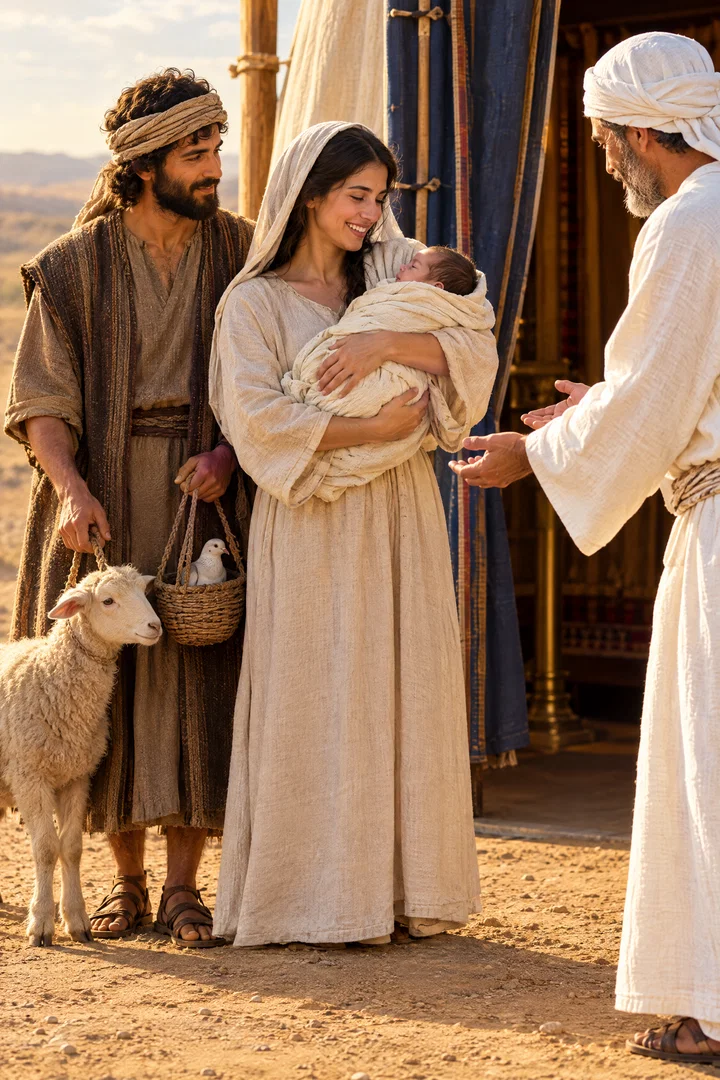
About forty days after His birth Joseph and Mary brought Jesus to Jerusalem to present Him to the Lord and to offer the sacrifice the law allowed for the poor, a pair of turtledoves or two young pigeons instead of a lamb.DA 50.1DA 50.2–3Ms 104, 1900, par. 1 The law required one bird for a burnt offering and the other for a sin offering, and both had to be without blemish because they represented Christ, who was free from physical defect and lived in full conformity to the laws of nature as an example of what obedience was designed to make humanity.DA 50.2–3Ms 104, 1900, par. 1 Their offering showed the poverty of His parents, who appeared no different from other simple working people, yet though He was heaven's most precious gift He could be acknowledged only by the smallest offering and shared the lot of the poor and lowly all His life.DA 50.2–3COS 17.5DA 55.1–2Ms 98, 1893, par. 10–11 As humanity's substitute He thus conformed to the law in every particular, having already submitted to circumcision as a pledge of obedience.DA 50.1Ms 104, 1900, par. 1 God expressly provided for the poor to bring a less costly offering with the same care as a costly one, and He accepts a gift according to what a person has, valuing a willing, loving and thankful heart above its monetary worth.ST Jul 15, 1880ST Oct 21, 1889Ms 8, 1880, par. 12–1521MR 224.8–225.2Ms 8, 1880, par. 18–20
Presentation and Offering
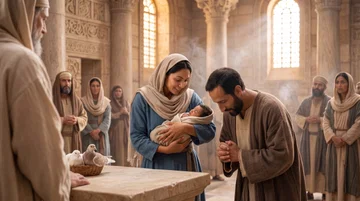
About forty days after His birth, Joseph and Mary took Jesus to Jerusalem to present Him to the Lord and to offer sacrifice according to the Jewish law.DA 50.1 The presentation took place at the temple entrance with its tall columns and stone steps.DA 50 There Mary knelt while holding the swaddled child, with Joseph standing behind her.DA 50
The law normally required a year-old lamb for a burnt offering and a young pigeon or turtledove for a sin offering.DA 50.2–3Ms 104, 1900, par. 1 Parents too poor to bring a lamb could bring a pair of turtledoves or two young pigeons instead, one bird for a burnt offering and the other for a sin offering.DA 50.2–3Ms 104, 1900, par. 1 As humanity's substitute, Christ had to conform to the law in every particular.DA 50.1Ms 104, 1900, par. 1 He had already been subjected to circumcision as a pledge of obedience to the law.DA 50.1
The birds had to be without blemish because they represented Christ.DA 50.2–3 This showed that Jesus Himself was free from physical deformity, with a strong and healthy body unmarked by defect.DA 50.2–3 Throughout His life He lived in conformity to nature's laws, physically as well as spiritually an example of what obedience was designed to make all humanity.DA 50.2–3
Christ in Poverty Revealed
The pair of birds brought for the purification offering marks the family as poor, for the law allowed parents unable to afford a lamb to bring two turtledoves or two young pigeons instead.DA 50.2–3ST Jul 15, 1880Ms 8, 1880, par. 12–1521MR 224.1–5 Joseph and Mary came looking no different from the many other simple working fathers and mothers bringing their children day by day.COS 17.5DA 55.1–2 Their appearance and their gift alike bore the visible stamp of poverty.DA 55.1–2ST Jul 15, 188021MR 224.1–5
Though the Child was heaven's most precious gift to the world, a gift beyond all reckoning, He could be acknowledged on earth by only the smallest appointed offering.ST Jul 15, 188021MR 224.1–5Ms 98, 1893, par. 10–11 That lowly beginning foretold His whole earthly course, for through all His life He shared the lot of the poor and lowly in self-denial and sacrifice.Ms 98, 1893, par. 10–11 In the temple He was dedicated to the work He had come to do.DA 55.1–2
Yet the officiating priest perceived only a helpless infant like any other child, seeing and feeling nothing unusual in Him.COS 17.5DA 55.1–2 He did not know he was holding the Saviour of the world, the High Priest of the heavenly temple.COS 17.5 Had he been obedient to God's word, the Lord would have taught him who the Child was.COS 17.5
Instead it was Simeon who, taught by the Spirit, understood that the infant being presented was the Consolation of Israel.COS 17.5DA 55.1–2 He took the Child in his arms and lifted his face in joy, declaring that he could now depart in peace because his eyes had seen salvation, while the aged Anna stood by watching.DA 55.1–2COS 14
Accepted Giving and Thanksgiving
The law made express provision for the poor to bring a less costly offering of a dove or pigeon, and it required the same care and exactness in its preparation as for the more expensive offerings.ST Jul 15, 1880Ms 8, 1880, par. 12–1521MR 224.1–5 When the parents of Jesus came to the temple with the child, they were poor and could bring only that appointed offering of two turtledoves for the Son of the living God, yet their simple gift fully met the requirement.ST Jul 15, 1880Ms 8, 1880, par. 12–1521MR 224.1–5 What God requires is a gift according to what a person has, whether great or small, and He accepts it when the heart is opened to Him, valuing the willing heart and love rather than the monetary amount.ST Oct 21, 1889Ms 8, 1880, par. 12–1521MR 224.1–5 Though Mary's gift of two doves was small, it was accepted and was precious to God.ST Oct 21, 1889Ms 8, 1880, par. 12–1521MR 224.1–5
Those who are poor, if willing and obedient, are as precious in God's sight as the most wealthy, and the most humble offering is accepted when it is all they can bring.ST Jul 15, 1880 The simple, humble, freewill and cheerful offering given with sacrifice is precious and fragrant to Him, more acceptable than thousands of gold and silver given grudgingly by the wealthy from their abundance without personal inconvenience.ST Jul 15, 1880 The smallest talent and the humblest service offered to Jesus with a sincere heart, in love to God and desire to serve Him, is wholly acceptable, presented by Him with His own merits to the Father.Ms 98, 1893, par. 10–11 This record was placed for the encouragement of the poor, so that everyone can lay up treasure in heaven.ST Jul 15, 1880Ms 98, 1893, par. 10–11
As the sacrifice was offered and the smoke of the altar rose, Joseph and Mary prayed with thanksgiving and gratitude because God had provided an offering for them to bring.21MR 224.8–225.2Ms 8, 1880, par. 18–20 Their example teaches gratitude to God through giving offerings in response to His goodness and care.21MR 224.8–225.2Ms 8, 1880, par. 18–20 After giving ourselves, the best offering to God is our property, with Christ regarded as first and last and best in everything, because Jesus gave Himself without reserve.21MR 224.1–5
Sources
Pioneers and periodicals
27 sources
After the days of purification were complete Joseph and Mary presented Jesus in the temple in obedience to the prescribed rite for the firstborn, offering the sacrifice required in the law.ST Jan 22, 1894ST Apr 23, 1894RH Apr 16, 1908STRH Jul 21, 1903 The pair of turtledoves or two young pigeons was the purification offering the law in Leviticus 12:8 allowed a poor mother to bring instead of a lamb with a bird, and bringing only the birds signifies the poverty and low estate of the family.ST Jan 24, 1906RH Nov 18, 1862ST Jan 27, 1890ST Dec 22, 1898ST Jan 22, 1894 God accepted Mary's small gift because of her willing heart and love rather than its amount, teaching that the poor are as precious to Him as the wealthy when willing and obedient and that the most humble offering is accepted when it is all they can bring.ST Jul 15, 1880ST Oct 21, 1889RH Aug 5, 1902 It is called the law of the Lord because the Lord authored the ceremonies, and the law of Moses because God delivered it to Moses alone to write in a book, unlike the Ten Commandments alone properly called the law of God because Jehovah spoke them directly to all the people and engraved them on stone.RH Jan 20, 1853ST Aug 5, 1897 Ceremonial commands were commands of God carrying moral obligation while in force and to be obeyed without neglect or change, yet the sacrificial laws expired at the cross, and the interchangeable use of the law of God and the law of Moses for the same thing does not argue against keeping the seventh-day Sabbath.ST Oct 15, 1912ST Sep 3, 1912ST Sep 10, 1912RH Feb 18, 1873RH Jun 10, 1862
Temple Presentation Setting
Luke 2:24 belongs to the presentation of Jesus in the temple, following his circumcision and naming.ST Jan 22, 1894 It belongs to the account of his parents presenting him in the temple after the days of his mother's purification were complete, after which they returned with him to Nazareth.RH Apr 16, 1908 The presentation followed his circumcision at eight days of age and included the prophecies of the aged Simeon and Anna.ST Aug 13, 1912 It stands with the worship of the humble shepherds, the adoration of the Magi, the flight into Egypt, and the return to Nazareth of Galilee to the home of Joseph as part of the birth and infancy of Jesus told together by Matthew and Luke.ST Aug 13, 1912 It shows the infant Saviour brought to the temple by his mother in his first public appearance to have the required offering made for him, where he was recognized by two prophets, Simeon and Anna.RH Jul 21, 1903 It records the purification of Mary and the presentation of Christ in the temple, an event commemorated on February 2 as Candlemas Day.ST Feb 20, 1896
The presentation and the offering prescribed by the law took place before the family left for Egypt, and belong to the events probably performed before the wise men arrived.ST Dec 20, 1910 The offering made at Jesus' presentation in the temple places their visit after the events connected with his presentation.ST Jul 30, 1912 The family may have stayed in Bethlehem or Jerusalem until the presentation required by the law for the infant took place.ST Mar 8, 1910
The presentation took place in obedience to the law, with Joseph presenting the firstborn Child to the priest according to the prescribed rite, and the family's offering a pair of turtledoves or two young pigeons. Luke 2 shows that Jesus' parents were Jews, of the family of David and the tribe of Judah.ST Apr 23, 1894 Luke's record of Jesus' birth, of which Luke 2:24 is part, marks the fulfillment of the Old Testament gospel promises. Christ's temple presentation in Luke 2:22-32 is a sign that a child's life belongs first to God, supporting the duty of parents to guide their children toward God and his service from their earliest years.ST
Poor Family's Offering
The two birds were the purification offering the law allowed a poor mother to bring when she could not afford a lamb, with one bird taking the place of the lamb required from those able to bring a lamb with a bird.ST Jan 27, 1890ST Dec 22, 1898ST Jan 22, 1894 This was the poor person's offering, the less costly sacrifice permitted at the mother's purification.ST Jan 27, 1890ST Dec 22, 1898ST Jan 22, 1894 The turtledoves or young pigeons were chosen because they were common and cheap and therefore suited to the poorest.ST Dec 9, 1880
Bringing only the two birds signified poverty and the poor, mean and low condition in which Jesus was born.RH Nov 18, 1862ST Dec 22, 1898ST Jan 22, 1894 It showed deep poverty and that the family was reduced to a very low estate, proving the lowliness of his parents on both his father's and his mother's side though they were descended from illustrious ancestors.RH Nov 18, 1862ST Dec 22, 1898 It showed that Jesus' family lived in modest circumstances, that the parents were poor, and that the doves were the only offering they could afford.ST Jul 15, 1880ST Jan 27, 1890 That poorest sort of sacrifice did not ease their need nor provide means for their later journey to Egypt and return.ST Jan 24, 1906
God expressly allowed the poor to bring this less valuable offering, yet required the same care and exactness in its preparation as for more expensive offerings.ST Jul 15, 1880 Mary's small gift of two doves was accepted because God valued her willing heart and love rather than the gift's monetary amount.ST Jul 15, 1880ST Oct 21, 1889 The poor are as precious in the sight of God as the most wealthy if they are willing and obedient, and the most humble offering is accepted when it is all the poor can bring.ST Jul 15, 1880 The instance stands for the encouragement of the poor, showing that simple, freewill, cheerful offerings given with sacrifice are more acceptable and fragrant to God than thousands of gold and silver given grudgingly by the wealthy from their abundance without personal inconvenience.ST Jul 15, 1880 Mary's offering of birds instead of a lamb marked her extreme poverty, yet the helpless infant carried by a poor woman in human weakness was nevertheless the power and salvation of God, whose strength is made perfect in weakness.RH Aug 5, 1902
Law of the Lord
The offering of the two birds was required by a temporary sacrificial law, and it is described as written in the law of the Lord.ST Oct 15, 1912 The phrase law of the Lord does not refer only to the Decalogue but can refer also to other laws God gave.ST Oct 15, 1912 Which sense is meant is determined by the context and nature of each law.ST Oct 15, 1912 The sacrificial laws were limited in duration and expired at the cross.ST Oct 15, 1912
A ceremonial requirement for turtledoves or pigeons is called the law of the Lord because the Lord was the author of those ceremonies.RH Jan 20, 1853 It is also called the law of Moses because God delivered it to Moses alone for him to write in a book and present to the people.RH Jan 20, 1853 It does not belong to the Ten Commandments, which alone are properly called the law of God because Jehovah spoke them directly to all the people and engraved them on tables of stone as the principles of His moral government.RH Jan 20, 1853 The book of the law often called the law of Moses is also called the law of God, and that book also contained the Ten Commandments whose moral principles are in the Decalogue.ST Aug 5, 1897
Together with verses 22-23 the verse uses the law of the Lord interchangeably with the law of Moses for the whole Mosaic code, including its sacrificial and priesthood provisions and not only the Ten Commandments.RH Feb 18, 1873 The expressions the law of God, the law of Moses, the book of the law of God, and the book of the law of Moses are frequently used interchangeably to signify precisely the same thing.RH Jun 10, 1862 That interchangeable use does not argue against keeping the seventh-day Sabbath.RH Jun 10, 1862 The Ten Commandments and the law of Moses do not signify precisely the same thing.RH Jun 10, 1862
The prescribed offering belonged to the law of the Lord and shows that ceremonial commands, like other commands of God, carried moral obligation and could not be neglected without sin.ST Sep 3, 1912 While the ceremonial law was in force, obeying it was a moral duty rather than an optional or morally indifferent practice, and its requirements could not be changed.ST Sep 10, 1912 The phrase the law of the Lord points to God's law as evidence that if God has a kingdom He has a law.ST Dec 3, 1902
Sources