Luke 2:23
( As it is written in the law of the Lord, Every male that openeth the womb shall be called holy to the Lord;)
Translations
(As it is written in the law of the LORD, Every male that opens the womb shall be called holy to the Lord;)
( As it is written in the law of the Lord, Every male that openeth the womb shall be called holy to the Lord;)
(as it is written in the law of the Lord, Every male that openeth the womb shall be called holy to the Lord;)
(As it is written in the law of the Lord, Every male that is the first born of his mother shall be called holy to the Lord)
Revised Version, American Standard Version
( as it is written in the law of the Lord, Every male that openeth the womb shall be called holy to the Lord),
as it hath been written in the Law of the Lord, — 'Every male opening a womb shall be called holy to the Lord,'
( as it is written in the law of [ the] Lord: Every male that opens the womb shall be called holy to the Lord),
according as it is written in the law of the Lord—Every male that is a firstborn, Holy unto the Lord, shall be called,
Berean Standard Bible, Majority Standard Bible
( as it is written in the Law of the Lord: “ Every firstborn male shall be consecrated to the Lord”),
( as it is written in the law of the Lord, “ Every male who opens the womb shall be called holy to the Lord”),
( As it says in the law of the Lord, Every mother's first male child is to be holy to the Lord),
(As it is written in the Lawe of the Lord, Euery man childe that first openeth ye wombe, shalbe called holy to the Lord)
Douay-Rheims (Challoner revision)
As it is written in the law of the Lord: Every male opening the womb shall be called holy to the Lord:
Pictures
Cross-references
- Leviticus 12:8
And if she be not able to bring a lamb, then she shall bring two turtles, or two young pigeons; the one for the burnt offering, and the other for a sin offering: and the priest shall make an atonement for her, and she shall be clean.
Provides two birds instead of a lamb for a family unable to afford one.
- Exodus 13:2
Sanctify unto me all the firstborn, whatsoever openeth the womb among the children of Israel, both of man and of beast: it is mine.
The law sets every firstborn male apart to the Lord.
- Luke 2:39
And when they had performed all things according to the law of the Lord, they returned into Galilee, to their own city Nazareth.
The family fulfills the requirements of the law of the Lord.
- Exodus 13:12
That thou shalt set apart unto the LORD all that openeth the matrix, and every firstling that cometh of a beast which thou hast; the males shall be the LORD’s.
It commands Israel to dedicate every firstborn male to the Lord.
- Numbers 3:13
Because all the firstborn are mine; for on the day that I smote all the firstborn in the land of Egypt I hallowed unto me all the firstborn in Israel, both man and beast: mine shall they be: I am the LORD.
The firstborn belong to the Lord and are consecrated to him.
- Exodus 34:20
But the firstling of an ass thou shalt redeem with a lamb: and if thou redeem him not, then shalt thou break his neck. All the firstborn of thy sons thou shalt redeem. And none shall appear before me empty.
It requires the firstborn son to be redeemed.
- Leviticus 12:2-4
Speak unto the children of Israel, saying, If a woman have conceived seed, and born a man child: then she shall be unclean seven days; according to the days of the separation for her infirmity shall she be unclean.
It gives the purification period after childbirth.
- Luke 2:6-7
And so it was, that, while they were there, the days were accomplished that she should be delivered.
Records Jesus’ birth in Bethlehem as a real human child.
- Exodus 4:22
And thou shalt say unto Pharaoh, Thus saith the LORD, Israel is my son, even my firstborn:
Israel is called the Lord’s firstborn, linking to the presentation of the firstborn.
- Matthew 1:18
Now the birth of Jesus Christ was on this wise: When as his mother Mary was espoused to Joseph, before they came together, she was found with child of the Holy Ghost.
Records the circumstances of Christ’s birth.
- Matthew 1:20-25
But while he thought on these things, behold, the angel of the Lord appeared unto him in a dream, saying, Joseph, thou son of David, fear not to take unto thee Mary thy wife: for that which is conceived in her is of the Holy Ghost.
Describes Jesus’ conception and birth as fulfillment of the prediction.
- Luke 1:31-35
And, behold, thou shalt conceive in thy womb, and bring forth a son, and shalt call his name JESUS.
The angel announces that Mary will conceive and bear Jesus by God’s power.
- Luke 2:36-38
And there was one Anna, a prophetess, the daughter of Phanuel, of the tribe of Aser: she was of a great age, and had lived with an husband seven years from her virginity;
aged prophetess watches the presentation
Commentary
Each commentary is drawn from primary sources: the writings of Ellen G. White and Adventist pioneers and periodicals. Each commentary is separate. Its own words are not a quotation; follow the references to read the source passages.
Ellen G. White
13 sources
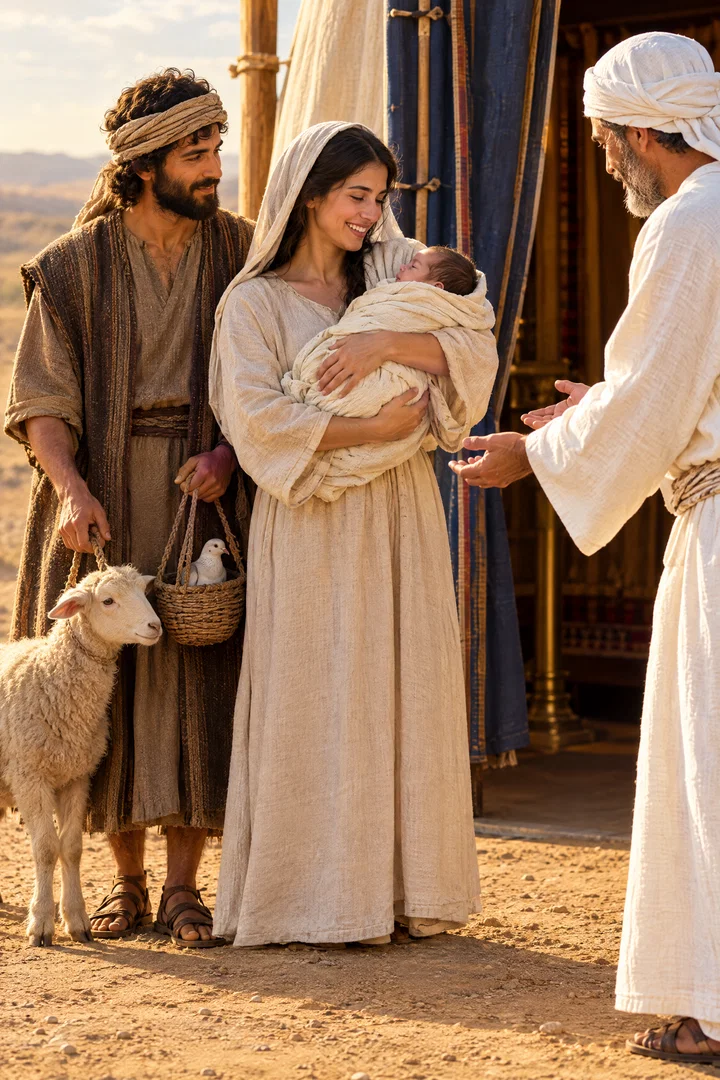
The law required that every firstborn male be set apart as holy to the Lord and presented to Him in the temple at Jerusalem.COS 17.5COS 15.1–16.1Ms 8, 1880, par. 12–15 Joseph and Mary obeyed it as faithful Jews, bringing Jesus to Jerusalem about forty days after His birth to present Him and offer sacrifice.DA 50.1COS 15.1–16.1Ms 104, 1900, par. 1 As man's substitute He conformed to the law in every particular, fulfilling it in obedience to teach obedience by His example and dedicating Himself as firstborn Son to the work He had come to do.DA 50.1COS 15.1–16.1DA 55.1–2Ms 104, 1900, par. 1 Being poor they could bring only the offering allowed for the poor, two doves or turtledoves, yet the Lord received it as acceptable and did not reject it for its smallness.ST Oct 21, 188921MR 224.1–5Ms 8, 1880, par. 12–15 God measures gifts not by amount but by motive and heart service, accepting what is given to the utmost of ability when the heart is opened to Him in faith.ST Oct 21, 188921MR 224.1–5Ms 8, 1880, par. 12–15
Law and Presentation Setting
The law required that every firstborn male be set apart and presented as holy to the Lord in the temple at Jerusalem.COS 17.5COS 15.1–16.1Ms 8, 1880, par. 12–15 As Jews keeping the custom of their nation, Joseph and Mary obeyed it by bringing Jesus to Jerusalem about forty days after His birth, when He was six weeks old, to present Him to the Lord and to offer sacrifice.DA 50.1COS 15.1–16.1Ms 104, 1900, par. 1
They came as many other fathers and mothers came every day with their children, entering the stone temple to the priest, with Mary kneeling and holding the swaddled child before the broad temple entrance with its tall columns and steps while Joseph stood behind her.DA 50COS 17.5COS 14 Because they were simple working people and poor parents, the priest performed the dedication as routine and saw nothing different in them, seeing and feeling nothing unusual but only a helpless infant like any other child.COS 17.5DA 55.1–2 He did not know he was holding in his arms the Saviour of the world, the High Priest of the heavenly temple, for spiritual things are spiritually discerned, and if he had been obedient to God's word the Lord would have taught him who the child was.COS 17.5DA 55.1–2
Though He was presented by poor parents, God acknowledged His own act in giving His Son to the world, and the occasion received recognition when Simeon, warned by the Spirit, understood the infant being presented to be the Consolation of Israel, the Lord's Christ.DA 55.1–2COS 14 The aged white-bearded Simeon in white and gold robes took the swaddled child in his arms and lifted Him joyfully, declaring that he could now depart in peace because his eyes had seen salvation, while aged Anna leaned on her staff and watched.DA 55.1–2COS 14
Christ's Obedient Example
As man's substitute He conformed to the law in every particular in His presentation, having already been subjected to circumcision as a pledge of His obedience to the law.DA 50.1Ms 104, 1900, par. 1 He who was God's own Son and the Prince of heaven fulfilled this law to be obedient in all things, and by His example teaches obedience.COS 15.1–16.1 His dedication as first-born Son, holy to the Lord, was to the work He had come to do.DA 55.1–2
The offerings presented with Him had to be without blemish because they represented Christ Himself.DA 50.2–3 He Himself was free from physical deformity, with a strong and healthy body marred by no defect, the lamb without blemish and without spot.DA 50.2–3 Throughout His lifetime He lived in conformity to nature's laws, and physically as well as spiritually He was an example of what obedience to God's laws makes all humanity to be.DA 50.2–3 The ceremony was to keep in memory how the children of Israel were slaves in Egypt.COS 15.1–16.1 The Lord sent Moses to Pharaoh king of Egypt to say Israel is His son and His first-born and to let His son go to serve Him or He would slay Pharaoh's first-born, which Pharaoh refused by saying he did not know the Lord and would not let Israel go.COS 15.1–16.1
Poor Gift Accepted
Being poor, Joseph and Mary could bring only the offering permitted by the law for the poor, two doves or two turtledoves.ST Oct 21, 188921MR 224.1–5Ms 8, 1880, par. 12–15 The Lord Himself had provided by law that the poor might bring that simple offering instead of a great offering.21MR 224.1–5Ms 8, 1880, par. 12–15 Mary had little to offer for the precious gift entrusted to her, and could not bring the costly treasures the wise men laid before Jesus at Bethlehem.ST Oct 21, 188921MR 224.1–5
The Lord received her two doves as an acceptable offering and did not reject her because of the smallness of her gift.ST Oct 21, 1889 He looked on the willingness of her heart, and her love made the offering sweet.ST Oct 21, 1889 God measures gifts by motive and heart service, not by amount in money, and accepts what is done in faith to the utmost of ability.ST Oct 21, 1889 He does not require a great gift but a gift according to what a man has, be it ever so simple, and accepts it whether rich or poor when the heart is opened to Him, in proportion to what a person has.21MR 224.1–5Ms 8, 1880, par. 12–15
After giving ourselves, the best offering to God is our property, following Jesus who gave Himself without reserve, and even a little offering of two turtledoves is precious in the sight of God in return for His great gift.21MR 224.1–5 In bringing their offering to God at the temple, Joseph and Mary prayed with thanksgiving for the gift of His Son.21MR 224.8–225.2 Their prayers rose with thanksgiving for the offering God had provided.Ms 8, 1880, par. 18–20
Sources
Pioneers and periodicals
26 sources
The verse states the written requirement behind the infant Jesus being brought to Jerusalem to be presented to the Lord after the days of purification were fulfilled.ST Jan 22, 1894ST Dec 22, 1898ST May 8, 1907 Under that requirement every firstborn male was counted set apart as holy to the Lord, so Jesus as Mary's firstborn son was presented to fulfill it and to be redeemed by the fixed payment, with the offering of birds instead of a lamb showing the family's extreme poverty.ST Dec 22, 1898ST Jan 22, 1894RH Aug 5, 1902 The requirement is called both the law of the Lord and the law of Moses, showing the two names are used interchangeably for the Mosaic code as a whole.ST May 20, 1875RH Feb 18, 1873RH Jun 10, 1862 That law was temporary and belonged to the remedial and priestly system that expired at the cross, yet while in force it was fully binding and not morally indifferent because it was God's command.ST Oct 15, 1912ST Sep 10, 1912ST Sep 3, 1912RH Feb 18, 1873 The dedication of the firstborn expresses God's prior claim on a child's life and the parents' duty to guide children to His service from their earliest years, and Mary's two doves show that God measures gifts by motive and heart service rather than amount, accepting what is done in faith to the utmost of ability.ST Oct 21, 1889ST
Presentation Under the Law
The written law stands behind Jesus being brought up to Jerusalem to be presented to the Lord after the days of purification according to the law of Moses were fulfilled.ST Jan 22, 1894ST Dec 22, 1898 That law declared every firstborn male holy to the Lord, and Jesus was presented in keeping with it.ST Jan 22, 1894ST Dec 22, 1898 In Luke's account this requirement for every firstborn male to be counted holy forms part of the setting for the story of His birth and early life.ST May 8, 1907
Under that law every firstborn male, the first male child born to a mother, was counted set apart as holy to the Lord.ST Dec 22, 1898 Jesus as Mary's firstborn son was therefore brought to Jerusalem and presented to the priest so this requirement could be fulfilled, and the law also required His parents to redeem Him by paying a fixed sum.ST Dec 22, 1898 At that presentation the offering brought was a pair of turtledoves or two young pigeons.ST Jan 22, 1894 The woman carrying Jesus brought birds instead of a lamb as an offering, which shows the family's extreme poverty.ST Jan 22, 1894RH Aug 5, 1902
The presentation took place after the forty days of Mary's purification and before the parents returned with Him to Nazareth.RH Apr 16, 1908 This chronology helps date His birth to between the summer of 5 B.C. and early 4 B.C., supporting placing it near the end of 5 B.C.RH Apr 16, 1908 It probably took place several weeks after His birth, while the family was still in Bethlehem or Jerusalem awaiting it.ST Dec 20, 1910ST Mar 8, 1910 It belonged to the events of the presentation in the temple which took place before the Magi visited Him in Jerusalem and found Him in a house, before the wise men visited Him.ST Dec 20, 1910ST Jul 30, 1912
The birth account shows Jesus was truly human, born of Mary in Bethlehem though begotten by the power of the Highest.RH Nov 14, 1854 It identifies His parents as Jews belonging to the family of David and the tribe of Judah.ST Apr 23, 1894 The presentation was His first public appearance, when He was brought to the temple by His mother so the required offering could be made for Him.RH Jul 21, 1903 There He was recognized by two prophets, the devout Simeon and Anna the prophetess.RH Jul 21, 1903 Simeon recognized Him as the promised Holy One and Anointed One when the child was presented to the priest as holy to the Lord.RH Jul 21, 1903
Law of the Lord
The requirement is called both the law of the Lord and the law of Moses because the Lord is its author and Moses is the human medium through whom it was given.ST May 20, 1875 In this setting the law of the Lord is interchangeable with the law of Moses and denotes the Mosaic code as a whole, not only the Ten Commandments.RH Feb 18, 1873 Luke 2:22-24 applies both names to the same requirements of purification, presentation of every male that openeth the womb as holy to the Lord, and sacrifice, showing that the expressions law of God, law of Moses, book of the law of God, and book of the law of Moses are frequently used interchangeably.RH Jun 10, 1862
The phrase the law of the Lord can therefore refer to a temporary law, not only to the eternal moral law.ST Oct 15, 1912 The law about the firstborn and Mary's offering belonged to the laws of Moses, which included the law of the priesthood and a remedial system and expired at the cross.ST Oct 15, 1912RH Feb 18, 1873 Those ceremonial requirements were part of the law of God and were binding while in force, and their being ceremonial did not make them morally indifferent or optional, for they remained obligatory until their appointed end.ST Sep 10, 1912 A command does not lose its moral obligation because it belongs to a ceremonial requirement, showing that God's law includes commands beyond the Ten Commandments.ST Sep 3, 1912
That interchange of names does not prove they signify precisely the same thing, for the Ten Commandments and the law of Moses do not signify precisely the same thing.RH Jun 10, 1862 It therefore does not argue against keeping the seventh-day Sabbath.RH Jun 10, 1862 The verse belongs to Luke 2 as an account of the Lord becoming man and to Luke's account of Jesus' birth as a landmark in the fulfillment of the Gospel promises of the Old Testament.ST Jan 5, 1882 It is an example of the gospel's message of comfort, in contrast with the law's message of wrath and despair.RH Apr 30, 1867 It is not to be taken as a sentence standing alone with an occasional explanatory remark and a passing moral reflection, but to be taught with the general subject of the chapter to give a true conception of the grace of the Lord in becoming man and to awaken the heart to the lofty strain of the angels' jubilee song.ST Jan 5, 1882
The verse records the day of Christ's birth as a memorable day in His history, but not a day the Lord claimed as holy or as the Lord's day.ST Apr 6, 1882
Lesson and Application
The dedication of the firstborn son expressed God's prior claim on a child's life.ST The presentation of Jesus in the temple illustrates that claim and upholds the duty of parents to guide their children toward service to God from their earliest years.ST Mary presented the infant Jesus to the Lord when she was poor and had little to offer for the precious gift entrusted to her.ST Oct 21, 1889 She could bring only two doves to the altar, not the costly treasures the wise men laid before Jesus at Bethlehem.ST Oct 21, 1889 The Lord received her two doves as an acceptable offering and did not reject her because of the smallness of her gift, for He looked on the willingness of her heart and her love made the offering sweet.ST Oct 21, 1889 God therefore measures gifts by motive and heart service, not by amount in money, and accepts what is done in faith to the utmost of ability.ST Oct 21, 1889
Christ's presentation in the temple was part of His beginning missionary work.RH Oct 3, 1907 Though only a helpless babe in the manger in Bethlehem, He already drew people to Himself.RH Oct 3, 1907 He brought joy to Joseph and Mary and to Simeon and Anna in the temple, just as He drew the shepherds from the plains of Bethlehem and the philosophers from the East.RH Oct 3, 1907
The presentation of Christ as holy to the Lord, joined with the purification of Mary, is kept in memory on February 2 as Candlemas Day.ST Feb 20, 1896 The passage is not to be taken as a sentence standing alone with an occasional explanatory remark and a passing moral reflection.ST Jan 5, 1882 It is to be taught with the general subject of the chapter to give a true conception of the grace of the Lord in becoming man and to awaken the heart to the lofty strain of the angels' jubilee song.ST Jan 5, 1882
Sources