Leviticus 12:8
And if she be not able to bring a lamb, then she shall bring two turtles, or two young pigeons; the one for the burnt offering, and the other for a sin offering: and the priest shall make an atonement for her, and she shall be clean.
Translations
American King James Version, King James Version, KJV Cambridge Paragraph Bible
And if she be not able to bring a lamb, then she shall bring two turtles, or two young pigeons; the one for the burnt offering, and the other for a sin offering: and the priest shall make an atonement for her, and she shall be clean.
And if she shall not be able to bring a lamb, then she shall bring two turtles, or two young pigeons; the one for the burnt-offering, and the other for a sin-offering: and the priest shall make an atonement for her, and she shall be clean.
And if her means suffice not for a lamb, then she shall take two turtledoves, or two young pigeons; the one for a burnt offering, and the other for a sin offering: and the priest shall make atonement for her, and she shall be clean.
And if her means suffice not for a lamb, then she shall take two turtle-doves, or two young pigeons; the one for a burnt-offering, and the other for a sin-offering: and the priest shall make atonement for her, and she shall be clean.
'And if her hand find not the sufficiency of a sheep, then she hath taken two turtle-doves, or two young pigeons, one for a burnt-offering, and one for a sin-offering, and the priest hath made atonement for her, and she hath been cleansed.'
And if her hand cannot find what is sufficient for a sheep, she shall bring two turtle-doves or two young pigeons; one for a burnt-offering, and the other for a sin-offering; and the priest shall make atonement for her; and she shall be clean.
But, if her hand findeth not sufficiency for a lamb, then shall she take two turtle doves or two young pigeons, one for an ascending-sacrifice and one for a sin-bearer,—so shall the priest put a propitiatory-covering over her, and she shall be clean.
Berean Standard Bible, Majority Standard Bible
But if she cannot afford a lamb, she shall bring two turtledoves or two young pigeons, one for a burnt offering and the other for a sin offering. Then the priest will make atonement for her, and she will be clean.’”
If she cannot afford a lamb, then she shall take two turtledoves or two young pigeons: the one for a burnt offering, and the other for a sin offering. The priest shall make atonement for her, and she shall be clean.’”
And if she has not money enough for a lamb, then let her take two doves or two young pigeons, one for a burned offering and the other for a sin-offering, and the priest will take away her sin and she will be clean,
But if she bee not able to bring a lambe, she shall bring two turtles, or two yong pigeons: the one for a burnt offring, and the other for a sinne offring: and the Priest shall make an atonement for her: so she shall be cleane.
Douay-Rheims (Challoner revision)
And if her hand find not sufficiency, and she is not able to offer a lamb, she shall take two turtles, or two young pigeons, one for a holocaust, and another for sin: and the priest shall pray for her, and so she shall be cleansed.
Pictures
Cross-references
- Luke 2:24
And to offer a sacrifice according to that which is said in the law of the Lord, A pair of turtledoves, or two young pigeons.
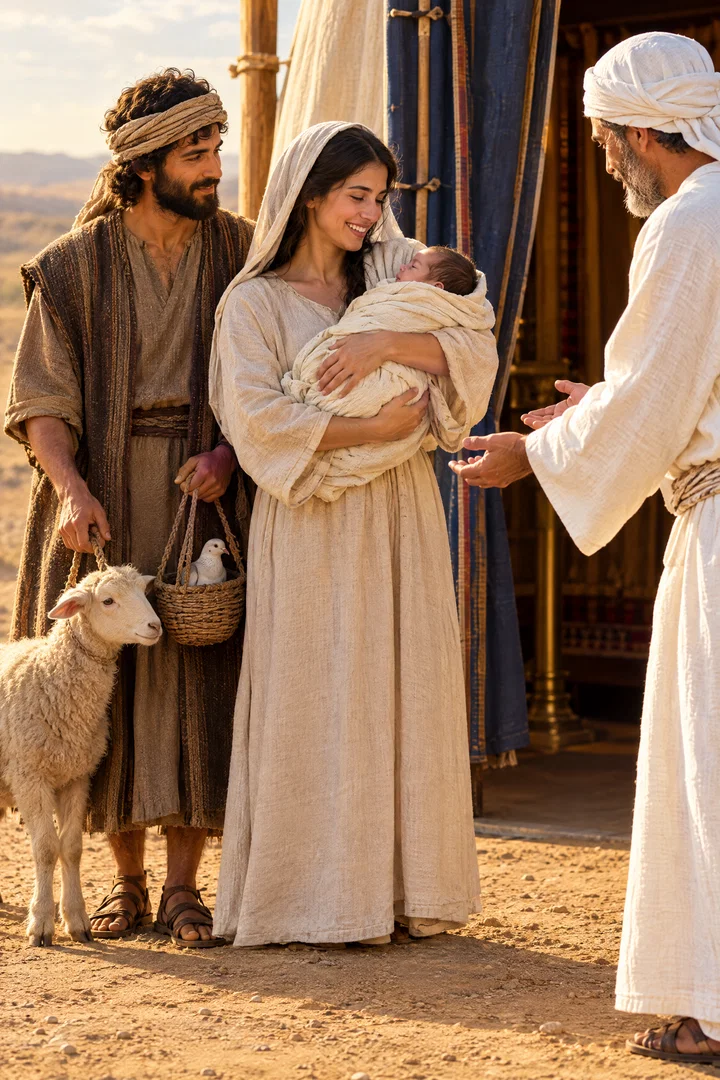
Mary and Joseph offer the two birds allowed when a lamb is unaffordable.
- Leviticus 12:4
And she shall then continue in the blood of her purifying three and thirty days; she shall touch no hallowed thing, nor come into the sanctuary, until the days of her purifying be fulfilled.
Her purification period barred her from the sanctuary until its days were fulfilled.
- 1 Peter 1:19
But with the precious blood of Christ, as of a lamb without blemish and without spot:
The offerings foreshadow Christ as the spotless lamb.
- Luke 2:22
And when the days of her purification according to the law of Moses were accomplished, they brought him to Jerusalem, to present him to the Lord;
parents fulfilled purification law in Jerusalem
- Hebrews 9:13-14
For if the blood of bulls and of goats, and the ashes of an heifer sprinkling the unclean, sanctifieth to the purifying of the flesh:
Sacrificial blood purifies, while Christ’s blood purges the conscience.
- Romans 5:9-11
Much more then, being now justified by his blood, we shall be saved from wrath through him.
Justification by blood is linked with receiving atonement.
- Leviticus 14:21
And if he be poor, and cannot get so much; then he shall take one lamb for a trespass offering to be waved, to make an atonement for him, and one tenth deal of fine flour mingled with oil for a meat offering, and a log of oil;
The priest makes atonement for a person who is then clean.
- 2 Chronicles 29:24
And the priests killed them, and they made reconciliation with their blood upon the altar, to make an atonement for all Israel: for the king commanded that the burnt offering and the sin offering should be made for all Israel.
Blood on the altar makes atonement for Israel.
- Luke 2:39
And when they had performed all things according to the law of the Lord, they returned into Galilee, to their own city Nazareth.
return to Nazareth after rites
- Hebrews 9:12
Neither by the blood of goats and calves, but by his own blood he entered in once into the holy place, having obtained eternal redemption for us.
The yearly offering points to Christ’s once-for-all sacrifice.
Commentary
Each commentary is drawn from primary sources: the writings of Ellen G. White and Adventist pioneers and periodicals. Each commentary is separate. Its own words are not a quotation; follow the references to read the source passages.
Ellen G. White
6 sources
About forty days after birth, the law required a child to be taken to Jerusalem to present him to the Lord and to offer sacrifice, following circumcision as a pledge of obedience to the law.DA 50.1 The normal requirement was a first-year lamb for the burnt offering and a young pigeon or turtledove for the sin offering, but if she was not able to bring a lamb she was to bring two turtledoves or two young pigeons, the one for the burnt offering and the other for the sin offering, and the priest would make atonement for her and she would be clean.DA 50.2–3ST Jul 15, 1880 Even the less costly offering had to be without blemish and prepared with the same care and exactness, because the offerings represented Christ.DA 50.2–3ST Jul 15, 1880
As man's substitute Christ had to conform to the law in every particular, so Joseph and Mary took Him to Jerusalem to fulfill this requirement.DA 50.1 Joseph and Mary used this provision for the poor of two turtledoves or two young pigeons when they came to the temple to do after the usual custom with the child Jesus, because they were poor and could not bring a great offering, which shows Jesus was born as the son of poor parents.ST Jul 15, 188021MR 224.1–5Ms 8, 1880, par. 12–15Ms 98, 1893, par. 10–11 Though the child was the Son of the living God, heaven's most precious gift to the world, a gift above all computation, He could be acknowledged only by the smallest offering.21MR 224.1–5Ms 8, 1880, par. 12–15Ms 98, 1893, par. 10–11
The blemish-free offering shows Jesus Himself was free from physical deformity, with a strong, healthy, undefective body, and throughout His life He lived in conformity to nature's laws as a physical as well as spiritual example of what obedience makes humanity to be, sharing during all His sojourn on earth the lot of the poor and lowly in a life characterized by self-denial and sacrifice.DA 50.2–3Ms 98, 1893, par. 10–11 The verse shows God's provision for the poor, that the poor are precious to God, and that He does not require a great gift but a gift according to what a man has, be it ever so simple, accepting the humble offering when it is all they can bring as precious in His sight in return for His great gift.ST Jul 15, 188021MR 224.1–5Ms 8, 1880, par. 12–15 The smallest talent and humblest service may be offered to Jesus as a consecrated gift, and when the best a person has is presented with a sincere heart in love to God from longing desire to serve Him, with the heart open to Him with Christ first and last and best in everything, He will present it with the fragrance of His own merits to the Father as wholly acceptable, so everyone can lay up treasure in heaven; after giving self, the best offering to God is property.21MR 224.1–5Ms 98, 1893, par. 10–11
Sources
Pioneers and periodicals
15 sources
The law required every mother at the close of her purification to present both a burnt offering and a sin offering, normally a year-old lamb for the burnt offering and a young pigeon or turtledove for the sin offering.ST Dec 22, 1898ST Dec 22, 1898 If she could not afford a lamb she was to bring two turtledoves or two young pigeons instead, one for each offering.ST Jan 27, 1890ST Aug 6, 1912ST Jan 22, 1894 Through that offering of blood the priest made atonement for her before God, and she was pronounced clean.RH Oct 14, 1852RH Sep 16, 1852 Mary fulfilled this poverty provision when Jesus was presented in the temple forty days after His birth, offering only birds because she could not afford a lamb, which shows that Jesus was born to poor parents in humble circumstances.ST Jul 15, 1880ST Jan 27, 1890ST Aug 6, 1912ST Jan 22, 1894 Like all the sacrifices this offering pointed forward to Jesus Christ, the Lamb of God who takes away sin, showing that the humble offering of the poor is precious to God and accepted when it is all they can bring.ST Jul 15, 1880ST Feb 7, 1911
The Law's Provision
At the close of her days of purification every mother is required to bring both a burnt offering and a sin offering.ST Dec 22, 1898ST Dec 22, 1898 A mother who is able brings a lamb of the first year, a year-old lamb, for the burnt offering.ST Dec 22, 1898ST Dec 22, 1898 For the sin offering she brings a young pigeon or a turtledove.ST Dec 22, 1898ST Dec 22, 1898
If she is not able to bring a lamb, she brings two turtledoves or two young pigeons instead.ST Jan 27, 1890ST Aug 6, 1912ST Jan 22, 1894ST Dec 22, 1898ST Dec 22, 1898 The one bird is for the burnt offering and the other is for the sin offering.ST Jan 27, 1890ST Aug 6, 1912ST Jan 22, 1894ST Dec 22, 1898ST Dec 22, 1898 An additional turtledove or young pigeon thus takes the place of the lamb, so that the poorer woman still presents two birds.ST Jul 15, 1880ST Jan 27, 1890 The priest makes an atonement for her, and she shall be clean.ST Jul 15, 1880ST Aug 6, 1912ST Jan 22, 1894ST Dec 22, 1898ST Dec 22, 1898
The priest's atonement in this individual case makes the woman clean.RH Oct 14, 1852RH Sep 16, 1852 That atonement is made through an offering, and blood is the means of atonement.RH Sep 16, 1852 It cleanses and brings the person into favor with God.RH Sep 16, 1852 The law of purification thus made an unclean person visibly clean before the sanctuary itself was reconciled or cleansed through atonement, illustrating that physical uncleanness was removed first.RH Oct 14, 1852
Fulfilled at Jesus' Birth
The purification law called for a mother to bring two offerings, and that ceremony was the one kept when Jesus was presented in the temple.ST Jun 25, 1894ST Aug 17, 1904 Every mother at the end of her days of purification was to bring a burnt offering and a sin offering, with means bringing a year-old lamb for the burnt offering and a young pigeon or turtledove for the sin offering, and with inability to bring a lamb bringing two turtledoves or two young pigeons instead, one for each offering, after which the priest made atonement and she was clean.ST Dec 22, 1898 The mother's offering for purification came forty days after the birth of a son, and it was kept at Jerusalem forty days after Jesus was born, after remaining near Jerusalem for over a month.ST Aug 17, 1904 It was accomplished on the same visit when Jesus was ransomed, and when both requirements were completed the family returned to Nazareth, Jesus being about six weeks old.ST Aug 17, 1904
Mary brought the poor person's provision of an additional turtledove or young pigeon in place of a lamb, so that one bird served for the burnt offering and the other for the sin offering, when she was ceremonially purified after Jesus' birth, showing the moderate circumstances of the family.ST Jan 27, 1890 She brought this offering of two birds at the presentation of Jesus in the temple because she could not afford a lamb.ST Aug 6, 1912ST Jan 22, 1894ST Jan 22, 1894 That offering showed that she was numbered among the poor and that Jesus had poor parents.ST Jul 15, 1880ST Aug 6, 1912ST Jan 22, 1894
Mary with Joseph fulfilled this poverty provision forty days after Jesus' birth by offering only birds at Jerusalem.ST Dec 22, 1898ST Dec 22, 1898 While mothers with means were to bring a lamb of the first year for a burnt offering and a young pigeon or turtledove for a sin offering, parents too poor to provide a lamb satisfied the law with only a pair of turtledoves or two young pigeons, one for the burnt offering and one for the sin offering.ST Dec 22, 1898ST Dec 22, 1898 Their bringing only this poorer offering when they took Jesus to Jerusalem shows that the parents of Jesus were in the deepest poverty.ST Dec 22, 1898ST Dec 22, 1898
Typology and Application
The details of Israel's sacrificial laws had meaning that finds its fuller meaning in the sacrifice, life, and work of Jesus Christ.ST Feb 7, 1911 The sacrifices set out in Leviticus point forward to Jesus Christ, the Lamb of God who takes away sin. This provision forms one part of the complete round of service performed every year in the sanctuary of the Levitical dispensation, the sanctuary built by Moses in the wilderness and later replaced by the temple.ST Nov 28, 1895 That sanctuary in its building, appointments, priesthood, and service typified Christ and His priesthood in the heavenly sanctuary, which He began when He ascended on high, with the yearly round typifying in each year the service of Christ which was once for all.ST Nov 28, 1895
The allowance for a woman who cannot afford a lamb to bring two turtledoves or two young pigeons instead, one for a burnt offering and one for a sin offering with atonement made and cleanness secured, shows that the less costly offering is still accepted.ST Jul 15, 1880 Even that humbler offering requires the same care and exactness in preparation.ST Jul 15, 1880 The poor are precious to God, and their humble offering is accepted when it is all they can bring, as seen when the poor parents of Jesus brought this offering.ST Jul 15, 1880 The choice between a lamb and turtledoves stands as an example of giving according to blessings received, urging that none come before God empty-handed.RH May 21, 1908 The regulation belongs among the laws concerning cleansing given to ancient Israel, and those cleansing truths are not to be abandoned by Christians, just as Israel fell away from the instructions given to them.RH Nov 3, 1868
Sources