Luke 2:48
And when they saw him, they were amazed: and his mother said unto him, Son, why hast thou thus dealt with us? behold, thy father and I have sought thee sorrowing.
Translations
And when they saw him, they were amazed: and his mother said to him, Son, why have you thus dealt with us? behold, your father and I have sought you sorrowing.
King James Version, KJV Cambridge Paragraph Bible
And when they saw him, they were amazed: and his mother said unto him, Son, why hast thou thus dealt with us? behold, thy father and I have sought thee sorrowing.
And when they saw him, they were amazed: and his mother said to him, Son, why hast thou thus dealt with us? behold, thy father and I have sought thee sorrowing.
And when they saw him, they were astonished: and his mother said unto him, Son, why hast thou thus dealt with us? behold, thy father and I sought thee sorrowing.
And when they saw him, they were astonished; and his mother said unto him, Son, why hast thou thus dealt with us? behold, thy father and I sought thee sorrowing.
And, having seen him, they were amazed, and his mother said unto him, 'Child, why didst thou thus to us? lo, thy father and I, sorrowing, were seeking thee.'
And when they saw him they were amazed: and his mother said to him, Child, why hast thou dealt thus with us? behold, thy father and I have sought thee distressed.
And, when they behold him, they were astounded, and his mother said unto him—Child! why, hast thou dealt with us, thus? Lo! thy father and I, in anguish, were seeking thee.
Berean Standard Bible, Majority Standard Bible
When His parents saw Him, they were astonished. “ Child, why have You done this to us?” His mother asked. “ Your father and I have been anxiously searching for You.”
When they saw him, they were astonished; and his mother said to him, “ Son, why have you treated us this way? Behold, your father and I were anxiously looking for you.”
And when they saw him they were surprised, and his mother said to him, Son, why have you done this to us? see, your father and I have been looking for you with sorrow.
So when they sawe him, they were amased, and his mother said vnto him, Sonne, why hast thou thus dealt with vs? beholde, thy father and I haue sought thee with very heauie hearts.
Douay-Rheims (Challoner revision)
And seeing him, they wondered. And his mother said to him: Son, why hast thou done so to us? behold thy father and I have sought thee sorrowing.
Pictures




Cross-references
- Luke 2:40
And the child grew, and waxed strong in spirit, filled with wisdom: and the grace of God was upon him.
Describes Jesus growing before the temple visit.
- Exodus 20:12
Honour thy father and thy mother: that thy days may be long upon the land which the LORD thy God giveth thee.
Jesus’ obedience to his earthly parents reflects the command to honor father and mother.
- Luke 2:52
And Jesus increased in wisdom and stature, and in favour with God and man.
Both describe Jesus growing during his boyhood.
- Luke 2:35
( Yea, a sword shall pierce through thy own soul also,) that the thoughts of many hearts may be revealed.
Simeon foretold sorrow that Mary later recalled.
- Luke 15:8
Either what woman having ten pieces of silver, if she lose one piece, doth not light a candle, and sweep the house, and seek diligently till she find it?
The woman diligently searches for her lost coin using the same word.
- Luke 1:31-35
And, behold, thou shalt conceive in thy womb, and bring forth a son, and shalt call his name JESUS.
Announces Jesus’ conception and birth as the Son of God.
- John 7:15
And the Jews marvelled, saying, How knoweth this man letters, having never learned?
Both texts express amazement at Jesus’ wisdom despite his lack of formal learning.
Commentary
Each commentary is drawn from primary sources: the writings of Ellen G. White and Adventist pioneers and periodicals. Each commentary is separate. Its own words are not a quotation; follow the references to read the source passages.
Ellen G. White
53 sources
At twelve years old during the Passover visit to Jerusalem, after a day's journey without Him and three sorrowful days seeking Him, Mary and Joseph found Jesus in the temple among the learned teachers and in amazement His mother asked why He had remained behind and caused them such anxious grief.DA 75.1MH 19.1Ms 93, 1899, par. 17–18Ms 183, 1903, par. 8–9 Her question was spoken as a reproof that wrongly cast blame on Him for the separation, when they themselves had lost Him through absorption in company and talk and neglect of watchfulness and prayer.LC1 26.1–27.22SP 33.11RED 26.1–28.1 His mother called Joseph His father and revealed how little they yet grasped His divine Sonship and the meaning of the Passover that pointed to His saving work.Ms 78, 1893, par. 40–45DA 81.1–3IRCUP 10.1 His answer that He must be about His Father's business respectfully turned the censure back upon them, declaring that His life was wholly governed by His heavenly Father's will and mission to reveal God and redeem the fallen.MH 19.1Lt 58, 1906, par. 14–15RH Mar 13, 1900RH Nov 21, 1907 Their experience warns followers that Christ can be lost sight of through carelessness and recovered only after many sorrowful days, and it calls parents and disciples to honor earthly ties while placing duty to God first and making everything subordinate to the work He gives.Ms 242, 1902, par. 7–82SP 31.2–32.1RH Nov 21, 1907Ms 183, 1903, par. 3–4
Passover Visit Setting
Luke 2:48 belongs to Jesus' Passover visit to Jerusalem as a boy when He was twelve years old.DA 75.1Ms 18, 1893, par. 1IRCUP 10.1 That was the age at which a Hebrew boy was considered a son of the law and was expected to take part in the sacred feasts.DA 75.1 Joseph and Mary attended the Passover each year, and on this occasion they brought Him with them to Jerusalem.DA 75.1IRCUP 10.1
The feast drew worshipers from across Palestine and the wider Jewish diaspora.DA 75.2 Pilgrims traveled in large groups, and the journey from Galilee took several days.DA 75.2 For many the observance of the Passover had become formal, but its ceremonies held deep meaning for Jesus because they portrayed His saving work and helped reveal His mission.DA 77.2 The temple rites and the meaning of the Passover began to show Him the work He would do for the covenant people descended from Abraham, Isaac, and Jacob.IRCUP 10.1
He had grown from infancy toward manhood under God's protection, remaining without sin.Ms 77, 1910, par. 29 He grew up in a humble home at Nazareth under His parents' instruction, and as a child He was faithful in His work.Ms 77, 1910, par. 29RH Oct 30, 1900 He made His home there for thirty years, living unhonored and unknown.Ms 181, 1897, par. 8–11 Nazareth had become proverbial for wickedness and was regarded as the worst of the people of Palestine, a town of bad reputation from which it was thought a wonder if any good thing could come, a place of moral darkness and misery.Ms 181, 1897, par. 8–11
Christ, the mighty Worker to uplift and regenerate the whole human soul, commenced there by becoming a citizen of that lowly place and setting His own feet upon the paths the poor and neglected souls must tread.Ms 181, 1897, par. 8–11 Thus the Light of the world pours contempt upon human pride of place, station, honor, and fame.Ms 181, 1897, par. 8–11 He might have made His home in places of renown, but He did not, lest His followers who were compelled to live in lowly places should frame an excuse for their sins and for their rough, hard, uncourteous characters.Ms 181, 1897, par. 8–11 One who left the courts of heaven and took humanity upon Himself to live out a pure human character made His abode among those far down in the scale of popularity and morality, to demonstrate that any place, however hard and lowly, if it is our post of duty, can be made honorable by fidelity.Ms 181, 1897, par. 8–11
After being found in the temple following His parents' search for Him, Jesus returned home and worked with His father as a carpenter, helping to support the family.Ms 73, 1895, par. 6 Ordinary useful work was not degrading.Ms 73, 1895, par. 6
Sorrowful Search and Discovery
The loss came to light on the homeward journey from Jerusalem when the company halted to rest, and Mary and Joseph looked in vain for the Boy among kinsfolk and acquaintances.Ms 183, 1903, par. 8–9DA 80 They turned back alone to retrace their steps to Jerusalem, cut off from the active companionship of friends and relatives.Ms 183, 1903, par. 8–9 They sought their lost Son with troubled, heartsore, sorrowing anxiety and a keen sense of responsibility for the sacred trust committed to them.Ms 78, 1893, par. 40–45Ms 183, 1903, par. 8–9 The search lasted three days, stopping at every place and questioning every traveler, until they came again to the temple courts and up the marble steps.Ms 183, 1903, par. 8–9Ms 145, 1906, par. 28–31Ms 143, 1906, par. 23–24
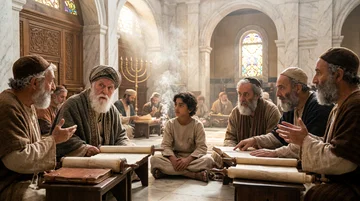
After three days they found Him in the temple in the school of the rabbis, seated in the midst of the grave and learned doctors, scribes, teachers, lawyers, and wise men.Ms 22, 1898, par. 13–14Ms 143, 1906, par. 23–24ST Dec 9, 1880 He sat as a learner listening to them and asking discreet questions, and His questions and answers gave manifest proofs of superior wisdom, penetration, and mature judgment.Ms 22, 1898, par. 13–14Lt 53, 1898, par. 25–26ST Dec 9, 1880 They threw great light into their minds, bringing gems of light and new thoughts about the Messiah.Ms 22, 1898, par. 13–14Lt 53, 1898, par. 25–26 All who heard were astonished, and His words started trains of thought never to be forgotten.Ms 13, 1897, par. 30–31Lt 53, 1898, par. 25–26
When His parents saw Him they were amazed and gratified to see Him thus honored among the dignitaries of the temple.Ms 93, 1899, par. 17–18ST Dec 9, 1880 Amid large numbers flocking to the temple they knew His well-known voice marked with solemn melody before they could see Him for the crowd.ST Dec 9, 1880 They gazed in astonishment at His questions and answers, with divinity flashing through humanity in His countenance.Ms 93, 1899, par. 17–18Ms 13, 1897, par. 30–31ST Dec 9, 1880 Light flashed into their minds and left them scarcely knowing what to say.Ms 93, 1899, par. 17–18Ms 13, 1897, par. 30–31Ms 183, 1903, par. 8–9
Their fear and grief had been heightened by dread that harm had come to Him and by the memory of Herod's attempt to kill Him as an infant and massacre of the children.COS 35.1–6ST Oct 4, 1877 To find Him unharmed brought great joy and relief.COS 35.1–6 Mary afterward remembered that anguish, and the same sorrowing anxiety returned when she later waited anxiously for His return.Ms 145, 1906, par. 28–31DA 144.3–145.1
Mary's Reproving Question
It was His mother who spoke to Him, at one point alone, asking why He had dealt thus with them and left them, saying that His father Joseph and she had sought Him sorrowing and anxiously.MH 19.1GW 111.2–3Ms 147, 1902, par. 8–9Ms 85, 1906, par. 6–13COS 35.1–6 The exchange came after they found Him in the school of the rabbis, and her distress was heightened by the memory of Herod's attempt to kill Him as an infant, so that finding Him brought great joy and relief.COS 35.1–6DA 75 The amazement at the scene belonged both to the people and to His parents, who were gratified to see Him thus honored among the grave and learned doctors, scribes, teachers, lawyers and wise men.ST Dec 9, 1880 That amazement was greater because His parents were poor and He had not received the advantages of education, yet His discreet questions and answers gave manifest proofs of superior wisdom, penetration and mature judgment.ST Dec 9, 1880
Mary's words were spoken in a reproving manner and implied a rebuke and censure, expressing grief, anxiety and distress over His tarrying at Jerusalem.LC1 26.1–27.2ST Dec 9, 18802SP 33.11RED 26.1–28.1 They wrongly reflected blame onto Jesus for remaining in Jerusalem as though He had wronged them and caused their distress, instead of acknowledging their own neglect of the sacred trust and responsibility entrusted to them.LC1 26.1–27.22SP 33.11RED 26.1–28.1LC1 28.1–29.1ST Dec 9, 1880 They had lost Him through their own neglect by leaving without Him and becoming absorbed in conversation and visiting on the return journey.1RED 26.1–28.1LC1 28.1–29.12SP 33.2–34.1 That neglect included vain talking, jesting, joking, evil speaking, and neglect of watchfulness and prayer, by which they forgot Him for an entire day.ST Dec 9, 18802SP 33.2–34.1
Her calling Joseph His father reflects their family relationship, while their sorrow revealed their sense of responsibility for Him.Ms 78, 1893, par. 40–45DA 81.1–3 His absence also exposed how little they had understood the prophecies and the significance of the Passover, which contemplated would have revealed His mission.Ms 78, 1893, par. 40–45 Jesus respectfully and modestly turned the censure back upon them and pointed heavenward to His Father's business.1RED 26.1–28.15MR 103.2–104.1 Mary in great measure understood that His Father meant Jehovah, not Joseph, and laid the saying in her heart to ponder.
Yet His words about His Father's business were a mystery to them that filled them with solemn awe, and they did not understand them.RH Mar 13, 19005MR 103.2–104.1 From then on His way of acting remained a mystery to them.DA 89.6 Mary kept His sayings in her heart to ponder, marking His words, His spirit, and His willing obedience.1RED 26.1–28.15MR 103.2–104.1
Heavenly Father and Mission
Mary's sorrowing question when she found the boy among the teachers draws out His answer that He must be about His Father's business.MH 19.1GW 111.2–3Ms 22, 1898, par. 13–14 The work He was then doing in the temple was the very work He had come into this world to do.Ms 22, 1898, par. 13–14Lt 53, 1898, par. 25–26 His reply reveals the central and guiding purpose of His life.Lt 58, 1906, par. 14–15GW 42.1–2RH Dec 30, 1902
His life, desires, wishes, and choices were governed by and wholly subject to His mission from God and His Father's will.MH 19.1GW 111.2–3ST Apr 29, 1903 That purpose was to do God's will and serve in obedience to God's law, placing His own wishes beneath His mission.Lt 58, 1906, par. 14–15GW 42.1–2 His life was devoted to His heavenly Father's work.RH Dec 30, 1902ST Apr 29, 1903
The visit marks when Jesus realized He was indeed the Son of God with a special work before Him, beginning to realize His relation to His heavenly Father.Ms 22, 1898, par. 13–14Ms 145, 1906, par. 28–31 At twelve He already knew the work before Him and was beginning to make this clear, showing He understood His Sonship to God and His Father's work.Ms 22, 1898, par. 13–14DA 81.1–3Ms 143, 1906, par. 22 That work was revealing God, explaining God's word to Israel's leaders, and showing new meaning in their sacrifices and offerings.Lt 53, 1898, par. 25–26STE 67.2 Even in youth He brought His wishes into strict abeyance to His mission and glorified His life by making everything in it subordinate to His Father's will and His mission to redeem the fallen.RH Nov 21, 1907ST Jun 9, 1914 His answer is the keynote of His life-work of constant self-sacrifice, making every desire and earthly claim subordinate to His Father's work.RH Nov 21, 1907ST Jun 9, 1914
Though His life often looked like that of other children, His divinity was veiled in humanity.2SP 35.15MR 103.2–104.1 Divinity flashing through humanity illuminated His face with the light and glory of heaven and started trains of thought never to be forgotten.Ms 13, 1897, par. 30–315MR 103.2–104.1 He stayed because He understood God had given Him a duty and recognized the moment to teach His parents that His heavenly Father's claims came first.5MR 103.2–104.1Ms 183, 1903, par. 3–4 He then went down with them to Nazareth and lived subject to them, yet He never lost the realization of His future work and knowledge that He must labor to save the lost.Ms 22, 1898, par. 13–145MR 103.2–104.1 He kept faithful watch over every faculty lest Satan gain advantage, lived in every action as the Son of God representing the Father, and lost no opportunity to make others sons of God.Ms 22, 1898, par. 13–14
Though His public ministry did not begin for eighteen years, He constantly ministered even in childhood in words of comfort and tenderness to young and old.5MR 103.2–104.1 Having laid off His royal robe and kingly crown to labor as the son of a poor family, He lived a life of perfect obedience without a single offense to be a pattern for every soul.Ms 79, 1909, par. 15 He steadfastly followed the Lord's instruction rather than the counsel of priests and rulers even under those regarded as God's messengers.Ms 79, 1909, par. 15Lt 62, 1911, par. 2–3 Joseph and especially Mary kept His divine Fatherhood before them, instructed Him according to His mission, and found gratification in His inclination to the right and willing obedience.5MR 103.2–104.1
Prophecy Warning and Discipleship
The three days in which He was separated from them foreshadowed the coming time when His death for the sins of the world would separate Him from them, after which He would reveal Himself and be found of them and their faith would rest upon Him as the Redeemer and their advocate with the Father.1RED 30.2 Their sorrowful search stands as a warning that those who follow Christ may lose sight of Him through carelessness and neglect of watchfulness and prayer, and that the recovery of His presence and of the peace and comfort of His grace may require many sorrowful days.2SP 31.2–32.1
The setting shows that human authority, even parental authority, cannot override conscience or duty to God, for His duty to His heavenly Father's work came before earthly ties.Ms 242, 1902, par. 7–8Ms 183, 1903, par. 3–4 He had remained because He understood that God had given Him a duty, and He recognized the moment to teach His parents that His heavenly Father's claims came first.Ms 183, 1903, par. 3–4 He was to love, obey, and honor His earthly parents in everything that did not conflict with duty to God.Ms 183, 1903, par. 3–4
His life was held in abeyance to His great work of redemption, with everything made subordinate to the mission He came to accomplish and every desire and earthly claim made subordinate to His Father's work and His mission to redeem the fallen.Ms 242, 1902, par. 7–8Ms 13, 1897, par. 30–31RH Nov 21, 1907 That consecration calls His disciples to the same devotion, self-denial, self-sacrificing spirit, and subjection to the claims of the Word of God, making everything subordinate to their mission to glorify God and cooperate with Him in saving sinners rather than serving or pleasing themselves.Ms 242, 1902, par. 7–8Ms 13, 1897, par. 30–31 Social claims and earthly affections are to be placed beneath the work God gives them.Ms 242, 1902, par. 7–8 Having laid off His royal robe and kingly crown to come into this world and labor as the son of a poor family in a life of perfect obedience without offense in a single instance, His course was to be a pattern for every human soul, calling for the same consecration to the will of God with hearts softened by the Holy Spirit, giving Christ entrance into the home and accepting the saving merits of the crucified and risen Saviour unto deeper love for God and stronger determination to serve Him.RH Nov 21, 1907Ms 79, 1909, par. 15
Their natural habit of regarding Him merely as their own child put them in danger of overlooking the blessing of His presence and the high favor God had shown in entrusting the Son of God to their care, and His remaining in Jerusalem gently reminded them of their duty and kept His divine mission from being obscured by treating Him only as their child.ST Oct 4, 18772SP 35.1 Though His life often appeared like that of other children because His divinity was veiled in humanity, His presence with them was a special trust and blessing.ST Oct 4, 18772SP 35.1 Because Christ was once a little child, mothers for His sake should deal gently with little ones and honor them as a sacred charge from God and as God's property, loved by Him, not to be indulged, petted, and idolized but to be taught to live a pure, noble life and, in cooperation with Him, to form perfect characters.Ms 34, 1899, par. 5
Sources
Pioneers and periodicals
38 sources
At twelve years old, on the Passover visit to Jerusalem when He was counted responsible for character and service to God, Jesus was left behind when His parents supposed Him to be among their traveling companions, and after three days of anxious searching they found Him in the temple court among the learned teachers, listening and asking searching questions and answering with a wisdom that astonished them.ST Jan 29, 1894ST Jun 15, 1904ST Mar 16, 1904RH Aug 12, 1875ST Aug 17, 1904 When they saw Him they were amazed, and His mother spoke with loving sorrow and gentle reproof, asking why He had caused them such distress and saying that His father and she had sought Him sorrowing.ST Jul 16, 1894ST Jan 11, 1899RH Apr 9, 1867 By thy father she meant Joseph, while His answer about His Father meant God, declaring that He must be about His heavenly Father's business and that He knew Himself to be the promised Messiah and not merely Joseph's son.ST Jan 10, 1906ST Jul 1, 1880ST Sep 15, 1898ST May 30, 1911 Her reproof blamed Him for their sorrow when they themselves had lost Him through neglect of their sacred trust, forgetting Him for a whole day, and the incident reminds them that His divine mission must not be obscured by treating Him merely as their own child.ST Dec 9, 1880ST Oct 4, 1877ST Jan 10, 1906 Though He understood His calling, He did not remain with the rabbis but returned to Nazareth and was subject to His parents until He was thirty, teaching youth to obey godly parents while putting God's claim first when mature and converted, and teaching all who lose His presence through self-satisfied living to turn back in grief and abide in Him by constant faith.ST Mar 16, 1904RH Aug 12, 1875ST Jun 17, 1913ST Aug 27, 1912ST Jul 15, 1880
Setting and Wording
The verse belongs to the only recorded events of childhood, when Jesus was twelve years old on the Passover visit to Jerusalem.ST Sep 17, 1894ST Mar 16, 1904ST May 15, 1907 It was His first visit there since His dedication as a babe, and by Jewish custom He was then counted a son of the law expected to take conscious responsibility for character and service to God.RH Mar 13, 1900ST Jun 14, 1899 His age is given without giving the calendar date of His birth, as His age of about thirty-three at finishing His mission is given without that date.
He was lost on the return journey when His parents joined the returning company without Him, supposing Him to be with traveling companions and believing He was with relatives and acquaintances.ST Jun 15, 1904ST May 17, 1910 They searched for Him anxiously with aching hearts and in sorrow, and found Him only after three days and three nights.ST Jan 29, 1894ST Jun 15, 1904ST May 24, 1910 Their search included seeking among relatives and acquaintances after discovering He was missing on leaving Jerusalem.ST May 17, 1910
He was found in the temple, in the school of the rabbis in the temple court, sitting with other youth in the midst of the grave and learned doctors, scribes and teachers of the law.ST Dec 9, 1880ST Aug 17, 1904ST Jun 14, 1899 There He listened and asked searching, steadfast questions about the deep mysteries of Scripture, doctrines, prophecies, laws and the Messiah.ST Dec 9, 1880ST Jul 29, 1880ST Jun 14, 1899 He also gave exact answers with manifest superior wisdom, penetration and mature judgment that astonished them and left the learned men mute.ST Dec 9, 1880RH Aug 12, 1875ST Jul 29, 1880ST Jun 14, 1899
When they saw Him they were amazed, and the amazement belonged both to the people flocking to the temple and to His parents.ST Dec 9, 1880ST Jan 11, 1899 His parents knew His well-known voice marked with solemn melody before they could see Him for the crowd, and they gazed in astonishment at the scene.ST Dec 9, 1880 They were gratified to see Him thus honored in the midst of the learned doctors.ST Dec 9, 1880
His mother still held the grief and anxiety of the sorrowful search, and in a reproving manner with loving sorrow and gentle chiding she asked why He had thus dealt with them and caused them such sorrow and distress.ST Dec 9, 1880ST Jul 16, 1894ST Jan 11, 1899 She said that His father and she had sought Him sorrowing after searching anxiously for Him.ST Jan 11, 1899ST Mar 12, 1896ST Jul 16, 1894 She appeared pale, tear-stained and disheveled, pressing trembling lips upon His hair while whispering the question and relating her fears and sorrow on His account.ST Dec 9, 1880ST Jul 29, 1880
The word translated sought describes the most intense and determined effort, showing that Joseph and Mary searched in deep distress.RH Apr 9, 1867 Seeking is therefore not a weak wish and cannot be sharply contrasted with striving.RH Apr 9, 1867
Mary's phrase thy father means Joseph, while Jesus' reply about His Father means Jehovah, not Joseph.ST Sep 15, 1898 In that reply He identified God as His Father and explained that He was doing His Father's work, knowing His identity as the promised Messiah and not Joseph's son.ST Sep 15, 1898ST May 30, 1911
The setting is His humble childhood home at Nazareth, where He received His parents' instruction and spent His early years among its hills and country.RH Oct 30, 1900ST May 19, 1898 His parents were poor and He had not received the advantages of education, which made the amazement greater.ST Dec 9, 1880 He had grown strong in spirit and wisdom without rabbinical schooling, God Himself being His teacher and Mary His first human teacher.ST Dec 9, 1880ST Jun 14, 1899
Christ's Sonship and Mission
Even at twelve He understood better than most men what it meant to be about His heavenly Father's business.ST Mar 16, 1904 He counted being with the teachers in the temple a necessity and wondered that His parents were surprised to find Him there, expecting them to know He would be in His Father's house and about His Father's business.ST Mar 16, 1904ST Jan 10, 1906ST Jul 1, 1880 Mary’s question why He had caused His parents sorrow by remaining in Jerusalem while she and Joseph searched for Him shows she had not yet fully understood the responsibility God had entrusted to her or His mission.ST Jan 10, 1906
They had supposed Him to be with traveling companions and, after searching anxiously for three days, found Him in the temple, not understanding that He was attending to His heavenly Father’s work.ST Jun 15, 1904 That work concerns both people’s everyday needs and their eternal welfare.ST Jun 15, 1904 It was at that childhood Passover visit that the temple rites led Him to understand His connection to their meaning and His part in their fulfillment.ST May 17, 1910
Even in youth, found by His mother in the school of the rabbis after sorrowful seeking when she questioned His course toward them, He held His own wishes in strict subjection to His mission.ST Oct 30, 1907RH Nov 21, 1907ST Jun 9, 1914 He glorified His life by making everything in it, every desire and earthly claim and choice, subordinate to the will of His Father.ST Oct 30, 1907RH Nov 21, 1907ST Apr 29, 1903ST Jun 9, 1914 That answer gives the keynote of His life-work of constant self-sacrifice in carrying responsibility for the salvation of men and the redemption of the fallen.ST Oct 30, 1907RH Nov 21, 1907ST Jun 9, 1914
His words about His Father’s business were a mystery to Mary and Joseph and filled them with solemn awe.RH Mar 13, 1900 Though they were amazed and astonished at His wisdom and answers in the temple on that first visit, found after losing Him on the return, their amazement had not yet made them understand His divine identity and mission.RH Mar 13, 1900ST Sep 15, 1898 Mary called Joseph His father, while His reply identified God as His Father and explained that He was doing His Father’s work and knew His identity.ST Sep 15, 1898 The childhood account of Luke 2:40-52 shows Him growing in wisdom and in stature, presenting His growth in wisdom as parallel to Moses who was learned in all wisdom and as one point of likeness between Moses and Messiah.RH Feb 19, 1861
Parents' Sorrow and Reproof
Mary's question was spoken in reproof, censuring and blaming her twelve-year-old son for the way he had dealt with them instead of acknowledging that she and Joseph had lost him through their own neglect of their sacred trust.ST Dec 9, 1880ST Oct 4, 1877ST Dec 9, 1880 They had forgotten him for an entire day on the return journey, having neglected their responsibility to keep him with them through vain talking, jesting, joking, evil speaking, and neglect of prayer.ST Dec 9, 1880 When they found him in the temple after three days of anxious, sorrowful searching, they were amazed and gratified to see him thus honored in the midst of the learned doctors, yet Mary could not forget the grief and anxiety his staying behind had caused, so she told him that she and his father Joseph had sought him sorrowing.ST Dec 9, 1880ST Oct 4, 1877ST Dec 9, 1880 He respectfully and modestly turned the censure back upon them, and Mary in great measure understood that his Father meant Jehovah, not Joseph, and laid the saying in her heart to ponder.
Their grief during the search was intensified by fear that harm had come to him, including the memory of Herod's massacre of children.ST Oct 4, 1877 Her words revealed that she had not fully understood the responsibility God had entrusted to her or the mission of Jesus, for she should have expected to find him in his Father's house and business.ST Oct 4, 1877ST Jan 10, 1906 The incident reminded Mary and Joseph that his divine mission must not be obscured by treating him merely as their own child.ST Oct 4, 1877 His presence with them was a special trust and blessing.ST Oct 4, 1877
The reproach was spoken after they found him in Jerusalem, having believed he was with their traveling companions, and it illustrates the parents' responsibility to know where their children are.ST Dec 9, 1880ST Dec 9, 1880 Assuming a child is with relatives or acquaintances does not remove that responsibility.
Obedience and Spiritual Lessons
Though He understood His calling to be about His heavenly Father's business, He did not remain in Jerusalem for further instruction under the formalistic rabbis but returned with Mary and Joseph to Nazareth and was subject to them.ST Mar 16, 1904ST Aug 17, 1904ST Jun 14, 1899 Having grown strong in spirit and wisdom without rabbinical schooling, with God Himself as His Teacher and Mary as His first human teacher, He had lingered behind the departing multitude on His first visit to Jerusalem since His dedication as a babe and sat with other youth at the feet of the learned doctors in the temple court, astonishing them with His questions and answers about the Messiah while keeping His heavenly Father's work in mind.ST Jun 14, 1899 After astonishing the learned teachers He went home with His parents, to whom He remained subject, content to do ordinary work until He was thirty and until the days of His baptism, showing that even the Son of God submitted to parental authority.ST Mar 16, 1904RH Aug 12, 1875ST Jun 14, 1899 The lesson drawn is that youth should be subject and obedient to their parents following Jesus' example, and that true progress and wisdom come through submission to God.ST Sep 17, 1894RH Aug 12, 1875ST Mar 12, 1896 His obedience to them meant no conflict with obedience to God, because they were godly parents whose direction served God's will.ST Jun 17, 1913
At twelve He became responsible to God under the Jewish custom of becoming a son of the law, yet remained subject to His parents in all things.ST Jun 17, 1913 This marks the critical stage when He was expected to take conscious responsibility for forming His character and serving God as His larger life unfolded.ST Jun 17, 1913ST Jan 10, 1906 The distinction taught is between parental authority and a child's responsibility to God: when a child is mature, truly converted, and clearly understands God's claim, God's claim comes first, but the child should still obey without a rebellious spirit.ST Jun 17, 1913 His life at Nazareth afterward demonstrated that a holy life was possible even in unfavorable surroundings.ST Aug 17, 1904
Mary's reproach over the sorrowful search teaches that people may go through a day intending to do God's will while living by their own concerns and feeling self-satisfied, yet fail to keep Christ's presence with them.ST Aug 27, 1912 The danger is illustrated by joining the returning company without Him and turning back from a clear purpose, since Jesus was intent on His Father's business while His parents returned with the travelers.ST Aug 27, 1912ST Jul 15, 1880 When darkness or trouble reveals how far they have gone without Him, they may suffer grief before finding Him again.ST Aug 27, 1912 The lesson is to abide in Christ, let His words remain within, hold His presence by living constant faith, and make belonging to Him part of character by joining self, time, and interests to Him.ST Aug 27, 1912 Since He counted being with the teachers a necessity and expected His parents to know He would be there, what is strange is for the teacher to be absent from the teachers' meeting, and a teacher who neglects it declares that he needs no growth or can grow without the helps his Divine Master needed.ST Jul 1, 1880 As a real child as real as any child, who when about His age knew what it is for children to be tried and met trial by answering with His Father's Word, children now should do as Jesus did when He was their age.ST Apr 9, 1902
Sources