Translations
And if I also ask you, you will not answer me, nor let me go.
King James Version, Webster Bible
And if I also ask you, ye will not answer me, nor let me go.
and if I also ask you, you will not answer me, nor let me go.
Revised Version, American Standard Version
and if I ask you, ye will not answer.
and if I also question [you], ye will not answer me or send me away;
and if I should ask [ you], ye would not answer me at all, nor let me go;
And, if I should put questions, in nowise would ye answer;
And if I ask you a question, you will not answer.
And if I ask you a question, you will not answer Me nor release Me.
and if I ask, you will in no way answer me or let me go.
And if I put a question to you, you will not give an answer.
And if also I aske you, you will not answere me, nor let me goe.
Douay-Rheims (Challoner revision)
And if I shall also ask you, you will not answer me, nor let me go.
Pictures
Cross-references
- Matthew 26:62-66
And the high priest arose, and said unto him, Answerest thou nothing? what is it which these witness against thee?
The council questions Jesus, hears His answer, and condemns Him.
- Mark 14:60-64
And the high priest stood up in the midst, and asked Jesus, saying, Answerest thou nothing? what is it which these witness against thee?
Jesus is questioned before the council and condemned.
- John 18:20-21
Jesus answered him, I spake openly to the world; I ever taught in the synagogue, and in the temple, whither the Jews always resort; and in secret have I said nothing.
Jesus says He taught openly and directs his interrogator to ask those who heard Him.
- Luke 23:1
And the whole multitude of them arose, and led him unto Pilate.
After questioning Jesus, the council leads Him to Pilate.
- Daniel 7:13-14
I saw in the night visions, and, behold, one like the Son of man came with the clouds of heaven, and came to the Ancient of days, and they brought him near before him.
Jesus foretells coming in the clouds with power and glory.
- Psalms 110:1
The LORD said unto my Lord, Sit thou at my right hand, until I make thine enemies thy footstool.
Jesus speaks of the Son of man seated at God’s right hand.
Commentary
Each commentary is drawn from primary sources: the writings of Ellen G. White and Adventist pioneers and periodicals. Each commentary is separate. Its own words are not a quotation; follow the references to read the source passages.
Ellen G. White
11 sources
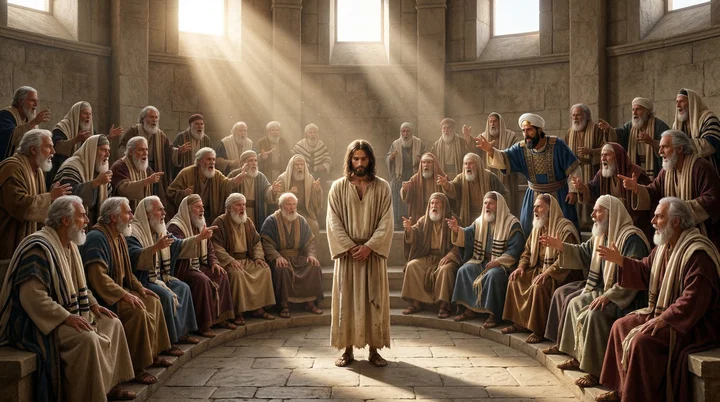
The words were spoken during the trial before the Sanhedrin, when the priests and judges pressed close around Him asking whether He was the Christ.19MR 170.1–2DA 714.1–4ST Jun 27, 1878 That council condemned Him, but it could not carry out the execution without confirmation from Pilate.Ms 107, 1893, par. 2 When He was brought before Pilate, the accusers' testimonies contradicted one another and had no value, and Pilate declared Him faultless.Ms 107, 1893, par. 2
He knew that telling them plainly would not make them believe Him, even if He declared Himself the Christ.Ms 104, 1897, par. 26–275RED 41.1DA 714.1–4ST Jun 27, 18783SP 120.2–121.1 He knew that if He put questions to them, they would not give an honest answer.Ms 104, 1897, par. 26–27Ms 51, 1897, par. 23–2419MR 170.1–2DA 698.1–700.55RED 41.1 He knew they would not let Him go or release Him.Ms 104, 1897, par. 26–27Ms 51, 1897, par. 23–2419MR 170.1–2DA 698.1–700.55RED 41.1 Their refusal to listen and respond fairly exposed that their inquiry was not a sincere search for truth but an unjust effort to secure His condemnation.Ms 104, 1897, par. 26–27DA 698.1–700.5DA 714.1–4 Their determination to condemn Him left no opening for truthful exchange or justice and made a fair trial impossible.Ms 51, 1897, par. 23–2419MR 170.1–2
He answered them calmly despite their hypocrisy.ST Jun 27, 1878 He could have traced the prophecies to prove that what was predicted about the Messiah was then being fulfilled, and could have pointed to His mighty miracles and silenced them.5RED 41.1ST Jun 27, 18783SP 120.2–121.15RED 39.3–40.2 But their hearts were set against the light of heaven so no further evidence or power could make them believe.5RED 41.1ST Jun 27, 18783SP 120.2–121.15RED 39.3–40.2 Their treatment of Him displayed enmity against Christ and those who serve God, driven by envy, jealousy, and religious bigotry.9MR 108.1–109.1
Sources
Pioneers and periodicals
6 sources
Luke 22:68 belongs to Luke 21-22, to be read together with Luke 9-20 in Luke's Gospel.ST Sep 27, 1910 It needs little explaining yet holds many precious things to learn.ST Sep 27, 1910 It stands in the telling of Christ's last Passover with His disciples and His apprehension in the garden.ST Sep 27, 1910 Specifically it belongs to the account of His trial before the Sanhedrin.ST Sep 27, 1910ST Oct 28, 1913
He spoke it while facing the elders, chief priests, and scribes at daybreak.ST Jan 17, 1900 The hypocritical priests and judges pressed close around Him asking whether He was the Christ.ST Jun 27, 1878 He answered just before declaring that the Son of man would sit at God's right hand.ST Jan 17, 1900 The verse means He knew His questioners would neither answer Him nor respond honestly to His questions, and would not release Him.ST Nov 12, 1894ST Nov 12, 1894 Their refusal to respond showed they were unwilling to engage honestly and were not seeking truth.ST Nov 12, 1894ST Nov 12, 1894
He calmly told the council their questioning could not lead to an honest outcome.ST Jan 17, 1900ST Jun 27, 1878 Telling them plainly would not make them believe.ST Jan 17, 1900ST Jun 27, 1878 Putting questions to them would bring no honest answer and no release.ST Jan 17, 1900ST Jun 27, 1878 He could have traced the prophecies to prove that what was predicted about the Messiah was then taking place, and He could have pointed to His mighty miracles and silenced them.ST Jun 27, 1878 But they still would not have believed because they had set their hearts against the light of heaven and no power could change them.ST Jun 27, 1878 In this setting the verse reveals His mighty power and wisdom and love to stimulate devotion and promote spiritual growth.ST Sep 27, 1910
Sources