Translations
American King James Version, Webster Bible
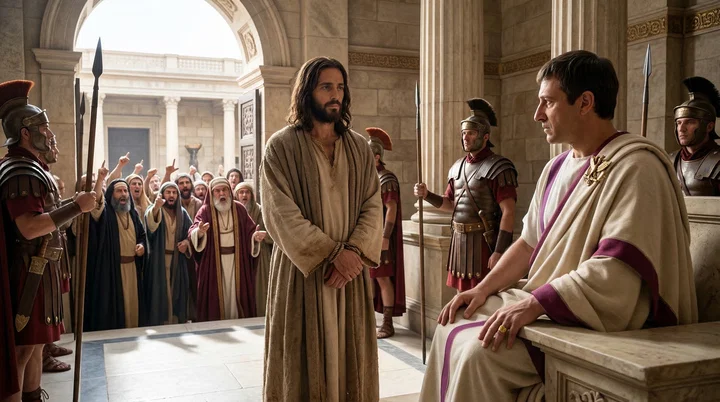
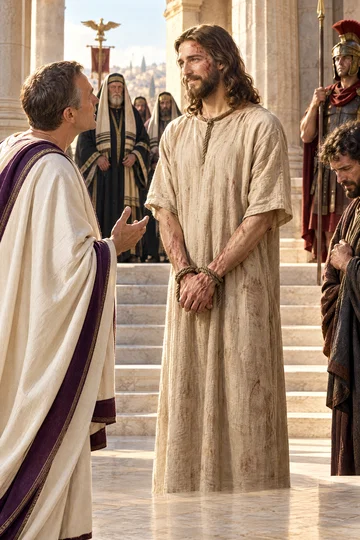
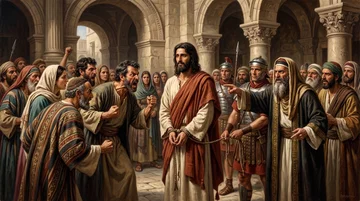
And the whole multitude of them arose, and led him to Pilate.
King James Version, KJV Cambridge Paragraph Bible
And the whole multitude of them arose, and led him unto Pilate.
Revised Version, American Standard Version
And the whole company of them rose up, and brought him before Pilate.
And having risen, the whole multitude of them did lead him to Pilate,
And the whole multitude of them, rising up, led him to Pilate.
And one and all the throng of them, arising, led him unto Pilate.
Berean Standard Bible, Majority Standard Bible
Then the whole council rose and led Jesus away to Pilate.
The whole company of them rose up and brought him before Pilate.
And they all went and took him before Pilate.
Then the whole multitude of them arose, and led him vnto Pilate.
Douay-Rheims (Challoner revision)
And the whole multitude of them rising up, led him to Pilate.
Pictures
Cross-references
- John 18:28-38
Then led they Jesus from Caiaphas unto the hall of judgment: and it was early; and they themselves went not into the judgment hall, lest they should be defiled; but that they might eat the passover.
Jesus is brought before Pilate, who questions him and finds no fault in him.
- Matthew 27:2
And when they had bound him, they led him away, and delivered him to Pontius Pilate the governor.
Jesus is led away and delivered to Pilate.
- Mark 15:1
And straightway in the morning the chief priests held a consultation with the elders and scribes and the whole council, and bound Jesus, and carried him away, and delivered him to Pilate.
Jesus is brought before Pilate after the leaders deliver him.
- Matthew 27:11-31
And Jesus stood before the governor: and the governor asked him, saying, Art thou the King of the Jews? And Jesus said unto him, Thou sayest.
Parallel account of Jesus being brought before Pilate and the events that follow.
- Luke 22:66-71
And as soon as it was day, the elders of the people and the chief priests and the scribes came together, and led him into their council, saying,
The council condemned Jesus before bringing him to Pilate.
- John 19:1-16
Then Pilate therefore took Jesus, and scourged him.
Continues Pilate’s examination and judgment of Jesus, ending with his being handed over.
- Mark 15:3-4
And the chief priests accused him of many things: but he answered nothing.
Records the accusations brought before Pilate.
- Matthew 27:22-23
Pilate saith unto them, What shall I do then with Jesus which is called Christ? They all say unto him, Let him be crucified.
The crowd demands Jesus’ crucifixion before Pilate.
- Mark 15:12-14
And Pilate answered and said again unto them, What will ye then that I shall do unto him whom ye call the King of the Jews?
The crowd rejects Jesus and cries for his crucifixion.
- Luke 22:47-54
And while he yet spake, behold a multitude, and he that was called Judas, one of the twelve, went before them, and drew near unto Jesus to kiss him.
Judas betrays Jesus, and armed men arrest and lead him away.
- Luke 23:6-7
When Pilate heard of Galilee, he asked whether the man were a Galilæan.
Pilate sends Jesus to Herod after learning he is a Galilean.
- Luke 23:5
And they were the more fierce, saying, He stirreth up the people, teaching throughout all Jewry, beginning from Galilee to this place.
Jews fiercely press the charge of stirring up the people
- Matthew 27:19
When he was set down on the judgment seat, his wife sent unto him, saying, Have thou nothing to do with that just man: for I have suffered many things this day in a dream because of him.
Pilate’s wife warns him to release Jesus after suffering in a dream about him.
- John 11:47-53
Then gathered the chief priests and the Pharisees a council, and said, What do we? for this man doeth many miracles.
decided to deliver him to save city
Commentary
Each commentary is drawn from primary sources: the writings of Ellen G. White and Adventist pioneers and periodicals. Each commentary is separate. Its own words are not a quotation; follow the references to read the source passages.
Ellen G. White
9 sources
The whole multitude of accusers and the assembled Jewish leaders rose together and led Jesus to Pilate.Ms 112, 1897, par. 1–6Ms 104, 1897, par. 26–2719MR 170.1–2DA 723.1–724.1DA 722.5 This took place right after the daylight meeting of the elders of the people with the chief priests and scribes.Ms 104, 1897, par. 26–2719MR 170.1–2 There Jesus had declared that hereafter the Son of man would sit on the right hand of the power of God and had affirmed that He is the Son of God, which they declared to be sufficient witness from His own mouth to condemn Him.Ms 104, 1897, par. 26–2719MR 170.1–2
Before this He had been betrayed by Judas and arrested after His agony in Gethsemane.Ms 107, 1893, par. 2 He was led bound as a prisoner to Pilate's judgment seat.Ms 112, 1897, par. 1–6 Pilate looked upon Him with suspicion and severity while people and spectators gathered on every side as the charges against Him were read.Ms 112, 1897, par. 1–6
After the Sanhedrin had condemned Him to death, He was brought to Pilate because the Roman governor's confirmation was required to confirm, carry out, and execute their sentence.DA 723.1–724.1Ms 107, 1893, par. 2 The priests and other Jewish officials stayed outside the judgment hall to avoid ceremonial defilement before the Passover, though their murderous hatred had defiled their hearts.DA 723.1–724.1 By rejecting Jesus, the true Passover Lamb, they had lost the significance of the feast.DA 723.1–724.1
The verse begins the account of Jesus being brought before Pilate, as part of the trial that led to His condemnation.DA 722.54RED 102.2–103.1 The scene continues from Pilate's judgment hall as Jesus is led toward Calvary to be crucified.DA 722.5 The crowd that had once welcomed Him as king later scorned Him and called for His crucifixion.4RED 102.2–103.1 He had prepared His faithful disciples for this reversal so that the crowd's rejection and the betrayal and condemnation of their Master would not take them wholly by surprise or cause them to lose faith.4RED 102.2–103.1
He was delivered up from envy under the inspiration of Satan to destroy life rather than save it.Ms 112, 1897, par. 1–6 This shows how professedly righteous men carry through a wicked purpose by envy and jealousy and religious bigotry in the spirit of Satan.Ms 112, 1897, par. 1–69MR 108.1–109.1 This united handing over illustrates the league against good that always exists where God's holy law is transgressed, with fallen men uniting in desperate companionship with fallen angels as Satan inspires disloyal elements to work in harmony with his spirit.9MR 108.1–109.1 It fulfills in a special manner the enmity foretold in Eden between the serpent and her seed, showing Christ pledged to conflict with the prince and power of darkness to bruise the serpent's head in an unwearied war that will not end until He comes the second time without sin unto salvation.9MR 108.1–109.1
It shows Jesus utterly helpless on the cross against the Jewish priests and rulers who forced even the Roman governor to work their will.RH Nov 11, 1915 It proves that by trusting the word of God He withstood the power of the whole world.RH Nov 11, 1915
Sources
Pioneers and periodicals
12 sources
The verse opens the account of the trial before Pilate after questioning by the Jewish council, beginning the Roman trial and the final scene of Jesus' life on earth.ST Nov 12, 1894ST Oct 4, 1910RH Jun 10, 1862 His appearances before Pilate and Herod belong to the events leading through cruel treatment to crucifixion.RH Jun 10, 1862 The chapter as a whole goes on to cover his trials, his crucifixion, his triumph over death, and his parting instruction to his disciples.ST Oct 4, 1910
The whole multitude that arose and led Him was the Jewish leadership — priests, elders, scribes, and council — acting together after they had condemned Him and judged Him worthy of death.ST Oct 26, 1882ST Jun 18, 1912ST Oct 27, 1898ST Mar 13, 1901 They brought Him to Pilate because they lacked authority to carry out a death sentence, since Rome reserved the power of life and death and execution.ST Jun 18, 1912RH Feb 11, 1862ST Mar 13, 1901 They needed the Roman governor to confirm their decision and to sentence Him before they could proceed to execute Him.ST Jun 18, 1912RH Feb 11, 1862ST Mar 13, 1901
Pontius Pilate was then governor of Judea, as Tacitus and Josephus record.RH Feb 11, 1862 This exact agreement with the political rule and history of that period, together with the minute details of the trial and execution and burial, shows minute accuracy.RH Feb 11, 1862 Their natural, undesigned consistency with outside histories and with the customs and institutions of that time is evidence for the truth of the Gospel history.RH Feb 11, 1862 The morning proceedings gave the appearance of observing the rule that judicial proceedings must be conducted and concluded by day, but the trial had begun the previous evening and sentence was passed and carried out on that same Jewish day, violating the rule that a death sentence could not be pronounced on the day of trial.ST Oct 26, 1882
The delivery to the Romans was the Jews' rejection of Christ after He had presented Himself to them as their king in entering Jerusalem seated upon the ass, when the fate of the Jews as a nation was decided.ST Nov 8, 1883 Denying His right to call Himself their king, they seized Him as a rebel against Caesar and delivered Him to the Romans to be put to death to save their city from destruction by the Romans, but God punished this terrible crime by employing the Romans to destroy their city and their nation.ST Nov 8, 1883 The leading of Jesus to the governor on unproved charges, with malignant priests and scribes clamoring for His death, presented God's gospel in glorious perfection before great Rome, with Jesus Christ standing for the gospel and Pilate standing for Rome.ST Oct 27, 1898 It began God's effort to save Pilate by convincing him that Jesus was more than man and appealing to his heart to do right whatever the consequences.ST Oct 27, 1898
Jesus before Pilate is pictured in humility, in humble contrast with the Pope.RH Dec 28, 1911RH Dec 21, 1911 The verse shows Jesus utterly helpless on the cross against the Jewish priests and rulers who forced even the Roman governor to work their will.RH Nov 11, 1915 It proves that by trusting the word of God He withstood the power of the whole world.RH Nov 11, 1915
Sources