Mark 14:60
And the high priest stood up in the midst, and asked Jesus, saying, Answerest thou nothing? what is it which these witness against thee?
Translations
And the high priest stood up in the middle, and asked Jesus, saying, Answer you nothing? what is it which these witness against you?
King James Version, KJV Cambridge Paragraph Bible, Revised Version, American Standard Version
And the high priest stood up in the midst, and asked Jesus, saying, Answerest thou nothing? what is it which these witness against thee?
And the high priest stood up in the midst, and asked Jesus, saying, Answerest thou nothing? what is it which these testify against thee?
And the chief priest, having risen up in the midst, questioned Jesus, saying, 'Thou dost not answer anything! what do these testify against thee?'
And the high priest, rising up before them all, asked Jesus, saying, Answerest thou nothing? What do these testify against thee?
And, the High-priest rising up into the midst, questioned Jesus, saying—Answerest thou, nothing? What are these, against thee, witnessing?
Berean Standard Bible, Majority Standard Bible
So the high priest stood up before them and questioned Jesus, “ Have You no answer? What are these men testifying against You?”
The high priest stood up in the middle, and asked Jesus, “ Have you no answer? What is it which these testify against you?”
And the high priest got up in the middle of them, and said to Jesus, Do you say nothing in answer? what is it which these say against you?
Then the hie Priest stoode vp amongst them, and asked Iesus, saying, Answerest thou nothing? what is the matter that these beare witnesse against thee?
Douay-Rheims (Challoner revision)
And the high priest rising up in the midst, asked Jesus, saying: Answerest thou nothing to the things that are laid to thy charge by these men?
Pictures
Cross-references
- Matthew 26:62
And the high priest arose, and said unto him, Answerest thou nothing? what is it which these witness against thee?
The high priest asks Jesus to answer the witnesses’ accusations.
- John 18:19-21
The high priest then asked Jesus of his disciples, and of his doctrine.
Jesus is questioned about his teaching and replies that he taught openly.
- Luke 22:66-71
And as soon as it was day, the elders of the people and the chief priests and the scribes came together, and led him into their council, saying,
Jesus is questioned by the council during his trial.
- Matthew 26:63-64
But Jesus held his peace. And the high priest answered and said unto him, I adjure thee by the living God, that thou tell us whether thou be the Christ, the Son of God.
Gives the parallel exchange and Jesus’ answer to the high priest.
- Isaiah 53:7
He was oppressed, and he was afflicted, yet he opened not his mouth: he is brought as a lamb to the slaughter, and as a sheep before her shearers is dumb, so he openeth not his mouth.
The afflicted servant remains silent before his accusers.
- Matthew 27:12-14
And when he was accused of the chief priests and elders, he answered nothing.
Jesus remains silent when accused, despite being asked why he does not answer.
- Matthew 27:1
When the morning was come, all the chief priests and elders of the people took counsel against Jesus to put him to death:
parallel account of same hearing
- John 19:9
And went again into the judgment hall, and saith unto Jesus, Whence art thou? But Jesus gave him no answer.
Jesus remains silent when questioned during his trial.
- Matthew 22:44
The LORD said unto my Lord, Sit thou on my right hand, till I make thine enemies thy footstool?
Christ invokes the Lord seated at God’s right hand.
- Mark 15:1
And straightway in the morning the chief priests held a consultation with the elders and scribes and the whole council, and bound Jesus, and carried him away, and delivered him to Pilate.
parallel account of same hearing
Commentary
Each commentary is drawn from primary sources: the writings of Ellen G. White and Adventist pioneers and periodicals. Each commentary is separate. Its own words are not a quotation; follow the references to read the source passages.
Ellen G. White
6 sources
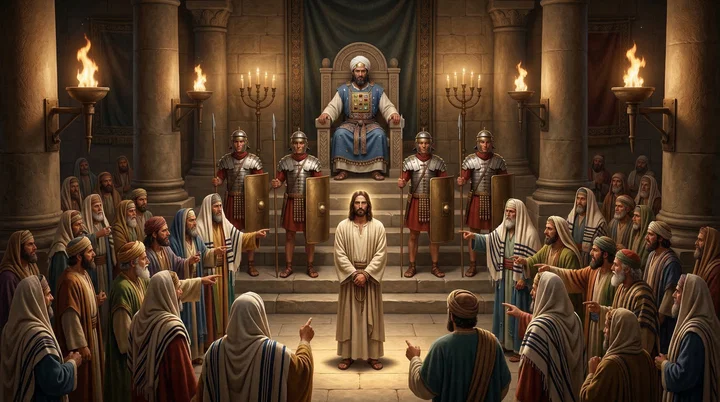
The moment comes while Jesus stands before Annas and the court of Caiaphas.DA 698 Caiaphas rises up from the throne of judgment to confront Him at its foot, with judges and interested parties ranged on either side, Roman soldiers on the platform below, and the multitude looking on.3SP 115.3–116.2 He rises in gorgeous priestly robe with glittering tiara and costly breastplate, while Jesus stands in coarse, homely garments, though in truth He had reigned crowned in the courts of heaven in garments of brightness attended by holy angels and now stands at an earthly throne to be tried for His life.3SP 115.3–116.2
Standing before the council, the high priest demands that Jesus answer the accusations brought against Him by the witnesses.Ms 102, 1897, par. 1–3DA 698.1–700.55RED 39.1–25RED 35.3–36.23SP 115.3–116.2 Those witnesses charge Him with destroying the temple and rebuilding it, but their statements do not agree.Ms 102, 1897, par. 1–3 The questioning belongs to a trial arranged to secure His condemnation, for the rulers sought charges of blasphemy for the Jewish authorities and sedition for the Romans, and tried to obtain evidence through perjury, violating their own rule that a person must be treated as innocent until proved guilty.DA 698.1–700.5
Jesus remains silent, calm, serene, majestic, and composed, not responding to the demand and hearing the sneering, haughty demand as though He heard it not, in strong contrast to the hostility, agitation, and excited, malignant bearing around Him.Ms 102, 1897, par. 1–35RED 39.1–25RED 35.3–36.23SP 115.3–116.2 He is silent because the sentence has already been decided and the witnesses have supplied no evidence deserving death.5RED 39.1–2 His silence fulfills Isaiah's prophecy of the afflicted servant who does not open his mouth when led like a lamb to slaughter.5RED 39.1–2 After this demand, the high priest presses Him further to say whether He is the Christ, the Son of the Blessed.Ms 102, 1897, par. 1–3 A holy influence emanates from Him, so that even the hardened multitude question whether a man of God-like presence should be sentenced as a common criminal, and Caiaphas himself is momentarily struck with admiration for His dignified bearing and convicted that He is akin to God, then banishes the thought and hastens the trial.3SP 115.3–116.2
Sources
Pioneers and periodicals
7 sources
After His arrest Jesus was brought before the high priest and the hastily assembled Sanhedrin in the judgment hall, in a night trial that could not lawfully decide a capital case before sunrise.ST May 27, 1889ST Mar 14, 1906ST May 25, 1904 That proceeding was informal and unjust despite its pretense of keeping the law.ST May 27, 1889 Caiaphas presided over the council and regarded Jesus as a rival, resenting the crowds drawn by His teaching.ST May 27, 1889
In the midst of the council the high priest stood up and pressed Jesus to answer what the witnesses testified against Him.ST Mar 6, 1901ST Mar 14, 1906RH Dec 29, 1863ST Dec 1, 1898 The council had sought false testimony to put Jesus to death but had found none until witnesses made a claim about the temple.ST Mar 6, 1901 The charge was blasphemy, punishable by death, and though the law required two agreeing witnesses, the leaders relied on two false, hired witnesses whose testimony conflicted.ST Mar 6, 1901ST May 25, 1904ST Dec 1, 1898
Jesus remained silent before those conflicting accusations but answered truthfully when placed under oath and asked whether He was the Son of God.ST Dec 1, 1898 His answering some questions at His trial and refusing to answer others therefore depended on the questions asked.ST May 6, 1897ST Dec 1, 1898 The questioning belongs to the account of Christ mocked and rejected, marking the movement from hollow homage to open outrage against Him.RH Dec 29, 1863
Sources