Luke 22:67
Art thou the Christ? tell us. And he said unto them, If I tell you, ye will not believe:
Translations
Are you the Christ? tell us. And he said to them, If I tell you, you will not believe:
Art thou the Christ? tell us. And he said unto them, If I tell you, ye will not believe:
Art thou the Christ? tell us. And he said unto them, If I tell you, you will not believe:
Saying, Art thou the Christ? tell us. And he said to them, If I tell you, ye will not believe.
Revised Version, American Standard Version
If thou art the Christ, tell us. But he said unto them, If I tell you, ye will not believe:
saying, 'If thou be the Christ, tell us.' And he said to them, 'If I may tell you, ye will not believe;
If thou art the Christ, tell us. And he said to them, If I tell you, ye will not at all believe;
But he said unto them—If I should tell, you, in nowise would ye believe,
Berean Standard Bible, Majority Standard Bible
“ If You are the Christ, tell us.”Jesus answered, “ If I tell you, you will not believe.
“ If you are the Christ, tell us.”But he said to them, “ If I tell you, you won’t believe,
If you are the Christ, say so. But he said, If I say so you will not have belief;
Saying, Art thou that Christ? tell vs. And he said vnto them, If I tell you, ye wil not beleeue it.
Douay-Rheims (Challoner revision)
And he saith to them: If I shall tell you, you will not believe me.
Pictures
Cross-references
- Matthew 26:63-64
But Jesus held his peace. And the high priest answered and said unto him, I adjure thee by the living God, that thou tell us whether thou be the Christ, the Son of God.
Jesus is questioned about his identity and declares himself the Son of Man.
- Mark 14:61-62
But he held his peace, and answered nothing. Again the high priest asked him, and said unto him, Art thou the Christ, the Son of the Blessed?
The high priest asks if Jesus is the Christ, and Jesus answers.
- Luke 23:1
And the whole multitude of them arose, and led him unto Pilate.
The council leads Jesus to Pilate after questioning Him.
- John 18:19-27
The high priest then asked Jesus of his disciples, and of his doctrine.
Jesus faces questioning by the authorities as Peter denies knowing him.
- Daniel 7:13-14
I saw in the night visions, and, behold, one like the Son of man came with the clouds of heaven, and came to the Ancient of days, and they brought him near before him.
Jesus’ Son of Man reference echoes the vision of one coming with heaven’s clouds.
- Luke 23:2-3
And they began to accuse him, saying, We found this fellow perverting the nation, and forbidding to give tribute to Cæsar, saying that he himself is Christ a King.
The Christ-king charge is brought before Pilate.
- Luke 22:71
And they said, What need we any further witness? for we ourselves have heard of his own mouth.
The leaders treat Jesus’ own words as sufficient testimony against him.
- Psalms 2
Why do the heathen rage, and the people imagine a vain thing?
Psalm 2 was fulfilled that day as Jesus faced opposition and was questioned about his messiahship.
- Mark 15:1
And straightway in the morning the chief priests held a consultation with the elders and scribes and the whole council, and bound Jesus, and carried him away, and delivered him to Pilate.
Continues the account with the council’s action at daybreak.
Commentary
Each commentary is drawn from primary sources: the writings of Ellen G. White and Adventist pioneers and periodicals. Each commentary is separate. Its own words are not a quotation; follow the references to read the source passages.
Ellen G. White
10 sources
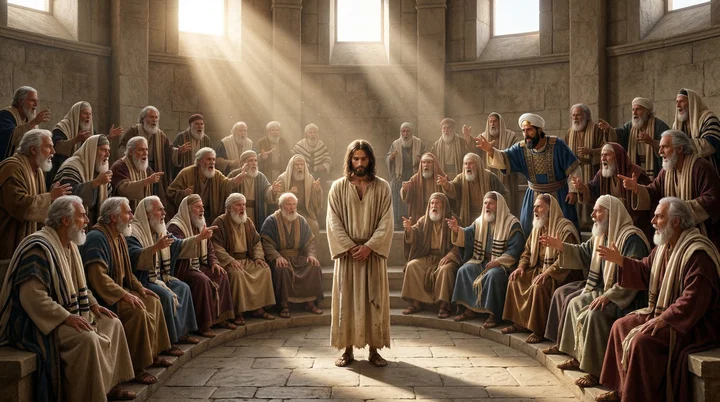
This belongs to Jesus' examination before the Jewish rulers, the council, the Sanhedrin, when they asked Him whether He was the Christ, although they had already determined to condemn Him.Ms 104, 1897, par. 26–27Ms 51, 1897, par. 23–2419MR 170.1–29MR 108.1–109.15RED 39.3–40.2 Jesus knew and told them that if He told them, they would not believe Him.Ms 104, 1897, par. 26–27Ms 51, 1897, par. 23–2419MR 170.1–29MR 108.1–109.15RED 41.1 He knew His judges would not believe Him if He identified Himself as the Christ and declared Himself to be so.5RED 41.1DA 714.1–4
Their question was not asked in faith or as a sincere search for truth, but was hypocritical.Ms 104, 1897, par. 26–2719MR 170.1–2ST Jun 27, 1878 Exulting priests and judges pressed close around Him, hiding malicious satisfaction and pretending they could hardly believe what they had heard, while He looked calmly at them.ST Jun 27, 1878 Their questioning shows the enmity between Christ and the forces of evil, in which professedly righteous people can act against Him from envy, jealousy, and religious bigotry.9MR 108.1–109.1
Their hearts were set against the light of heaven, so further evidence would not change their minds and no power could change them.5RED 41.1ST Jun 27, 18783SP 120.2–121.1 He could have traced the prophecies concerning the Messiah to prove that the very things then taking place fulfilled what was predicted and to silence them, and He could have pointed to His mighty miracles.5RED 41.1ST Jun 27, 18783SP 120.2–121.1 Even the prophecies and His mighty miracles would not persuade them, because they had already set their hearts against the light.5RED 41.1ST Jun 27, 18783SP 120.2–121.1 Their unwillingness to believe and to answer His questions or release Him kept the trial from making progress.Ms 51, 1897, par. 23–2419MR 170.1–2DA 714.1–4
He spoke so they would have no excuse, openly confessing under oath that He was the Christ, the Son of God, and warning them that they would see the Son of Man seated at God's right hand and coming in the clouds of heaven.Ms 51, 1897, par. 23–24DA 714.1–45RED 39.3–40.2 That confession pointed to a reversal of the trial: He will be the supreme Judge, and His enemies will face His judgment.5RED 39.3–40.2 The leaders rejected His answer and used His words and claim as grounds to condemn Him, while seeking a charge that the Roman authorities would treat as political and worthy of death.Ms 104, 1897, par. 26–27Ms 51, 1897, par. 23–24DA 714.1–4 After the Sanhedrin condemned Him, they brought Him before Pilate for legal condemnation, but the later examination found the accusations contradictory and without value, and Pilate declared Him faultless.Ms 107, 1893, par. 2
Sources
Pioneers and periodicals
4 sources
As soon as it was day, at daybreak, the assembly of the elders of the people, both the chief priests and scribes, gathered and led Jesus into their council.ST Jan 17, 1900ST Nov 12, 1894 There they demanded of Him whether He was the Christ.ST Jan 17, 1900ST Nov 12, 1894 This was the Sanhedrin's first question to Him.ST Dec 17, 1896 His questioners were exulting priests and judges pressing close around Him, hiding their malicious satisfaction and hypocritically pretending they could hardly believe they had heard aright, while He looked calmly at them.ST Jun 27, 1878
He answered that if He told them, they would not believe, so telling them would do no good, thereby exposing their refusal to accept His testimony.ST Jan 17, 1900ST Jun 27, 1878ST Nov 12, 1894ST Dec 17, 1896 He did not deny the claim to be the Christ.ST Dec 17, 1896 He could have traced down the prophecies to prove that the very things then taking place fulfilled what was predicted about the Messiah and thus have silenced them, and He could have pointed to His mighty miracles, but they had set their hearts against the light of heaven so that no power could change them.ST Jun 27, 1878
His reply also pointed to their future acknowledgment of His claim.ST Dec 17, 1896 The question shows that claiming to be the Messiah was distinct from claiming to be God's Son in a higher, divine sense, since many Jews could accept the former while rejecting the latter.ST Dec 17, 1896
Sources