Matthew 26:62
And the high priest arose, and said unto him, Answerest thou nothing? what is it which these witness against thee?
Translations
And the high priest arose, and said to him, Answer you nothing? what is it which these witness against you?
King James Version, KJV Cambridge Paragraph Bible
And the high priest arose, and said unto him, Answerest thou nothing? what is it which these witness against thee?
And the high priest arose, and said to him, Answerest thou nothing, what is it which these testify against thee?
Revised Version, American Standard Version
And the high priest stood up, and said unto him, Answerest thou nothing? what is it which these witness against thee?
And the chief priest having stood up, said to him, 'Nothing thou dost answer! what do these witness against thee?
And the high priest standing up said to him, Answerest thou nothing? What do these witness against thee?
And the High-priest, arising, said unto him—Nothing, answerest thou? What are these, against thee bearing witness?
Berean Standard Bible, Majority Standard Bible
So the high priest stood up and asked Him, “ Have You no answer? What are these men testifying against You?”
The high priest stood up and said to him, “ Have you no answer? What is this that these testify against you?”
And the high priest got up and said to him, Have you no answer? what is it which these say against you?
Then the chiefe Priest arose, and sayde to him, Answerest thou nothing? What is the matter that these men witnesse against thee?
Douay-Rheims (Challoner revision)
And the high priest rising up, said to him: Answerest thou nothing to the things which these witness against thee?
Pictures
Cross-references
- John 18:19-21
The high priest then asked Jesus of his disciples, and of his doctrine.
Jesus is questioned about his disciples and teaching during his hearing before the high priest.
- Mark 14:60
And the high priest stood up in the midst, and asked Jesus, saying, Answerest thou nothing? what is it which these witness against thee?
The high priest demands that Jesus answer the accusations.
- Isaiah 53:7
He was oppressed, and he was afflicted, yet he opened not his mouth: he is brought as a lamb to the slaughter, and as a sheep before her shearers is dumb, so he openeth not his mouth.
Jesus’ silence under accusation fulfills the prophecy of the suffering servant.
- Luke 22:66-71
And as soon as it was day, the elders of the people and the chief priests and the scribes came together, and led him into their council, saying,
Parallel account of Jesus’ hearing before the council.
- Matthew 27:1
When the morning was come, all the chief priests and elders of the people took counsel against Jesus to put him to death:
The next stage of Jesus’ proceedings begins after this hearing.
- Mark 15:3-5
And the chief priests accused him of many things: but he answered nothing.
Jesus remains silent despite the many accusations against him.
- John 18:22-23
And when he had thus spoken, one of the officers which stood by struck Jesus with the palm of his hand, saying, Answerest thou the high priest so?
An officer struck Jesus, who answered without retaliation.
- Luke 23:9
Then he questioned with him in many words; but he answered him nothing.
Jesus remains silent when questioned by his accusers.
- Matthew 27:12-14
And when he was accused of the chief priests and elders, he answered nothing.
Jesus likewise gives no answer to the accusations before Pilate.
- Matthew 26:67-68
Then did they spit in his face, and buffeted him; and others smote him with the palms of their hands,
The account proceeds from rejection to smiting and buffeting.
- John 2:19
Jesus answered and said unto them, Destroy this temple, and in three days I will raise it up.
Jesus’ saying about the temple was misstated by the witnesses.
- Exodus 20:16
Thou shalt not bear false witness against thy neighbour.
command forbidding such testimony
- Mark 15:1
And straightway in the morning the chief priests held a consultation with the elders and scribes and the whole council, and bound Jesus, and carried him away, and delivered him to Pilate.
The corresponding next stage in Mark’s account.
- John 18:28
Then led they Jesus from Caiaphas unto the hall of judgment: and it was early; and they themselves went not into the judgment hall, lest they should be defiled; but that they might eat the passover.
Jesus is led from Caiaphas to the judgment hall.
- Matthew 26:49-50
And forthwith he came to Jesus, and said, Hail, master; and kissed him.
The greeting “Hail, Master” is presented as hollow homage to Christ.
- Matthew 26:58
But Peter followed him afar off unto the high priest’s palace, and went in, and sat with the servants, to see the end.
contrasts following afar off with keeping close
Commentary
Each commentary is drawn from primary sources: the writings of Ellen G. White and Adventist pioneers and periodicals. Each commentary is separate. Its own words are not a quotation; follow the references to read the source passages.
Ellen G. White
13 sources
The high priest rises in anger and demands that Jesus answer the conflicting false charges brought against Him, pressing especially the temple accusation of the last two witnesses.Ms 51, 1897, par. 10–115RED 35.3–36.25RED 39.1–2 It is a midnight secret trial kept under a show of legality, carried on by perjury and abuse and hidden from the people lest they defend Him and turn against His judges.DA 698.1–700.55RED 33.1 Jesus stands calm, serene and silent before the sneering demand, refusing to answer because His condemnation is already decided and their evidence proves nothing worthy of death.Ms 51, 1897, par. 10–115RED 35.3–36.25RED 39.1–2ST Jun 13, 1878 His silence as the afflicted One who opens not His mouth fulfills the prophecy of the lamb brought to the slaughter, and He holds it until the high priest adjures Him by the living God to declare whether He is the Christ, the Son of God.Ms 111, 1897, par. 1–412MR 399.2–400.15RED 39.1–2 In that moment Christ stands as the true High Priest appointed by God before a corrupt and unworthy priest who wears only the covering garment without the character, humbling Himself in flesh to represent man and open by suffering and death a new and living way into His priestly office forever.Ms 111, 1897, par. 1–412MR 399.2–400.1
Trial Scene and Accusation
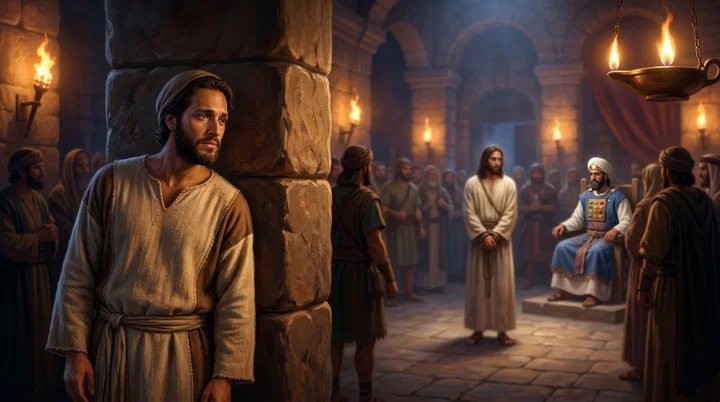
The demand for an answer was made during the hearing before Annas and the court of Caiaphas.DA 698 It came in the very early dark morning, when Jesus was hurried with insult and mockery through dark and narrow streets by torches and lanterns to the palace of Caiaphas the officiating high priest.5RED 27.1
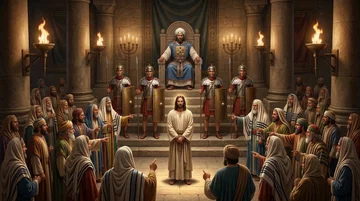
Caiaphas rose to hasten the trial because he felt a holy influence from Jesus pervading the place.3SP 115.3–116.2 The multitude involuntarily contrasted the excited and malignant bearing of Annas and Caiaphas with the calm, majestic bearing of Jesus, and wondered if a man of God-like presence should be sentenced as a common criminal.3SP 115.3–116.2 In rising he took his position on the throne of judgment, while Jesus stood at its foot, with the judges and those specially interested in the trial on either side and the Roman soldiers ranged on the platform below the throne.3SP 115.3–116.2 He arose in gorgeous robe with glittering tiara and costly breastplate upon which the light of God's glory had often flashed in former days, in strong contrast with the coarse habiliments of Jesus.3SP 115.3–116.2 There an earthly high priest in splendor tried for his life One who had reigned in the courts of heaven crowned and clothed in garments of brightness and attended by holy angels, now standing in coarse clothing at the foot of an earthly throne.3SP 115.3–116.2
The proceeding was a midnight secret trial kept under the appearance of legality.DA 698.1–700.55RED 33.1 It was carried on by perjury, mob seizure, mockery and abuse before accusation or condemnation, managed to unite the Sanhedrin against Him and to silence possible defenders, in violation of the law that no man be judged before he is heard and that every man be treated as innocent until proved guilty.DA 698.1–700.5 It was kept secret so the people would not learn of it and testify of His mighty works in His defense, lest such testimony turn public anger against the Sanhedrin, defeat its efforts, and secure His release and renewed honor among the people.5RED 33.1
The high priest demanded that Jesus answer the conflicting and false accusations of the witnesses.Ms 51, 1897, par. 10–115RED 35.3–36.2 He pressed especially the temple charge brought by the last two witnesses.5RED 39.1–2 He also sneeringly questioned Him and even challenged Him to perform a miracle.5RED 27.1ST Jun 13, 1878
The demand belonged to a fixed purpose to secure condemnation as a blasphemer before the Jews and as a seditionist before the Romans.DA 698.1–700.5 Under Roman rule the Sanhedrin could not execute a death sentence but could only examine and pass judgment for the Romans to ratify.DA 698.1–700.5 It followed the failure of the preliminary examination before Annas about His disciples and doctrines, which had tried to draw out proof of a secret society plotting a new kingdom in order to deliver Him to the Romans as a disturber of the peace.DA 698.1–700.5
The chief priests and elders, jealous of Jesus and afraid He would gain authority, had arranged for false witnesses so they could condemn Him and put Him to death.ST Feb 5, 1880 The scribes and Pharisees opposed Him with false statements and accusations to portray Him in the worst possible light before the people.Lt 50, 1889, par. 6–9 Their conduct was driven by a spirit unlike His, the spirit that stirs the unsanctified heart.Lt 50, 1889, par. 6–9
While enduring coarse accusation, sneering questioning, and reviling in this mockery of an examination, Jesus suffered a keener pang than His enemies could inflict.5RED 27.1 That pang came when He heard His beloved disciple deny Him with cursing and swearing.5RED 27.1
Silence and True Priesthood
Jesus stood calm, serene and silent before the high priest, patiently refusing to answer the false testimony brought against Him.Ms 51, 1897, par. 10–115RED 35.3–36.2ST Jun 13, 1878 His dignified bearing stood in sharp contrast to the high priest's haughty, sneering conduct.5RED 35.3–36.2ST Jun 13, 1878 He did not respond even to the sneering challenge to perform a miracle.ST Jun 13, 1878
He answered nothing to the conflicting accusations and to the temple charge pressed by the last two witnesses, because His condemnation was already decided and their evidence proved nothing worthy of death.Ms 51, 1897, par. 10–115RED 39.1–2 His calm silence left the priests and rulers disappointed and perplexed, fearing they would fail to gain their object after all, since they had gained nothing from the false witnesses on which to condemn Him.5RED 39.1–2 The high priest's angry demand that He answer revealed desperation over lies that had produced no charge that could condemn Him.Ms 51, 1897, par. 10–11 Their only hope now was to make Jesus speak out something that would condemn Him before the people.5RED 39.1–2
His silence as the oppressed and afflicted One who opens not His mouth fulfilled the prophecy of One brought as a lamb to the slaughter.5RED 39.1–2 That continued silence held until the high priest adjured Him by the living God to tell whether He is the Christ, the Son of God.Ms 111, 1897, par. 1–412MR 399.2–400.1 That adjuration was the Jewish form of placing a person on oath, made as an appeal by the first magistrate of the nation in a position higher than any in earthly courts.Ms 111, 1897, par. 1–412MR 399.2–400.1
The questioning high priest was corrupt and unworthy to occupy that office, hiding a hard, cruel heart under a cloak of religion.Ms 111, 1897, par. 1–412MR 399.2–400.1 He lorded over the people and made godliness a source of gain, never accepted by God as a typical high priest, with fitness for the priesthood extending only to the covering garment he wore.Ms 111, 1897, par. 1–412MR 399.2–400.1 He lacked the character that would enable God to connect with him, and belonged to a priesthood become corrupt, performing religious duties like actors in a theater, whom the people detested.Ms 111, 1897, par. 1–412MR 399.2–400.1
Christ fully knew that unworthiness and incapacity, yet He responded.Ms 111, 1897, par. 1–412MR 399.2–400.1 The true High Priest appointed to His office by God stood before the false priest to be criticized by him.Ms 111, 1897, par. 1–412MR 399.2–400.1 Concealing His divinity in a prepared body of flesh and garb of humanity, He refused to glorify Himself or display power to make His judges quail, humbling Himself, being found in fashion as a man, to be qualified to represent man in the heavenly courts.Ms 111, 1897, par. 1–412MR 399.2–400.1 He did not take even the nature of angels, but washed the disciples' feet and mourned over transgression.12MR 399.2–400.1
He did not rend His robe, but had His soul rent and His garment of human flesh rent on the cross as Sin-bearer, and by suffering and death opened a new and living way to enter upon His priestly office forever.12MR 399.2–400.1 By that way He entered the holy place as High Priest for the whole world, with no longer a wall of partition between Jew and Gentile.12MR 399.2–400.1 The enemies' effort through this unjust accusation to prevent Jesus from becoming king instead led to His becoming the Redeemer of mankind, but God's overruling of events did not lessen their guilt.ST Feb 5, 1880
Sources
Pioneers and periodicals
24 sources
The high priest stood up in Caiaphas's house before the united council and demanded why Jesus made no answer to the hired false witnesses brought to condemn Him on a charge about destroying the temple and building it in three days.ST Feb 5, 1880ST Mar 6, 1901ST Dec 1, 1898 The demand was a crafty pressure to force some statement that could be turned into a civil offense.ST Mar 6, 1901ST Dec 1, 1898 Jesus held His peace in calm and dignified meekness, refusing to revile His accusers or answer with divine power though He could have done so.ST Jun 13, 1878ST Dec 1, 1898 He answered truthfully only when put under oath before the living God, declaring Himself the Son of God and equal with God, upon which He was pronounced guilty of blasphemy in a mock trial meant to punish rather than fairly judge.RH Oct 27, 1874RH Nov 18, 1862ST Dec 1, 1898 In His silence He fulfilled the prophecy of the lamb brought to the slaughter who opens not His mouth, showing a meekness excelling even that of Moses.ST Oct 12, 1904
Trial Setting and Participants
The questioning takes place at a hearing in the house or palace of Caiaphas, before the Sanhedrin with chief priests, elders, scribes, priests, Sadducees and Pharisees present.ST Mar 6, 1901ST Mar 27, 1901 Jesus stands there alone as the accused after all the disciples forsook Him and fled, bound though the binding was utterly needless.ST Mar 14, 1906 He had first been taken to Annas the former high priest and father-in-law of Caiaphas, who then held the office.ST Mar 14, 1906 The jealous leaders set aside their differences and united every possible faction against Him, making a vindictive assembly.ST Mar 14, 1906ST Mar 27, 1901
The body before which His case was considered was the celebrated highest court of the Jewish nation for several centuries, by which He was condemned as a malefactor and a false prophet.RH Feb 16, 1911 It claimed to continue the large council of seventy-one over which Moses presided, with seventy prominent men from Israel endued with the Holy Spirit as counselors upon whom Moses relied, though no such council is mentioned after Moses' death.RH Feb 16, 1911 Its name comes from the Greek Sunedrion and has no Hebrew Bible equivalent, showing an origin after the Babylonian captivity, probably within a century or two after the return from Babylon.RH Feb 16, 1911 It served as supreme court for several hundred years before the destruction of Jerusalem by Titus, holding great authority while Christ was on earth, moving its seat of authority from place to place, and ceasing to exist in Tiberias in A.D. 425.RH Feb 16, 1911
The events belong to the day of Christ's crucifixion, on the way of the cross to Calvary, in the judgment hall where Christ is humiliated.RH Feb 13, 1872RH Aug 14, 1860 They belong to the account of His rejection and abuse, in which the hollow greeting of Hail, Master is followed by mockery and open violence against Him.RH Dec 29, 1863 The trial is not a mere incident of a day in the nation's life but an event of world-wide and ages-long import.ST Mar 6, 1901 It holds vitally important lessons in the name, the character, the mission, and the end of both Jesus and Caiaphas.ST Mar 6, 1901
Caiaphas sits as judge as head of the highest court of Jesus' own nation, with Jesus standing before him as an accused culprit, and pronounces Him guilty of blasphemy.ST Dec 24, 1912ST Mar 6, 1901 Caiaphas could condemn Jesus but had no power to enforce a death sentence.ST Dec 24, 1912 The sentence was later passed by Pilate, who nevertheless declared that he found no crime or fault in Jesus.ST Dec 24, 1912
Accusation and Questioning
The chief priests and elders were jealous of Jesus and afraid He would gain authority, and they had already determined to put Him to death.ST Feb 5, 1880ST Dec 1, 1898 To condemn Him they arranged hired false witnesses, needing two agreeing witnesses from His past life.ST Feb 5, 1880ST Dec 1, 1898 The hired testimony did not agree, and the accusations of the false witnesses were frivolous and could not ground condemnation.ST Dec 1, 1898ST Feb 20, 1901 The charge finally produced was that He said He was able to destroy the temple of God and build it in three days, that if the temple were pulled down He could build it up in three days, with others agreeing something of that sort had been said, yet it was not enough to condemn Him.ST Mar 6, 1901ST Dec 1, 1898
The high priest arose and stood up to press Jesus, demanding why He answered nothing to what the witnesses testified against Him.ST Mar 6, 1901ST Dec 1, 1898 The demand was a crafty attempt to make Jesus commit Himself to some statement that could be labeled a civil offense.ST Dec 1, 1898
Jesus held His peace, remaining completely silent, calm and meek up to that moment.ST Jun 13, 1878ST Dec 1, 1898 He did not respond to the sneering challenge to perform a miracle.ST Jun 13, 1878 He displayed the dignified silence of conscious innocence, and though He could have summoned angels or answered with divine power, He did not revile His enemies. His silence did not make the accusation true.ST Dec 6, 1883
He only answered truthfully when put under oath before the living God and asked directly whether He claimed to be the Son of the Most High.ST Dec 1, 1898 He then declared Himself the Son of God, thereby making Himself equal with God and asserting His divinity.ST Dec 1, 1898ST Feb 20, 1901 The priest then declared no further evidence of guilt was necessary, and the case was taken to the Roman tribunal to have the judgment confirmed.ST Dec 1, 1898 There He was condemned as a malefactor and false prophet for blasphemy, not for Sabbath-breaking.ST Dec 1, 1898ST Dec 6, 1883 The whole proceeding was a mock, unjust trial convened to punish rather than fairly judge or test His claims, and a fair application of the law would have acquitted Him as the promised Messiah whose words were true.RH Oct 27, 1874RH Nov 18, 1862ST Dec 7, 1904
Meaning Doctrine and Application
When false witnesses testified and the high priest demanded an answer, Jesus opened not His mouth, showing a flawless meekness excelling even the meekness of Moses and literally fulfilling the prophecy that He was oppressed and afflicted as a lamb brought to the slaughter and as a sheep dumb before her shearers.ST Oct 12, 1904 Though even the governor who passed sentence of death upon Him could find no fault in Him, His meekness brought Him no inheritance of the earth during His earthly pilgrimage.ST Oct 12, 1904 Bearing false witness here means not only outright lying but stating facts in a way that insinuates conspiracy and guilt contrary to the truth, as Doeg did against Ahimelech, and it stands as a violation of the command not to bear false witness.RH Jun 23, 1868
Jesus is the promised Messiah whose words are true, and a fair application of the law would have acquitted Him.RH Oct 27, 1874 The council's failure lay in wrongful interpretation and use of the law, for it did not search Scripture or test His fulfillment of prophecy and the Scriptures to which He appealed, but rejected Him because He had not come as the leaders expected, though reexamination could have convinced them.RH Oct 27, 1874RH Oct 27, 1874 The trial had been convened to punish rather than fairly judge His claims, with chief priests and elders jealous of Him and afraid He would gain authority arranging hired false witnesses to condemn Him and put Him to death, and the high priest's demand for an answer came in pursuit of that unjust accusation.ST Feb 5, 1880RH Oct 27, 1874 The accusations of the false witnesses were frivolous and could not ground condemnation, and His final condemnation came not from their testimony but for declaring Himself to be the Son of God, thereby making Himself equal with God and asserting His divinity, which is the very foundation of hope.ST Feb 20, 1901 Their effort to prevent Him from becoming king instead led to His becoming the Redeemer of mankind, but God's overruling of events does not lessen their guilt.ST Feb 5, 1880
Followers must not deny the Master or follow afar off in the judgment hall where Christ is humiliated, but follow with Him and keep close under all circumstances, in humiliation as in glory, in the judgment hall and toiling up Calvary as on the Mount of Transfiguration and in the triumphal entry.ST Mar 14, 1906 Christian perfection does not consist in uninterrupted transports of praise and ceaseless raptures of joy, in ecstasies and extraordinary revelations and constant joy, or in building a tabernacle upon Mount Tabor to enjoy rare sights there, but in resolutely taking up the cross and following Christ to the palace of Caiaphas, to the judgment hall of Pilate, and to the top of Calvary through unjust judgment and suffering.ST Mar 14, 1906RH Aug 14, 1860RH Jul 30, 1867 The scene warns against condemning people for reading Scripture differently without testing their teaching by Scripture itself, since the charges and judgment arise from wrongful interpretation.RH Oct 27, 1874 Its setting with priests using false witnesses connects it with priests trying to use false witnesses against Sabbath keepers by accusing them of teaching disobedience to the government.RH Jul 23, 1914
Sources