Luke 4:17
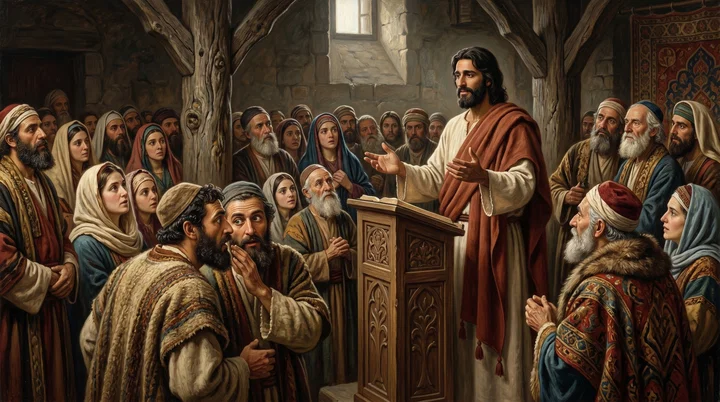
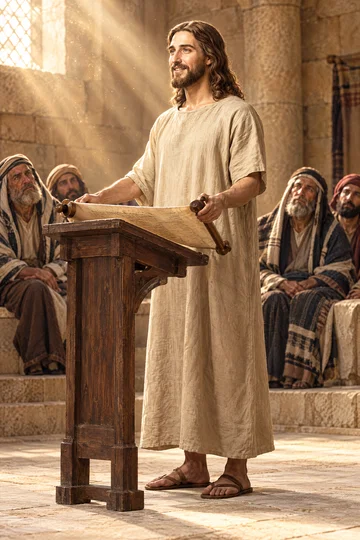
And there was delivered unto him the book of the prophet Esaias. And when he had opened the book, he found the place where it was written,
Translations
American King James Version, Webster Bible
And there was delivered to him the book of the prophet Isaiah. And when he had opened the book, he found the place where it was written,
King James Version, KJV Cambridge Paragraph Bible
And there was delivered unto him the book of the prophet Esaias. And when he had opened the book, he found the place where it was written,
Revised Version, American Standard Version
And there was delivered unto him the book of the prophet Isaiah. And he opened the book, and found the place where it was written,
and there was given over to him a roll of Isaiah the prophet, and having unfolded the roll, he found the place where it hath been written:
And [ the] book of the prophet Esaias was given to him; and having unrolled the book he found the place where it was written,
And there was handed to him a scroll of the prophet Isaiah; and unfolding the scroll, he found the place where it was written:
the scroll of the prophet Isaiah was handed to Him. Unrolling it, He found the place where it was written:
the scroll of Isaiah the prophet was handed to Him. Unrolling it, He found the place where it was written:
The book of the prophet Isaiah was handed to him. He opened the book, and found the place where it was written,
And the book of the prophet Isaiah was given to him and, opening the book, he came on the place where it is said,
And there was deliuered vnto him the booke of the Prophet Esaias: and when hee had opened the booke, hee founde the place, where it was written,
Douay-Rheims (Challoner revision)
And the book of Isaias the prophet was delivered unto him. And as he unfolded the book, he found the place where it was written:
Pictures
Cross-references
- Isaiah 61:1-2
The Spirit of the Lord GOD is upon me; because the LORD hath anointed me to preach good tidings unto the meek; he hath sent me to bind up the brokenhearted, to proclaim liberty to the captives, and the opening of the prison to them that are bound;
Jesus declares Isaiah’s prophecy of the Anointed One’s mission fulfilled.
- Luke 4:21
And he began to say unto them, This day is this scripture fulfilled in your ears.
Jesus declares the Scripture he read fulfilled that day.
- Luke 4:22
And all bare him witness, and wondered at the gracious words which proceeded out of his mouth. And they said, Is not this Joseph’s son?
The hearers marvel at Jesus’ gracious words, then question his identity.
- Isaiah 40:3
The voice of him that crieth in the wilderness, Prepare ye the way of the LORD, make straight in the desert a highway for our God.
John the Baptist fulfills Isaiah’s prophecy, preparing the way for Jesus.
- Luke 4:28-30
And all they in the synagogue, when they heard these things, were filled with wrath,
The synagogue reading ends in the crowd’s wrathful rejection of Jesus.
- Luke 24:27
And beginning at Moses and all the prophets, he expounded unto them in all the scriptures the things concerning himself.
Both passages show Christ explaining Scriptures about himself.
- Hebrews 10:7
Then said I, Lo, I come ( in the volume of the book it is written of me,) to do thy will, O God.
Both texts present Scripture as speaking of Christ.
- Matthew 11:5
The blind receive their sight, and the lame walk, the lepers are cleansed, and the deaf hear, the dead are raised up, and the poor have the gospel preached to them.
Both present preaching to the poor as Christ’s work.
- John 5:39
Search the scriptures; for in them ye think ye have eternal life: and they are they which testify of me.
Jesus says the Scriptures testify of him.
- Matthew 3:3
For this is he that was spoken of by the prophet Esaias, saying, The voice of one crying in the wilderness, Prepare ye the way of the Lord, make his paths straight.
Isaiah’s prophecy is fulfilled in John’s work.
Commentary
Each commentary is drawn from primary sources: the writings of Ellen G. White and Adventist pioneers and periodicals. Each commentary is separate. Its own words are not a quotation; follow the references to read the source passages.
Ellen G. White
56 sources
On the Sabbath at Nazareth where he had been brought up he stood up to read, the book of Isaiah was handed to him, and he unrolled it to find the appointed place.LC1 53.2–54.1Ms 31a, 1898, par. 28–29Ms 12b, 1896, par. 5–7 He deliberately chose a passage understood to speak of the Messiah in order to set forth his own work, and explained it with such clarity that his hearers marveled.DA 236.1–2ST Jun 23, 1909Ms 133, 1902, par. 1–10 The work he found there was his Spirit-anointed mission to preach the gospel to the poor, heal the brokenhearted, proclaim deliverance to captives, give sight to the blind, set the bruised free, and announce the acceptable year of the Lord.RH Jul 2, 1908Ms 3, 1897, par. 28Ms 31a, 1898, par. 28–29 He declared that scripture fulfilled that very day in their hearing, presenting himself as the Anointed One sent to bring salvation and freedom.1RED 53.2–57.1Ms 12b, 1896, par. 5–7ST Feb 17, 1881 That same announcement defines the compassionate restoring work his followers continue, and its rejection at Nazareth warns that unbelief and prejudice shut the heart against plain truth and against him.Ms 105, 1898, par. 15–17Ms 125, 1897, par. 1–2Lt 51a, 1895, par. 5–8Ms 7, 1884, par. 1–2Ms 52, 1896, par. 71–73
Synagogue Reading Described
At Nazareth where he had been brought up, on the Sabbath day as his custom was, he stood up to read in the synagogue, and the book of the prophet Isaiah was delivered to him, and when he had opened it he found the place where it was written.LC1 53.2–54.1Ms 31a, 1898, par. 28–29Ms 12b, 1896, par. 5–7Ms 39, 1889, par. 2Ms 55, 1901, par. 18–20 That finding was in his hometown synagogue on the Sabbath after being asked to take part in the service, when the scroll was handed to him and he opened to the prophecy of the Spirit-anointed preaching to the poor, healing the brokenhearted, deliverance to captives, sight to the blind, liberty to the bruised, and the acceptable year of the Lord.Ms 31a, 1898, par. 28–29Ms 12b, 1896, par. 5–7Ms 39, 1889, par. 2Ms 55, 1901, par. 18–20Lt 51a, 1895, par. 5–8 His careful opening of the book introduced the words describing that mission of good news and healing and deliverance.Ms 55, 1901, par. 18–20Lt 51a, 1895, par. 5–8
The reading took place in the regular Sabbath synagogue service, in which an elder ordinarily read from the prophets, any Israelite might give the reading, and a visiting rabbi present was expected to preach, and he took part at request.DA 236.1–2ST Jun 23, 1909Ms 39, 1889, par. 2 He stood up to read and was handed the roll of Isaiah in that order of service.DA 236.1–2ST Jun 23, 1909 The scripture he found was understood as referring to the Messiah, and he deliberately chose it to present his work.DA 236.1–2ST Jun 23, 1909DA 236.3–4 He explained it with such clarity and reason that the people were amazed, especially because they knew he had never attended school.Ms 133, 1902, par. 1–10 That careful use of Scripture introduced his teaching of the people and proclaiming of the kingdom of heaven.Ms 55, 1901, par. 18–2013MR 213.1–2 His patient seeking of opportunities for personal ministry to draw people to study the Scriptures provides the model, working patiently with those who lacked understanding of truth.Ms 21, 1910, par. 7
Mission Christ Announced
The place he found announces his Spirit-anointed life-work to preach the gospel to the poor, heal the brokenhearted, preach deliverance to the captives, bring recovering of sight to the blind, set at liberty the bruised and oppressed, and preach the acceptable year of the Lord.RH Jul 2, 1908Ms 3, 1897, par. 28Ms 31a, 1898, par. 28–29Ms 105, 1898, par. 15–17Ms 125, 1897, par. 1–2 That word stood at the beginning of his ministry as the declaration of the character of his work for the world.RH Jul 2, 1908Ms 3, 1897, par. 28 That text is a wonderful description of his work and defines the same work of reaching the common people.Ms 31a, 1898, par. 28–29Ms 125, 1897, par. 1–2Ms 65b, 1898, par. 1–2
That work means giving encouragement, comfort and help where it is most needed.Ms 31a, 1898, par. 28–29Ms 65b, 1898, par. 1–2 It is directed to the poor, the meek, the friendless, the suffering and the hopeless, to those whom the Pharisees and Sadducees and the learned and rich despised and neglected as though riches, learning, wealth and knowledge made men of more value.Ms 31a, 1898, par. 28–29Ms 65b, 1898, par. 1–2Ms 191, 1897, par. 10–11ST Jul 8, 1889 The learned and rich counted them of less value because of lack of wealth, learning and riches, yet to them he brings good news, healing, freedom and the proclamation of the Lord's favor.Ms 65b, 1898, par. 1–2Ms 191, 1897, par. 10–11ST Jul 8, 1889
It means rescuing those bowed down by Satan's power and setting them free from his yoke of bondage.Ms 191, 1897, par. 10–11ST Sep 15, 1909 It means breaking the spell of infatuation Satan has wrought on the human mind and bringing eternity into view.ST Sep 15, 1909 He does this as the great Physician with infinite wisdom for diseases of body and soul, able and longing to deliver everyone bound in soul and body by evil practice and long-indulged master passion, doing his utmost to set free captives held by weakness, so that bodily healing belongs within the sphere of his labor and he is Saviour of body as well as soul.Ms 191, 1897, par. 10–119MR 129.5–131.1
He came not as a temporal prince to break Roman rule and establish an earthly kingdom and rule with armies.1RED 53.2–57.1ST Jul 8, 1889 The people expected a Messiah ruling from an earthly throne to defeat Israel's enemies, but in humility he came to do the work Israel had left undone and to bring relief, healing, liberation and the light of truth.1RED 53.2–57.1ST Jul 8, 1889ST Feb 17, 1881 That mission is a life of self-denial and self-sacrifice, bringing the good news of salvation and freedom rather than earthly dominion.1RED 53.2–57.1Ms 28, 1897, par. 43–45
He himself had first presented this mission to Isaiah, then came into the world as its fulfillment.Ms 28, 1897, par. 43–45Lt 106, 1898, par. 14–21 As the Anointed One he came to comfort, bless and save the sorrowing and sinful, to restore and uplift people and bring peace and happiness.SLP 229.1–230.2AA 416.2–417.1Ms 136, 1899, par. 17–18 He came to represent the Father, showing divine power by raising the dead and restoring the sick and suffering to health, in the world as the tree of life.Ms 136, 1899, par. 17–18 His work is not consolation only, for he also restores people and reproves them, comforting all that mourn and giving beauty for ashes, the oil of joy for mourning and the garment of praise for heaviness, to bind up the brokenhearted and proclaim liberty to the captives and opening of the prison to the bound.Lt 81, 1896, par. 2–3Lt 106, 1898, par. 14–21
His discourse at Nazareth was part of work confined for a time to a small circumference among the Jewish nation.ST Dec 16, 1897Ms 50, 1897, par. 1 The heathen nations were not prepared for his work, and devoting his time to labor for the conversion of the Gentile world would have closed the door by which he could bear his message to Israel.ST Dec 16, 1897Ms 50, 1897, par. 1
Fulfillment Declared and Proved
He declared the scripture fulfilled that day in the hearing of his listeners, identifying himself as the Messiah and the Anointed One sent to bring good news of salvation and freedom.1RED 53.2–57.1Ms 12b, 1896, par. 5–7ST Feb 17, 18814RED 3.2–4.2ST Feb 17, 1881 He took the book of Isaiah in the Nazareth synagogue and found the prophecy of the Messiah's work, then announced that it was fulfilled in him, not as the earthly king ruling with armies whom the people expected but as the one sent to relieve, heal, liberate and reveal the light of truth.1RED 53.2–57.1Ms 12b, 1896, par. 5–7ST Feb 17, 18814RED 3.2–4.2ST Feb 17, 1881 He explained the prophets' words about himself plainly and meekly, and with perfect knowledge of the Jewish economy as represented in the Scriptures, though he had not received instruction from the religious teachers of the nation.ST Dec 16, 1897
That word was fulfilled in his ministry, for the sick were healed, demoniacs restored, lepers and paralytics made whole, the dumb spoke, the ears of the deaf were opened, the dead were brought to life, and the poor had the gospel preached to them.RH Jul 2, 1908 He also fed the hungry and comforted the sorrowful, cast out devils who confessed him the Son of God, walked upon the waves and by a word stilled them and silenced their roaring, and held thousands entranced by wisdom and by words of wisdom.RH Jul 2, 19082SP 370.3DA 541.2–3 Every miracle convinced some of his true character, and the same works done by a man in the common walks of life would have been declared as done by the power of God, yet those who did not receive the light of heaven set themselves more determinedly against this evidence.RH Jul 2, 1908
Rejection at Nazareth
At first His words were gracious and carried the divine influence of the Spirit, laying an overpowering conviction upon all that He was all the text claimed.Ms 7, 1884, par. 1–212MR 182.2–183.2Lt 33a, 1888, par. 3–4Lt 33, 1888, par. 19–24Ms 24, 1888, par. 11–15 The hearers were touched, wondered, witnessed to His words with hearty response, and recognized the gracious words He spoke.Ms 7, 1884, par. 1–212MR 182.2–183.2Lt 49, 1899, par. 6–10Lt 33a, 1888, par. 3–4Lt 33, 1888, par. 19–24 That conviction was soon lost when admiration turned to questioning Him as Joseph's son and demanding miracles such as had been done in Capernaum.Lt 51a, 1895, par. 5–8 Familiarity with His family from childhood fed the resistance, making them reluctant to recognize the remarkable character and calling of One known from childhood, and their unbelief stumbled that He showed perfect knowledge of the Jewish economy as represented in the Scriptures without having received instruction from the religious teachers.ST Dec 16, 1897Ms 4, 1890, par. 13–162SP 151.1
His answer was that no prophet is accepted in his own country.Lt 51a, 1895, par. 5–8 He proved it by the many widows in Israel in the three years and six months of famine when Elijah was sent to none but the widow of Sarepta in Sidon, and by the many lepers in Israel when Elisha cleansed none but Naaman the Syrian.Lt 51a, 1895, par. 5–8 This showed that God's favor was not limited to them but included the Gentiles.SLP 229.1–230.2RH Sep 25, 1900 It warned that unbelief and rebellion can lead God to turn from His professed people, while those outside who respond faithfully to heaven's light may be accepted as more righteous.SLP 229.1–230.2AA 416.2–417.1
The synagogue was filled with wrath.Lt 51a, 1895, par. 5–8 The mob drove Him out of the synagogue and thrust Him out of the city to the brow of the hill to cast Him down headlong and throw Him from a precipice, pushing Him hither and thither while quarreling how to stop His voice entirely.Lt 51a, 1895, par. 5–8ST Dec 16, 1897 But divine power and angels guarded Him, so that He passing through their midst went His way and vanished they knew not whither.Lt 51a, 1895, par. 5–8ST Dec 16, 1897Lt 49, 1899, par. 6–10Lt 33a, 1888, par. 3–4Lt 33, 1888, par. 19–24 Being received unfavorably He left to preach where people would listen and receive His message.ST Feb 3, 18813RED 14.2–15.12SP 151.1
The rejection happened because hearts blinded by prejudice, pride, insane hatred and willful blindness closed eyes that would not see and ears that would not hear.Lt 51a, 1895, par. 5–82SP 370.31RED 57.2Ms 15, 1888, par. 38–40 Their understanding was darkened against manifestations of the Spirit of God under the infatuation of the ruler of darkness.Lt 51a, 1895, par. 5–8 They could not endure the plain truth that exposed their spiritual condition and challenged their ideas, for truth did not languish on His tongue.Ms 7, 1884, par. 1–2ST Dec 16, 1897Lt 33a, 1888, par. 3–4 They resolutely rejected the light despite the opportunity to receive blessing, even though He healed the sick, restored sight to the blind, hearing to the deaf and speech to the dumb, fed the hungry, comforted the sorrowful, walked upon the waves and stilled them by a word, cast out devils, raised the dead, and held thousands entranced by wisdom.2SP 370.31RED 57.2
The path of unbelief at Nazareth warns that it is dangerous to call the work of the Spirit of God the work of Satan.Lt 51a, 1895, par. 5–8 Admitting doubt can drive away the Spirit of God and open the heart to Satan's influence, putting men in the enemy's power by yielding to temptation.Ms 7, 1884, par. 1–2Lt 33a, 1888, par. 3–4 Rejecting the message sent through Him is rejecting Him.Lt 4, 1889, par. 29 The same is acted over and over today when He comes not in person but by His Word and in the person of His servants and is rejected because of the plainness of the truth, so all must take one of two positions, either for or against Him.Ms 7, 1884, par. 1–2
That present rejection after God stirs hearts is repeated with just as much danger and with less excuse, when the Lord speaks through His delegated messengers and men close their hearts in unbelief, prejudice and pride while supposing they preserve dignity and freedom, holding themselves in bondage to Satan.11MR 283.3–284.2 Those who in controversy have taken the course of the men of Nazareth are given a second opportunity to accept the gracious light of truth, and after the first rejection may again be called upon by the divine Messenger.11MR 283.3–284.2 To harden the heart then is final rejection of the message that would work salvation, which is rejection of Him in the person of His messengers.11MR 283.3–284.2 Teachers are thereby taught to study and understand God's Word, because neglecting lessons of eternal importance leaves them unfit to teach others.Ms 12b, 1896, par. 9
Pattern for Followers
The handing of the scroll and finding of the place was an announcement of life-work that defines the work of full followers as co-laborers with him in restoring the moral image of God in man.Ms 105, 1898, par. 15–17Ms 125, 1897, par. 1–2 It remains their work to reach the common people as he reached them, laboring with him in compassionate service to people in need.Ms 125, 1897, par. 1–2Ms 52, 1896, par. 71–73Lt 4, 1894, par. 4–5 That character of work is to preach good tidings to the meek and poor, bind up the brokenhearted, proclaim liberty to the captives and the opening of the prison to those who are bound, break the yoke of oppression, and relieve human woe.ST Sep 15, 1909ST Jul 8, 1889Lt 4, 1894, par. 4–5 It is to be done with tender pity toward the infirmities, necessities, troubles and perplexities of the people for whom he died, rescuing those bowed down by Satan's power and yoke of bondage, breaking the spell of infatuation wrought on the human mind and bringing eternity into view.ST Sep 15, 1909Lt 4, 1894, par. 4–5 His words and work there were simple and clear, and his example shows how his followers are to do their work, in humility doing the work left undone.ST Jul 8, 1889
His work there is the example of how every other person on earth should work.Ms 19, 1899, par. 18–19Lt 114, 1895, par. 7–10 The act reveals tender humanity toward people and a life of seeking first the kingdom of God and his righteousness in oneness with the Father, fulfilling the law by continual obedience.Ms 19, 1899, par. 18–19 His lesson to his disciples is in perfect harmony with this announcement, and his followers are commanded to follow his example in his strength so they may stand perfect before God's throne.Ms 19, 1899, par. 18–19
His announcement of the gospel to the poor rebukes making color or caste a basis for exclusion.STBk 159.1 Salvation in him is for people of every race, and those who slight a person because of color also slight him.STBk 159.1
Because he so claimed this work as his own, sufferers are encouraged to hope largely, come in faith, take him at his word and receive abundantly of his rich grace.Lt 106, 1898, par. 14–21 They are to trust the great Physician to restore health, for he is abundantly able and glad to respond to the faith of believers.Lt 106, 1898, par. 14–21
Sources
Pioneers and periodicals
83 sources
On the Sabbath in Nazareth where He had been brought up, Jesus stood up in the synagogue as His custom was and was handed the separate roll of Isaiah to give the reading from the prophets.ST Jun 23, 1909ST Feb 12, 1894ST Mar 22, 1899ST Sep 24, 1894ST Mar 22, 1899 When He had opened the book He at once found the prophecy of the Spirit-anointed One sent to preach good tidings to the poor, heal the brokenhearted, proclaim deliverance to captives, give sight to the blind, set the bruised free, and preach the acceptable year of the Lord, identified as Isaiah 61:1-2.ST Sep 24, 1894ST Mar 22, 1899ST Aug 12, 1897ST Jan 9, 1896ST Dec 3, 1896 He then declared that scripture fulfilled that day in their hearing, identifying Himself as the promised Messiah anointed by the Holy Spirit and beginning His public Spirit-anointed ministry.ST Feb 12, 1894ST Sep 24, 1894RH Sep 9, 1902RH Jan 11, 1870ST Jan 9, 1879 He stopped in the middle of the sentence after the acceptable year and left unread the day of vengeance, showing the first portion applies to His first advent in the day of grace while judgment is left for an appointed later time before His second coming.ST Sep 16, 1886ST Jan 13, 1887ST Jul 30, 1902RH Nov 24, 1874RH Feb 23, 1860 His reading defines His work as compassionate healing, freedom from the prison of sin and Satan, rest, and practical care rather than earthly rule, a mission His followers are enlisted to share, yet at Nazareth it met unbelief and violent rejection even to thrusting Him toward the brow of the hill.ST Sep 15, 1909ST Nov 20, 1884RH Dec 28, 1911ST Dec 17, 1894
Nazareth Sabbath Reading
Jesus came to Nazareth where he had been brought up, went into the synagogue on the Sabbath day as his custom was, stood up to read, and had the book of the prophet Isaiah handed to him.ST Feb 12, 1894ST Mar 22, 1899ST Sep 24, 1894ST Jan 9, 1896RH Jan 10, 1856 He opened the book and found the place where it was written, the passage about his mission which he then read and declared fulfilled in the hearing of those present.ST Feb 12, 1894ST Mar 22, 1899ST Sep 24, 1894ST Jan 9, 1896RH Jan 10, 1856 The passage he found foretold his Spirit-anointed work of bringing good news to the poor, release to captives, sight to the blind, liberty to the oppressed, and proclamation of the Lord's acceptable year.ST Mar 22, 1899ST Sep 24, 1894ST Jan 9, 1896
He took part in the regular service at request, since any Israelite might give the reading from the prophets and a rabbi present was expected to preach.ST Jun 23, 1909 When he came to Nazareth he was asked to read in the synagogue service, and the book delivered to him for that reading was the separate roll of Isaiah.ST Jun 23, 1909ST Mar 22, 1899ST Aug 23, 1910 Afterward he closed the book, gave it back to the minister, and sat down while all eyes were fastened on him.ST Jan 9, 1896
The scene follows his anointing by the Holy Spirit at baptism when about thirty years old and his forty-day fast and wilderness temptations.GSAM 61.4–62.1RH Mar 1851ST Jan 9, 1896 It follows his journey through Galilee and several months preaching in Judea, including the first Passover at Jerusalem and the journey north through Samaria.ST Mar 12, 1896ST Jan 9, 1896 It stands at the start of his early Galilean ministry, after his baptism, anointing, and temptation in the wilderness, when he also taught on the Sabbath at Capernaum.GSAM 61.4–62.1RH Jan 10, 1856RH Mar 1851ST Jan 9, 1896
He had lived in Nazareth from childhood to age thirty and had long taken a leading part in the synagogue services, so his standing up to read caused no surprise. His asking for the separate roll of Isaiah and finding the place he wanted to read showed familiar acquaintance with the Scriptures. Yet familiarity made the people slow to believe that he was called to an exalted position and a great work, as he began the work that led to his rejection by people who had long known him.ST Mar 16, 1904 That rejection illustrates reluctance to recognize the admirable qualities of someone known since childhood while becoming excited about a stranger or adventurer.ST Feb 1, 1905
Isaiah Passage Found
When he had opened the book he found the place where it was written, and that place was Isaiah 61:1-2, sometimes reckoned as 61:1-3.ST Sep 24, 1894ST Aug 12, 1897ST Jul 30, 1902 It was understood as referring to the Messiah, setting out beforehand the nature of the Messiah's work and outlining his life-work and connection with heaven.ST Dec 3, 1896ST Jan 7, 1897RH Apr 8, 1909 It is an instance of referring to prophecies about himself and his mission, placing his public ministry within prophetic Scriptures that bore witness to him and foretold what would happen to him.ST Aug 27, 1885RH Apr 8, 1909 His opening it and finding the written prophecy marked the beginning of his public reading of that prophecy, which he read aloud and declared fulfilled in the hearing of those present.ST Sep 24, 1894ST Aug 12, 1897RH Apr 8, 1909
The passage he found announces that the Spirit of the Lord is upon the Anointed because he is anointed to preach the gospel and good tidings to the poor and meek.ST Apr 16, 1894ST Mar 22, 1899ST Jan 9, 1896RH Nov 11, 1915 It commissions him to heal the brokenhearted and bind them up, to preach deliverance and opening of the prison to the captives and bound, to give recovering of sight to the blind, and to set at liberty the bruised and oppressed.ST Apr 16, 1894ST Mar 22, 1899ST Jan 9, 1896ST Mar 6, 1907 It commissions him also to preach the acceptable year of the Lord, the acceptable time when mercy is offered.ST Mar 22, 1899ST Jan 13, 1887ST Jul 30, 1902 That reading introduces his Spirit-anointed and Spirit-empowered work of bringing good news, healing, and deliverance from sin and Satan's bondage, a prophecy written about seven hundred years earlier and now being fulfilled as his hearers listened at the start of his ministry.ST Apr 16, 1894ST Mar 22, 1899RH Nov 11, 1915ST Dec 3, 1896 When he says this scripture is fulfilled, it means its message of good news and hope is being brought to the poor, brokenhearted, captive, blind, and oppressed, not abolished or taken away.ST Oct 23, 1893
His choice of passage and stopping point show that Scripture should be rightly divided and applied according to what is then relevant.ST Sep 16, 1886 He read Isaiah 61:1-2 only through the promise to proclaim the Lord's acceptable year, then stopped in the middle of a sentence and left unfinished the part about the day of God's vengeance.ST Jul 30, 1902ST Mar 19, 1885 He stopped because that time had not come and the vengeance was not yet due, because its remaining words concerned a different subject, and because it was not the burden of his preaching but belonged to the lesson he intended to teach on that occasion.ST Sep 16, 1886ST Mar 19, 1885ST Sep 27, 1910 The first portion through the acceptable year applies to him and his work in the day of grace when the gospel offers mercy, while the following words about the day of God's vengeance, identified with the judgment, were not then declared fulfilled but await fulfillment just before his second coming.ST Jan 13, 1887ST Jul 30, 1902 Different parts of a prophecy can therefore apply at different times, and Scripture must be compared with Scripture to determine when each part applies.ST Sep 27, 1910
His finding the passage at once showed perfect knowledge of the Jewish economy as represented in the Scriptures and how to interpret them.ST Dec 16, 1897 It manifested familiar acquaintance with the Scriptures, for he asked for the separate roll of Isaiah and found the place he wanted to read. His standing up to read caused no surprise because he had lived in Nazareth from childhood to age thirty and had long taken a leading part in the synagogue services. Yet he spoke plain truth without having received instruction from the religious teachers of the nation, which displeased hearers stirred by strong Jewish prejudice.ST Dec 16, 1897
Mission Declared Fulfilled
He opened the scroll to the prophecy of the Spirit-anointed ministry and at once announced that it was fulfilled that day in the hearing of those present.ST Feb 12, 1894ST Sep 24, 1894RH Sep 9, 1902RH Apr 17, 1855RH Mar 17, 1859 That public reading was the beginning of his public reading of that prophecy, the announcement of the Spirit of the Lord upon the Anointed to preach good news to the poor, heal the brokenhearted, proclaim release to captives, restore sight to the blind, free the oppressed, and announce the acceptable year of the Lord.ST Sep 24, 1894RH Sep 9, 1902RH Apr 17, 1855RH Aug 11, 1853RH Mar 17, 1859 His preaching of the gospel in that reading was a sign of his first advent proving him to be the true Messiah.RH Apr 17, 1855RH Aug 11, 1853RH Mar 17, 1859
That word was fulfilled in his ministry at the beginning of his work.RH Jul 2, 1908 The sick were healed, demoniacs restored, lepers and paralytics made whole, the dumb spoke, the ears of the deaf were opened, the dead were brought to life, and the poor had the gospel preached to them.RH Jul 2, 1908 Every miracle convinced some of his true character, and the same works done by a man in the common walks of life would have been declared as done by the power of God, yet those who did not receive the light of heaven set themselves more determinedly against the evidence.RH Jul 2, 1908
The captives and the bound are all sinners, who have transgressed the law of God and are in the prison and cruel bondage of sin, since only those who seek his precepts walk at liberty and all others are servants of corruption.ST Nov 20, 1884 His work by the Spirit was to press the claims of the law home to the heart and bring sinners to repentance and faith in him, where they find true liberty, a liberty that continues only in obedience to the law as the Spirit abides with them.ST Nov 20, 1884 The same Spirit-work was done through Noah preaching to the wicked antediluvians to lead them to repent and find liberty.ST Nov 20, 1884 His name Jesus signifies Saviour and his work is salvation from sin, which is the transgression of the law.RH Feb 14, 1854 That mission means rescuing those bowed down by Satan's power and setting them free from his yoke of bondage, breaking the spell of infatuation Satan has wrought on the human mind and bringing eternity into view.ST Sep 15, 1909
His announced work was broad, going beyond preaching to bring healing, freedom, comfort, joy, and practical care to people in need.RH Dec 28, 1911 His chosen vocation was that of a missionary and physician, a healing evangelist, and his life and ways of doing that blended work give the pattern for all who make his calling their own, joining healing of disease and care for physical needs with preaching the gospel. His Sabbath reading introduced his ministry of compassionate service and deliverance.RH Oct 2, 1900 His work was to restore and uplift people and bring peace and happiness, and the same work defines the character of the work his followers must do.ST Sep 15, 1909RH Dec 28, 1911
The commission applies to opposition to slavery and oppression, presenting the acceptable year of the Lord as the Jubilee and his kingdom as grounded in liberty and human brotherhood.RH Oct 8, 1861 When he says the scripture is fulfilled it means its message of good news and hope for the poor, brokenhearted, captive, blind, and oppressed is being brought to them, not abolished or taken away.ST Oct 23, 1893 Fulfillment does not mean that the message has ceased or that the gospel has been taken away.ST Oct 23, 1893
The reading identifies him as the Deliverer sent to heal the brokenhearted.ST Jun 4, 1894 His healing brings rest that lasts through this life and continues forever.ST Jun 4, 1894 The people expected a Messiah who would rule from an earthly throne and defeat Israel's enemies, but the passage he found described a mission of bringing good news to the poor, healing, and deliverance.ST Feb 17, 1881
The passage proclaims his mission of mercy and love to the people of Nazareth and also to readers now.ST Mar 12, 1896 The power that was in his spoken word then has never left that word through the centuries, so the same message comes with the same power today and is to be read, believed, and personally appropriated.ST Mar 12, 1896 Its fulfillment marked his presence among people and the preaching of the gospel in a new setting, beginning a movement whose hearers took up the work.RH Nov 11, 1915 Some left their former occupations, while others devoted their resources to it, and opposition did not turn them aside.RH Nov 11, 1915
Prophetic Timing Divided
The prophecy he opened had been written about seven hundred years before and waited for fulfillment in John the Baptist and Jesus, setting out beforehand the nature of the Messiah's work.RH Nov 11, 1915ST Oct 29, 1902ST Jan 7, 1897 His public ministry stands within prophetic Scriptures of one common intent to bear witness to Jesus and to foretell what would happen to him.ST Feb 15, 1883RH Apr 8, 1909 The passage he found declared his connection with heaven and outlined his life-work, and by reading it aloud and declaring it fulfilled in the hearing of his listeners he took his place within that foretold work.RH Nov 11, 1915RH Apr 8, 1909
His reading and declaration that the scripture was fulfilled that day in their ears identified him as the promised Messiah.RH Jan 11, 1870ST Jan 9, 1879ST Jan 8, 1880RH Mar 17, 1859 The announcement that the Spirit of the Lord was upon him because he was anointed to preach the gospel and good tidings made the preaching of the gospel a sign of his first advent proving Jesus to be the true Messiah.RH Jan 11, 1870ST Jan 9, 1879ST Jan 8, 1880RH Apr 17, 1855RH Aug 11, 1853 With all eyes fastened on him in the synagogue he declared that fulfillment present among his hearers.RH Apr 17, 1855RH Aug 11, 1853
His anointing by the Holy Spirit at baptism and his beginning to preach mark him as the Messiah, fulfilling the sixty-nine weeks in the fall of A.D. 27.RH Mar 1851ST Aug 8, 1878ST Oct 22, 1874 That is exactly 483 full years from the going forth of the commandment of Artaxerxes in B.C. 457.ST Aug 8, 1878RH Mar 10, 1874ST Nov 13, 1879ST May 11, 1876 The period extends not to his birth but to his anointing, since Messiah signifies the Anointed One, and his announcement that the time is fulfilled declares that period complete.ST Aug 8, 1878RH Mar 10, 1874ST May 11, 1876 In that year he used Isaiah 61:1-2 as authority for declaring himself God's Anointed commissioned to deliver from sin, reading that the Lord had anointed him to preach the gospel after his baptism, anointing, and temptation in the wilderness.RH Mar 1851ST Oct 22, 1874
He announced the fulfillment in his day of part of Isaiah's prophecy but not its proclamation of judgment.ST Jul 30, 1902RH Nov 24, 1874RH Feb 23, 1860 He read Isaiah 61:1-2 only through the promise to proclaim the Lord's acceptable year, then stopped in the middle of Isaiah 61:2 before the words about the day of vengeance.ST Jul 30, 1902RH Feb 23, 1860 The first portion through the acceptable year applies to Jesus and his work in the day of grace when the gospel offers mercy, while the following words about the day of God's vengeance, identified with the judgment, were not then declared fulfilled but left for an appointed later time.ST Jul 30, 1902RH Feb 23, 1860 That remainder belongs to another time and to what he did not then wish to press upon the Jews, reserved for the last days and the final message just before his second coming.ST Jul 30, 1902ST Oct 28, 1913 Different parts of a prophecy can thus apply at different times, and Scripture must be compared with Scripture to determine when each part applies.ST Jul 30, 1902RH Nov 24, 1874
The episode marks the beginning of the gospel in Jesus' ministry, not the beginning of the gospel at Pentecost.RH Feb 18, 1873 It shows the gospel is made up of different parts or proclamations, so that rejecting any part rejects God's authority and the Saviour's work.RH Jan 17, 1871 His earlier work at Nazareth led up to the Galilean work of preaching repentance because the kingdom of heaven is at hand, calling Peter, Andrew, James and John to be fishers of men, teaching in synagogues, preaching the gospel of the kingdom, and healing disease.ST Dec 23, 1897 That Galilean work took place in A.D. 28, in the second year of his ministry, when he was between thirty-one and thirty-two years old.ST Dec 23, 1897
The verse stands near the close of Luke's fuller treatment of the birth of John the Baptist and of Jesus, the angelic vision to the shepherds, the presentation in the temple, the preaching of John the Baptist, and the genealogy tracing back to Adam as Saviour of all nations.ST Mar 17, 1909 The account of the temptation and the ministry at Nazareth comes about six months after the temptation.ST Mar 17, 1909 His forty days of fasting and temptation parallel Matthew 4:2 and are to be read with it.ST Oct 10, 1906 His appeal to the Scriptures uses the Old Testament Scriptures available in his time.ST May 21, 1885
Sabbath and Gospel Witness
It was his regular custom to attend Sabbath worship and take part in the services, and receiving and opening Isaiah's scroll in the Nazareth synagogue on the Sabbath to find the passage he would read shows that custom in action.RH Apr 3, 1900ST Aug 22, 1916 There he taught from the Old Testament Scriptures and knew how to interpret them, proving he was a faithful Sabbath-keeper who kept his Father's commandments including the fourth commandment.ST Aug 22, 1916 He used Sabbath gatherings to continually instruct the people concerning proper Sabbath observance.ST Aug 22, 1916 The reading proclaimed that the Spirit of the Lord had anointed him to preach the gospel, introducing his announcement of a Spirit-given mission to preach good news, heal, and free the oppressed.RH Apr 3, 1900RH Jan 24, 1871 That ministry carried out this work especially on the Sabbath, making him the model Sabbath-keeper.RH Apr 3, 1900
By reading Isaiah's prophecy and declaring it fulfilled in his own ministry in the hearing of his listeners, he recognized that the Old Testament foretold his coming and work.ST Aug 9, 1910ST May 21, 1885 This evidences that the Scriptures available in his time meant the Old Testament.ST May 21, 1885
In the events that follow, he explains that God had shown healing mercy to Gentiles in the days of the prophets when Israel was in unbelief.ST Jun 20, 1900 The synagogue's leaders responded with such rage that they tried to kill him.ST Jun 20, 1900 This shows that sinful unbelief can prevent God from displaying healing gifts among his own people.ST Jun 20, 1900
His opening the Scriptures in the synagogue, finding the written passage, and reading it to the people provides an example of presenting the gospel by clearly and reverently reading the written Word rather than merely quoting or alluding to it.RH Jun 13, 1912 His preaching prophecy by reading Isaiah 61:1-2 is an example of the importance of studying and believing prophecy.ST Oct 5, 1904 His preaching in the synagogue is an example of using legitimate opportunities to reach people.RH Aug 26, 1902
Rejection and Disciples Pattern
The reading belongs to his earlier rejection at Nazareth where he was refused.ST Dec 17, 1894 His own home village did not want him but took him to the brow of the hill to cast him down and put him out of the town, seeking to destroy him if they could.RH Aug 17, 1876 The people tried to precipitate him from the almost perpendicular cliff on the spur of the hill to the south of the town, after he had stood up to read in the synagogue on the Sabbath.ST May 19, 1898 His path there included hostility as well as welcome.ST Mar 2, 1915
His announcement of himself as the Anointed One was received so unfavorably that he left to preach where people would listen and receive his message.ST Feb 3, 1881ST Feb 1, 1877 He chose to preach elsewhere, among people more willing to hear and receive his message.ST May 6, 1886
The people of Nazareth initially thought they loved him, but rejected him when he showed that God's favor was not limited to them and included the Gentiles, and they dragged him from the synagogue and tried to throw him from a hill.RH Sep 25, 1900 His discourse was confined to the Jewish nation because the heathen nations were not prepared and labor for the Gentile world would have closed the door for his message to Israel, yet it stirred strong Jewish prejudice.ST Dec 16, 1897 The hearers were displeased because he spoke plain truth without having received instruction from the religious teachers of the nation, though he showed perfect knowledge of the Jewish economy as represented in the Scriptures.ST Dec 16, 1897 Enraged, the mob drove him out of the synagogue, pushed him hither and thither while quarreling how to stop his voice entirely, and would have killed him because truth did not languish on his tongue, but divine power saved him so he vanished from their sight they knew not whither, for he came unto his own and his own received him not, surrounded by religious enemies.ST Dec 16, 1897 He came to bear the burdens of the heavy-laden, and his human heart longed for human sympathy, most of all from his own little church at Nazareth, but he found there no brotherly welcome to make his pilgrim life happier, no place to worship, and no loving hands to provide him the comforts of life.ST Sep 12, 1916
His beginning of public ministry in the synagogue at Nazareth became a scene of controversy that began and continued throughout his life until the cross.ST Apr 1, 1889ST May 27, 1913 That rejection proves that no village in the country wanted him then, and no town or village or nation under heaven wants him now or would vote to receive him as king.RH Aug 17, 1876
That reading introduces the kind of work his followers are called to do.ST Apr 16, 1894 It announces a broad ministry that went beyond preaching to bring healing, freedom, comfort, joy, and practical care to people in need, to preach good news, heal the brokenhearted, and free people from bondage to Satan.ST Apr 16, 1894RH Dec 28, 1911 He was anointed for this work of preaching the gospel to the poor, healing the brokenhearted, preaching deliverance to the captives, giving sight to the blind, setting at liberty the bruised, and preaching the acceptable year of the Lord, which means rescuing those bowed down by Satan's power and setting them free from his yoke of bondage, breaking the spell of infatuation Satan has wrought on the human mind and bringing eternity into view, and the same work defines the character of the work his followers must do.ST Sep 15, 1909 He came not as a temporal prince to break Roman rule, but in humility to do the work Israel had left undone, to bring good news to the meek and poor, heal, free captives, and proclaim the Lord's favor, with words and work simple and clear, and his example shows how his followers are to do their work.ST Jul 8, 1889 He enlisted his disciples to share in it.RH Dec 28, 1911 Its fulfillment marked his presence among people and the preaching of the gospel in a new setting, beginning a movement whose hearers took up the work, some leaving their former occupations while others devoted their resources to it, and opposition did not turn them aside.RH Nov 11, 1915
Sources